Iranian Rehabilitation Journal, Vol. 8, No. 12, December 2010
Original Article
Study of the efficacy of cognitive restructuring teaching at student's
attribution style and academic performance
Niloofar Mikaeili, PhD
Department of Psychology, University of Mohaghegh Ardabili, Ardabil, Iran
Hossein Zare, PhD
Department of Psychology, University of Payame Noor, Tehran, Iran
Aref Akbari Alhashem, MD*
University of Payame Noor, Tehran, Iran
Introduction: One of the education ministry’s concerns in high schools is the problem of academic achievement. The researches have mentioned that student’s false attribution and absence of scholastic counseling service are the most important factors affecting student’s low performance and achievements.
Objective: The main goal of this research was to study the rate of cognitive reconstructive effect on attribution style and girl students’ academic performance at high school in Khalkhal. Pre-test and post-test experimental designs with control group were used in this study. Thirty high school girl students were chosen randomly in 2 groups including 15 persons in experimental group and 15 persons in control group. Eight sessions of cognitive reconstructive counseling, like communal for experimental group, were held. Subjects were evaluated by attributive style inventory and school year average by per-test and post–test. The general hypothesis was “cognitive reconstructive education influence, students’ attribution style and academic performance”. Manava and independent groups’ t-test for testing hypotheses were used.
Results and conclusion: Analyses showed that cognitive reconstructive education increase internal, permanent and general attributions for positive events and decrease those attributions for negative events. Also, cognitive reconstructive education increase students’ academic performance.
Key word: Cognitive restructuring-attribution style-academic performance, Education, Academic achievement
Introduction
One of the major and critical subjects in teaching and training psychological area is the student's ability in explaining their successes and failures. Usually learning is considered as a part of teaching and training and evaluation is a part of it as well. Evaluating students and university student’s work leads to the matter that they take some reasons into consideration for their success and failure and considering the reason, they react toward evaluation. Some people attribute success to internal factors and failure to external ones and some people think conversely.
Observational attempts for inferring the reasons of behavior have been central and crucial topics of social psychology (Pervin; as cited in [1]). If we reach to the conclusion that, in fact something in a person causes that behavior, our inference is called dips positional or internal attribution. Dips position,
here, is applied to believes, attitudes, and personality characteristics of an individual. But, if we get to the conclusion that some external reasons are the factor of that behavior, it is called situation or external attribution.
perception of the subject that why an, uncontrollable experience occurs? Therefore, making clear and attribution concepts were used to answer helplessness theory’s defects.
Causal attributionis a process that they realized the
producing factors of an event or a result, using it. The perceptive reasons of an event mainly change according to three dimensions (internal – external, stable – unstable, general – private). Internal dimension plays a special role in generating the emotions related to self – respect like pride and guilt and interpersonal emotions like anger. Stability and general dimension relate to motivational factors such as severity and period that an individual shows a special behavior via success and failure expectations. Attributing successful results to stable factors leads to success expectation increase in the future and it causes behavior constancy as encountering difficult situations, while attributing unsuccessful results to stable factors leads to success expectation decrease on the one hand and inclination towards leaving attempt and extra effort on the other hand (5).
Students and university students experience a variety of emotional reactions after passing or failing the exams. As experiences show, the students who fail, see themselves less happy and satisfied and they are more unhappy and feel incompetence. A part from the reason of performance, the students find a negative emotional state when they fail and they find a positive emotional state when they succeed.
Weiner et. al distinguish between an efficiency dependent emotion and an attribution dependent emotion. They round out that some emotional reactions such as happiness, self-confidence, depression, disappointment, aversion and agitation are dependent an efficiency. Some of these reactions are merely affected by exam marks. Moreover the emotions such as capability, fear, guilt complex and excitement are dependent an attribution. Weiner indicates that attributing to ability and talent after success creates capability and pride feelings, but the same attribution after failure brings incompetence, surrendering and unhappiness feelings (6).
The goal of cognitive restructuring is changing students’ undesirable attribution style. That is the students who attribute their failure to their low ability, learn to change their undesirable attributions. It is possible to generate a change in students’ motivation and performance by means of attributive re-learning programme. In fact, this programme must give a realistic perception of an individual’s ability to him or her. Many researches confirm the
benefit of this educational method too (7). Most of the research findings show that incompatible indication style accompanies to high degrees of depression, low educational progress and more helplessness behaviors in the class and depression and learned helplessness can be decreased by correcting attributive styles.
Peterson & Seligman (8) found out that, disappointed subjects may use general, stable and internal attributions for the failures and use private, unstable and external attributions for successes compared to non-depressed subjects.
On the basis of studying laboratory and linear researches about students’ educational progress during last two decades at university of Manitoba it was revealed that the people lose their mastery feeling and personal control affected by weak controlling experiences resulted from more emphasis on being accepted or failed, severe educational competition, pressure increase for being merit and soon when passing to university from high school, passing from B.A or B.S to M.A and PHD and ultimately attaining academic committee membership degree. The feeling that the reason of the events is out of an individual’s control leads to self-provocation and defeat feeling decrease and finally they decrease attempt and result in educational failure (9).
In a study on the teenagers who had mental problems, it was revealed that general, stable and internal failure attributions have a relation with depression and learned helplessness and it is possible to decrease depression and learned helplessness by changing them (10).
Sauter et. al (11), in a study on anxious teenagers, understood that however cognitive–behavioral therapy is one of the most common actions for treating adolescence anxiety and remarkable research evidences support it, anxiety symptoms are reported in teenager treatment receivers. Considering cognitive capacities of anxious teenagers such as their attributive styles and appropriate cognitive – behavioral therapy planned on the basis of cognitive restructuring can increase effectiveness of the treatment.
more on negative attributive styles decrease.
Tamanaie Far’s research results (13) show that there is a relationship between learned helplessness and depression in children. In other words the depressed children attribute negative events to general, stable and internal factors compared to non-depressed children and they attribute positive events to private, unstable and external factors. Also it was revealed that cognitive–behavioral therapy has more effect on children’s depression decrease compared to drug therapy.
Paying attention to the mentioned subject, the present research tries to study cognitive restructuring educational effect on student’s attribution style and academic performance.
Research hypothesis
1.Cognitive restructuring education, increases attribution style (internal, stable and general) on positive events.
2.Cognitive restructuring education decreases attribution style (internal, stable and general) on negative events.
3.Cognitive restructuring education has a positive effect on students’ academic performance.
Research method
Propounded hypothesis in the present research were tested in the frame of a posttest-pretest experimental research project with control group.
The present research’s statistical society includes all female high school students in Khalkhal Township who have been studying in the first, second and third grades in 2009-2010. In the present research, multi stage random sampling method was used. After referring to Khalkhal education office, two high schools were chosen randomly among girls’ schools. In the second stage five classes were selected among each school’s classes and ten students were chosen randomly from each class. So a sample with 100 students was provided. In the first stage of the research, attribution style questionnaire was performed on them as pretest. After pretest performance, 30 students who had got the lowest marks in whole questionnaire were chosen as the sample group. In the next stage, these 30 students were replaced randomly in experiment (n=15) and control (n=15) groups.
Research tool
In the present research, Attribution Style Questionnaire (ASQ) has been used. ASQ is a self-report tool and
grades are resulted in external-internal, stable-unstable, private-general dimensions extension. ASQ has considered 12 imaginary conditions for attribution style. The half of it is pleasant and the other half is unpleasant. The pleasant and unpleasant conditions are reversal marking. The total mark is gotten separately for positive and negative events by adding up the questions of each dimension divided on 6. The reports of the test validity are satisfactory (Peterson et. al, 1982; as cited in (14) In the present research, permanency with Cronbakh`s Alpha for three dimensions has been 0.77, 0.72 and 0.75 respectively. Also, for measuring academic performance of the students, their last year average marks were used.
Data collecting method
In the research, in dependent variable is cognitive restructuring education that was done by the researcher and the amount of learned helplessness is the dependent variable. As the sample of research was defined, satisfaction form and commitment to take a part in educational classes were collected from the subjects of experiment group. Then experiment group was trained cognitive restructuring for & sessions, but the control group did nit receive any independent variable. The number of educational sessions and the time of each session was one and a half hour. After a week from the last educational session, both experiment and control groups were post tested under attribution style simultaneously. Proper statistical analysis was performed on them after collecting the data.
Cognitive restructuring performance stages Beck method (as cited in (7)) was used on experiment group’s students and on their cognitive restructuring. This method includes the following stages.
A)Patients become aware of their won thoughts B)They learn how to identify wrong thoughts.
C)These wrong thoughts are replaced with more correct and objective ones.
D)The patient feed back and reinforcement is an important part of this process.
Cognitive restructuring educational stages were performed on the subjects during 8 sessions as it is explained:
The first session (familiarity with group) 1. The members’ familiarity with each other.
3. Explanation about the rules of the group and the way of sessions formation.
4. Creating motivation in the students to participate in the class.
5. Acquaintance with treatment method and its logic. 6. To emphasize the assignment.
7.Acquaintance with behavior concept and its occurrence reasons.
8. Acquaintance with learned helplessness pattern.
The second session (introducing attributions)
1.Perceiving the fact that each of them considers
some reasons for their behaviors by the group.
2.The members of the group got familiar with
attribution concept.
3.Perceiving control concept by the subjects and its
dimensions.
4.Acquaintance with attributive errors.
5.Acquaintance with the attributions of helpless
people.
The third session (Introducing the automatic thoughts of cognitive patterns)
1.The members felt the relationship between
emotions and thoughts.
2.They perceived the difference between the fact
and subjective understanding.
3.Acquaintance with cognition effect concept on
performance.
4.The members of the group got familiar with
negative thoughts concept.
5.Acquaintance with campaign methods and
correcting negative thoughts.
6.The members of the group perceived the relation
between negative automatic thoughts and learned helplessness.
The fourth session (Introducing cognitive pattern-cognitive error)
1.Acquaintance with cognitive error concept or
cognitive change.
2.Acquaintance with how cognitive error affects
self-respect decrease and creates learned helplessness.
3.Teaching the techniques and the methods of
treatment with cognitive errors.
4.The students learnt how to fill in spirit measuring
daily sheet.
The fifth session (Teaching cognitive restructuring stable–unstable attribution)
1.Acquaintance with responsibility concept.
2.The members learnt that they must accept the
responsibility of their deeds and actions.
3.Perceiving the fact that the kind of attribution for
pleasant and unpleasant events determine and individual’s reaction.
4.The members got familiar with some thoughts of
changing techniques.
5.Acquaintance with wrong thoughts.
The sixth session (Teaching cognitive restructuring external-internal attribution)
1.The members got familiar with stable-unstable
dimension.
2.They were able to distinguish different
dimensions of attribution in pleasant and unpleasant times.
3.The members got familiar with identification,
distinction and correcting methods of wrong attributions via cognitive treatment techniques.
4.They learnt how to study the documents and
examples.
5.They got familiar with experimental method.
The seventh session (Teaching cognitive restructuring, general–private attribution)
1.Acquaintance with the profits and losses of
method analysis.
2.Acquaintance with words definition method.
3.Acquaintance with reattribution method.
4.Acquaintance with vertical arrow method.
The eighth session (concluding and summarizing previous sessions)
In this session, the researcher tried to propound briefly the subjects that had been proposed.
At first, the researcher reviewed helplessness patterns, attribution style and its kinds and finally cognition treatment subject of automatic thoughts. Then he advised the subjects to use learned techniques in other affairs of their lives and all events.
Results
Table1. The mean and standard deviation of attribution style (internal, stable and general) for positive events in experiment group and control in pre-test, post-test and pre-test post-test difference.
posttest pretest SD M SD M Group Variables 5.05 36.07 4.89 28.67 experiment 4.68 28.27 3.69 30.93 control internal – external 4.50 35.33 5.75 27.47 experiment 4.10 26.27 2.70 29.47 control stable – unstable 5.82 34.80 2.95 28.13 experiment 3.87 27.60 3.91 29.20 control general – private
As it is observed in table 1, about all three dimensions (internal, stable and general), post test mean of experiment group is more than control group’s for positive events.
Table2. The mean and standard deviation of attribution style (internal, stable and general) for negative events in experiment group and control in pretest- posttest and pre-test post-test difference.
Posttest Pretest SD M SD M Group Variables 4.17 16.47 3.40 29.47 experiment 3.10 32.53 3.22 30.93 control internal– external 4.03 17.00 5.04 27.87 experiment 5.11 31.20 3.97 28.07 control stable – unstable 4.04 17.00 3.98 28.53 experiment 4.87 25.47 5.05 23.27 control general – private
As it is observed in Table2, in each three dimensions (internal, stable and general), post test mean of experiment group is less than control group’s for negative events.
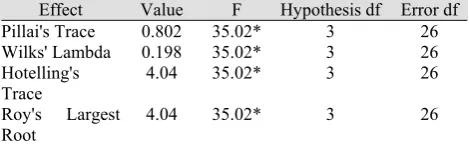
Table 3. Multi variable variance analysis results of internal attribution style’s (internal, stable and general) difference marks for positive events in experiment and control groups.
Error df Hypothesis df F Value Effect 26 3 35.02* 0.802 Pillai's Trace 26 3 35.02* 0.198 Wilks' Lambda 26 3 35.02* 4.04 Hotelling's Trace 26 3 35.02* 4.04 Roy's Largest Root
*p < 0.001
As it is observed in table3, significance level of all tests indicate that there is a significant difference between experiment and control group’s students at least from one of the independent variables points of view (internal, external and general). To find out this difference, the results of effects test among the subjects are in table 4.
Table 4. The results of effects among the subjects from posttest- pretest difference marks of attribution style (internal, stable and general) for the positive events in experiment and control groups.
F Mean Square df Type III Sum
of Squares Dependent Variable Source 60.04* 760.03 1 760.03 internal – external 73.45* 918.53 1 918.53 stable – unstable
50.72* 512.53
1 512.53 general – private
Groups
*p < 0.001
As it is observed in table4, there is a significant difference among the students of experiment and control groups from all three attribution dimensions (internal, stable and general) for positive events. In other words, cognitive restructuring education, considering the means of the mentioned items in experiment group compared to control group has caused this item increase about positive events. Therefore the first hypothesis is confirmed.
Table5. Multi variable variance analysis results of internal attribution style’s (internal, stable and general) difference marks for negative events in experiment and control groups.
Error df Hypothesis df F Value Effect 26 3 70.50* 0.891 Pillai's Trace 26 3 70.50* 0.109 Wilks' Lambda 26 3 70.50* 8.134 Hotelling's Trace 26 3 70.50* 8.134 Roy's Largest Root
*p < 0.001
As it is observed in table 5, all tests’ significance level indicates that there is a significant difference among the students of experiment and control groups from at least one of independent variables (internal, stable and general) .
Table 6. The results of effects among the subjects from post-test pre-test difference marks of attribution style (internal, stable and general) for the negative events in experiment and control groups. F Mean Square df TypeIIISum of Squares Dependent Variable Source 79.14* 1598.70 1 1598.70 internal – external
72.28* 1470.00
1 1470.00 stable – unstable
113.12* 1414.53
1 1414.53 general – private
Groups
*p < 0.001
(internal, stable and general) points of views in negative events. In other words, cognitive restructuring education, considering the mean of the mentioned items in experiment group compared to control group has caused these item’s decrease about negative events. There fore the second hypothesis is confirmed.
Table7.Independent T-test results for comparing academic performance of experiment and control groups.
T df SD M
Group Variable
4.05 15.12
experiment 28 5.69**
4.78 14.08
control
average marks **p < 0.01
As it is observed in table 7, there is a significant difference between average marks mean of experiment and control group considering (P<0.5 and T=5.69). In other words, the third hypothesis is confirmed.
Discussion and conclusion
Hypothesis 1, with the title of “cognitive restructuring education increases attribution style (internal, stable and general) for positive events”, was confirmed. Internal attribution dimension means that the reasons of events occurrence and pleasant events depends on the individual. Stable attribution dimension of positive events means that an individual considers the events and pleasant incident permanently. General attribution dimension of positive events means that an individual does not limit the reasons of events and pleasant events’ occurrence to a special condition or an area. He or she should improve his or her successes to other conditions using extension process. On the basis of research results, cognitive restructuring education can be effective in all three cases and lead to internal, stable and general attributions about the positive events. The results of the research conform to Evans et. Al (10) and Sauter et. al (11) studies. On the basis of Beck et. al (4) attitude, the depressed people are obsessed with their wrong thoughts and cognitions about the word. There fore, to decrease the amount of an individual’s depression, his or her insufficient attitude to life must be corrected and adjusted. During cognitive restructuring education, the researcher tried to teach the students to attribute not only success in school lessons but also success in other aspects in the life to internal factors. The students got the ability not to limit the pleasant events to a special condition or an area, but improve
their successes using extension process. They got this ability during cognitive restructuring sessions. Raymond (9) also believes that a helpless person believes that there are uncontrollable events in many aspects of his or her life, while uncontrollable events are special for a condition. Cognitive restructuring education with correcting cognitive errors such as not paying attention to positive affairs and imagining them unimportant and supposing the errors as a disaster and self-confidence increase, increase, optimism, etc are effective in this aspect.
believes that the attributions are as agents that maintain respectable appearance and they create positive pictures in people’s minds.
The researcher tried to persuade the subjects during education period not only to attribute their failures to external and unstable factors, but also learn to limit these failures to special conditions, that is f a person failed in a case or encountered an uncontrollable situation, he or she must learn to know the reason of this unpleasant event just in that case. Cognitive restructuring education with correcting ones thoughts and cognitive plans and considering private, unstable and external attributions for negative events is effective in this case.
The third hypothesis with the title of “cognitive restructuring education has a positive effect on students’ academic performance” was confirmed. In this subject it can be claimed that since cognitive restructuring education leads to general, stable and internal attribution styles’ in crease for positive events and their decrease for negative events, it can lead to self-confidence and responsibility taking increase. These variables are as factors which pave the way for educational progress. So, cognitive restructuring education can be effective on improving students’ condition.
About confirming all hypothesis of the research, it can be mentioned that learned helplessness amount decrease and general, stable and internal attributions increase for positive events and private, unstable and external attribution increase for negative events, are somehow correlated. That is, helplessness decrease
means wrong attributions decrease and right attributions increase. Right attributions increase for pleasant events causes wrong attributions decrease for unpleasant events.
The results of the present research indicate that the teachers must be sensitive towards test results against students’ attributive reactions. Generally, if the students who are not good at school, conclude that they do not have the ability to change their efficiency, this failure weakens their motivation and satisfaction of school and themselves.
But if the teachers encourage the students to attribute their failures to the factors that can be controlled by them, so it is possible to avoid failures harmful results. The teacher can guarantee students continuous success after being successful relying on general and stable internal factors.
The important point is that students’ attributions change or increase must be in balance and in a logical extent.
That is, if a student attributes his or her successes to general, stable and internal factors and attributes his or her failures to private, unstable and external, ones he or she must do it in a logical extent and does not go to extremes.
Extending the results to boy’s society limitation and the lack of exploring the results of the cognitive restructuring education are some of the limitations of the present research. Performing more researches can help to identify the effective factors on the students’ psychological problems and educational improvement more precisely.
References
1. Parvin LA (1993) Characteristics psychology. Translated by Javadi M and Kadivar P, Tehran, Roshd publication
2. Seligman MP (1975) Helplessness: On depression, development, and death. Sanfransisco, Freeman
3. Seligman MP (2001) Learned optimism, Pocket book. New York: NY
4. Beck AT, Emery G & Greenberg RL (2005) Anxiety Disorders and Phobias: A Cognitive Perspective. Basic Books
5. Brewin CR & Harris J (1985) Induced mood and causal attributions: Further evidence. Cognitive Therapy and Research, 9 (2), 225-229
6. Forsyth DR (1980) The functions of attributions. Journal of Social Psychology, 43, 184 – 189
7. Seif A (2007) Behavior change and behavior treatment of the theories and hypothesis. Doran publication
8. Peterson C & Seligman MP (1984) Causal explanations as a risk factor for depression: Theory and evidence, Psychological Review, 91,347-374
9. Raymond P (2003) Perceived (Academic) Control and Causal Thinking in Achievement Settings. Psychologie canadienne, 44(4), 312-331.
10.Evans DL, Foa EB, Gur RE, Hendin H, Obrien CP, Seligman MEP, & Walsh BT (2005) Treating and preventing adolescent mental health disorders: What we know and what we don’t know. New York, Oxford University Press
11.Sauter FM, Heyne D & Westenberg PM (2009) Cognitive Behavior Therapy for Anxious Adolescents: Developmental Influences on Treatment Design and Delivery. Clinical Child and Family Psychology Review, 12(4), 310-335 12.Marian M & Filimon L (2010) Cognitive restructuring and
improvement of symptoms with cognitive-behavioral therapy and pharmacotherapy in patients with depression. Annals of General Psychiatry, 9(1):S173
13.Tamanaie Far M (2000) The relationship between learned helplessness and depression in children and the effect of drug treatment and behavioral cognitive treatment, P.H.D thesis, Alameh Tabatabaie University.