UDC 613.2
DOI: 10.21668/health.risk/2019.1.17.eng
TECHNIQUES FOR DETERMINING PHTHALATES IN FOOD PRODUCTS AIMEd FOR INFANTS' NUTRITION: An OVERVIEW
Т.S. Ulanova,Т.D. Karnazhitskaya, А.S. Zorina
Federal Scientific Center for Medical and Preventive Health Risk Management Technologies, 82 Monastyrskaya Str., Perm, 614045, Russian Federation
Phthalates (esters of phthalic acid) are widely used as plasticizers in polymer materials production and it has re-sulted in substantial contamination with phthalates as they occur in environmental objects, food products, drinking wa-ters, and human biological media. Toxic effects produced by phthalates lead to functional disorders in the endocrine sys-tem and synthesis of insulin, phthalates have reproductive toxicity, they cause allergenic reactions and bronchial asthma in children as well as some other diseases. Food products are a primary source of influences exerted by phthalates on population health, first of all, children. To assess risks related to adverse effects by phthalates on children, it is necessary to obtain data on concentrations of these substances in food products aimed for children nutrition. In order to work out a highly sensitive and selective technique for determining phthalates in children nutrition, the authors performed an overview of scientific and technical literature that focused on techniques for determining phthalates in products for infant nutrition (milk mixtures, milk cereals, and canned meat). It was detected that gas and liquid chromatography together with mass spectrometry were widely applied to analyze phthalates in children nutrition; several techniques were applied for samples preparations to exert direct influence on measurements sensitivity and precision. It is still vital to determine how to efficiently extract phthalates with conventional and up-to-date extraction techniques and how to purify them from complicated food matrixes, first of all, milk and vegetable fats that can be found in products aimed for children nutrition. There is a still a problem related to secondary contamination of samples with phthalates due to their occurrence in the air inside laboratories, reagents, solvents, etc., and it needs to be solved. Basing on the analysis of all the reviewed data, we can conclude that it is necessary to work out highly sensitive, selective, and highly precise techniques for determining phthalates in products aimed for children nutrition with new methodical tools for samples preparation taking into ac-count a matrix effect which is specific for certain products as well as risks related to secondary contamination of samples in the process of their preparation and analysis.
Key words: phthalates, food products, milk mixtures, canned meat, gas and liquid chromatography, mass-spectrometry, samples preparation.
Phthalates (esters derived from o-phtha-lic acid) are widely spread contaminants; they are identified as endocrine-disrupting chemicals. Phthalates are applied as plasti-cizers for polymer materials based on poly-vinyl chloride (PVC), polystyrene, and rub-bers; they products with mass fracture of polymers in their structure being equal to 15-40% more flexible and durable. There are no any chemical bonds between phthalates and polymers and the former are washed out of plastic products during their use. People, especially younger children, are exposed to
phthalates primarily due to their occurrence in food products [1, 2, 3].
Exposure to phthalates results in hormonal and metabolic disorders, development defects, deviations in the reproductive system function-ing, and other diseases [4, 5]. Bis(2-ethylhexyl phthalate) is considered to be "a possible hu-man carcinogen" by the International Agency for Research on Cancer [5].
Over the last decades there has been ex-tensive research on assessing health risks caused by exposure to phthalates; fixing per-missible daily consumption of individual
Read online
__________________________
Ulanova Т.S.,Karnazhitskaya Т.D., Zorina А.S., 2019
Tat'yana S. Ulanova – Doctor of Biological Sciences, Professor, head of Chemical and Analytical Research Depart-ment (e–mail: [email protected]; tel.: +7 (342) 233-10-37).
Tatyana D. Karnazhitskaya – Candidate of Biological Sciences, Head of the Laboratory for Liquid Chromatography Techniques (e-mail: [email protected]; tel.: +7 (342) 233-10-37; ORCID: https://orcid.org/0000-0001-6768-0045).
phthalates; determining phthalates concentra-tions in food products, drinking water, the at-mospheric air and air inside buildings, and other media. Speaking about impacts exerted by phthalates on children's health, especially infants and children younger than 3, we should mention one of the most vital lines of research, namely monitoring over contamination of milk and milk products (powder-like and liquid milk mixtures and milk cereals) as they are the only nutrition suitable for infant children and children younger than 3.
The paper dwells on surveying various techniques for determining phthalates in food products for younger children's nutrition (milk mixtures, milk cereals, and canned meat). Pri-marily our attention is paid to techniques ap-plied to prepare samples for instrumental analysis and to reduce risks of secondary con-tamination with phthalates which can happen to analyzed samples.
Phthalates were first determined in food products more than 50 years ago [6, 7]. As it was not the case with other chemical contami-nants, data on phthalates concentrations in food products were rather limited due to prob-lems related to methodical support and high phthalates concentrations in field blanks; the latter was caused by laboratory environment, reagents, and materials being contaminated with these chemicals.
According to the Sanitary-epidemiologic rules 2.3.2.1940-05 food products made for younger children's nutrition are food products that can be consumed by children from their birth to 3 years as their structure and properties correspond to physiological peculiarities that children have at this age [8]. Food products for younger children are substitutes for breast milk made from animal milk or vegetable raw mate-rials (cow's milk, soya proteins, etc.) as well as food products introduced into children's daily ration during their first year of life in addition to breast milk or its substitutes; such products are made of animal and/or vegetable raw mate-rials and they can be either purees or dried mixtures.
In spite of multiple works focusing on methodical approaches to determining
phtha-lates in food products from various catego-ries, there are very few data on how to ana-lyze them in food products for younger chil-dren; basically any data we could find concern phthalates occurrence in various food products made for common nutrition. Thus, scientific and technical information that can be found on SciensDirect web-site reveals that only 356 works out of total 7,343 con-taining such key words as "determination of phthalates" and published over the last 5 years dealt with analyzing phthalates in children nutrition [9].
Over the last years such techniques as liquid and gas chromatography together with mass spectrometry have been applied to quan-titatively determine phthalates mixture in food products, including those aimed for children's nutrition; they allow to successfully resolve issues related to measuring techniques being sensitive and selective. Apart from mass spectrometric detectors, gas chromatog-raphy is accomplished with flame ionizing detectors and electronic capture [10]; high-performance liquid chromatography is ap-plied to analyze phthalates with ultrasound and fluorimetric detectors [10].
Capillary gas chromatography (GC) with subsequent mass spectrometric detection (MS) of analytes (GC-MS) is most frequently ap-plied to perform instrumental analysis of phthalates [11]. A most widely applied tech-nique in gas chromatography analysis of phthalates in food products is derivatization (primarily etherification); it is done in order to make analyzed compounds more volatile as phthalates boil at rather high temperature (from 284 оС to 490.6 оС), and chroma-tographic separation on capillary columns is limited to 280 оС - 300 оС [12, 13]. As a result, sample preparation becomes more complicated and, consequently, there are higher risks of secondary contamination and a decrease in de-termination sensitivity.
formed with its mass-to-charge being equal to 149 m/z, and this ion is common for most phthalates. It imposes certain limits on apply-ing GC-MS for analyzapply-ing mixtures that con-tain phthalates and their isomers, first of all, due to joint elution of analytes with the same mass but different molecule structure [14, 15].
Liquid chromatography/mass spectrome-try (LC-MS) is an alternative for GC-MS. Tandem quadruple mass spectrometer provides high selectivity, especially when separating phthalates isomers, and sensitivity of determi-nation [3, 14, 16-18]. Electrospray ionization (ESI) is most frequently applied to ionize phthalates; in few cases chemical ionization is applied for the purpose [16]. Positive ioniza-tion mode is usually applied to analyze phtha-lates diethers while negative ionization one provides better sensitivity for detecting mono-phthalates [19]. A basic issue which arises in analyzing phthalates in food products for chil-dren with LC-MS with electrospray ionization is how to achieve ion signals inhibition related to use of buffers in analysis with interfering influences exerted by components of sample matrix and poor chromatographic separation. To resolve it, various strategies can be applied, for example, improved procedures for samples treatment and/or higher resolution of chroma-tographic separation [3]. High performance LC-MS and LC-MS-MS are rarely used as liq-uid chromatographers are more prone to con-tamination than gas ones due to greater num-ber of potential contamination sources such as solvents applied for extraction and chroma-tographic separation, chemical reagents, fil-ters, tubes, etc. [20, 21].
To analyze 27 phthalates in milk and dairy products, experts applied a relatively in-novative analytic procedure, high-performance liquid chromatography with quick resolution together with a mass-spectrometric detector with an Orbitrap (UHPLC-Q-Orbitrap) in elec-trospray ionization mode. The authors pointed out that if an orbit ion trap was applied, ac-companying matrix compounds could be eas-ily excluded out of analysis and it facilitated phthalates identification and quantitative de-termination [22].
Mass-spectrometric detectors applied in gas and liquid chromatography to quantita-tively determine phthalates in food products for children are mostly calibrated with inter-nal standard and more rarely with absolute calibration; it is due to complex sample preparation that includes multi-stage proce-dures for extracting and purifying an obtained extract from matrix components. There are several compounds which are most frequently used as internal standards; they are deuterated compounds such as d10-phenanthrene, d4 -di(2-ethylhexyl) phthalate or d4-dibutyl phthalate, as well as non-deuterated ones, for example, benzyl butyl phthalate (BBP), anthracene, pyrene, or dibutyl adipate (DBA) [16]. In some research individual deuterated internal standards are applied for each analyzed phtha-late which proves that various phthaphtha-lates be-have differently during extraction and further treatment of an obtained extract [16].
Sample preparation that includes analytes extraction out of matrix and extract purifica-tion from interfering influences exerted by accompanying components is a significant stage in analyzing phthalates in food products for children as sensitivity and precision of determining phthalates concentrations de-pends on efficient selective extraction of ana-lytes. Methodical and scientific-technical lit-erature describes a great variety of techniques for phthalates extraction and it proves that the task is truly complicated and far from being solved completely. Most techniques are aimed at phthalates determination in breast milk [23-26], milk mixtures for children [27-30], and natural milk [22]. There are very few works on analysis of phthalates in milk cere-als and canned meat, and we can say there are one or two papers that dwell on deter-mining phthalates in food products for chil-dren which are consumed by them during their first year of life in addition to breast milk [29, 13]. Practically every published re-search work confirms that food products for children are contaminated with phthalates.
techniques can be applied: liquid-liquid ex-traction (LLE) [25, 31-34], headspace-solid phase micro-extraction (HS-SPME) [35], dif-fusion solid phase extraction QuEChERS [22], solid phase extraction (SPE) [23], auto-mated online solid phase extraction [23, 36]. Some of them have certain limits, for exam-ple, high variability of results due to unstable quantity of components in composure of samples from one matrix; necessity to purify extracts thoroughly in order to prevent con-tamination of analytical equipment and it takes a lot of time to do it; complexity related to separating an extract and a product matrix after extraction; application of complex sam-ple preparation which is not quite relevant for a routine analysis procedure.
Liquid extraction accompanied with ex-tracts being purified from milk fats is the most widely used procedure for extracting phtha-lates out of milk and milk mixtures. Most au-thors prefer to use acetonitrite as a solvent-extractant among polar and non-polar organic solvents applied in extraction procedures for organic compounds [13, 22]. In some cases extraction is then followed by a sample being dried and then repeatedly dissolved in a sol-vent suitable for a research procedure; there can also be re-extraction in order to further purify an extract. Due to some additional pro-cedures, concentrations of certain phthalates go up, for example, there is an increase in dibutyl phthalate (DBP) and bis(2-ethylhexyl) phthalate (BEHP) in field blanks, and it results in a procedure being less sensitive.
Direct extraction of phthalates out of food products for children via solid phase extraction with automated systems usually involves sec-ondary contamination of analyzed samples and field blanks in the same way as with other sample preparation techniques [26, 33].
Liquid extraction is applied to purify ex-tracts from fats, proteins, and other matrix components. When analyzing phthalates in milk and milk products, including milk mix-tures and milk cereals, researchers success-fully purify an acetonitrite extract with hex-ane; the procedure is based on better solubil-ity of phthalates in acetonitrite, and milk fats,
in hexane. Depending on how contaminated extracts are with animal and vegetable fats, the authors recommend to perform re-extrac-tion twice or three times [37].
Size-exclusion chromatography (SEC) is frequently applied as a purification procedure after liquid extraction of milk samples [24] and milk mixtures [29]. When samples are pu-rified with it, phthalates concentration in field blanks is determined within a range from 0.1 µg/kg to several µg/kg.
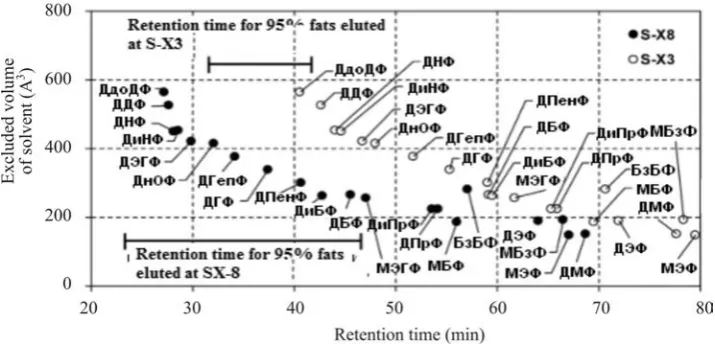
Size-exclusion chromatography (gel chro-matography) based on separating molecules from various compounds as per their size means that big molecules can't penetrate sor-bent pores and elute earlier than smaller mole-cules which can penetrate pores and remain on a sorbent. This technique is more and more frequently seen as an efficient sample prepara-tion procedure for determining organic con-taminants in lipid matrices. Phthalates with molecular masses within 200 to 4000 Daltons range are separated from lipids with molecular mass about 800 Daltons on GPC columns. classic GPC separation is performed on big columns being 400 mm long and having an internal diameter equal to 25 mm under low pressure and operating speed being 5 ml/min [38, 39]. An example when size-exclusion chromatography was successfully applied for analyzing phthalates is a procedure for purify-ing an extract from milk fat with gel-penetration chromatography (GPC). An ex-tract that contained phthalates and milk fat was fractioned on S-X3 zeolite under eluting with a mixture of cyclohexane and ethyl ace-tate, the volume ration of solvents being 9:1. Two fractions F1 and F2 (Figure1) that con-tained substances being analyzed were col-lected separately; F1: 43-50 minutes, and F2: 50-82 minutes; concentrated to a volume equal to 1 cm3 in nitrogen flow and directly analyzed with gas chromatography with mass spectrometry (GC-MS).
Figure 1. Retention time (min) for di-ethers and mono-ethers of o-phthalic acid on S-X8 and S-X3 zeolites under eluting with a mixture of cyclohexane and ethyl acetate, the volume ration of solvents
being 9:1 at a speed equal to 4.5 cm3/min: МЭФ is mono-ethyl phthalate, МБзФ is mono-benzyl phthalate, МБФ is mono-butyl phthalate, МЭГФ is mono-(2-ethylhexyl) phthalate, ДМФ is di-methyl
phthalate, ДЭФ is di-ethyl phthalate, ДПрФ is di-propyl phthalate, ДиПрФ is di-isopropyl phthalate, БзБФ is benzyl butyl phthalate, ДБФ is butyl phthalate, ДиБФ is isobutyl phthalate, ДПенФ is
di-pentyl phthalate, ДГексФ is di-hexyl phthalate, ДГепФ is di-heptyl phthalate, ДнОФ is di-n-octyl phthalate, ДЭГФ is bis-(2-ethylhexyl) phthalate, ДиНФ is di-isononyl phthalate, ДНФ is di-nonyl
phthalate, ДДФ is di-decyl phthalate, ДдоДФ is di-dodecyl phthalate
being up to 500 µl, column thermostat, UV-de-tector with variable wave length, and a device to collect fractions), separation is performed at a speed equal to 1 ml/min with dichloro-methane on a column which is 300 mm long and has an internal diameter equal to 7.5 mm, with sorbent particles sized 5 µm and pores size being equal to 5 nanometers. Pores size equal to 5 nanometers matters a lot as it allows to separate organic compounds with their masses within 100-1000 range. Better resolu-tion is achieved when two columns are used.
Feng Y., Zhu J., Sensenstein R. examined how to apply headspace solid phase micro-extraction (HS-SPME) in order to exclude milk fat out of samples before GC-MS when analyzing phthalates in milk. The procedure is based on creating a vapor phase above a milk sample when it is being heated in a hermetic vessel, absorption of analyzed phthalates ex-tracted into a vapor phase on poly-dimethyl-siloxane fiber and thermodesorption of ana-lytes directly into a chromatographic column of a gas chromatographer for analysis. The re-searchers reported that extraction took a long time (the shortest extraction period lasted for
60 minutes at 90 оC). Detection limits for phthalates varied from 0.1 µg/kg to 100 µg/kg depending on how fat milk samples were. When extraction on SPME fiver was per-formed, milk fats were absorbed together with phthalates, and there were a lot of interfering peaks detected on a chromatograph in analysis of a sample with gas chromatography [35].
QuEChERS technique applied for ex-tracting and purifying when phthalates are detected in cow's milk allows to achieve smaller secondary contamination at a level lower than 1 µg/kg [22].
compo-nent of food), fat-containing one (fats in a pro-duct), and cereal-fruit-vegetable one (carbohy-drates); each matrix, on one hand, has a com-plicated multi-component structure, but on the other hand, it has its specific peculiarities re-lated to a chemical structure of a product.
According to the State Standard R 54628-2011 "Food products for children nutrition. Canned meat. Puree for younger children. Technical conditions", the following raw mate-rials can be used to manufacture canned meat:
– meat (beef, veal, pork, rabbit meat, and others);
– oil (sunflower, soya, or corn oil; but-ter), lard;
– starch (potato, corn, or rice one); – salt and water.
100 g of canned meat that can be given to children starting from the 4th month of life contain 2.5-3.0 g of proteins, 2.6-3.0 g of fats, and 6.7-9.3 g of carbohydrates recalculated as per dry weight; 100 g of canned meat mixed with cereals and vegetables and aimed for children aged from 6 months to 1 year contain 2.5-9.8 g of proteins, 3.0-9.5 g of fats, and 2.9-8.0 g of carbohydrates recalculated as per dry weight. Component structure that ana-lyzed products have exerts its influence on a sample preparation procedure, background contamination level, and, consequently, on sensitivity and precision of measurement pro-cedures aimed at determining phthalates con-centrations in food products for younger chil-dren's nutrition.
M. Russo et al. applied GC-MS procedure to determine 6 phthalates (DMP, DEP, DBP, DiBP, BBP, and DEHP) in food products for children (canned puree for children made of chicken and rabbit meat as well as freeze-dried samples of chicken, turkey, sea bream, and flatfish); they applied liquid-liquid extraction to extract target components with heptane with a sample being treated with ultrasound. The authors describe a problem related to preparing puree samples: intense mixing led to formation of a jelly-like emulsion, and it was next to im-possible to extract an organic phase out of it thus blocking any further extraction. Develop-ers of the procedure explain it through
occur-rence of surfactants which are usually added to stabilize a product. To solve the problem, it was suggested to freeze-dry children nutrition before extraction and purification. Each sam-ple was dried out for 4 hours at -52 оC and pressure being equal to 0.08 mbar in a device aimed for freeze-drying. The authors recom-mend to add NaCl solution into samples and treat them with ultrasound as it can help to de-struct the emulsion. When conditions were op-timized, phthalates extraction amounted to 96.2-109.2% with extraction inaccuracy being equal to ≤10,5 %, and the bottom detection limit being 20 µg/kg [13].
Petersen J. and Breindahl T. focus on phtha-lates determination with GC-MS in 11 various products for younger children (fruit, cereals, rice mixed with fruit, or meat mixed with vegeta-bles). To prepare samples, the authors applied liquid-liquid extraction with pentane and then purified an obtained extract with a mixture of ethyl acetate/cyclohexane (1:1); a supernatant (pentane extract) was further purified with gel-penetration chromatography (GPC), dried, and re-dissolved for being analyzed with chromato-mass-spectrometry. Detection limits for DBP, BBP, and DEHP amounted to 0.35, 0.015 and 0.25 µg/kg respectively, extraction degree varied from 76 to 128 % [29].
So, it is rather difficult to prepare samples of children nutrition for analyzing phthalates concentrations in them with chromato-mass-spectrometry (both GS-MS and LC-MS); in ad-dition to that, an issue related to secondary con-tamination of samples with analyzed compounds during their preparation and analysis hasn't been resolved yet. Phthalates are widely spread in the environment and they can be detected practically in any piece of laboratory equipment and in the air inside any laboratory. Given that, practically all the researchers who deal with phthalates pay their special attention to this issue and try out to develop and recommend various measures aimed at reducing background contamination with phthalates in laboratories, air inside them, equipment, reagents, solvents, laboratory vessels and materials.
equipped with high-performance filters that pu-rify air with absorbed carbon. Excess pressure should be maintained within the room in order to avoid any air contamination from outside. Special attention is paid to purification of re-agents which is performed as follows: first, so-dium chloride is heated for 12 hours at 450 оС in a muffler and kept in a glass bottle until it is used. Anhydrous sodium sulfate and fiberglass filters are also treated and kept at 150 оC before application. Aluminum oxide is purified under 450 оC for a night and then applied immedi-ately. Distilled water of HPLC range is purified with hexane for three times. Cyclohexane is treated with purified aluminum oxide (30 g of Al2O3 per a liter of solvent) via manual shaking during 30 sec and then it passes through a puri-fied fiberglass filter. Glass vessels are washed before application with hot potassium hydrox-ide solution in methanol, hot chrome mixture, and purified water, and then they are dried completely under 300 оC for an hour. Glass vessels for taking and preparing milk samples are washed with isopropyl alcohol before appli-cation. As a result, when breast milk samples and milk mixtures were analyzed, DiBP con-centration in field blanks (samples without milk or milk products which underwent the complete sample preparation procedure) amounted to 0.79-1.08 µg/kg; DBP one, 0.27-0.36 µg/kg; and DEHP one, 0.88-1.14 µg/kg; against 18-25 µg/kg for DiBP, 6.2-11 µg/kg for DBP, and 18-75 µg/kg DEHP in the analyzed samples [12].
Ren R. notes that there is a potential risk of secondary contamination at any stage in an analytical procedure including sampling, pre-paring a food product sample for analysis, and chromatographic analysis itself. In order to reduce contamination of materials with phtha-lates, various purification procedures are sug-gested. In most cases it is recommended to treat all glass units (sampling containers, pi-pettes, volumetric flasks, centrifuge vials, and other laboratory vessels) which are applied during analysis; they should be thoroughly washed in strong oxidizers and rinsed with or-ganic solvents before application. The authors of the paper usually keep clean vessels under 400 °C for 8 hours, wash them in hexane for
12 hours and then dry at 120 °С before appli-cation. Field blanks are analyzed with gas chromatography-mass spectrometry techniques simultaneously with samples of artificial milk mixtures so that probable secondary contami-nation of samples that occurs when samples are being prepared for analysis is taken into account. DEHP was the single phthalate out of 17 which was detected in field blanks in a con-centration equal to 3.2 µg/kg [33].
As a rule, thorough treatment of laboratory equipment, vessels, auxiliary materials, reagents and solvents reduces phthalates concentration in field blanks which are usually samples prepared for analysis but without any contents of exam-ined products in them, but it can't completely resolve an issue related to secondary contamina-tion of analyzed samples. It is obligatory to ana-lyze field blanks for each series of anaana-lyzed samples in order to take into account background contents when calculating ultimate phthalates concentrations in food products.
A lot of researchers note that background contamination can probably be decreased via reducing a number of procedures applied to prepare samples for analysis [10, 20, 33].
So, all the accomplished research on exam-ining and analyzing methodical approaches to phthalates determination in food products for younger children indicate that it is vital to de-velop highly sensitive, selective, and high-precision determination procedures taking into account interfering influences exerted by com-ponent structure of matrices which are specific for a specific food product. To achieve as com-plete extraction of analyzed compounds as pos-sible, it is necessary to apply new sample prepa-ration procedures which should be simplified as regards extraction and purification of compli-cated matrices such as milk, milk mixtures, or canned meat; it is also advisable to apply reli-able techniques aimed at reducing background influences exerted by phthalates which are pre-sent everywhere in the environment.
Funding. The research was not granted any sponsor support.
References
1. Yen T., Lin-Tan D.-T., Lin J.-L. Food safety involving ingestion of foods and beverages pre-pared with phthalate-plasticizer-containing clouding agents. Journal of the Formosan Medical As-sociation, 2011, no. 110, pp. 671–684.
2. Fasano E., Bono-Blay F., Cirillo T., Montuori P., Lacorte S. Migration of phthalates, alkyl-phenols, bisphenol A and di(2-ethylhexyl)adipate from food packaging. Food Control, 2012, no. 27, pp. 132–138.
3. Gallart-Ayala H., Nunez O., Lucci P. Recent advances in LC-MS analysis of food-packaging contaminants. Trends in Analytical Chemistry, 2013, no. 27, pp. 99–124.
4. Gupta R. Reproductive and developmental toxicology editor, second edition. – KY, Breathitt Veterinary Center, Murray State University, Hopkinsville Publ., 2017.
5. Eveillard A., Mselli-Lakhal L., Mogha A., Lasserre F., Polizzi A., Pascussi J. Di-(2-ethylhe-xyl)-phthalate (DEHP) activates the constitutive androstane receptor (CAR): A novel signaling pathway sensitive to phthalates. Biochemical Pharmacology, 2009, no. 77, pp. 1735–1746.
6. Cerbulis J., Ard J. Method for isolation and detection of dioctyl phthalate from milk lipids //
Association of Official Analytical Chemists, 1967, no. 50, pp. 646–650.
7. Williams D. Gas chromatographic determination of low levels of di-(2-ethylhexyl)phthalate in soy oil. Association of Official Analytical Chemists, 1973, vol. 56, no. 1, pp. 181–183.
8. Sanitarno-epidemiologicheskie pravila i normativy SanPiN 2.3.2.1940-05. Prodovol'stvennoe syr'e i pishchevye produkty. Organizatsiya detskogo pitaniya (s izmeneniyami na 27 iyunya 2008 goda). Available at: https://base.garant.ru/12138699 (10.11.2018).
9. ScienceDirect. Available at: https://www.sciencedirect.com (17.08.2018).
10. Leo M. Analysis of Endocrine Disrupting Compounds in Food. Iowa: Blackwell Publ., 2011, 491 р.
11. Wei T. Analysis of phthalates in foods by using gas chromatography mass-spectrometry (GC-MS). Researhc report submitted in fulfillment of the requirements for the degree of master of sci-ence. Department of chemistry, Faculty science Universiti of Malaya Publ., Kuala Lumpur, 2014, p. 53.
12. Bubba M., Ancillotti C., Checchini L, Fibbi D., Rossini D., Ciofi L., Rivoira L., Profeti C., Orlandini S., Furlanetto S. Determination of phthalate diesters and monoesters in human milk and infant formula by fat extraction, size-exclusion chromatography clean-up and gas chromatography-mass spectrometry detection. Journal of Pharmaceutical and Biomedical Analysis, 2018, no. 148, pp. 6–16.
13. Russo M., Avino P., Notardonato I. Fast analysis of phthalates in freeze-dried baby foods by ultrasound-vortex-assisted liquid-liquid microextraction coupled with gas chromatography-ion trap/mass spectrometry. Journal of Chromatography A, 2016, no. 1474, pp. 1–7.
14. Hu J., Feng T., Li W., Zhai H., Liu Y., Wang L., Hu C., Xie M. Surface molecularly im-printed polymers with synthetic dummy template for simultaneously selective recognition of nine phthalate esters. Journal of Chromatography A, 2014, no. 1330, pp. 6–13.
15. Llompart M., Celeiro M., Lamas J., Sanchez-Prado L., Lores M., Garcia Jares C. Analysis of plasticizers and synthetic musks in cosmetic and personal care products by matrix solid-phase dispersion gas chromatography–mass spectrometry. Journal of Chromatography A, 2013, no. 1293, pp. 10–19.
16. Gonzalez-Salamo J., Socas-Rodrıguez B., Hernandez-Borges J. Analytical methods for the determination of phthalates in food. Current Opinion in Food Science, 2018, no. 22, pp. 122–136.
17. Masiа A., Moliner-Martinez Y., Munoz-Ortuno M., Pico Y., Campíns-Falcо P., Multiresi-due analysis of organic pollutants by in-tube solid phase microextraction coupled to ultra-high per-formance liquid chromatography–electrospray-tandem mass spectrometry. Journal of Chromatogra-phy A, 2013, no. 1306, pp. 1–11.
18. Xu D., Deng X., Fang E., Zheng X., Zhou Y., Lin L., Chen L., Wua M., Huang Z. Determi-nation of 23 phthalic acid esters in food by liquid chromatography tandem mass spectrometry.
19. Tranfo G., Papaleo B., Caporossi L., Capanna S., De Rosa M., Pigini D., Corsetti F., Paci E. Urinary metabolite concentrations of phthalate metabolites in Central Italy healthy volunteers de-termined by a validated HPLC/MS/MS analytical method. International Journal of Hygiene and En-vironmental Health, 2013, vol. 216, pp. 481–485.
20. Yang J., Li Y., Wang Y., Ruan J., Zhang J., Sun C. Recent advances in analysis of phthalate esters in foods. Trends in Analytical Chemistry, 2015, no. 72, pp. 10–26.
21. Hayasaka Y. Analysis of phthalates in wine using liquid chromatography tandem mass spectrometry combined with a hold-back column: Chromatographic strategy to avoid the in-fluence of pre-existing phthalate contamination in a liquid chromatography system. Journal of Chromatography A, 2014, no. 1372, pp. 120–127.
22. Jia W., Chu X., Ling Y., Huanga J., Chang J. Analysis of phthalates in milk and milk products by liquid chromatography coupled to quadrupole Orbitrap high-resolution mass spec-trometry. Journal of Chromatography A, 2014, no. 1362, p. 110–118.
23. Calafat A., Slakman A., Silva M., Herbert A., Needham L. Automated solid phase extrac-tion and quantitative analysis of human milk for 13 phthalate metabolites. Journal of Chromatogra-phy A, 2004, vol. 805, no. 1, pp. 49–56.
24. Hоgberg J., Hanberg A., Berglund M., Skerfving S., Remberger M., Calafat A., Filipsson A., Jansson B., Johansson N., Appelgren M., Håkansson H. Phthalate diesters and their metabolites in human Breast milk, blood or serum, and urine as biomarkers of exposure in vulnerable popula-tions. Environmental Health Perspectives, 2008, vol. 116, no. 3, pp. 334–339.
25. Mortensen G., Main K., Andersson A., Leffers H., Skakkebæk N. Determination of phtha-late monoesters in human milk, consumer milk, and infant formula by tandem mass spectrometry (LC-MS-MS). Analytical and Bioanalytical Chemistry, 2005, vol. 382, no. 4, pp. 1084–1092.
26. Zimmermann S., Gruber L., Schlummer M., Smolic S., Fromme H. Determination of phthalic acid diesters in human milk at low ppb levels. Food Additives & Contaminants: Part A, 2012, vol. 29, no. 11, pp. 780–1790.
27. Bradbury J. UK panics over phthalates in baby milk formulae. Lancet, 1996, no. 347, pp. 1541.
28. Bradley E., R. Burden, Leon I., Mortimer D., Speck D., Castle L. Determination of phtha-late diesters in foods. Food Additives & Contaminants: Part A, 2013, no. 30, pp. 722–734.
29. Petersen J., Breindahl T. Abstract in total diet samples, baby food and infant formulae.
Food Additives & Contaminants: Part A, 2000, vol. 17, no. 2, pp. 133–141.
30. Tsumura Y., Ishimitsu S., Kaihara A., Yoshii K., Tonogai Y. Phthalates, adipates, citrate and some of the other plasticizers detected in Japanese retail foods: a survey. Journal of Health Sci-ences, 2002, no. 48, pp. 493–502.
31. Cirillo T., Latini G., Castaldi M., Dipaola L., Fasano E., Esposito F., Scognamiblio G., Fran-cesco F., Codellis L. Exposure to Di-2-Ethylhexyl Phthalate, Di-n-Buthyl Phthalate and Bisphenol through infant formulas. Journal of Agricultural and Food Chemistry, 2015, no. 63, pp. 3303–3310.
32. Ge V., Yang X., Wu X., Wang Z., Geng W., Guo C. Phthalate residue in goat milk-based in-fant formulas manufactured in China. Journal of Dairy Science, 2016, vol. 99, no. 10, pp. 7776–7781.
33. Ren R., Jin Q., He H., Bian T., Wang S., Fan J. Determination of 17 phthalate esters in in-fant milk powder and dairy products by GC–MS with 16 internal standards. Chromatographia, 2016, no. 13–14, pp. 903–910.
34. Sorensen L. Determination of phthalates in milk and milk products by liquid chromatogra-phy/tandem mass spectrometry. Rapid Communications in Mass Spectrometry, 2006, vol. 20, no. 7, pp. 1135–1143.
35. Feng Y., Zhu J., Sensenstein R. Development of a headspace solid-phase microextraction method combined with gas chromatography mass spectrometry for the determination of phthalate esters in cow milk. Analytica Chimica Acta, 2005, vol. 538, no. 1–2, pp. 41–48.
37. Tienpont B. Determination of Phthalates in Environmental, Food and Biomatrices – An Analytical Challenge. Department of Organic Chemistry Ghent University, 2004. Available at: http://www.researchgate.net/publication/267703038 (17.08.2018).
38. Specht W., Tilkes M., Frezenius Z. Gas-chromatographische Bestimmung von Rückständen an Pflanzenbehandlungsmitteln nach Clean-up über Gel-Chromatographie und Mini-Kieselgel-Säulen-Chromatographie. Analytical Chemistry, 1980, no. 301, 300 p.
39. Thier H., Zeumer H. Manual of Pesticide residue Analysis. VCH, Weinheom, 1987, vol. 1, pр. 75.
Ulanova Т.S.,Karnazhitskaya Т.D., Zorina А.S. Techniques for determining phthalates in food products aimed for infants' nutrition: an overview. Health Risk Analysis, 2019, no. 1, pp. 154–163. DOI: 10.21668/health.risk/2019.1.17.eng