Vol. 4, No. 1 (2014): 442-446 Research Article
Open Access
I
ISSSSNN::22332200--66881100
Analytical Method Development and Validation of
Ibandronic Acid in API and Its Tablet Dosage Form by
LC
Shanthi Chalasani*, Ravi Pratap Pulla and K. Vanitha Prakash
Department of Pharmaceutical Analysis and Quality Assurance, SSJ College of Pharmacy, V.N. Pally, Gandipet, Hyderabad, Andhra Pradesh, India
* Corresponding author: Shanthi Chalasani; e-mail: [email protected]
ABSTRACT
A simple, accurate and sensitive liquid chromatographic method has been developed for the determination of Ibandronic Acid (IBN) in tablet dosage form. The separation was achieved on Inertsil ODS (250 mm X 4.6 mm) C18,
5μm column. The mobile phase consists of Buffer: ACN (50:50 v/v); Flow rate 0.8ml min−1 at ambient temperature.
The analytes were monitored by UV detector. The method was validated for specificity, precision, linearity, and accuracy. The average recoveries for Ibandronic Acid were in the range of 99.0–102.0% and the method can be successfully applied for the routine analysis of the drug substance.
Keywords:
Reverse Phase HPLC, Ibandronic Acid, UV Detector, ValidationINTRODUCTION
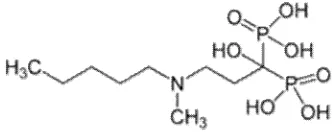
Ibandronic Acid is {1-hydroxy-3-[methyl (pentyl) amino] propane-1, 1-diyl} bis(phosphonic acid)[1] Figure 1. It is a potent Biphosphonate drug [2] used in the prevention and treatment of osteoporosis. The empirical formula [3] is C9H23NO7P2 and Molecular weight is 319.229 gms/mol. It is taken up by osteoclasts [4] and inhibits their bone resorbing activity in a dose dependent manner. It is given orally or intravenously, and is used in the prevention of skeletal events in breast cancer patients with bone metastates, in the treatment of tumour induced hypercalcemia, and in the treatment of postmenopausal Osteoporosis. Men show an increase in osteoporotic hip fractures after the age of about 70, similar to that shown by women 5 to 10 years younger [5].
Figure 1. Structure of Ibandronic Acid
Hence our present plan is to develop a new, simple, precise and accurate method for its analysis in formulation after a detailed study, a new RP-HPLC method was decided to be developed and validated. For the estimation of this method we used Phosphate buffer and Acetonitrile in ratio of 50: 50 v/v.
MATERIALS AND METHODS
The Ibandronic Acid used for estimation for this drug was procured from local market. The label claim for IBN is 150 mg for each tablet. Acetonitrile and water used were of HPLC grade. Pure API (Active Pharmaceutical Ingredient) sample of Ibandronic Acid was acquired from Natco Pharma Pvt. Ltd, Hyderabad, India. Acetonitrile HPLC grade (Merck Pvt. Ltd). Sodium Lauryl Sulphate (S.D.Fine Chemicals, Mumbai). Potassium Di Hydrogen Phosphate (S.D.Fine Chemicals, Mumbai).
Equipments
The instrument used was Water Empower 2, 2695 separation module, having UV detector. The system was connected with the help of water (alliance) Empower 2 software in a computer system for data collection and processing. The analytical column used was Inertsil ODS C18, 250 X 4.6 mm, 5 µm.
HPLC CONDITIONS
Chromatographic condition Buffer: Acetonitrile (50:50 v/v)
Buffer Preparation: Add 2.5 gm of Sodium Lauryl Sulphate to 1000 ml of 0.1N Potassium Di Hydrogen Phosphate. The mobile phase consists of a mixture of buffer preparation (50 volumes) and Acetonitrile [50 volumes].before use. The injection volume was 20 µL with a a flow rate 0.8 mL min-1 and detection Wavelength 272 nm having ambient condition and run time 7 min.
Preparation of Stock solution
Weigh accurately and transfer about 100 mg of Ibandronic acid to 100 mL of volumetric flask.Add 60
mL of diluents and sonicate to dissolve and dilute to volume with diluents.
Preparation of Standard solution
Transfer10 mL of standard stock solution into 100 mL volumetric flask and dilute to volume with diluents.
Sample Preparation:
Grind not less than previously weighed 20 tablets, and transfer tablet powder equivalent to 100 mg of Ibandronic acid into 100 mL volumetric flask and add 60 mL of diluent, sonicate to dissolve for 10 minutes and dilute to volume with diluent. Further filter the solution through 0.45µ filter paper. Dilute 10 ml of filtrate to 100 ml with diluent.
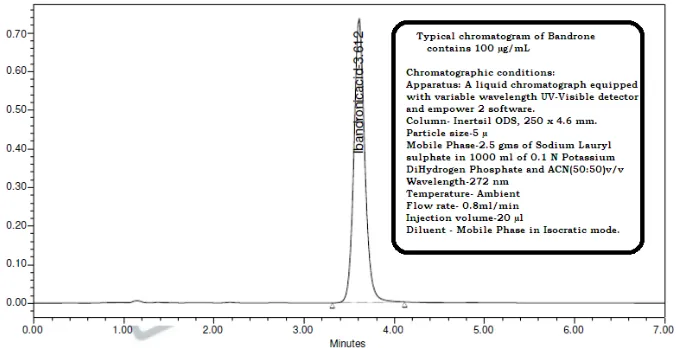
Figure 2. Typical chromatogram of standard Ibandronic Acid
Figure 3. Typical chromatogram of working standard sample of Ibandronic Acid
RESULTS AND DISCUSSION
Method Development and OptimizationPreliminary experiments were carried out using C18 250 x 4.6 mm with 30ml of 0.2% TEA and 70% of Acetonitrile. Ibandronic acid was lost peak shape. Ibandronic acid was determined on Inertsil ODS C18 column, peak was separated using phosphate buffer (Add 2.5 gm of Sodium Lauryl Sulphate to 1000ml of 0.1N Potassium Di Hydrogen Phosphate. To the above add 200 ml of Acetonitrile); Buffer: ACN (50:50 v/v).
Satisfactory separation and good peak shapes were achieved with a flow rate of 0.8 ml min-1. Statistical analysis proves that the method is repeatable, selective and accurate for the determination of investigated drug.
Method Validation
formulations in the first instance for the active ingredients in the concentration of 50% of the working standard solution (50 µg/mL of Ibandronic acid), 100% of the working standard solution (100 µg/mL of Ibandronic Acid) and 150% of the working standard
solution (150 µg/mL of Ibandronic acid) by the proposed method. Each concentration was injected three times and the peak areas were recorded.
Table 1. Recovery studies of Ibandronic Acid
Sr.No % Accuracy Peak area Amount obtained
by proposed method(mg)
% Recovery by proposed method
1. 50% 5807223
5714462 5802273
148.89 100.39
2. 100% 8685141
8699082 8705251
147.2 99.88
3 150% 11439082
11545251 12039082
149.36 100.15
LOD and LOQ
The LOD and LOQ of the developed method were determined by injecting progressively low concentrations of the standard solutions using the developed RP- HPLC method. The LOD is the smallest concentration of the analyte [6]that gives a measurable
response [signal to noise ratio of 3]. The LOD for Ibandronic Acid was found to be – 2.9 µg mL-1.The LOQ is the smallest concentration of the analyte, which gives response that can be accurately quantified[7] [signal to noise ratio of 10]. The LOQ was 10.0 µg mL-1 for Ibandronic acid respectively.
Figure 4. LOD and LOQ chromatograms of Ibandronic Acid
Figure 5. LOD and LOQ chromatograms of Ibandronic Acid
Linearity
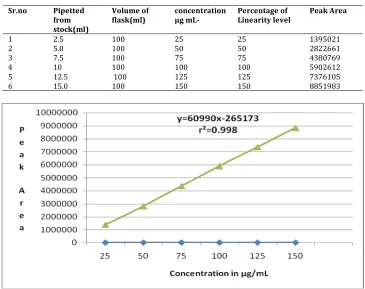
Working dilutions of Ibandronic acid in the range of 25-150μg/ml was prepared by taking suitable aliquots of working standard solutions of drug in different 100ml volumetric flask and diluting up to the mark with diluents. 20μl quantity of each dilutions was injected in
regression method. The slope and intercept value for calibration curve was y=60990x – 265173 (R2=0.998).
The standard calibration values and Linearity graph are depicted in Table 3 and Figure 6.
Table 3. Standard Calibration Values of Ibandronic Acid
Sr.no Pipetted
from stock(ml)
Volume of flask(ml)
concentration µg mL-
Percentage of Linearity level
Peak Area
1 2.5 100 25 25 1395021
2 5.0 100 50 50 2822661
3 7.5 100 75 75 4380769
4 10 100 100 100 5902612
5 12.5 100 125 125 7376105
6 15.0 100 150 150 8851983
Figure 6. Standard Calibration Curve of Ibandronic Acid
Specificity
Specificity of the method was determined by injecting the diluted placebo. There was no interference of
placebo with the principle peak; hence the developed analytical method was specific for Ibandronic Acid in tablet dosage form.
Figure 7. Chromatogram of Ibandronic Acid (placebo)
Precision
System precision: The system precision of the method was established by six replicate injections of the standard solution containing Ibandronic acid. The percentage RSD were calculated and presented in Table 4. From the data obtained, the developed RP-HPLC method was found to be precise.
Table 4. System Precision
S.No Peak Area
Systemprecision results Method precision
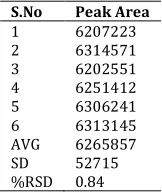
The method precision of the method was established by carrying out the analysis of Ibandronic Acid in dosage form [n=6] using the proposed method. The low value of the relative standard deviation showed that the method was precise the results obtained were presented in Table 5.
Table 5. Method precision of Ibandronic Acid
S.No Peak Area
1 6207223 2 6314571 3 6202551 4 6251412 5 6306241 6 6313145 AVG 6265857 SD 52715 %RSD 0.84
Table 6. Result of analysis of formulation
Drug amount (mg/tab)
Ibandronic acid Label Claim Found
150mg 148.89mg
Robustness
Robustness of the method was determined by making slight change in the chromatographic condition. It was observed that there were no marked changes in the chromatograms, which. The results of robustness were presented in Table 7.
Table 7. Method robustness of Ibandronic acid in dosage form
Condition Change Retention
time(min)
% RSD
Temperature + 5.0º C - 5.0º C
2.965 3.718
0.111 0.125 Flow Rate +0.2 mL min-1
- 0.2 mL min-1
3.047 4.458
0.1 0.121
Ruggedness
The ruggedness of test method is demonstrated by carrying out precision study with different analysts and on different days. Relative Standard Deviation of ruggedness on Day-1 and Day-2 are calculated in the below tables 8 and 9.
% of RSD on Day-1 = 0.670 % % of RSD on Day-2 = 0.590 %
Table 8. Ruggedness (Day-1)
S No Name RT Area
1 Injection-1 3.608 6307223 2 Injection-2 3.611 6314462 3 Injection-3 3.612 6202273 4 Injection-4 3.614 6301277 5 Injection-5 3.602 6256224 6 Injection-6 3.618 6276225
Avg 3.611 6276281
Std Dev 0.005 42236.2
% RSD 0.151 0.67
Table 9. Ruggedness (Day-2)
S No Name RT Area
1 Injection-1 3.621 6201245 2 Injection-2 3.628 6284461 3 Injection-3 3.618 6282314 4 Injection-4 3.620 6281267 5 Injection-5 3.615 6226425 6 Injection-6 3.624 6286354
Avg 3.621 6260344
Std Dev 0.005 36937.2
% RSD 0.126 0.590
CONCLUSION
The proposed RP-HPLC method for the estimation of Ibandronic Acid in tablet dosage forms is accurate, precise, linear, robust, simple and rapid. Hence the present RP-HPLC method is suitable for the quality control of the raw material, formulation and dissolution studies. From the typical chromatogram of Ibandronic Acid (Figure: 6.2), the retention time was found to be 3.608 minutes. A mixture of 2.5 gms of Sodium Lauryl Sulphate in 1000 ml of 0.1N Potassium Di Hydrogen Phosphate with Acetonitrile (50:50 v/v) was found to be the most suitable solvent for elution to obtain well defined peaks, free from tailing as per the ICH guidelines. In the HPLC method, the standard and sample preparations required less time and no tedious extraction were involved thereof. A good linear relationship (r = 0.998) was observed between the concentration range of linearity in the range of 25-150 µg/mL for Ibandronic Acid respectively. The absence of additional peaks in the chromatogram indicated non-interference of the common excipients used in the tablets.
REFERENCES
1. Bauss F, Schimmer RC [March 2006].The first once –monthly oral biphosphonate for the treatment of Postmenopausal osteoporosis.Therapeutics and clinical risk management 2[1]: 3-18.
2. “Bonviva "The American Society of Health-System Pharmacists.Retrieved 3 April 2011.
3. Information for healthcare professionals: Biphosphonates (marketed as actonel, actonel+ca, aredia, boniva, didronil,Fosamax, fosamax+D,Reclast, Skelid and Zometa).US food and drug administration. Retreived 27 October 2010 4. Made for F.Hoffmann-La Roche Ltd, Basel, Switzerland by
Vetter Pharma- Fertigung GmbH & Co KG, Langenargen, Germany.
5. Update on the risk of breast cancer and long term safety; Current problems in pharmacovigilance, volume 29 Sept 2003.Management of osteoporosis; Scottish Intercollegiate Guidelines Network, June 2003.Tannan. Hormone replacement therapy: risks and benefits; Pharmaceutical Journal 2003; 271: 646-648. Otseoporosis – treatment and prevention of fragility fractures; Prodigy Guidance, May 2006. 6. International Conference On Hormonization, Hormonized Tripartite Guideline, Validation of Analytical Procedures; Text and Methodology Q2R1, November 2005, See www.ich.org. 7. Swartz , M.E and Krull; I.S Handbook of Analytical Method
Validation, Taylor and Francis 2006 in press
*****
© 2014; AIZEON Publishers; All Rights Reserved