University of South Carolina
Scholar Commons
Theses and Dissertations
1-1-2013
The Artist's Gauntlet: A Singers' Physiological
Responses to the Stimuli of Rehearsing and
Performing
John H. Pritchard
University of South Carolina - Columbia
Follow this and additional works at:https://scholarcommons.sc.edu/etd Part of theMusic Commons
This Open Access Dissertation is brought to you by Scholar Commons. It has been accepted for inclusion in Theses and Dissertations by an authorized administrator of Scholar Commons. For more information, please [email protected].
Recommended Citation
THE ARTIST’S GAUNTLET: A SINGERS’ PHYSIOLOGICAL RESPONSES TO THE STIMULI OF REHEARSING AND PERFORMING
by
John H. Pritchard
Bachelor of Music Columbus College, 1994
Master of Music University of Michigan, 1996
Master of Music University of Florida, 2009
Submitted in Partial Fulfillment of the Requirements
For the Degree of Doctor of Musical Arts in
Music Performance
School of Music
University of South Carolina
2013
Accepted by:
Walter Cuttino, Major Professor Chairman, Examining Committee
Janet Hopkins, Committee Member
Jacob Will, Committee Member
Jerry Curry, Committee Member
Ellen Exner, Committee Member
A
CKNOWLEDGEMENTSSpecial thanks to Alex Lucas, M. D., Ethel Smith Chair Vasculitis Research,
Section Head Vascular Research, Professor of Medicine, Divisions of Cardiovascular
Medicine and Rheumatology at the University of Florida (Gainesville, FL), for her kind
A
BSTRACTThis study examined the relationship of a subject’s heart rate variability,
respiration rate and other vital statistics to rehearsing and performing as a singer. Among
the events used for data collection were individual lessons of undergraduates and a
lecture-recital presented by a graduate student. Findings indicate a general upward trend
in HRV and an increase in range of HR%MAX among subjects while singing, along with
T
ABLE OFC
ONTENTSACKNOWLEDGEMENTS ... iii
ABSTRACT ... iv
LIST OF FIGURES ... vi
LIST OF ABBREVIATIONS ... vii
CHAPTER 1INTRODUCTION ...1
1.2PURPOSE OF THE STUDY ...2
1.3LIMITATIONS OF THIS STUDY ...4
1.4REVIEW OF LITERATURE ...6
1.5METHODOLOGY ...7
CHAPTER 2STUDY OF PHYSIOLOGICAL OUTPUT WHILE SINGING ...10
2.1STUDY OF UNDERGRADUATE SINGERS IN LESSONS ...10
2.2CHART EXAMINATION ...11
2.3STUDY OF PHYSIOLOGICAL RESPONSES TO PRACTICING,REHEARSING AND PERFORMING AS A SINGER ...22
2.4SUMMARY OF FINDINGS ...29
2.5FUTURE STUDIES ...30
BIBLIOGRAPHY ...31
APPENDIX A–DESCRIPTION OF EQUIPMENT ...34
L
IST OFF
IGURESFigure 2.1 Subject A, HR%MAX and HRV ...12
Figure 2.2 Subject B, HRV and BPM ...14
Figure 2.3 Subject C, HRV and BPM ...15
Figure 2.4 Subject D, BPM and HR%MAX ...17
Figure 2.5 Subject D, BPM and HRV...17
Figure 2.6 Subject E, HRV and HR%MAX ...19
Figure 2.7 Subject E, BPM and HRV ...19
Figure 2.8 Subject F, HRV and HR%MAX (signal error) ...21
Figure 2.9 Subject G, HRV and HR%MAX (signal error) ...22
Figure 2.10 Self, Individual Practice ...23
Figure 2.11 Self, Choir rehearsal A ...25
Figure 2.12 Self, Choir rehearsal B ...26
Figure 2.13 Self, HR%MAX and PI ...28
L
IST OFA
BBREVIATIONSBPM ... Respiration Rate
HRV ... Heart Rate Variability
HR%MAX ... Heart Rate as Percentage of Theoretical Maximum
CHAPTER
1
I
NTRODUCTIONIn recent decades, heart rate variability (HRV) has become increasingly used as
an indicator of relative conditioning in medical research, athletics training, and even
real-time monitoring of public service and military personnel in hazardous situations.1
Defined in simple terms, heart rate variability measures the distance in time between the
onset of complete heart beats.2 In general, it is desirable to have a variety of HRV values
over a time span, as opposed to a stable HRV. It is noteworthy that the main function of
HRV monitoring currently is as a detection precursor to a heart-related issue. HRV is not
singularly accepted as a be-all, end-all indicator, but it does consistently aid in diagnosing
individuals who are in danger of severe health issues but do not yet have a structural
heart-related issue. The following study will undertake an examination of various
subjects’ HRV (as a primary measurement) while in the act of singing. This will be
achieved through two separate types of contained studies: a sample of voice students
with varying levels of voice study (measured during a subject’s lesson) and a self-study
1
Electrophysiology, Task Force of the European Society of Cardiology the North American Society of Pacing. “Heart Rate Variability Standards of Measurement, Physiological Interpretation, Clinical Use.” Circulation 93, no. 5 (March 1, 1996): 1043–1065. doi:10.1161/01.CIR.93.5.1043.
2
that will involve a variety of conditions, including a voice lesson, a church choir
rehearsal, and a recital performance. The goal, for which the data will be collected, is to
view the differential in HRV and other vital statistics between singing and not singing,
and between singing in varied circumstances. In other words, to see the real-time and
direct physiological impact of singing on the performer’s body. Many studies have
examined the affects of music on non-musicians and generally indicate a positive
correlation between musical stimuli and increased HRV (a positive cardiovascular health
indicator).3 However, studies that examined instrumental musicians as they performed
found that heart rate and HRV trends were tied to the experience levels of performers and
what type of ‘performance environment’ was in effect (rehearsal vs. performance,
performance vs. competition).4 The advent of certain wireless and mobile technologies
now allows study subjects to be untethered while their ECG/EKG data is collected- an
enormous advantage in measuring data while a subject moves on stage.
1.2 PURPOSE OF THE STUDY
This study will examine certain parameters in the physiology of a singer in the act
of rehearsing and performing repertoire. The technology that will be used gathers a
significant number of vital statistics; this study will primarily be focused on HRV and,
3
Vickhoff, Bjorn, Helge Malmgren, Rickard Astrom, Gunnar Nyberg, Seth-Reino Ekstrom, Mathias Engwall, Johan Snygg, Michael Nilsson, and Rebecka Jornsten. “Music Structure Determines Heart Rate Variability of Singers.” Frontiers in Psychology 4 (July 9, 2013). doi:10.3389/fpsyg.2013.00334.
4
secondarily, the percentage of heart rate maximum (HR%MAX) and rate of breaths per
minute (BPM). By focusing mainly on HRV, we hope to demonstrate in real terms the
physiological benefits of singing on the singer’s body. A recent study stated that HRV
increases in singing (perhaps due to performers being required to control and coordinate
their individual breaths) and that heart beat rates tended toward synchronicity within the
performing group.5 The purpose here is to look closer at HRV changes in solo singing- at
what occurs physiologically while a singer is in the act. A comparison of HRV trends
across a variety of non-musical activities will demonstrate that musical activity, and
particularly singing, has a remarkably positive effect on the cardiovascular system. It is
believed that this singing-acting zone may be as healthy as other forms of moderate
exercise. The results will also be perused for the effects of change (tessitura, languages,
etc.) and the often-dreaded differential of anxiety experienced in a live performance
versus a closed rehearsal.
The parameters that are collected are wirelessly transmitted in real time from the
measuring device to a computer. Specialized software then translates the provided data
into chart and graph form for analytical purposes. The equipment used will also provide a
time-stamp relationship between changes in heart-rate, heart rate variability, and the
actual musical demands as they occur in real time. That is, the study will examine what
happens on a physiological level while a singer is in the act. There are two primary
concerns- what happens in terms of measured physiological parameters (as the
performer-subject varies repertoire, languages sung, etc.) and what is the relationship of
anxiety to performance, as expressed by the differential between a rehearsal ‘average’
5
and the data provided on in a lesson and/or recital. By a large margin, the bulk of the
existing studies on performance-anxiety and physiology have used instrumental
musicians as subjects, due to the constraints of past technologies. Even so, such studies
(particularly Iñesta et al.) suggest that there is a positive correlation between a
performer’s physiological load and a sensation of anxiety in performance. When solo
sections or particularly difficult passages occur, a noticeable increase in HR%MAX has
been documented. This study will examine not only this observation in terms of real-time
data provided by subjects, but also how anxiety levels affect HRV. Future research might
delve deeper into this field in a more finite manner, such as using physiological data to
help determine what Fach (vocal category), and operatic roles might be best for an
individual singer from a purely physical level. It seems possible that how a group
rehearses and prepares for a performance, or perhaps how an individual singer prepares
an opera role, could be influenced by using such data as biofeedback information. That is,
how to aid the singer in being ‘healthy’ in an overall sense by avoiding ‘over-rehearsal’,
or highlighting anxiety-causing passages. Future use of this technology might also show
that some singing-actors react negatively to mitigating the demands of singing over an
orchestra, as opposed to the pianos used in rehearsals and coaching. Such real-time data
would be able to show the effects of ‘oversinging’, or ‘pushing’ the sound, in order to
compensate for an expanded acoustic for performance space.
1.3 LIMITATIONS OF THIS STUDY
The first and foremost limitation to mention is one of sample size. Because the
combination of wireless devices with electrocardiography monitoring is recent, the
live subject at a time would be high.6 Such applications do exist, however, for use in
aerospace and military medical support. On the basis of affordability, the sample group of
subjects must be limited to one-at-a-time observation. Secondly, the technologies
involved will be limited, and varied, in their respective capabilities. Newer technologies
often come with a proprietary component; every manufacturer’s equipment will vary
slightly. This study will be in part governed by the state of privately-obtainable hardware
and software. The data collected might be skewed by some unknown mechanical or
technological flaw that is related to its manufacturing process. That being said, no
updates or changes to either the hardware or software package will occur during the
study. There are additional limitations to the communication standards placed on wireless
devices that are commercially available and legal for the public at large. All wireless
devices have a limitation on their transmission range. Common wireless devices (i.e.
"Bluetooth", Wifi-related) that transmit and receive in the 2.4GHz spectrum compete for
signal among many other digital wireless devices. Additionally, many cordless phones,
remote controls, and electronic doorbells operate in this same spectrum. Line-of-sight
transmission is the way to control most of the potential attenuation and contamination
problems. The equipment selected for this study records data and transmits data by
default, providing an additional error buffer. Although the sensor array (which in this
case is an undershirt-worn band around the mid-chest) cannot be removed during any part
of data collection, the freedom of movement allows for longer contact time between
6
At time of writing, it costs just under $1000 USD to acquire the necessary
subject and sensor, and also allows the potential for measurements to be taken while the
subjects are engaged a broad range of sample activities.
1.4 REVIEW OF LITERATURE
In the sample of studies related to the topics of both electrocardiography and
music, the majority deal with issues related to music therapy. That is, the application of
musical stimuli for the goal of some level of physiological rehabilitation or relaxation.
The overall trend of such studies suggests that musical stimulus has a broad-context
effect of relaxation, demonstrated in particular by a decrease in HR and an increase in
HRV. As this study touches on a well-scrutinized body organ, we must also be mindful of
the vastness of information on cardiovascular studies. An enormous aid in this process
are the databases which are maintained by US National Library of Medicine and the
National Institutes of Health (USA). Medical knowledge is notoriously fluid; historians
suggest that heart rate was not studied until the beginning of the 17th Century (and the
invention of a watch that allowed heart beat rate to be calculated)7. However, since
heart-related issues have become known as a leading cause of mortality in the modern world,
parameters of heart function measurement (such as HRV) have increased research focus.
As previously stated, studies that involved performing musicians indicated that
HR and HRV are greatly affected by two primary factors: the level of experience and
training of the individual performer, and the context of the ‘performance’ itself 8,9. The
7Billman, George E. “Heart Rate Variability - a Historical Perspective.”
Frontiers in Physiology
2 (2011): 86. doi:10.3389/fphys.2011.00086.
8
less-trained musicians involved showed demonstrable increases in anxiety levels
experienced during performance. Of great interest to this study is the research that finds
the difference in physiological responses (again, primarily through HR and HRV)
between rehearsal, performance, and competition performance conditions. The observed
trend demonstrates that greater levels of anxiety are experienced in certain performance
conditions (especially competition) over traditional live performance.
With the advent of certain technologies, here namely wireless tethering or the use
of a device’s on-board memory to allow download via serial bus, the physical connection
between the sensors placed on the subject and the data-collection apparatus (i.e.
computer) need not be constant. It should be noted that untethered studies- studies that
used wireless technology, therefore allowing subjects to move and sing normally, are not
common. This wireless advantage has not gone unnoticed, even outside of medical
research. There are numerous studies on HRV relating to sport training and sports
medicine. The diversity of studies does create some difficulty for the field of HRV study
at-large; there is no standardization of equipment or of measurement values used. Each
study is in effect limited to the technologies chosen.
1.5 METHODOLOGY
As previously mentioned, this study will be two small studies: a survey of a
sample of voice students with varying levels of vocal training, and an extended
monitoring of a single subject in multiple environments. For the multiple subject study,
volunteer voice students will have their vital signs recorded wireless during their normal
9Williamon, Aaron, et al. "Influence of fitness and physical activity on cardiovascular
weekly lesson time. A minimum of 30 minutes of data will be collected from each
subject. The data is date-time stamped and then uploaded to a computer with specialized
software that analyzes the information. The information can be examined in total elapsed
time or by real time clock.
We will specifically look at changes to HRV while the subject is singing.
Additionally, the study will examine the parameter of heart rate maximum, expressed as a
percentage. Once this information is gathered and interpreted, the data can be placed
alongside data collected from other studies, thus allowing a comparison of the
physiological load placed on a singer actively singing versus other pursuits. To be sure,
an individual’s level of physical conditioning, mental state-of-mind at time of
measurement and other factors will need to be excluded, in favor of the search for a
broader trend of HRV and HR%MAX values.
Once the sensor equipment is installed and tested, a baseline reading of the subject’s vital
signs will be acquired. This will be done while the subject sits in a relaxed position,
breathing deeply, until their vital signs reflect a decrease in HR. A marker is placed in the
software at the moment the student begins physically singing. Voice lessons are often
filled with starts-and-stops, so it should not be assumed that full-voice singing for a full
hour will occur in each lesson.
For the second study, a trained singer-subject will have their vital signs measured
in a variety of musical activities. Each collection session will be no less than thirty (30)
minutes and will reflect data from: 1. individual practice, seated at a piano, 2. two church
activities will be compared to other subjects’ results and analyzed for changes in
CHAPTER 2
S
TUDY OFP
HYSIOLOGICALO
UTPUTW
HILES
INGING2.1 STUDY OF UNDERGRADUATE SINGERS IN LESSONS
Once the equipment was acquired and tested, the study began by examining eight
(8) subjects while in their normally scheduled voice lessons. Each subject was fitted with
the sensor strap for the duration of their lesson. We should note here that the strap was
too small to correctly fit certain subjects. Where not enough data was collected, the
subject's heart rate variability cannot be discussed in depth. The equipment provides
feedback on its signal strength via a parameter which the software describes "heart rate
confidence". This signal confidence parameter was also recorded; sections where the
signal confidence was too low (for accurate data to be collected) are ignored in this study.
Overall, five male and three female singers were measured. Each subject had their age,
height and weight entered into the data collection software. Subjects were asked about the
length of their vocal study in years, and if they had eaten any food prior to the lesson.
This last factor is a general consideration; heart rates are normally accelerated around two
hours after eating a meal (as body organ use more energy to digest food intake). There
was no consideration given to repertoire sung in the lesson or to the demands of Fach.
The data gathered from each subject was recorded to a solid state drive and
subsequently loaded into analysis software provided by the sensor manufacturer. The
Additionally, markers were manually added through the software to approximate
different events in each lesson (warm-up, repertoire, etc.).
2.2 CHART EXAMINATIONS
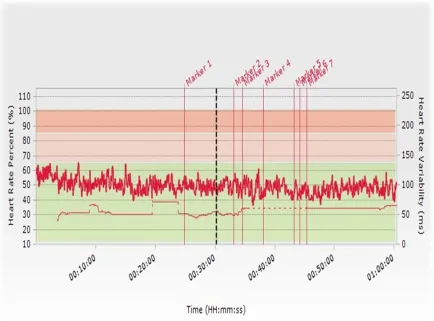
Subject A: This chart (Figure 1) presents a general impression of a declining
HR%MAX during the lesson. According to the data, the subject underwent a shift from a
range of 50-65% down to 35-50% in HR%MAX. Note that as this general trend occurs,
there is not as much variation plotted on the chart in HRV. Looking at the parameter of
HR Confidence (or, signal strength) reveals that the sections where there is a 'flatline'
reading of HRV corresponds to a temporary loss or weakness of signal. The possible
reasons for this anomaly are numerous; the most likely cause is that the sensor strap itself
was slightly loose on the subject's torso.
Until the identifier 'Marker 1', the subject was in the warm-up section of the
lesson. Note how, even without singing repertoire, overall HR began diminishing, with
the spikes in HR%MAX generally accounting for temporary spikes in tessitura. At
'Marker 1', the subject began working on the notes to a Handel oratorio aria. The range of
heart responses is less than in the warm-up section and HRV stays near 50ms. The
section delimitated by markers 3 to 4 corresponds to a Mozart opera aria. There is a rise
in HRV here, but the signal from the strap becomes more flatline after this rise. Other
subject's charts will further indicate the presence of signal quality issues where HRV
appears stagnant.
Marker 5 shows a section where the subject read aloud a text in monologue style.
HR%MAX decreased during the event. However, the sung version has a pronounced
spike in HR. It would be errant to make a blanket assumption that singing a text is always
more work for the body than speaking the same text; one observation does not constitute
a trend. However, the coordination of the breath along with the physiological load of
singing does at least here have an impact on HR%MAX.
Figure 2.1 Subject A, HR%MAX and HRV
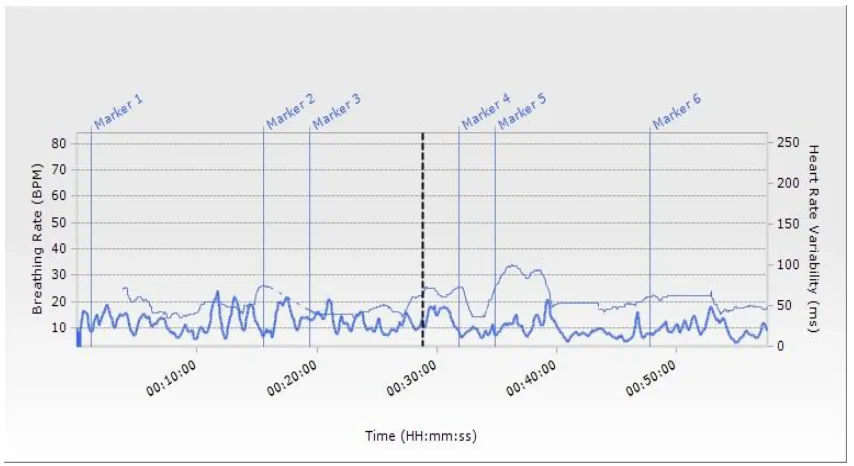
Subject B: Shown here in Figure 2.2 are the measured HRV and breath rate per minute
(BPM). These two lines can be seen as opposite indicators- where the subject breathes
normally (a higher rate of breath), HRV diminishes; the opposite occurs when
The breath is in an exhalation mode for an extended period of time. This subject's HRV
ranged between 45-104 ms for the measured hour, while breaths per minute ranged from
6 to 22 BPM. Periods of singing demonstrated a decreased rate of breath.
The calculated HR%MAX shows another interesting relationship between singing
and the response of the heart. As the range of HR diminishes while singing, HRV often
spikes. While sustaining a breath line for a phrase, it is supposed that the body is
challenged in breath-gas management. The longer a particular phrase needs to be
sustained, the less air enters the lungs over time. The response of the human body to this
the lesson went on in time, a general upward trend in HRV occurs.
Figure 2.2: Subject B, HRV and Respiration rate
Subject C: The chart (Figure 2.3) for this subject reflects a contrast of demands on the
heart. Markers 1-3 are the subject participating in the normal lesson events of warming
up, followed by two songs. Note that the subject's HRV decreased during the warm-up
phase, but increased while singing the two songs. At Marker 4, the subject sat down to
view part of their recent recital which was on video. Even though the subject was seated,
was seated and not singing. It is worth pointing out that the small spike in both recorded
parameters near the end of the session was due to a good laugh, indicating the positive
correlation between humor and heart already discovered in cardiovascular research.
Another observation is that this subject's breath rate is in a less narrow range from
Markers 1-4 than after Marker 4 where the video viewing began (see Figure 2.3 below).
Subject D: The amount of data collected for this subject was limited to a thirty (30)
minute lesson time (Figure 2.4). As such, broad trends are not readily visible. However,
another mitigating circumstance might be at work. This subject’s primary instrument was
trumpet. It was not clear during the lesson if the student had yet mastered the technique
of sourcing the breath from the lower abdomen; breathing in this manner is not
universally accepted as common practice in the study of singing, much less in
instrumental breath management instruction. A possible interpretation is that a breath
higher in the torso (commonly called ‘chest breath’) might be the technique the student
employed. There is no desire in this study to enter into a comparison of breathing
techniques, but rather to point out that Markers 4 and 5 (where the student sang a German
and English language song, respectively) do not show the rise in HR%MAX as observed
previously in other subjects. Additionally, the data collection process reflected a problem
in gathering samples for the HRV parameter. Figure 2.6 shows that when the data was
briefly collected with some confidence the subject’s HRV slightly increased in
Figure 2.4: Subject D, Respiration rate and HR%MAX
Figure 2.5: Subject D, Respiration rate and HRV
Subject E: This subject was an upper-level performance major, with the most years of
voice study among the sample group (over six years of lessons). Marker 1 shows the
and HRV decreased as the student worked on vocalizing at and around the second
passaggio. Markers 2-3 identify the time span of a Bach cantata aria. Here we see the
effects of longer phrases (requiring a single breath to last upwards of ten seconds) as
demonstrated in the positive increase in HRV and the decrease of HR%MAX. As the
student began to coach two French songs, the shape of spread between HRV and
HR%MAX returns to what was observed in the warm-up period.
Marker 5 was placed where the subject sang a Verdi opera aria. The aria had wide
range and ended in the low chest voice register. The subject experienced a noteworthy
decrease in HR%MAX (from approximately 56% of theoretical maximum down to below
40%). Even more interesting was the spike in HRV, which more than doubled from
measurements taken immediately prior to the Verdi aria. The subject’s HRV went from
38ms just prior to singing the aria to 100ms at the zenith. Figure 2.8 displays BPM and
HRV to show that the time period where the large increase in HRV occurs pairs with
Figure 2.6: Subject E, HRV and HR%MAX
Figure 2.7: Subject E, Respiration rate and HRV
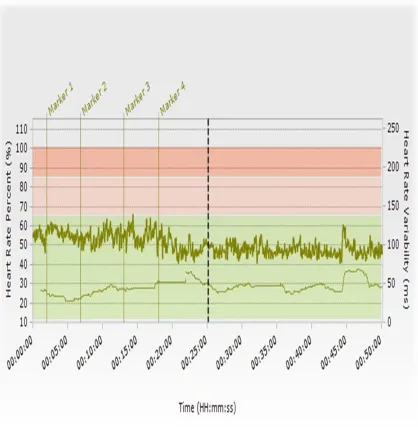
Subject F: This subject’s data (as well as the data for Subject G) reflect a problem with
data collection during the session. The problem is related to the size of the sensor strap
diameter strap is available from the manufacturer but was not available at the time of
measurement. By the point of Marker 1, the problem was repaired and accurate data
collection began. At and immediately after Marker 3 was the section where the subject
young soprano vocalized up to (and sustained) several ‘high C’s’ (on the piano, C5). Note
the spikes in HR%MAX and the decrease in HRV. All voices perhaps will not experience
such a dramatic shift, as not all voices would find this exercise as Herculean this
particular soprano. Even so, such a pattern in a general sense was observed in subjects.
Another observation during this subject’s lesson occurred just before Marker 4.
The teacher asked the student to recall an emotional memory- a memory that subject had
personally experienced, and one the subject found to be particularly sad and painful. Note
the decrease in HRV immediately after the 30:00 minute elapsed time point as the student
focused on that memory. It seems less-than-trivial to mention that many studies link
depression and grief in general and negative effects on the condition of the heart.10 The
positive recovery of the subject’s HRV in the following section (beginning at Marker 4)
shows the aggregate effects of singing.
10
Mostofsky, Elizabeth, Malcolm Maclure, Jane B Sherwood, Geoffrey H Tofler, James E Muller, and Murray A Mittleman. “Risk of Acute Myocardial Infarction after the Death of a Significant Person in One’s Life: The Determinants of Myocardial Infarction Onset Study.” Circulation 125, no. 3 (January 24, 2012): 491–496.
Figure 2.8: Subject F, HRV and HR%MAX (signal error)
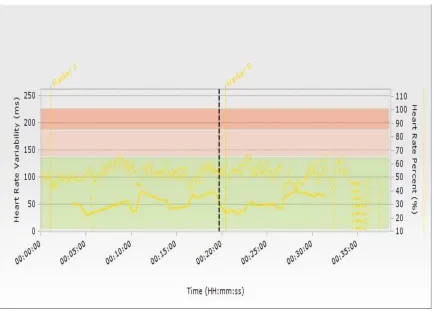
Subject G: As with the previous subject, the sensor strap required significant adjustment
before an accurate data collection session could begin. The area following Marker 2
developed pronounced collection issues and are excluded from commentary.11 This
particular subject entered the lesson with a heart rate that was above 50% of theoretical
maximum. As before, Markers 1-2 denote the warm-up phase; a slight general trend
upward in HRV while the HRV%MAX touches 70% was recorded. The range of HRV
was smaller than the range observed in other subjects, here demonstrating approximately
50ms of variation, while the subject’s HR%MAX varied widely. During the periods
11The sensor strap required significant adjustment following just before the 2:40PM
where the observed subject’s HR%MAX increased, a general flat-to-downward trend in
HRV is shown.
Figure 2.9: Subject G, HRV and HR%MAX (signal error)
2.3 SELF-STUDY OF PHYSIOLOGICAL RESPONCES TO PRACTCING, REHEARSING AND PERFORMING AS A SINGER
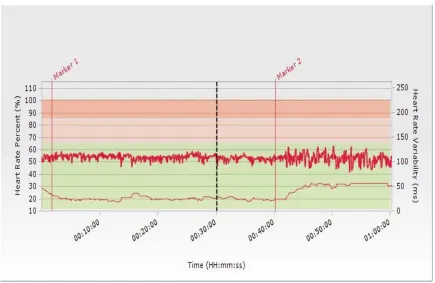
The genesis of this self-study comes from the examination of the chart below
(Figure 2.10). With the sensor strap attached and data recording, I sat down at a piano to
practice reading open orchestral scores. The impacts of this are reflected in the first
section of the chart. Note that both HR%MAX and HRV show a range of variation that
indicates the activity level is slightly above sedentary. However, Marker 2 indicates
As indicated below, HRV more than doubles and the range of HR%MAX
approaches a 20% range while singing (even though seated) when compared to score
study at the piano. This is not to suggest that an accomplished pianist would not
experience pronounced physiological load while rehearsing; my piano skill is closer to
elementary and years of additional training might elicit a more active response at the
piano. However, it is worth mentioning that it was not necessary for me to stand in order
to demonstrate a rise in physical activity. Even while seated, the recorded HR%MAX
touches in the areas above 60%- the area of heart rate often targeted for cardiovascular
training.
Figure 2.10: Self, Individual Practice
For the next series of observations, the effects of a choir rehearsal were recorded.
As with the previous score-study/sing session, a seated posture was maintained during the
in parts. Since I was involved in the rehearsal, there were no data markers placed.
However, the analysis software used for this study places a real-time stamp on the data as
well.
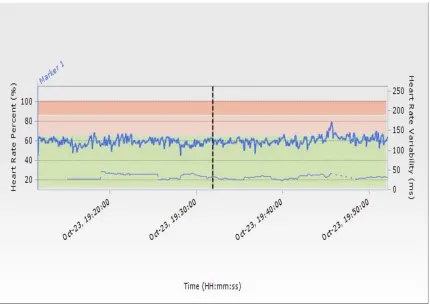
Note that the range of HR%MAX stays near 60% for much of the rehearsal. It is
normal to experience an elevated heart rate during post-meal digestion. When combined
with the demands of rehearsal, the overall physiological load remained in well above
sedentary. The spike in HR%MAX (near the 19:46 mark)12 also coordinates with a
temporary drop in HRV. The Haydn anthem “The Heavens are Telling” (from The
Creation) was rehearsed during this phase. There is a brief moment of a sustained A4 in
the tenor part. The demands of a temporarily exposed high note are the likely explanation
of such an increase in output.
12 Please note that the software used for this study records real-time session data on a 24-hour, and not
Figure 2.11: Self, Choir rehearsal A
The idea that pitches that lay in high vocal tessitura cause temporary spikes in
HR%MAX is supported by the next chart (Figure x) that shows three different spikes-
each of which caused by the previously mentioned Haydn anthem. The two spikes before
the 20:00 mark and the spike shortly after the 20:30 mark all represent the demands of
singing the sustained A4 in the tenor part. In each of these cases, the recorded respiration
rate drops just prior to the spike in HR%MAX. In preparation for singing the
aforementioned pitch, there was a brief period of deep inhalation. This chart shows that
the range of respiration rate (or BPM) stays lower than 20 BPM during most of the
rehearsal. This decreased rate of breath seems to aid in the elevation of HRV values. The
underway, during conversations and the like. As the singing began, note the decrease in
respiration rate.
Figure 2.12: Self, Choir rehearsal B
The next chart details the responses to stimuli experienced during a lecture-recital.
As this is a real-time chart, we can see the period before the recital began. Even though
17:00 was a half-hour before the recital was to start, the chart displays a range of
approximately 20% in HR%MAX during the pre-recital phase. It is not unreasonable to
believe that general nervousness was a factor during this time. The significant rise in
HR%MAX, followed by a higher sustained range, was recorded during the opening set of
music: four Lieder selections by Brahms. It is during this phase that we may observe
HR%MAX often above 70% and ranging to nearly 90%. The two pieces that were
bookends for the set of selections had faster tempi than the interior selections
“Feldensamkeit” were the interior selections). Whether it was tempo, or the difficulty of
the songs themselves that caused the pronounced ‘shoulder’-shaped spike in HR%MAX
is not possible to say; multiple factors could easily contribute to such a reading.
Following the opening song selections there was a period of lecturing, followed
by another set of musical selections (this time, Faure’s Poeme d’un jour). During this
second group of songs we find a similar pattern to the first: a rise during and decline after
singing. The middle song of this set (“Toujours”) had the fastest tempo of the set; notice
how during this particular song there was the zenith of HR%MAX for this set. The
observed range of HR%MAX was not the same as in the Brahms, but it did increase as
before. In between the two sung portions there was a significant drop in HR%MAX. Note
the second interpolated scale on the chart, “Physiological Intensity”. This simple scale (1
through 10) rates the instantaneous output of the body against its potential maximum (for
example, a 4/10 indicates that 40% of the body’s potential maximum output is being
exerted). We can interpret that lecturing and singing had dramatically differing demands,
and subsequently effects, on the body in this instance. According to the chart, a
physiological intensity near 7 of 10 was experienced during the performance parts of the
lecture-recital, while during the spoken voice sections PI dipped to a nearly sedentary
level.
Last sung during this event was a Puccini opera aria (“Recondita armonia” from
Tosca). I sat down briefly to help demonstrate the difference in HR%MAX between
resting and working positions. The aria is less than three minutes in length, but still
fermata ‘high’ Bb4. As before, once the singing ended, a downward recovery in
HR%MAX occurred.
Figure 2.13: HR%MAX and PI
Since the act of singing requires breath management and coordination with
musical events, it is important to note the interaction between respiration rate and general
physiological output. The following chart beautifully illustrates this. During periods of
singing there is a marked increase in instantaneous load in the body in coordination with
a decrease in respiration rate. It is this relationship, between reduced breath rate and
Figure 2.14: Respiration rate and PI
2.4 SUMMARY OF FINDINGS
This study set out to observe changes in vital statistics that occurred during
singing events. Primary attention was given to heart rate variability, respiration rate and
heart rate as a percentage of theoretical maximum. The technology used for the study also
provided additional data, such as posture, skin temperature, and theoretical caloric output.
Observed subjects demonstrated an overall increase in HRV range during periods
of singing. The exact amount of increase varied widely, but the trend of a general rise in
HRV is common among subjects while singing was noted. Changes that were observed
ranged between ten (10) to over 100% in HRV. Amounts of variation in HRV were
observed to be more pronounced in students that had received the most amount of vocal
instruction.
An additional HRV-related finding was that vocalizing at the upper extreme of an
deduce that singing at the high end of one’s possible vocal range is a somewhat
Herculean task. Long, sustained high pitches cause a notable spike in HR%MAX as well.
Weight lifting is an exercise that causes similar temporary spikes.
The heart rates of individuals as measured during singing had a larger range in
general than heart rate ranges observed in talking. Coupled with the requirement of breath
management, the aggregate effect of the physiological demands of singing often puts
individual subjects into a moderate workout zone (between 50-70% HR%MAX). This is
not dissimilar to the effects of participating in a yoga session, but the key difference is
that the length of musical phrases (and subsequently the length of a singer’s breath to
accommodate the phrase) varies widely. This variability in breath-phrase length is a key
factor in the reasons HRV increases in while singing.
2.5 FUTURE STUDIES
The next study to undertake would likely involve a larger sample group. As the
technology employed would allow over ten (10) subjects to be measured simultaneously,
we would likely have greater statistical relevance than the smaller group of subjects
observed here. An ideal venue for the next study would be an opera company. It would be
desirable to observe not only the principal singing-actors on stage, but perhaps the
orchestra conductor as well. Additionally, pairing the data collected by the sensor strap
with a real-time audio recording of the session would better illustrate the relationship of
the demands of a sung role to real-time vital statistics. Only with the advent of wireless
B
IBLIOGRAPHYElectrophysiology, Task Force of the European Society of Cardiology the North American Society of Pacing. “Heart Rate Variability Standards of Measurement,
Physiological Interpretation, Clinical Use.” Circulation 93, no. 5 (March 1, 1996): 1043– 1065. doi:10.1161/01.CIR.93.5.1043.
Billman, George E. “Heart Rate Variability - a Historical Perspective.” Frontiers in Physiology 2 (2011): 86. doi:10.3389/fphys.2011.00086.
Chang, S-H, C-H Luo, and T-L Yeh. "An experimental design for quantification of cardiovascular responses to music stimuli in humans." Journal of Medical Engineering & Technology 28, no. 4 (July 2004): 157-166. MEDLINE, EBSCOhost (accessed March 12,2012)
Dousty, Mehdy, Sabalan Daneshvar, and Majid Haghjoo. "The effects of sedative music, arousal music, and silence on electrocardiography signals." Journal of Electrocardiology 44, no. 3 (May 2011): 396.e1-6. MEDLINE, EBSCOhost (accessed March 12, 2012).
Escher, J ., and D. Evéquoz. "[Music and heart rate variability. Study of the effect of music on heart rate variability in healthy adolescents]." Praxis 88, no. 21 (May 20, 1999): 951-952. MEDLINE, EBSCOhost (accessed March 12, 2012). '
Fox K. M., et al. "Circadian variation of heart rate is affected by environment: a study of continuous electrocardio graphic monitoring in members of a symphony
orchestra." British Heart Journal 64, no. 6 (December 1990): 388-3 92.MEDLINE, EBSCOhost (accessed March 12, 2012).
Glass, Thomas A., Carlos Mendes de Leon, Richard A. Marottoli and Lisa F. Berkman. “Population Based Study of Social and Productive Activities as redictors of Survival among Elderly Americans.” BMJ: British Medical Journal , V/fip 319, Nb. 7208 (Aug. 21, 1999), pp. 478-483.
Huikuri, Heikki V, Timo Mäkikallio, K.E.Juhani Airaksinen, Raul Mitrani, Agustin Castellanos, and Robert J Myerburg. “Measurement of Heart Rate Variability: a Clinical Tool or a Research Toy?” Journal of the American College of Cardiology 34, no. 7 (December 1, 1999): 1878–1883. doi:10.1016/S0735-1097(99)00468-4.
EBSCOhost (accessed March 12, 2012).
Iñesta, Claudia, Nicolás Terrados, Daniel García, and José A. Pérez. “Heart Rate in Professional Musicians.” Journal of Occupational Medicine and Toxicology 3, no. 1 (July 25, 2008): 16. doi:10.1186/1745-6673-3-16.
Kinoshita, Hiroshi, et al. "Performing music can induce greater modulation of emotion-related psychophysiological responses than listening to music." International Journal of Psychophysiology: Official Journal of The International Organization of
Psychophysiology 81, no. 3 (September 2011): 152-158. MEDLINE, EBSCOhost (accessed March 12, 2012).
Laguna, Pablo, et al. "A method for continuously assessing the autonomic response to music-induced emotions through HRV analysis." Medical & Biological Engineering & Computing 48, no. 5 (May 2010): 423-433. MEDLINE, EBSCOhost (accessed March 12 2012).
Mostofsky, Elizabeth, Malcolm Maclure, Jane B Sherwood, Geoffrey H Tofler, James E Muller, and Murray A Mittleman. “Risk of Acute Myocardial Infarction after the Death of a Significant Person in One’s Life: The Determinants of Myocardial Infarction Onset Study.” Circulation 125, no. 3 (January 24, 2012): 491–496.
doi:10.1161/CIRCULATIONAHA.111.061770.
Nikiforova, N. G., et al. "[State of cardio-respiratory system, psychoemotional state and life quality in Tyva guttural traditional singing]." Meditsina Truda I Promyshlennaia Ekologiia no. 8 (2010): 32-36. MEDLINE, EBSCOhost (accessed March 12, 2012).
Smolen, D., R Topp, and L Singer. "The effect of self-selected music during colonoscopy on anxiety, heart rate, and blood pressure." Applied Nursing Research 15, no. 3 (August 2002): 126-136. CINAHL Plus with Full Text, EBSCOhost (accessed March 12, 2012).
Tucker, A., M. E. Faulkner, and S. M. Horvath. "Electrocardiography and lung function in brass instrument players." Archives Of Enviromnental Health 23, no. 5 (November 1971): 327- 334. MEDLINE, EBSCOhost (accessed March 12, 2012).
Urakawa, Kayoko, and Kazuhito Yokoyama. "Music can enhance exercise-induced sympathetic dominancy assessed by heart rate variability." The Tohoku Journal of Experimental Medicine 206, no. 3 (July 2005): 213-218. MEDLINE, EBSCOhost (accessed March 12, 2012).
Williamon, Aaron, et al. "Influence of fitness and physical activity on cardiovascular reactivity to musical performance." Work 41, no. 1 (2012): 27-32. CINAHL Plus with Full Text, EBSCOhost (accessed March 12, 2012).
“Music Structure Determines Heart Rate Variability of Singers.” Frontiers in Psychology 4 (July 9, 2013). doi:10.3389/fpsyg.2013.00334.
Williamon, Aaron, et al. "Influence of fitness and physical activity on cardiovascular reactivity to musical performance." Work 41, no. 1 (2012): 27-32. CINAHL Plus with Full Text, EBSCOhost (accessed March 12, 2012).
Yoshie, M., K. Kudo and T. Ohtsuki. "Effects of psychological stress on state anxiety, electromyographic activity, and arpeggio performance in pianists." Medical Problems Of Perfonning Artists 23, no. 3 (September 2008): 120-132. CINAHL Plus with Full Text, EBSCOhost (accessed March 12, 2012).
A
PPENDIXA
D
ESCRIPTION OFE
QUIPMENTThis study used the Assessment Pack from the Zephyr™ Technology Corporation
(Annapolis, Maryland). The package includes the sensor strap, module recharging station,
wireless gateway and Omnisense™ software (both Omnisense Live and Omnisense
Analysis programs). The software was installed on a laptop using Microsoft Windows
A
PPENDIXB
University of South Carolina School of Music
JOHN H. PRITCHARD, tenor in
OPERATIC ROLE
Opera at USC
February 25-27, 2011 Drayton Hall
Cendrillon Jules Massenet
Role of “Prince Charmant” (1842-1912)
Mr. Pritchard is a student of Walter Cuttino.