PERSON IDENTIFICATION USING IRIS
RECOGNITION USING FASTEST SEARCHING
ALGORITHM
Shivani Bakshi, Karishma Bavne, Ruchita Rahate,
Madhuri Satare, Prof. Pankaj Agarkar
Computer Engineering, Dr. D Y Patil School of Engineering, Pune, India
Abstract: The security is an important aspect in our daily life whichever the system the security plays vital role. Iris based authentication system is essentially a pattern recognition technique that makes use of iris pattern, which are statistically unique, for the purpose of personal identification. In this system, hamming distance is used for recognition of iris pattern. The zigzag collarette area of the iris is selected for iris feature extraction because it captures the most important areas of iris complex pattern and higher recognition rate is achieved. The proposed method is computationally effective as well as reliable
Keywords: Biometric, Hamming distance, zigzag collarette area, Iris recognition.
1. INTRODUCTION
In this study we focus on iris biometrics as it is the most reliable and accurate among all biometric traits presented because of its statistically unique feature iris is a ring shaped colored area around the pupil, has an extraordinary structure and provide many interlacing minute characteristics such as coronas, Stripes, freckles, zigzag collaret area etc.
Fig1.1: Structure of iris
Journal homepage: www.mjret.in
There are many biometric viz. fingerprint, iris, face, ear, to access the location its application varies from access of personal computer. It is used for unique identity detection, border security, crime control, airport security etc. In this we focus on iris biometrics because it is one of most accurate and reliable among all the biometric traits presented because of its statistically unique feature. Ring shaped colored area around the pupil is a iris. It has an extraordinary feature and provides many interlacing minute characteristics such as stripes, coronas, freckles, zigzag collarette area etc. The iris of an eye has unique pattern from eye to eye and person to person. Its pattern is formed by six month after birth, stable after a year and remains the same for life time. In iris authentication system the iris feature need to record. The iris feature recording is called as an enrolment process. In matching process the authentication system attempts to confirm an individual’s claim identity by comparing a submitted sample to previously enrolled templates
2. REFERENCING TO PRIOR WORK
2.1 IRIS RECOGNITION SYSTEM
In this work we are using two classification methods rather than a single method. The Zigzag collarette area of iris is selected for iris feature extraction because it captures the most important areas of iris complex pattern. A median filter is used for eyelash removal and a parabola detection technique is used for eyelid detection. 1D log Gabor filter is used for feature Extraction and HAAR wavelet of decomposition level 3. Hamming distance was used as a classifier for the purpose of classification. The purpose of authentication system is divided in two phase. In the first phase, the iris patterns need to record; it is referred as an enrolment phase. We capture current iris feature and compare it with the stored feature at the time of identification which is called as an identification phase. Working of propose System which is described in details in the following Section.
The process of iris image processing takes place in five steps.
Fig1.2: System Flow Diagram
2.2 DETECTION OF IRIS REGION
The first stage of iris recognition is to extract the actual iris region in a digital eye image. The iris segmentation has been achieved by the three main steps. The first step by using circular Hough transform it locates the pupil/iris boundary. The second is to find the zigzag collarette area of the iris. The last step is to locate the eyelids in the eye image.
3. SEGMENTATION
The iris segmentation has been achieved by the following two steps:
Iris image Acquisition Segmentation Normalization
1. Locate the pupil/iris boundary by using circular Hough transform. 2. To find the zigzag collarette area of the iris.
3.1 HOUGH TRANSFORM
The Hough transform is a technique that can be used to determine the parameters of simple geometric object, such as circle and lines present in image. This technique can be employed to deduce the centre and radius coordinated of the pupil and iris regions when a number of points that fall on the perimeter are known. The step to find occurrence of a shape in an image: Basic idea is to transform the perform the easier pattern detection problem space via Hough transforms and perform the easier pattern detecting parametric pattern such as line (linear Hough transform), circles (circular Hough transform) , i.e. any pattern which can be mathematically formulated as an equation. In an image find all the desired (edge) feature points. Transform each feature point into parameter space. The transformed feature point (e.g., could be a line, a circle) voted in the parameter space. The votes are accumulated and the local maxima are extracted. Hough Transform Parametric Space
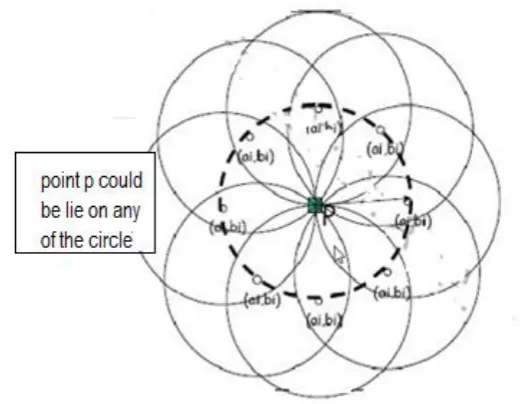
Consider 2D circle. It can be parameterized as: r2= (x - a)2+ (y-a)2
Assume an image point was part of a circle, it could belong to a unique family of circle with varying parameters: a, b, r. This is shown in Fig 2.1
Fig 2.1: Hough Transform Parametric Space
Fig 2.2: Hough Transform Procedure
The most important area of iris complex pattern is the zigzag collarette area of the iris is selected for iris feature extraction. It is also not very much affected by eyelids and eyelashes because it is closed to the pupil. The previously obtained centre value of pupil is used for detection of collarette zigzag area because it is generally concentric to pupils and radius of this part of the iris was restricted in a certain range.
4. NORMALIZATION
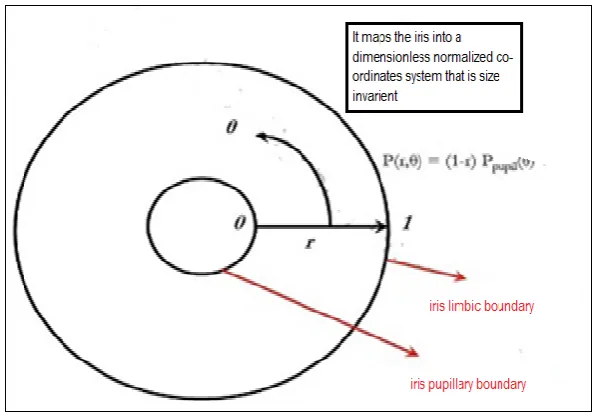
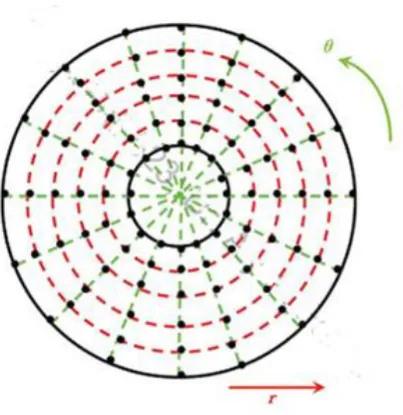
In order to allow comparisons, once the iris region is successfully segmented from an eye image, the next stage is to transform the iris region such that it has fixed dimensions. In normalization, Polar co-ordinate is transferred to Cartesian co-ordinates i.e. the converted into a rectangle. This is done by taking the distance of outer radius- inner radius as the height of rectangle and circumference of the outer disk as length of the rectangle. The length is divided into 360 parte depicting 3600 of the circle. For normalization we use Doughmans Rubber Sheet model. See Fig.3.1 and Fig.3.2
Fig 3.2 Daughman Rubber Sheet Model
5. FEATURE EXTRACTION
Once the segmented iris region was normalized the relevant texture information needs to be extracted. In this two methods for feature extraction were proposed. First one was HAAR wavelet decomposition and the second one was 1D log Gabor wavelet.
5.1 HAAR WAVELET DECOMPOSITION
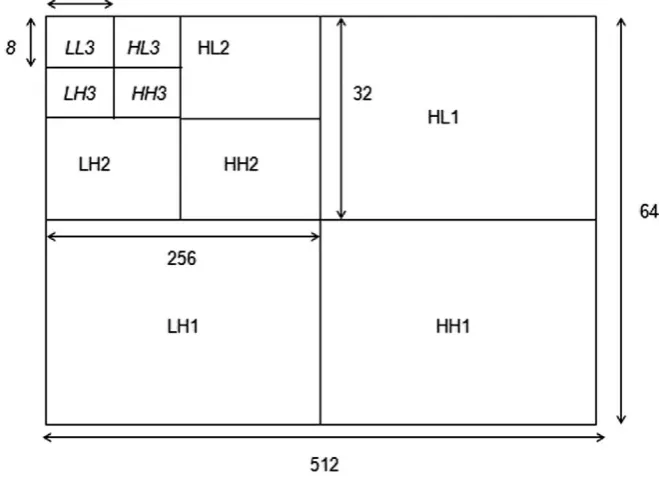
Wavelets can be used to analyze the data in the iris region in multi-resolution mode. It has the advantage over traditional Fourier transform as the frequency data is localized in wavelet, allowing feature which occur at the same position and resolution to be matched. Suppose HAAR wavelet is applied to the normalized image of size 64*512 at three different levels successively for feature extraction. The wavelet transform has been performed and the image is divided into for sub-regions LL, HL, LH, and HH. The maximum accuracy is found in the LL region on the multi-divided iris image co-ordinates; this LL is provided as an image to be newly processed so that we can apply the wavelet transform to the region again. The HAAR wavelet transform is repeatedly performed in order to reduce information sizes as shown in Fig 6.1.
The characteristic values of further reduced region such as LL3 are obtained, for each iris image the region LL3 is obtained by wavelet transforms three times which is considered as a major characteristic input vector to SVM. At this time, the region LL3 contains the information having 8*64 512 features
5.2 1D LOG GABOR WAVELET
region. Rather than the radial the angular direction is taken, which corresponds to columns of the normalized pattern, since maximum independence occurs in the angular direction. The intensity values at known noise areas in the normalized pattern are set to the average intensity of surrounding pixels to prevent the influence of noise in the output. The output of filtering is then phase quantized to four levels using each filter producing two bits of data for each phase. In image processing system filters are mainly used to suppress either the high frequencies in the image, i.e. smoothing the image, or the low frequencies, i.e. enhancing or detecting edges in the image. Either in the frequency or in the spatial domain the image can be filtered. The first step involved the image transformation into frequency domain, then multiplying it with the frequency filter function is shaped so as to attenuate some frequencies smaller than the cut-o frequency and 0 for all others. The output of phase quantization is chosen to be grey code, so that when going from one quadrant to another, only 1 bit changes this will minimize the number of bits disagreeing, we can provide more accurate recognition if say two intra class patterns are slightly misaligned. The encoding process produces a noise mask along with bitwise template. The generated bitwise template are corresponding noise mask is further used in classification purpose.
Fig 4.1 HAAR three level wavelet decomposition
6. PATTERN MATCHING
6.1 WORKING OF HAMMING DISTANCE
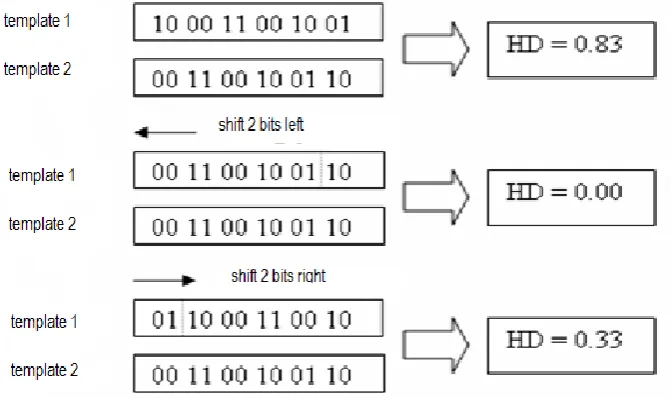
Given two pattern X and Y, it is the sum of disagreeing bits (sum of the exclusive-OR between) divided by N, the total number of bits in the pattern.
If two patterns are derived from the same iris, the Hamming distance between them will be close to 0.0 due to high correlation
In order to account for rotational inconsistencies, one template is shifted left and right bit-wise and a number of hamming distance values are calculated from successive shifts.
The smallest Hamming distance is selected as it corresponds to the best match between to templates.
Fig 5.1 shifting process
7. RELATED WORK
Himanshu Rai, Anamika Yadav[1] proposed scheme ”iris recognition using combined
support vector machine and hamming distance approach.” In this system they had combined two method first is support vector machine and second is hamming distance for the purposed of personal identification system. The proposed method is computationally effective as well as reliable with a recognition rate of 99.91% and 99.88% on CASIA and Chek image database respectively.
Patil, PatilKulkarni[2] Iris Feature Extraction For personal Identification Using Lifting Wavelet Transform. In this paper they present a novel approach to iris recognition, they developed a Lifting (integer) Wavelet-based algorithm that enhances iris image, reduces noise to the maximum extent possible, and extract the important features from the image then the similarity between two iris image is estimated using Euclidean distance and comparison of threshold. The proposed technique is computationally effective with recognition rate of 99.97% on iris database
are applied on the eye image of 320x280 dimension is obtained from CASIA database. 1 D Gabor filter is used for eyelid detection and enhancing the segmented iris image. Edge detection techniques such as canny, sobel and prewitt are used for obtaining the fine edges.
8. OUTCOME OF PROJECT
Today’s security are in critical need of finding accurate, secure and cost effective alternative to passwords and personal identification number (PIN) as financial losses increase dramatically year over year from computer based fraud such as computer hacking and identity theft. Biometric solutions address these fundamental problems, because an individual’s biometric data is unique and cannot be transferred. An advantage of using biometric authentication is that it cannot be lost or forgotten, as the person as to be physically present during the point of identification process.
In our work identification and verification modes are two main goals of the system based on the needs of the environment. In the verification stage, the system check if the user data was entered is correct or not but in the identification stage, the system tries to discover who the subject is without any input information. Hence verification is one to one search but identification is one too many comparisons.
9. CONCLUSION
In our scheme an efficient and a novel approach for iris feature extraction and recognition was presented. The zigzag collarette area of the iris was selected for iris was selected for iris feature extraction because it captures the most important area of iris complex pattern and higher recognition rate has been achieved. HAAR wavelet and 1d Log Gabor filter have been used feature extraction. These extracted features were utilized for iris identification using the Hamming distance approach.
REFERENCES
[1] HimanshuRai, Anamika Yadav (2014) Iris recognition using combined support vector machine and hamming distance approach. Department of Electrical Engineering, National Institute of Technology, Raipur, C.G., India Expert System with Application 41(2014) 588-593.
[2] Patil, Patil kulkarni(2010),An approach ofiris feture Extrcation for Personal Identification using Lifting Wavelet Transform. International Hournal of computer Application(0975-8887)
[3] Roy, k., Bhattacharya, P. (2011). An iris recognition method based on zigzag collarette area and asymmetrical support vector machines. IEEE international Conference on system, Man and Cybernetics, 1,861-865.
[4] J.Daugman, C. Downing, Nochange ove time is shown in Rankinetal. Iris recognition failure over time: the effect soft texture, pattern Recognition (2012)
[5] D.M. Rankin, B.W.Scotney, P.J. Morrow, B.K. Pierscionek, Iris recognition Failure over time: the effect of texture, Pattern Recognition 45(2012) 45150.
[6] Daugman, J.2011. How iris recognition works. IEEETrans, CSVT14,2130
[7] Yachna Kumari, Mrs Rohini Sharma “Iris Recognition System using Gobar Filter and Edge Detection” International Journal on Recent and Innovation Trends in Computing and Communication