IJPAR |Vol.8 | Issue 4 | Oct - Dec - 2019 Journal Home page: www.ijpar.com
Research article Open Access
Development and evaluation of push pullosmotic pump tablets of valsartan
by using ntural polymers
Rozeena Nigar Osman*, G.GaneshKumar
1*1
SriKurpa Institute of Pharmaceutical Sciences, Siddipet, Telangana- 502277. India. (Affiliated to
Osmania University, Hyderabad)
*Corresponding Author: Rozeena Nigar Osman
E-mail: [email protected]
ABSTRACT
Push pull osmotic pump (PPOP) drug delivery system is a dosage form, which provides controlled release of drug for long duration and makes it one of the most promising drug delivery systems in the recent times. The present study was aimed to develop a POPP for valsartan to achieve zero order release that would reduce the frequency of dosing and thus improves the patient compliance. The effect of degree of semi permeable coating essentially consisting of Opadry CA and mannitol as pore forming agent also evaluated. In all, 12 batches of valsartan PPOP subjected to various pre and post compression evaluation. The dissolution data was fitted to various mathematical models to describe kinetics of drug release. All the pre and post compression parameters of formulated PPOP tablets results within the limits. The FTIR results optimized formulation suggested that good chemical stability of drug and polymer. The optimized formulation (F-10) contain locust bean gum (50 mg)successfully retarded drug release for 12 h and the drug release followed zero order kinetic with (R2 = 0.974). The accelerated stability profiles indicate that the physicochemical properties of the tablets are not affected on storage at 40 ± 2ºC & 75 ± 5% RH up to 3 months.
Keywords:
Push Pull Osmotic Pump, Controlled release, Valsartan, Opadry CA.INTRODUCTION
The oral route for drug delivery is the most popular, desirable, and most preferred method for administrating therapeutically agents for systemic effects because it is a natural, convenient, and cost effective to manufacturing process. In these systems [1], drug dose and dosing intervals are optimized to maintain the drug concentration within the therapeutic range, thus ensuring efficacy
range, it is often necessary to take these types of dosage forms several times a day [4].Controlled drug delivery has taken an important place in pharmaceutical development, improving the tolerability and patient compliance with prescribed dosing regimens[5]. Despite the predominant use of polymer-based systems, alternatives have been developed to decrease the influence of the various physiological factors that occur following food intake or that are dependent on patient age [6].[7] One of the most promising technologies is the oral osmotically driven system (OODS). Osmotic devices are the most reliable controlled drug delivery systems (CDDS) and can be employed as oral drug delivery systems. Osmotic pressure is used as the driving force for these systems to release the drug in a controlled manner [8].Osmotic pump tablet (OPT) generally consists of a core including the drug, an osmotic agent, other excipients and semi-permeable membrane coat [9].
Push-pull osmotic drug delivery features a semi- permeable, rate-controlling membrane surrounding an osmotic core, which contains a push layer and a drug layer. The rate-controlling membrane consists of cellulose acetate with various hydrophilic-hydrophobic plasticizers. The push layer swells releasing the drug at a controlled rate. This may offer significant patient benefits by providing enhanced efficacy and reduced side effects and may also reduce the number of necessary daily doses compared to conventional therapies 10-12
MATERIALS & METHODS
Materials
Valsartan(IP/BP/USP) was the active pharmaceutical ingredient obtained yarrow chemicals, locust bean gum, karayagum, carragenan gum & Opadry CA, mannitol were used a excipents to design push pull osmotic tablets
Method
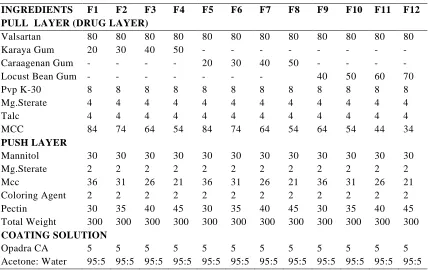
Table 1: Formulation table
INGREDIENTS F1 F2 F3 F4 F5 F6 F7 F8 F9 F10 F11 F12 PULL LAYER (DRUG LAYER)
Valsartan 80 80 80 80 80 80 80 80 80 80 80 80
Karaya Gum 20 30 40 50 - - - -
Caraagenan Gum - - - - 20 30 40 50 - - - -
Locust Bean Gum - - - 40 50 60 70
Pvp K-30 8 8 8 8 8 8 8 8 8 8 8 8
Mg.Sterate 4 4 4 4 4 4 4 4 4 4 4 4
Talc 4 4 4 4 4 4 4 4 4 4 4 4
MCC 84 74 64 54 84 74 64 54 64 54 44 34
PUSH LAYER
Mannitol 30 30 30 30 30 30 30 30 30 30 30 30
Mg.Sterate 2 2 2 2 2 2 2 2 2 2 2 2
Mcc 36 31 26 21 36 31 26 21 36 31 26 21
Coloring Agent 2 2 2 2 2 2 2 2 2 2 2 2
Pectin 30 35 40 45 30 35 40 45 30 35 40 45
Total Weight 300 300 300 300 300 300 300 300 300 300 300 300
COATING SOLUTION
Opadra CA 5 5 5 5 5 5 5 5 5 5 5 5
Acetone: Water 95:5 95:5 95:5 95:5 95:5 95:5 95:5 95:5 95:5 95:5 95:5 95:5
Preparation of tablet core
Pull layer (drug)
The core tablets valsartan were prepared by wet granulation. All the ingredients of tablet core
in sufficient quantity of isopropyl alcohol and the resulting wet mass was passed through 10-mesh sieve. The granules were dried at 50oC for 30 mins in hot air oven. Finally the dried granules were blended with magnesium stearate and talc for 10
mins in a polybag and were compressed into tablets having average 200mg using a single stroke tablet punching machine (cemach India) fitted with a 10mm round concave punches.
Push layer (Osmogen layer)
Push layer ingredients were prepared by direct compression.
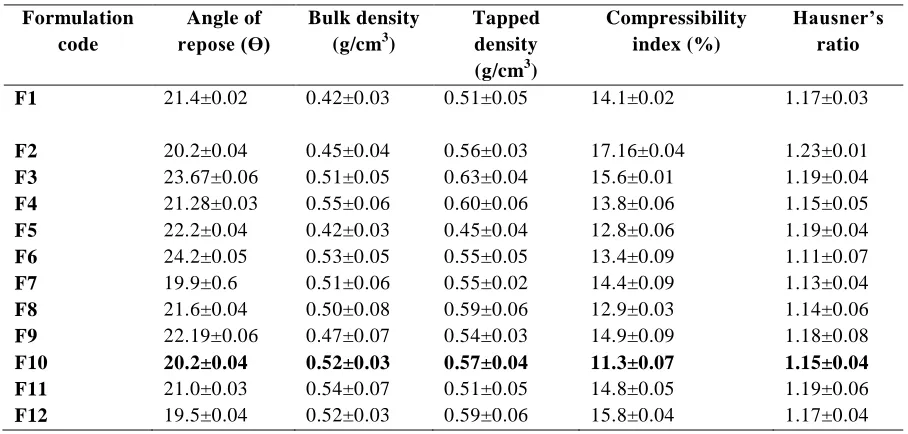
Table 2: Preformulation Studies of blend of all formulations Formulation
code
Angle of repose (Ɵ)
Bulk density (g/cm3)
Tapped density (g/cm3)
Compressibility index (%)
Hausner’s ratio
F1 21.4±0.02 0.42±0.03 0.51±0.05 14.1±0.02 1.17±0.03
F2 20.2±0.04 0.45±0.04 0.56±0.03 17.16±0.04 1.23±0.01
F3 23.67±0.06 0.51±0.05 0.63±0.04 15.6±0.01 1.19±0.04
F4 21.28±0.03 0.55±0.06 0.60±0.06 13.8±0.06 1.15±0.05
F5 22.2±0.04 0.42±0.03 0.45±0.04 12.8±0.06 1.19±0.04
F6 24.2±0.05 0.53±0.05 0.55±0.05 13.4±0.09 1.11±0.07
F7 19.9±0.6 0.51±0.06 0.55±0.02 14.4±0.09 1.13±0.04
F8 21.6±0.04 0.50±0.08 0.59±0.06 12.9±0.03 1.14±0.06
F9 22.19±0.06 0.47±0.07 0.54±0.03 14.9±0.09 1.18±0.08
F10 20.2±0.04 0.52±0.03 0.57±0.04 11.3±0.07 1.15±0.04
F11 21.0±0.03 0.54±0.07 0.51±0.05 14.8±0.05 1.19±0.06
F12 19.5±0.04 0.52±0.03 0.59±0.06 15.8±0.04 1.17±0.04
Dip coating and drying process
The finished tablets were coated with coating solution by dip method. The coating solution was taken in a small beaker and each tablet was dipped manually using forceps and shifted into a coating pan for drying. Drying was carried out using a conventional hair dryer. Tablets were further placed in hot air oven and dried at 40°C for 24 h,
later keptin a closed air tight container for 2 days at room temperature (25± 2°C)[13,14].The drying process was continued until all the tablets had sufficient dryness free from any moisture. The process was repeated three times to have an effective coat [14, 15].The coated tablet was checked for any defects before in-vitro evaluation tests.
Table 3: Post Compression Parameters of Bi Layer Push Pull Osmotic Pump Tablet Of Valsartan Formulation code Weight variation
(mg)
Thickness (mm)
Hardness (kg/cm2)
Friability (%)
Drug content
F1 301.6±0.5 4.45±0.03 6.55±0.02 0.39±0.03 98.2±1.06
F2 299.3±0.3 4.60±0.02 6.49±0.12 0.38±0.07 97.8±1.28
F3 298.3±0.2 4.62±0.06 6.57±0.31 0.46±0.06 98.7±0.58
F4 300.8±0.3 4.52±0.04 6.43±0.25 0.25±0.05 98.3±1.91
F5 300.3±0.7 4.69±0.02 6.49±0.22 0.53±0.06 97.8±1.38
F6 298.5±0.5 4.26±0.03 6.09±0.25 0.59±0.03 99.2±1.28
F7 299.2±0.6 4.19±0.04 6.24±0.13 0.68±0.04 99.2±1.04
F8 298.9±0.7 4.39±0.03 6.28±0.23 0.35±0.02 95.2±1.28
F9 301.8±0.3 4.45±0.08 6.20±0.37 0.83±0.06 98.6±1.27
F11 299.2±0.7 4.47±0.04 6.22±0.35 0.36±0.02 98.1±1.04
F12 301.1±0.5 4.32±0.05 6.19±0.27 0.48±0.06 98.1±1.33
EVALUATION
Pre-compression Parameters
Granules were evaluated for following parameters Angle of repose, Bulk Density, Tapped Density, Carr’s index and Hausner’s Ratio
Post -Compression Blend
Weight variation, Hardness, Friability, Thickness of tablet and drug content, In-vitro
dissolution studies
RESULTS
Drugcompatibility study
Figure 1: FTIR Spectra of VALSARTAN
Figure 3: FTIR Spectra of Optimized formulation (F10)
In vitro drug release studies
Figure 4: Comparison of cumulative drug release profiles of Valsartan push pull tablets:F1 -F4
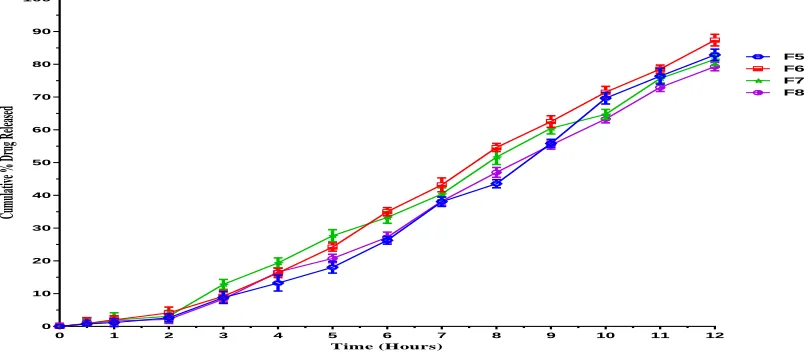
Figure 5: Comparison of cumulative drug release profiles of Valsartan push pull tablets:F5 -F8
0 1 2 3 4 5 6 7 8 9 10 11 12
0 10 20 30 40 50 60 70 80 90 100
Time (Hours)
Cu
mu
lat
ive
%
D
ru
g R
ele
as
ed
F1 F2 F3 F4
0 1 2 3 4 5 6 7 8 9 10 11 12
0 10 20 30 40 50 60 70 80 90 100
Time (Hours)
Cu
mu
lat
ive
%
D
ru
g R
ele
ase
d
Figure 6: Comparison of cumulative drug release profiles of Valsartan push pull table ts:F9-F12
Table 3: Drug Release Kinetics of optimized formulation F10 of valsartan Osmotic Pump Tablet S.No Kinetics Regression value
1 Zero order 0.9747
2 First order 0.751
3 Higuchi plot 0.881
4 Korsermayer-papas 0.925
PREFORMULATION STUDIES IDENTIFICATION OF DRUG
The IR spectrum of pure drug was found to be similar to the reference standard IR spectrum of valsartan.
Table 4: FTIR data for estimation of valsartan
S.No Functional group present Type of vibration Reference peak(cm-1) Observed peak (cm-1)
1 Carboxylic acid C=o stretch 1050-1150 1604
2 Ketone C=O stretch 1725-1705 1730.94
3 amide N-H stretch 1360-1310 1353.94
DRUG-EXCIPIENT COMPATIBILITY
STUDIES
Fourier Transform Infrared (FTIR)
Spectroscopy
Potential chemical interaction between drug and polymer may change the therapeutic efficacy of the drug. To investigate the possibility of chemical interaction between drug and polymer FTIR spectra of pure valsartan and optimized formulations were analyzed over the range 400–4000 cm−1. FTIR spectra of the optimized formulations displayed all the characteristic bands of both drug and excipients, without any significant spectral shift.
This suggested that there was no potential chemical interaction between the components of the formulations.
The Micrometric properties of granules for
Bi-layer Push Pull Osmotic Tablet
System (PPO) of valsartan were characterized with respect to angle of repose, bulkdensity, tapped density, Carr's index and Hausner's ratio (table 1)
Angle of repose (0) was found to be within 20°-30° and Carr's index valueswere less than 21 for all granules of all formulations indicating good to fair flowability and compressibility Hausner's ratio was
0 1 2 3 4 5 6 7 8 9 10 11 12
0 10 20 30 40 50 60 70 80 90 100
Time (Hours)
Cu
mu
lat
ive
%
D
ru
g R
ele
as
ed
found to be less than 1.25 for granules of all formulations indicating good flow properties.
Formulation development of osmotic tablet
The Osmotic tablets of valsartan were prepared using Wet granulation method the Osmogen layer was blended by Direct Compression.
Post-Compression Parameters of Matrix
Tablets
The results of the weight variation, hardness, thickness, friability and drug content of the prepared matrix tablets of valsartan are given in (Table 2).
All the tablets of prepared formulations are compiled with the official requirements of weight variation as per I.P and U.S.P as their weights varied above 324mg i.e., +5 %. The hardness of the tablets ranged from 6-7 kg/cm before coating and after coating and the friability values were found to be less than 0.8% indicating the prepared tablets were compact and hard thus they can withstand mechanical hazards. The thicknesses of the tablets were ranged from 4.19-4.69 mm. All the formulations satisfied the content of the drug as they contained 90-102 % of variation and good uniformity in drug content was observed. Thus all the physical attributes of the prepared matrix tablets were found to be practically within control
Coating of the core tablets
Bi-layer core tablets containing varying proportions of osmogen and other were coated with coating solution opadry CA. The tablets were coated until a desired weight gain (10%) was achieved. The tablets were then dried at 50°C for 10 h. The tablets were then evaluated for post compression evaluation parameters. The results of which are discussed as above.
In vitro drug release studies
The developed formulations of valsartan were subjected to in vitro dissolution studies using USP -Type II dissolution apparatus [Paddle -Type] in two media ie. 0.1N Hydrochloric acid pH 1.2 and in Phosphate buffer pH6.8 The dissolution study was taken place in pH 1.2 (0.1N HCI) for initial 2 h and Phosphate buffer pH 6.8 as dissolution medium for next 10 h. All tablet formulations released 0.406 to 4.15 % of drug during initial 2 h. The formulation F10 released 98.45% of drug at 12 h. The tablet
formulations prepared by Mannitol as osmogen sustained drug release up to 12h. The best fit with higher correlation (r=0.989) was found with zero order equation for tablet formulation F10.
Kinetic data of In vitro Dissolution Data
The release rate kinetics data for the F10 is shown in table 3 As explained by Zero order shown in figures, drug release was best followed by equation, as the plots showed higher linearity in zero order (=0.974), Korsmeyer - Peppas (=0.925) and Higuchi plot(r=0.881) and first order (=0.751).As the drug release was best fitted in the Zero order kinetics, indicating that the rateof drug release is concentration independent.
Mechanism of Drug Release
As shown in, the corresponding plot (Log Cumulative Drug Release VsLog time) for Korsmeyer (=0.925). The diffusional exponent "n" was 0.0496, which appears to indicating the release of drug polymer matrix formulations was found to be Peppas equation indicated a good linearity Anomalous (Non-Fickian Diffusion).
Accelerated stability studies
The stability of this optimized formulation was known by performing stability studies for three months at accelerated conditions of 40°C+75 % RH on optimized formulation F10. The formulation was found to be stable, with no change in the weight variation, thickness, and friability, hardness, drug content and In vitro drug release pattern.
CONCLUSION
In this work an attempt was made to design push pull osmotic pump drug delivery system an active ingredient Valsartan. The main objective of the present research work is to alter release rate of valartan for 12hrs i.e., by using the osmosis principle.
This was followed by procurement of materials and standardization of all materials used in the formulation of matrix tablets.it non he concluded that
From the obtained results it can be concluded
that
IR spectra of pure drug and with the exeipients are identical and do not show any incompatibility, thus the excipients are compatible with the drug.
The prepared granules were also evaluated for various micrometric properties such as angle of repose, bulk density, tapped density and Carr's index values were found to be within the limits.
Lower values of angle of repose below 30 indicate good flow properties of powder Blend.
The drug content was uniform in all the formulation of tablets prepared. The low values of the standard deviation indicate uniform distribution of drug within polymer matrices.
The prepared tablets were evaluated for various parameters such as drug content, weight variation, hardness, thickness, friability, swelling studies, In vitro drug release studies, and release rate kinetics. Friability and hardness were within the
Pharmacopocial limits thus showing good mechanical strength of tablets.
The prepared bi-layer are successfully coated with Opadry CA coating solution and weight gain was maintained uniform at 10% weight gain of total weight of the core tablet. Formulation F10 showed significant increase in drug release and it all showed better
pre-compression and post compression parameters.
Among all the batches of prepared of Bi-layer Push Pull Osmotic Tablet System (PPOP) valsartan, formulation prepared by employing the locust bean gum and pectin in the concentration of 50 % and35% respectively. F1 showed better release of valsartan from semipermeable membrane coatings of 98.45 % and all the Pre-compression and Post-compression parameters are also within the limit as per pharmacopoeial standards.
Further the analysis of release mechanism was carried out by fitting the drug release data to various kinetic equations like Zero order, First order, Higuchi's and krosmeyerpeppas equations and from the values so obtained, the best fit model were arrived at.
Stability studies of the selected formulation was carried out to determine the effect offormulation additives on the stability of the drug and also to determine the physical stability of the formulation.
The stability studies were carried out at 40+2°C and 75+5% RH for 90days. There was no significant change in the physical property and weight variation, hardness, thickness, friability, swelling studies, surface pH, In vitro drug release studies, drug content during the study period.
REFERENCES
[1]. Leon Shargel, Susanna Wu-Pong, Andrew BC Yu. Modified-ReleaseDrug Products. In: Applied Biopharmaceutics& Pharmacokinetics, 5, 2004.
[2]. Gadage MA, Senthilkumar SK, Tamizhamani. Osmotically Controlled Tablets, “A Modified -release Drug Delivery Technology. Inventi Rapid: Advanced Dosaging 4, 2011, 1 -6.
[3]. Leon Shargel, Susanna Wu-Pong, Andrew BC Yu. Modified-Release Drug Products. In: Applied Biopharmaceutics& Pharmacokinetics, 5, 2004.
[4]. Robinson JR, Lee VHL.Controlled Drug Delivery: Fundamentals and Applications. New York, Marcel Dekker, Inc. 2, 1987.
[5]. D.M. Brahmankar, Sunil B.Jaiswal.Controlled Release Medication. In: Biopharmaceutics and Pharmacokinetics. VallabhPrakashan. 2, 2009, 399-400.
[6]. Gupta roop, Gupta rakesh, RathoreGarvendra“ Osmotically controlled drug delivery systems - A review” Int. J. Ph. Sci., Sept-December 1271(2), 2009, 269-275.
[8]. Welling P. G. and Dobrinska M. R., Dosing consideration and bioavailability assessment of controlled drug delivery system, Chapter 7, Controlled drug delivery; fundamentals and applicat ions, Robinson J.R. and Lee V. H. L. (Eds.), Marcel Dekker Inc., New York, 29(2), 1978, 254, 373.
[9]. S.p.vyas,R.k.khar, “controlled drug delivery concepts and advances”; osmotically regulated systems, 1, 477-501.
[10]. V. Malaterre, J. Ogorka, N. Loggia, R. Gurny, Approach to design push–pull osmotic pumps, Int. J. Pharm. 376 (2009) 56–62
[11]. R. Kumaravelrajana, N. Narayananb, V. Subac, K. Bhaskard, Simultaneous delivery of nedipine and Metoprololtartarate using sandwiched osmotic pump tablet system, Int. J. of Pharm. 3 99, 2010, 60–70. [12]. D. Prabhakaran, P. Singh,P. Kanaujia, K.S.Jaganathan, S.P.Vyas, Modified push -pull osmotic system for
simultaneous delivery of theophylline and salbutamol: development and in-vitro characterization, Int. J. Pharm. 284, 2004, 95-108.