ISSN
: 2455-104X
Volume 4,Issue 2 (July-December
)
2018,27-39
Received
: 15 Oct .2018 ;
Accepted
: 02 Nov. 2018 ;
Published
: 14 Nov. 2018 ;
Paper ID
: IJRLS-1292
Page
CHALLENGES IN SKILL DEVELOPMENT
AMONG LIBRARY AND INFORMATION
SCIENCE PROFESSIONALS
S. Ravi
Dean, School of Communication, Professor and Head, Dept. of Library and Information Science, Central
University of Tamil Nadu, Thiruvarur - 610 005
E-mail: [email protected]
ABSTRACT
Today’s changing environment in library and
information centres looks for change in the professional skills besides the academic skill. This study examines nearly 49 criteria across the spectrum of Key
Requirements; Inquisitiveness; Infrastructure environment; Work Environment; Professional Challenges and Future Skill Capacity to determine the viability of the skills for the booming of library and information science professionals. This study carried out to identify the Key Requirements for professional skill and to identify the Inquisitiveness in developing the skill. Further the impact of Infrastructure environment and work environment in developing the skill were also identified. This study was carried out among 210LIS professionals of 76 engineering institutions in 8 districts (Ariyalur, Cuddalore, Nagapattinam, Perambalur, Thanjavur, Tiruvannamalai, Tiruvarur, and Villupuram) under the affiliation of Anna University. Out of 210 distributed 157 responded. The response rate works out to 74.76%. The Professionals aware that there exist
Challenges towards skill development and they aware that it is essential to develelop future Skill Capacity in the changing technological environment.
Keywords: Skill development, key requirement in skill, future skill, impact of professional and work environment, challenges in skill development.
1.
INTRODUCTION
The dramatic changes, largely the result of rapidly evolving information and communication technologies (ICTs), have impacted significantly on the knowledge and skills requirements for library and information science (LIS) professionals practicing in this environment. The transformed landscape requires a new generation of LIS professionals to effectively and efficiently mediate it. Orme (2008) [1]categorised knowledge and skills required for this transformed environment into: discipline-specific knowledge (that is, knowledge that relates specifically to the LIS profession), generic skills (general skills which apply to all disciplines) and personal competencies (attitudes, values and personal traits). Choi and Rasmussen (2009) [2], Venkataraman S, Gopalakrishnan S and Gopalakrishnan S (2011) [3] studied the knowledge sharing among the library professionals and emphasised the need.
National Knowledge Commission (2007) while
recommending the role of libraries as “gateways to knowledge” emphasized the skills required to fulfill the changing role of libraries as Library and information handling skills, Service orientation, ICT knowledge skills, Communication and training skills, Marketing and presentation skills, Understanding of cultural diversity, Knowledge mapping skills.
S. Ravi
Page
Since the dawn of 21st Century, libraries are facingserious transition on account of the following three main reasons:
• The transition from paper to electronic media as
the dominant form of information storage retrieval and dissemination. Convergences of different media, such as text, graphics, and sound, into multimedia resources, have direct impact on this transition.
• Increasing attention on accountability, with focus
on quality customer services, performance measurement, bench marking andcontinuous improvement. In addition, shrinking financial resources have direct bearing on this shift.
• New forms of work organization such as
end-user computing,work-teams, downsizing, reengineering, outsourcing etc.
Thus in order to cope up with the ever-changing in library
and information science profession, the library
professionals must be a skilled professional. The skills can be categorised as
• Domain Specific Skills - Engineering, Medicine
etc.;
• Essential Skills - Reading, Writing, Computer
Application, Creative Thinking, Analyzing Skills etc;
• Managerial Skills - Planning, Organisation,
Managing Negative People, Assertive Skills, Conflict Management Skills etc;
• Leadership Skills - Goal Setting, Team Building,
Motivation, Risk Taking, Formulating Vision etc;
• Contextual Skills – Operational Skills in
different environment or culture.
2.
REVIEW
OF
RELATED
LITERATURE
Few of the skills such as Information Skills (Pintos 2008 [4],Walter 2008 [5], Dell –Price and Cotton 2008) [6], Information Literacy Skills (Ramesh Babu 2011 [7], Ramesh Babu&NageswaraRao 2011 [8], Hagland and Herson 2008) [9], ICT skills (Thomas and Rulter 2008 [10], Owvia, Bada&Aimbonam 2006) [11], Soft Skills (Harris 2007) [12] that are need has been discussed in the literature. The skills which are required for various professionals had been studied. The skills required by LIS professionals by Thenmozhi, N and Gopalakrishnan S.
(2013) [13],Muthukumar G, Venkataraman S,
Gopalakrishnan S and Gopalakrishnan S (2014) [14],Pattabhiraman T, Gopalakrishnan S, Gnanasekaran D and Gopalakrishnan S (2014) [15],Balakrishnan, T, Gopalakrishnan, S and Gopalakrishnan, S (2014) [16],Sadagoban, K, Tamizhchelvan, M, Gopalakrishnan, S and Gopalakrishnan, S (2015) [17]. Capabilities and Skill requirements by fashion professionals by Mohanraj,
P, Gopal, S K, and Gopalakrishnan S (2015) [18],Mohanraj.P, Gopal.S K and Gopalakrishnan.S (2015) [19],Mohanraj.P, Gopal.S K and Gopalakrishnan.S (2015) [20] and Mohanraj.P, Gopal.S K and Gopalakrishnan.S (2015) [21].
In the present day environment a professional should be able to understand problems, manage users and encourage teams of individuals with different skills to work together, as those "hybrid" teams will be the corner stones of progress for the management and provision of information systems in the future (Biddiscombe,2001) [22].
3.
OBJECTIVES
Following were the objectives of the study.
• To identify the Key Requirements for
professional skill
• To know the Inquisitiveness in developing the
skill
• To identify the role Infrastructure environment in
developing the skill
• To know the role of Work Environment in
enhancing the skill
• To identify the role of Professional Challenges towards skill development
• To know the future Skill Capacity in the
changing technological environment
4.
HYPOTHESIS
The hypotheses were formulated based on the objectives • There exist challenges in the Key Requirements
for professional skill
• There exists Inquisitiveness among the LIS
professionals in developing the skill
• The Infrastructure environment also challenges the professionals in developing the skill
• There exist significant challenges in Work
Environment towards enhancing the skill
• There exist Professional Challenges towards skill
development
•
The professionals aware about the future SkillCapacity in the changing technological
environment
5.
CRITERIA FOR SELECTION OF
COLLEGES
Page
resources in print/digital and multimedia mode, librarypersonnel strength, services, established rules and regulations and human relation policies and practices.
6.1
Administration of Questionnaire
The questionnaire was administered to allto the 210 LIS professionals of 76 engineering institutions in 8 districts
(Ariyalur, Cuddalore, Nagapattinam, Perambalur,
Thanjavur, Tiruvannamalai, Tiruvarur, and Villupuram) under the affiliation of Anna University. Out of 210 distributed 157 responded. The response rate works out to 74.76%.
6.2
Data collection
The questionnaires were mailed to respondents for collecting the data. The respondents were reminded through e-mail for forwarding the filled questionnaire. Few of the questionnaires were collected directly from the respondents. The data were collected during the period July and December 2016. Questionnaire were distributed to the entire population whoever were in service during the period July to December 2016.
6.3
Sample
The questionnaires were distributed to the Library and Information Science professionals of 76 engineering institutions. The questionnaire distributed and responses received were shown in Table 1, Fig 1.
6.4
Demographic Details
The demographic details of the respondents were shown in Table 2 and Fig 2.
6.5
Data Analysis
This study examines nearly 49 criteria across the spectrum of Key Requirements; Inquisitiveness; Infrastructure
environment; Work Environment; Professional
Challenges and Future Skill Capacity to determine the viability of the skills for the booming of library and information science professionals. . The number of variables thus taken up for the study has been shown in Table 3.
The data collected through the questionnaire have been analyzed and interpreted to test the hypotheses framed and to fulfill the stated objectives. For this purpose, SPSS Software Package has been used in the analysis of data.
6.6
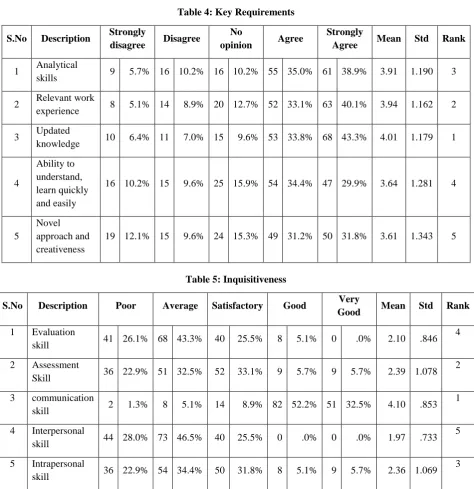
Key Requirements
The key requirements has been ascertained based on five variables such as Analytical skills; Relevant work experience; Updated knowledge; Ability to understand, learn quickly and easily and Novel approach and creativeness on a five point scale such as Strongly disagree; Disagree;No opinion; Agree Strongly and Agree
from the respondents. The mean and standard deviation were calculated based on opinion. The ranks were ascertained based on mean and standard deviation. The variables, respondents’ opinion, mean, standard deviation and rank were shown in Table 4.
The mean value all the five inquisitiveness variables ranges between 3.61 and 4.0139 which indicates that they lie towards agree. The standard deviation ranges between 1.162 and 1.343 which indicates that there has been no deviation on opinion.
The first preference was given for “Update knowledge”. It is followed by “Relevant work experience” and “Analytical skill”. The least preference was indicated to “Novel approach and creativeness”.
6.7
Inquisitiveness
The inquisitiveness has been ascertained based on five
variables Evaluation skill; Assessment Skill;
communication skill; Interpersonal skill and Intrapersonal skill on a five point scale such as Poor; Average;
Satisfactory; good and very good from the
respondents. The mean and standard deviation were calculated based on opinion. The ranks were ascertained based on mean and standard deviation. The variables, respondents’ opinion, mean, standard deviation and rank were shown in Table 5.
The mean value all the five inquisitiveness variables ranges between 1.97 and 2.39 which indicates that they lie between average and satisfactory. The standard deviation ranges between 0.733 and 1.078 which indicates that there has been no deviation on opinion.
The first preference was given for “Communication skill”. It is followed by “Assessment skill” and “Intrapersonal skill”. The least preference was indicated to “Interpersonal skill”; mean value was 1.96 each which indicates that the respondents have average to the variables.
6.8
Infrastructure environment
The Infrastructure environment has been ascertained based on 12 variables Working environment; Job location;
Working hours; Noise free; Comfortable space;
S. Ravi
Page
The mean value all the twelve infrastructure environmentvariables ranges between 2.22 and 4.36 which indicates that they lie between no opinion and satisfactory. The standard deviation ranges between 0.943 and 1.462 which indicates that there has been no deviation on opinion. The first preference was given for “ICT tools”. It is followed by “Internet speed” and “e-collection”. The least preference was indicated to “Ergonomic furniture”; “Comfortable space” and “Noise free”.
6.9
Work Environment
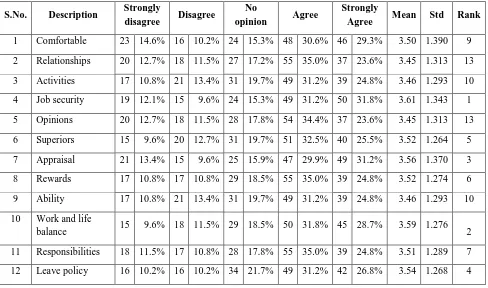
The work environment has been ascertained based on 13 variables such as Comfortable; Relationships; Activities; Job security; Opinions; Superiors; Appraisal; Rewards; Ability; Work and life balance; Responsibilities; Leave policy and Long term benefits were employed to ascertain the opinion from the respondents on a five point scale such as Poor; Average; Satisfactory; good and very good from the respondents. The mean and standard deviation were calculated based on opinion. The ranks were ascertained based on mean and standard deviation. The variables, respondents’ opinion, mean, standard deviation and rank were shown in Table 7.
The mean value all the thirteen variables of work environment variables ranges between 3.45 and 3.81 which indicates that they lie between no opinion and satisfactory. The standard deviation ranges between 1.264 and 1.390 which indicates that there has been no deviation on opinion.
The first preference was given for “Job security”. It is followed by “work and life balance” and “Appraisal”. The least preference was indicated to “Opinion”; and “Relationship”.
6.10
Professional Challenges
The professional challenges in work environment have been ascertained based on 10 variables as shown in Table x. The opinions were obtained in a five point scale such as Strongly disagree, Disagree, No opinion, Agree and Strongly Agree. The mean and standard deviation were calculated based on opinion. The ranks were assigned based on mean and standard deviation. The responses were compared between gender The mean and standard deviation were calculated. The ranks were assigned based on mean and standard deviation. The responses, mean, standard deviation and rank were shown in Table8. The first preference were indicated as other than the nine variables thus selected. It is followed by Organisation development and training. The least preference was indicated to employee engagement and followed by leadership. The mean value ranges between 3.41 and 3.96 which indicated that all the variables were agreed by the LIS professionals. The standard deviation lies between
1.167 and 1.474 which indicates that there has been no significant deviation in their opinion.
The correlation test has been administrated to identify the significance of the variable and the relation between the variables has been ascertained and the same has been shown in Table 9.
The correlation value of all the variables ranges between 0.647 and 0.871 which indicates that all the variables were highly positively correlated. The test also shows that the variables were significant at 99% level in 2 tailed test. Further closely associated were
Closely associated variables
• T
alent management and managing changes
• O
rganisational performance and Training
• C
reativity and talent management Distinctly associated variables
• O
rganisational development and managing
changes
• O
rganisational development and talent
management
• O
rganisational development and training
6.11
Future Employees
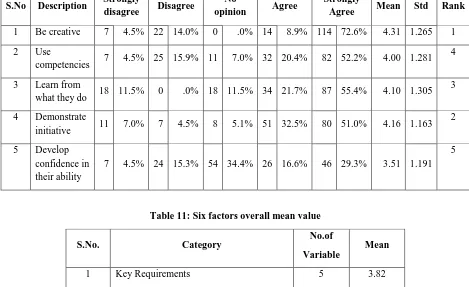
The future employees expectation in work environment were ascertained on five variables Be creative; Use competencies; Learn from what they do; demonstrate initiative and develop confidence in their abilityin a five point scale such as Strongly disagree, Disagree, No opinion, Agree and Strongly Agree. The mean and standard deviation were calculated based on opinion. The ranks were assigned based on mean and standard deviation. The responses were compared between gender The mean and standard deviation were calculated. The ranks were assigned based on mean and standard deviation. The responses, mean, standard deviation and rank were shown in Table 10.
Page
To conclude the future of employees on the responsesreceived from the respondents, the first preference given to “be creative”, followed by Demonstrate initiative and Learn from what they do. The least preference was given by the respondent is “develop confidence in their ability
6.
FINDINGS
7.1
Sample
• Nearly 210 questionnaires were distributed. Out
of 210 distributed 157 responded. The response rate works out to 74.76%.
• Maximum number of respondents were from
Villupuram (44,28.0%) district.
• Out of 157 LIS professionals, 94 (59.9%) were
male and 63(40.1%) were female respondents. 77.1% of the respondents are librarians.
7.2
Key Requirements
• The key requirements has been ascertained based
on five variables such as Analytical skills; Relevant work experience; Updated knowledge; Ability to understand, learn quickly and easily and Novel approach and creativeness
• The first preference was given for “Update
knowledge”. It is followed by “Relevant work experience” and “Analytical skill”. The least preference was indicated to “Novel approach and creativeness”.
7.3
Inquisitiveness
• The inquisitiveness has been ascertained based
on five variables Evaluation skill; Assessment Skill; communication skill; Interpersonal skill and Intrapersonal skill
• The first preference was given for
“Communication skill”. It is followed by “Assessment skill” and “Intrapersonal skill”. The least preference was indicated to “Interpersonal skill”; mean value was 1.96 each which indicates that the respondents have average to the variables.
7.4
Infrastructure environment
• The Infrastructure environment has been
ascertained based on 12 variables Working environment; Job location; Working hours; Noise free; Comfortable space; Ergonomic furniture; ICT tools; Efficient infrastructure; e-collection; Internet speed; Telephonic services; and Opportunities.
• The first preference was given for “ICT tools”. It is followed by “Internet speed” and “e-collection”. The least preference was indicated to “Ergonomic furniture”; “Comfortable space” and “Noise free”.
7.5
Professional Challenges
• The first preference were indicated as other than
the nine variables thus selected. It is followed by Organisation development and training. The least preference was indicated to employee engagement and followed by leadership.
• Closely associated variables were Talent management and managing changes; Organisational performance and Training ; Creativity and talent management
• Distinctly associated variables
wereOrganisational development and managing changes; Organisational development and talent management and Organisational development and training.
7.6
Future Skill Capacity
• The future employees expectation in work
environment were ascertained on five variables Be
creative; Use competencies; Learn from what they do; demonstrate initiative and develop confidence in their ability in a five point scale.
• The first preference were indicated as Be
creative. It is followed by demonstrate initiative and Learn from what they do. The least preference was indicated to develop confidence in their ability.
• The future of employees on the responses
received from the respondents, the first preference given to “be creative”, followed by Demonstrate initiative and Learn from what they do. The least preference was given by the respondent is “develop confidence in their ability”.
7.
CONCLUSION
This study reveals the challenges in skill requirements of the LIS professionals on six factors. The average mean value of all the six categories in a five point likertscale such as strongly disagree, disagree, no opinion, agree and strongly agree indicates agreed that their exist challenges in six factors. The factors and the overall mean value were shown in Table 11.
The overall mean value works out 3.48 which indicates that the library and information science professionals agreed for the forty nine criteria on six factors .
This study indicates that there exist challenges in the Key Requirements among LIS professional skill. Further there exists Inquisitiveness among the LIS professionals in developing the skill. The Infrastructure environment and work environment also challenges the professionals in developing and enhancing the skill. The professionals were well aware about the future Skill Capacity in the
changing technological environment. There exist
Professional Challenges towards skill development.
2.
REFERENCES
[1] Orme, V. (2008). You will be …: A study of job
S. Ravi
Page
LIS professionals in the UK in 2007. Library Review,57(8), 619–633.
[2] Choi, Y., & Rasmussen, E. (2009). What
qualifications and skills are important for digital librarian positions in academic libraries? A job advertisement analysis. The Journal of Academic Librarianship, 35(5), 457–467.
[3] Venkataraman S, Gopalakrishnan S and
Gopalakrishnan S (MIT) (2011). Knowledge sharing among library and information science professionals: a study. Journal of Current Trends in Education and Research, 3(2), 41-47.
[4] Pinto Molina Maria (2008) Cyber abstracts:
APortal on the Subject of Abstracting Designed to Improve Information Literacy Skills: Journal of Information Science 34(5): 667-679.
[5] Walker, A Stephanie (2008). Computer –assisted
library instruction and face-to-face library instruction prove equally effective for teaching basic library skills in academic libraries. Evidence Based Library and Information Practice 3(1):57-60.
[6] Dell –Price and Cotton 2008 Dell –Price, Carol and Cotton Yvonne (2008). Assessing Information literacy skills within a core module ALISS Quarterly 3(3):31-33.
[7] Ramesh babu B (2011). Information Literacy
skills for LIS Professionals. In: National Conference on Information Literacy Skills for college Librarians in Digital Environment. New Dellhi:Vayu Education of India. pp.3-16.
[8] Ramesh babu B and NageswaraRao P (2011).
Competencies and Skills for LIS Professionals in the context of Information Literacy and Digital Literacy. IN:
National Conference on Information Literacy
Competencies for Higher Learning and Research
organised by Tumkur University (Proceedings).
Bangalore: Indian Academic Library Association pp.254-262.
[9] Haglund, Lotta and David, A Herron (2008).
Students with non-proficient information seeking skills greatly over-estimate their abilities. Evidence Based Library and Information Practice 3(2): 48-51.
[10] Thomas Peter and Ruttert Paul M. (2008). A
Computer Literacy Skills Profile of Pharmacists Residing in Two Counties of England Health Information and Libraries Journal 25(4): 288-294.
[11] Owei Vesper; BadaAbiodun O. and Aniebonam Manny (2006).Addressing the information technology
skills shortage in developing countries: tapping the pool of disabled users. Journal; of Information Communication and Ethics in Society 4(2):77-89.
[12] Harris, Lesley Ellen (2007). When the
negotiations begin listen carefully stayon point. Information Outlook 11(3): 32-33.
[13] Thenmozhi, N and Gopalakrishnan S. (2013).
Performance Measurement in University Libraries of Tamil Nadu: A Study. Journal of Advances in Library and Information Science, 2(4), 243-250.
[14] Muthukumar G, Venkataraman S,
Gopalakrishnan S and Gopalakrishnan S (2014). An Empirical Study on Knowledge Sharing Among LIS Professionals. Journal of Advances in Library and Information Science, 3(2), 101-109
[15] Pattabhiraman T, Gopalakrishnan S,
Gnanasekaran D and Gopalakrishnan S (2014). Work Environment and Dynamic Capability: Empirical Views of Library and Information Professionals. European Academic Research, 2(7), 9734-9751.
[16] Balakrishnan, T, Gopalakrishnan, S and
Gopalakrishnan, S (2014). Decision Making and Leadership Skill among the LIS Professionals: An Empirical Study. European Academic Research, 2(8), 10320 - 10340. ISSN: 2286-4822.
[17] Sadagoban, K, Tamizhchelvan, M,
Gopalakrishnan, S and Gopalakrishnan, S (2015). Information Gathering Practices of Engineering Faculty Members: An Empirical Study. International Journal of Applied Engineering Research (IJAER), 10 (3), 6389-6404.
[18] Mohanraj, P, Gopal, S K, and Gopalakrishnan S
(2015). Capabilities and Skill Requirements for
Employees of Select Organized Fashion Retail Outlets of Textile and Clothing in Chennai: A Study. Global Journal of Engineering Science and Research Management, 2 (6), June 2015.
[19] Mohanraj. P, Gopal.S K and Gopalakrishnan.S
(2015). . Framework for Categorizing the Employees of Organized Fashion Retail Outlets of Textile and Clothing: An Exploratory Factor Analysis (EFA) Method.
International Journal of Emerging Research in
Management &Technology, 4 (11), November 2015.
[20] Mohanraj. P, Gopal.S K and Gopalakrishnan.S
Page
[21] Mohanraj. P, Gopal.S K and Gopalakrishnan.S
(2015). Skill Enrichment among Employees of Select Organized Fashion Retail Outlets of Textile and Clothing in Chennai: A Study. International Journal of Emerging Research in Management &Technology, 4 (6), June 2015.
[22] Biddiscombe, R. (2001). “The Development of
S. Ravi
Page
Table 1: Questionnaire distributed and Responses
S.No District No. of
colleges Distributed
Responses Received %
1 Ariyalur 5 20 10 50.00
2 Cuddalore 6 20 16 80.00
3 Nagapattinam 7 20 16 80.00
4 Perambalur 10 20 16 80.00
5 Thanjavur 13 30 25 83.33
6 Tiruvannamalai 14 40 24 60.00
7 Tiruvarur 3 10 6 60.00
8 Villupuram 18 50 44 88.00
Total 76 210 157 74.76
Page
Table 2: Demographic Details
Fig 2: Demographic details of the Respondents S.No Description Respondents
District
1 Ariyalur 10 6.4%
2 Cuddalore 16 10.2%
3 Nagapattinam 16 10.2%
4 Perambalur 16 10.2%
5 Thanjavour 25 15.9%
6 Thiruvannamalai 24 15.3%
7 Thiruvarur 6 3.8%
8 Villupuram 44 28.0%
Gender
1 Male 94 59.9%
2 Female 63 40.1%
Designation
1 Librarian 121 77.1%
2 Asst. Librarian 18 11.45%
3 Others 18 11.45%
Overall
S. Ravi
Page
Table 3:Category Variables
Table 4: Key Requirements
S.No Description Strongly
disagree Disagree
No
opinion Agree
Strongly
Agree Mean Std Rank
1 Analytical
skills 9 5.7% 16 10.2% 16 10.2% 55 35.0% 61 38.9% 3.91 1.190 3
2 Relevant work
experience 8 5.1% 14 8.9% 20 12.7% 52 33.1% 63 40.1% 3.94 1.162 2
3 Updated
knowledge 10 6.4% 11 7.0% 15 9.6% 53 33.8% 68 43.3% 4.01 1.179 1
4
Ability to understand, learn quickly and easily
16 10.2% 15 9.6% 25 15.9% 54 34.4% 47 29.9% 3.64 1.281 4
5
Novel approach and creativeness
19 12.1% 15 9.6% 24 15.3% 49 31.2% 50 31.8% 3.61 1.343 5
Table 5: Inquisitiveness
S.No Description Poor Average Satisfactory Good Very
Good Mean Std Rank
1 Evaluation
skill 41 26.1% 68 43.3% 40 25.5% 8 5.1% 0 .0% 2.10 .846
4
2 Assessment
Skill 36 22.9% 51 32.5% 52 33.1% 9 5.7% 9 5.7% 2.39 1.078
2
3 communication
skill 2 1.3% 8 5.1% 14 8.9% 82 52.2% 51 32.5% 4.10 .853
1
4 Interpersonal
skill 44 28.0% 73 46.5% 40 25.5% 0 .0% 0 .0% 1.97 .733
5
5 Intrapersonal
skill 36 22.9% 54 34.4% 50 31.8% 8 5.1% 9 5.7% 2.36 1.069
3
S.No. Category
No.of
Variable
1 Key Requirements 5
2 Inquisitiveness 5
3 Infrastructure environment 12
4 Work Environment 13
5 Professional Challenges 9
6 Future Skill Capacity 5
Page
Table 6 Infrastructure Environment
S.No. Infrastructure Strongly
disagree Disagree
No
opinion Agree
Strongly
Agree Mean Std Rank
1 Working
environment 10 6.4% 2 1.3% 12 7.6% 81 51.6% 52 33.1% 4.04 1.018 5
2 Job location 37 23.6% 65 41.4% 35 22.3% 13 8.3% 7 4.5% 2.29 1.056 9
3 Working hours 35 22.3% 52 33.1% 49 31.2% 10 6.4% 11 7.0% 2.43 1.116 8
4 Noise free 35 22.3% 60 38.2% 51 32.5% 7 4.5% 4 2.5% 2.27 .943 10
5 Comfortable
space 37 23.6% 64 40.8% 41 26.1% 13 8.3% 2 1.3% 2.23 .946 11
6 Ergonomic
furniture 40 25.5% 60 38.2% 44 28.0% 9 5.7% 4 2.5% 2.22 .976 12
7 ICT tools 6 3.8% 20 12.7% 0 .0% 17 10.8% 114 72.6% 4.36 1.209 1
8 Efficient
infrastructure 6 3.8% 23 14.6% 11 7.0% 33 21.0% 84 53.5% 4.06 1.242 4
9 e-collection 16 10.2% 0 .0% 18 11.5% 36 22.9% 87 55.4% 4.13 1.256 3
10 Internet speed 9 5.7% 7 4.5% 8 5.1% 53 33.8% 80 51.0% 4.20 1.106 2
11 Telephonic
services 7 4.5% 22 14.0% 53 33.8% 28 17.8% 47 29.9% 3.55 1.185 7
12 Opportunities 14 8.9% 33 21.0% 11 7.0% 23 14.6% 76 48.4% 3.73 1.462 6
Table 7: Work Environment
S.No. Description Strongly
disagree Disagree
No
opinion Agree
Strongly
Agree Mean Std Rank
1 Comfortable 23 14.6% 16 10.2% 24 15.3% 48 30.6% 46 29.3% 3.50 1.390 9
2 Relationships 20 12.7% 18 11.5% 27 17.2% 55 35.0% 37 23.6% 3.45 1.313 13
3 Activities 17 10.8% 21 13.4% 31 19.7% 49 31.2% 39 24.8% 3.46 1.293 10
4 Job security 19 12.1% 15 9.6% 24 15.3% 49 31.2% 50 31.8% 3.61 1.343 1
5 Opinions 20 12.7% 18 11.5% 28 17.8% 54 34.4% 37 23.6% 3.45 1.313 13
6 Superiors 15 9.6% 20 12.7% 31 19.7% 51 32.5% 40 25.5% 3.52 1.264 5
7 Appraisal 21 13.4% 15 9.6% 25 15.9% 47 29.9% 49 31.2% 3.56 1.370 3
8 Rewards 17 10.8% 17 10.8% 29 18.5% 55 35.0% 39 24.8% 3.52 1.274 6
9 Ability 17 10.8% 21 13.4% 31 19.7% 49 31.2% 39 24.8% 3.46 1.293 10
10 Work and life
balance 15 9.6% 18 11.5% 29 18.5% 50 31.8% 45 28.7% 3.59 1.276 2
11 Responsibilities 18 11.5% 17 10.8% 28 17.8% 55 35.0% 39 24.8% 3.51 1.289 7
S. Ravi
Page
13 Long term
benefits 18 11.5% 18 11.5% 32 20.4% 46 29.3% 43 27.4% 3.50 1.314 8
Table 8: Professional Challenges
S.No Description Strongly
disagree Disagree
No
opinion Agree
Strongly
Agree Mean Std Rank
1 Managing
changes 15 9.6% 34 21.7% 13 8.3% 22 14.0% 73 46.5% 3.66 1.474 5
2 Talent mgmt 22 14.0% 20 12.7% 7 4.5% 45 28.7% 63 40.1% 3.68 1.459 4
3 Training 18 11.5% 22 14.0% 25 15.9% 15 9.6% 77 49.0% 3.71 1.473 3
4 Org develop 6 3.8% 21 13.4% 37 23.6% 42 26.8% 51 32.5% 3.71 1.167 2
5 Leadership 17 10.8% 25 15.9% 28 17.8% 27 17.2% 60 38.2% 3.56 1.411 9
6 Org.
performance 13 8.3% 25 15.9% 31 19.7% 24 15.3% 64 40.8% 3.64 1.368 7
7 Emp
engagement 24 15.3% 22 14.0% 26 16.6% 36 22.9% 49 31.2% 3.41 1.441 10
8 Creativity 23 14.6% 22 14.0% 14 8.9% 32 20.4% 66 42.0% 3.61 1.501 8
9 Benchmarking 6 3.8% 21 13.4% 40 25.5% 43 27.4% 47 29.9% 3.66 1.152 6
10 Others 15 9.6% 16 10.2% 17 10.8% 22 14.0% 87 55.4% 3.96 1.393 1
Table 9: Professional Challenges – Correlations
S.No. Description 1 2 3 4 5 6 7 8 9 10
1 Managing
changes 1
2 Talent mgmt .871(**) 1
3 Training .781(**) .854(**) 1
4 Org
development .657(**) .679(**) .647(**) 1
5 Leadership .791(**) .794(**) .758(**) .816(**) 1
6 Org
performance .823(**) .826(**) .870(**) .653(**) .821(**) 1
7 Employee
engagement .711(**) .834(**) .778(**) .727(**) .722(**) .822(**) 1
8 Creativity .740(**) .860(**) .853(**) .710(**) .782(**) .847(**) .830(**) 1
9 Benchmarking .691(**) .733(**) .810(**) .755(**) .799(**) .789(**) .775(**) .724(**) 1
10 others .760(**) .813(**) .768(**) .713(**) .694(**) .775(**) .798(**) .700(**) .809(**) 1
Page
Table 10: Future Employees
S.No Description Strongly
disagree Disagree
No
opinion Agree
Strongly
Agree Mean Std Rank
1 Be creative 7 4.5% 22 14.0% 0 .0% 14 8.9% 114 72.6% 4.31 1.265 1
2 Use
competencies 7 4.5% 25 15.9% 11 7.0% 32 20.4% 82 52.2% 4.00 1.281
4
3 Learn from
what they do 18 11.5% 0 .0% 18 11.5% 34 21.7% 87 55.4% 4.10 1.305
3
4 Demonstrate
initiative 11 7.0% 7 4.5% 8 5.1% 51 32.5% 80 51.0% 4.16 1.163
2
5 Develop
confidence in their ability
7 4.5% 24 15.3% 54 34.4% 26 16.6% 46 29.3% 3.51 1.191
5
Table 11: Six factors overall mean value
S.No. Category
No.of
Variable
Mean
1 Key Requirements 5 3.82
2 Inquisitiveness 5 2.58
3 Infrastructure environment 12 3.29
4 Work Environment 13 3.51
5 Professional Challenges 9 3.66
6 Future Skill Capacity 5 4.02