Volume 2
Issue 2Spring 2014 Article 3
4-1-2014
Promoting Client Goal Ownership in a Clinical
Setting
Laura H. VanPuymbrouck
University of Illinois at Chicago, [email protected]
Follow this and additional works at:https://scholarworks.wmich.edu/ojot
Part of theCommunication Sciences and Disorders Commons,Nursing Commons,
Occupational Therapy Commons, and thePhysical Therapy Commons
This document has been accepted for inclusion in The Open Journal of Occupational Therapy by the editors. Free, open access is provided by ScholarWorks at WMU. For more information, please [email protected].
Recommended Citation
Abstract
Effective goal setting involves collaboration between the client and therapist and is an important component of
occupational therapy practice. However, encouraging involvement and collaboration does not necessarily guarantee that client goals are incorporated into the treatment plan. The purpose of this innovative treatment program was to determine if providing a client with a venue for goal identification, documentation, and maintenance might impact participation and satisfaction in a day rehabilitation setting. Responses to a study satisfaction survey (Ss) were taken at baseline and immediately postintervention from the experimental (N = 11) and control (N = 10) groups and attendance rates were compared between groups. Semi-structured post-intervention interviews were used to obtain qualitative feedback of the intervention. Minimal differences between the control and experimental group were found on the quantitative measures. However, unanticipated results to components were identified. Qualitative findings suggested that both patients and therapists felt the intervention created positive outcomes. This innovative program approach outlines basic strategies therapists can employ to provide a venue for client goal ownership focusing on client goal identification, client goal documentation, and client goal maintenance. While results do not support increases in self-efficacy, further research to explore the role of client-owned goals is suggested.
Comments
To view a video about this article with the author, Laura VanPuymbrouck, visit our partner, MedBridge, at:
http://ojot.medbridgeeducation.com/breakouts/11-promoting-client-goal-ownership-in-a-clinical-setting
OJOT is excited to partner with MedBridge to offer online CEUs through Breakouts – short, evidence-based video interviews featuring OJOT authors.Click hereto learn more about this unique opportunity for discussions on hot topics in OT by leading researchers.
Keywords
Goal setting, collaboration, occupational therapy, self-efficacy, client-centered
Cover Page Footnote
The authors would like to thank Dr. Marcia Finlayson and Dr. Miho Asano for their assistance in reviewing multiple drafts of this manuscript, staff and clients at the Rehabilitation Institute of Chicago Grand Day Rehab clinic, the Betts Innovation committee of The Rehabilitation Institute of Chicago for funding and support of this project, and students of the University of Illinois-Chicago who provided feedback on the initial stages of the manuscript. Portions of the material in this article were presented at the Illinois State Conference, 2011, and have been accepted for a poster session at the AOTA Annual Conference & Expo, Baltimore, April 2014.
Credentials Display
Laura H. VanPuymbrouck, OTR/L
Copyright transfer agreements are not obtained by The Open Journal of Occupational Therapy (OJOT). Reprint permission for this Applied Research should be obtained from the corresponding author(s). Click hereto view our open access statement regarding user rights and distribution of this Applied Research. DOI: 10.15453/2168-6408.1087
Effective goal setting involves collaboration
between the client and therapist and is an important
component of occupational therapy practice.
According to Adams and Grieder, “there is perhaps
no greater expression of respect, understanding,
hope, and empathy by the provider than the ability
to elicit, acknowledge, and accept the individual’s
and family’s goals” (2005, p. 122). The
Occupational Therapy Practice Framework (AOTA,
2002) emphasizes involvement of the client and
their family in establishing rehabilitation goals.
However, encouraging involvement and
collaboration does not necessarily guarantee the
incorporation of client goals into the treatment plan.
There is evidence supporting the use and
effectiveness of clients creating their own action
plans or goals in mental health rehabilitation and
chronic illness management (Lorig & Holman,
2003; Lorig, Sobel, Ritter, Laurent, & Hobbs,
2001). Yet, there is little literature in the area of
physical rehabilitation that describes methods for
providing clients with the opportunity to create their
own goals or therapy plans.
The purpose of this paper is to describe an innovative pilot program that incorporates strategies to maximize opportunities for clients and their families to generate their own rehabilitation goals and manage their own goal documentation in an interdisciplinary rehabilitation setting. As other existing studies suggest, greater collaboration with and participation of clients in goal setting might increase satisfaction with the therapeutic experience (Holliday, Ballinger, & Playford, 2007; Doig, Fleming, Cornwell, & Kuipers, 2009). It is the
guiding hypothesis of this innovative approach to therapy that clients, when given the opportunity to generate, document, and maintain their own goals, will have a greater positive response on discharge surveys compared to clients who did not have this opportunity, and that they will demonstrate on subjective reports that they perceive the process as having a positive impact on satisfaction during the rehabilitation experience. For this study,
occupational, physical, and speech therapists, as well as psychologists, nurses, and the clinic
physicians, are all part of the interdisciplinary team that join in this process with the client.
Literature Review Goal setting in Occupational Therapy
Client-centered care is a prominent theme
throughout the Occupational Therapy Practice
Framework (AOTA, 2002). It is defined as an
approach where “the client participates actively in
negotiating goals which are given priority and are
at the centre of assessment, intervention and
evaluation” (Sumsion, 2000, p. 308). Despite the
near universal recognition that early goal setting is
critical to successful therapy, Barnard, Cruice, and
Playford (2010) have observed that attempts to
facilitate client participation in goal setting is
“rarely a straightforward translation of patient
wishes into agreed-upon written goals” (p. 241).
Indeed, in a study investigating occupational
therapists’ and clients’ perceptions of practice,
75% of the therapists interviewed believed that
their clients participated in setting their goals,
while the majority of the clients reported little or
Erway, 2006). The researchers identify a
“perceptual gap that exists between occupational
therapists and their clients in relation to their
stated use of and participation in client-centered
practice” (p. 308). They suggest that occupational
therapists establish a therapeutic environment that
facilitates open communication with clients and
develop a strategy to encourage their clients’
participation in the rehabilitation process.
Another study investigating whether and how occupational therapists involved their clients in goal setting concluded that “although therapists do involve their patients and families in a goal-setting process, they are not consistently involving patients to the maximum extent” (Northen, Rust, Nelson, & Watts, 1995, p. 219). Although therapists seem to believe that they are engaging
in client-centered goal setting, the evidence
suggests that their clients do not share this view
(Holliday, Ballinger et al., 2007; Maitra & Erway,
2006). This gap may be due to a lack of
awareness of the methods identified for client
collaboration or because of views that the process
is too time consuming. Evidence obtained from
literature reviews of patient-centered goal setting
supports this conclusion (Rosewilliam, Roskell, & Pandyan, 2011; Sumsion & Law, 2006). Both of these reviews conclude that clear strategies and explicit frameworks for creating a process of patient-centered goal setting is lacking in physical rehabilitation programs.
Methods and measures do exist and are
frequently cited for use in goal collaboration
during occupational therapy. These include the
Canadian Occupational Performance Measure
(COPM) (Law et al., 2005) and the Interest
Checklist (Klyczek, Bauer-Yox, & Fiedler, 1997;
Rogers, Weinstein, & Figone, 1978). The COPM
is an example of a tool used by occupational
therapists that facilitates communication between
the therapist and client and the opportunity for
client choice (Sumsion & Law, 2006). While this
tool has the potential to increase client-therapist
collaboration, it does not define a process that
allows clients to create their own documentation
and maintenance of their own identified goals or
therapy plans. The element of providing the
environment for client control over defining and
documenting treatment goals goes beyond the
parameters of tools such as the Interest Checklist
(Klyczek et al., 1997) and the COPM (Law et al.,
2005). If therapists provide clients with a method
for thinking about, selecting, and performing
ongoing maintenance of their own rehabilitation
goals, the process could facilitate power sharing in
a more client-centered relationship, as suggested
by Townsend, Galipeault, Glidon, & Little (2003).
The current literature points to the need for research that documents strategies for engaging clients and families in goal setting that goes beyond collaboration and also provides a means for allowing optimal goal ownership during the physical rehabilitation phase of recovery (Playford et al., 2000; Holliday, Ballinger et al., 2007). Background: Client-owned goals
few studies that describe methods for supporting clients to generate, document, and maintain their goals in a physical rehabilitation setting. Okun and Karoly (2007) describe client-owned goals as those goals that are “self-set” or “self-created” by
the client vs. “other set” by a team member or family member. Playford et al. (2000) described a workshop consisting of sixteen rehabilitation staff from three different settings that reviewed various methods of client collaboration during goal
setting. The consensus of the participants was that the rehabilitation team, and not the patient, often set goals. Yet, they acknowledged that goals negotiated with the client were felt (by the clinicians) to be more successful. However, they did not report a unified method for consistently incorporating client-established goals into the rehabilitation plan.
Other studies expand on the complexities and difficulties perceived by rehabilitation teams in providing a format for clients to establish their own goals (Barnard et al., 2010; Holliday, Cano, Freeman, & Playford, 2007). The study by Holliday, Ballinger et al. (2007) examined the impact that establishing a goal-setting protocol had on an inpatient neuro-rehabilitation unit. This protocol provided clients with methods for
defining and prioritizing their own goals.
Through use of a “goal setting workbook,” clients
and therapists worked together to document client-identified long- and short-term goals. Results of this study were mixed with no functional outcome differences; however, clients did report greater perceived autonomy and greater perceived
relevance of the goals that were addressed during the rehabilitation period. This literature suggests the importance of providing clients with the ability to identify, document, and manage their own rehabilitation goals. Holliday, Ballinger et al. (2007) suggested that future studies should focus on extending their methods to people with other disabilities working in different environments to investigate the impact that client goal setting would have on the participation in and promotion of client well being. This current innovative approach to therapy incorporates some of the Holliday methodology in a day rehabilitation clinic setting to identify whether providing an opportunity for client-generated goal selection, documentation, and maintenance would have an impact on their perceived satisfaction with and participation in their physical rehabilitation program.
Methods Design
This is a quasi-experimental pilot study of
an innovative approach to therapy using an
intervention and control. The guiding hypothesis
of this pilot program is that the participants in the
experimental group, who have the opportunity to
generate, document, and maintain their own goals,
will show greater positive ratings on the discharge
study satisfaction survey (Ss) and higher scores of
satisfaction on the facility-wide discharge
satisfaction survey (Fs) when compared to the
control group. Quantitative measures included a
Ss, given to all of the participants at the beginning
of the participants only at the completion of the
intervention. The researchers used qualitative,
semi-structured postintervention interviews to
obtain feedback from the participants and the
families of the experimental group on the
perceived impact use that a Goal Log book had on
the rehabilitation process. A questionnaire was
also provided to therapy staff who had worked
with the participants in the experimental group.
This form consisted of seven open-ended
questions asking the therapists to provide thoughts
on the positive and negative impact of the Goal
Log book on the rehabilitation process.
Recruitment and Sampling
Participants were eligible for inclusion in
this innovative therapy approach if they were 18
years of age or older and were referred to the day
rehabilitation unit for post acute rehabilitation.
Day rehabilitation is intensive (at least three hours
a day and up to five days a week, requiring at least
two out of three of either occupational therapy
[OT], physical therapy [PT], or speech and
language pathology[SLP]) interdisciplinary care
performed in an outpatient setting. Clients were
referred by the same large acute rehabilitation
hospital and referred to the day rehabilitation unit
by their physiatrist, due to a need for continued
therapy. Beginning with an established date, the
participants were assigned to one of the two
groups sequentially upon admission to the day
rehabilitation unit. If the unit received two
admissions in one day, the assignment was based
on the time of day that the unit received the
referral in order to maintain the sequential
selection criteria. Participants were not eligible if
they demonstrated a limitation in the ability to
engage in therapy. This criterion excluded clients
with low levels of alertness, arousal, severe
cognitive deficits, or severe communication
deficits determined upon the first day of the initial
evaluation. Clients physically unable to write
were included; however, either a family member
or a therapist performed this task with instruction
from the participant. Recruitment was completed
after six weeks from the start of the allocation
period.
The participant’s liaison therapist
introduced the study to the participant and his or
her family to obtain consent, and the signed
consent forms were placed into the participant’s
medical chart. In this clinical setting a liaison
therapist is the case-managing clinician (OT, PT,
or SLP) assigned the responsibility of facilitating
communication among the interdisciplinary staff
and the family, caregiver, and client. Eligible
participants who consented were assigned to either
the control group or the experimental group in a
randomized alternating fashion based on their start
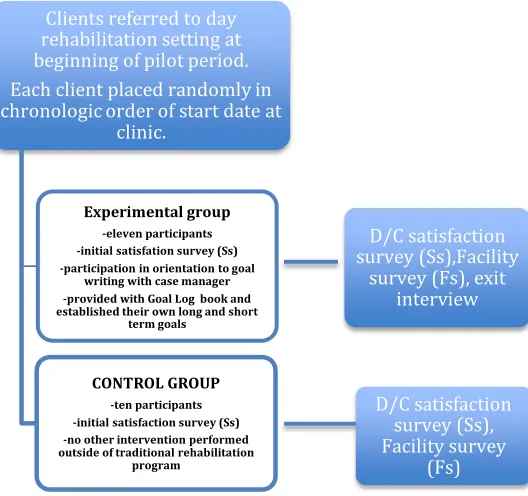
date at the day rehabilitation unit (see Figure 1).
The researchers recruited participants from
a variety of diagnostic groups in to the program.
Four people with traumatic brain injury, two with
acquired brain injury, three with either arthritis or
orthopedic injuries, nine with cerebral vascular
accidents, two with general deconditioning/cancer,
one with multiple sclerosis, and one with
Parkinson’s disease. One client from the control
readmission to the hospital. This resulted in 11
participants in the experimental group (six women
and five men) and 10 participants in the control
(five women and five men) (see Figure 1). The
participants all spoke English. No other
demographic was collected for the study. At the
time of the study all of the participants were living
at home with assistance.
Figure 1. Study intervention pathway for experimental vs. control groups.
The hospital’s innovation awards
committee approved and funded this pilot
program. The committee screens, selects, reviews,
and supervises the use of proposed innovative
interventions from hospital staff for use of new
and “innovative therapeutic practice approaches
designed solely to enhance the well-being of an
individual client that have a reasonable
expectation of success” (U.S. Department of
Health and Human Services, 1979, “Part A,” para.
2).
Measures. This treatment program used three data sources to assess differences between the
experimental and control group:
Quantitative
o Study satisfaction survey (Ss)
o Facility discharge survey (Fs)
Qualitative
o Informal exit interview of experimental
group and feedback of treating
therapists
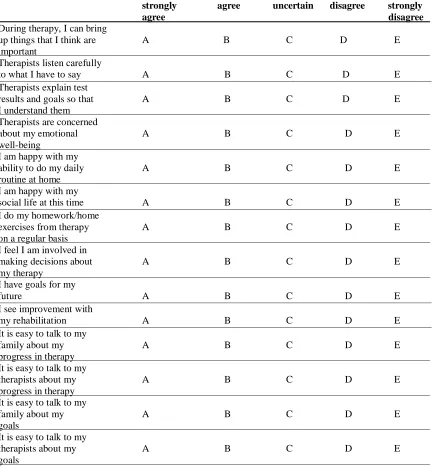
The Ss is comprised of 14 questions and
was created by a multi-disciplinary group from the
clinic to identify perceived satisfaction in three
areas: interaction with staff, psychosocial
wellness, and self-advocacy (see Table 1). The
survey development occurred over a one-month
period, fielding questions from all
multi-disciplinary staff, grouping the questions into
thematic categories, and funneling the questions Clients referred to day
rehabilitation setting at beginning of pilot period. Each client placed randomly in chronologic order of start date at
clinic.
Experimental group -eleven participants -initial satisfation survey (Ss) -participation in orientation to goal
writing with case manager -provided with Goal Log book and established their own long and short
term goals
CONTROL GROUP -ten participants -initial satisfaction survey (Ss) -no other intervention performed outside of traditional rehabilitation
program
D/C satisfaction survey (Ss),Facility
survey (Fs), exit interview
D/C satisfaction survey (Ss), Facility survey
down into the final 14 questions. The final survey
was critically analyzed by all staff and field tested
for “plain language” issues on all staff prior to use.
This Ss is a Likert-type survey that asked
for responses ranging between five levels. The
ranges of these were “strongly agree” to “strongly
disagree.” The initial admission component of
this survey asked the participants to respond to
questions regarding their most recent experiences
with therapy. Each participant had been receiving
therapy at the acute inpatient facility just prior to
admission to the day rehabilitation unit. The
questions asked at admission on the Ss would
require the participant to reflect on interactions
with therapy regarding goal setting and goal
collaboration up to this point in time.
Table 1. Study Survey Satisfaction Form (Ss)
strongly agree uncertain disagree strongly
agree disagree
During therapy, I can bring
up things that I think are A B C D E
important
Therapists listen carefully
to what I have to say A B C D E
Therapists explain test
results and goals so that A B C D E
I understand them Therapists are concerned
about my emotional A B C D E
well-being
I am happy with my
ability to do my daily A B C D E
routine at home I am happy with my
social life at this time A B C D E
I do my homework/home
exercises from therapy A B C D E
on a regular basis I feel I am involved in
making decisions about A B C D E
my therapy
I have goals for my
future A B C D E
I see improvement with
my rehabilitation A B C D E
It is easy to talk to my
family about my A B C D E
progress in therapy It is easy to talk to my
therapists about my A B C D E
progress in therapy It is easy to talk to my
family about my A B C D E
goals
It is easy to talk to my
therapists about my A B C D E
The inpatient facility protocol for client
participation in goal setting requires therapists to
identify and document client goals in the
electronic medical record during the initial
evaluation. Currently, no standard protocol exists
for formalized collaboration of treatment goals
beyond a prompt on the initial evaluation form.
The discharge component of the Ss would again
ask the participants to reflect on their most recent
experiences with therapy pertaining to goal setting
and goal collaboration at the day rehabilitation
unit.
The Fs has been utilized by the hospital for
quality assurance purposes for over 10 years. This
Fs was filled out per the clinic’s protocol, which is
a discharge only, one time survey of satisfaction
with the therapeutic experience. This form has
four levels for reporting satisfaction, ranging
between “excellent” and “poor.” Daily attendance
was tracked for each participant in the study;
however, due to factors beyond the reach of this
pilot program, it was not used as a dependent
outcome measure. Psychometric properties of the
Ss and the Fs have not been evaluated. A
comparison was made between the responses on
the admission and discharge Ss and rates of
satisfaction as recorded on the Fs. Experimental Intervention
The participants in the experimental group
were responsible for generating, documenting, and
maintaining their own therapy goals, eliminating
the necessity for the therapists to translate or make
presumptions about client goals. The participants
were provided with a format for creation ofgoals
that were self-set, or “owned goals,” as described
by Okun & Karoly (2007). The participants
assigned to the experimental group were
introduced to the program and oriented to all of
the components of the goal-setting packet. When
possible, the process included the participants and
their family members. The goal-setting packet
included a worksheet on how to identify potential
goal areas, examples of long- and short-term
goals, a Declaration of Client Responsibility,and
the Goal Log book. The Declaration of Client
Responsibility was signed by the participant,
reinforcing his or her commitment to refer to and
update the log book as necessary. The packet’s
Goal Log book provided space for multiple
long-term goals with corresponding short-long-term goals or
“stepping stones.” Some participants required
outside assistance with developing and
maintaining their personalized Goal Log book.
Therapists provided this, if necessary; however,
they encouraged families to be the primary
facilitator during the process. If possible, the
participants performed all written documentation
in the log book. When outside assistance was
necessary, goals were documented verbatim for
the participant in his or her own words.
Throughout the duration of the program, the
participants required varying amounts of outside
cueing to use the log book. Some participants
used the book daily with total independence, while
others required daily cues to access the book and
refer to it. Those who were less independent were
reoriented to the purpose of the log book at least
The participant and their family updated or
modified the goals as they determined to be
appropriate. Log books were used during
family-therapist meeting sessions, as well as during
clinical psychology sessions. The therapists were
instructed to review the participant’s goals and
incorporate them in daily treatment plans and
activities.
The participants from the experimental
group took part in an informal exit interview
administered by their liaison therapist. In this
interview, they were asked to provide one or two
statements on paper regarding their opinions about
the impact that documenting their own goals had
on their rehabilitation. The clinical staff that had
clients in the experimental group were also
provided with an informal feedback form
requesting input on the impact of the
client-managed goal setting program.
Control Condition
The process for goal setting for the control
group followed the standard facility protocol.
This protocol, as in the inpatient rehabilitation
setting, requires therapists to ask clients to identify
their therapy goals. The therapist then documents
these goals in the medical record during the initial
evaluation. Similar to the inpatient setting, there
are no current standard protocols that exist for
formal approaches to use for collaboration of
treatment goals with clients beyond this prompt on
the initial evaluation form. Similar to the study by
Maitra & Erway (2006), the therapists’
involvement in collaborating with the participants
to identify goals generally resulted in a vague
description of goal statements by the participant in
the treatment plan. Therapists working with
participants in the control group ask, “What are
your goals for therapy?” This results in responses
that are typically general and do not include
specific long- term and short-term distinctions.
Examples of these might be, “I want to walk”, or “I would like to go back to work.” Once client
goals are documented in the initial evaluation,
therapists create a treatment plan, identifying
long- and short-term goals that focus on identified
client deficits that demonstrate potential for
improving functional levels of independence. The
participants in the control group did not have their
own Goal Log book.
Procedure
All disciplines at the day rehabilitation
setting participated in the project, which included
OT, PT and SLP; the clinic physician; and the
clinical psychologist. Prior to the start of the
project, all staff received a one-hour orientation
and training session about the procedures and
methods of the program. The orientation was lead
by the programs’ developer, an occupational
therapist, and included the background, purpose,
and methods of the program and a review of all
documents. The documents included the Ss,
which was created by a multi-disciplinary group
from the clinic and given to both groups, and the
goal-setting packet that was only given to the
experimental group. The Ss was created to
identify perceived satisfaction in three domains:
interaction with staff, psychosocial wellness, and
worksheet on how to identify potential goal areas,
examples of short- and long-term goals, a
Declaration of Client Responsibility, and the Goal
Log book. An informal exit interview form for the
participants in the experimental group was also
reviewed. All of the therapists in the facility
verbalized a good understanding of the program
procedures and agreed to participate. No changes
at the facility were made in the protocol for client
assignment to therapy staff. Clients continued to
be assigned to therapists based on caseload
openings. All of the participants in the study were
provided with a study introduction within the first
two days of treatment. The participants from each
group were asked to fill out the Ss at that time.
This survey was created to assess perceived client
satisfaction with the rehabilitation experience.
The survey questions seek a comprehensive
response to the participants’ rehabilitation
experience, and do not ask for discipline-specific
feedback. The survey required the participants to
reflect on their most recent experiences with
therapy just prior to admission to the day
rehabilitation unit. The participants in the control
group then received therapy as prescribed by the
referring physician with no further innovation
program-based intervention. The participants in
the experimental group were provided with the
goal-setting information packet and oriented to its
contents by a primary team therapist. The study
was not blinded to staff, as clinicians were
required to facilitate the use and incorporation of
the client Goal Log book into daily treatment.
Both the experimental and control groups
were asked to fill out a second copy of the Ss on
the day of their individual discharge from the day
rehabilitation program. The client’s liaison
therapist administered the Ss. They were not
provided with their original copy for reference.
The survey again required the participants to
reflect on their most recent experiences with the
interdisciplinary therapy occurring at the day
rehabilitation unit. The participants from each
group were also asked to complete the Fs, which is
a standard, ongoing procedure at the facility.
Data Analysis
The data collected from the participants
using the two surveys were first summarized
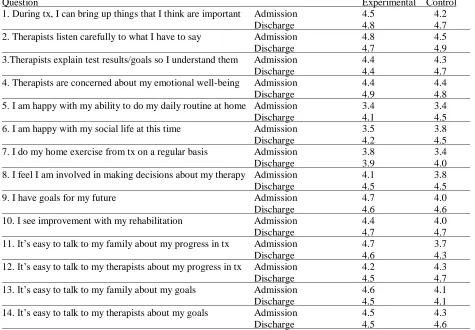
descriptively (see Table 2 and 3). Fisher’s Exact
test was then used to compare the proportion of
people reporting strongly agree/agree in the Ss
upon discharge from therapy between the
experimental and control group at the beginning
and the end of the program intervention (see Table
4). Due to the small sample size, the response
categories of “agree” and “strongly agree” each
were combined, as were “strongly disagree”,
“disagree”, and “uncertain” for the statistical
analysis. The qualitative data included responses
from the participants’ semi-structured exit
interviews and the therapist feedback forms. The
same multi-disciplinary clinician group that had
created the Ss reviewed and coded the
participants’ responses. In a formal meeting, this
group identified three main themes that emerged
across the responses. These were: (a) providing
(c) strong goal ownership. The primary program
investigator separated responses from the
therapists’ feedback into “positive” vs. “negative”
categories referring to the intervention. Member
checking followed the siloing of these responses
with no contradictions found.
Table 2. Mean Scores for Satisfaction Survey (Ss) Responses (average rating on 1-5 scale)
Question Experimental Control
1. During tx, I can bring up things that I think are important Admission 4.5 4.2
Discharge 4.8 4.7
2. Therapists listen carefully to what I have to say Admission 4.8 4.5
Discharge 4.7 4.9
3.Therapists explain test results/goals so I understand them Admission 4.4 4.3
Discharge 4.4 4.7
4. Therapists are concerned about my emotional well-being Admission 4.4 4.4
Discharge 4.9 4.8
5. I am happy with my ability to do my daily routine at home Admission 3.4 3.4
Discharge 4.1 4.5
6. I am happy with my social life at this time Admission 3.5 3.8
Discharge 4.2 4.5
7. I do my home exercise from tx on a regular basis Admission 3.8 3.4
Discharge 3.9 4.0
8. I feel I am involved in making decisions about my therapy Admission 4.1 3.8
Discharge 4.5 4.5
9. I have goals for my future Admission 4.7 4.0
Discharge 4.6 4.6
10. I see improvement with my rehabilitation Admission 4.4 4.0
Discharge 4.7 4.7
11. It’s easy to talk to my family about my progress in tx Admission 4.7 3.7
Discharge 4.6 4.3
12. It’s easy to talk to my therapists about my progress in tx Admission 4.2 4.3
Discharge 4.5 4.7
13. It’s easy to talk to my family about my goals Admission 4.6 4.1
Discharge 4.5 4.1
14. It’s easy to talk to my therapists about my goals Admission 4.5 4.3
Discharge 4.5 4.6
Table 3. Facility-wide Discharge survey (Fs); Excellent responses only.
Experimental N = 9 Control N = 8
I felt staff were courteous and respectful 7 6
I was satisfied with any treatment of pain 8 8
I participated in goal setting 9 6
I was satisfied with the skills of staff 8 8
I was satisfied with communication with staff 9 7
I felt staff satisfactorily explained procedures 9 6
I am satisfied with my discharge planning 9 4
I participated in patient/family teaching 5 6
I was always informed of progress 9 7
Results Quantitative results
The guiding hypothesis of this pilot
program was that the participants in the
experimental group would show greater positive
ratings on the discharge Ss and higher scores of
satisfaction on the Fs when compared to the
control group. The quantitative findings did not
support this hypothesis. On the Fs, more
participants in the experimental group reported
excellent in discharge planning than those in the
control group (100% vs. 50%, P = 0.03) (see Table
3). However, the proportion of participants
reporting excellent were statistically identical
between the two groups for the other nine
questions of this survey (Fs). It is interesting that
the results of the Ss demonstrated no statistically
significant differences in the proportions of
participants reporting satisfaction between the two
groups for all 14 questions, both at admission and
discharge (see Table 4).
Table 4. Study Satisfaction survey (Ss) strongly agree/agree versus disagree/uncertain: control and experimental
Admission
Experimental group (N = 11)
Control group (N = 10)
Fisher’s Exact Test Question Strongly Agree/ Agree Disagree or Uncertain Strongly Agree/ Agree Disagree or Uncertain P
1. During tx, I can bring up things that I think are important 11 0 9 1 0.48
2. Therapists listen carefully to what I have to say 11 0 9 1 0.48
3.Therapists explain test results/goals so I understand them 9 2 8 2 1.00
4. Therapists are concerned about my emotional well-being 10 1 9 1 1.00
5. I am happy with my ability to do my daily routine at home 6 5 6 4 1.00
6. I am happy with my social life at this time 5 6 6 4 0.67
7. I do my home exercise from tx on a regular basis 7 4 6 4 1.00
8. I feel involved in making decisions about my therapy 9 2 7 3 0.63
9. I have goals for my future 9 2 8 2 1.00
10. I see improvement with my rehabilitation 10 1 9 1 1.00
11. It’s easy to talk to my family about my progress in tx 10 1 7 3 1.00
12. It’s easy to talk to my therapists about my progress in tx 9 2 10 0 0.48
13. It’s easy to talk to my family about my goals 10 1 6 4 1.00
14. It’s easy to talk to my therapists about my goals 11 0 10 0 0.15
Discharge Experimental group (N=11) Control group (N=10) Fisher’s Exact Test Question Strongly Agree/ Agree Disagree or Uncertain Strongly Agree/ Agree Disagree or Uncertain P
1. During tx, I can bring up things that I think are important 11 0 10 0 1.00
2. Therapists listen carefully to what I have to say 10 1 10 0 0.48
3. Therapists explain test results/goals so I understand them 9 2 10 0 0.21
4. Therapists are concerned about my emotional well-being 11 0 9 1 1.00
5. I am happy with my ability to do my daily routine at home 9 2 8 2 1.00
7. I do my home exercise from tx on a regular basis 9 2 9 1 0.59
8. I feel involved in making decisions about my therapy 11 0 8 2 0.59
9. I have goals for my future 11 0 8 2 1.00
10. I see improvement with my rehabilitation 11 0 9 1 1.00
11. It’s easy to talk to my family about my progress in tx 10 1 10 0 0.48
12. It’s easy to talk to my therapists about my progress in tx 10 1 8 2 1.00
13. It’s easy to talk to my family about my goals 9 2 7 3 1.00
14. It’s easy to talk to my therapists about my goals 10 1 9 1 1.00
Qualitative results
Review of the exit interview statements
from the experimental group provide insight into
client perceptions of self-generated and
maintained goal documentation during the therapy
process. Participant feedback expressed overall
high levels of satisfaction with use of the Goal
Log book. The responses generally fall into three
categories: (a) providing structure to therapy, (b)
setting priorities, and (c) goal ownership. The
overall theme in the comments appeared to be one
of increased conceptualization for the participants
on what they were working toward in the
rehabilitation process. The following are
representative examples of the participants’
comments:
“The log book helped me see how far I have come.”
“The log book keeps me focused” and “setting the goals initially helped me to crystalize what I wanted to accomplish.”
“The log book changed my way of thinking from ‘I want to get stronger’ to ‘I want to be able to do this or I want to
be able to do that.’”
“The log book helped me in my sessions
with the psychologist to focus on
specifics versus the uncontrollable.”
The control group received no exit interview and
therefore insight into their perspective on the
standard methods used for goal collaboration is
unavailable.
Responses from the therapist feedback
form were generally positive. The themes that
emerged in these responses were:
Goal ownership: “Instead of talking about
how the therapist can get them better the
conversation changed to what the client
can and needs to do to get better.”
Provision of structure: “This process helped me to pinpoint what activity was
most important to clients.”
Engagement: “The clients seem more
proactive and focused on the activity when
they know what they are working
toward.”
The negative feedback from the therapists focused
primarily on the difficulty in working with the
participants who had greater cognitive deficits,
specifically memory. The therapists expressed
concerns and difficulties with adhering to the
required more than minimal cueing for use of the
log book.
Discussion
The purpose of this innovative program
was to explore the impact of providing clients with
the opportunity to generate, document, and
maintain their own goals. This paper describes a pilot program that incorporated strategies to maximize opportunities for clients and their families to participate in rehabilitation goal identification and documentation in a clinical setting and reports the results in context of
occurrence. It was anticipated that through greater involvement in the goal setting process and using
a Goal Log book for personalized documentation,
the participants would have greater satisfaction
with the rehabilitation process (Holliday, Cano et
al., 2007).
The results of this program’s quantitative
measures showed statistical difference in
satisfaction between the participants assigned to
the experimental vs. the control group for only one
question on the Fs, the question concerning
discharge planning. No differences were found
between the two groups on the Ss. Similarly, in
the study by Holliday, Cano et al. (2007), no
significant differences were reported on functional
measures between the two participant groups.
In this program, qualitative results were
obtained through semi-structured informal exit
interviews of the experimental group. The
participants’ responses provide greater insight into
how the daily use of the log books impacted
therapy. The responses of the participants from
this program were categorized into three themes:
(a) providing structure to therapy, (b) setting
priorities, and (c) goal ownership. In the study by
Doig et al. (2009), a client-centered approach to
goal identification was used to direct the content
of the occupational therapy program with clients
consisting largely of people with moderate to
severe TBI. The qualitative results of this
program fell into four themes: “(1) provision of
structure, (2) goals and motivation, (3) goal
ownership, and (4) impact of awareness on
participation” (Doig et al., 2009, p. 563). The
similar themes of structure and ownership suggest
that through an increased involvement of clients in
the process of goal development and management,
clients are able to better conceptualize the ongoing
experiences of rehabilitation.
The therapists who had worked with the
participants in the experimental group had
generally positive reports; however, they did
identify some barriers to effective use of the log
book with some participants. The therapists
verbalized difficulty in working with participants
who were more dependent in their daily use of the
log book, due to decreased insight or recall. The
therapists in the study by Doig et al. (2009)
reported similar responses. Suggestions were
made that use of traditional memory books for
clients with cognitive deficits could occur initially
in treatment with a “graduation” to use of a Goal
Log book. Therapists felt that increased insight
was required to use the Goal Log effectively.
Therapists did feel that the Goal Log was effective
use the Goal Log with minimal outside cueing.
The increased perception of therapists in the
usefulness of client collaboration in goal setting is
potentially an area for future analysis.
Investigating whether this program influenced the
therapists’ future goal setting collaboration
strategies would be of interest.
In the study by Holliday, Cano et al.
(2007), the client priorities resulted in changes in
the focus of rehabilitation interventions. Holliday
reported, “this change appears to support
individuals in maintaining both activity and
participation, and may be important in promoting
self-management and well being” (p. 579). It is
unknown whether therapists in this program
adjusted or changed the treatment to focus on
client goals vs. therapist- or team-developed goals.
In some of the responses by treating therapists,
statements regarding activity focus and client goal
prioritization suggest that this may have occurred.
Implications for Occupational Therapy Practice
Introducing a program similar to the one discussed in this innovative approach provides a pathway for client-centered treatment, but will it make a difference in outcomes? This study does not specifically answer that larger question, but it does provide some insight into methods for addressing client autonomy within a traditional rehabilitation setting. Cardol, De Jong, and Ward (2002) suggested that “autonomy, as the
fundamental pre-requisite for participation, is a key concept for client-centered rehabilitation” (p. 970). Client-centered goal setting becomes more
meaningful, as noted in the comments by this current study’s participants, when the clients write the goals in a document that they can refer to as needed to identify the short-term and long-term reasons for the treatment that they are
participating in at the moment. This moves beyond simply collaborating with a client to establish pertinent goals, to providing the opportunity for clients to participate throughout the rehabilitation process in goal generation, documentation, monitoring, and re-evaluation. Use of the Goal Log book required the participants
to make personal decisions regarding on which areas to focus in therapy, and to engage in an ongoing reevaluation of the relevance of their goals. Life skills that are necessary for long term management of conditions, such as those seen by the participants in this pilot study, are problem solving, decision making, resource use, patient or health care provider partnership formation, and action taking (Lorig & Holman, 2003). The process of generating, documenting, and
maintaining a personalized Goal Log book may reinforce these skills by providing a formalized method of monitoring their own progress in therapy. The qualitative information that was obtained from the experimental group and staff
interviews suggest that both groups felt the
experience was generally beneficial to the therapy
process.
Limitations
Due to the small sample size, the quantitative
results demonstrate minimal to no differences in
both surveys when they were compared, which
may have been the result of a Type II error. The
only statistically significant finding could be
explained as a chance occurrence. In addition to
the small sample size, the measures used to
evaluate the results may not have been sensitive or
accurate in measuring the changes between
groups.
Neither survey in this pilot study has been
evaluated for its psychometric properties. The Fs
may not have been sensitive in addressing issues
pertinent to the experiences of the population in
the day rehabilitation setting. The Ss may also not
be a sensitive measure for identifying the changes
in a client’s perceptions. As this survey was
staff-generated, construct validity and internal
consistency issues should be tested in future
studies prior to commencing use in any future
studies. The Ss may also not have accurately
identified a client’s perceptions of therapeutic
experiences and relationships as the admission
component of the Ss asked for reflection on
experiences that occurred outside the day
rehabiliation unit.
Including an exit interview component for the control group to obtain the groups’ insights and perceptions on the goal-setting process could have provided invaluable qualitative comparisons. In addition, while attendance for both groups was tracked, no formalized means of determining why
participants missed a session was included, and therefore this quantitative data was of little use.
This eliminated a potential means to determine a client’s commitment to the rehabilitation program
and would be an area to address in a future study. Lastly, the informal exit interviews of the
participants were often performed by a treating therapist, which may have influenced attitudes and responses. For example, participants may have responded positively to avoid conflict with the treating therapists. Not addressing the potential impact of having a treating therapist administer this interview compromises the responses. While evaluation of this pilot program demonstrates its limitations, addressing these could provide a guide for future clinical research projects on this topic area. In addition, defining key concepts, such as goal decision-making and goal management, could guide future study more specifically.
Conclusion
Of interest to the outcome of this program
is that the intervention was incorporated in
context, during true clinical encounters with
clients while engaging in a dynamic multi-team
rehabilitation experience. Scobbie, Wyke, and
Dixon (2009) conducted a literature review for
studies that “proposed a specific theory of
behaviour change relevant to setting and/or
achieving goals in a clinical context” (p. 321).
Twenty-four papers were included in the review,
and of those, only one of the interventions was
“implemented by a standard multi-disciplinary
team and incorporated within their routine
rehabilitation practice” (p. 328). These authors
suggest that studies must be incorporated into
real-life settings to best assess feasibility and
acceptability for optimizing implementation.
While this current program was not addressing
behavior change, the methods and process of
implementing client-goal setting into a day
rehabilitation experience can guide future study.
One of the most significant lessons of this
innovative program is the complexity of planning
and the rigor required in thorough analysis of all
components of performing any type of pilot study
within that of a real life clinical setting.
The quantifiable impact of allowing clients to manage their own goals in therapy is not known based on the results of this pilot program. Future studies using a more robust design, with adequate power and measurement strategies, are necessary to better understand the impact this approach to client-centered care might have on satisfaction outcomes. The qualitative information from the
participants’ narratives provides some insight that
References
Adams, N., & Grieder, D. (2005). Treatment planning for person-centered care: The road to
mental health and addiction recovery. Burlington, MA: Elsevier Academic Press.
American Occupational Therapy Association. (2002). Occupational therapy practice
framework: Domain and Process. American Journal of Occupational Therapy, 56(6),
609-639.
Baker, S., Marshak, H., Rice, G., & Zimmerman, G. (2001). Patient participation in physical
therapy goal setting. Physical Therapy, 81(5), 1118-1126.
Barnard, R., Cruice, M., & Playford, E. (2010). Strategies used in the pursuit of achievability
during goal setting in rehabilitation. Qualitative Health Research, 20(2), 239-250.
Cardol, M., De Jong, B., & Ward, C. (2002). On autonomy and participation in rehabilitation.
Disability and Rehabilitation, 24(18), 970-974.
Doig, E., Fleming, J., Cornwell, P., & Kuipers, P. (2009). Qualitative exploration of a client-
centered, goal-directed approach to community-based occupational therapy for adults
with traumatic brain injury. The American Journal of Occupational Therapy, 63(5),
559-568.
Holliday, R., Ballinger, C., & Playford, E. D. (2007). Goal setting in neurological rehabilitation:
Patients’ perspectives. Disability and Rehabilitation, 29(5), 389-394.
Holliday, R., Cano, S., Freeman, J., & Playford, E. D. (2007). Should patients participate in
clinical decision-making? An optimised balance block design controlled study of goal
setting in a rehabilitation unit. Journal of Neurologic Neurosurgical Psychiatry, 78(6),
576-580.
Klyczek, J., Bauer-Yox, N., & Fiedler, R. (1997). The Interest Checklist: A factor analysis.
American Journal of Occupational Therapy, 51(10), 815-823.
Law, M., Baptiste, S., Carswell, A., McColl, M., Polatajko, H., & Pollock, N. (2005). The
Canadian Occupational Performance Measure, (4th ed.). Ottawa, ON: CAOT
Publications ACE.
Lorig, K. R., & Holman, H. (2003). Self-management education: History, definition, outcomes,
and mechanisms. Annals of Behavioral Medicine, 26(1), 1-7.
Lorig, K. R., Sobel, D. S., Ritter, P. L., Laurent D., & Hobbs, M. (2001). Effect of a self-
256-262.
Maitra, K., & Erway, F. (2006). Perception of client-centered practice in occupational therapists
and their clients. American Journal of Occupational Therapy, 60(3), 298-310.
Northen, J., Rust, D., Nelson, C., & Watts, J. (1995). Involvement of adult rehabilitation patients
in setting occupational therapy goals. American Journal of Occupational Therapy, 49(3),
214-220.
Okun, M. A., & Karoly, P. (2007). Perceived goal ownership, regulatory goal cognition, and
health behavior change. American Journal of Health Behavior, 31(1), 98-109.
Playford, E. D., Dawson, L., Limbert, V., Smith, M., Ward, C. D., & Wells, R. (2000). Goal-
setting in rehabilitation: Report of a workshop to explore professionals’ perceptions of
goal-setting. Clinical Rehabilitation, 14(5), 491-496.
Rogers, J. C., Weinstein, J. M., & Figone, J. J. (1978). The Interest Checklist: An empirical
assessment. American Journal of Occupational Therapy, 32(10), 628-630.
Rosewilliam, S., Roskell, C. A., & Pandyan, A. (2011). A systematic review and synthesis of the
quantitative and qualitative evidence behind patient-centred goal setting in stroke
rehabilitation. Clinical Rehabilitation, 25(6), 501-514.
Scobbie, L., Wyke, S., & Dixon, D. (2009). Identifying and applying psychological theory to
setting and achieving rehabilitation goals. Clinical Rehabilitation, 23(4), 321-333.
Sumsion, T. (2000). A revised occupational therapy definition of client-centered practice.
British Journal of Occupational Therapy, 63(7), 304-309.
Sumsion, T., & Law, M. (2006). A review of evidence on the conceptual elements informing
client-centred practice. Canadian Journal of Occupational Therapy, 73(3), 153-162.
Townsend, E., Galipeault, J. P., Glidon, K., & Little, S. (2003). Reflections on power and justice
in enabling occupation. Canadian Journal of Occupational Therapy, 70(2), 74-88.
U.S. Department of Health and Human Services, The National Commission for the Protection of
Human Subjects of Biomedical and Behavioral Research. (1979). Ethical Principles and
Guidelines for the Protection of Human Subjects of Research (The Belmont Report).
Retrieved on Dec. 21, 2013 from