ISSN 1392-2785 ENGINEERING ECONOMICS. 2005. No 3 (43)
ECONOMICSOFENGINEERINGDECISIONS
Internal Audit Reporting Relationships: the Analysis of Reporting Lines
Rolandas Rupšys, Romas Sta
č
iokas
Kauno technologijos universitetas K. Donelaičio g. 73, LT-44029, Kaunas
Initially created as an accounting oriented function in-ternal auditing has been transformed into management oriented profession. If at the beginning internal auditors were seen just as assistants of accountants and external auditors, nowadays it is certainly an independent profes-sion, which is playing a significant role in the management of organizations. Internal auditing evolved to satisfy the needs of a management of organizations. Private compa-nies as well as government institutions have become so difficult, large and complex that their managerial line be-came concerned about monitoring and controlling activi-ties that are in their responsibility. Internal auditors may assist management in many areas.
Broad scope of internal audit functions and roles emerged year by year. Initially internal auditing was basi-cally concerned with accounting and financial matters. Al-though first Statement of Responsibilities published in 1947 by the Institute of Internal Auditors challenged to tap oper-ating matters, however it emphasized the role of internal auditing in accounting and financial issues. Statements of Responsibilities issued later by the Institute of Internal Audi-tors help to track the development of internal auditing pro-fession: from accounting oriented function up to manage-ment oriented, sophisticated and value added discipline.
Obviously reporting relationships of internal auditing has changed and developed together with the progress of internal audit discipline. At the beginning (when internal auditors mostly were dealing with accounting and finan-cial issues) reporting lines of internal auditors went to the accounting level and external auditors, who saw internal auditors mainly as assistant in financial audits. Accord-ingly as functions and roles of internal auditing expanded, changed and shifted more to management oriented matters than accounting matters, reporting lines have also been transformed. Moreover, if at the beginning reporting lines of internal auditing were generally simple and straightfor-ward, together with changed functions of internal audit they have made a shift to more complex and difficult rela-tionships. Of course, due to the fact that internal auditing is internal function of organizations, most constituents (customers) of internal audit services are members of companies or institutions, such as senior and operating management or audit committees. Because interests and needs of these customers differ, internal auditing fre-quently faces potential conflicts of internal audit concerns and reporting. One customer usually is interested mainly in assurance services (i.e. audit committee), another group is concerned about consulting services and recommenda-tions (i.e. operating management) and the third group may be paying attention to both services of assurance and
con-sulting (i.e. senior management). Of course these interests of the customers of internal audit services may interfere and one group of customers may shift their concern from one service to another.
Internal audit reporting lines usually are classified to administrative or functional. According to the Practice Ad-visories of International Standards for the Professional Practice of Internal Auditing, ideally the chief audit execu-tive should report functionally to the board or audit commit-tee and administratively to the chief executive officer of the organization. However as the results of the research pro-vided in this article show reporting lines of internal audit activity are not always organized as they should be ideally.
Keywords: internal audit, internal audit services, internal audit reporting relationships and reporting li-nes, audit committee
Introduction
Disputes about the internal audit relationships have never turned out since the first appearance of the internal audit. During the emerging phase of internal audit profes-sion the scope of internal auditing and the reporting lines were quite straightforward. Sawyer (2003) has described internal auditing as the “eyes and ears of management.” Internal auditors had to investigate operations in order to assure that they were properly controlled and make rec-ommendations to the management. It was presumed that recommendations would be similar to what management would have done if management had the time to individu-ally review all operations for adequate controls (The IIA Research Foundation, 2003).
Definition of the internal auditing provided by the In-stitute of Internal Auditors states that “internal auditing is an independent, objective assurance and consulting activity designed to add value and improve an organization’s op-erations. It helps an organization accomplish its objectives by bringing a systematic, disciplined approach to evaluate and improve the effectiveness of risk management, control, and governance processes”.
This definition identifies an important role for internal auditing, which is based on the activities in which it has a defined expertise. At the same time, it recognizes that there are many different customers (constituencies) for internal audit services. Such (internal) customers of the internal audit services in organization may be excluded:
• Senior management • Operational management
Due to the fact that different customers of internal au-dit services may have different interests, potential conflicts may rise serving these customers. For example, senior management may be interested in activities, which may directly affect the bottom line in the profit (loss) account, i.e. potentially their bonuses. On the other hand, opera-tional management may be interested only in recommenda-tions on improving the efficiency or effectiveness of opera-tions. Audit committee may be more concerned with man-aging their own risk and request a greater focus on risk management and control activities.
The purpose of this article is to observe reporting rela-tionships of the internal audit activity taking into consid-eration the roles and functions of internal auditing, review possible threats and conflicts related with reporting lines and explore the results of the research in the context of theoretical assumptions.
Review of published literary sources, graphical analy-sis of survey results and other methodsare used in order to formulate conclusions. The issue of internal audit reporting relationships is analyzed in the context of systematic ap-proach. This approach is developed by proceeding from theoretical problems formulation to the interpretation of results of empirical studies.
An overview of the assumptions of the
activity of internal auditing
As it was mentioned above, internal audit has experi-enced significant transformations since its appearance. These transformations refer to the status of internal audit activity in the organization and broad range of internal audit functions, which currently covers many areas. Nowa-days, internal audit activity covers many functional areas:
• Assessment of internal controls • Operational audits
• Compliance audits • Fraud investigations
• Partial or full participation in financial audits • Involvement in risk management process • Other activities.
Wide spectrum of areas, covered by internal audit, de-termined the principles of internal audit team formation (Bou-Raad, 2000). In other words, internal audit functions are exceptional in some case comparing with other func-tions of organization because of (1) advantageous position of internal audit function within organization, (2) extensive variety of functional areas it examines (including different types of audit), and (3) multidisciplinary backgrounds of individual auditors comprising the internal audit team (Rit-tenberg & Schwieger, 1997).
Bearing in mind the whole spectrum of functional ar-eas that are examined by the internal audit function, inter-nal audit function is based mostly on two services: assur-ance services and consulting services. Assurassur-ance services are understood as “providing an independent assessment on risk management, control, and governance processes of the organization. Examples may include financial, per-formance, compliance, system security, due diligence en-gagements” (Standards for the Professional Practice of Internal Auditing, Glossary).
Consulting services are different from assurance vices and are defined as “advisory and related client ser-vice activities, the nature and scope of which are agreed upon with the client and which are intended to add value and improve an organization’s operations. Examples in-clude counsel, advice, facilitation, process design, and training” (Standards for the Professional Practice of Inter-nal Auditing, Glossary).
According to the Standards for the Professional Prac-tice of Internal Auditing, the nature of work of internal audit function is to evaluate and improve the effectiveness of the risk management processes, control processes and governance processes. Risk management processes com-prise identification and evaluation of potential risks that might affect the achievement of objectives of an organiza-tion and determinaorganiza-tion of adequate corrective acorganiza-tions. Policies, procedures, and activities, which ensure that risks are kept within the limits defined by management in the risk management process, are defined as control processes. Governance processes include procedures which allow stakeholders to evaluate risk and control processes defined by management.
According to the Institute of Internal Auditors (IIA), internal auditing reviews the reliability and integrity of information, compliance with policies and regulations, the safeguarding of assets, the economic and efficient use of resources, and established operational goals and objectives. Internal audits encompass financial activities and opera-tions including systems, production, engineering, market-ing, and human resources.
Internal audit relationships
There may be many customers of internal audit ser-vices (see Figure 1). Customers relatively may be named as internal (CEO’s, audit committee, Board, etc.) or exter-nal (exterexter-nal auditors, vendors, suppliers, etc.).
Figure 1. Customers of internal audit services
Detailed relationships with internal customers of inter-nal audit activity are illustrated in Figure 2. Dealing with different internal customers may bring potential conflicts.
Organization (internal customers)
Internal audit activity CEO, Audit
committee, Board, etc.
The auditee
External customers
External auditors, vendors, suppliers,
For example, audit committee may be concerned mostly with risk management and demanding for assurance re-garding specific areas (i.e. internal controls). Operating management may express a need for consultations con-cerning the improvement of operational effectiveness and efficiency. Senior management may be interested in their bonuses and seeking advises from internal auditors how to improve financial results.
As it was mentioned above, the demands from differ-ent customers of internal audit services may differ. Opera-tional management is responsible for operaOpera-tional processes and primarily is concerned with effectiveness and effi-ciency of operations. Thus operational management tradi-tionally is experiencing demand for consultation services from internal auditors. The audit committee is interested in assurance services. Senior management is experiencing the need for both consultations and assurance regarding risks and controls.
Internal audit activity has contributed to an organiza-tion’s understanding of risk and control in a number of di-verse ways (Dittenhofer, 2001; Stern, 1994; Flesher, 1996). For example, internal auditors have performed each of the following functions (Hermanson & Rittenberg, 2003):
• Risk:
− assess existing risk of audited area and report that assessment to management, the audit com-mittee, or both;
− develop a plan to systematically assess risk across the organization;
Figure 2. Internal customers of internal audit services (Source: The IIA Research Foundation, 2003)
− lead the risk management activities when a void has occurred within the organization;
− facilitate risk assessment through risk self-assessment techniques;
− evaluate risks associated with new computing de-velopments and stop the project if risks are not controlled at predetermined acceptable levels;
− assist management in implementing a risk model across the organization;
• Control:
− test compliance with controls in functional ar-eas. Report findings to management, and if im-portant, to the audit committee;
− assist management in designing a comprehen-sive assessment, including testing of controls across the organization;
− assist management in preparing a report on the effectiveness of internal controls;
− identify significant control deficiencies, including elements of the tone at the top, and communicate to the audit committee (for areas examined); − implement computerized testing techniques,
e.g., continuous control monitoring techniques, to monitor effectiveness of controls;
− facilitate the understanding and development of controls within functional areas through control self-assessment (CSA) techniques.
Reporting lines of internal auditors: review
of the research results
Independence of auditors was always a sensitive issue. Especially when auditors are not external (truly independ-ent), but internal (Flaherty & Stein, 1991). According to the International Standards for the Professional Practice of Internal Auditing, the Chief Audit Executive should report to a level within the organization that allows the internal audit activity to fulfill its responsibilities.
Practice advisories that generally are the guiding tool for internal auditors and are not mandatory to use state that the Chief Audit Executive (CAE) should be responsible to an individual in the organization with sufficient authority to promote independence and to en-sure broad audit coverage, adequate consideration of engagement communications, and appropriate action on engagement recommendations. Ideally, the Chief Audit Executive (a person who is primary responsible for in-ternal audit functions) should report functionally to the board or audit committee and administratively to the chief executive officer of the organization.
Figure 3. Functional Reporting Responsibilities (Source: The IIA Research Foundation, 2003)
Audit Committee
55% President
10%
Chief Executive
Officer 12%
Legal Counsel
1% Other3%
Chief Financial
Officer 17%
Controller 2%
Internal audit
Senior management Operational
management
Audit committee
C
on
su
lt
at
io
ns
A
ss
ur
an
However results of the research show that theoretical ap-proach usually is not always implemented practically. As the survey of the chief audit executives made by the IIA for 2003 shows, functional (direct) reporting lines of the internal audit activity in many cases comply with Practice Advisories (see Figure 3). More than 50 percent of respondents functionally report to the audit committee. However 22 percent of respon-dents have answered that they report to the president or Chief Executive Officer (CEO).
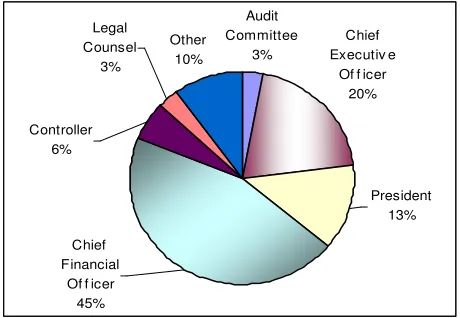
At the same time near 50 percent of respondents an-swered that administratively they report to the Chief Fi-nancial Officer (see Figure 4). Only 33 percent of respon-dents administratively report to the CEO or president.
Figure 4. Administrative Reporting Responsibilities (Source: The IIA Research Foundation, 2003)
A reason why empirical data deviates from theoretical fundamentals may be explained through the concerns of inter-nal auditing in that companies (institutions). That is, in many companies of the respondents internal auditors are more con-cerned on initial or traditional matters, such as accounting and financial issues, rather on management matters.
Conclusions
Following conclusions may be drawn:
• Initially created as an accounting oriented function internal auditing has been transformed into man-agement oriented profession. Private companies as well as government institutions have become so dif-ficult, large and complex that their managerial line became concerned about monitoring and controlling activities that are in their responsibility. Internal auditors may assist management in many areas. • Disputes about the internal audit relationships have
never turned out since the first appearance of the in-ternal audit. During the emerging phase of inin-ternal audit profession the scope of internal auditing and the reporting lines were quite straightforward. However together with expanded functions and changed roles of internal audit a shift of reporting lines has also taken place.
• Although internal audit functions may be used in many areas, internal auditors mainly provide two services to their customers: assurance services and consulting services. Usually the main customers of internal audit services are: operating management,
senior management, audit committee and the board. Needs of these customers regarding internal audit services may substantially differ. Due to the fact that different customers of internal audit services may have different interests, potential conflicts may rise serving these customers.
• According to theoretical fundamentals of internal audit discipline (Standards for the Professional Practice of Internal Auditing, Practice Advisories) ideally the Chief Audit Executive (a person who is primary responsible for internal audit functions) should report functionally to the board or audit committee and administratively to the chief execu-tive officer of the organization.
• However as the latest research of IIA shows, admin-istrative reporting lines in practice generally are not always organized by the theoretical assumptions. A reason why empirical data deviates from theoretical fundamentals may be explained through the tradi-tional concerns of internal auditing, when internal auditors primary concern more on accounting and financial issues rather than on managerial matters.
References
1. Anonymous. Expectations gap in internal auditing thriving //
Ac-countancy, Vol. 14, 1997.
2. Audit Customer Satisfaction: Marketing Added Value. Altamonte
Springs, FL.: The Institute of Internal Auditors, 1996.
3. Bou-Raad, G. Internal auditors and a value-added approach: the new
business regime // Managerial Auditing Journal, Vol. 15 (4), 2000.
4. Dittenhofer, M. Internal auditing effectiveness: an expansion of
pre-sent methods // Managerial Auditing Journal, Vol. 16 (8), 2001.
5. Flaherty, J.J. Solution-Focused Audit Reporting / J.J.Flaherty, J.Stein
// Internal Auditor, October, 1991.
6. Flesher, D.L. Internal Auditing: Standards and Practices. Altamonte
Springs, FL: The Institute of Internal Auditors, 1996.
7. Flesher, D.L. Management accountants express a desire for change in
the functioning of internal auditing / D.L. Flesher, J.S. Zanzig // Managerial Auditing Journal, Vol. 15, No 7, 2000.
8. Galloway, D. Internal Auditing: A Guide for the New Auditor, The
Institute of Internal Auditors, Altamonte Springs, FL., 1995.
9. Global audit information network. www.gain2.org.
10. Hermanson, D.R. Research opportunities in internal auditing. Chapter
2: Internal audit and organizational governance / D.R. Hermanson, L.E. Rittenberg. Altamonte Springs, FL.: The Institute of Internal Auditors, 2003.
11. Hunton, J.E. How information systems managers view internal auditors /
J.E. Hunton, G.B. Wright // Internal Auditing, Vol. 11, No 2, 1995.
12. Kinney, W.R. Auditing risk assessment and risk management
proc-ess. The research opportunities in internal audit, Chapter No 5. Alta-monte Springs, FL: The Institute of Internal Auditors, 2003.
13. Kinney, W.R. Information Quality Assurance and Internal Control
for Management Decisions. Boston: Irwin McGraw-Hill, 2000.
14. Mathews, C. CEOs' perceptions of internal audit in Australia/ C.Mathews,
B.J.Cooper, P.Leung // Internal Auditing, Vol. 10, No 4, 1995.
15. Moeller, R. Brink’s Modern Internal Auditing / R.Moeller, H.N.Witt.
New York: John Wiley & Sons, Inc., 1999.
16. Practice Advisories for the Standards for the Professional Practice of
Internal Auditing. Altamonte Springs, FL: The Institute of Internal Auditors, 2002.
17. Ratliff, R.L. Introduction to Auditing: Logic, Principles, and
Tech-niques/ R.L. Ratliff, K.F. Reding. Altamonte Springs, FL: The Insti-tute of Internal Auditors, 2002.
18. Rittenberg, L.E. Auditing Concepts for a Changing Environment (2nd
ed.) / L.E. Rittenberg, B.J. Shweiger. Fort Worth, TX: The Dryden Audit
Committee 3%
Chief Executiv e
Of f icer 20% Other
10%
Chief Financial
Of f icer 45% Controller
6%
President 13% Legal
Press, 1997.
19. Sawyer, L.B. Sawyer's Internal Auditing The Practice of Modern
Internal Auditing. Altamonte Springs, FL: Institute of Internal Audi-tors, Inc., 2003.
20. Spencer Pickett, H.K. The Internal Auditing Handbook / H.K.
Spencer Pickett, G.Vinten. New York: John Wiley and Sons, 1997.
21. Standards for the Professional Practice of Internal Auditing.
Alta-monte Springs, FL: The Institute of Internal Auditors, 2002.
22. Stern, G.M. Fifteen Ways Auditing Departments Are Adding Value //
Internal Auditor, April, 1994.
23. The IIA Research Foundation. Internal Audit Reporting
Relation-ships: Serving Two Masters. Altamonte Springs, FL.: The Institute of Internal Auditors, 2003.
24. The institute of internal auditors. www.theiia.org
25. Wycoff, E.B. The Language of Listening // Internal Auditor, April, 1994.
Rolandas Rupšys, Romas Stačiokas
Vidaus audito pavaldumo ryšiai: pavaldumo grandinės analizė
Santrauka
Pastaruoju metu vidaus auditas įgauna vis svarbesnį vaidmenį
organizacijų valdyme. Sukurtas ir įdiegtas kaip viena iš pagalbinių
apskaitos funkcijų organizacijų viduje, ilgainiui vidaus auditas
trans-formavosi į organizacijų vadovybės poreikius tenkinančią discipliną.
Pačiame vidaus audito užuomazgos ir vystymosi etape vidaus
audito-riai buvo siejami su apskaita bei finansais ir dažniausiai buvo
apibūdinami kaip išorės auditorių padėjėjai, o šiuo metu vidaus
audi-tas neabejotinai galėtų būti įvardijamas kaip atskira ir nepriklausoma
disciplina, daranti ryškią įtaką organizacijų valdymui. Per
pastaru-osius penkiasdešimt metų organizacijų veiklos apimtys, sudėtingumas
bei tarpusavio santykiai tiek transformavosi, kad jų valdymas tapo
itin sudėtingas. Šie pokyčiai vyko tiek privačiose bendrovėse, tiek
valstybinėse institucijose.
Pačiuose pradiniuose vidaus audito vystymosi etapuose vidaus
auditas buvo apibūdinamas kaip „vadovybės ausys ir akys“. Kitaip
tariant, vidaus auditoriai turėjo tikrinti, kaip vykdomos ir
kontroliuo-jamos kasdieninės operacijos, ir pateikti vadovybei jų tobulinimo
rekomendacijas.
JAV Vidaus auditorių institutas vidaus auditą apibrėžia kaip
ne-priklausomą, objektyvią tikrinimo ir konsultavimo veiklą, skirtą
pridėtinei vertei kurti ir organizacijos veiklai gerinti. Vidaus audito
funkcija – sistemingai ir visapusiškai vertinti ir skatinti gerinti
or-ganizacijos rizikos valdymo, kontrolės ir priežiūros procesų
veik-smingumą ir taip padėti įgyvendinti organizacijai keliamus tikslus.
Pateikta vidaus audito definicija akcentuoja, kad iš esmės gali būti
keletas vidaus audito paslaugų klientų.
Pagrindinis šio straipsnio tikslas – apibrėžti vidaus audito
pavaldumo ryšius atsižvelgiant į plačią vidaus audito funkcijųį
vai-rovę, apžvelgti galimas grėsmes ir konfliktus, galinčius kilti
pavaldumo grandinėje, bei išanalizuoti tyrimų rezultatų duomenis
teorinių prielaidų kontekste. Tikslo siekiama naudojant mokslinių
šaltinių analizę, publikuotų tyrimų apžvalgą bei išvadų formulavimą.
Problema nagrinėjama nuo teorinių teiginių pereinant prie praktinių
tyrimų.
Vidaus audito funkcija iš esmės skiriasi nuo kitų funkcijų
or-ganizacijos viduje dėl savo išskirtinės padėties organizacijoje, didelės
apimties funkcinių sričių bei vidaus auditorių kompetencijos
dauge-lyje sričių. Mokslinėse publikacijose (Sawyer, 2003; Hermanson,
Ritenberg, 2003; IIA Research Foundation, 2003 ir kt.) išskiriamos
šios funkcinės vidaus audito sritys:
• vidaus kontrolės sistemos vertinimas;
• veiklos operacijų auditas;
• procedūrų, politikų ar kt. standartų laikymosi auditas;
• apgavysčių bei neteisėtų veiksmų tyrimas;
• dalinis arba nuodugnus dalyvavimas finansiniuose audituose;
• dalyvavimas rizikos valdymo procese;
• kitos veiklos sritys.
Kita vertus, net įvertinus didelę apimtį funkcinių sričių, kurias
apima vidaus auditas, galima teigti, kad iš esmės vidaus auditoriai
teikia dviejų rūšių paslaugas: tikrinimo ir konsultavimo. Tikrinimas
yra suprantamas kaip objektyvus ir nepriklausomas rizikos valdymo,
kontrolės ir vadovavimo procesų įvertinimas. Gali būti tikrinamos
įvairios sritys (finansinė atskaitomybė, sistemų saugumas, procedūrų
laikymasis ir t.t.). Konsultavimas – tai patarimų teikimas siekiant
pagerinti organizacijos veiklą ir sukurti pridėtinę vertę, dėl kurių
apimties ir pobūdžio iš anksto susitarta su klientu.
Teikdami savo paslaugas, vidaus auditoriai sąveikauja tiek su
savo organizacijos nariais, tiek su kitais išorinės aplinkos dalyviais.
Pagal priklausomumą organizacijai vidaus audito klientai sąlygiškai
gali būti skirstomi į vidinius ir išorinius. Vidiniais klientais, kaip jau
minėta, gali būti vidutinio bei aukščiausiojo lygio organizacijos
(ben-drovės, institucijos ir t.t.) vadovybė, vidaus audito komitetai,
ben-drovės valdyba. Iš išorinių vidaus audito paslaugų klientų būtų
galima paminėti išorės auditorius, su kuriais paprastai bendraujama
finansinių auditų metu.
Pažymėtina, kad vidiniai organizacijos klientai gali būti
su-interesuoti gauti skirtingas vidaus audito paslaugas, kadangi jų
veik-los prioritetai yra skirtingi. Dėl šios priežasties vidaus auditoriai
dažnai susiduria su potencialių konfliktų grėsme savo pavaldumo
grandinėje. Pavyzdžiui, audito komitetų nariai daugiausia akcentuoja
ir yra suinteresuoti atskirų sričių (pvz., vidaus kontrolės sistemos)
tikrinimo paslaugomis. Tuo tarpu vidutinio lygio vadovybė bus
su-interesuota kasdieninių veiklos operacijų efektyvumo bei našumo
pagerinimu. Todėl jos poreikis vidaus audito paslaugoms apsiribos
daugiausia rekomendacijomis. Kadangi aukščiausiojo lygio
vadovy-bės atlyginimo ir motyvavimo sistema paprastai yra siejama su
finan-siniais rezultatais, todėl aukščiausiojo lygio vadovai paprastai bus
suinteresuoti konsultacinėmis vidaus auditorių paslaugomis, nors taip
pat jiems turėtų būti aktualios ir tikrinimo paslaugos.
Auditorių nepriklausomumo problema visuomet buvo aktuali.
Ypač tuo atveju, jei auditoriai yra ne išorės, bet vidaus. Tarptautiniai
vidaus auditorių profesinės praktikos standartai numato, kad vidaus
audito vadovas (asmuo, atsakingas už vidaus audito funkcijas
organi-zacijoje) turėtų būti pavaldus bei teikti ataskaitas tokiam
organizaci-jos vadovybės lygiui, kuris leistųįvykdyti visus vidaus audito veiklai
keliamus reikalavimus.
Praktiniai vidaus audito patarimai, kuriuos parengė ir išleido
JAV vidaus auditorių institutas, numato, kad vidaus audito vadovas
turėtų būti pavaldus organizacijos vidaus asmeniui, kuris turėtų
pakankamai įgaliojimų, leidžiančių užtikrinti didelę vidaus audito
funkcijų įvairovę, atitinkamą komunikaciją bei tinkamus veiksmus
vidaus auditorių rekomendacijoms įgyvendinti. Idealiu atveju vidaus
audito vadovas turėtų būti funkciniu požiūriu pavaldus valdybai,
audito komitetui arba kitam organizacijos vadovybės organui, o
ad-ministraciniu požiūriu – organizacijos vadovui.
Kaip rodo JAV Vidaus auditorių 2003 m. atlikti tyrimai, kurių
metu buvo apklausti įvairių organizacijų (bendrovių, įstaigų ir t.t.)
vidaus audito vadovai, 55 proc. respondentų funkciniu požiūriu yra
pavaldūs audito komitetams (22 proc. – organizacijos vadovui, likę –
kitiems organizacijos pareigūnams arba skyriams). Įdomu tai, kad net
45 proc. respondentų administraciniu požiūriu yra pavaldūs
organi-zacijos finansų direktoriams (33 proc. – organizacijos vadovui, likę –
kitiems organizacijos pareigūnams arba skyriams). Pažymėtina, kad
toks pavaldumas iš esmės susijęs su tradicinių vidaus auditorių
funk-cijų, svarbių su apskaitai bei finansams, akcentavimu.
Raktažodžiai: vidaus auditas, vidaus audito paslaugos, vidaus audito
pa-valdumo ryšiai ir papa-valdumo grandinė, audito komitetas.
The article has been reviewed.