Alo O.O. et al.
/LAUTECH Journal of Engineering and Technology 11(1) 2017: 18-23
18
DEVELOPMENT OF AN IMPACT ASSESSMENT ALGORITHM FOR THE
ADOPTION OF INFORMATION AND COMMUNICATION TECHNOLOGY IN
BASIC EDUCATION USING CROSS-IMPACT METHOD
Alo O. O., Olabiyisi S. O., Omidiora E. O., Ganiyu R. A.,
Department of Computer Science and Engineering, Ladoke Akintola University of Technology, Oyo State,
Nigeria.
[email protected], [email protected],
[email protected]
,
[email protected]
Authors are correspondent Authors
ABSTRACT
In many countries, the adoption of Information and Communication Technology (ICT) in basic education has been
continuously linked to higher efficiency, productivity, and educational outcomes, including quality of cognitive,
creative and innovative thinking. This paper focuses on the development of an impact assessment algorithm for
evaluating the adoption of ICT in basic education using Cross-impact method. A questionnaire on adoption of ICT in
basic education was designed based on Government Policy (GP), Teacher Competency (TC), Availability of ICT
infrastructure (IF), Integration of ICT in school curriculum by Ministry of Education (MC), Student preparedness in
adopting ICT in learning process (SC) and Perception of schools’ management in adoption of ICT in schools (MI),
which are the six major events considered. The questionnaire was administered to experts in basic education within
the selected South-Western states of Nigeria (Oyo, Lagos and Ekiti). Experts’ opinions from the administered
questionnaires were quantitatively analysed using descriptive statistic in Statistical Package for Social Sciences. The
results obtained from the analysis of questionnaires were used to derive the Initial Probability (InitProb) and generate
the Conditional Probability Matrices (CondProbMatrices) for occurrence and non-occurrence of the six events under
consideration. The impact assessment algorithm was developed such that its starting instructions would determine the
consistence of the InitProb and the CondProbMatrices using the three fundamental laws of probability calculus
(Normalization, Product and Addition rules). These are followed by sequential instructions which would determine
the occurrence of each event in the CondProbMatrices. Then, through repetitive instructions, each event would be
selected at random and its occurrence and non-occurrence would be determined using a random number generator.
The last group of instructions would successively determine the impact of each event on other alternative events.
Thus, the developed impact assessment algorithm could replace the existing user perspective method of evaluating the
adoption of ICT in basic education.
General Term
Information and Communication Technology
Keywords
Impact assessment algorithm, Basic education, Event, Adoption of ICT, Instruction
1. INTRODUCTION
Studies have established the roles of ICT in achieving quality education at all levels of the school system. ICT is seen as a key tool in acquiring, processing and disseminating knowledge [1]. It offers increasing possibilities for codification of knowledge about teaching activities anywhere, anytime [2]. Other researchers have also argued that ICT has the potential to transform learning environments and improve the quality of teaching [3], providing access to richer environment [4], increasing opportunities for active learning, inter connectivity and feedback [5], enhancing motivation to learn [6], and having a positive effect on students’ achievement in different subject areas [7]. Thus, in addition to the benefits associated with the practical application of ICT in the achievement of ‘Education For All’ (EFA) goals and especially in the context of Nigeria’s UBE, it is equally important to develop an algorithm that could assist in assessing the effect of integrating ICT in Education.
19
enhance the quality of education across the board of primary, secondary and tertiary level to support teacher training.
Information and Communication Technology (ICT) in education has been continuously linked to higher efficiency, higher productivity, and higher educational outcomes, including quality of cognitive, creative and innovative thinking. As early as 1983 in Australia, a Commonwealth Schools Commission was established, which recommended that schools should provide all students (Years 2-12) with at least 30 minutes hands-on experience with computers per week, and that every school should have at least one teacher with sufficient computer competence to advise other teachers [10]. Likewise, Nigeria developed an ICT policy in 2001, one of the objectives of the policy focused on integrating ICT into the mainstream of education and training, including basic education. Quality improvement has two important dimensions: to increase in the amount of subjects covered by existing curriculum and through better pedagogy (changes in the learning process). The later includes developing new types of learning; ability to gather and manipulate information, problem solving, higher order thinking, critical and creative thinking and other necessary skills to interact in knowledge based economies. The need for the changes in the learning process paved way for ICT use in the teaching and learning processes where students are expected to play more active roles than before [11].
Forecasting is a process that predicts the future. Good forecasting can give more bases to making decisions and avoid risks [12][13]. To forecast the future of an event, a number of forecasting approaches have been introduced and they can be divided into four groups: ‘Explorative’, ‘Comparative’, ‘Causal models’ and ‘Probabilistic meth
od’[14]. These approaches were combined and adapted to the nature and to the quantity of data available. The Cross-impact method is a methodology for forecasting which draws its strength from the recognition of mutual effects between events and developments. Nevertheless, this paper entails the development of an impact assessment algorithm that assessed the impact of adopting Information and Communication Technologies (ICTs) in basic education using South-West Nigeria as a case study.
2. RESEARCH METHODOLOGY
2.1 Delphi Study
Delphi study was used in this work to survey and collect the opinions of experts in educational system to get their opinion as touching the adoption of ICT in teaching and learning activities. The processes involved in the study are as follows.
2.1.1 Gathering and formulation of major events
This is the most important, and time consuming aspect of the process; it involves desk/field research activity. Literatures, journals, and textbooks that talked about the integration of ICT in Education were consulted. Federal and State Universal Basic Education Boards were visited to get policy documents that were concerned with adoption of ICT in schools. However, inherent survey was not left out to get related information which was useful in drawing out the conclusion. Therefore, major factor events were filtered out from the numerous events gathered from the literatures, policy documents and survey conducted.
The relevant events for this research work were enlisted below: i Government policy
ii Teacher competency iii ICT Infrastructure
iv Ministry of Education Involvement v Student readiness
vi School Management preparedness.
2.1.2
The events definition
There are many factors that need to be put in place for successful adoption of ICT in basic Education; these factors are referred to as events in this research work. The ones used are briefly explained as follows:
(a) The Event 1: The Government policy
For the successful integration of ICT in Education, it is acknowledged that government should create the necessary guiding frameworks (polices and strategies) both at the National and sectorial (education) levels. The ICT in Education policy should be linked to the national ICT policy and vice-versa. In turn, national ICT policies should be rooted in the countries overall development plan.
(b) The Event 2: Teacher Competency
This event considers two distinct but related issues with respect to teacher training and ICT. On the one hand, ICT provides support for general teacher training programmes, (pre and in-service) and continuous upgrading programmes, many of which, in the Nigerian context, use distance methods. On the other hand, training of teachers in use of ICT for teaching, in an integrated manner, is an essential component of successful adoption of ICT across the education sector.
(c) The Event 3: Availability of ICT infrastructure
Effective ICT integration in schools depends on the available of sufficient physical and technological infrastructure. The physical infrastructure includes learning areas such as classroom, computer labs, dedicated ICT resource rooms and libraries: in short, all of the space and furniture required for ICT enhanced school environment. Technological infrastructure includes interactive whiteboard, computers, video conference system, slate/Tablet, student response system, projector, Digital TV, Digital Recorder, broad-band internet access are technological resources used in education. Therefore, schools need to provide at least basic physical and technological infrastructure if they want to integrate ICTs effectively into teaching and learning process of their schools.
(d) The Event 4: Integration of ICT in school curriculum by Ministry of Education
Since the Nigerian educational system is highly centralized, ICT related school policies are linked to National policies as developed by the Ministry of Education (MOE) either Federal or State. The MOE promotes ICT use, but links this explicitly to the prescribed National curriculum, the central examination system and teacher-led didactical strategies. However, an ICT policy does not automatically result in the adoption of innovations unless all stakeholders involved are clearly aware of the policy.
(e) The Event 5: Student preparedness in adopting ICT in learning process
The wide use of ICT has been a topic of discussion and concern all over the world, hence, educational systems around the world are under increasing pressure to utilize the new Information and Communication Technologies to teach students the knowledge and skills they require in the 21st century. Therefore, a flexible timetabling system which, can make maximum use of teaching space and encourage innovative approached to delivery is essential if schools management plan to move flexible modes of development and delivery.
(f) The Event 6: Perception of schools’ management in adoption of ICT in schools
20
2.1.3 Design of the Delphi Questionnaire
In this work, the aim of the questionnaire was to carry out
a survey that would capture critical data on the adoption of information and communication technologies in basic education in South-West Nigeria. The Null hypothesis postulated was based on the following:
(i) Nigeria government policy in supporting the integration of ICT in basic education in teaching and learning processes. (ii) Availability of ICT infrastructural tools in supporting teaching and learning process in basic schools in Nigeria. (iii) Teachers competency in use of ICT in teaching and learning in basic education in Nigeria.
Face to face interview with the respondents were used during the course of survey. The questionnaire was divided into three stages. In the first stage, experts were asked to provide the initial probability of occurrence of each single event. The judgement referred to the proportion of primary and junior secondary school teachers, Head-teachers, Principals, Inspectors of Education and parents in South West Nigeria that adopted the use of ICT. In the second stage of the questionnaire, experts were asked to indicate the conditional probability of the events, whereby referring to the probability that each of the other events listed were implemented given that selected events turned out to be true (or occurred). Finally, in the third stage, experts were asked to indicate the probability that each of the other events listed was implemented given that event selected did not turn out to be true (or did not occur).
A Likert rating scale is psychometric scale commonly used in questionnaires and is the most widely used scale in survey research. The experts responded to the questionnaire using a Likert probability rating scale ranges from 1 to 5. The meaning of the Likert probability scale follows this trend:
1= (0-10%): Event almost impossible 2= (11-30%): Event unlikely
3= (31-50%): Event equally likely of unlikely 4= (51-70%): Event likely
5= (71-90%): Event almost certain.
2.2 Procedure for Data Collection
The first part of data collection involved the scientific and purposive sampling of South West states selected. Tables 2.1, 2.2 and 2.3 present the descriptive statistic of South West states and total number of their local government areas, the selection of South West states based on scientific sampling and the selected local government areas in selected states respectively. The target population was from Oyo, Lagos and Ekiti States with 6, 4 and 3 local government areas respectively. A total number of 200 copies of questionnaire were administered via face-to-face interview with the respondents. A total number of 168 questionnaires (84%) were correctly filled, returned and used for this research; the Table 2.4 showed the numbers of questionnaires administer to each selected states. For instance, 60, 90 and 50 questionnaires were administered while 51, 81 and 36 copies were returned meaning that 85%, 90% and 72% were received from Lagos, Oyo and Ekiti States respectively. Percentage of unreturned questionnaires was 16%.
Table 2.1: South-West states of Nigeria and number with scientific sampling of their local government area.
States No of LGA 20% of No of
LGA
Lagos 20 4
Ogun 20 4
Ondo 20 4
Oyo 33 6
Osun 32 6
Ekiti 16 3
Table 2.2: Number of Selected local government areas in selected state
States No of LGA No of selected LGA
Lagos 20 4
Oyo 33 6
Ekiti 16 3
Table 2.3: Selected States with their local government areas
STATE Local Govt. Area
Lagos Ikeja Epe Badagry Lagos Island
Oyo Ibadan Central Ogbomoso South Surulere Akinyele Atiba Iseyin
Ekiti Ado-Ekiti Oye Ikole
Table 2.4: Analysis of the administered and returned questionnaires
State No of questionnaire administered
No of question naire returned
Percent age(%) of question naire returned
Percenta ge (%) of question naire unreturn ed
Lagos 60 51 85% 15%
Oyo 90 81 90% 10%
Ekiti 50 36 72% 28%
Total 200 168 84% 16%
2.3 Characteristics of the Respondents
The participants were selected to be representative of an expert community rather than of the public at large. Therefore, the criteria for the selection of experts were based on the following:
i. The primary school teachers. ii. The primary school head teachers. iii. The junior secondary school teachers.
iv. The junior secondary school principals and vice principals.
v. The local inspectors of Education.
vi. The permanent secretaries in Ministry of Education. vii. The secretaries to the board at Universal Basic
21
viii. Lecturers in departments of computer science, information science and education in tertiary institutions.
The Table 2.5 presents the demographic information and descriptive statistics of the experts. It shows that both male (61.9%) and female (38.1%) actively participated in the survey with a wide margin in favour of the male counterparts. Majority (44.1%) of experts have educational qualification of first degree and Higher Diploma Certificate (HND), followed by experts (33.3%) with National Certificate in Education (NCE) and Ordinary National diploma. Master degree holders were 14.9% and Ph.D. holders were 7.7%. Lastly, the degree of expertise of the experts were measured, with the results that show that 1.3% were unfamiliar with the topic, 4.6% casually acquainted with the topic, 7.6% familiar, 18.3% knowledgeable and 68.2% expert.
Table 2.5: Demographic Information of the Experts
ITEM Percentage
(%) Sex
distribution
Female (64) Male (104)
38.1% 61.9%
Education Qualification
NCE/OND (56)
B.A/B.SC/B.ED/HND(74) M.SC/M.A/M.ED/(25) PhD/PROF.(13)
33.3% 44.1% 14.9% 7.7%
Degree of Expertise
Unfamiliar with the topic Casually Acquainted Familiar
Knowledgeable Expert
1.3% 4.6% 7.6% 18.3% 68.2%
2.4 Data Analysis
The first step of the analysis is data coding. The data was coded into a format with alphanumerical code using the SPSS. The major events under consideration were coded as follow: Event 1: Government policy (GP)
Event 2: Teacher Competency (TC)
Event 3: Availability of ICT infrastructure (IF)
Event 4: Integration of ICT in school curriculum by Ministry of Education (MC)
Event 5: Student preparedness in adopting ICT in learning process (SC)
Event 6: Perception of schools’ management in adoption of ICT in schools (MI)
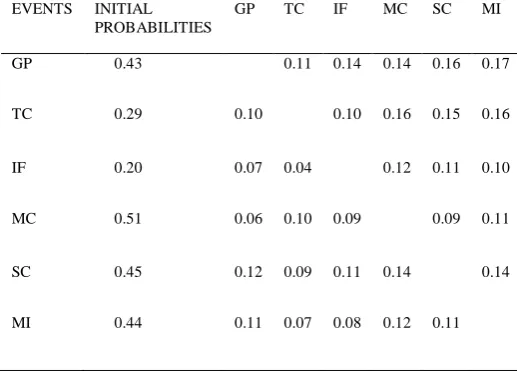
The coded events were analysed using descriptive statistics in SPSS. Thereafter, the Cross-impact probability matrices for occurrence and non-occurrence of the events were formulated from the results of the aforementioned analysis. The matrices showed the initial probabilities of events under consideration, the conditional probabilities when the events occurred and the conditional probabilities when the events did not occurred. The matrices were shown in Tables 2.6 and 2.7.
Table 3.6: Cross-impact probability matrix when the events occurred
EVE NTS
INITIAL PROBAB ILITIES
GP TC IF MC SC MI
GP
0.43 0.60 0.44 0.65 0.64 0.59
TC 0.29 0.44 0.40 0.53 0.56 0.61
IF 0.20 0.65 0.67 0.72 0.71 0.72
MC 0.51 0.64 0.61 0.61 0.66 0.75
SC 0.45 0.41 0.48 0.53 0.51 0.53
MI 0.44 0.53 0.74 0.63 0.69 0.67
Table 2.7: Cross-impact probability matrix when the events do not occurred
EVENTS INITIAL PROBABILITIES
GP TC IF MC SC MI
GP 0.43 0.11 0.14 0.14 0.16 0.17
TC 0.29 0.10 0.10 0.16 0.15 0.16
IF 0.20 0.07 0.04 0.12 0.11 0.10
MC 0.51 0.06 0.10 0.09 0.09 0.11
SC 0.45 0.12 0.09 0.11 0.14 0.14
MI 0.44 0.11 0.07 0.08 0.12 0.11
3. THE DEVELOPED ALGORITHM
The Cross-impact method was based on the analysis of experts’ opinions considered. The list of the 6 (six) events were considered relevant to the adoption of ICT in Basic Education. The events and their interpretations were as enumerated below: The event1 represents Government policy
The event2 represents Teacher Competency
The event3 represents Availability of ICT infrastructure The event4 represents Integration of ICT in school curriculum by Ministry of Education
The event5 represents Student preparedness in adopting ICT in learning process
The event6 represents Perception of schools’ management in adoption of ICT in schools
22
= probability of event i given the occurrence of event j;
and = Probability of event i given the non-occurrence
of event j
Thus, the opinion given by the experts through the administered questionnaire were corrected in such a way that the final probabilities were in conformity with the following three elementary postulates of the calculus of probabilities:
(P1) Normalization.
(P2) Rule of the product.
(P3) Rule of addition.
The conditional probabilities were calculated from the cumulative probability distribution equation:
= , where
= probability that event i will occur (Initial probability of event i)
= probability that event j will occur (Initial probability of event j)
= probability of event i given the occurrence of event j (Conditional probability)
= probability of event j given the occurrence of event I (Conditional probability)
= = probability that event j will not occur = probability of event i given that j does not occur (non-occurrence)
The smallest possible value for is 0 (zero) and the largest possible value is 1(one) the range of the probability of event i given the occurrence of event j (conditional probability) is:
Thus, the probabilities were checked in order to be sure that the estimated values fall between the acceptable limits. The Solved provided the non-occurrence probability and answered
the converse to the conditional probability question that if event j did not occur, what is the new probability of event i? The non-occurrence probability matrix was calculated once the conditional probabilities had been verified.
The developed algorithm entails the following steps:
STEP 1: Start {by identifying the events [n] relevant to adoption of ICT in basic education}
STEP 2: Input n;
STEP 3: Input initProb[n]; STEP 4:
i. Input Matrix M1=Matrix[n,n]; ii. Input Matrix M2=Matrix[n,n]; STEP 5: Input i=0,j=0; initialise i and j to 0 STEP 6: Repeat {Compute odd ratio}
i. ComputeOddRatio1[i,j]=M1[i,j]/(1-M1[i,j]); ii. Compute OddRatio2[i,j]=M2[i,j]/(1-M2[i,j]); iii. Increment j;
iv. Until j=n; v. Repeat vi. Increment i; vii. Goto i viii. Until i=n;
STEP 7: Input i=0,j=0,; initialise i and j to 0 STEP 8: Repeat {Test for Occurence}
i. SET isCross=false; test for occurrence of i and j
ii. If i=j then iii. SET isCross=true; iv. If isCross=true then
v. Compute OccurenceoddRatio[i,j]=null vi. Compute NonOccurenceoddRatio[i,j]=null else goto vii
vii. Compute OccurenceoddRatio[i,j]=M1[i,j]/([j,i]) viii. Compute NonOccoddRatio[i,j]=M2[i,j]/(1-M2[i,j]) ix. Increment j;
x. Until j=n; xi. Repeat xii. Increment i; xiii. GOTO i. xiv. Until i=n;
STEP 9: Select an event probability such that: i. If rand> event
ii. Set IsOccur=false else iii. Set IsOccur=true STEP 10: Select
i. If IsOccur =true
ii. Compute J1= initprob[n]* M1[i,j] Else Compute J2= initprob[n]* M2[i,j] STEP 11: Repeat STEPS 3 to 10
Until Event[n]=tested STEP 12: Repeat STEP 3 through 11
STEP 13: Compute freq=TotalNoOccurence/TotalNoRun STEP 14: Set SelectedEvent=Event[n];
STEP 15: Input NewInitialProb=x STEP 16: Repeat STEPS 9 to 15 STEP 17: Display NewMatrix[n,] STEP 18: Stop
4. CONCLUSION AND FUTURE WORK
In this paper, we have been able to develop an impact assessment algorithm for the adoption of Information and Communication Technology (ICT) in basic education using cross-impact method. For the establishment of the relevant events needed for the developed algorithm, this research work explored the creation and evaluation of a set of six major events that are responsible for the adoption of Information and Communication Technology in basic education in South-West Nigeria. The events are: Government policy (GP), Teacher competency(TC), Availability of ICT infrastructures(IF), Integration of ICT in school curriculum by ministry of education (MC), Student preparedness in adopting ICT in learning process (SC) and Perception of school’s management in adopting ICT(MI). The developed impact assessment algorithm is characterized by the quantitative and qualitative methods of evaluating the adoption of ICT in basic education. It is sufficiently flexible to accommodate other impacts in future studies. It is recommended that future work should be geared towards implementation of the developed algorithm and qualitative evaluation of the same through analysis of variance, regression analysis and sensitivity testing.5. REFERENCES
[1] Adedoyin, A., Akinnuwesi B. and Adegoke, M. (2008): “A Framework of information and communication technology (ICT) policy for education in Nigeria”, In J.B. Babalola, L.
[2] Larsen, K. and S. Vincent-Lancrin (2005): “The impact of ICT on tertiary education: advances and promises”, Presented at OECD/NSF/U. Michigan conference, 10-11th
January, 2005, Available from
http://www.advancingknowledge.com/drafts/larsen.
23
technology and distance learning, available from http://www.idtl.org/journal/jam_05/article01.htm ; accessed 5th June,2005.
[4] Caplan, D. (2005): “The development of online courses”, In T. Anderson and F. Elloumi (Eds.), Theory and practice of online learning, Creative commons: Athabasca University, pp. 175.
[5] Launllard, D. (2002): “Rethinking university teaching: A conversational framework for the effective use of teaching technologies”, 2nd ed., London, New York, pp188-192.
[6] Abrami, P. C. (2001): “Understanding and promoting complex learning using technology”, Educational research and evaluation, Vol. 7, No. 2, pp 113-136.
[7] Chambers, E. A. (2003): “Efficacy of educational technology in elementary and secondary classrooms”: A meta-analysis of the research literature from 1992-2002, Ph.D dissertation, Southern Illinois University at Carbondale, ProQuest digital dissertations database publication, No. AAT 3065343.
[8] Federal Government of Nigeria (2003): “Universal basic education Act”, NERDC, Lagos.
[9] Nigeria Federal Ministry of Education (2000): “Implementation guidelines for the Universal Basic Education (UBE) programme”, Federal Ministry of Education, Abuja, pp. 1-17.
[10] UNESCO (2004): “Integrating ICT into education”, ICT lessons learned series, Bangkok.
[11] Alabi, A. (2004): “Evolving role of ICT in teaching, research and publishing”, Nigeria Tribune, Friday,30 April,2004, pp. 30-31
[12] Sprague, R.H.Jr. and Watson, H.J. (1993): “Decision support system: Putting theory into practise”, Englewood cliffs: Prentice-Hall, pp. 142-153.
[13] Robert, W. Blanninga (1999): “Cross-impact analysis using group decision support system: An application to the future of Hong Kong”, Futures research methodology, Vol.31, pp 39-56.