Received Date: 23rd Oct 2018
Accepted Date: 04th Dec 2018
Published Date:15th Dec 2018
CORRESPONDENCE AUTHOR
Maurice Miller, PhD.
University of the West Indies, Mona Campus
Email: [email protected]
CITATION
Maurice Oneil Miller, Modeling a HPGe detector's absolute efficiency as a function of gamma
energy and soil density in uncontaminated soil(2018)SDRP Journal of Earth Sciences &
Environ-mental Studies 3(4)
Copy rights: © This is an Open access article distributed under the terms of International License.
ABSTRACT
This study develops a mathematical model for pre-dicting the absolute efficiency value of a HPGe de-tector based on the gamma energy and soil density for a typical counting arrangement for measuring gamma activity concentration in uncontaminated sur-face soils. The generation of the experimental effi-ciency curves was carried in AGLE 3.0 using the Or-tec GEM-FX8530P4 with a warranted resolution (FWHM) at 1.33 MeV (Co-60) =1.9 keV and factory reported measured value of 1.76 keV. ANGLE 3.0 was used to output the efficiency and solid angle data for the various soil densities in the density range 0.8 – 1.8 g cm-3 and gamma range 20 – 2000 keV. The
inter-relationship is defined using SigmaPlot, as a 3D Lorentzian model with R2= 0.9925. Further analysis
was done to determine the uncertainties in this pre-dictive model, and a set of correcting equations based on energy ranges were developed. The data indicated that with each soil density, the uncertainties increase with increasing gamma energy in the energy range
400 – 1600 keV, and that the level of uncertainty was significant. The uncertainties at the energy range be-low 400 keV were not considered significant within the context of general experimental errors.
Keywords: detector characterization, semi-empirical, ANGLE, uncertainties, HPGe, detector efficiency
INTRODUCTION
In determining the activity of gamma emitters with HPGe detectors, it is routine to compare measure-ments of an unknown source with those of a calibrat-ed source of equivalent geometry and density. The total efficiency is defined as the ratio of the number of pulses recoded in the spectrum and the number of photons emitted by the source. Detector full-energy efficiency curves form the foundation on which accu-rate radioactivity is measured in environmental sam-ples such as top soil using a standard and verifiable source counted above the detector. The specific activ-ity (A) of the sample is measured by the formula shown below:
Equation 1: Measurement of the specific activity
where CPS = net count per second under the gamma peak of interest; = branching ratio, m = mass, and ε(γ) = absolute or full energy peak efficiency for a particular gamma energy of interest. From equation 1, it is apparent that any over-statement or
understate-Modeling a HPGe detector's absolute efficiency as a function
of gamma energy and soil density in uncontaminated soil
SDRP Journal of Earth Sciences & Environmental Studies (ISSN: 2472
-
6397)
ment of the efficiency value leads to an under
-statement or over-statement respectively of the radio-activity of the sample. Typically the uncertainty in the efficiency calibration is the largest contributor to the total uncertainty in the measurement [1]. ANGLE uses the concept of the effective solid angle ( ) to calculate the value of the energy dependent full
-energy peak efficiency or absolute efficiency qualita-tivelydefined in Equation 2.
Equation 2 -Full-energy peak efficiency
This efficiency is impacted by the detector properties and the solid angle ( ) subtended by the radio-active source counted on the face of the detector. The absolute efficiency of the sample is related to that of the reference standard by the expression in Equation 3 [2].
Equation 3 -Efficiency and solid angle relationship
The key is the determination of ε, which may be ex-perimentally determined by fitting a function of the form shown in Equation 4 to a plot of full-energy ef-ficiency versus gamma energies using a reference source of verifiable activity and reference date to ac-count for activity on the date of measurement. Vari-ous software can be used to determine the efficiency fitting parameters “a, b, c and d” below, which can then be extrapolated to determine the gamma energies of interest. SigmaPlot version 10 was used in this re-search due to its ease of use and flexibility.
Equation 4 -Absolute Efficiency
The absolute efficiency is a function of the solid angle Ω; the solid angle is dependent on the source to detector distance or counting geometry. In this paper, the geometry employed is an Eu 152/154 cylindrical and disc calibration sources; the former in contact geometry with the detector and the latter counted 25 cm above the face of the detector.
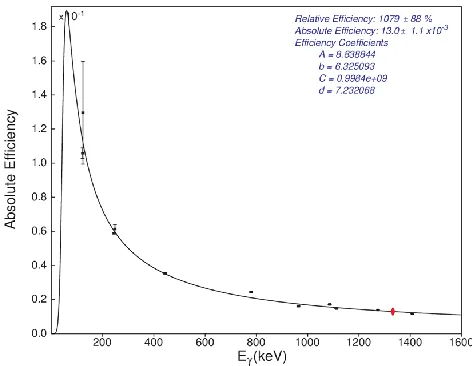
Figure 1: Absolute efficiency curve for the Eu-152
(93%) –Eu-154(7%) source in a cylindrical container of volume 63 cubic cm and activity 6.7 +/- 0.2 kBq (as of 20/2/2001) and in touch geometry with the HPGe detector. Efficiency results corrected for ener-gy drift and summing effect by SPECTRA software
The empirical function used for the fit is shown in Equation 5
Equation 5 -The empirical function used for the fit:
where A = 8.838844, B = 6.325093, C = 0.998e + 09, and D = 7.232068, x = gamma ray energy and y = absolute efficiency.
Numerous studies to optimize detector efficiency have been conducted for point and extended sources using Monte Carlo and optimization of geometric parameters for Marinelli beakers [3-7]. Monte Carlo determination of water concentration effect on gam-ma-ray detection efficiency in soil samples for photon energies ranging from 60 keV to 2 MeV developed
corresponding correction factors. It this study, it was observed that the correction factor approaches unity with increasing energy and decreases with increasing water concentration [8]. The impact of soil density on in situ gamma spectra analysis has been studied to determine the specific relationship between soil bulk density and peak-to-valley ratio of natural radionu-clides [9]. The impact of material density on gamma attenuation has been established in a number of stud-ies [9-13]. Finally, a review and application of com-puter codes to develop absolute full-energy peak effi-ciency at the desired gamma-ray energy has been un-dertaken [14, 15].
The objective of this study is to develop a mathe-matical model for predicting the efficiency value of the soil’s primordial gamma ray based on its density and the energy of the emitted gamma. The counting geometry employed is the typical plastic cylindrical container in contact geometry with the face of a HPGe detector.
Materials and Methods
The generation of the experimental efficiency curves was carried using the Ortec GEM-FX8530P4 with a warranted resolution (FWHM) at 1.33 MeV (Co-60) = 1.9 keV and factory reported measured value of 1.76 keV. The amplifier shaping time was 6μs, peak
-to-Compton ratio (Co-60) was 55:1 (warranted) and 61:1 measured, relative efficiency at 1.33MeV (Co
-60) was 40.5 %. The setup consisted of a high voltage filter, detector, and pre-amplifier all housed in the detector casing. A recommended high voltage of 4800V was applied to the detector from a FAST NHQ
-205M NIM module. [16]. The dimensions of the cy-lindrical container used for the soil and EU-152/154 efficiency measurements were as follows; diameter = 70mm, height = 21mm, bottom thickness = 1mm, and side thickness = 1mm. Details of the preparation of the Eu-152/154 calibration sources used in this paper have been published [17]. Figure 1 shows the detec-tor’s configuration as supplied by the manufacturer, ORTEC. In ANGLE, the input data are categorized as detector, container, geometry, source and reference efficiency curve. The majority of the data require-ment is for the detector. Details of the input to
AN-GLE are available on Ortec’s help documentation [18] .
Figure 2: Detector parameters for GEM-FX8530P4 HPGe detector. Data courtesy of Ortec.
ANGLE 3.0 was used to output the efficiency and solid angle data for the various soil densities in the density range 0.8 – 1.8 g cm-3 and gamma range 20 –
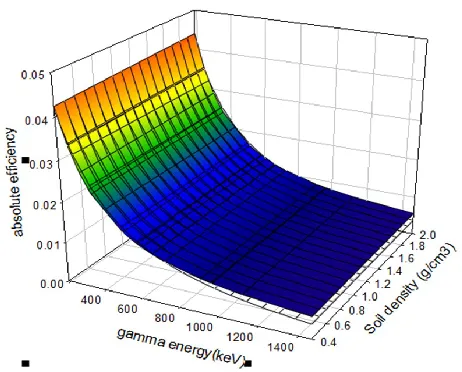
2000 keV. The density range was selected based on 66 soil samples collected island-wide in Jamaica, and the gamma energy range covers the main primordial gamma energies for environmental sample analysis. The data was input to SigmaPlot software which was used to generate the 3-D plot shown in Figure 2 and the mathematical description of the formula show in the Results and Discussion section of this paper.
Results and Discussion
Figure 3 - Predicted gamma efficiency as a function of soil density and gamma energy
mathematical model for describing this curve is shown in Equation 6.
Equation 6 - 3D Lorentzian model for soil density, gamma energy and efficiency
ɛ=A/((1+((ρ-X0)/B)^2)*(1+((γ-Y0)/C)^2))
ɛ, ρ and γ denotes the efficiency values, soil density and gamma energy respectively, with X0 =
-263.6587, Y0 = -0.5757, A = 0.1674, B = 257.9514,
and C = 15603.6766. The quality of the fit is de-scribed with R2= 0.9927 with standard error of
esti-mate = 0.0010. Sigma Plot reported the Total Num-ber of Fits = 400 and Maximum NumNum-ber of Iterations =200. The Kolmogorov-Smirnov goodness-of-fit test for the data set indicated a statistic = 0.1442 and sig-nificance level = <0.0001 which indicated that which rejected the hypothesis that the distribution differed substantially from theoretical expectations.
In Figure 3, the lowest end of the soil density was used to compare the actual versus predicted (fitted value) for the absolute efficiency over the range 200 – 1660 keV. The black dots represent the actual val-ues and the white dots represent the predicted valval-ues for the absolute efficiency. The fitted curve devel-oped was an exponential decay, double, 4-parameter curve as shown in Equation 7.
Equation 7 -The actual versus predicted (fitted val-ue, ) for the absolute efficiency over the range
20 – 1660 keV for soil density = 0.4 g/cm3
A*exp(-B*γ) +C*exp(-D*γ)
with the following denotations; f = fitted value of the efficiency, γ = gamma energy, A = 0.0851, B = 0.0060, C = 0.0185, and D = 0.0009.
Figure 4- Predicted versus actual gamma efficiency for soil density = 0.4 g/cm3
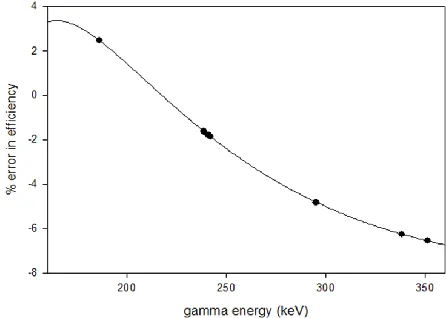
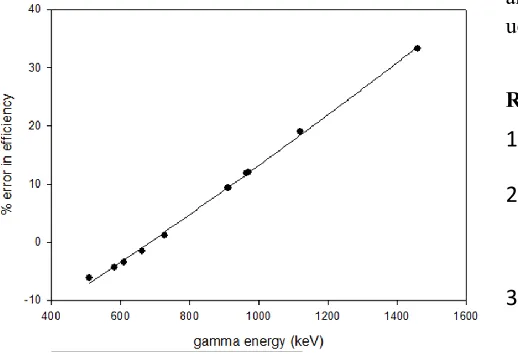
Further analysis was done to determine the uncertain-ties in this predictive model, and to develop neces-sary correcting equation. Figures 5 and 6 shows the percentage errors in the energy range 20-400 keV and
400 – 1600 keV respectively.
Figure 5 -Percentage error in efficiency for the ener-gy range between 0 to 400 keV
The fitting curve for Figure 4 is described by the pol-ynomial, inverse third order equation shown in Equa-tion 8:
Equation 8 - Percentage error in efficiency for the energy range between 0 to 400 keV
δ1(%)=y0+(A/γ) + (B/γ ^2) + (C/γ ^3)
val-ue, y0 = 3.2390, A = -12229.4007, B = 033136.9472, C =, -331978265.5734, and γ = gamma energy. The quality of the fit is denoted by a R2 = 1.0000, which
suggest a perfect fit for all points in the designated region. The findings show that within the 0 – 400 keV range, the error in the efficiency values decrease with increasing gamma energies. The error values fall within the -7% - 3% range and may therefore be ig-nored within the context of general experimental er-rors.
From Figure 6 (energy > 400keV), the fitting curve is a polynomial, quadratic equation shown in Equation 9.
Equation 9 - Percentage error in efficiency for the energy range 400 keV to 1600 keV
Δ1(%) =y0+A*γ + B*γ^2
where Δ1(%)= percentage error in the efficiency
val-ue, y0 = -26.8198, A = 0.0371, B = 2.9059E-006, and γ = gamma energy. The quality of the fit is denoted by a R2 = 0.9993, which suggest a good fit for all
points in the designated region. The findings show that within the 400 – 1600 keV range, the error in the efficiency values increases with increasing gamma energies. Unlike the previous energy range, the error values fall within a wider range of -10% - 30% range, and therefore cannot be ignored. Equation 9 is then used to correct for the errors inherent in the Lorentzi-an model shown in Equation 3.
Figure 5 -Percentage error in efficiency for the
ener-gy range between 400 to 1600 keV
The final model based on corrections to the energy efficiency is show in Equation 10.
Equation 10 -Improved predictive model incorporat-ing error corrections
where and ɛ, represents the corrected effi-ciency value and uncorrected effieffi-ciency value (defined in Equation 6) respectively, and δ1 and Δ1 are
the correcting functions defined in Equations 8 and 9 for the energy intervals 20 – 400 keV, and 400 – 1600
keV respectively.
CONCLUSION
A mathematical model using commercially available software tools was developed and tested to produce the absolute efficiency values for an HPGe detector in a typical counting arrangement for uncontaminated soils. To reduce errors in the model, the necessary correcting equations were developed to improve the reliability of the efficiency values. The analysis of errors in the efficiency values were consistent with visual examination of Figure 3 which shows a better fit of the 3D curve at the lower gamma energy. The mathematical model can be easily implemented in any spreadsheet to generate absolute efficiency val-ues based on gamma energy and soil density.
REFERENCES
1.
Canberra, Model S574 LabSOCS*™ CalibrationSoftware. 2013) 10.
2.
Ortec. Advanced Efficiency Calibration Softwarefor High Purity Germanium Gamma-Ray Detectors.
2012 [cited 2012 October 12]; 8]. Available from:
View Article
3.
K. Abbas, F. Simonelli, F. D'Alberti, M. Forte, andM.F. Stroosnijder, Reliability of two calculation codes for efficiency calibrations of HPGe detectors.
Applied Radiation and Isotopes. 56. (2002) 703
4.
M.I. Abbas, HPGe detector photopeak efficiency calculation including self-absorption and coinci-dence corrections for Marinelli beaker sources us-ing compact analytical expressions. Applied Radia-tion and Isotopes. 54.(2001) 761-768. 00308-0View Article
5.
C. Agarwal, S. Chaudhury, A. Goswami, and M.Gathibandhe, Full energy peak efficiency calibra-tion of HPGe detector for point and extended sources using Monte Carlo code. Journal of
Radio-analytical and Nuclear Chemistry. 287.(2011) 701
-708.
View Article
6.
A.S. Ahmed, K. Capello, A. Chiang, E. Cardenas-Mendez, and G.H. Kramer, Optimization of geo-metric parameters for Marinelli beaker to maximize the detection efficiency of an HPGe detector. Nu-clear Instruments and Methods in Physics Research Section A: Accelerators, Spectrometers, Detectors
and Associated Equipment. 610.(2009) 718-723.
View Article
7.
A. Aksoy, Efficiency Inter-ComparisonMeasure-ments of Medium and Large Volume HPGe Detec-tors in Far and Close Geometries. Arabian Journal
for Science and Engineering. 36.(2011) 131-136.
View Article
8.
N. Celik and U. Cevik, Monte Carlo determinationof water concentration effect on gamma-ray
detec-tion efficiency in soil samples. Applied Radiadetec-tion
and Isotopes. 68.(2010) 1150-1153.
PMid:20133141
View Article PubMed/
NCBI
9.
T.C. Feng, J.P. Cheng, M.Y. Jia, R. Wu, Y.J. Feng,C.Y. Su, and W. Chen, Relationship between Soil bulk density and PVR of In situ Gamma Spectra. Nuclear Instruments and Methods in Physics Re-search Section A: Accelerators, Spectrometers,
De-tectors and Associated Equipment. 608.(2009) 92
-98.
View Article
10.
N.Q. Huy, D.Q. Binh, V.X. An, T.T.H. Loan, and
N.T. Can, Self-absorption Correction in
Determin-ing the 238U activity of Soil samples via 63.keV Gamma ray using MCNP5 code. Applied Radiation
and Isotopes. 71.(2013) 11-20. PMid:23079486
View Article PubMed/NCBI
11.
J.F. Cameron and M.S. Bourne, A gamma
-scattering soil density gauge for subsurface meas-urements. The International Journal of Applied Ra-diation and Isotopes. 3.(1958) 15-16, IN11, IN12, 17-19.12.
A.V. de Groot, E.R. van der Graaf, R.J. de Meijer,
and M. Maucec, Sensitivity of In-situ Gamma ray
Spectra to Soil Density and Water content. Nuclear Instruments and Methods in Physics Research Sec-tion A: Accelerators, Spectrometers, Detectors and
Associated Equipment. 600. (2009) 519-523.
View
Article
13.
F.L. Melquiades and C.R. Appoloni, Self
-absorption Correction for Gamma Spectrometry of Powdered Milk samples using Marinelli beaker.
Applied Radiation and Isotopes. 55.(2001) 697
-700. 00114-2
View Article
14.
K. Jackman and S. Biegalski, Methods and
soft-ware for predicting germanium detector absolute full-energy peak efficiencies. Journal ofRadioana-lytical and Nuclear Chemistry. 279.(2009) 355-360.
View Article
15.
K. Jackman, R. Gritzo, and S. Biegalski, A
soft-ware package using a mesh-grid method for
simu-lating HPGe detector efficiencies. Journal of
Radio-analytical and Nuclear Chemistry. 282.(2009) 223
-226.
View Article
16.
Canberra. Model 8715 Analog
-to-Digital Convert-er. 2012 [cited 2012 August 15]; Available from:View Article
17. C. Tsabaris, G. Eleftheriou, V. Kapsimalis, C.
Anag-nostou, R. Vlastou, C. Durmishi, M. Kedhi, and C.A. Kalfas, Radioactivity levels of recent sedi-ments in the Butrint Lagoon and the adjacent coast of Albania. Applied Radiation and Isotopes2006) 9.