IIII
nternational
nternational
nternational
nternational
JJJJ
ournal of
ournal of
ournal of
ournal of
Agriculture and Biosciences
Agriculture and Biosciences
Agriculture and Biosciences
Agriculture and Biosciences
www.ijagbio.com; [email protected]
Research Article
Production and Performance Evaluation of Brake Pad Made from Rice Husk and
Palm Kernel Shell Powder
SC Nwigbo and IO Asogwa
Department of Mechanical Engineering, Nnamdi Azikiwe University Awka, Nigeria *Corresponding author: [email protected]
Article History: Received: July 18, 2016 Revised: September 22, 2016 Accepted: November 07, 2016
A B S T R A C T
Experimental study and investigation of alternative material mixture for brake pads are necessary in this new era as a result of phasing out of a commonly used brake pad material called Asbestos due to its carcinogenic effects. This paper presents a new material mixture methodology in brake pad formulation with the integration of statistical and triangular lattice design mixture experiment with optimization techniques. Keeping this in view, the present work has been undertaken to develop a polymer matrix composite brake pad using Rice Husk and Palm Kernel Shell powder as a major constituent in the mix of other regular ingredients in the brake pad manufacture. In this experimental study, the average changes of friction surface, amount of wear loss, stopping time or deceleration, oil and water absorption, hardness capacity of the pad and the noise level generated of sample one (S1) at contact air pressure of 15kN were 0.438, 3.72%, 5.1s, 0.292%, 0.396%, 234.33Bh, 28.67db respectively, which compares relatively well with the following results, 0.362, 3.468%, 7.5s, 231.67Bh and 36db of brake pad imported into the Nigerian market on coefficient of friction, wear loss, stopping time, hardness capacity and noise level respectively. In addition, thermo-graphic analysis, energy dispersion analysis and micro structural characterizations of braking pad were carried out to determine thermal degradation, elemental composition and morphology of the brake pad produced.
Key words: Frictional Materials, Palm Kernel Shell, Rice Husk Powder, Brake Pad and Statistical Design Matrix
INTRODUCTION
A brake plays an important role in any automobile vehicle so as to slow down vehicle or completely stop a vehicle. During the application of brake, friction between the pads and the rotating disc stops the vehicle by converting kinetic energy of the vehicle into heat energy. In other to achieve the properties required of brake pads, most brake materials are not composed of single element or compounds but rather are composites of many materials, more than 2000 different materials and their variants are now used in commercial brake pads components (Weintraub, 2007). The use of biomaterials in general and agro-waste in particular in producing composites such as brake pad is a subject of great interest, nowadays not only from the technological and scientific point of view, but also socially and economically too. The development in composite materials has cascaded down for catering to domestic and industrial applications. Composite the wonder material with light-weight, high strength-to weight ratio and stiffness properties have come
a long way in replacing the convectional material like metals and asbestos. Therefore, the brake pad material should quickly absorb heat, should withstand for high temperature and should not wear off easily.
The brake pad mixture material should maintain a sufficiently high friction coefficient with the brake disc, the brake pad should not break down in such a way that the friction coefficient with the brake disc is compromised at high temperature and should exhibit a stable and consistent friction coefficient with the brake disc. A unique feature of composite is that the characteristics of the finished products can be tailored to a specific engineering requirement by the careful selection of matrix and their reinforcement type. Nevertheless, one can safely mark the origin of the distinct discipline of the composite materials as the beginning of the 1960s, it would not be too much off the mark to say that a concerted research and development efforts in composite materials began in 1965. Since the early 1960s, there has been an increasing demand for materials that are stiffer and strong yet lighter in fields as diverse as automobile. In the past years,
asbestos is used in brake pad production, however experiments have shown that the use of asbestos causes carcinogenic effects on human health which led to investigation of new materials particularly agricultural residues are now emerging as a new and inexpensive materials in brake pad development with commercial viability and environmental acceptability for brake pad which possesses all the required properties.
Generally, brake pad consists of a composition of reinforced fiber, binder, filler, and friction additives. All these constituents are mixed or blended in varying composition and brake pad material is obtained using different manufacturing techniques. Reinforced fibers increase mechanically strength to the friction material, the purpose of a binder is to maintain the brake pads structure integrity under mechanical and thermal stresses. Binders help to hold the components of a brake pad together and prevent its constituents from shattering apart. Fillers in brake pad are present for the purpose of improving its manufacturability as well as to reduce the overall cost of the brake pad. Abrasive and lubricants are considered as friction additives, abrasives in a friction material increases the friction coefficient, they remove iron oxides from the counter friction material during braking, lubricant like graphite stabilizes the developed friction coefficient at high temperature.
Consequently, many studies have been done and are still ongoing for development of not only asbestos free brakes but also less temperature generated pads for better human health and technical efficiency. Coconut and palm kernel shells were used successfully to replace asbestos in the brake pad manufacture as reported by (Dagwa, 2005), (Aigbodion and Akadike, 2010), (Bashar et al., 2012) and
(Deepika et al., 2013) later showed in their work that
palm kernel shell gave a good friction material for brake pads and that palm kernel shell is cheap biomass that is readily obtainable from agro wastes as characterized by (Ishidi et al., 2011). Researches all over the world today
are focusing on ways of utilizing either industrial or agricultural wastes as a source of raw materials in industry. Utilization of these wastes will not only be economically, but may also result in foreign exchange earnings and environmental controls. The purpose of this study is to assess the tribology effects of the filler quantity such as PKS and RH powder and its particle size on the properties of the brake pad, carry out thermal stability of the composite and the elemental distribution on the composites and characterization rice husk and palm kernel shell powder as potential materials for asbestos-free brake materials, since they are readily available and very cheap to obtain.
MATERIALS AND METHODS
Research materials and equipments
The materials used for this work includes rice husk, palm kernel shell powder, CaCO3, powdered graphite, silica, and binders (Epoxy resin and hardener). The Important factors considered in selecting these materials include high and stable coefficient of friction, low wear rate, good heat dissipation while retaining the mechanical strength, ability to dry up as quickly as it passes through water or oil. Laboratory equipment used include sieve of 100micro meter, steel spatula, stirrer, bowls, digital and analogue weighing balance, aluminum mould, hand gloves, metal files, mobile hardness tester, furnace, milling machine, inertial dynamometer, inclined plane, calipers, water and engine oil. Apart from rice husk and palm kernel shell powder, other chemical materials in the brake pad mixture were purchased from standard chemical dealers shop in Enugu, Nigeria. The laboratory and workshop equipment were accessed at Scientific Equipment and development Institute SEDI Enugu. Other equipment was used at ANAMMCO Enugu, University of Nigeria Pharmacy workshop Enugu and Turrent Engineering Services Limited Portharcourt, Rivers State.
Materials preparations
About 100 kg of palm kernel shell was obtained from a local palm oil processing mill at Itchi in Igbo-Eze South Local Government Area of Enugu State, Nigeria. The shells were sorted out to remove whole nuts and other fine particles adhering to the shells. Also rice husk obtained from local mill factory at Adani in Uzuwani Local Government Area of Enugu State were sortted out to remove impurities such as sand, bran rice and other small particles adhering in the rice husk. Both palm kernel shell and rice husk were soak solutioned in sodium hydroxide to improve fibre matrix interactions by disrupting hydrogen bonding in the fibre surface thus increasing surface roughness by removing lignin and hemicelluloses present in the fibre. Thereafter, the palm kernel shell and rice husk were washed in water and sun dried in an open air. The treated fibers were grinded into powder with local milling machine and the powdered fibres were carburizeded in a furnace to remove any moisture that may be present in the fibre.
Material list
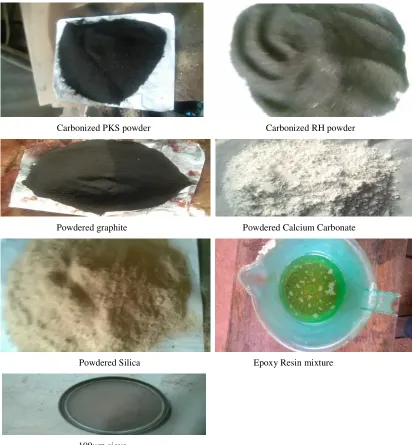
The materials that was used in producing brake pad taking difference compositions as shall be seen in this work is shown in Fig. 1.
Table 1: Functions of selected brake pad materials
Sr. No Materials Role Function in composite
1 Rice husk and palm kernel shell powder
Filler Available as agricultural waste with properties that favors its use in friction lining manufacture
2 Silica Abrasive It is useful for increasing friction and for controlling the build-up of
friction film
3 Calcium carbonate Reinforcement It influences adhesion and disperses polymer in composite
4 Powdered graphite Friction modifier For improving wet friction
Carbonized PKS powder Carbonized RH powder
Powdered graphite Powdered Calcium Carbonate
Powdered Silica Epoxy Resin mixture
100µm sieve
Fig. 1: List of materials used in the brake pad production
Response surface methodology
Response Surface Methodology used in brake pad mixture combines statistical and experimental methods with data fitting techniques. Based on the responses acquired in the experiments, Regression Analysis is utilized to identify the relationships between the responses and the variables to establish a mathematical model that satisfies the relationship between a group of test factors and objective functions. This model was used to explore the optimal solution in the experimental area based on its practicability. RSM tends to focus on the relationships between multiple factors x1, x2, x3…xk of the mixture and the response y. Consequently, the functional relationship between the responses and the independent variables should first be determined to produce a proper approximating function, and then the factor setting levels x1, x2, x3…xk needed to obtain the optimal response was identified. The relationship
between the response variables and the independent variables (factors) was presented in the form of an equation below.
1
Where f is a multivariate function, the items represent the factors (independent variables), and the relationship describes a curved surface y = f (X1, X2, X3…Xk ) that is known as a Response Surface. RSM can be of first order and second order equations as shown bellow:
2 3
Specimen brake pad production
The technique of powder metallurgy as practiced by (Edokpia et al., 2014) and (Dagwa and Ibhadode, 2005)
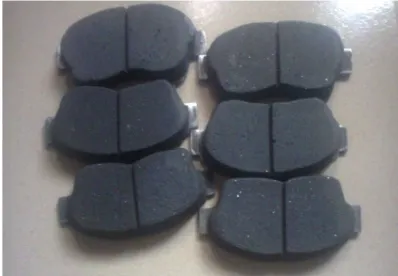
where used in the production of this brake pad specimen, were the weight of palm kernel shell powder and rice husk powder filler materials, matrix (epoxy resin and hardener) was varied while that of the abrasives and reinforcement was kept constant. For each formulation quantities expressed in percentage weight where fillers, abrasives and reinforcement were approximately measured into mixing vessel and thoroughly mixed for 15 to 20 minutes to obtain homogenous mixture. The desired amounts of epoxy resin (polyepoxide) was poured into a separate container and required quantity of hardener was added to form the matrix and thoroughly stirred for about 5 minutes to obtain uniform mixture. Thereafter, the matrix mixture was poured onto the powdered friction material mixture and stirred further to obtain a paste-like homogenous mixture. The formed paste was poured into mold cavities that already had powdered talc applied for ease of component removal, the mixture was thereafter pressed with a hydraulic pressing machine at 100kN force for 2 minutes at room temperature and allowed to cure for 90 to 130 minutes and thereafter hardened by putting them under controlled temperature of 150oC for 3hours in an oven to ensure a complete curing of the resin. The optimum manufacturing parameters for this formulation are 100kN pressing force, 130minutes curing time, temperature of 150oC for heat treatment of 3hours. Samples of the produced samples are shown in Fig 2.
Fig 2: Brake pad samples.
Wear and strength test
An inertial dynamometer was used as the de facto testing machine for the measuring of the engineering properties of the produced brake pads such properties are wear rate, coefficient of friction, temperature generated, and noise level at different speeds ranging from 60 to 250km/h in compliance with Society of Automotive Engineers SAE J2552 issued in august 1999. This assesses the effectiveness behavior of a friction material with regards to pressure, temperature and speed. Fig. 3 shows an example of the inertial dynamometer used for this work, a complete brake module consisting of original disc, pads, and caliper, where the pad is mounted as a test sample. With this machine, the complete brake pad was exposed to real life load cycle and repeated as often as necessary. With the results obtained as tabulated from table 3 to 4 not included in this paper.
Fig 3: brake assembly units of the inertial dynamometer (ANAMMCO).
Table 2: Dynamometer Specifications
Max drive power 375kW(540hp)
Max drive torque 2527Nm
Max drive speed 2500rpm (400km/h)
Max brake torque 25000Nm
Pressure brake 6000N*2
Flywheel Inertial Max/min (1900/400kgm2) Acceleration time 1min 30sec
Hardness test
To determine the resistance of brake lining material used to indentation, hardness test was carried out on the brake pad with Mitech Leeb HardnessTester Model MH320. The equipment hardness mode was set to Brinell hardness mode HB, and the impact device was loaded and impacted on three points at random. The result obtained is recorded and tabulated in table 2 not included here for each brake samples with the aim of determining the hardness of the produced brake pad, each specimen is clamped down on the floor while the striking arm of the mobile tester is released and allowed to strike the surface of the produced brake pad and the commercial brake pad respectively at three different positions and the average values of the results of S1, S2, S3, S4, S5 and S6 are recorded and tabulated.
Thermal property of the produced pad
Thermal decomposition was observed in terms of global mass loss by using a TA instrument TGA Q50 thermo-gravimetric analyzer. This apparatus detects the mass loss with a resolution of 0.1 as a function of temperature. The samples were evenly and loosely distributed in an open sample pan of 6.4mm diameter and 3.2 mm deep with and initial sample amount of 8-10mg. due to different bulk density, the depth of the sample layer filled in the pan was about 1-2 mm. The temperature change was controlled from room temperature (25±30C) to 10000C at a heating rate 200C/min. The sampling segment was set as 0.5 second per point. The TG and DTA curves that was obtained from TGA runs was carefully smoothed at a smoothing region width of 0.20C buying least squares smoothing method, and analyzed by using universal analysis 2000 software from TA instruments.
Energy-dispersive spectrum
lines of a given element for comparison with the recorded spectrum.
RESULTS AND DISCUSSION
Hardness test
The hardness of the brake pad specimen ranges from 238BH to 205.30BH and 231.67BH for commercial pad. Sample S2 with Brinell hardness of 238BH and mixture compositions of binder 23g, PKS 40g, RH 22g, Graphite 5g, Silica 5g, CC 5g, gave a higher hardness of the samples. The high hardness is attributable to the increase in bonding and close packing that strain hardened the composite brake pad and raised its hardness; the average hardness for the entire laboratory specimen was 232.715BH while commercial pad had 231.67BH. this results suggest that the laboratory brake pad was only slightly harder than commercial brake pad hence the laboratory brake pad specimen would not have any adverse effect on the brake disk. Therefore, the specimen has an equal comparative advantage as that of the conventional brake pad.
Oil and water absorptions
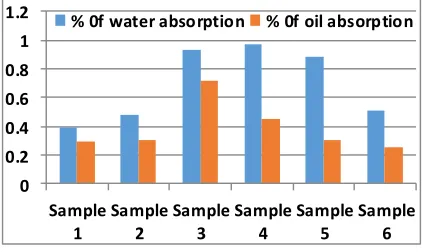
In Figure 5, water absorbent property of samples 1, 2 and 6 decreased respectively as weight ratio of fillers and binders increase in the formulation. Oil absorption property of samples 2, 3 and 6 decreased as filler content of rice husk decreased from the range 25 to 21 respectively in the brake pad formulation. This decreased water and oil absorption rate may be due to the increased interfacial bonding between binder and filler particle that caused decreased porosity according to (Dagwa and Ibhadode, 2005). The result compared favourably with that of conventional model with water and oil absorption rates of 0.425% and 0.375% respectively.
Thermal Stability of the brake pad
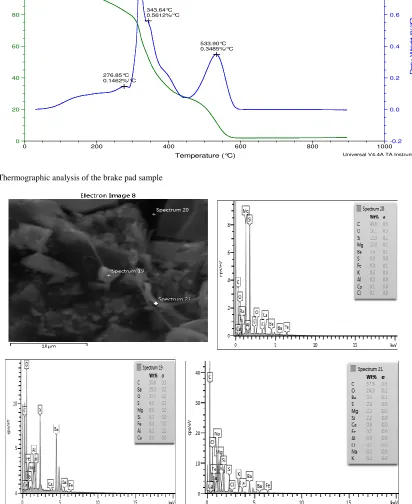
The thermographic analysis as shown in Fig 6 shows the thermal stability of the brake pad formulation which exhibits a good thermal stability up to 600oC but disintegrates faster beyond 600oC. since the temperature of the brake in operation is found to be within 300oC to 400oC, the pad produced using PKS and RH powder is predicted to be thermally stable and could be used for brake pad production. The initial weight loss of 4.92% observed within 161.48oC is attributed to the vaporization of the water from the sample, while degradation of the sample started at higher temperature precisely after 600oC. above this temperature, the thermal stability of PKS and RS powder gradually decreased and degradation of the sample was seen to have occurred.
An energy dispersive Xray spectroscopy (EDX) as seen in Figure 7 was used to identify the main constituents present in the brake pad sample from where it was generally observed that all the element present in the brake pad was evenly distributed at each sections of the brake pad.
The SEM analysis done on the brake pad specimen revealed the friction material of the brake pad displaying similar texture patterns of coarse aggregates of good bonding between the elements as seen in the Fig 4. Where pores are not evident and uniform morphology of brake pad mixture was observed.
180 190 200 210 220 230 240 250
S1 S2 S3 S4 S5 S6
Brake pad samples
)B
H
Fig. 4: Mobile hardness test of sample specimen
0 0.2 0.4 0.6 0.8 1 1.2 Sample 1 Sample 2 Sample 3 Sample 4 Sample 5 Sample 6
% 0f water absorption % 0f oil absorption
Fig. 5: water and oil analysis of specimen samples.
Wear rate data was different for different formulations due to different additives and their weight percentages ratios used in their compositions. The increase in speed leads to increase in contact pressure between the rotor and the brake pads thus increases wear rate as reported by (Sanders, 2001). Therefore, selection of materials and their weight percentages used in the friction formulation will significantly affect tribological behaviour of brake pad as reported by (Lim et al., 2006). The average material lost of
samples S1, S2, S3, S4, S5, S6 which are 1.75, 1.96, 2.29, 2.13, 2.07, and 2.15% respectively compares very well with the commercial pad with 2.15 % which suggest that laboratory pad for S1with mixture compositions of binder 24g, PKS 36g, and RH 25g shows a slower wear rate as speed increases and is seen to perform better than the commercial pad at 6kN contact pressure.
343.64°C 0.5612%/°C 321.38°C 0.9362%/°C
533.90°C 0.3485%/°C
276.85°C 0.1462%/°C 161.48°C
95.08%
-0.2 0.0 0.2 0.4 0.6 0.8 1.0
D
e
ri
v
.
W
e
ig
h
t
(%
/°
C
)
0 20 40 60 80 100 120
W
e
ig
h
t
(%
)
0 200 400 600 800 1000
Temperature (°C) Universal V4.4A TA Instruments
Fig. 6: Thermographic analysis of the brake pad sample
Fig 7: EDX profiles of the brake pad sample.
From Fig. 11, it was observed that laboratory brake pad samples S3 with mixture compositions binder 27g, PKS 38g and RH 20g shows a lower rise in temperature as the speed increases at the contact air pressure of 6kN whereas commercial brake pad sample shows sharp increase in temperature as the speed increases. It was generally observed that S3 mixture has good heat dissipation ability. During a dynamic application of a
Fig 8: SEM image of the specimen.
Fig. 9: Variations of wear loss with speed at the contact air pressure of 6Kn
Fig. 10: Variations of coefficient of friction with speed at contact air pressure of 6KN
Fig. 11: variations of temperature with speed at contact air pressure of 6KN
Fig. 12: variations of stopping time with speed at contact air pressure of 6kN
Stopping time is the ability of the brake pad in stopping a car at any speed in time of emergencies Figure 12 shows that the variations of speed with stopping time of the produced brake pad and the commercial type S7 increases uniformly as the speed increases, agreeing with the trend reported by Sanders (2001). Values of the produced brake pads varies from 3-12s which is far better than the values of 4.1-13s as reported by (Sanders, 2001), it was seen that the produced brake pad is almost in range with the commercial brake pad and compares very well with commercial brake pad at varying speed.
Conclusions
Characteristics of frictional materials is very complex to predict and it’s a controlling factor in brake system design and performance, nevertheless, in this present research, the effects of major components of the produced brake pads such as Rice Husk Powder and Palm Kernel Shell Powder contents on the brake pad properties such as coefficient of friction, wear rate, stopping time, temperature, noise level, water and oil absorption used in automobile industries were experimentally analyzed using Inertial dynamometer, as a result of experiments, brake pad properties generated on the friction surface is significantly different from each of the samples produced. Therefore, there is no simple relationship existing between the material formulations.
This work shows the compatibility of rice husk and palm kernel shell powder as used in brake pad productions where sample S1 at different speed exhibited stable coefficient of friction, low wear rate and good temperature dissipation, S1 at 15kN line pressure showed unstable coefficient of friction with a highest friction rate of 0.53 at speed of 80km/h. Generally, wear rate, temperature, coefficient of friction, noise level is within the accepted range, some micro void observed in specimen samples of S6, S4 and S2 are not too serious to course harm to the effectiveness of the produced brake pads but formulations of S1, S3 and S5 is recommended for stable friction of brake pads, lower wear rate and for good temperature dissipation. Finally, RH and PKS powder are compatible with other constituents of the brake pad formulations therefore it can be used efficiently in brake pad formulations, and will compare very well with other commercial brake pad constituents like asbestos. Reinforced polymer composite of PKS and RH particles can be an alternative to asbestos based reinforced material in brake pad formulation.
REFERENCES
Agarwal, BD and IJ Broutman, 2000. Analysis and performance of fiber composites. John Wiley & Sons, New York: pp: 3-12.
Aigbodion, VS and JO Agunsoye, 2010. Suger cane waste non-Asbestos free brake pad materials. LAP Lambert Academic publishing, Germany. ISBN 978-3-8433-8194-9.
Bashar et al., 2012. Material selection and production of a
cold worked composite brake pad. World Journal of Engineering and Pure and Applied Science (WJEPAS). Blau PJ, 2007. Composition function and testing of
report by Oak Ridge National Laboratory for US Department of Energy.
Chan LY, 2000. Optimum design for experiments with mixtures a survey statistics.
Chand N et al., 2008. Rice husk ash filled-polyester resin composites. Journal of Material Science Letters 6. Cornell JA, 2004. Experiment with mixtures, design
models and analysis of mixture data. 2nd ed. Wiley, New York.
Dagwa IM and AO Ibhadode, 2005. Design and manufacture of automobile disk brake Pad. Nigerian Journal of Engineering Research and Development. Deepika K et al., 2013. Fabrication and performance
evaluation of a composite materials for wear resistance application. International Journal of Engineering Sciences and Innovation Technology (IJESIT) Volume 2 issue 6.
Edokpia RO et al., 2014. Evaluation of properties of
ecofriendly brake pad using egg shell Particles. Eriksson L et al., 2001. Wear and contact condition of
brake pad. dynamical in situational studies of pad on glass Tribology International.
Ishidi EY et al., 2011. Morphology and thermal properties
of alkaline treated palm kernel nut shell. ADPE Composite Journal of Engineering and Applied Sciences. (JETEAS).
Kim MS, 2011. Vibration analysis of tread brake block in the brake dynamometer for the high speed cars. International Journal of system Application, Engineering and Development.
Koya OA and TR Fono, 2010. Palm kernel shell in the manufacture of automotive brake pad. Agricultural Engineering International: Vol. XX. pp: 220-230. Lewis, Thomas M. and P Shah, 2009. Analysis and
control of brake noise. Paper No. 872240, SAE Truck and Bus Exposition, 1987.
Sanders PG, 2001. a reduced-scale brake dynamometer for friction haracterization. Tribology International: vol 34, pp 609-615.
Weintraub M, 2007. Brake additives.