ISSN: 2333-6374(Print), 2333-6382(Online) Copyright © The Author(s). All Rights Reserved. Publishedby American Research Institute for Policy Development DOI: 10.15640/jsbed.v4n2a2 URL: https://doi.org/10.15640/jsbed.v4n2a2
Heightened Corporate Social Responsibility: Insight from the Evolving Value Creation of Buy-One
Give-One Model
Ariana Chang
1& Wei Lo
2& Shu-Yin Lee
3Abstract
This paper documents key aspects in the CSR implementation via the buy-one give-one business model and analyzes the collective value that derives from the consumption of buy-one give-one products. This one for one concept has transformed beyond one for one with profound value dimensions. This paper commences that, in fact, the one for one model is heightened via varying value combination design. This escalating social value of given products is stimulated by the content combination of value pairs, transforming consumer purchases into benefactors. Also noted will be future expectations for the one for one concept since the dawn of burgeoning social entrepreneurships.
Keywords: CSR, social entrepreneurship, social value, buy-one give-one
Introduction
According to the Veblen’s theory (1899), fashion is a signal of wealth that contrasts Bourdieu’s (1984) views that fashion as a signal of cultural capital. In this paper, fashion mirrors a symbolic dimension that refers to what the products signify and a derived social value from how the product evokes experiential nature of behavior, one’s own subjective value as well as personal connection with the product. With more social concept awareness, this gives rise to the success of the CSR implementation through the buy-one give-one model utilized by for-profit companies such as TOMS, a fashion apparel brand. Although concerns were raised in regards to the one for one concept, this paper does not address the social impact of giving as some have criticized this model for just mitigating problems. This paper focuses on the increment stages of the one for one model in which it does not only conform to one for one.
About the aforesaid, this paper documents key aspects in the CSR implementation of TOMS and analyzes the collective value that derives from the consumption of TOMS products, the resulting escalating value creation of given products for its targeted recipients and the model of pairing through content combination. This one for one concept has transformed beyond one for one with profound value dimensions. This paper commences that, in fact, the one for one model is heightened via varying value combination design. This escalating social value of given products is stimulated by the content combination of value pairs. Since the inception of TOMS Shoes in 2006, this one for one concept refers to the company's promise to deliver a pair of free new shoes to a child in need for every sale of a pair of shoes. Thus, this winning equation has propelled TOMS beyond selling shoes, transforming consumer purchases into benefactors. Also noted will be future expectations for the one for one movement since the dawn of burgeoning social entrepreneurships.
1 Ariana Chang, Ph.D Candidate, Graduate Institute of Business Administration, FuJen Catholic University, Email: [email protected] 2 WeiLo, Graduate Institute of Business Administration, FuJen Catholic University
As the public has become more conscious and thus place higher values on social issues in just short time, companies must now try to embed cultural capital and social value, especially as this dual-value would help spark the conspicuously consumption. There is an increasing number of companies opt to comply with ethically accepted rules to gain society’s appreciation (Hemingway and Maclagan, 2004). Hence, companies that comply with such decisions believe that such behavior will allow them to transmit a positive corporate image and gain a better reputation for the company (Adkins, 1999; Darby, 1999). As a result, a new frontier of fashionable chic apparel with social value uniquely advantaged has emerged since the inception of TOMS, formerly known “Shoes for a Better Tomorrow” with a giving concept that is a part of the business itself.
With the increase of socially conscious consumerism, particularly the millennial generation who also cares for the current fashion trends, the cycle of fast purchasing for current “it” products can therefore be broken down by the inception of a winning formula of the buy-one give-one model. Einstein (2012) stated that shoppers in their late twenties and early thirties or the millennial, are particularly susceptible to pitches from a charity angle. For those who are highly motivated to fit into a particular group will need to be aware of the fashion cues not just of that group but of other less desirable groups. This so that the 'wrong’ cues may be avoided (Auty and Elliott 1998).
Management by objective has widely been discussed and searching for the right objective is imperative since emphasizing only the profit tends to undermine the future (Kotler, 1954). TOMS, one of the fastest-growing companies globally, serves as the prime example of the one for one company concept that has trademarked the one for one platform. Furthermore, this widely embraced and effective model utilized by TOMS Shoes creates fashionable apparel and accessories that creates both economic and social value with each purchase. TOMS pioneered the “buy one, give one” model and therefore created a wave of firms who employ the same model. One of the most representatives of these phenomena is the rise of TOMS footwear fueled by the simple and clear concept of one for one. When a pair of shoes is bought, a pair of shoes is given to one in need.
The success of TOMS has prompted other prominent companies to utilize or make minor alterations to this model such as War by Parker and Skechers USA Inc. Warby Parker, Eyewear Company founded in 2010, thus strictly adheres to the one for one concept by donating an identical or similar product for each pair of glasses sold. The American Shoe Company Skechers, whose revenue fell short by 20 percent in 2011, persuaded consumers to spend in a tough economy by introducing a brand called Benefitting Others by Shoes (Timberlake, 2012). As more companies move in tandem with this buy-one give-one unorthodox business model, which encompasses tremendous potential, TOMS continuously, find a route to enhance its value approaches.
2. Theoretical Background
2.1 Social entrepreneurship
New approaches of solutions to societal societal challenges are required as exisiting institutions and incentives may or may not be able to cope with new complexities (Auerwald, 2009). A person’s personal experience will often help espouse ideas for social entreprenurs (Guclu, Dees, & Anderson, 2002). New venture creation is the result of the nexus of individuals, environment and process (Gartner, 1985). Considerations of starting a business do not suddenly emerge from an entrepreneur’s mind. For TOM’s founder Mr.Mycoskie, this idea of modifying the Argentinian alpargatas conceived from travel to Argentina. A socially driven business is a business created to further a social purpose in a financially sustainable way.
2.2 Corporate Social Responsibility
Corporate Social Responsibility (CSR) is often defined as the voluntary activities, behaviour and actions that a company exhibits while operating in an economic, social and environmentally sustainable manner. If CSR is not actively consolidated into the daily routines of the organization then there is a risk they will remain empty ideals (Lauring and Thomsen, 2009). By utilizing the buy-one give-one model, the concept the CSR initiative is instilled as the company’s main goal. Companies comply in a corporate socially responsible manner not in response to legal or technical requirements to do so, but rather to uphold the values and ideals espoused by that company’s official statement of shared beliefs. CSR implementation can be seen as organization’s method for new approaches to take up larger societal goals to boost their own reputations (Morsing and Beckman, 2006). Incorporation of CSR policies in the corporation’s identity, it can help guide the management aspire to imbed social response practices in daily organizational routines (Lauring and Thomsen, 2009). For the purpose of this paper, we will examine intriguing dynamics of CSR as it is embedded through the buy-one give-one model. Companies that exercise the choice for the concept of CSR respond to a series of demands that promote an economic, technological and legal system where social benefits take preference over traditional economic benefits (Deniz and Cabrera, 2005; McWilliams and Siegel, 2001).
2.3 Value creation
With the burgeoning ubiquitous prevalence of social enterprises, creating social value is the most vital mission for social entrepreneurship. Economic value is created when there is financial return on investment and the creation of social value is generated from combinations of resources and inputs to help improve the society as a whole (Gair, 2002). There has been increasing public awareness and the millennial generation placing high values on social issues. Thus, social values are shifting and there is an elevated focus on responsible behavior. This is particularly given, in the foci of market viability, competitiveness, a method for businesses is to maintain integrity, and reputation is to dedicate itself to responsible behavior.
The one for one concept is effective for creating both economic and social value as it also offers marketing and economic benefits since consumers are enticed by its clear social impact: for every product purchased, one is given away to a person in need (Marquis and Park, 2014).In addition, Marquis and Park (2014) foresee this model to dominate the cause marketing area in the years ahead as there is a direct connection between a company’s core business and social value through the donation method, exemplifying shared value approach will thus be of great immense interest. In addition, by combining the effects of economic value and social value, businesses can acquire better competitive advantages (Austin et al. 2006). Overall, social enterprises should strive to achieve sustainability, emulate and realize the creation of social value (Weerawardena and Mort, 2006).
3. Research Methodology& Data
3.1 Sample Characteristics and Features
The product representation and values that TOMS presents has an all-encompassing range of dimensions that must be exhaustively examined.From understanding the one for one concept, this paper is able to grasp the interrelationship between the products sold and the social value creation it creates. Overall, this paper studied and compared the five product lines within TOMS with significant economic value and social value contribution. Analyzed was their originality to create a comprehensive framework illustrating the development of the products lines of TOMS.
Table.1: The background, product features, partnerships and values of examined product lines
Product Shoe Glasses Coffee Beans Handbag Standup Backpacks
Year launch 2006 2011 2014 2015 2015
Price range 48-124 USD 98-179 USD 12.99 USD 28-248 USD 54 USD
Partners NPO Seva
Foundation and others
NPO- Water for People and others
NPO U.S schools
Giving Shoe &
Education
Eye exam & treatment
Water Training for
skilled birth attendants
Training for bullying prevention
Recipient Children in
need of shoes
People in need of sight
Communities Mother & baby Students
Achievement as of May 2016
More than 60 million pairs of new shoes
Over 400 thousand people in need
Over 335,000 weeks of safe water Safe birth services for over 25,000 mothers N/A
SymbolicValue Prevent foot
diseases & access to education
Proper eye care Safe clean water
Safe births Bullying prevention
Source: Adapted and compiled from http://www.toms.com/
3.2 Research Phenomena
Perhaps it is this uncanny ability of social products to forge such deep emotional connections with consumers that can explain their remarkable resilience during a period of global economic uncertainty and reined-in consumer spending. Of course, one can argue that social products is centered around a brand’s strong social mission, solid brand values and inevitably the promise of quality to accompany the price premium that such brands would demand. Consumers identify products with the companies behind their production, hence the resurgence of the importance of intangible factors such as the company’s image and values with respect to its corporate social responsibility, and how the company is perceived in this regard within the overarching community.
Therefore, the donated product or services enacts as the additional value-driven benefactor. The purpose of this paper is to assess and document key aspects in TOMS’ success by identifying is escalating value creation namely via its one for one concept through different content combinations and to provide direction for future research efforts.
4. Analysis &Results
Product lines of TOMS are rooted with an all-encompassing range of dimensions. Through its development and changes in regards to its business direction, changes in business practices such as manufacturing and sustainable futures are recognized. At its inception, shoes were manufactured in China, Ethiopia, and Argentina. Nonetheless, TOMS increases its significance in helping with sustainable features such as building shoe industry in Haiti. This practice not only creates jobs but also help with the local economy. Approximately, 700 jobs were created in given manufacturing and sourcing regions. Currently, shoes are made in Haiti, India, and Kenya in addition to the original three manufacturing locations. What is more, one third of given shoes have been produced locally since 2013.
Issues such as gender equality were also mentioned as TOMS employs equal ration of men to women. From the above-mentioned, TOMS continuously demonstrates perseverance in innovating further opportunities to help. Social entrepreneurs seek to provide real social improvements to their beneficiaries and their communities creating a fit between investor values and communities needs as an important part of challenge (Dees, 2001).
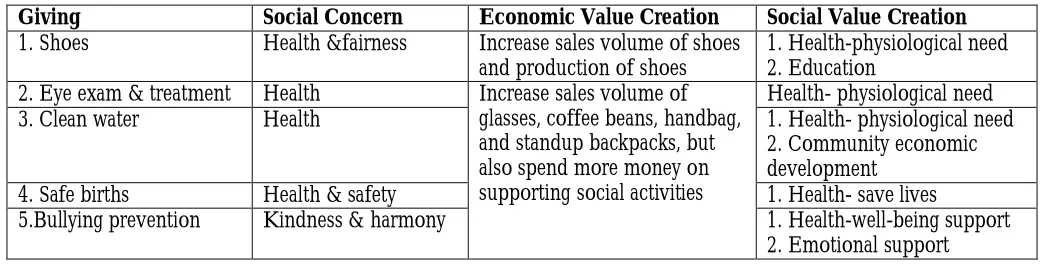
Table 2: Derived economic and social value from social concern
Giving Social Concern Economic Value Creation Social Value Creation
1. Shoes Health &fairness Increase sales volume of shoes and production of shoes
1. Health-physiological need 2. Education
2. Eye exam & treatment Health Increase sales volume of glasses, coffee beans, handbag, and standup backpacks, but also spend more money on supporting social activities
Health- physiological need
3. Clean water Health 1. Health- physiological need
2. Community economic development
4. Safe births Health & safety 1. Health- save lives
5.Bullying prevention Kindness & harmony 1. Health-well-being support
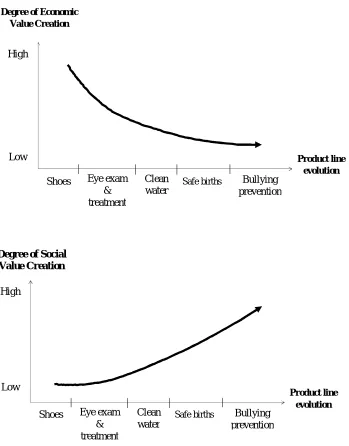
Figure 1: Increasing and decreasing degree of economic & social value creation
With the given figure 1, this paper proposes that the social mission is interrelated value pairing design based on the underlying meanings of the given gifts. Ultimately, shoes support education, proper eye care helps restore independence, clean water provides economic opportunity of constructing water systems for locals, safe birth helps with giving life to bullying prevention to rebuild dignity and self-respect. Figure 1 presents the escalating social value creation from the product lines. As reference, the value created by Aravind Eye Care System founded in 1976 by Dr. Venkataswamy, a retired ophthalmologist in Madurai is extraordinary. Aravind has helped restoration of sight for many of the desperately poor people in India. Auerswald (2009) has stated that the value to the patients of the service provided, restoration of sight is magnificent since it is restoring a basic human capability.
Degree of Economic Value Creation
Product line evolution
Shoes Eye exam
& treatment
Clean water
Safe births Bullying
prevention Low
High
Degree of Social Value Creation
Product line evolution
Shoes Eye exam
& treatment
Clean water
Safe births Bullying prevention High
Thus, social businesses like this derive their impacts not the from the market exchange but rather from the inherent value of the human lives that their actions help to preserve or enhance (Auerswald, 2009). It is undeniable that the ability to see is more valuable than receiving a pair of shoes even though they may be priced comparably.
Value evolution escalates through the model of pairing of consumer goods and social services. Through the stimulation of value combination design of the provided “gift” in regards to its field content for its target recipients, peculiar social value is generated. It is imperative to note that social enterprises are value-led, and market-driven (Westall, 2001). From giving the tangible shoes to a mix of tangible and intangible products and services to its recipients, TOMS has been vigilant to this one for one concept that there could be more substance in regards to social value. Hence, increasing value substance could be a method to create longstanding social improvements.
Therefore, it is fundamental for social entrepreneurs to adopt a mission to create and sustain social value, creating lasting social improvements what distinguishes social entrepreneurs from business entrepreneur and socially responsible business (Dees, 2001). Dees also indicated that being creative is not one time process but a continuous process of exploring, learning and improving. The model of pairing is illustrated in the table below as is selling comsumer goods and social services through its value combination design. With each purchase, the buyer is receiving a product and contributions to people in need through a nonprofit organization.
This paper prosposes a social value creation modelthat is derived from the one for one concept. Opting for the concept of CSR through one for one concept, social value could be generated either concurrently with economic value or through the path of the transformation from social advancement. In this research, we prevision this model to be applicable in other industries that also utilize the buy-one give-one model, ulitmately creating a blended value of the products sold.
The greatest potential for impact occurs when all aspects of social and economic performance can be blended according to Ridyley-Duff’s model (2005; 2009). As TOMS began manufacturing drives in Mainland China, Ethiopia and Argentina, TOMS furthered its social mission by helping establish, support, and grow a responsible plus sustainable shoe industry in countries such as Haiti.
Economic value
Deliver Create
Figure 2: Model of Social Value Creation One for one
concept
Social advancement Transform
Social change
Corporate Social Responsibility
Social valuecreation
This practice not only simulates local economy but also provide job opportunities. Thus, simply employing the buy-one give-one model is longer sufficient. Not only does TOMS need to stay socially aware, but also needs to stay fashion-focused. As this model is more replicated and adopted by various businesses, such novelty would eventually wear off. Henceforth, this business model would not solely enact as a brand differentiator anymore. Therefore, companies need to search for innovative ways to stand out.
The applicability of model is beginning to emerge in different industries and as more businesses adopt this model, benefits will likely diminish (Marquis and Park, 2014). This model has now been utilized in apparel, food & beverage, dental, beauty hygiene, school supplies, financial services, light, online platforms, as well as household goods. Thus, this paper proposes that companies that utilize this model will have to find methods to further this model.Therefore, characteristics of TOMS, social enterprises should stay alert at all times, resolve conflicts, as well as and encourage intra-organizational learning and communication (Chang, Hu and Huang, 2012). From social-embedded enterprises, the creation of value occurs simultanelously ranging from economic, socio-economic to social on a continuum (Gair, 2002).
5. Discussion
As a company with a CSR-based strategy, it does not only limit itself to collaborating with social businesses but fashion brands such as Ralph Lauren to develop a co-branded Polo Rugby Shoe, making it the first time Ralph Lauren has done a collaboration outside its own brand. The latest collaboration include limited-edition shoe designed exclusively for luxury German car company Audi for the summer of Audi Sales Event 2015. Hence, these forging partnerships with recognizable luxury brands mirror that these brands resonate with TOMS’ mission of giving. For TOMS, giving back to the community is an important part of any Corporate Responsibility program as it is already ingrained in its business model. Function and utility do not lie at the heart of the promotion of social products, but rather something different: an intangible quality that can best be described as appealing to the very foundation of a consumer’s social concerns and awareness by elevating the brand above their pedestrian counterparts.
As TOMS increases its prevalence in philanthropy through the one for one concept, up starting social enterprises that based their businesses on this concept must stay intact. It is imperative for upstart businesses utilizing the one for one business model to have good products that can create social value and an authentic story to tell for brand differentiation, as in the same market segment; there could be multiple companies involved.
In this case, TOMS has the first-mover advantage and therefore necessary for upstart companies to be innovative in regards to social value making. Mr. Mycoskie also mentioned that this one for one concept could be utilized in different industries such as banking and hospitality. The most current expansion for TOMS has included TOMS Cafes that serve TOMS Roasting Co. coffee. Hence, this paper foresees cross-industry innovation vis-à-vis cross industry collaboration for TOMS in the future. With these contexts, in the decades ahead, how different industries intersect with each other via the one for one concept will thus unequivocally be of immense interest.
6. Conclusion and Implication
As observed and with the aforementioned analyses, any action is critical. Overall, the social values which emerged from the one for one concept is closely knitted within the value pairing design. Besides having marketing benefits, consumers are attracted by the simplicity of a model, which includes a personal touch as consumers are actively engaged. With an increasing consumers regard for ethical consumption and social responsibility, the pursuit of CSR could become a source of competitive advantage (Cambra-Fierro and Polo-Redondo, 2008). Therefore, the providing of intangible benefits is of great importance as companies are more likely to attract employees, as well as consumers who are more cognizant of social issues.
The bottom line is that profit or loss in traditional business is overthrown with the concept triple bottom line factors of social equity, economic, as well as environmental factors. Overall, these three factors serve as a trio of sustainability pillars. Moreover, TOMS serves as a key example of the vitality of the triple value proposition in which the products works well, reasonably priced, and thus embed social value. Hence, by discrening CSR is quintessential for social businesses as it could help them stay at the forefront of producing quality products without having to compromise its social values.
Therefore, from giving donations to caring for economic prosperity, TOMS recognizes that values need to be transformed and that value giving is one of the essences of the one for one concept. Henceforth, it is with the ultimate pursuit of the coalescing aforesaid values that will amass heightened support for the recipients. Products with social meaning attachment needs to be conscientious of not losing its social spirit as losing its luster may prompt the product to fall into commonplace. Being conscientious could help companies stay at the forefront of producing quality products without having to compromise its social values.
With these analyses, this paper studies the driving forces behind such CSR strategies that can therefore be refined for future strategic proposals for social entrepreneurship based on thebuy-one give-one business model.
Acknowledgement
We would like to acknowledge Professor Jersan Hu for his assitance in this research.
References
Adkins, S. (1999). Cause Related Marketing: Who Cares Wins, Heinemann Butterworth, London. Auerswald, P. (2009). Creating Social Value. Stanford Social Innovation Review,Spring, 51-55.
Austin, J., Gutiérrez, R., Ogaliastri, E., and Reficco, E. (2006). Effective Management of Social Enterprises-Lessons from Businesses and Civil Society Organizations in Iberoamerica, Boston: Harvard Business School Press. Auty, S., and Elliot, R. (1998). Social Identity and the Meaning of Fashion Brands. European Advances in Consumer
Research,3, 1-10.
Benevuto, S. (2000). Fashion: Georg Simmel. Journal of Artificial Societies and Simulation, 3(2). Bourdieu, P. (1984). Distinction: A Social Critique of the Judgment of Taste. Routledge Classics.
Cambra-Fierro, J., and Yolanda Polo-Redondo, S.H. (2008). Environmental Respect: Ethics or Simply Business? A Study in the Small and Medium Enterprise (SME) Context, Journal of Business Ethics, 82: 645-656.
Chang, T., Hu, J., & Hwang, H. (2012). Dual-Value Driven Parallel Operating Systems and Interrelations of Resources in Social Enterprise. International Journal of Business and Management,7(22).
Darby, I. (1999). P&G Unveils Plan to Link Products to Good Causes, Marketing Magazine, 19th August, 1. Dees, J.G. (1998). Enterprising Nonprofits, Harvard Business Review, Vol. 76, pp.55-67.
Dees, J.G. (2001). The Meaning of “Social Entrepreneurship”. Center for theAdvancement of Social Entrepreneurship, Fuqua School of Business, Duke University. Retrieved from:
Deniz, M., and Cabrera, M. (2005). Corporate Social Responsibility and Family Business in Spain, Journal of Busines
Ethics 56, 27-41.
Einstein, M. (2012). Compassion, Inc: How Corporate America Blurs the Line Between What We Buy, Who We Are, and Those
We Help. University of California Press.
Gair, C. (2002). “A Report From the Good Ship SROI”. Retrieved from: http://www.socialreturns.org/docs/good_ship_sroi_gair.pdf
Gartner, W. (1985). A conceptual framework for describing the phenomenon of new venture creation. Academy of
Management Review, 10(4), 696-706.
Guclu, A., Dees, J. G.,& Anderson, B. B. (2002). “The process of social entrepreneurship: Creating opportunities worthy of serious pursuit.” Center for the Advancement of Social Entrepreneurship (CASE), Fuqua School of Business, Duke University
Hemingway, C., and Maclagan, P. (2004). Managers Personal Values as Drivers of Corporate Social Responsibility,
Journal of Business Ethics 50, 33-53.
Kotler, P. (1954). The Practice of Management. Harper Collins.
Lauring, J., and Thomsen, C. (2009). Collective Ideals and Practices in Sustainable Development: Managging Coporate Identity. Corporate Social Responsibility and Environmental Management 16, 28-47.
Mair, J., and Marti, I. (2006). Social Entrepreneurship Research: A Source of explanation, prediction and delight. Journal of World Business, 41(1), 36-44.
Marquis, C., and Park, A. (2014). Inside the Buy-one Give-one Model. Stanford Social Innovation Review,12(1), 28-33. McWilliams, A., and Siegel, D. (2001). Corporate Social Responsibility: A Theory of the Firm Perspective’, Academy of
Management Review 26. 117-127.
Morsing, M., and Beckman CS. (2006). Strategic CSR Communication. Djøf: Copenhagen.
Morsing, M., and Schultz M. (2006). Corporate Social Responsibility Communication: Stakeholder Information, Response and Involvement Strategies. Business Ethics: a European Review 15(4): 323-338.
Ridely-Duff, R.J. (2005).Communitarian Perspectives on Corporate Governance. Ph.D Thesis, Sheffield Hallam University. Ridely-Duff, R.J. (2009). Coaching for Performance: Evaluation Report for Nottinghamshire NHS County. Sheffield: Sheffield
Business School, Centre for Individual and Organizational Development.
Shaw, E. (2004). Marketing in the Social Enterprise Context: Is it Entrepreneurial? Qualitative Market Research: An
International Journal, 7(3), 194-205.
Veblen, T. (1899). The Theory of the Leisure Class: An Economic Study of Institutions. Macmillan.
Weerawardena, J., and Mort, G.S. (2006). Investigating social entrepreneurship: A multidimensional model. Journal of
World Business 41, 21–35.
Westall, A. (2001). Value, Led, Market Drvien- Social Enterprise Solutions to Public Policy Goals. London: The Institute of Public Policy Research.