Development of new Lemnaceae breeding technology using Apol-humus
and biogas plant waste**
Zdzisława Romanowska-Duda1 *, Krzysztof Piotrowski1, Natalia Jagiełło1, Marcin Dębowski2 , and Marcin Zieliński2
1Department of Plant Ecophysiology, Faculty of Biology and Environmental Protection, University of Łódź, Banacha 12/16, 92-237 Łódź, Poland
2Department of Environmental Engineering, Faculty of Environmental Sciences, University of Warmia and Mazury in Olsztyn, Warszawska 117, 10-720 Olsztyn, Poland
Received October 10, 2018; accepted December 21, 2018
*Corresponding author e-mail: [email protected]
**This work was financed by National Centre for Research and Development in Poland, Grant BIOSTRATEG2/296369/5/ NCBR/2016 (2016-2020).
A b s t r a c t. Numerous possibilities of Lemnaceae use (biofu-el production, supplementation of animal feed, phytoremediation, bioindication) as well as their cheap production and rapid growth offer many novel benefits. The experiment was carried out in laboratory conditions using Spirodela polyrrhiza plants. Plant cultivation was carried out in a phytotron room at 24°C, on the liq-uid standard “Z” medium which was supplemented with various concentrations of Apol-humus. Plant growth, chlorophyll index, net photosynthesis, transpiration, stomatal conductivity, intercel-lular CO2 concentration, fresh and dry weight were analysed. The obtained results indicated the beneficial effects of the addition of Apol-humus to the standard Z medium. The designed novel technologies were beneficial for the growth and development of
Spirodela polyrrhiza and produced plants with physico-chemical parameters which surpassed those of the control. Rapid growth, a high chlorophyll index, and a far more intensive gas exchange resulted from the presence of fulvic and humic acids as well as chi-tosan polymers in the medium which originated from Apol-humus and of the substances originating from the waste of methane fer-mentation. The obtained results confirmed previous assumptions and demonstrated the possibility of obtaining increased biomass of Spirodela plants and also the possibility of using it in biogas plants and for environmental protection.
K e y w o r d s : Spirodela polyrrhiza, Apol-humus, growth, physiological activity
INTRODUCTION
The global economic crisis created unmatched possi-bilities to develop modern energy production technology
based on renewable resources. An unstable oil market, political conflicts, the growth of the European popula -tion and climate change are among the major problems of
the modern world. According to a document adopted by
the Polish Government on the 22nd of December, 2007,
the increase in the use of final energy in Poland in 2025 will exceed 50%. In that case, meeting the energy needs
of both individual and business entities is impossible from
the economic point of view. Renewable energy is one of
the main strategies of sustainable development. The elec-tricity industry based on conventional sources of energy
is becoming less and less competitive and efficient, it is very costly and harmful to the environment. According to
EU commitments, Poland must increase its share of energy
from renewable resources to 15% by 2020. According to the Polish Central Statistics Office, in 2016 only 11% of
the energy used in Poland came from renewable resources. One of the most promising concepts of using renewable energy resources consists in creating agricultural biogas plants using waste biomass. The assessed amount of biogas produced from the available biomass is 5 billion m3. The
on both the availability and quality of substrates,
includ-ing biomass from field production and animal breedinclud-ing. A different biogas composition may be obtained depending
on the substrate used to produce various post-fermentation wastes. These wastes may be used as an organic fertilizer or as a media supplement for water plant cultivation for plants such as Lemnaceae. The use of post-fermentation waste
increases the profitability of substrate processing in biogas plants, moreover it remedies soil deficiencies in organic
compounds. This improves soil sorption and water reten-tion. Limiting the use of synthetic fertilizers, which are dangerous to the environment, is crucial for contemporary sustainable agriculture. The use of natural biopreparations in agriculture, favours the more effective utilization of soil nutrients, the limitation of stress factors and an increase
in yields. Apol-humus contains humus acids and chitosan
polymers. Humic substances occur naturally in soil, they comprise humic and fulvic acids. They have a compli-cated composition and are responsible for the storage of nutrients, soil structure, thermal conditions and for pH sta-bilization. They may originate from compost, peat, lignite
and minerals. Due to the beneficial effect of humic acids,
plants increase their intake of nutrients through an increase
in the cation exchange capacity of the soil, the precipita -tion of calcium phosphate and plant enzyme stimula-tion. The effect of these substances depends on their origin, dose, application method and environmental conditions
(Du Jardin, 2015). Apol-humus compounds originating from organic matter decomposition (amino acids, carbon
-ate residues, carboxylic, methoxy, hydroxyl and amino groups) stimulate plant growth and development. Their presence intensifies the important physiological processes of plants such as respiration and gas exchange. Plants sup -plemented with this biopreparation are more resistant to
stress and Apol-humus has a phytosanitary effect which
prevents the development of pathogenic microorganisms.
Chitosan is an important component of Apol-humus. In
plants, it activates many enzymes, increases cell wall per-meability and decreases the negative effects of harmful substances, it is an absorbent limiting pathogen develop-ment and it regulates pH in plant tissues. Chitosan in plants
occurs in the cation form which positively influences the
cation/anion balance through permanent anion binding
e.g. in chlorides, nitrates. The pragmatic use of energy from renewable resources, including biomass, is one of the crucial elements of sustainable development. That is why there is a growing demand for biomass produced by plants, including Lemnaceae, which are widely used in phytore-mediation and may be used to produce energy. The research was conducted to verify the hypothesis that
supplementa-tion with Apol-humus (Poli-Farm Spółka z o.o.) and waste
from biogas plants will stimulate Lemnaceae growth. The aim of the research was to investigate the potential of using
Apol-humus and waste to stimulate the growth and
develop-ment of the water plant Spirodela polyrrhiza and to obtain a greater yield of biomass for a multitude of applications.
MATERIALS AND METHODS
The tests were carried out in laboratory conditions using Spirodela polyrrhiza water plants, which were cha- racterized by a logarithmic growth phase and were grown on
liquid medium “Z” (Zehnder in Staub 1961). The research focused on the effects of various concentrations of Apol-humus and post-digestion effluents from biogas plants on
the growth and development of Spirodela polyrrhiza. In order to determine the most favourable concentration of
Apol-humus and digestate effluents from biogas plants, a wide concentration range was used in the experiment, and then each experimental variant was inoculated with the
shoot members of Spirodela polyrrhiza. The experimen -tal medium was prepared on the basis of previous results of macrophyte cultivation obtained at the Laboratory of
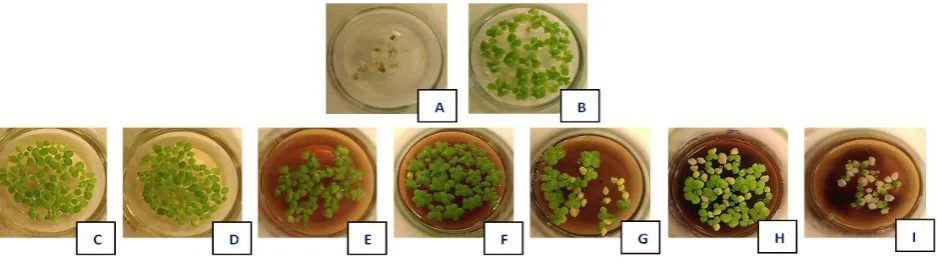
Plant Ecophysiology. The following experimental variants were prepared: A – tap water – Control 1; B – medium “Z” – Control 2; C – Apol-humus 0.01% + medium “Z”; D – Apol-humus 0.02% + “Z” medium; E – Apol-humus 0.04% + “Z” medium; F – medium “Z” + Apol-humus 0.5%; G – tap water + humus 0.5%; H – tap water + Apol-humus 1.0%; I – liquid waste from fermentation + tap water + Apol-humus 0.5%. Plant cultivation was carried out over
the course of 14 days in a phytotron room at 24°C, with
constant lighting (PHILIPS MASTER TL-D2 x 18W/840).
Plant growth kinetics was determined based on the
num-ber of fronds. All visible fronds were counted regardless of their surface size. The measurement of gas exchange parameters (net photosynthesis (Pn, µmol CO2 m-2 s-1), tran
-spiration (E, mmol H2O m-2 s-1), stomatal conductance (Gs,
mmol H2O m-2 s-1) and intercellular CO2 concentration (Ci,
µmol mol-1)) in Spirodela polyrrhiza was carried out with
a TPS-2 apparatus from PP Systems (USA). The chloro
-phyll index content was determined using a Konica Minolta SPAD-502 chlorophylometer. The test samples were placed
in an instrument clip, where they were subjected to a beam
of radiation (wavelength 650 nm). The device measures the
amount of light absorbed by chlorophyll. On the opposite side of the light source there is a photo-detector that showed the radiation value passing through the tissue. In order to make a correction of the obtained measurement, the light
(940 nm wavelength) absorbed by the remaining elements of the structure is measured (Pacewicz and Gregorczyk, 2009). All experiments were performed three times in 5
re-plicates for each treatment. Within each series, each repeti-tion was set up in a completely randomized block design. The data obtained, provided in the form of means from replicates, were processed by applying an analysis of
vari-ance (ANOVA), using Statistica 12. The means of chosen
parameters were grouped by employing Duncan’s test at
RESULTS AND DISCUSSION
During the production of conventional plants for ener-gy generation purposes various problems appear e.g. the availability of soils with an appropriate nutrient content, a reduction in crop biodiversity, the high costs of synthetic fertilizers, pesticides and herbicides, a high water demand. Water is a vital and indispensable natural resource and its value grows with increasing environmental pollution. That
is why it is crucial to develop cost-efficient technologies to clean it and make it reusable (Romanowska-Duda and Pszczółkowski, 2013). The use of macrophyte-originating
biomass does not require the use of synthetic plant protec-tion products, which means an absence of water polluprotec-tion,
thus the water may be reused (Fedler and Duan, 2011).
Water plants from the Lemnaceae family may be used for the phytoremediation of water reservoirs. They can accu-mulate more heavy metals and radionuclides compared to other macrophytes. The Lemna species is a hyperaccumu-lator and can store more than 1 mg kg-1 of its dry weight.
Biomass from Lemnaceae plants may be also be used as
animal feed. It contains significant amounts of lysine and
methionine, amino acids, which are more abundant in
animals than in plants (M). Lemnaceae plants have many potential applications, they can be used for biogas and
bio-fuel production, in biorefineries, for phytoremediation and as an animal feed supplement (Romanowska-Duda and Pszczółkowski, 2013). Currently it seems promising to use
water plants, mainly Lemnaceae, in biogas production as they rapidly produce large amounts of biomass, which is a perfect substrate, rich in valuable macro- and
microele-ments (Ge et al., 2012; Romanowska-Duda et al., 2018).
They can be cultivated in open reservoirs or in special lagoons. Duckweed mass doubles in 5-6 days under Polish climatic conditions, this means that 13 t of mass may be pro-duced from 1 hectare per year. It could be a valuable animal
feed for farm animals and wildfowl (Romanowska-Duda and Pszczółkowski, 2013). Lemnaceae also accumulate
heavy metals (Wechterowicz et al., 2005), municipal pol
-lution and nitrogen and phosphorus (Mkandawire and Dudeln, 2007).
During the experiment there were 2 controls: one on the “Z” medium (Zehnder in Staub, 1961) rich in macro-
and microelements which are optimal for plant growth and development and the other on tap water. In the latter variant, even on the second day the effects of a lack of
nutrients were visible (B). After 48-h culture, plant growth
was inhibited and shoot segments were light brown, which
reflects chlorophyll reduction and the lack of its synthesis.
This led to plant death.
Daily observations of the morphological features and counting the shoot segments revealed that the plants
react-ed variously to different concentrations of Apol-humus and liquid waste from methane fermentation (Fig. 1).
The number of shoot segments was the first parameter
to be analysed. During the 14-day observation period the
“Z” medium supplemented with 0.5% Apol-humus pro
-duced the best results (12% growth). The other “Z” plus Apol-humus variants (0.01, 0.02, 0.04%) also produced a greater (by 2-5 %) numbers of shoot segments. For com
-parison, waste remaining after methane fermentation (2% concentration) was used as the source of macro- and micro-elements. The mixture of liquid waste, tap water and 0.5% Apol-humus was the least effective, 85% growth inhibition
was observed in comparison with the control. For the tap
water and 0.5 and 1% Apol-humus variants plant growth was limited by 26-28% (Fig. 2-I).
After being cultured for 14 days the fresh weight of
Spirodela polyrrhiza was measured. The variants with
0.5, 0.01, 0.02, and 0.04% Apol-humus produced the best effects as compared with the “Z” medium only. The mix
-tures of tap water with 0.5 and 1.0% Apol-humus and of 2% liquid waste and 0.5% Apol-humus were the least effec
-tive, the fresh weight was 40-50 % lower compared with
the control. The results obtained demonstrate the positive
effect of Apol-humus on Spirodela polyrrhiza growth and
development (Fig. 2-II).
The chlorophyll (a+b) content index and gas exchange parameters (net photosynthesis, transpiration, stomatal
conductance and concentration of intercellular CO2) were
also analysed in Spirodelapolyrrhiza. The results obtained
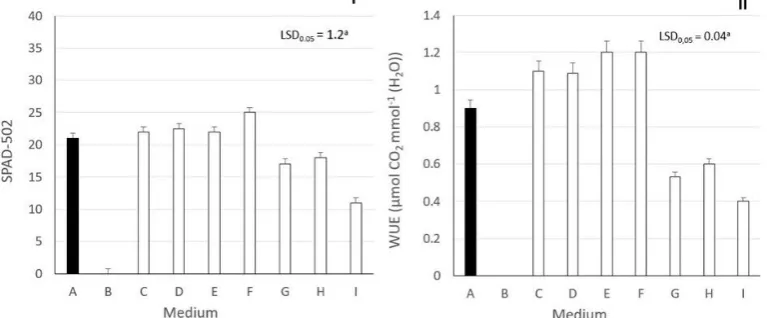
confirmed a chlorophyll content increase caused by all Apol-humus concentrations applied with the “Z” medium compared with the control (“Z” medium). The best results were produced by 0.5, 0.04, 0.02 and 0.01% Apol-humus variants, the chlorophyll index in shoot segments increased by 20-25% (Fig. 3-I). The variants with tap water and 0.5 or 1.0% Apol-humus were the least beneficial, producing a decrease in the chlorophyll index by 30-50% compared
with the control. Water use efficiency (WUE) was higher in variants plus 0.5 and 0.04% Apol-humus (by 30%) and plus 0.01 and 0.02% Apol-humus (by 21%) compared with con -trol. The least effective variants as far as WUE is concerned
were tap water plus 0.5 and 1.0% Apol-humus, (decreases by 41 and 48% were observed) and liquid waste plus 0.5% Apol-humus, (decrease by 66%) as compared with the con
-trol (Fig. 3-II).
Net photosynthesis in Spirodela polyrrhiza plants
increased by 8% in the variants with the medium sup
-plemented with 0.04 and 0.02% Apol-humus, the other Apol-humus concentrations had the same parameter. For the tap water, 2% liquid waste and 0.5% Apol-humus vari
-ant net photosynthesis dropped by 50% as compared with the control (Fig. 4-l). Transpiration intensity increased by
Fig. 2. Number of fronds (I) and fresh biomass (II) of Spirodela polyrrhiza L. Schleid. plants cultivated invitro in laboratory conditions, supplemented with different variants of Apol-humus over the course of 14 days: A – tap water - Control 1; B – medium “Z” – Control 2; C – Apol-humus 0.01% + medium “Z”; D – Apol-humus 0.02% + “Z” medium; E – Apol-humus 0.04% + “Z” medium; F – medium “Z” + Apol-humus 0.5%; G – tap water + Apol-humus 0.5%; H – tap water + Apol-humus 1.0%; I – liquid waste from fermentation + tap water + Apol-humus 0.5%. Vertical bars denote ± SE. LSD at alpha level of 0.05.
Fig. 3. Index of chlorophyll content (I) and water use efficiency WUE (II) in the fronds of plants Spirodela polyrrhiza L. Schleid. cultivated in vitro in laboratory conditions, supplemented with different variants of Apol-humus over the course of 14 days: A – tap water – Control 1; B – medium “Z” – Control 2; C – Apol-humus 0.01% + medium “Z”; D – Apol-humus 0.02% + “Z” medium; E – humus 0.04% + “Z” medium; F – medium “Z” + humus 0.5%; G – tap water + humus 0.5%; H - tap water + Apol-humus 1.0%; I – liquid waste from fermentation + tap water + Apol-Apol-humus 0.5%. Vertical bars denote ± SE. LSD at alpha level of 0.05.
5% in the 0.04% Apol-humus variant. In the “Z” plus 0.01, 0.04 and 0.5% variants this parameter was close to the con
-trol value. In the tap water and 1.0% Apol-humus variant transpiration dropped by 50% in comparison with the con
-trol. In the tap water, 2% liquid waste and 0.5% Apol-humus variant net photosynthesis dropped by 70% as compared with the control (Fig. 4-II). Stomatal conductance increased in all experimental variants except for the tap water, 2% liquid waste and 0.5% Apol-humus experiments, where a 50% decrease was observed as compared with the control. The highest increase (by 16%) was observed in the “Z” plus 0.04% Apol-humus variant, increases by 14, 10 and 7% were noted in “Z” plus 0.5, 0.02% and 0.01% Apol-humus, respectively (Fig. 4-IIl). The intercellular CO2
concentra-tion was increased by 20% than it was for the control in the 0.01, 0.02, 0.04 and 0.5% Apol-humus variants. In the tap water and 0.5 and 1.0% Apol-humus it increased by 2-5%. In the tap water, 2% liquid waste and 0.5% Apol-humus variant this parameter dropped by 40% (Fig. 4-IV).
In Poland, the use of plant biomass for energy gen-eration surpasses other processes of energy production from renewable resources. The development of a novel, innovative technology for its production enhances the pos-sibility of diversifying Polish sources of energy, increasing energy security and reducing greenhouse gas emissions. The choice of an appropriate plant species will result in greater biomass yield, a higher heating value and resistance to unfavourable environmental conditions. Fast-growing
Lemnaceae (Les et al., 2002) provides a good alternative
raw material for bioethanol production.
These plants accumulate large amounts of starch (up to 46% dry weight), contain relatively low levels of lignin (1-3%), and can utilize a wide range of nutrients thus they can be cultivated on wastewater (Cui and Cheng, 2015; Cheng and Stomp, 2009; Basiglini et al., 2018; Pszczółkowska et
al., 2019). This type of production allows for the utilization
of water from sewage treatment plants thereby
addition-ally limiting the production costs. Recovered liquid waste
used for water plant cultivation may come from industrial, agricultural and municipal wastewater. The results obtained
justify the use of the biostimulators, Apol-humus and of
liquid waste from the fermentation of water plant culture.
The supplementation of macrophyte culture with a mix -ture of humic substances at appropriate concentrations is
beneficial for Spirodela polyrrhiza growth and development and may be used to increase water plant yield in industrial and commercial production. There is a lot of information available concerning the use of biostimulators in water plant culture. However, there is as yet no information
concern-ing the influence of Apol-humus over the growth of water macrophyte. Kalčíková et al. (2016) showed that the use
of humic acids in Lemnaceae culture might increase
chro-mium phytoextraction from the water environment. The presence of humic acid reduced Cr(VI) to Cr(III), which
indicates that humus biostimulators may be used to remove heavy metals from water. Winck et al. (2016) described the
positive effect of fertilizing Leptospermumscoparium with biosolids. The term biosolids is used with regard to a few types of treatments, which may be used as soil condition-ers. Their use increased the length of plants by 9 to 13 fold as compared with the controlled ones. Moreover, Gonzga et al. (2017) and Romanowska-Duda et al. (2019) showed the positive influence of biosolids on Zea mays and Sorghum
growth and development.
CONCLUSIONS
1. The results obtained demonstrated the positive effect
of Apol-humus and liquid waste on Spirodela polyrrhiza
growth and shoot segment development.
2. The best effect was obtained with 0.5% Apol-humus followed by its 0.04, 0.02 and 0.01% concentrations as
compared with the “Z” medium control. The tested plant
was highly sensitive to Apol-humus.
3. The results obtained using tap water and Apol-humus
variants were similar to those obtained using the “Z”
medi-um, this confirmed the positive effect that the biostimulant
had on the macrophytes.
4. The analyses of the physicochemical parameters
indicated that Apol-humus increased the rate of water plant multiplication. The use of biostimulators such as Apol-humus may increase the efficiency of biomass production
by the water plant, Lemnaceae. This may help to lower the costs and intensify the production of biomass, which may be a perfect substrate for biogas plants.
Conflict of interest. The Authors do not declare conflict
of interest.
REFERENCES
Basiglini E., Pintore M., and Forni C., 2018. Effects of treated industrial wastewaters and temperatures on growth and enzymatic activities of duckweed (Lemna minor L.). Ecotoxicol Environ Saf., https://doi.org/10.1016/j. ecoenv.2018.01.053
Cheng J. and Stomp A.M., 2009. Growing duckweed to recover nutrients from wastewaters and for production of fuel etha-nol and animal feed. Clean, 37(1), 17-26, https://doi. org/10.1002/clen.200800210
Cui W. and Cheng J.J., 2015. Growing duckweed for biofuel production. Plant Production, 17, 16-23, https://doi. org/10.1111/plb.12216
Du Jardin P., 2015. Plant biostimulants: definition, concept, main categories and regulation. Scientia Horticulturae, 196, 3-14, https://doi.org/10.1016/j.scienta.2015.09.021
Fedler C.B. and Duan R., 2011. Biomass production for bioen-ergy using recycled wastewater in natural waste treatment system. Resources, Conservation and Recycling, 55, 792-800, https://doi.org/10.1016/j.resconrec.2011.04.001
Ge X., Zhang N., Phillips G.C., and Xu J., 2012. Growing Lemna minor in agricultural wastewater and converting the duckweed biomass to ethanol. Bioresource Technol., 124, 485-488, https://doi.org/10.1016/j.biortech.2012.08.050
Gonzaga M., Mackowiak C.L., and Comerford N.B., Flávio da Veiga Molineb E., Shirley J.P., and Guimaraes D.V.,
2017. Pyrolysis methods impact biosolids-derived biochar composition, maize growth and nutrition. Soil Till. Res., 165, 59-65, https://doi.org/10.1016/j.still.2016.07.009 Kalčíková G., Vávrová M., and Zagorc-Končan J., 2016.
Seasonal variations in municipal landfill leachate quality. Management of Environmental Quality: An Int. J., 22(5), 612-619, https://doi.org/10.1108/14777831111159734
Les D.H., Crawford D., and Kimball R., 2002. Phylogeny and systematics of lemnaceae, the duckweed family. Systematic Botany, 27(2), 221-240.
Mkandawire M. and Dudeln E.G., 2007. Are Lemna spp. effec-tive phytoremediation agents? Bioremediation, Biodiversity and Bioavailability, 1(1), 56-71.
Pacewicz K. and Gregorczyk A., 2009. Comparision values of chlorophyll content by chlorophyll meter SPAD-502 and N-tester. Folia Pomer. Univ. Technol. Stetin. 2009 Agric., Aliment., Pisc. Zootech., 269(9), 41-46, https://doi. org/10.21005/aapz2018.46.2
Pszczółkowska A., Pszczółkowski W., and Romanowska-Duda
Z., 2019. Potential of Chlorella vulgaris culture for waste treatment from anaerobic biomass biodigestion at the Piaszczyna (Poland) integrated facility. J. Phycology; htt-ps://doi.org/10.1111/jpy.12856
Romanowska- Duda Z., Grzesik M., Janas R., 2019. Maximal Efficiency of PSII as a Marker of Sorghum Development Fertilized With Waste From a Biomass Biodigestion to Methane. Frontiers in Plant Sciences, 9, 1920; DOI:10.3389/ fpls.2018.01920
Romanowska-Duda Z., Piotrowski K., and Dziugan P., 2018.
Utilization of Waste from Methane Fermentation in Lemnaceae Plant Breeding Intended for Energy Purposes. In: Renewable Energy Sources: Engineering, Technology, Innovation (Eds K. Mudryk, S. Werle) Springer Proc. in Energy. Springer, Cham, https://doi. org/10.1007/978-3-319-72371-6_26
Romanowska-Duda Z. and Pszczółkowski W., 2013. Lemnaceae
biomass an alternative substrate for renewable energy. Acta Innovations, No 9. http://www.proakademia.eu/en/acta-innovations/publications/number2013/no-9/237.html
Wechterowicz Z., Rajkowska M., and Protasowicki M., 2005.
Common duckweed (Lemna minor) as a potential bioindi-cator of heavy metal pollution of freshwaters. Chemia i Inżynieria Ekologiczna, 12(10), 1155-1161.
Winck F.V., Riaño-Pachón D.M., and Franco T.T., 2016. Advances in microalgae biology and sustainable applications. Frontiers in Plant Science, 7, article 1385. DOI: 10.3389/ fpls.2016.01385
Zehnder in Staub R., 1961.