COORDINATE INFLUENCE ON SINGULARITY OF A 3-UPS
PARALLEL MANIPULATOR
A. Rahmani Hanzaki* and E. Yoosefi
Shahid Rajaee Teacher Training University, Lavizan, Tehran, Iran
Received: 12/7/2011 Accepted: 29/8/2011 Online: 11/9/2011
ABSTRACT
This paper shows the coordinates influence on singularity of a three degree-of-freedom structure, namely, three-Universal-Prismatic-Spherical (3-UPS) parallel manipulator. Rotational coordinates, which are chosen to define the orientation of the platform, affect the singularity of the manipulator. Euler parameters, which don't have any inherent geometrical singularity are utilized, however they are dependent coordinates. This paper shows the advantage of Euler parameters rather than Euler angles as the rotational coordinates for the manipulator. Additionally, the real loci of singularity for the manipulator due to its structure are predicted.
KEYWORDS
:
Singularity analysis, 3-UPS, Euler parametersINTRODUCTION
Singularity is an important issue in kinematic and dynamic analyses of multibody systems like robot manipulators and mechanisms, in which several classification methods have been described in articles. Gosselin and Angeles [1] divided singularity of closed-loop systems into three main groups, which are based on the properties of the Jacobian matrices of the manipulator. The first type of singularity (inverse kinematics singularity) occurs when the manipulator reaches internal or external boundaries of its workspace and the output link loses one or more DOFs. The second type of singularity (direct kinematics singularity) occurs when the output link has a finite motion whereas all the actuated joints are locked. In other words, the DOF of the output link increases by one or more. Third type (combined singularity) is related to linkage parameters and occurs when both first and second type of singularity are involved simultaneously.
Later on, Ma and Angeles [2] classified singularity phenomenon of multibody systems into three categories based on nature of mechanisms, which are: 1) Architecture singularity due to certain structural design of the manipulators; 2) Configuration singularity because of a particular arrangement of the manipulator; and 3) Formulation singularity, which is consequence of mathematical modeling and can be avoided simply by changing the formulating method. The third type of singularity is the subject of this article.
Many researchers have investigated singularity of multibody systems by using the properties of the Jacobian matrices [3-13]. In [3-6], it is shown that singularity of the manipulators in a particular configuration is caused by formulation singularity.
*
dynamics simulation of a multibody system requires the kinematics equations and the equations of motion to be solved simultaneously, which needs to consider
singularity due to some
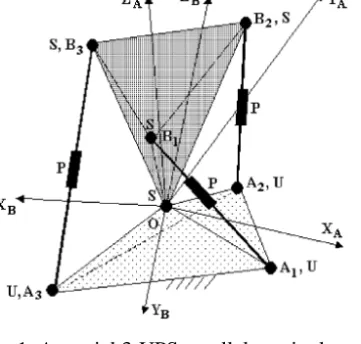
coordinates failure at a particular configuration of a manipulator. The purpose of the present work is to illustrate the influence of coordinates on singularity of a 3-UPS parallel manipulator. The manipulator considered in this study is depicted in Fig. (1), where two pyramid-like rigid bodies are connected together by a spherical pair at the common apex O. The outputs of the manipulator are three angular motions of moving a platform.Related to this structure, Alici and Shirinzadeh [3] presented a method based on the determinants of the Jacobian matrices to generate the singularity contours of a 3-UPS parallel manipulator in terms of output orientation using Euler angles. [14] and [15] are presented as singularity analysis of manipulators using geometrical approaches. Although, the methods are independent of any coordinate system, they are not useful for simulation. Hence, they are not include in the current research.
At first, this article describes some coordinates that are employed for representing the rotation of a body. Then the singularity contours of the 3-UPS manipulator are generated employing Euler parameters. As a result, singularity contours output in particular configurations are compared with results shown in [3] to show the formulation singularity of Euler angles. This emphasizes the fact that Euler parameters don't have any formulation singularity and are more useful in kinematic and dynamic analyses.
Fig. 1. A spatial 3-UPS parallel manipulator.
ROTATIONAL DESCRIPTION OF A BODY
A free rigid body in space requires six independent coordinates to determine its configuration of which three specify its translation and the other three specify its rotation.
One of the most important causes of singularity, which has been specified, is the coordinates describing orientation of the body. Some of the more common rotational coordinates are Euler angles, Euler parameters, direction cosines and Rodriguez parameters.
EULER ANGLES
(1)
For inverse kinematics problem, X-Y-Z Euler angles have singularity at pitch values of:
(2)
It is thus only suitable for describing vehicles that do not perform vertical or inverted maneuvers, such as land vehicles, boats and ships, and transport aircraft. All Euler angle sequences have this type of singularity in a particular configuration. For more details one can refer to [17].
EULER PARAMETERS
Euler parameters are defined based on the Euler theorem, which states that the orientation of a rigid body with one point fixed can be defined using rotation about an imaginary axis by an angle φ at any instant of
time. Accordingly, the Euler parameters are established as:
(3) where u is the imaginary axis, which the rotation of the body happens about. From Eq. (3), it is obvious that the sum of the squares of Euler parameters is equal to one. In other words:
(4) The rotation matrix, R, based on the Euler parameters, is thus obtained as:
(5) In inverse problem, Euler parameters can be determined by the following equations:
(6)
The inverse process in determining the Euler parameters shows that there is no singularity associated with these parameters. But the disadvantage of Euler parameters is that they are dependent, i.e., the existence of Eq. (3).
RODRIGUEZ PARAMETERS
Rodriguez parameters are similar to Euler parameters and are defined based on the Euler theorem. Rodriguez parameters are three independent parameters:
(7)
The rotation matrix R, based on the Rodriguez parameters, is represented as:
(8)
The Rodriguez parameters have a singularity at φ = ±180°.
SINGULARITY ANALYSIS
The nonlinear kinematic equations describing the relationship between input and output position vectors are expressed as:
(10)
where C and D are configuration-dependent Jacobian matrices, and represent the actuator velocity vector and the end effector (platform) velocity vector, respectively.
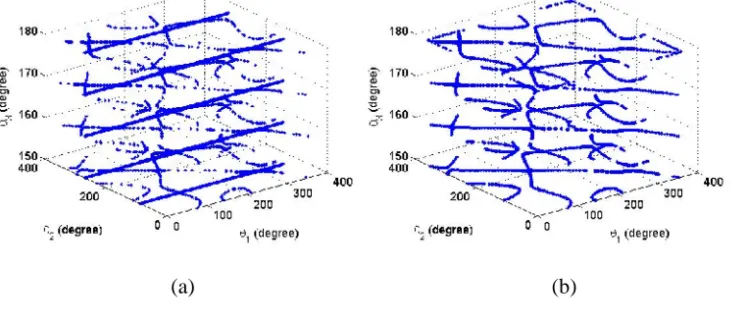
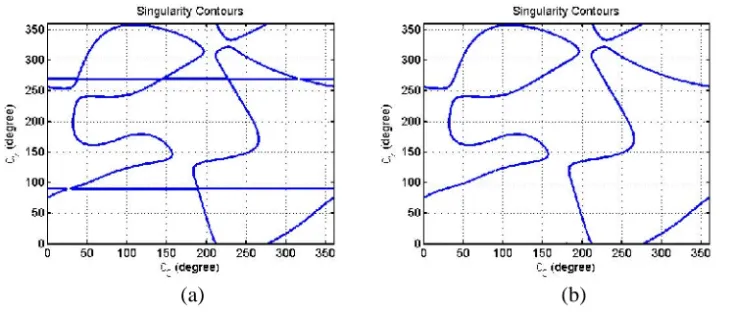
In this paper, the singularity contours in output angles represent inverse kinematics singularity and occur when det(D)=0 is shown. To compare the influence of Euler angles and Euler parameters on singularity, Eq. (10) is solved twice: first using X-Y-Z Euler angles, and second using Euler parameters then converting it to the same set of Euler angles. The outcomes are indicated in Figs (2) and (3). Figs (4) and (5) represent some particular configuration since Fig. (2) is not sufficiently clear and comparable.
(a) (b)
Fig. 2. Singularity contours while operation range of platform is , ,
(a) based on Euler angles and (b) based on Euler parameters.
(a) (b)
(a) (b)
Fig. 4. Singularity contours at , (a) based on Euler angles and (b) based on Euler parameters.
(a) (b)
Fig. 5. Singularity contours at , (a) based on Euler angles and (b) based on Euler parameters.
The comparison of Figs. (4a) and (4b), and Figs. (5a) and (5b) shows that the two lines which appear in Figs. (4a) and (5a) depict singularity due to formulation, while the other curves are inherent singularity of the manipulator. In addition, the real loci of singularity for the manipulator due to its structure is predicted.
CONCLUSIONS
This paper presents coordinate influence on singularity of a 3-UPS parallel manipulator. The singularity contours of the manipulator are generated in terms of Euler angles and Euler parameters. This paper investigates the first type of singularity, which is classified on the basis of properties of Jacobian matrices. The comparison of the results shows the advantage of Euler parameters rather than Euler angles, as well as the real loci of singularity of the 3-UPS manipulator.
REFERENCES
[1] C. Gosselin and J. Angeles, "Singularity analysis of closed-loop kinematic chains," IEEE Transactions on Robotics and Automation, Vol.6, No.3, 281-290 (1990).
235, (2004).
[5] E. Ottaviano, C. Gosselin and M. Ceccarelli, "Singularity Analysis of CaPaMan: A Three-Degree of freedom Spatial Parallel Manipulator," IEEE International Journal of Robotics and Automation, Vol.2, 1295-1300 (2001).
[6] S. Briot and V. Arakelian, "Singularity Analysis of PAMINSA manipulator," Proc. 12th IFToMM World Congress, Besançon (France), June 18-21 (2007).
[7] Y. Lu, Y. Shi and J. Yu, "Determination of singularities of some 4-DOF parallel manipulators by translational/rotational Jacobian matrices," J. Robotica, Vol.27, 599-606, (2009).
[8] Y. Lu, B. Hu and P. Li-Liu, "Kinematics and dynamics analyses of a parallel manipulator with three active legs and one passive leg by a virtual serial mechanism," J. Multibody system dynamics, Vol.17, No.4, 229-241, (2007).
[9] J. Gallardo-Alvarado, J. M. Rico-Martínez and G. Alici, "Kinematics and singularity analyses of a 4-dof parallel manipulator using screw theory," J. Mechanism and Machine Theory, Vol.41, 1048-1061, (2006). [10] A. Sokolov and P. Xirouchakis, "Singularity analysis of a 3-DOF parallel manipulator with R-P-S joint structure, J. Robotica, Vol.24, 131-142, (2006).
[11] V. Arakelian, S. Briot and V. A. Glazunov, "Singular positions of a Paminsa parallel manipulator," J.Machinery Manufacture and Reliability, No.1, 62-69, (2006).
[12] C. H. Liu and S. Cheng, "Direct singular positions of 3RPS parallel manipulators," ASME J. Mechanical Design, Vol.126, 1006-1016, (2004).
[13] G. Yang, I. Chen, W. Lin and J. Angeles, "Singularity analysis of three-legged parallel robots based on passive-joint velocities," IEEE Transactions on Robotics and Automation, Vol.17, No.4, 413-422 (2001). [14] P. Ben-Horin and M. Shoham, "Singularity analysis of a class of parallel robots based on Grassmann–
Cayley algebra," J. Mechanism and Machine Theory, Vol.41, 958-970, (2006).
[15] A. Wolf, E. Ottaviano, M. Shoham and M. Ceccarelli, "Application of line geometry and linear complex approximation to singularity analysis of the 3-DOF CaPaMan parallel manipulator," J. Mechanism and Machine Theory, Vol.39, 75-95, (2004).
[16] A. A. Shabana, "Computational Dynamics," Wiley & Sons, (2001).