An Efficient Blind Watermarking Method based
on Significant Difference of Wavelet Tree
Quantization using Adaptive Threshold
Thien Huynh The
University of Technical Education Ho Chi Minh City, HCM City, Vietnam Email: [email protected]
Thuong Le Tien
Ho Chi Minh City University of Technology, HCM City, Vietnam Email: [email protected]
Abstract—In this research, we introduce an efficient blind watermarking method for gray image based on wavelet tree quantization using adaptive threshold in extraction process. Based on difference value between two largest coefficients, each scrambled binary watermark bit is embedded into each block which created by four LH3 coefficients and one LH4 coefficient. In extraction process, we compare difference value in each block to adaptive threshold to recover watermark bit. The quality of extracted watermark depends on the threshold which is determined by the Weighted Within-Class Variance algorithm. Performance of proposed method is represented through experimental results under various attacks such as, Histogram Equalization, Cropping, Low-pass Filtering, Gaussian noise, Salt & Pepper noise and JPEG compression.
Index Terms—blind watermarking, 3-level DWT, significant difference, adaptive threshold, within-class variance
I.INTRODUCTION
Due to the advantage of the Internet, people can arbitrarily and access or distribute digital products. Hence, the digital watermarking technique has been used in multimedia products to protect copyright and authenticate image... This technique embeds information into the digital contents so that the viewer cannot see any information. However, there are many problems in the watermarking system: the watermark has to ensure not degrading the quality of the cover image and being perceptually invisible for human eyes; the watermark must be robust to resist different attacks and the watermarking system is blindness.
Several wavelet tree-based watermarking methods are proposed based on the qualified significant wavelet tree (QSWT) [1, 2, 4, 5, and 6]. In [1], the authors embedded watermark in each of two sub-bands of wavelet tree. The authors in [2] improved the method in [1] by using four trees to represent two watermark bits to enhance visual
Manuscript received February 10, 2013; revised May 20, 2013.
quality. But this method’s disadvantage is that it cannot effectively resist low-pass filtering attacks such as median filtering and Gaussian filtering. The authors in [3] proposed the method based on significant difference quantization technique; that is, every seven-wavelet coefficients in 3-level DWT sub-band was grouped as a block and the watermark bit is embedded by quantizing the difference between two largest coefficients. Based on insignificant coefficients of a wavelet tree, the authors proposed the method that improved the quality of the watermarked image, but the quality of recovery watermark was decreased. An intelligent watermarking method based on particle swarm optimization (PSO) in [5] is the improved method in [3]. This method has been resolved the conflict between imperceptibility and robustness of watermarking by selecting randomly coefficients to make up a block to avoid the watermark being detected and the strength of embedding watermark among different blocks is adaptive by PSO method to balance the robustness and perceptual transparency. By scaling the magnitude of the significant difference between the two largest wavelet coefficients in a wavelet tree, the authors [6] improved the robustness of the watermarking. However, extracted watermark cannot ensure the quality under JPEG compression. Embedding the information into the significant wavelet coefficient in those dynamic blocks with strong edges according to a "Binary Algorithm" was proposed in research [7]. Since the change to the blocks with strong edge strengths is less visible to human eyes. The threshold in extraction process was limited by the demanded size of the watermark.
authors in [10] embedded watermark by modifying the center coefficient in each block and the value of this coefficient depend on the watermark bit and the mean of four cross neighbor coefficients. Another way to group was represented in [11]: LH3 and HL3 sub-band are divided into equal four sections. Each block was grouped by one coefficient in each section. Before that, the basic method is proposed in [12] embedding each watermark bit by comparing the difference of two largest significant coefficients in each wavelet tree to the average value. The maximum coefficient was modified based on value of watermark bit. In [13], the authors embedded each pixel of watermark into the wavelet coefficient of middle and low frequency of a block in the cover image. However, the proposed method is non-blind watermarking system; that is, using original image for extraction process. Additions, the authors in [14] used a re-watermarking approach employing blind, quantization-based and robust technique to embed multiple fingerprinting. They investigated two extensions to a wavelet coefficient-tree based embedding technique that turn out to improve detection performance.
In this research, an efficient blind watermarking method for image based on the significant difference of wavelet coefficients is developed from [3]. Due to the importance of determining threshold value in extraction process, this value could be determined based on the probability density function (pdf) of blocks along difference values instead of proposed algorithm in [3]. By computing the weighed within-class variance [15], we separate pdf plot into two parts and the difference value chosen as threshold has minimum variance. Simulation results under different attack cases demonstrate method's performance through PSNR of embedded image and NC of extracted watermark.
II.THE PROPOSED METHOD
A. The Watermarking Method
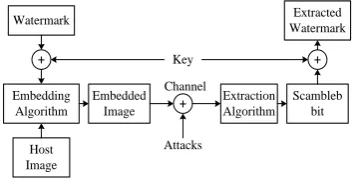
Watermarking model is represented in Fig. 1. The watermark after scrambling with security key will be hid into the host image. We decompose this image at 4-level DWT to four sub-bands. Based on the wavelet tree technique, three are three super wavelet trees: HH3-HH3-HH2-HH1 is easily eliminated when using the JPEG lossy compression. HL4-HL3-HL2-HL1 is suitable to embed the watermark in this paper to satisfy extracting watermark under different attacks instead of LH sub-band family. To limit computing capacity, we only choose HL4 and HL3 for embedding process.
Host Image Embedding
Algorithm Watermark
+ Key
Embedded Image
Extraction Algorithm
+
Extracted Watermark
Channel
+
Attacks
Scambleb bit
Figure 1. Watermarking model.
We have size of HL3 after decomposing is
when using image. There are watermark
bits are embedded into blocks, which are grouped based on wavelet tree as Fig. 2; that is, one coefficient of HL4 and four coefficients of the same orientation in the same location in HL3 are grouped as a block. Each wavelet tree consists of coefficients for a wavelet tree constructed at each node from HL4 to HL3. Each 4-level sub-band, we have 1024 coefficients which is the maximum number of watermark can be embedded.
However, due to watermark with size , we only need 512 blocks in embedded and extraction algorithm. For embedding process, we modify the maximum coefficient by the fixed quantity, – called quantization value, based on the significant difference of two largest coefficients in each block and value of watermark bit. This value is the mean of all significant difference values of all image used. For one image, we can find this value as follows:
1
1
(
)
N
i i
i
max
sec
N
(1)where N: number of blocks,
max
i andsec
i are twolargest coefficients in
i
th block. For many images, we have:1
1
mj
T
j
m
………..………..(2)where m: number of images. The images are considered in simulation include Lena, Baboon, Pepper, Goldhill and Sailboat. The value of each image and average of them is represented in TABLE I. The quantization value used in this paper is the mean of all above images.
TABLE I. QUANTIZATION VALUE OF EACH IMAGE
Image Lena Baboon Pepper Goldhill Sailboat
ℰ 25 41 38 38 58
T=Average
40
B. The Embedding Process
Comparing significant difference to threshold to extract watermark bit
Embedded Image
HL1 HH1 LH1 LH2
HL2 HH2 LH3 HL3 HH3
1 2 3 4 5
Extracted Watermark
4
1 2 3 4
Coefficient of the HL4
Figure 2. Embedding watermark based on wavelet tree quantization
gray image. In each block, we seek two values:
max
i-the largest coefficient and
sec
i - the second largestcoefficient and significant difference
(
)
i
max
isec
i
. Fori
th bit of watermark, weperform the embedding algorithm as the following steps for block:
With watermark bit 1:
i ; (; ( i ))
i i
max if T i max if T
max
(3)where
T
iWith watermark bit 0:
/ 2
i i i
max
max
sec
i
sec
i
i/ 2
(4)
The quality of embedded image depend on value T in the case we use same watermark. The detailed of embedding process can be showed in Fig. 3.
Host Image HL3 subband Binary watermark Embedding Algorithm 1024 blocks 3-level DWT pseudo-random sequence È Embedded
Image HL3 subband 1024 blocks
Scramble
IDWT
Restructure HL4 subband 4-level DWT
Figure 3. The flowchart of embedding process.
C. The Extraction Process
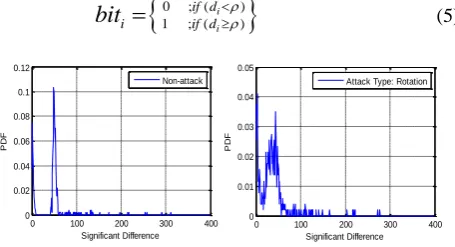
Watermark bit embedded into each block can be recovered based on comparing significant difference to threshold - denoted as . After embedding, difference in each block of cover image will be 0 or larger than as (3) and (4). In with non-attack case, watermark is extracted exactly when the threshold in the range
(1
y
)
. However, this value can be changed in different attack cases; that is, extracted bit is 1 instead of 0. When find out the threshold , we can extracted as below equation:
0 ; ( )
1 ; ( )i i if d
i if d
bit
(5)0 100 200 300 400 0 0.02 0.04 0.06 0.08 0.1 0.12 Significant Difference P D F Non-attack
0 100 200 300 400 0 0.01 0.02 0.03 0.04 0.05 Significant Difference P D F
Attack Type: Rotation
Figure 4. Probability density function
x n
( )
of significant differenceof cover image
We can consider the probability density function
( )
x n
of significant difference in Fig. 4. The function( )
x n
represents the number of block having the samedifference value. Without attacks, we can determine the threshold value to extract watermark exactly. However, the change of pdf is very light under some attacks, such as, histogram equalization, Gaussian filter; otherwise, some attacks affect pdf extreme seriously, such as average filter. In these cases, we cannot extract correctly encoded watermark; it can be explained that the watermark bit 0 are embedded, significant differences will be 0; however under various attacks, they are larger than value
.Significant difference of each block
Average value ℰ
Modified significant difference value
Weighted within-class variance
Determine adaptive threshold y
Compute average value
(1) (2)
Seek the minimum value
Figure 5. The flowchart for determining threshold
In this paper, we proposed an algorithm to determine adaptive threshold based on computing the weighed within-class variance. In more detail, we find the threshold that gets minimized the weighted within-class variance, or this turn out to be the same as maximizing the between-class variance. However, we need to modify significant difference of the blocks which have . This preprocess does not affect the quality of recovery watermark because these blocks will extract exactly since threshold value is always less than . The proposed algorithm for determining threshold is showed in Fig. 5. The process (1) in Fig. 5 can be performed as follows:
; ( ) ; ( )i i
i d if d
i if d
d
(6)The detailed process (2) in Fig. 5 can be calculated as:
2 2 2
0 0 1 1
( )
( )
( )
( )
( )
w
d
W d
d
W d
d
…….(7)where class probabilities and are
estimated: 0 1
( )
( )
d iW d
p i
( )
1
( )
( )
i max d
i=d+1
W d
p i
(8)
And the class means are given by:
0 1 0
( )
( )
( )
d ii
p i
d
W d
( ) 1 1 1( )
( )
( )
i max d i di
p i
d
W d
(9)Finally, the individual class variances are:
2 2 0 0 1 0
( )
( )
(
( ))
( )
d ip i
d
i
d
( )
2 2
1 1
1 1
( )
( )
(
( ))
( )
i max d
i d
p i
d
i
d
W d
These calculation steps were done through the range of value
d
i
[0,
max d
( )]
i and pick out the value thatminimized
2
( )
d
W
. The adaptive threshold is thesignificant difference value which has
(
2
min
)
W
. Ifthere are many values, the threshold will be the mean of them:
2
( /
W( )
)
mean d
d
min
(11)After determining adaptive threshold, we use (5) to extract watermark.
III. EXPERIMENTAL RESULT
We use the peak signal-to-noise ratio PSNR to evaluate the quality between embedded image and original image. This formula is defined as follows:
2
10
255
10log (
)
PSNR
MSE
(12)where MSE is computed as below equation:
21 1
1
( , )
( , )
M N
i j
MSE
I i j
I i j
M
N
(13)where M and N are height and width of the image, respectively.
I i j
( , )
andI i j
( , )
are the grey value located at coordinate( , )
i j
of the original image and embedded image. After extracting, estimation for quality of extracted watermark is compared to the original watermark is express according the normalized correlation NC value:1 1
1
( , )
( , )
m n
i j
NC
w i j
w i j
m n
(14)where is the watermark of size.
w i j
( , )
and( , )
w i j
are the values located at coordinate( , )
i j
of original watermark and extracted watermark. Value of( , )
w i j
is set 1 if it is a watermark bit 1, otherwise, it is set -1 and similar tow i j
( , )
. So the value of( , )
( , )
w i j
w i j
is either 1 or -1. If number of bit extracted correctly is larger than 50%, the NC value is positive; otherwise, it is negative.A. With Non-Attack
In below the simulation, the gray-images used as cover images have size
(512 512)
and watermark is the binary image with size(16 32)
. Additions, we applythe Haar wavelets to decompose and reconstruct to cover image. Simulation result of embedding process showed in TABLE.II, all cover images in this simulation get good invisibility (PSNR larger than 41dB).
In the non-attack case, the watermark image is extracted from the cover image according using proposed determining threshold algorithm. Table. II shows the quality of recovered watermark with NC=1 for all images.
TABLE II. RESULT OF EMBEDDED IMAGE AND RECOVERY
WATERMARK
Image Lena Baboon Pepper Goldhill Sailboat
Original Image
Embedded Image
PSNR 45.86 46.88 44.00 44.53 41.64
MSE 1.0000 1.0000 1.0000 1.0000 1.0000
Watermark
B. With Geometric Attacks
Under various attacks, we only use image Lena for simulation. There are some geometric attack types are considered in this simulation, such as, cropping, scaling, rotation and Gaussian noise. For the cropping attack, pixel of image is dropped at the center of embedded image and they are replaced by gray value 0 pixels. In the scaling case, the host image is scaled to and then scale one more time to original size. For two last attack types, the cover image is rotated by small degree and added Gaussian noise with many different variances. The result of watermarking under geometric attacks is showed in Table. III. With the larger value T, the robustness of watermark will be increased but the invisibility of host image will be reduced. There is a tradeoff between the robustness of watermark and the transparency of host image.
TABLE III. NC OF EXTRACTED WATERMARK UNDER GEOMETRIC
ATTACKS
Attack Type Cropping
Watermark
NC
PSNR 11.67
0.64
Scaling Rotation 0.250 Gaussian Noise
33.88
0.99
29.44
0.86
28.1692
0.86
C. With Non-Geometric Attacks
TABLE IV. NC OF EXTRACTED WATERMARK UNDER
NON-GEOMETRIC ATTACKS
Attack Type Histogram Equalization
Watermark NC
PSNR 19.12
0.88
Gaussian Filter
Median Filter (3×3)
Average Filter (3×3) 39.86
0.98
35.14
0.97
33.58
0.95
Sharpening
25.27
0.88
D. With JPEG Compression
TABLE.V showed the simulation result in JPEG lossy compression with quality factor from 10 to 60 . When we compress the image with quality factor 10%, although the size on disk of image is very small, NC value of watermark is always greater than 0.57 and NC=1 for 60%.
E. Comparing to The Other Methods
TABLE V. NC OF EXTRACTED WATERMARK UNDER JPEG
COMPRESSION
Quality Factor 10%
NC Watermark
20% 30% 40%
PSNR
50% 60% 30.23 32.77 33.97 34.76 35.40 35.98
0.57 0.87 0.94 0.99 0.99 1.00
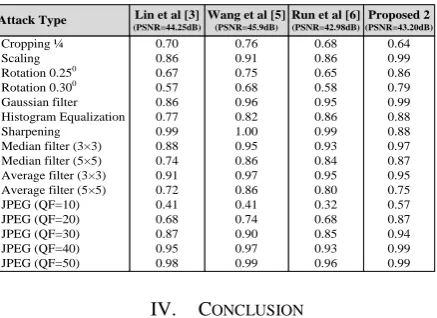
We compare our proposed method with some recently published papers: Lin et al [3], Wang et al [5], Run et al [6]. In our method, the experimental result is far better than the listed method, especially for JPEG lossy compression, scaling, rotation, low-pass filter, histogram equalization. Only cropping and sharpening, the proposed method is not good. Comparison is represented in TABLE.VI.
TABLE VI. COMPARING PROPOSED METHOD TO THE OTHER
METHODS
Attack Type Lin et al [3]
(PSNR=44.25dB)
0.70 0.86 0.67 0.57 0.86 0.77 0.99 0.88 0.74 0.91 0.72 0.41 0.68 0.87 0.95 0.98
Run et al [6]
(PSNR=42.98dB)
0.68 0.86 0.65 0.58 0.95 0.86 0.99 0.93 0.84 0.95 0.80 0.32 0.68 0.85 0.93 0.96
Wang et al [5]
(PSNR=45.9dB)
0.76 0.91 0.75 0.68 0.96 0.82 1.00 0.95 0.86 0.97 0.86 0.41 0.74 0.90 0.97 0.99 Cropping ¼
Scaling Rotation 0.250
Rotation 0.300
Gaussian filter Histogram Equalization Sharpening Median filter (3×3) Median filter (5×5) Average filter (3×3) Average filter (5×5) JPEG (QF=10) JPEG (QF=20) JPEG (QF=30) JPEG (QF=40) JPEG (QF=50)
Proposed 2
(PSNR=43.20dB)
0.64 0.99 0.86 0.79 0.99 0.88 0.88 0.97 0.87 0.95 0.75 0.57 0.87 0.94 0.99 0.99
IV. CONCLUSION
In this research, we propose an efficient blind watermarking for digital image when using the adaptive threshold algorithm in extraction process. This threshold is given based on computing weighted -within class variance through considering probability density function of significant difference. The proposed method is considered in simulation under different attack types. The proposed method in this paper has good imperceptibility through PSNR – peek signal-to-noise ratio parameter (PSNR>41dB) and effectively resist many attacks, such as, Gaussian filter, Median filter, Average filter (NC - Normalized Correlation of extracted watermark larger than 0.95) and JPEG compression (NC=0.87 for QF=30%). However, this method is weakly at some geometric attacks: cropping, Gaussian noise.
REFERENCES
[1] M. Hsiel, D. Tseng, and Y. Huang, “Hiding digital watermarks
using multiresolution wavelet transform,” IEEE Trans. Ind.
Electron, vol. 48, pp. 875–882, Oct. 2001.
[2] B. K. Lien and W. Lin, “A watermarking method based on
maximum distance wavelet tree quantization,” in Proc.19th Conf.
Computer Vision, Graphics and Image Processing, pp. 269-276, 2006.
[3] W. H. Lin, S. J. Horng, T. W. Kao, P. Fan, C. L. Lee, and Y. Pan,
“An efficient watermarking method based on significant
difference of wavelet coefficient quantization,” IEEE Transactions
on multimedia, pp. 746–757, Aug. 2008.
[4] W. H. Lin, Y. Rau, and S. J. Horng, “A wavelet-tree-based
watermarking method using distance vector of binary cluster,” Expert Systems with Applications, pp. 9869–9878, 2009.
[5] Y. R. Wang, W. H. Lin, and L. Yang, “An intelligent
watermarking method based on particle swarm optimization,” Expert Systems with Applications 38, pp. 8024–8029, 2011.
[6] R. S. Run, S. J. Horng, W. H. Lin, T. W. Kao, P. Fan, and M. K.
Khan, “An efficient wavelet-tree-based watermarking method,” Expert Systems with Applications, pp. 14 357–14 366, 2011.
[7] M. Keyvanpour and F. M. Bayat, “Bind image watermarking
method based on chaotic key and dynamic coefficient quantization
in the dwt domain,” Mathematical and Computer Modelling
(2012), doi:10.1016/j.mcm.2012.07.008.
[8] A. Ding and S. Dong, “Algorithm of Digital Image Watermark
Based on Decomposition of Wavelet Packet,” 2012 Sixth
International Confer-ence on Internet Computing for Science and Engineering, pp. 135–137, 2012.
[9] K. Byun, S. Lee, and H. Kim, “A watermarking method using
quanti-zation and statistical characteristics of wavelet transform,” PDCAT 2005. Sixth International Conference on Parallel and Distributed Com-puting, Applications and Technologies, pp. 689– 693, Dec. 2005.
[10] L. Fan and T. Gao, “A Novel Blind Robust Watermarking
SchemeBased on Statistic Characteristic of Wavelet Domain
Coefficients,” in Proc. International Conference on Signal
Processing Systems, pp. 121–125, May 2009.
[11] M. Hajizadeh, M. S. Helfroush, and M. J. Dehghani, “A Novel
Blind Watermarking Method Based on Distance Vector of
Significant Wavelet Coefficients,” 6th Iranian Machine Vision
and Image Process-ing (MVIP), pp. 1–6, Oct. 2010.
[12] P. Liu and Z. Ding, “A Blind Image Watermarking Scheme Based
on Wavelet Tree Quantization,” Second International Symposium
on Electronic Commerce and Security, vol. 1, pp. 218–222, May 2009.
[13] J. Huang and C. Yang, “Image Digital Watermarking Algorithm
Using multiresolution Wavelet Transform,” 2004 IEEE
International Conference on Systems, Man and Cybernetics, vol. 3, pp. 2977–2982, Oct. 2004.
[14] J. H. Uhl, C. Koidl, and A. Uhl, “Multiple Blind Re-watermarking
with Quantization-Based Embedding,” in Proc. 18th IEEE
International Conference on Image Processing, pp. 265–268, 2011.
[15] Y. Qiao, Q. Hu, G. Qian, S. Luo, and W. L.Nowinski,
“Thresholding based on variance and intensity contrast,” The
journal of the pattern recognition society, vol. Pattern Recognition 40, pp. 596–608, 2007.
Thien Huynh The was born in Bentre province, Vietnam in 1988. He received the B.E degrees from the University of Technical Education Ho Chi Minh City (HCMUTE), HCM City, Vietnam in 2011. He is currently pursuing the M.E degree at Faculty of Electrical & Electronics Engineering, HMCUTE.