Pak. J. Weed Sci. Res., 21(3): 381-391, 2015
DEVELOPMENT OF EFFICIENT AND OPTIMIZED PROTOCOL FOR RAPID MICROPROPAGATION OF Physalis ixocarpa, A
MEDICINAL HERB
Wajid Khan1 * and Jehan Bakht
ABSTRACT
The current study describes optimized protocol for in vitro micropropagation of medicinally important accession of Physalis ixocarpa. Plant extract from P. ixocarpa is used for stomach disorder, for purifying blood, as an antidote against local poison and in folk medicine to treat sore throat. Shoots were induced from nodal shoot explants using Murashige and Skoog (MS) media supplemented with different concentrations of benzyalminopurine (BAP). The effect of different concentrations of benzyalminopurine on shoot length, shoot number and per cent shoot induction of explant was observed. Sprouting of shoot explants started within 7-8 days of inoculation. Application of benzylaminopurine @1.5 mg L-1 induced maximum
shoot length (3.45 cm) with an average of 3.5 shoots explant-1 and
96% shoot induction. The healthy cultured shoots were transferred into new culture tubes having rooting media with different concentrations of indole-3-butyric acid (0.25 mg L-1, 0.5 mg L-1, 1
mg L-1IBA). Indole-3-butyric acid at the rate of 1 mg L-1 was best for
both primary and secondary roots production. In vitro grown plantlets having strong roots were successfully transferred to soil through successive acclimatization which yielded 90% survival rate.
Key words: BAP, IBA, mercuric chloride, micropropagation, Physalis.
Citation: Khan, W. and J. Bakht. 2015. Development of efficient and optimized protocol for rapid micropropagation of Physalis ixocarpa, a medicinal herb. Pak. J. Weed Sci. Res. 21(3): 381-391.
INTRODUCTION
Physalis ixocarpa which is commonly known as Tomatillo is belonging to genus Physalis and family Solanaceae. The genus Physalis has been established by Linneaus in 1753 and it comprises of 100 annual and perennial herbal species (Willis, 1966). According to Sullivan (1984), the unique identification features of this genus are the pendant flowers and an inflated fruiting calyx. Elongated rhizomes and broadly ovate linear leaves are also found in some members of this
1The University of Agriculture, Peshawar-Pakistan
genus. Out of these species only four are cultivated in different parts of the world for their fruit: P. peruviana L. and P. pruinosa L. are used as jam fruits; P. alkekengi L. is used as an ornamental; and P. ixocarpa Brot. is used as a vegetable or for sauces.
Endemic weed species of genus Physalis are grown in different places in America. Gentry and D'Arcy (1986) enlisted the most important six Physalis species growing in the phytogeographic region of Mesoamerica as P. cordata Mill., P. angulata L., P. ignota Britt., P. gracilis Miers, P. pubescens L. and P. lagascae R.S. Most species of the genus are diploid with basic chromosome number = 12 except P. peruviana which is a tetraploid (Menzel, 1951). The plant prefers well drained and sandy soil. About 17 accessions of P. ixocarpa have been reported from different regions of the world that include PI 309812 (India), PI 360740 (Mexico), PI 662844 (Mexico), PI 512009 (Argentina), PI 512008 (Mexico), PI 512010 (Mexico), PI 512007 (Mexico), PI 5129096 (Mexico), PI 662843 (Mexico), PI 512011 (Mexico), PI 512006 (Mexico), PI 2704599 (Mexico), PI 512005 (Ecuador), PI 662845 (Mexico), PI 662847 (California, United States), PI 662846 (Mexico), PI 291560 (California, United States) (National Plant Germ plasm System USDA). New accession of P. ixocarpa with voucher number WD1 was recently reported from District Shangla Khyber Pakhtunkhwa Pakistan by Khan (2015).
The cultivation forms of Physalis ixocarpa make Mexico an important center for its diversity as it is grown both as wild and cultivated plant in different parts of the country (Godina et al., 2013). Fruits of P. ixocarpa are commonly green in color and consumed in different parts of Mexico, USA and Central America (Mulato-Brito and Pena-Lomeli, 2007). However, purple fruit of P. ixocarpa is used in western and central regions of Mexico (Santiaguillo et al., 1998). Importance of tomatillo is also due to the increase in consumption and exports, since this crop is becoming more valuable in other countries. The yield of tomatillo crop in Mexico is low, however the study of autopolyploids in tomatillo offers an opportunity of new breeding strategy for this species (Mendoza et al., 2011). Besides Mexico, other countries are also important for the cultivation of this species including New Zealand, Australia, Africa, Kenya and India (Fisher et al., 1990).
Pak. J. Weed Sci. Res., 21(3): 381-3912015 383
endangered using proper measures (Ashraf and Akram, 2009; Gilani et al., 2009). Plant tissue culture is one of the most important techniques in biotechnology used for the conservation of endangered and rare economically important plant species. To overcome on biodiversity loss, micro propagation protocol was optimized in this study for mass multiplication and maintenance of biodiversity of this endangered medicinal plant.
MATERIALS AND METHODS
The plants of P. ixocarpa (collected from District Shangla KPK, Pakistan) were maintained in pots under greenhouse condition at Institute of Biotechnology and Genetic Engineering (IBGE), The University of Agriculture Peshawar, Pakistan. These plants served as the explant source for the present in vitro micro propagation experiments. Shoot nodal explants were used as experimental material. Expanding and emerging leaves were removed from the shoot with biracial needle. The shoot was cut into small portions of 2-3 cm long with sterile forceps and carefully transferred to the culture flask. The explants were washed thoroughly in running tap water for 30 minutes and then kept in liquid detergent (Tween 20) for 30 minutes for surface sterilization.
The sample was then washed with running tap water to remove any traces of the detergent. The explants were then dipped in 70% (v/v) ethanol for 1 minute and surface sterilized with 0.1% (w/v) mercuric chloride for 2 minutes followed by five rinses with distilled water in laminar air flow cabinet. The basal medium used for the culture was MS medium with sucrose 3% and 0.8% agar and growth hormones (Murashige and Skoog, 1974). Under sterile condition, the explants of suitable size were inoculated in culture test tubes containing MS medium with different concentrations of BAP (0, 0.5, 1 and 1.5 mg L-1) for shoot proliferation. After inoculation the mouth of
test tubes were quick flamed, tightly capped and properly sealed with kiln film to avoid entry of external air. The test tubes were transferred to growth room after proper labeling clearly mentioning media code, date of inoculation.
Data was recorded after 23 days of culture and only shoots greater than 2 cm were considered for recording the data. The explants with newly form shoots were taken out after 24 days of culture period. The newly formed shoots were then transferred to rooting media containing different concentrations of IBA (0.2 mg L-1,
0.5 mg L-1 and 1mg L-1). Each treatment was replicated 20 times. Data
culture room (Polylux XL, GE Britain, 36W) was 25± 10 °C with16 hrs photoperiod with light intensity of 2000-2500 lux (Provided by Polylux XL, GE Britain, 36W).
Prior to final transfer to the soil after 30 days of culture on rooting media, the plantlets were transferred to plastic pots for their hardening and acclimatization. Plants with newly formed roots were taken out from the test tubes with the help of forc eps with utmost care to prevent any damage to newly formed roots and dipped in warm water to remove the any traces of solidified agar. After this treatment the plants were carefully planted in plastic pots containing 1:1 mixture of soil and farmyard manure and thoroughly watered it. The plants were kept under poly house for ten days with temperature of 31°C and 80% humidity. During this duration the plants were thoroughly watered with the help of sprinkler to maintain the required level of humidity. The plants were then transferred to shade house with less humidity level and indirect sunlight and watered it two times a day i.e. morning and evening to prevent wilting.
Statistical Analysis
Data was analyzed using statistix 8.1. The one- way analysis was done for statistical comparison, and p values< 0.05 were considered significant.
RESULTS AND DISCUSSION
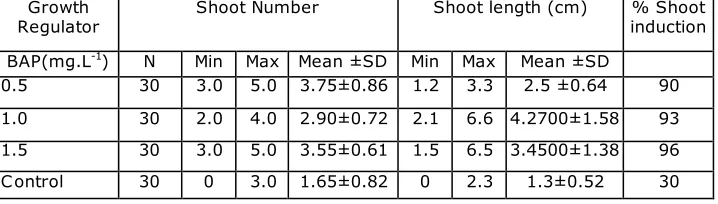
Analysis of the data indicated that soaking of shoot explants in 0.1% mercuric chloride for 5 minutes resulted in 100% mortality rate. When exposure time was reduced to 3 minutes, the mortality rate decreased to 20% with contamination rate of 12%. Mortality rate of 0% with contamination rate of 14% was observed by reducing the sterilization time of explants to 2 min. After one week of all the explants showed the signs of the shoot proliferation and new buds started to appear from the axial of the leaves and bud developed in to shoot. All treatments produced shoots from explants; however rate of shoot induction differed significantly in various concentrations of BAP. Difference in BAP level produced a significant response upon the length, number of shoots per plant and also on percent shoot induction at p<0.05 (Fig. 1). Similar results were also reported by Sudharson et al. (2014) and Ismail et al. (2012). The data defected in the Table-2 revealed that sprouting of shoot explants started within 7-8 days of inoculation. Application of BAP (0.5 mg L-1) produced an average of
3.75 shoot number per explant having shoot length of 2.5 cm. With increase in the concentration of BAP to 1 mg L-1, the average shoot
length reached to 4.2 cm and average shoot number decreased to 2.9 per explant. When the concentration was increased to 1.5 mg L-1, the
Pak. J. Weed Sci. Res., 21(3): 381-3912015 385
cm. In the present study shoot length was directly proportional whereas shoot number was inversely proportional to concentration of BAP. The finding corroborate the result of result of Singh and Arora (1995) who reported increasing the concentration of BAP result s in decrease in shoot length and increase in number of shoots per explant.
The hormone free culture media exhibited no significant effect on the shoot proliferation of the explant by producing average shoot number of 1.5 per explant and shoot length of 1.3 cm. Different concentration of BAP produced varying degree of percent shoot induction under in vitro culture conditions. At 23 days after culture, 0.5 mg.L-1 revealed 90% shoot induction which increased to 93% and 96% by the application of 1 mg L-1 and 96% at 1.5 mg L-1 BAP respectively. Afroz et al. (2009) reported that maximum number of shoot was observed on the media containing 1 mg L-1 BAP while Ramirez and Alejo (1991) stated that highest number of shoot formation was produced on media containing 2.5 mg L-1 BAP and 1 mg
L-1 NAA. Uddin et al. (2006) investigated that the highest number of
shoots was produced on medium containing 3 mg L-1 BAP while Afroz
et al. (2009) obtained highest shoot regeneration of 95% using BA and coconut water with 32 mean numbers of shoots on MS medium from nodal explants of P. minima. Similarly, Sheeba et al. (2010) reported 84% direct shoot regeneration with 19 mean number of shoots on MS medium supplemented with 2.0 µM BA. After 23 days of the explants on shooting media, the healthy cultured shoots were transferred in to new culture tubes containing rooting media. The rooting media was supplemented with different concentration of IBA (0.25 mg L-1, 0.5 mg
L-1, and 1 mg L-1. IBA free media was used as Control.
Analysis of the data shown in Table 3 revealed that culture media containing IBA (1mg.L-1) showed better root re-generation as
compared to other treatments. The data further indicated that application of the IBA (1mg L-1) induced primary roots of an average
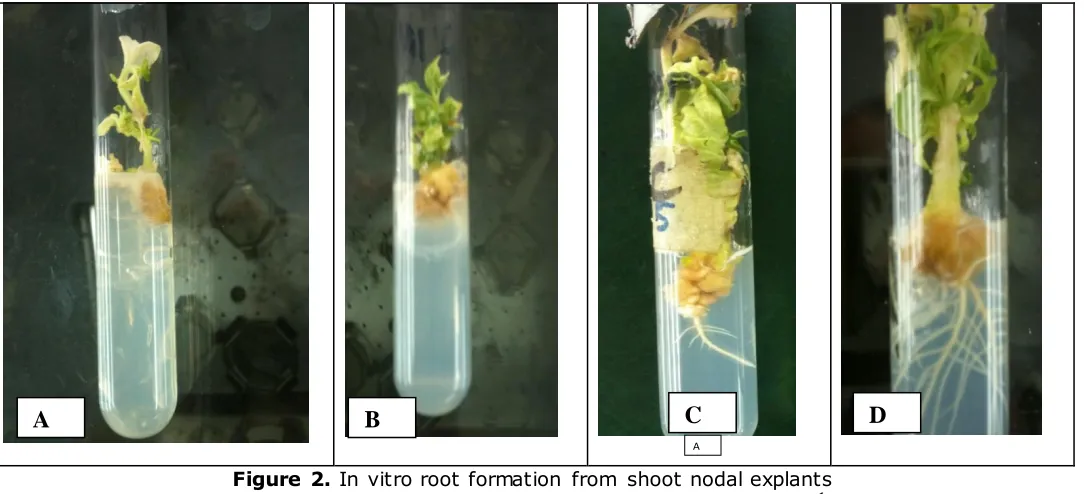
2.3 cm length and secondary roots with an average number of 22.26 per shoot respectively (Fig. 2D). The rooting media containing IBA (0.5 mg L) did not initiate the formation of the secondary roots and produced only primary roots with an average of 1.2 per shoot under invitro culture condition. However the hormone free media and the media containing IBA (0.2 mg L-1) did not induce rooting. Statistical analysis of the data revealed that significant (p<0.05) differences were observed in root number, root length and duration of root formation by applying different concentration of IBA to the shoots under control condition.
Application of IBA at 1mg L-1 had significant (p<0.05) effect on
number of roots was observed on the half strength media supplemented with 1 mg L-1 IBA within 30 days. Our results are
supported by Intzaar et al. (2013) who reported that maximum number of roots as well as the long roots was obtained on rooting media supplemented with 0.5 micromole of IBA.
Acclimatization of the tissue culture plants is the most critical step in micro propagation. The plants grown under in vitro condition are very sensitive and difficult to directly face ambient environmental conditions (Bhojwani and Razdan, 1992). The mortality rate of these plants depends on first and second hardening stage. First hardening stage is most critical in which the plants are kept in poly house for 10 days while in the second hardening stage survival rate is better than first as the plants are comparatively hardened during the first hardening stage. In this study, during the first hardening stage, the rooted plantlets were transferred to the pots containing farmyard manure and soil (1:1 ratio) prior to the final transfer to the soil. In both stages of hardening, the transplanted plant showed good survival rate. The first hardening stage showed 79% survival rate while in the second hardening stage 82% of the total plants survived.
Table-1. Effect of different dipping time intervals (0.1% mercuric chloride) on shoot tips responses of Physalis ixocarpa
Explant Percent Concentartion of sterilant
Time exposure
Percent Response
Contamination Mortality Survived Shoot
Tips
0.1 5 - 100 0
0.1 3 12 20 80
0.1 2 14 0 100
Table -2. Effect of different concentrations of BAP on number of shoot per explant and shoot length (± represent standard deviation from mean of the 30 samples)
Growth
Regulator Shoot Number Shoot length (cm) induction % Shoot
BAP(mg.L-1) N Min Max Mean ±SD Min Max Mean ±SD
0.5 30 3.0 5.0 3.75±0.86 1.2 3.3 2.5 ±0.64 90
Pak. J. Weed Sci. Res., 21(3): 381-391, 2015
Table-3. Effect of different concentration of IBA on root length, number of primary and secondary roots (± represent standard deviation from the mean of 20 samples)
IBA mg.L-1
No of Primary Root Length of Primary Root (cm) No of Secondary Root % Root
induction Days for Root Induction N Min Max Mean±SD Min Max Mean±SD Min Max Mean±SD
0.2 20 0 0 0 0 0 0 0 0 0 0 65
0.5 20 0 2 1.2±0.77 1.2 3.3 2.426±0.66 0 0 0 65 32±0.833 1.0 20 1 3 2.33±0.72 1.4 4.5 2.98±0.26 19 25 22.26±1.7 85 29±0.961
0.0 20 0 0 0 0 0 0 0 0 0 0 65
Figure 1. In vitro shoot formation from shoot nodal explants
A = MS media without BAP, B = MS media with 0.5 mg L-1 BAP, C = 1 mg L-1 BAP, D = 1.5 mg L-1 BAP
A
B
C
D
Figure 2. In vitro root formation from shoot nodal explants
A= half MS Medium without IBA, B= half MS Medium with 0.2 mg L-1 IBA,
C = half MS Medium with 0.5 mg L-1 IBA, D= half MS Medium with 1 mg L-1 IBA
A
B
C
A
Pak. J. Weed Sci. Res., 21(3): 381-391, 2015
CONCLUSION
Physalis ixocarpa is medicinal plant of significant importance. In Pakistan it is found in district Shangla of Khyber Pakhtunkhwa. Due to the excessive increase in human population, urbanization, and over exploitation of natural resources, this accession of P. ixocarpa has now become limited and endangered. In this study, we have optimized the simplest and efficient mircro propagation protocol for rapid mass multiplication, and maintenance of biodiversity of this endangered medicinal plant.
REFERENCES CITED
Afroz, F., A.K.M.S. Hassan, L.S. Bari, R. Sultana, N. Begum, M.A.A. Jahan and R. Khatun. 2009. In vitro Shoot Proliferation and Plant Regeneration of Physalis minima L. a Perennial Medicinal Herb. Bangladesh J. Sci. Ind. Res. 44: 453-456.
Alam, J. and S.I. Ali. 2009. Conservation status of Astragalus gilgitensis Ali (Fabaceae): A Critically endangered species in the Gilgit District, Pakistan. Phyton Int. J. Exp. Bot. 48: 211-225. Ashraf, M. and N.A. Akram. 2009. Improving salinity tolerance of
plants through conventional breeding and genetic engineering: An analytical comparison. Biotechnol. Adv. 27: 744-752.
Bhojwani, S.S. and M.K. Razdan. 1992. Plant tissue culture: Theory and practice, Elsevier, Amsterdam. Solecki, R.S. and I.V. Shanidar. Science 190: 880.
Fisher, G., M.P. Buitrago and P. Ludders. 1990. [Physalis peruviana L. cultivation and investigation in Colombia]. Physalis peruviana L. Anbau and Forschung in Kolombien. Erverbs-Obstbau. 32: 228-232.
Gentry, J.J. and W.G. D'Arcy. 1986. Solanaceae of Mesoamerica. p. 2-26. In: W.G. D'Arcy (ed.). Solanaceae, biology and systematics. Columbia Univ. Press, New York.
Gilani, S.A., A. Kikuchi and K.N. Watanabe. 2009. Genetic variation within and among fragmented populations of endangered medicinal plant, Withania coagulans (Solanaceae) from Pakistan and its implications for conservation. Afr. J. Biotechnol. 8: 2948-2958.
Godina, F.R., V.R. Torres, R.F. Pournabav, A.B. Mendoza, J.L. Hernández-Pinero, M.H. Reyes-Valdes and M.A. Alvarado-Vazquez. 2013. Yield and fruit quality evaluation in husk tomato autotetraploids (Physalis ixocarpa) and diploids. Aust. J. Crop. Sci. 7: 933-940.
Intzaar, S., M. Akram and H. Afrasiab. 2013. High frequency multiple shoot formation of pygmy ground cherry (Physalis minima): An endangered medicinal plant. Int. J. Agr. Biol. 15: 755-760. Ismail, H., Noraini, A. Shukor, Aziah, M. Yusoff, N.H. Hassan, F.
Zainudin, N. Abdullah and S.S.A. Rahman. 2012. In vitro shoot induction of Acacia auriculiformis from juvenile and mature sources. E3 J. Biotechnol. Pharm. Res. 3: 88-93.
Khan, W. 2015. Molecuar, Biochemical and in vitro culture study for pharmacological importance and conservation of Physalis ixocarpa. Thesis submitted to The University of Agriculture Peshawar, p. 41.
Mendoza, D.G., D.A. Martinez, A.H. Poox, V.M. Trujillo, O.G. Jaurez, F. Jose, Harnandez, L.C. Diaz and S.M.A. Marin. 2011. Phenolic compounds and physiochemical analysis of Physalis ixocarpa genotypes. Sci. Res. Essays. 6: 3808-3814.
Menzel, M.Y. 1951. The cytotaxonomy and genetics of Physalis. Proc. Am. Philos. Soc. 95: 132-183.
Mulato-Brito, J. and A. Pena-Lomeli. 2007. Germplasm evaluation of tomatillo (Physalis ixocarpa Brot.) cropped under Ontario, Canada and Chapingo, Mexico environmental conditions. Veg. Crop. Res. 66: 117-127.
Murashige, T. and F. Skoog. 1974. Plant propagation through tissue cultures. Annu. Rev. Plant Physiol. 25: 135-165.
Ramirez, M.R. and N.O. Alejo. 1991. Plant Cell Tissue Organ Cult. 25:185-188.
Rines, H.W. and T.J. McCoy. 1981. Tissue culture initiation and plant regeneration in hexaploid species of oats. Crop Sci. 21: 837-842.
Santiaguillo, H.J.F., L.A. Pena and D. Montalvo 1998. Evaluación de variedades de tomate de cáscara (Physalis pp) en Tlajomulco de Zuñiga, Jalisco. Rev. Chapingo Ser. Hortic.4: 83-88.
Sheeba, E., S. Parvathy and S. Palanival. 2010. Direct regeneration from leaves and nodes explants of Physalis minima Linn. European J. Appl. Sci. 2: 58-61.
Singh, K. and J.S. Arora. 1995. In vitro multiplication of Chrysanthemum morifolium Ramat cv. Riot. J. Ornam. Hort. 2: 63-68.
Sudharson, S., M. Anbazhagan, B. Balachandran and K. Arumugam. 2014. Effect of BAP on in vitro propagation of Hybanthus enneaspermus (L.) Muell, an important medicinal plant. Int. J. Curr. Microbiol. App. Sci. 3: 397-402.
Pak. J. Weed Sci. Res., 21(3): 381-3912015 13
Uddin, M.S., M.S.H. Chowdhury, M.M.H. Khan, M.B. Uddin, R. Ahmed and M.A. Baten. 2006. In vitro propagation of Stevia rebaudiana Bert in Bangladesh. Afr. J. Biotechnol. 5: 1238-1240.
Willis, J.C. 1966. A dictionary of the flowering plants and ferns Univ. Press, Cambridge, UK.