ISSN:2278 7496
AJPER April-June. 2019, Vol 8, Issue 2 (52-60)
FORMULATION, DEVELOPMENT AND EVALUATION OF TRANSDERMAL PATCHS
OF PROMETHAZINE HYDROCHLORIDE
Deepak Verma, Hemant Kumar Sharma, Prabhakar Budholiya
College of pharmacy, Sri satya sai university of technology and medical sciences, Bhopal (M.P)
*Corresponding Author’s E mail: [email protected]
Received 03/01/2019; Revised 12/01/2019; Accepted 04/02/2019, Available online 15/04/2019.
ABSTRACT
Transdermal patches are innovative drug delivery systems and can be used for achieving efficient systemic effect by passing hepatic first pass metabolism and increasing the fraction absorbed. Transdermal patches of Promethazine hydrochloride (PMZ) were prepared by the solvent casting evaporation technique using ethyl cellulose: HPMC, Eudragit RSPO, propylene glycol and permeation enhancer using different ratios. The physicochemical parameters such as flexibility, thickness, smoothness, weight variation, moisture content, hardness, folding endurance and tensile strength were evaluated for the prepared patches. The formulation exhibited flexibility, uniform thickness and weight, smoothness, good drug content (91.65 to 96.36%), and little moisture content. The in vitro diffusion studies were carried out using modified Franz diffusion cell using egg membrane as the diffusion membrane and the formulation followed the Korsmeyer-Peppas diffusion mechanism.The formulation containing ethyl cellulose: HPMC as polymers showed faster release rate compared to Eudragit: HPMC. The stability studies indicated that all the patches maintained good physicochemical properties and drug content after storing the patches in different storage conditions. Compatibility studies indicated that there was no interaction between the drug and polymers. Hence, the aim of the present study was to prepare the sustained release formulation (Transdermal patches) of the drug using different blend of polymers.
Keywords: Transdermal patches, Promethazine hydrochloride, Physicochemical parameters, in vivo
study
INTRODUCTION:
The developmental cost of a new drug may be about $ 250 million (Rs. 900 crores) and takes about 12 years to reach the market place. Whereas an existing drug molecule can get a second life with newer drug delivery systems that can be developed in half of the time with 20% cost of the new drug discovery1. A recent approach to drug delivery is to deliver the drug into systemic circulation at predetermined rate using skin as a site of application. A transdermal drug delivery is a formulation or device that maintains the blood concentration of the drug within the therapeutic window ensuring that drug levels neither fall below the minimum effective concentration nor exceed the minimum toxic dose. Transdermal drug delivery promises many advantages over oral and/or intravenous administration, such as better control of blood levels, a reduced incidence of systemic toxicity, avoids hepatic first-pass metabolism and
improves patient compliance. An ideal drug to be formulated as transdermal drug delivery should possess
several physico-chemical prerequisites, such as short half- life, small molecular size, low dose, etc 2. However, the highly organized structure of stratum corneum forms an effective barrier to the permeation of drugs, which must be modified if poorly penetrating drugs are to be administered. The use of chemical penetration enhancers would significantly increase the number of drug molecules suitable for transdermal delivery 3. Transdermal patch or skin patch is a medicated adhesive patch which is placed on the skin to deliver a specific dose of medication through the skin and in to the blood stream. Transdermal patches of PMZ with polymers were prepared by solvent casting technique 4, 5. However, from a drug delivery sand point, its far better that rate control resides with in the delivery devise in order to attain uniform input rates and reduce inter individual variability 6, 7. Promethazine hydrochloride is a first generation anti-histamine of the phenothazines family. It acts mainly as a strong antagonist of the H1 receptor
(antihistamine) and a moderate mACh receptor antagonist, hence it blocks the action of acetylcholine on the receptors (anticholinergic effect), and this explains its benefit in reducing the nausea experienced during motion sickness 8. PMZ though possessing 88% of bioavailability however undergoes tremendous hepatic “first-pass” metabolism and thus the absolute bioavailability is only 25%. Thus the problem
associated with PMZ will be overcome by formulating it into transdermal patchs. MATERIALS AND METHODS
Materials
Promethazine hydrochloride was received from Nicholas Piramal, Mumbai, India as a gift sample. Propylene glycol, HPMC, Ethyl Cellulose, and Eudragit RSPO purchased from Himedia Laboratory, Mumbai. Methanol, chloroform purchased from CDH chemical Pvt. Ltd. New Delhi. Dialysis membrane of Mol Wt cutoff 1200 was purchased from Himedia Laboratory, Mumbai. All other chemicals and reagents used were of analytical reagent grade.
Formulation of transdermal patches
In the present study, matrix type transdermal patches of PMZ were prepared by the solvent casting evaporation technique. The casting solution was prepared by dissolving weighed quantities of HPMC (350, 400 and 450mg), ethyl cellulose and Eudragit RSPO (50, 100 and 150mg) in 10 ml of methanol and chloroform in the ratio 1:1. To the resulting solution, 0.5% w/w of propylene glycol as plastisizer and 10% w/w penetration enhancer was added in this solution. Then drug (25mg) was added and mixed thoroughly to form a homogeneous mixture. The casting solution was then poured into glass mould/Petri
dish specially designed to seize the contents. The glass mould containing the casting solution was dried at room temperature for 24 hours in vacuum oven. The patch was removed by peeling and cut into round
Table: 1 Formulation Design of Promethazine HCl Transdermal Patches
Formulation Code
Drug (mg)
HPMC (mg)
Eudragit RSPO
(mg)
Ethyl cellulose
(mg)
Total polymer
weight (mg)
Propylene glycol (Plasticizer)
% w/w
Permeation Enhancer
% w/w
F1 300 450 - 50 500 0.5 10
F2 300 400 - 100 500 0.5 10
F3 300 350 - 150 500 0.5 10
F4 300 450 50 - 500 0.5 10
F5 300 400 100 - 500 0.5 10
F6 300 350 150 - 500 0.5 10
Dose calculations
Width of the plate (mould) = 5 cm Length of the plate (mould) = 12 cm
No. of 2.5 x 2.5 cm patch present whole(mould) = 12 Each film contains 25 mg of drug.
12 no. of films contains mg of drug? = 25×12 = 300mg
The amount of drug added in each plate was approximately equal to 300 mg.
Characterization of transdermal patches
The prepared transdermal patches were evaluated for the following parameters:
Physical appearance
All the transdermal patches were visually inspected for color, flexibility, homogeneity and smoothness.
Film thickness
The thickness of the patches was measured at five different places on a single patch of each formulation using a digital micrometer screw gauge and the mean values were calculated 11.
Weight variation
Drug content uniformity
The patches (2.5*2.5 cm (Equivalent to 6.25 mg of drug) were taken into a three separate 10 ml volumetric flask and dissolved in methanol (10ml) with the help of mechanical shaker.The solution was centrifuged to separate out any particulate matter. 1ml of sample was withdrawn and transferred in volumetric flask (10 ml of capacity). The sample was dilute upto the mark with distilled water and analyzed by UV spectrophotometer at 250.0 nm using the placebo patch solution as blank and the drug content was calculated 11, 12.
Folding endurance
A strip of 2.5 cm × 2.5 cm was subjected to folding endurance by folding the patch at the same place repeatedly several times until a visible crack was observed and the values were reported 13.
Tensile Strength.
The tensile strength of the patch was evaluated by using the tensiometer (Erection and instrumentation, Ahmedabad). It consists of two load cell grips. The lower one was fixed and upper one was movable. Film strips with dimensions of 2×2cm were fixed between these cell grips, and force was gradually applied till the film broke. The tensile strength was taken directly from the dial reading in kg.
𝑇𝑒𝑛𝑠𝑖𝑙𝑒 𝑆𝑡𝑟𝑒𝑛𝑔𝑡ℎ (𝑠) = 𝐴𝑝𝑝𝑙𝑖𝑒𝑑 𝑓𝑜𝑟𝑐𝑒 (𝑚 ∗ 𝑔)
𝐶𝑟𝑜𝑠𝑠 𝑠𝑒𝑐𝑡𝑖𝑜𝑛𝑎𝑙 𝑎𝑟𝑒𝑎(𝑏 ∗ 𝑡)
Where,
S = tensile stress in 980 dynes/cm2 m = mass in grams
g = acceleration due to gravity (980 dynes/cm2) b = breadth of strip in centimetres
t = thickness of strip in centimetres
Percent moisture content
Weighed individually the films (1cm2) and kept them in desiccators containing calcium chloride at room temperature for at least 24 hrs. Film was weighed again; the difference in weight (initial and final weight) gives moisture content.
% 𝑀𝑜𝑖𝑠𝑡𝑢𝑟𝑒 𝑐𝑜𝑛𝑡𝑒𝑛𝑡 =𝐼𝑛𝑡𝑖𝑎𝑙 𝑤𝑒𝑖𝑔ℎ𝑡 − 𝑓𝑖𝑛𝑎𝑙 𝑤𝑒𝑖𝑔ℎ𝑡
Percent moisture uptake
Weighed individually the films and kept them in desiccator containing calcium chloride at room temperature for at least 24 hrs. remove the films from desiccators and exposed to 4% relative humidity (Rh) using saturated solution of potassium chloride in a another desiccator until a constant weight is achieved.
% 𝑀𝑜𝑖𝑠𝑡𝑢𝑟𝑒 𝑢𝑝𝑡𝑎𝑘𝑒 =𝑓𝑖𝑛𝑎𝑙 𝑤𝑒𝑖𝑔ℎ𝑡 − 𝐼𝑛𝑡𝑖𝑎𝑙 𝑤𝑒𝑖𝑔ℎ𝑡
final weight × 100
Compatibility studies
In the present study, compatibility studies were carried out to assess any incompatibility between the drug and polymers. The IR studies were performed to check the compatibility with excipients. Spectra of the pure drug and the formulated patch were taken individually by the potassium bromide pellet method 14.
Stability studies
The stability studies of the formulated transdermal patches were carried out on prepared films at different temperature and humidity: 25-30°C (60%RH) and 45-50°C (75%RH) over a period of 60 days. The patches were wrapped in aluminum foil and stored in a desiccator for stability study. The patches were characterized for drug content and other parameters at regular intervals (0, 15, 30, 45 and 60 days) 15.
In Vitro skin permeation study
The in vitro skin permeation study was carried out by using a Franz diffusion cell (receptor compartment capacity: 80 ml: area: 2.5*2.5 cm (Equivalent to 6.25 mg of drug). The egg membrane was separated and used for in vitro study. The receiver compartment was filled with 40 ml of phosphate buffer, pH 7.4. The Transdermal patch was firmly pressed onto the centre of the egg membrane and then the membrane was mounted on the donor compartment. The donor compartment was then placed in position such that the
Kinetic study
To know the mechanism of drug release from these formulations, the data were treated according to first order (log percentage of drug to be released vs time), Higuchi’s (percentage of drug released vs square
root of time), and zero-order (percentage of drug released vs time) Korsmeyer-Peppas model (log percentage of drug to be released vs log time) patterns.
RESULT AND DISCUSSION
The λmax of the drug was found to be 250 nm. The calibration curve of the drug displayed a high linearity
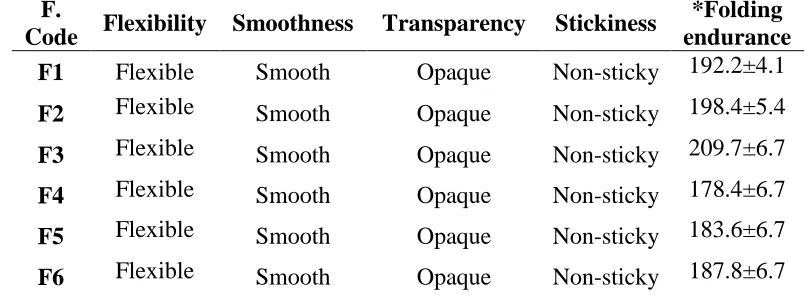
with an r2 value of 0.995 where a linear relationship was observed within the concentration range. All the patches prepared with different polymer concentration were found to be flexible, smooth, opaque, non-sticky and homogeneous in nature [Table 2]. This may be due to the presence of plasticizer. Marginal
difference in thickness was observed among each group indicated that more the amount of polymer higher the thickness values [Table 3]. All the six patches have showed good folding endurance, and [Table 2] indicated that the patches have good flexibility. All the formulation show lowest moisture content i.e. less than 2%. Moisture in this value is required to provide strength and flexibility to the patches. Formulations F1, F2, F3, F4, F5 and F6 were found to be contains 0.85±0.05%, 0.95±0.06, 0.65±0.09, 0.69±0.08, 0.75±0.10and 0.79±0.08% of moisture content respectively. In all formulations formulation F3 contain minimum moisture contain 0.65±0.09 and Moisture uptake was less in F3 as compared to other formulation [Table 3]. The effect of concentration of polymers was observed on the percentage elongation and tensile strength. It was found that as the concentration of polymers increased, the percentage elongation and tensile strength were also increased within the patches. There was no significant difference in the drug content among the patches [Table 3] indicated content uniformity. The maximum drug content was found in formulation F3, 96.36%.
Table 2: Physicochemical properties of the prepared transdermal patches
F.
Code Flexibility Smoothness Transparency Stickiness
*Folding endurance
Table 3: Physicochemical properties of the prepared transdermal patches F. Code *Thickness (mm) *% Moisture Content *% Moisture Uptake *Tensile Strength (kg/cm) *% Drug Content
F1 0.87±0.08 0.85±0.05 11.25±0.12 3.4±0.7 93.75±0.25
F2 0.92±0.09 0.95±0.06 13.65±0.14 3.7±0.3 94.53±0.32
F3 0.89±0.10 0.65±0.09 8.98±0.25 4.3±0.5 96.36±0.42
F4 0.86±0.05 0.69±0.08 11.65±0.32 2.9±0.3 91.65±0.33
F5 0.95±0.06 0.75±0.10 12.25±0.25 3.4±0.5 93.92±0.48
F6 0.93±0.07 0.79±0.08 11.54±0.12 3.6±0.2 95.45±0.41
*Average of three determinations
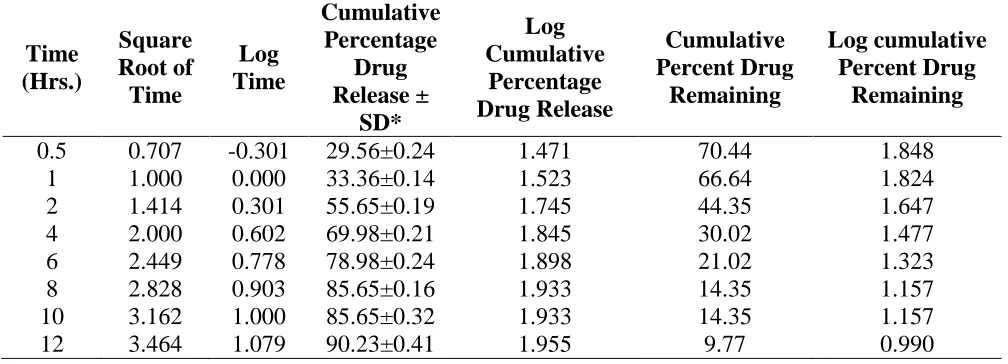
In vitro drug release study of optimized formulation was showed in (Table 4 and fig 1-3). The release kinetics of the transdermal patches followed Korsmeyer-Peppas diffusion mechanism (Table 5).
Stability studies showed that, there is no significant change in physical characteristics and drug content. Based on these results it was concluded that the formulated transdermal patches were found to be physically and chemically stable during the study period (60 days).
Table 4: In Vitro cumulative % drug release from optimized batch of transdermal patches F3
Time (Hrs.) Square Root of Time Log Time Cumulative Percentage Drug Release ± SD* Log Cumulative Percentage Drug Release Cumulative Percent Drug Remaining Log cumulative Percent Drug Remaining
0.5 0.707 -0.301 29.56±0.24 1.471 70.44 1.848
1 1.000 0.000 33.36±0.14 1.523 66.64 1.824
2 1.414 0.301 55.65±0.19 1.745 44.35 1.647
4 2.000 0.602 69.98±0.21 1.845 30.02 1.477
6 2.449 0.778 78.98±0.24 1.898 21.02 1.323
8 2.828 0.903 85.65±0.16 1.933 14.35 1.157
10 3.162 1.000 85.65±0.32 1.933 14.35 1.157
12 3.464 1.079 90.23±0.41 1.955 9.77 0.990
Values are represented as mean ±SD (n=3)
Table 5: Regression analysis data of formulation F3
Formulation Zero order First order Pappas plot
F3 R² = 0.839 R² = 0.959 R² = 0.962
Conclusion
and in vitro release studies, formulation F3 were considered as the best formulations. Based on the encouraging results, the PMZ transdermal patch can be used as a controlled drug delivery system and frequency of administration can be minimized. Though the efforts were made for the development of PMZ transdermal patch, long-term pharmacokinetic and pharmacodynamic studies are needed to undertake the establishment of the usefulness of these patches. Further, these findings may help the industry to scale up for commercial production. Transdermal dosage form of PMZ may provide clinicians an opportunity to offer more therapeutic options to their patients to optimize their care.
References
1. Barr M. Percutaneous absorption. Journal of Pharmaceutical Sciences. 1962; 51 (5):395-409. 2. Chein YW. Novel drug delivery systems. New York: Marcel Dekker, Inc. 1992; 50: 301.
3. Kanikannan N, Andega S, Burton S, Babu RJ and Singh M. Formulation and in vitro evaluation of transdermal patches of melatonin. Drug Dev Ind Pharm. 2004; 30:205-12.
4. Liang W, Levchenko TS and Torchilin VP. Encapsulation of ATP into liposomes by different methods: optimization of the procedure. J Microencapsul. 2004;21(3):251-61.
5. Lec ST, Yak SH, Kim SW and Berner B. One way membrane for transdermal drug delivery
systems/system optimization. Int J Pharm. 1991; 77:231-7.
6. Crank J. The Mathematics of Diffusion, Oxford University Press, Ely House, London W.I. 2nd ed.1975.
7. Carslaw HS and Jaeger JC. Conduction of Heat in Solids, Oxford University Press. Oxford, edn. 1986.
8. Indian Pharmacopoeia: Promethazine hydrochloride. The Indian Pharmacopoeia Commission, Ghaziabad. 2007; 3: 989-990.
9. Patel KN, Patel HK and Patel VA. Formulation and characterization of drug in adhesive transdermal patches of diclofenac acid. Int J Pharm Pharm Sci, 2012; 4(1):296–9.
10.Patel MP and Gupta MM. Formulation development and evaluation of transdermal patch of anti-diabetic drug pioglitazone. Pharm Innov. 2013; 2:80–8.
11.Gattani SG, Gaud RS and Chaturvedi SC. Formulation and evaluation of transdermal films of chlorpheniramine maleate. Indian Drugs. 2007; 44:27-33.
12.Rao RP and Divan PV. Influence of casting solvent on permeability of ethyl cellulose free films for
transdermal use. East Pharma. 1997;40: 135-7.
13.Kusum DV, Saisivam S, Maria GR and Deepti PU. Design and evaluation of matrix diffusion
29:495-14.Pandit V, Khanum A, Bhaskaran S and Banu V. Formulation and evaluation of transdermal films for the treatment of overactive bladder. Int J Pharm Tech Res. 2009; 1:799-804
15.Sankar V, Johnson DB, Sivanad V, Ravichadran V and Raghuram S. Design and evaluation of nifedipine transdermal patches. Indian J Pharm Sci. 2003; 65:510-5.