IJEDR1602274
International Journal of Engineering Development and Research (www.ijedr.org)1530
Comparative Analysis of RC Structures Progressive
Collapse for Different Seismic Zones
1
Pavithra B.R,
2Manjula K
1PG Student, 2Assistant Professor 1Department of Civil Engineering,
1BGS Institute of Technology, B.G. Nagar, India
________________________________________________________________________________________________________
Abstract - Now a days, buildings exposed to progressive collapse is produced by immediately deleting some vertical loads
due to ultimate loads and results gives the failure of structural buildings. G+8 storey of building is considered for progressive collapse analysis by using dynamic methods. The sudden column removal gives damages of nearest beams up to some storey levels building conduct different seismic zones. The dynamic analysis is carried out using E-TABS Version 9.6.0 software. Demand capacity ratios (DCR) of multi typical storey RC framed structure are calculated approximately by using general service administration guidelines. The comparative analysis of frame structure in different ground motion zones for progressive collapse. During earthquake effect, the causes of progressive collapse are checked and safe and unsafe structural members are to be studied for different models are analyzed in different ground motion zones.
Index Terms –Progressive collapse, RC Building, ETABS, Column removal, Dynamic analysis.
________________________________________________________________________________________________________
I.INTRODUCTION
The ground motion loads for some buildings of structures like RC walls carry to the foundation and then distributes to the ground soil. In buildings of structure with vertical unequal members i.e. column or walls also the floors about vertical axis and horizontally displace are twisted. During ground vibrations, irregular shapes of building tend to twist more. Same floor level of twist in building induces more cracks in the sides of columns/walls on the buildings.
Using some codes to resist ground force for structures of ground motion resistant are designed. Various waves affect more damages to structural buildings by their ground motion swell on the surface of earth in both vertical and horizontal paths. But the most of their energy is reflected back when wave reaches the ground surface. Shaking of ground is most severe at the earth surface at certain depths. A seismograph has consists of three division namely the timer, the sensor and the recorder are used to apparatus that measurement ground shaking. These seismic/ground motion waves reach at some time instants, different amplitudes and also take some different stages of power.
Vibration causes structural building resting on it will undergo motion at its base, thus the movement between their ends of the columns, it results columns failure. In vertical position, the columns should not carry earthquake horizontal force through them. Usually most design of structures to resist the ground motion loads tend to be suitable against vertical shaking. The poorly constructed/designed RC columns can be progressive collapsed. The columns of ground storey are failure, thus resulted in numerous building progressive collapses during Bhuj-2001(India) ground vibration.
For a building safe during ground shaking, beams should be weaker than columns; columns should be weaker than the foundations. In case other structural members are made stronger than columns, then they suffer specific storey of a several local failure. This contained failure can lead to collapse of whole building and then remaining columns of all stories are almost uninjured. Conventional ground motion design tries to make structure do not damage under strong ground shaking but may withstand failure to non structural elements in the building.
In recent years, a large number building of open ground storey has been built in India. A fire, liquefaction, landslides etc these earthquake hazards cause the building damages and critical life line failures. An accurate elastic analysis is not needed because the response during seismic motion is generally in the non linear range. Under the ground shaking horizontally, the horizontal forces of inertia are produced usually situated at the different levels of floor. These forces of inertia are moved by slab to walls/columns, and then foundations will receives the all forces of inertia, finally to the underneath system of soil. Disastrous for weak constructed designed columns of building.
II.PROGRESSIVECOLLAPSE
IJEDR1602274
International Journal of Engineering Development and Research (www.ijedr.org)1531
Thus, collapsed building causes larger damage to the structural elements of building than the early stage. The forecast of desirable progressive fall down under specific points can apply very important information that could be used to control building collapse.Buildings are vulnerable to progressive fail analysis is performed by instantly removing one/more vertical loads due to extreme (ultimate) loadings and analyzing the building elements remaining capability to absorb the failure. Due to the instantaneous loss of members of building, this member loss disturbs the earlier load equilibrium of subjective forces and exterior loads. Then the building vibrates until a new equilibrium point is originated or until the structural building collapses. In case analysis of collapse for column removed condition consider is used to understand the behaviour of collapse of RC progressive building for structure under different “column failed” situation.
Some Design rules and criteria for preventing of future failures of building structures are they tried to develop. The building structures such as vertical loads were caused due to the failure of a transfer girder. During the enemy attacks, the building near the impact zone was damaged and losing its supports to the above load. The collapsing upper part weight resulted in a downward progressive failure of structures.
The building of collapse is usually a rare accident in developed countries, but collapse of RC progressive building effect on elemental structures is very dangerous and costly. It cannot be prevented without any significant consideration of acceptable in quantity or quality continuity, redundancy and ability of a material. There are many extreme hazard which caused by collapse of progressive building in a members that may lead to fatality. After that incidents, it apply on the assessment of buildings have increased towards the preventing progressive collapse.
III.DESCRIPTIONOFBUILDING
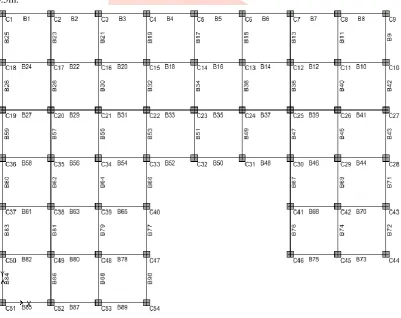
For this study, the (G+8) storey of RC typical frame model is considered. Bay size is taken as 4.5m in one direction and 4m in another direction. The structural models for a building have the typical storey height of 3.15m. The RCC structure is located on soft soil (type III) in different seismic zones (Zone IV & Zone V) using ETABS Version 9.6.0. The floor slabs are modelled as plates of thickness is 0.15m. The thickness of wall is considered on all beams as 0.23m and all the supports as fixed supports at the base at the foundation level are modelled at different seismic zones. Beam size is taken as 0.45m x 0.3m and column size is taken as 0.6m x 0.5m.
Figure 1 Plan of framed structure
IJEDR1602274
International Journal of Engineering Development and Research (www.ijedr.org)1532
IV.ANALYSIS OF MODEL
The analysis of structural model for different seismic zones of RC frame Progressive collapsed structure is done by using ETABS Version 9.6.0 Package. The load combinations and loads are considered for the comparison analysis of RC frame structure progressive collapse for different seismic zones. Demand capacity ratio is calculated for three cases of column failure. Second storey of column C30, C33 and C51 are removed for progressive collapse analysis in different cases.
Objectives
Important goal of this investigation is to study the comparative analysis of structure progressive collapse can be listed as follows
i. To evaluate the response for structural building of G+8 storey of RC structure i.e., DCR (Demand Capacity Ratio), storey shear, mode period and base shear by using finite element based software ETABS Version 9.6.0.
ii. The study is conducted to know the mode shapes and mode periods for comparison of different models in both bare frame and removed column condition.
iii. To study the comparative analysis of reinforced concrete structures progressive collapse for different vibration zones using both time history and response spectrum analysis using Bhuj-2001 ground vibration data.
iv. To study the effect of structural behaviour of progressive collapsed building i.e., vertical loads and beams.
v. To calculate the storey shear, base shear, different models mode periods and demand capacity ratio by using time history analysis and response spectrum method for different ground motion zones for soil type III. To compare the curves plotted on demand capacity ratio i.e., bare frame and removed column condition for different seismic zones by using THA and RSM.
Steps Adopted for Analysis
i. A described review of research report is carried out on the progressive collapse of reinforced concrete frame structures at different ground motion zones.
ii. 3-D view of RC frame structure modal analysis is carried out to get the mode shapes of the collapsed progressive structure and get the different models 1, 2, 3 and 4 mode periods. The RC bare frame modals are considered of (G+8) storey building of comparative analysis progressive collapse for different seismic zones with removed column conditions.
iii. Using the ETABS Version 9.6.0 software, the method of analysis are carried out such as “Time-History Analysis” and “Response Spectrum” to obtain the every storey shear, base shear & demand capacity ratio(DCR).
iv. Finally results of progressive collapse RC modal analysis i.e. (RSA and THA) are tabulated and discussed about results
Demand capacity ratio
The analysis results will be performed to identify the potential demands (i.e. magnitudes and distribution) for evaluating the building collapsed area. Demand capacity ratio indicates potential demands for magnitudes and distribution (capacity of member at any section) of structural elements of building. In these three cases (column removal cases), the DCR values do not exceeds acceptance criteria by general service administration and hence columns are safe but for column removal case adjacent beams DCR values exceeds the criteria value considering columns are unsafe against progressive collapse of building.
IJEDR1602274
International Journal of Engineering Development and Research (www.ijedr.org)1533
V.RESULTSANDDISCUSSION
This investigation analysis is conduct to evaluate the demand capacity ratio (DCR) of RC bare frame and column removal cases for quantifying potential collapse areas. Totally eight models (same building but consider seismic zone IV and zone V) are considered for the dynamic analysis which includes model analysis, response spectrum analysis and time history analysis. In model analysis, Mode Periods and Mode Shapes are obtained. From Time history analysis and Response Spectrum analysis, Storey shear, Base shear and DCR outcome for zone-IV and zone-V are obtained.
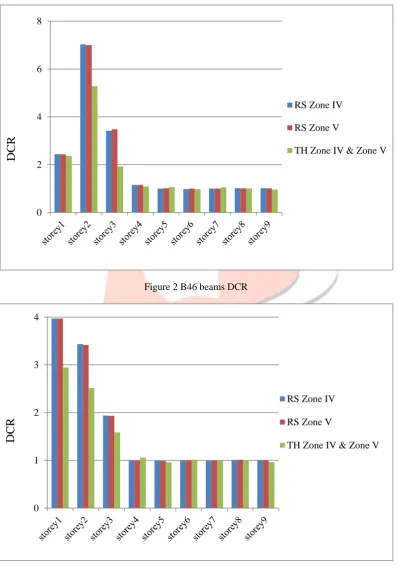
Figure 2 B46 beams DCR
Figure 3 B48 beams DCR
For column C30 removed, the adjacent beams are B46 and B48 DCR values are exceed (up to storey 1-storey 3) the acceptance criteria value recommended by GAS guidelines and all other beams are safe i.e. storey 4 to storey 9 for both THA and RSA.
0 2 4 6 8
RS Zone IV RS Zone V
TH Zone IV & Zone V
D
CR
0 1 2 3 4
RS Zone IV RS Zone V
TH Zone IV & Zone V
IJEDR1602274
International Journal of Engineering Development and Research (www.ijedr.org)1534
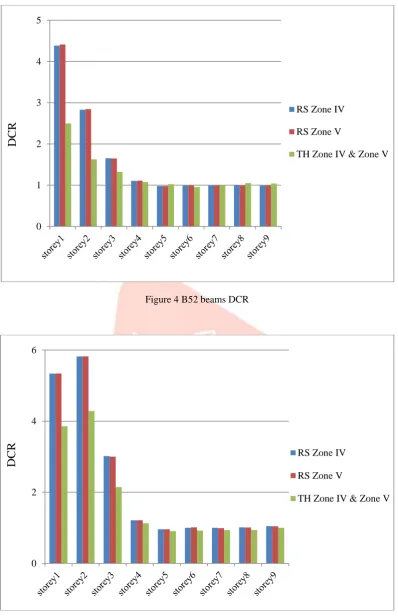
Figure 4 B52 beams DCRFigure 5 B66 beams DCR
For column C33 removed, the beam B52 and B66 exceed acceptance criteria value suggested by GSA for progressive collapse guidelines as in Fig.4 and Fig.5 respectively.
0 1 2 3 4 5
RS Zone IV RS Zone V
TH Zone IV & Zone V
D
CR
0 2 4 6
RS Zone IV RS Zone V
TH Zone IV & Zone V
IJEDR1602274
International Journal of Engineering Development and Research (www.ijedr.org)1535
VI. CONCLUSIONS
The DCR value (QUD/QUE) maximum in storey-2 compared to storey-9. The demand capacity ratio values of response spectrum analysis maximum in zone-IV than the zone-V and the time history analysis of demand capacity ratio values very less than the response spectrum analysis. The adjacent beams in column removal condition up to storey-3 are failure and storey-4 to storey-9 beams is safe. At corner column deleting condition maximum adjacent beams of every storey are failures using values suggested by General Service Administration guidelines. Storey shear 50% maximum in zone-V and less in zone-IV, soil type III in both cases. Time history analysis values are same in both zones (because bhuj earthquake 2001-India data is applied), storey shear maximum in time history analysis and less in response spectrum method.
REFERENCES
[1] Mr. T.H. Almusallam, Mr. H.M. Elsanadedy, Mr. H. Abbas, Mr. T. Ngo and Mr. P. Mendis (2010), “Progressive
Collapse Analysis of a Typical RC Building of Riyadh” International Journal of Civil and Environmental Engineering IJCEE-IJENS, Volume: 10 No: 02.
[2] Mr. Kevin A. Giriunas, Dr. Halil Seze (2011), “Progressive Collapse Analysis of an Existing Building”.
[3] Mr. H.R. Tavakoli, Mr. A. Rashidi Alashti & Mr. G.R. Abdollahzadesh (2012),“3D Non Linear Static Progressive Collapse Analysis of Multi Story Steel Bracing Buildings”.
[4] Mr. Shuang Li, Mr. Shengping Liu, Mr. Changhai Zhai and Mr. Lili Xie (2012), “Unified Analysis on Progressive and Seismic Collapses of RC Framed Structure: The Effect of Masonry Infill Walls”.
[5] Mr. H.R. Tavakoli, Mr. F. Kiakojouri (2013), “Numerical Study of Progressive Collapse in Framed Strucrues: A New Approach for Dynamic Column Removal” International Journal of Engineering, Volume 26, No.7, 685-692.
[6] Mr. Rakshith K.G, Mr. Radhakrishna (2013), “Progressive Collapse Analysis of Reinforced Concrete Framed Structure” International Journal of Research in Engineering and Technology, ISSN: 2319-1163.
[7] Mr. Abdolreza S. MOGHADAM, Mr. Somayyeh KARIMIAN (2014),“Seismic Progressive Collapse Assessment of RC Moment Resisting Buildings with Eccentricity in Plan” International Institute of Earthquake Engineering and Seismology.
[8] IS: 456-2000, “Plain and Reinforced Concrete-code of practice”, Bureau of Indian Standards, New Delhi.
[9] IS: 1893-2002 (Part 1), “Criteria for Earthquake Resistant Design of Structures”, General Provisions and Buildings, Bureau of Indian Standards, New Delhi.