Light Weight Service Mash up Middleware with REST Style
Architecture and Multi Priority DAG Workflow for IOT
application
________________________________________________________________________________________
Mrs. Afrin Banu
1, Angel.J, ME
21
Assistant Professor M.E ,2Student M.E
1 2 Computer Science and Engineering, Rajas International Institute of technology for women
Abstract:- Internet of Things can provide new value-added service by connecting the physical devices to virtual up bringing s
connection with their framework, and there is also a vast demand in ad-hoc facilities by the end users for IoT applications. By
spreading mash up concept into IoT applications, we can accomplish a novel and more lightweight amenities creation approach.
This paper suggests a lightweight IoT service mash up middleware grounded on REST-style architecture for IoT applications, and
design an uniform sensor devices entry and dynamically protocol stack management framework, offer a dispensed
publish/subscribe created messages sharing service, and conditional IoT services mash up approach, which can be unified easily to
create new a malg a mated and conditional applications, and also apply the REST principles to define an extensible edge to build
comprehensive and situational mash up applications. Based on proposed service mash up middleware, end user can assimilate
applications and services in a more lightweight manner. We also demonstrated the states for REST ful Web service mash ups
representing for coal mine safety monitoring and control automation. In the experiments, the end-user evaluation has been
conducted to evaluate the middleware, and also the performance has been measured and analyzed.
Index Terms—Internet of Things, Service Mash up Middleware, REST ful Style
I. INTRODUCTION
1.1 The Internet of Things (IoT)
The Internet of Things may be a hot topic in the industry but it’s not a newidea. In the early 2000’s, Kevin
Ashton was laying the groundwork for what would become the
Internet of Things (IoT) at MIT’s AutoID lab. Ashton was one
of the pioneers, conceived this notion as he searched for ways
that Proctor & Gamble could improve its business by linking
RFID information to the Internet. The concept was simple but
powerful. If all objects in daily life were equipped with
identifiers and wireless connectivity, these objects could be
communicating with each other and be managed by computers.
In a 1999 article for the RFID Journal Ashton wrote:
―If computers that knew everything there was to know about
things—using data they gathered without any help from us – It
would be able to track and count everything, and greatly reduce
waste, loss and cost as well as know when things needed
replacing, repairing or recalling, and whether they were fresh or
past their best and need to empower computers with their own
means of gathering information, so that can see, hear and smell
the world for themselves, in all its random glory.
RFID and sensor technology enable computers to
observe, identify and understand the world—without the
limitations of human-entered data.‖ At the time, this vision
required major technology improvements. After all, would
connect everything on the planet. The type of wireless
communications could be built into devices, and changes would
need to be made to the existing Internet infrastructure to
support billions of new devices communicating? What would
power these devices, then must be developed to make the
solutions cost effective. There were more questions than
answers to the IoT concepts in 1999. Today, many of these
obstacles have been solved. The size and cost of wireless radios
________________________________________________________________________________________
communications address to billions of devices. Electronics
companies are building Wi-Fi and cellular wireless connectivity
into a wide range of devices. ABI Research estimates over five
billion wireless chips will ship in 2013.
Mobile data coverage has improved significantly with
many networks offering broadband speeds. While not perfect,
battery technology has improved and solar recharging has been
built into numerous devices. There will be billions of objects
connecting to the network with the next several years
IoT Key Features:
The most important features of IoT include artificial
intelligence, connectivity, sensors, active engagement, and
small device use. A brief review of these features is given
below:
AI – IoT essentially makes virtually anything ―smart‖, meaning
it enhances every aspect of life with the power of data
collection, artificial intelligence algorithms, and networks.
Mean something as simple as enhancing your refrigerator and
cabinets to detect when milk and your favorite cereal run low,
and to then place an order with your preferred grocer.
Connectivity – New enabling technologies for networking, and
specifically IoT networking, Mean networks are no longer
exclusively tied to major providers. Networks can exist on a
much smaller and cheaper scale while still being practical. IoT
creates these small networks between its system devices.
Sensors – IoT loses its distinction without sensors. They act as
defining instruments which transform IoT from a standard
passive network of devices into an active system capable of
real-world integration.
Active Engagement – Much of today's interaction with
connected technology happens through passive engagement.
IoT introduces a new paradigm for active content, product, or
service engagement.
Small Devices – Devices, as predicted, have become smaller,
cheaper, and more powerful over time. IoT exploits
purpose-built small devices to deliver its precision, scalability, and
versatility.
IoT Advantages:
The advantages of IoT span across every area of
lifestyle and business. Here is a list of some of the advantages
that IoT has to offer:
Improved Customer Engagement – Current analytics suffer
from blind-spots and significant flaws in accuracy; and as
noted, engagement remains passive. IoT completely transforms
this to achieve richer and more effective engagement with
audiences.
Technology Optimization – The same technologies and data
which improve the customer experience also improve device
use, and aid in more potent improvements to technology. IoT
unlocks a world of critical functional and field data.
Reduced Waste – IoT makes areas of improvement clear.
Current analytics give us superficial insight, but IoT provides
real-world information leading to more effective management
of resources.
Enhanced Data Collection – Modern data collection suffers
from its limitations and its design for passive use. IoT breaks it
out of those spaces, and places it exactly where humans really
want to go to analyze our world. It allows an accurate picture of
everything.
Internet of Things:
The Internet of Things (IoT) can create new value
added service by connecting the physical devices to virtual
environments in modern life, which will grow gradually
through deployment of new intelligence applications combining
the physical and information space. Mashup, a way to compose
a new service from existing services, is expected to play an
important role in these cases because people have different use
cases and preferences. The mashup paradigm has been
successfully applied to fast prototype valuable applications.
Some works have introduced the use of ―mashup‖ concepts,
also known as user-generated comprehensive applications.
However, they mainly focus on mashing up information
services and do not address the requirements that come with
IoT objects integration completely. As more real-life elements
become connected, we envision that the IoT mashup services
that are aware of their surrounding environment. Many recent
researches suggest that mashup in IoT is possible with existing
________________________________________________________________________________________
functionalities as a Web service. However, mashup in IoT
environment has more challenges because of large number of
devices, and their heterogeneity and availability. We give the
more specific challenges for IoT services mashup applications.
Devices Heterogeneity:
The nature of heterogeneity for sensors requires an
abstraction from the lower device layer to a common access
layer for other applications. Middleware can be used to serve as
the abstraction instance as it has the capability to gather and
connect the data from different sensor platforms.
Data Distribution:
With the huge amounts of data from the edge of the
sensor networks or electronic devices to the applications to be
available anywhere and anytime, and new type of middleware
is needed in the IoT networks, it is important with advanced
and intelligent event filtering capability, enabling management
of frequently disconnected and heterogeneous physical sensing
devices in the IoT.
Software Services:
The deployment and provision of the IoT application
is expected to consider with a new range of user-centric based
services. There is a huge demand in ad-hoc services by the end
users, and the delivery of those IoT services will be frequently
transparent and intuitive for the user.
User Interaction:
Visualization is critical for the IoT applications, which
can allow the interaction of the user with the physical sensory
devices environment. Hence, the traditional user-interfaces
should to become multimodal and fully intuitive. It is necessary
to provide a uniform and easy approach to access the physical
devices for the sake of interoperability and integrating these
sensor devices into the IoT applications. The IoT services mash
up is a relatively new area of interest. In particular, a significant
effort is needed to enable Internet-connected objects to become
seamlessly integrated into services and support dynamic service
composition. An ideal IoT service mashup middleware should
provide abstractions at various levels such as heterogeneous
environment for physical devices and software interfaces, and
the software service creation process. In order to meet the
above requirement, it is important to propose a middleware
software platform to provide the abstraction from the physical
sensory environment, and providing corresponding intelligent
services. Here, proposes a lightweight service mashup
middleware for IoT applications, by extending the mashup
concept to IoT physical objects, which allow the physical
things seamless integration into the Web, thus providing a new
type of IoT applications, and make aim to IoT applications
development and deployment easily, and which allow both
visualization and processing of a sensory data ecosystem at
different levels. Also, the middleware can provide the support
to create and adapt individual information centric applications
easily for end users. Specifically, the contributions of this paper
can be summarized in the following.
1. Propose a uniform devices access and protocol stack
management framework, which can dynamically manage the
physical sensory devices and the corresponding protocols,
which can be assembled the different protocol stack to parse the
sensory data from the physical devices space. To improve the
automation, a three-step deployment process and an automatic
protocol adaptation method are presented for the management
framework.
2. Design a distributed publish/subscribe(Pub/Sub)-based
messages distribution service, which contains one or more
distributed message brokers, which matches messages sent
from sensors with subscriptions and delivers them to control
visualization widgets. The broker supports service interaction
actively, and can distribute data between services in real-time.
3. Design a situational IoT services mashup approach that
supports the on-the-fly integration of different data services
mashup level, as well as the decision-making process mashup
level, which can be integrated easily to create new composite
and situational applications.
4. Design a REST principles-based extensible interface to build
comprehensive and situational mashup applications, which can
obtain comprehensive IoT application scenarios for physical
devices data streams, sends devices control commands
simultaneously. Five abstract patterns of IoT functions are also
defined that can be used to package the IoT resources into
________________________________________________________________________________________
II SYSTEM DESIGN
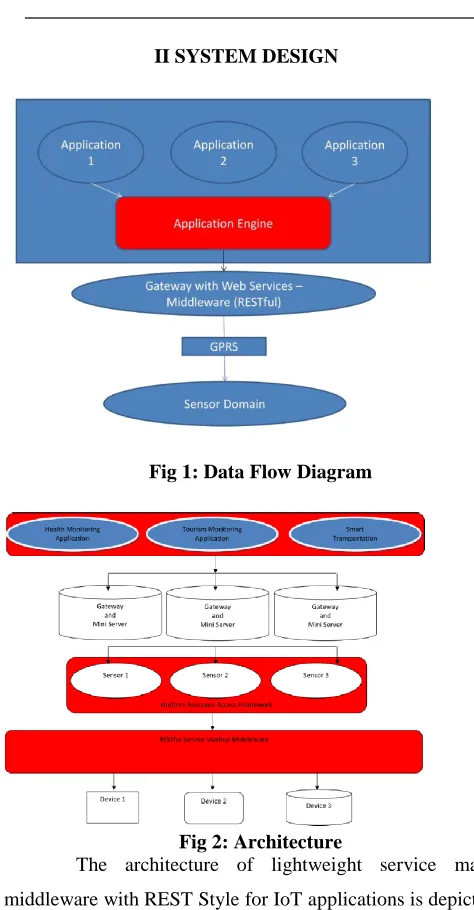
Fig 1: Data Flow Diagram
Fig 2: Architecture
The architecture of lightweight service mashup
middleware with REST Style for IoT applications is depicted in
Fig.2 and consists of the following components layers: Physical
sensor layer, uniform resource access framework layer, uniform
message space layer, service mashup layer, open service
interface layer and applications layer. These six components are
connected in a pipeline resulting in the provision of intelligence
IoT services. The overall goal of this architecture is to
accelerate the integration of sensory devices with existing
services and other information resources.
Physical sensor layer, each sensory nodes and physical
devices are plugged into the sensor network, and the nodes are
deployed in appropriate areas to acquire the environmental data
and detect possible anomalies.
Uniform resource access layer, provides a uniform framework
to obtain sensory data and operate various physical devices,
which adopts the OSGi technology to create a uniform
protocols management framework. In the framework, a three-
step deployment process is designed for the set of protocols,
and an automatic adaptation method is also presented to access
a proper protocol intelligently without user intervention.
Uniform message space layer, provides a publish/subscribe
based messages distribution service, which contains one or
more distributed message brokers, which matches messages
sent from sensors with subscriptions and delivers them to
control visualization parties. For the broker, a topic-based
publish/subscribe mechanism and message routing mechanism
are provided to support service interactions actively. Also, a
topic-based data distribution communication model is presented
to real-timely distribute data between services in dynamic IoT
environment.
Service mashup layer, use the sensory data from underground
with other resources to form a novel safety monitoring and
control application. The mashup approaches can be categorized
into physical data mashup, process mashup and widget mashup.
For data mashup, a hybrid mashup approach is presented based
on data operators and data services, which supports end-users
to customize the physical data according to their requirements.
For process mashup, a situational choreography approach is
proposed to customize the IoT processes. For widget mashup, a
WYSIWYG (what you see is what you get) mashup approach is
introduced to quickly create the user interface of IoT
applications.
Open service interface layer, provide the REST API interface
to access the mashup services, and to get the sensory data and
send the control commands on the Internet. For this layer, five
abstract patterns of IoT functions are defined to package the
IoT resources into RESTful API.
Application layer, a JavaScript based dashboard is provided
for displaying various sensor data visualizations quickly and
easily, and thus achieves the control automation of underground
physical devices.
III RESULT AND SCREESHOTS
We prepared four different experiments to test the
lightweight mashup middleware with actual scenarios, and each
experiment reflected the performance of the whole system from
________________________________________________________________________________________
coordination approach has several advantages over a
framework-oriented approach at developing dynamically
adapting business processes, which provides general models
that need to be instantiated and customized before they are
implemented. Since those models operate at a higher-level of
abstraction than frameworks, they impose fewer initial
constraints upon the system being developed. Therefore, event
driven SOA-based services coordination approach is more
suitable for IoT application scenarios that are highly delay
sensitive and demand a strict real-time response.
Application Selector
Application Engine
Application Passing Through Transmitter-1
Application Passing Through Transmitter-2
Application Received at Destination Level
File stored in Destination
________________________________________________________________________________________
Application at the Destination
CONCLUSION
A lightweight IoT service mashup middleware based
on REST-style architecture for the IoT applications. Focus on
the design and implementation for an OSGi based uniform
devices access and protocol stack management framework,
distributed publish/subscribe based messages distribution
service, and a situational IoT services mashup approach that
supports the on-the-fly integration of different data services
mashup level, as well as the decision-making process mashup
level, which can be integrated easily to create new composite
and situational applications, also apply the REST principles to
define an extensible interface to build comprehensive and
situational mashup applications and deployed a prototype in the
coal mine to test system validity. The results showed that the
lightweight mashup middleware worked well as expected.
FUTURE ENHANCEMENT
It is essential to optimize the real-time data
distribution service and data congest scheduling strategy with
different QoS constraints for a large IoT application
deployment. Also, the energy consumption will be a challenge
if some IoT services are directly deployed on the IoT devices,
the optimization method of energy consumption should be
introduced into such IoT scenario. Further it makes more
efficient and useful approach for future.
REFERENCES
1. P. Andreou, D. Zeinalipour-Yiazti, P. Chrysanthis, and G.
Samaras, ―Towards a network-aware middleware for wireless sensor networks,‖ in proc. of Int. Workshop Data Manage.
Sensor Netw., 2011.
2. D. Benslimane, S. Dustdar, and A. Sheth, ―Services
Mashups: The New Generation of Web Applications,‖ IEEE
Internet Computing, vol. 12, no. 5, pp.13–15, 2008.
3. A.Bouguettaya, S.Nepal, W.Sherchan, X. Zhou, J. Wu, S.-P.
Chen, D.-X. Liu, L. Li, H.B. Wang and X.-M. Liu, ―End-to-End Service Support for Mashups,‖ IEEE Transactions on
Services Computing, vol.3, no.3, pp.250-263, 2010.
4. A. Bozzon, M. Brambilla, F. M. Facca, and T. Carughu, ―A
Conceptual Modeling Approach to Business Service Mashup
Development,‖ in proc. of the IEEE International Conference
on Web Services, pp.751–758, 2009.
5. B. Cheng, M. Wang, S. Zhao, Z.Y Zhai, and J.L. Chen. ―Situation-Aware Dynamic Service Coordination in IoT Environment,‖ IEEE/ACM Transactions on Networking,
Vol.25, No.4, pp.2082-2097, 2017.
6. B. Cheng, S. Zhao, S.G. Wang, and J.L. Chen. ―Lightweight
Mashup Middleware for Coal Mine Safety Monitoring and
Control Automation,‖ IEEE Transactions on Automation
Science and Engineering, Vol.14, No.2, pp.1245-1255, 2017.
7. B.Cheng, ZY. Zhai, S.Zhao, and JL.Chen. LSMP: A
Lightweight Services Mashup Platform for Ordinary-Users.
IEEE Communications Magazine, Vol.55, No.4, pp.116-122,
2017.
8 B. Cheng, D. Zhu, S. Zhao, and J.L. Chen. ―Situation-Aware
IoT Services Coordination Platform Using Event Driven SOA
Paradigm,‖ IEEE Transactions on Network and Services
Management, Vol.13, No.2, pp.349-361, 2016.
9. A. Demers, J. Gehrke, R. Rajaraman, N. Trigoni, and Y.
Yao, The Cougar Project: a Work-in-progress Report,
SIGMOD Rec., 2003.
10. Y. Ding, Y. Jin, L. Ren, and K. Hao, ―An intelligent self-organization scheme for the internet of things,‖ IEEE Comput.
Intell. Mag., vol. 8, no. 3, pp. 41–53, Aug. 2013.
11. W. Heinzelman, A. Murphy, H. Carvalho, and M. Perillo,
Middleware to Support Sensor Network Applications, IEEE
Network, vol.18, no.1, pp.6-14, 2004.
12. JanggwanIm, Seonghoon Kim, Daeyoung Kim. ―IoT Mashup as a Service: Cloud-based Mashup Service for the
Internet of Things,‖ in proc. of IEEE 10th International
Conference on Services Computing, pp.462-469.
13. T. Liu and M. Martonosi, Impala: A Middleware System
for Managing Autonomic, Parallel Sensor Systems, in proc. of
the ninth ACM SIGPLAN Symposium on Principles and
________________________________________________________________________________________
14. E. Maximilien, A. Ranabahu, and K. Gomadam, ―An Online Platform for Web APIs and Service Mashups,‖ IEEE
Internet Computing, vol. 12, no. 5, pp. 32–43, 2008.
15. MicroSoft Azure IoT.
https://www.azure.cn/documentation/articles/
iot-suite-overview/, 2017-03-31.
16. Ousmane Diallo, Joel J. P. C. Rodrigues, MbayeSene,
Jaime Lloret, ―Distributed Database Management Techniques for Wireless Sensor Networks,‖ IEEE Transactions on Parallel
and Distributed Systems, vol.26, no.2, pp.604-620, 2015.
17. W.-J. Qin, Q. Li, L.-M. Sun, H.-S. Zhu and Y. Liu, ―RestThing: A Restful Web Service Infrastructure for Mash-up Physical and Web Resource‖, in proc. of IFIP 9th International
Conference on Embedded and Ubiquitous Computing,
pp.197-204, 2011.
18. M.A. Sami and T. Alakoski, ―Fixed-Mobile Hybrid
Mashups: Applying the REST Principles to Mobile-Specific
Resources,‖ in proc. of international workshops on Web
Information Systems Engineering, pp.172-182, 2008.
19. A.P. Sheth, K. Gomadam, and J. Lathem, ―SA-REST:
Semantically Interoperable and Easier-to-Use Services and
Mashups,‖ IEEE Internet Computing, vol.11, pp.91-94, 2007.
20. P. Spiess, S. Karnouskos, D. Guinard, D. Savio, O.
Baecker, L.M.S. d. Souza, and V. Trifa, ―SOA-Based
Integration of the Internet of Things in Enterprise Services,‖ in proc. of IEEE Int’l Conf. Web Services, pp. 968-975, 2009. 21. R. Tuchinda, C.-A. Knoblock, P. Szekely, ―Building
Mashups by example Tuchinda,‖ ACM Transactions on the
Web, vol.5, no.3, pp.1-45, 2011.
22. M. Vasko and S. Dustdar, ―Introducing Collaborative Service Mashup Design,‖ Proc. of Lightweight Integration on