International Journal of Science Technology
Management and Research
Available online at: www.ijstmr.com
IJSTMR
©
2019 | All Rights Reserved 29Realtime Driver Drowsiness Detection For Drivers
Safety Based On Image Processing
Lande Sumati C. Shelke Jayashree B. Dept. of Computer Dept. of Computer SSIERAS, Rahata SSIERAS, Rahata
M H. India M H. India
Dange. P. A. Asst. Prof. Dept. of Computer SSIERAS, Rahata M H. India
Abstract: Driver in-alertness is an important cause for most accident related to the vehicles crashes. Driver fatigue resulting from sleep deprivation or sleep disorders is an important factor in the increasing number of the accidents on today’s roads. Drowsy driver warning system can form the basis of the system to possibly reduce the accidents related to driver’s drowsiness. The purpose of such a system is to perform detection of driver fatigue. By placing the camera inside the car, we can monitor the face of the driver and look for the eye-movements which indicate that the driver is no longer in condition to driver is no longer in condition to drive. This System describes how to find and track the eyes. We also describe a method that can determine if the eyes are open or closed. The main criterion of this system is that it must be highly non-intrusive Nor should the driver be responsible for providing any feedback to the system..
Keywords: Preventive traffic safety, image processing sensor, Accident reduction, Color recognization,SVM, HOG
I.
INTRODUCTIONIJSTMR
©
2019 | All Rights Reserved 30 drowsiness is estimated then the output is send to the alarm system and alarm is activated .Also, for object detection, multi resolution multi-orientation decomposition's.II. LITERATURE SURVEY
Review of image processing based driver drowsiness detection General architecture for drowsiness detection using vision based image processing techniques is shown in Fig 3. First of all in these techniques they captured video by putting camera in vehicle and get images from video frames. From these video frames, one can use face detection algorithms to detect face of driver. After that eyes detection algorithms is used to detect eyes.
1] A Real Time Embedded System Application For Driver Drowsiness and Alcoholic Intoxication Detection Author: Dwipjoy Sarkar and Atanu Choudhary
This paper outlines a novel approach for the real time detection of car driver drowsiness and alcoholic intoxication. There are large numbers of road accidents which takes place due to fatigue or alcohol drinking of driver. Computer vision and alcohol gas sensor application is combined to an embedded system to achieve this goal. The proposed system is realized with an open source 5 megapixel digital camera supported embedded system board Raspberry-pi loaded with Raspbian-OS, and Python-IDLE with Open-CV installed. The Raspberry-pi system board is serially interfaced with another open source embedded system board Arduino Uno with I2C protocol, which will perform some task like issuing the alarm notification and switching off the car power source to stop the car upon receiving the positive detection message from Raspberry-pi.
2] Hough Transform Method for Iris Recognition-A Biometric Approach
Author: Prateek Verma, Maheedhar Dubey, Somak Basu, Praveen Verma
Iris recognition is most accurate and reliable biometric identification system available in the current scenario. Iris recognition system captures an image of an individual’s eye, the iris in the image is then meant for segmentation and normalized for feature extraction process. The performance of
iris recognition systems highly depends on the segmentation process. Segmentation is used for the localization of the correct iris region in an eye and it should be done accurately and correctly to remove the eyelids, eyelashes, reflection and pupil noises present in iris region. In our paper we are using Hough Transform segmentation method for Iris Recognition. Iris images are selected from the CASIA Database, then the iris and pupil boundary are detected from rest of the eye image, removing the noises. The segmented iris region was normalized to minimize the dimensional inconsistencies between iris regions by using Daugman’s Rubber Sheet Model. Then for the features of the iris were encoded by convolving the normalized iris region with 1D Log-Gabor filters and phase quantizing the output in order to produce a bit-wise biometric template. The Hamming distance was chosen as a matching metric, which gave the measure of how many bits disagreed between the templates of the iris.
3] Detecting Pupil and Iris under Uncontrolled Illumination using Fixed-Hough Circle Transform Author: Biswajit Sit , Md. Iqbal Quraishi
IJSTMR
©
2019 | All Rights Reserved 31 III. PROPOSED SYSTEMFig: 1. Architecture Diagram
The detailed block diagram of proposed system is shown in Fig.1, which consists of two tasks, first is driver's drowsiness detection and second is sign board detection. In driver`s drowsiness detection, the camera is mounted at car dash board. This camera is always capturing the image of driver, subsequently image of face and then eyes. The eye blinking frequency is counted. If that frequency exceeds the threshold value (which is already set), then alarm is on.
In object detection (sign board detection), the camera is mounted on external side of car where it can easily capture the images of sign board which are at the side of the roads. The images are saved in the system memory before so the system compare these data to the saved data and then with the help of sound signal it will give the information to the driver.
Modules -System uses following different Modules in the system:
1. Face Detection
2. Eyes Detection
3. Iris Detection
4. Alert Generation
4. Let`s see one by one
Face detection:
Face of the Driver is detected through front camera which is located at the front side of the drivers face by eliminating nearby noise. The human face poses even more problems than other objects since the human face is a dynamic object that comes in many forms and colors. However, facial detection and tracking provides many benefits. Facial recognition is not possible if the face is not isolated from the background.
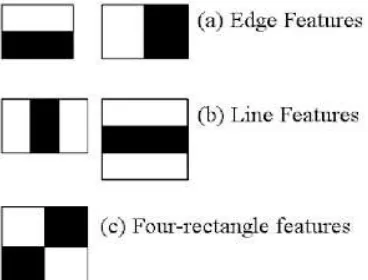
The function of this module is to determine where in an image a face is located. The face detection module works by scanning up an image at different scales and looking for some simple patterns that denote the presence of a appears in the center and presented at a uniform size. Face detection determines where in an image a face is located.
IJSTMR
©
2019 | All Rights Reserved 32 Fig: 2 Haar FeatureFig :3 Face detection Eyes Detection
In Eyes Detection Determining one candidate pair from among the candidate pairs as nostrils, establishing the remained candidate pairs forming equilateral triangles in relation with the nostrils as eye candidate pairs; and determining a candidate pair forming the small equilateral triangle as the driver`s eyes.
Iris detection
The iris recognition system consists of an automatic segmentation system that is based on the Haar algorithm, and it is able to localize the circular iris and pupil region, occluding eyelids and eyelashes, and reflections. The extracted iris region was then normalized into a rectangular block with constant dimensions to account for imaging inconsistencies.
Alert Generation
Alert generation is used for indication of detected drowsiness. The system generates the alarm along with the vibrator as soon as it detects the drowsiness.
A. Proposed System Screenshots
IJSTMR
©
2019 | All Rights Reserved 33 Fig: 5 Eyes detectionCONCLUSION AND FUTURE WORK
The aim of this dissertation is to detect the drowsiness for drivers using image processing. We are going to design a system using camera that points directly towards the driver’s face and monitor the driver’s eyes in order to detect fatigue or drowsiness by self-developed image processing algorithm which can give information regarding drowsiness of drivers. So the first step is the face detection. For face detection viola-jones method is used. Viola-jones has been successfully applied on the facial detection system and based on the accuracy of human location detection.
REFERENCES
1. W. L. Chan, S. L. P. Leo, and C. F. Ma, “Computer vision aplications in power substations,” IEEE International Conference on Electric Utility Deregulation, Restructuring and Power Technologies, vol. 1, pp. 383-388, 2004.
2. Z. Li, Y. Y. Liu, R. Walker, R. Hayward and J. Zhang, “Towards automatic power line detection for a UAV surveillance system using pulse coupled neural filter and an improved Hough transform,” Mach. Vision Appl., vol. 21, no. 5, pp. 677-686, 2010.
3. A. Rahmani, J. Haddadnia, A. Sanai and O. Seryasat, “Intelligent detection of electrical equipment faults in the overhead substations based machine vision,” 2nd International Conference on Mechanical and Electronics Engineering, vol. 2, pp. 141-144, 2010.
4. R. Wachal, J. Stoezel, M. Peckover and D. Godkin, “A computer vision early-warning ice detection system for the Smart Grid,” in Transmission and Distribution Conference and Exposition, pp. 1-6, 2012.
5. M. R. Bastos and M. S. L. Machado, “Visual, real-time monitoring system for remote operation of electrical substations,” 2010 IEEE/PES Transmission and Distribution Conference and Exposition: Latin America, pp. 417-421, 2010.
6. M. J. B. Reddy, B. K. Chandra, and D. K. Mohanta, “A DOST based approach for the condition monitoring of 11 kV distribution line insulators,” IEEE Trans. Dielectr. Electr. Insul., vol. 18, no. 2, pp. 588-595, 2011.
7. W. Cai, J. Le, C. Jin, and K. Liu, “Real-time image identificationbased anti-manmade misoperation system for substations,” IEEE Trans. Power Del., vol. 27, no. 4, pp. 1748,1754, 2012.
8. R. Waranusast, N. Bundon, V. Timtong, C. Tangnoi, and P. Pattanathaburt, Machine vision techniques for motorcycle safety helmet detection, 2013 28th International Conference on Image and Vision Computing New Zealand, pp. 35-40, 2013.
9. R. Silva, K. Aires, and R. Veras, “Helmet detection on motorcyclists using image descriptors and classifiers,” 2014 27th SIBGRAPI Conference on Graphics, Patterns and Images, pp. 141-148, 2014.