www. a a s sj o u rn a l . c o m
ISSN (Online): 2322 – 4479 ISSN (Print): 2476–4981
Original Article
www.AESAsport.com Received: 09/05/2017 Accepted: 28/08/2017
How Factors of the Interpretive Structural Model Affect the
Intent to Buy Original Brand Soccer Balls?
1
Hasan Gholami Ghajari,
1Masoumeh Kalateh Seifari
*1
Department of Sport Management, Faculty of Physical Education and Sport Science, University of Mazandaran, Babolsar, Iran.
ABSTRACT
Background. A soccer ball is the principal piece of sports equipment for soccer and original brands compete with each other for a big pie of the market. Objectives. The aim of this study’s interpretive structural model (ISM) was to ascertain the factors that affect the intent to purchase original brand soccer balls. Methods. First, by a study of the literature and by the use of the Delphi technique, effective factors impacting the intent to buy original brand soccer balls were identified. The ISM was then drawn up to show factors affecting the intent to buy an original brand soccer ball. The study’s population consisted of the country’s sports management professors as samples and eight experts were chosen in a targeted manner. The MATLAB2014 software was used for the implementation of the ISM.
Results. The findings were shown in diagrams with five levels. The factor ‘ball appearance’ was at the fifth level, the factors ‘brand name’ and ‘country of manufacturer of brand’ was at the fourth level, ‘congruence of price and quality’ was at the third level, four factors of ‘brand identity’, ‘brand image’, ‘perceived value’, and ‘brand store sales’ were at the second level, and ‘intention to buy’ was at the first level. Conclusion. An original brand soccer ball should be beautiful and have an attractive design. It must have a proper shape and it must create a unique identity so that the positive image of the product is accepted by customers. It must create value for customers when they weigh two aspects: What they have paid for it and what they have received.
KEY WORDS: Ball Appearance, Brand Name, Country of Manufacturer, Congruence of Price and Quality, Brand Identity, Brand Image, Perceived Value, Brand Store Sales, Intention to Buy.
INTRODUCTION
Football is the most popular sport in the world today (1). The ball is the principal item of sports equipment for soccer. The amount of sales of the product of this important sport was worth $1.15 billion in 2008. There was a significant increase of 240% in the football industry’s trade from the year 2001 to 2008 (2). Nike and Adidas brands have dominated the global soccer ball market. Adidas accounted for 34% of the global soccer balls business with sales of US$1.57
billion from football-related merchandising while Nike has annual revenues of U$1.7 billion from footballs and football-related products (3). Both Nike and Adidas have consolidated their positions as the two leading brands for soccer balls and soccer-related products. The term ‘leading brand’ means that for the first time, a creative offering in the form of a new product or service is being made. These brands have special credentials in the international sphere and even a
customer’s primary name or brand ascribe to that products class and products with primary brand name on recall mind (4). A leading brand means a brand that is better known than its competitors in the market and the customers’ ‘outstanding characteristics’ can understand it.
There are various types of soccer balls in the international market. Based on price, quality, performance and technology (3), they are ranked in the market. In general, there are four different categories of soccer balls, which include: International match ball, club’s match ball, practice and training ball, and promotional ball (2). Professional soccer balls are sold at higher prices than practice and training ball or promotional balls (3).
In accordance with the development of the market, soccer ball-makers focus on the purchases in it and try to understand customer purchase decisions, which are of key importance for marketing managers of branded soccer balls. Intent is an important factor in the attitude and can predict actual behaviour. When the intention to buy is more, a customer is likely to buy a product. Marketing managers to purchasing customer to predict sell products and services attention have existing or new. Information on intent to purchase can help marketing managers take decisions related to product demand, market segmentation, and promotional strategies. A purchase decision is a function of three factors: Consumer, product and situation. Thus, a consumer views the goods and service provided to obtain more information and assesses the brands before making any selection (5). Therefore, on account of the competition among the original brands of soccer balls, factors affecting the intention to buy this important product require a special look. The researcher’s aim is to provide a comprehensive model on the
relationship among factors affecting the
intention to buy brands of original soccer balls. However, the researcher did not find articles on the intention to buy original brand soccer balls— this has created a vacuum as far as information gathering is concerned.
Background
Several studies have been conducted on factors influencing the purchase behaviour of customers in accordance with the type of brand. Some research indicated that a customer’s
visualization of a store can influence purchases. Hence, among the constituent dimensions, a customer’s mental image of a store and the products offered at the store have the greatest impact on intent to purchase (6). The subjective image is an overview of the recorded store’s features in the memory of a customer; Based on collision previous and current to style direct and indirect (7).
Marketing research indicates that consumers value money and expect to buy the best quality products with their money (8). Pillai et al. (2015) determined the significance that a select group of factors play in influencing customer purchase choices of sporting goods. The results indicate that quality is regarded as the key factor that influences the purchase choice of sporting goods. Also, the price influences purchase choice. Again, this research placed no significant value on brand name(9). Often, brand name plays the main role among brand elements for a customer’s choice. Consumers trust the brands they are familiar with, and easily ignore brand names they are not familiar with (10).
Some studies have investigated the impact of product appearance on the intention to buy and concluded that packaging and appearance of the products influence purchase decisions (11). The appearance, packaging or any signs or unique symptoms are elements of brand identity. The brand identity concept is the integration of brand elements to create an impact on the customer’s mind so that a brand identity is created (12).
The image of a country significantly affects customer brand awareness. Countries that have positive images are perceived to produce quality products, which are technologically advanced and reliable, thereby giving such brands a positive image (13). Of course, research has shown a greater willingness to buy domestic sportswear brands than foreign brands among Chinese consumers (14). In Iran, too, customers’ patriotism had a negative effect on the intention to purchase foreign products. Also, the quality of foreign products had a positive effect on the intention to buy these products (15).
MATERIALS AND METHODS
The research is descriptive and applied with the ISM method. The ISM method is a suitable technique used to analyse the effects of an
element on other elements that examine the order and direction of complex relationships among the elements of a system (16). This method—based on group judgments—is an interpretative method and, based on the study of the relationship of variables, it is a structural method. Since it demonstrates the particular relationships among variables in a structured model, it is a modelling method. To carry out the research, firstly, by studying the literature available, the possible factors influencing the intent to buy the original brand soccer balls were identified. The factors found by six experts, all sport management professors, were identified using the Delphi technique till a theoretical saturation range. After identifying the factors, the ISM method was implemented. The study’s subjects in the ISM method were global sports management professors and eight of them were specialists in the field of intent to buy sports equipment. They had adequate knowledge of soccer balls. The ISM technique in five steps has been implemented using the MATLAB2014 software.
1. Determination of the relationship between factors and the formation of the structural self-interaction matrix (SSIM).
2. Creation of the initial reachability matrix. 3. Formation of the final reachability matrix. 4. Determination of the level of indicators. 5. Drawing up of the ISM.
RESULTS
Nine factors were identified by the study of literature and using the Delphi techniques. These are: Brand name, brand identity, brand image, perceived value, congruence of price and quality, ball appearance, country of manufacturer of brand, brand store sales, and intent to buy. These were effective factors affecting the purchase decision of the original brand soccer ball.
After identifying the factors, a pair
comparison questionnaire was distributed among
the experts. Based on the following
relationships, there was a matrix for each questionnaire (16).
V: i leads to j. A: j leads to i.
X: i and j lead to each other. O: Variables i and j are unrelated.
By aggregating the mode-based comments, we get the structural self-interaction matrix (SSIM). The construction is shown in Table 1.
Table1. Structural self-interaction matrix (SSIM) of effective factors on intent to buy original brand soccer balls
9 8 7 6 5 4 3 2 1 Factors
V O X O O O V V X 1. Brand name
V O A A O V X X 2. Brand identity
V O A A O A X 3. Brand image
V O A A A X 4. Perceived value
V V A A X 5. Congruence of price and quality
V O V X 6. Ball appearance
V O X 7. Country of manufacturer of brand
V X 8. Brand store sales
X 9. Intention to buy
Then, with the use of the following relationships and putting the numbers 0 and 1 in the structural self-interaction matrix, we obtain the initial reachability matrix, which is shown in Table 2.
If the (i, j) entry in the SSIM is V, then the (i, j) entry in the reachability matrix becomes 1 and the (j, i) entry becomes 0.
If the (i, j) entry in the SSIM is A, then the (i, j) entry in the reachability matrix becomes 0 and the (j, i) entry becomes 1.
If the (i, j) entry in the SSIM is X, then the (i, j) entry in the reachability matrix becomes 1 and the (j, i) entry also becomes 1.
If the (i, j) entry in the SSIM is O, then the (i, j) entry in the reachability matrix becomes 0 and the (j, i) entry also becomes 0.
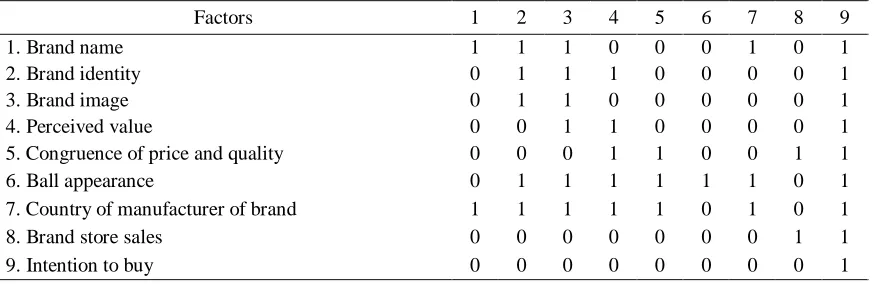
Table 2. Initial reachability matrix: Effective factors on intent to buy the original brand soccer balls 9 8 7 6 5 4 3 2 1 Factors 1 0 1 0 0 0 1 1 1 1. Brand name
1 0 0 0 0 1 1 1 0 2. Brand identity
1 0 0 0 0 0 1 1 0 3. Brand image
1 0 0 0 0 1 1 0 0 4. Perceived value
1 1 0 0 1 1 0 0 0 5. Congruence of price and quality
1 0 1 1 1 1 1 1 0 6. Ball appearance
1 0 1 0 1 1 1 1 1 7. Country of manufacturer of brand
1 1 0 0 0 0 0 0 0 8. Brand store sales
1 0 0 0 0 0 0 0 0 9. Intention to buy
After obtaining the initial reachability
matrix, secondary relations are controlled
among the factors. For this purpose, initial
matrix to the power K + 1 arrives in the
MATLAB 2014 software so that it stays
stable: M
k=M
k+1is to be achieved (17). So,
in the final reachability matrix, some
elements of 0 are also converted to 1, which
is represented as (*1) in Table 3.
Table 3. The final reachability matrix: Effective factors on intent to buy original brand soccer balls
9 8 7 6 5 4 3 2 1 Factors 1 1* 1 0 1* 1* 1 1 1 1. Brand name
1 0 0 0 0 1 1 1 0 2. Brand identity
1 0 0 0 0 1* 1 1 0 3. Brand image
1 0 0 0 0 1 1 1* 0 4. Perceived value
1 1 0 0 1 1 1* 1* 0 5. Congruence of price and quality
1 1* 1 1 1 1 1 1 1* 6. Ball appearance
1 1* 1 0 1 1 1 1 1 7. Country of manufacturer of brand
1 1 0 0 0 0 0 0 0 8. Brand store sales
1 0 0 0 0 0 0 0 0 9. Intention to buy
After obtaining the final reachability matrix, to determine the levelling of the variables, the reachability set, the antecedent set, and the intersection set are specified for each. In the reachability set, rows of final reachability matrix appear as one in the antecedent set columns. Which of intersection they obtained Intersection set. The variable for which the reachability and the intersection sets are the same is assigned as the first level variable. By discarding this factor and repeating this step for other elements, the next levels of effective factors on the intent to buy the original brand soccer ball can be specified. It is shown in Table 4. According to Table 4,
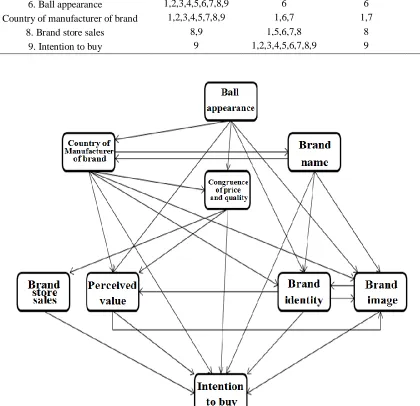
the intention to buy is accepted as the first level. By discarding this factor and repeating this step for other elements like brand identity, brand image, perceived value and brand store sales, the second level is obtained. After removing them, congruence of price and quality gives us the third level, and by removing that, brand name and country of manufacturer of brand gives the fourth level. By removing them, we get the appearance factor, which is the fifth level. Then, a model is mapped for the five levels in accordance with Figure 1. Our lines, plotted among each of the factors on each other, are based on the initial reachability matrix.
Table 4. Reachability set, antecedent set, intersection set, and the levels of each factors
Level Intersection set
Antecedent set Reachability set
Factors
4 1,7
1,6,7 1,2,3,4,5,7,8,9
1. Brand name
2 2,3,4,
1,2,3,4,5,6,7 2,3,4,9
2. Brand identity
2 2,3,4,
1,2,3,4,5,6,7 2,3,4,9
3. Brand image
2 2,3,4,
1,2,3,4,5,6,7 2,3,4,9
4. Perceived value
3 5
1,5,6,7 2,3,4,5,8,9
5. Congruence of price and quality
5 6
6 1,2,3,4,5,6,7,8,9
6. Ball appearance
4 1,7
1,6,7 1,2,3,4,5,7,8,9
7. Country of manufacturer of brand
2 8
1,5,6,7,8 8,9
8. Brand store sales
1 9
1,2,3,4,5,6,7,8,9 9
9. Intention to buy
Figure1. ISM’s effective factors on intent to buy original brand soccer ball
DISCUSSION AND CONCLUSION
The aim of this research and the ISM determined the factors that resulted in the intent to buy the original brand soccer ball. Based on the findings from library studies and the Delphi technique, we identified nine factors: Brand name, brand identity,brand image, perceived value, congruence of price
and quality, ball appearance, country of
manufacturer of brand, brand store sales, and intent to buy as factors affecting the intention to buy the original brand soccer ball. Also, the findings showed the factor of the ball’s appearance to be at the fifth
level, brand name and country of manufacturer of brand at the fourth level, and congruence of price and quality at the third level. Four factors—brand identity, brand image, perceived value and brand store sales—were at the second level and the first level was dedicated to the intention to buy.
The research findings indicate that the ball’s appearance is at the fifth level and affects the intention to purchase the original brand soccer ball. This conclusion is consistent with the results of Harith et al. (2014), because they confirmed the effects of appearance of the product on purchase intention (11). Also, the ISM has shown the impact of the ball’s appearance on factors like the country of manufacturer of brand, congruence of price and quality, perceived value and image and identity of the brand.
The research findings have shown that the two components of brand name and country of manufacturer are at the fourth level and influence the intention to purchase the main brands of the soccer ball. The result obtained in the brand name has been consistent with the research by Kinuthia et al. (2012) (10). It is not consistent with the results of Pillai et al. (2015), who do not find any worth of the brand name (9). In relation to the country of the manufacturer of the brand, the results of Yasin et al. (2007) state that the image of a country significantly affects consumer awareness of the brand (13). The structural interpretation model has shown that the country of manufacturer is a brand factor on brand names, congruence of price and quality, perceived value and image and identity of the brand. Also, according to the model, the brand name affects other components of the country of manufacturer, such as the image and identity of the brand.
The factor ‘congruence of price and quality’ is located at the third level, and its impact on the intention to purchase the original soccer balls brand is shown. This is consistent with the research of Pillai et al. (2015), which has identified quality as a key factor and price as the most influential factor in purchase intention (9). The impact of the congruence of price and quality on the perceived value factor and brand distributor store factor is shown in the model.
Four factors—brand distributor store, perceived value, and image and identity of the brand—have been shown at the second level, and influence the intention to purchase original branded soccer balls.
The factor of the brand distributor store only affects the intent to purchase. This result is in line with the results of Saeeda Ardakani and Jahanbazi (2015), They know that the images of the products offered in a store are a part of the consumer’s mental imagery, which has the greatest impact on purchase intention (6). The factors of brand identity and brand image have a two-way communication and brand image has an impact on the perceived value. Also, perception has been shown as effective for the value of the brand
image. These results show the cycle among of
brand identity, brand image and the perceived value. And these factors effect on the intention to purchase the original brand. Also, the ISM has shown the influence of other factors on the purchase intention factor.
Hence, it can be concluded that factors such as the appearance, the brand name, the country of the manufacturer of the brand and the congruence of price and quality, which are at a higher level of the ISM, can affect the intention to purchase soccer balls of the original brand by stimulating and influencing factors such as brand image, brand identity and perceived value that are at lower levels of the model. So, leading brands producing soccer balls must pay particular attention to the appearance factor and brand name. By choosing a special name and a beautiful and an attractive design, a brand can create a unique appearance and a name for itself. With a unique image and identity, it can create powerful and desirable mental associations in the consumer. This creates a positive image of the product. To create value from the consumer’s perspective, the company should see to it that the customer is satisfied in what he deals with and what he receives.
APPLICABLE REMARKS
The attractive appearance and name
create a unique image and identity for the main brands of soccer balls.
The unique image and identity of the
main brands create value from the consumer’s point of view.
The consumer makes his/her purchase on
the basis of the perception of what he/she deals with and what he/she receives.
REFERENCES
1. Cayolla R, Loureiro SMC. Fans club brand relationship: football passion. International Journal of Business and Globalisation 10. 2014;12(1):82-97.
2. Tanveer MA, Rizvi S, Riaz W. Declining market share of Pakistan in football industry. Asian Journal of Business and Management Sciences. 2012;1(11):33-42.
3. Nadvi K. Labour standards and technological upgrading: Competitive challenges in the global football industry. International Journal of Technological Learning, Innovation and Development. 2011;4(1-3):235-57.
4. EBRAHIMI SB, KETABIAN H, RAHIMI H. Identification of the effective criteria on choosing imitation brand for consumables. 2015.
5. Rodani aars, hosein. Motivations influencing the choice of brands in the insurance industry. Journal of the insurance industry. 2010;25(2):3-25.
6. Saeida Ardekani s, jahanbazi n. Influence of store image on purchase intention: The moderating role of trust and perceived risk. New Marketing Research Journal. 2015;5(2):53-72.
7. Hsu MK, Huang Y, Swanson S. Grocery store image, travel distance, satisfaction and behavioral intentions: Evidence from a Midwest college town. International Journal of Retail & Distribution Management. 2010;38(2):115-32.
8. Jahandideh M, Hoseini, E. & Ramezaninejad, R. onsumer decision-making styles in Sport goods. Scientific Journal Management System. 2015;5(10):37-45.
9. Pillai PS, S. Naude,M. . Selected factors as determinants in the purchase choice of sporting goods. Problems and Perspectives in Management. 2015;13(3):216-23.
10. Kinuthia LN, Keren G, Burugu M, Muthomi H, Mwihaki M. Factors influencing brand loyalty in sportswear among Kenyan university students: the case of swimmers. differences. 2012;1(4).
11. Harith Z, Ting C, Zakaria N. Coffee packaging: Consumer perception on appearance, branding and pricing. International Food Research Journal. 2014;21(3).
12. Keller KL, Parameswaran M, Jacob I. Strategic brand management: Building, measuring, and managing brand equity: Pearson Education India; 2011.
13. Mohd Yasin N, Nasser Noor M, Mohamad O. Does image of country-of-origin matter to brand equity? Journal of Product & brand management. 2007;16(1):38-48.
14. Lu J, Xu Y. Chinese young consumers’ brand loyalty toward sportswear products: a perspective of self-congruity. Journal of Product & Brand Management. 2015;24(4):365-76.
15. Mortazvi S, Poor, S., Saadatyar, F., Bitaraf, F. & Rezaeirad, M. The Effect of Cultural Tendency on Patriotism and its Impact on Customer's Buying Intention and Behavior. Management Researches. 2012;5(15):5-26.
16. Azar A, Bayat K. Designing a model for" Business process-orientation" using interpretive structural modeling approach (ISM). African Journal of Business Management. 2013;7(26):2558.
17. Mirfakhredini SHaE, Reza and jalilean, negar A model of comprehensive and integrated approach towards implementing Student Relationship Management interpretive structural modeling and structural equation modeling (Case Study: Yazd University). Educational Planning Studies. 2014;2(4):5-36.