Supplemental Issue of
National Seminar on Empowering and Empanelling Ayurveda System of Medicine
Organized by SC Mutha Aryangla Vaidyak Mahavidyalaya, Satara on 26-27 March 2015
Study of Shelf Life of Churna According To Modern Pharmaceutical
Parameters
Research Article
Vinod Patange1*, Ashwini Dhage2
1. Assistant Professor, Department of Dravyaguna, 2. UG Scholar, S.C.M.Aryangla Vaidyak Mahavidyalaya, Satara.
* Corresponding Author: Vinod Patange, Assistant Professor, Department of Dravyaguna, S.C.M.Aryangla Vaidyak Mahavidyalaya, Satara
E-mial: [email protected]; Phone No: +91-9028067171
Abstract
Quality control of herbal formulations such as Churna especially for determination of its ‘Shelf life’ is essential in order to assess the quality of the drugs for therapeutic value. According to an estimate of World Health Organization (W.H.O) nearly 80% population of developing countries rely on traditional medicines. The World Health Organization (WHO) in 1999 has given a detail protocol for the standardization of herbal drugs comprising of a single as well as multiple quality control parameters. During the study, Evaluation of five selected churna was done by determination of various parameters like Ash value, moisture contents, extractive values and TLC profile. It was observed that, total Ash value approximately remains the same. Due to seasonal variation, moisture content increases, which badly affects the shelf life of churna. Water soluble extractive value decreases with time. By determining the TLC profile, it is also concluded that there is a significant loss of the chemical constituents of churna. Further it will be interesting to study the shelf life of churna with the help of advanced analytical techniques such as HPTLC, LC_MS etc.
Keywords: Shelf life, modern pharmaceutical parameters, quality control of churna
Introduction
Basic principles of Bhaishajkalpana includes first & most “Panchavidhakashaykalpana“. The medicines, which we used to offer patient, is in different forms & those main forms in ayurvedic literature are called as “Panchvidhakashaykalpana”. This principle mainly contains those 5 basic varieties of drugs which are most commonly used by vaidya’s during their medical practice. On the basis of these
kalpanas all the formulation in Ayurveda have been made (1).
It contains Swaras, Kalka, Kwatha, Hima & Phanta. These all varieties are considered as “Panch vidha kashay kalpana”. These are the main or primary kalpanas of drugs which are further classified or divided into various “Upkalpanas” for proper fast absorption of medicine for more stability, increase shelf
life of drug than
etc are the different subtypes of kalpanas & hence these are termed as “Upkalpanas”. Churna’s subtype of kalka kalpana (3). Amongst these churna are one of the main or daily usable upkalpana, even essential in preparation of other medicine. Churna preparations are widely & largely used in pharmacy as well as by practitioners Ayurveda for different ailments.
Ayurvedic Definition of Churna
Meaning – Churna is defined as totally dried raw material which is powdered very minutely to make their small size & again filtered through cloth’s grid & obtained fine powder is called as “Churna”.
Why to determine the Shelf life?
The nature of drug, their mode of administration, doses & the time duration specially its expiry date & expected effect, ultimately decides the success of medicinal drugs & treatment of that pathy. Hence it is very important to study the shelf life of dosage form according to pharmaceutical parameters. According to Ayurvedic pharmaceutical science, churna preparations remain potent up to two months (13th century A.D., sharangdhara samhita ), after which they start degrading gradually thus losing their efficacy. The most important challenge faced by Ayurvedic formulations arises from lack of complete evaluation of its constituents, due to its complex nature.
Very little literature is available for the quality control of churna in terms of its Shelf life. And hence the present study was designed to study the Shelf life of churna by application of modern quality control parameters.
Objective
To evaluate the shelf-life of Ayurvedic formulation churna by means of modern pharmaceutical techniques.
Material and Methods
Five single drug churna formulations were selected for the study. 1) Manjishtha – Rubia cordifolia
2) Guduchi – Tinospora cordifolia 3) Vidang- Embelia ribes
4) Sariva – Hemidesmus indicus 5) Pippali – Piper longum
Different 5 Ayurvedic drug viz. Manjishta, Guduchi, Vidang, Sariva, Pippli selected for the study. The drugs were purchased from MANAKARNIKA AUSHADHALAYA, PUNE. The drugs were authenticated by using morphological and anatomical data department of dravyaguna vigyan at Aryangla Vaidyak Mahavidyalaya, Satara.
In order to check the quality & purity of all the churnas, following parameters were used. The study was carried out at Department of Pharmacognosy at “Satara College of Pharmacy, Satara”. Regular record of assessment according to modern pharmaceutical methods was maintained, after every 2 months. The study was started on 1st March 2014 & it was denoted as batch I. The various modern evaluation parameters were applied for standardization of churnas.
Standardization was carried out by using different methods like,(4,5,6,7,8,9,10)
I. Total Ash values
II. Moisture content (Loss on Drying) III. Water soluble extractive value IV. Ethanol soluble extractive value
V. TLC profile (Thin layer chromatography)
Thin layer chromatography (TLC)- 1) Rubia cordifolia-
Solvent system-Toluene: Ethyl acetate [85:15]
Procedure-Applied test solution on prepared silica gel 60 GF254 on TLC plate.
Visualisation-Viewed under the UV light at 254 nm
2) Tinospora cordifolia- Test Solution-
5 gm of dried powdered drug was refluxed with 50ml methanol for 2hours. Filtered and evaporated the filtrate to dry. The residue was dissolved in 5 ml methanol.
Solvent system-
Toluene: Acetone: Water (5:15:1)
Procedure-
Applied standard solution on prepared silica gel 60 GF254 on TLC plate.
Visualisation-
viewed under the UV light at 254 nm.
3) Embelia ribes- Test Solution-
5 gm of the powdered drug was refluxed with 50ml methanol for 1 hour. Filtered and evaporated the filtrate to dry. The residue was dissloved in 5ml methanol.
Solvent system-
Toluene: Acetone: Acetic acid (9:1:0.5)
Procedure-
Applied standard solution on prepared silica gel 60 GF254 on TLC plate.
Visualisation-
Viewed under the UV light at 254 nm.
4) Hemidesmus Indicus- Test Solution-
5gm of finely powdered drug was taken with 25ml of ethanol and left it for complete extraction for 24 hours, process was repeated for three times. Filtered combined extract and concentrated the filtrate to dry. The ethanolic extract was dissolved in 10 ml of chloroform.
Solvent System-
Toluene: Ethyl acetate: Methanol (8:2:0.5)
Procedure-
Applied standard solution on prepared silica gel 60 GF254 on TLC plate.
Visualisation-
Viewed under the UV light at 254 nm.
5) Piper longum- Test Solution-
1 gm of the powdered drug was refluxed with 10ml methanol for 30 mins. Filter and evaporate the filtrate to dry. The residue was dissolved in 5ml methanol.
Solvent System-
Toluene: Ethyl acetate [7:3]
Procedure-
Applied standard solution on prepared silica gel 60 GF254 on TLC plate.
Visualisation-
Viewed under the UV light at 254 nm.
Results-
TABLE – I – Result Showing Morphological Study of Churnas.
Batch no.
Name of churna
Taste Odour Colour
1st BATCH
Manjishta Sweetish Characteristically Pleasant Reddish Brown
Guduchi Bitter Odourless Creamish Brown
Vidang Pungent - Light Reddish Brown
Sariva Acrid, Vanilin Like Pleasant ( Coffee Like) Yellowish Brown
Pippli Bitter TikshnaGandha Deep Moss Green
2nd BATCH
Manjishta Sweetish Characteristically Pleasant Reddish Brown
Guduchi Bitter Odourless Creamish Brown
Vidang Pungent - Light Reddish Brown
Sariva Acrid, Vanilin Like Pleasant ( Coffee Like) Yellowish Brown
Pippli Bitter Tikshna Gandha Deep Moss Green
3rd BATCH
Manjishta Sweetish Characteristically Pleasant Reddish Brown
Guduchi Bitter Odourless Creamish Brown
Vidang Pungent - Light Reddish Brown
Sariva Acrid, Vanilin Like Pleasant ( Coffee Like) Yellowish Brown
Pippli Bitter TikshnaGandha Deep Moss Green
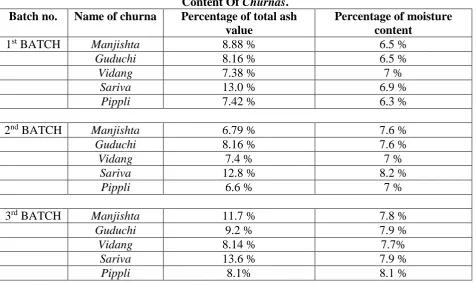
TABLE – II – Result Showing Percentage of Total Ash Value and Percentage Of Moisture Content Of Churnas.
Batch no. Name of churna Percentage of total ash value
Percentage of moisture content
1st BATCH Manjishta 8.88 % 6.5 %
Guduchi 8.16 % 6.5 %
Vidang 7.38 % 7 %
Sariva 13.0 % 6.9 %
Pippli 7.42 % 6.3 %
2nd BATCH Manjishta 6.79 % 7.6 %
Guduchi 8.16 % 7.6 %
Vidang 7.4 % 7 %
Sariva 12.8 % 8.2 %
Pippli 6.6 % 7 %
3rd BATCH Manjishta 11.7 % 7.8 %
Guduchi 9.2 % 7.9 %
Vidang 8.14 % 7.7%
TABLE – III Result Showing Percentage of Water Soluble Extractive and Percentage of Ethanol Soluble Extractive of Churnas.
Batch no. Name of churna Percentage of water soluble extractive
Percentage of ethanol soluble
extractive
1st BATCH Manjishta 3.45 % 1.66 %
Guduchi 5.40 % 1.56 %
Vidang 3.25 % 4.41 %
Sariva 5.16 % 2.98 %
Pippli 11.12 % 4.76 %
2nd BATCH Manjishta 4.14 % 1.51 %
Guduchi 4.98 % 1.91 %
Vidang 2.82 % 4.36 %
Sariva 5.13 % 3.05 %
Pippli 9.38 % 4.91 %
3rd BATCH Manjishta 3.27 % 1.014 %
Guduchi 4.9 % 1.8 %
Vidang 2.7 % 4.5 %
Sariva 4.3 % 2.3 %
Pippli 8.7 % 4.34 %
TABLE – IV Result Showing Rf Values of Churnas.
Batch no. Name of churna Rf value
1st BATCH
Manjishta 0.08,0.17,0.24,0.28,0.37,0.48,0.74,0.86,0.93
Guduchi 0.08,0.13,0.21,0.40,0.47,0.55,0.63,0.71,0.82,0.91,0.96,0.98 Vidang 0.05,0.08,0.14,0.18,0.29,0.44,0.55,0.67,0.76,0.87
Sariva 0.05,0.22,0.38,0.54,0.65,0.78,0.90,
Pippli 0.17,0.31,0.60,0.66,0.72,0.80,0.85,0.90
2nd BATCH
Manjishta 0.08,0.10,0.16,0.20,0.24,0.27,0.36,0.48,0.57,0.75,0.87,0.91
Guduchi 0.08,0.14,0.20,0.28,0.51,0.62,.075,0.88,0.96,0.98 Vidang 0.09,0.15,0.18,0.22,0.24,0.30,0.37,0.42,0.52,0.70,0.84
Sariva 0.27,0.38,0.45,0.56,0.72,0.82,0.92
Pippli 0.11,0.20,0.35,0.62,0.70,0.78,0.90,0.92
3rd BATCH
Manjishta 0.08,0.11,0.19,0.35,0.39,0.48,0.51,0.57,0.91
Guduchi 0.09,0.32,0.39,0.45,0.70,0.77,0.86,0.97 Vidang 0.24,0.28,0.34,0.41,0.52,0.63,0.78,0.90
Sariva 0.12,0.20,0.64,0.73,0.94
DISCUSSION Total Ash value
Ash value is a direct measure of soil and sand particles present in the powdered drug. There is no modified or significant change in the percentage of Ash value. The results have shown that there is no significant rise in total Ash value of each churna. All the churnas were preserved well in air tight containers, so it could be the reason for no change in ash value of every churnas. There is little change in the value of batch II, the reason might be the practical error.
Moisture content
Moisture content of batch III of all the churnas have found to be increased significantly. The batch I moisture content is the lowest for all the 5 churnas & gradually it has been increased in batch II & III. The significant rise in moisture content leads to attack of atmospheric moisture on the formulation. It is also subjected to the atmospheric conditions since, batch I was carried out in summer & batch III carried out in rainy season.
The moisture attack on the churna formulation may lead to microbial growth & fungus attack. This could be prevented by keeping & storing the formulation in air tight containers. We have also preserved all the churna in closed container, but moisture attack was not prevented. So to ensure the life of churna it should be preserved in well closed air tight containers, so that shelf life of churna could be improved.
Water and ethanol soluble extractive value
Water soluble extractive value of IIIrd batch is found to be lower compared with batch I and II. On standing churna might have lost certain ingredients ( phytochemicals) so that it will reduce the total extractive value.
Extractive value is the measure of
powdered drug. Extractive value may vary with the preservation of drug/formulation. In our study, it has been noticed that water soluble extractive value is decreased as the time proceeds i.e. from batch I to III for all 5 churnas, water soluble extractive value decreased. It signifies that water soluble active principles might have lost on standing the formulation for a longer period. So it becomes very essential for churna to retain its chemical constituents for at least 1 year, so that it could produce desired therapeutic effect. In case of ethanol soluble extractive value only Guduchi & Vidanga chruna retained their ethanol soluble extractives during the course of the study ( 4 months ) & rest of all the churna i.e. Manjista, Sariva & Pippali have lost chemicals on standing.
Thin Layer Chromatography (TLC)
Also this could be supported by results of extractive values.
Conclusion
The present study was carried out on 5 different churna reveals that all 5 churna have lost certain amount of chemical constituents on standing for 4 months. Also moisture attack on churna signifies the deterioration of formulation & also decomposition of active chemicals. So, one can conclude that churnas under study have lost their potency on standing for 4-6 months. The traditional claim about shelf life of churna is 2 months4 and there on it starts to degrade, present study also support this claim. When modern parameters used to evaluate the churna, it seems that the shelf life may be up to 6 months. The surrounding temperature, packing of container are the aspects to be considered while thinking about the shelf life of a churna formulation.
References -
1. Charak samhita, edited by Dr. A. V. Shukla & Prof. R.D. Tripathi published by chaukhambha Sanskrit prakashan, Delhi. Reprint – 2005. 15,447,30,20.
2. Sartha vagbhata, edited by G.K.Garde, published by Rajendra Prakashan Pune 38, New print -2009. 5,341.
3. Sharangadhara samhita, edited by parashuram shastry, published by chaukhambha orientalia, Varanasi, India. 6thedition 2005. 13.
4. Database on Medicinal plants used in Ayurveda & Siddha – volume 5, edited by Prof G.S.Lovekar et al, published by Central Council for Research in Ayurveda & siddha, New Delhi – 110058, Reprint – 2008. 171,478.
5. Database on Medicinal plants used in Ayurveda – volume 3,edited by P.C.Sharma et al, published by central council for Research in Ayurveda & Siddha New Delhi – 110058, Reprint – 2005. 256,472. 6. Good manufacturing practices &
quality control of Ayurvedic powder preparations.
7. The Ayurvedic pharmacopoeia of India, part – 1 volume – 2 edited by Government of India, Department of ISM & H, published by The controller of publications civil lines, Delhi – 110054, 1st edition. 190,191,195.
8. Quality standards of Indian Medicinal plants – volume 2,3, co-ordinator by A.K. Gupta, published by Indian council of Medical Research, New Delhi – 110029. Reprint – 2005. 312,123.
9. Vandana, S. Arora, Comparison of TLC fingerprint profile of different extracts of Embelia ribes, IJPR – vol-2-2010,Rajpura.
[email protected] 10. Indian Herbal pharmacopoeia,
published by Indian drug manufacturers association, Mumbai, Revised New edition – November 2002.311.