Gender Factor and Its Effects in Computation
of Mental Stress
Khalid Masood Khan
Faculty of Computing and IT, University of Jeddah, Saudi Arabia
Abstract
This paper presents variation in stress severity and its affects in human body for male and female participants. In this study, a wireless sensor platform is used to record physiological signals which are triggered by inducing stress in a controlled environment. Stressors are created in a laboratory by designing a protocol that contains a series of cognitive experiments. Deep breathing technique is used to relax the body before and after each mental activity. As there are equal numbers of male and female subjects, the size of sample that is highly stressed for a particular activity is determined. For classification, SVM is used to separate stressful activities form relax class. Experimental results demonstrate that the affect of stress is similar for both categories of the participants and accuracy metrics are also same. It supports the notion that male and female subjects react similarly under stress and in reaction, the quantity and quality of physiological signals that are produced to cope with the stress, are also similar.Keywords
Mental Stress, Wireless Sensors, Support Vector Machine, Cognitive Experiments1. Introduction
Stress is termed for response of the body reacting to a change caused by external forces. It is a complex mechanism that consists of physical and psychological processes [1]. It is reported that stress increases the wear and tear of the body which is already in progress with increment in age. Chronic or long term stress produces negative effects on a body’s defence mechanism and impacts adversely on immune and cardiovascular systems of an individual [2, 3]. With increase in duration of stress, the suffering person becomes vulnerable to infections and chronic diseases and with prolonged stress the immune system of the body becomes weaker and slower than the normal age factor [4, 5].
Changes in hormones along-with physical and physiological changes are associated with stress as they show presence of mental stress [6, 7]. During stress, hormones such as cortisol are released in larger amounts. The analysis to measure the change in hormones needs laboratory methods and procedures which are generally very long. There are various physical and physiological measures such as variation in the heart rate, blood pressure changes, pupil dilation, changes in breathing patterns, skin conductance and changes in voice etc. represent presence of stress [8, 9]. These physiological measures can be obtained
* Corresponding author:
[email protected] (Khalid Masood Khan) Published online at http://journal.sapub.org/ajbe
Copyright © 2016 Scientific & Academic Publishing. All Rights Reserved
through non invasive means. For objective assessment of stress, physiological measures such as heart rate, skin conductance and respiration changes are more preferable than physical symptoms including facial expressions, voice variation and gesture changes [10, 11].
measures containing heart rate variation, skin conductance and changes in respiration patterns only and ignore physical features such as facial expressions, voice intonation and gesture variation as physiological features require shorter time periods for detecting and objective analysis of mental stress [21].
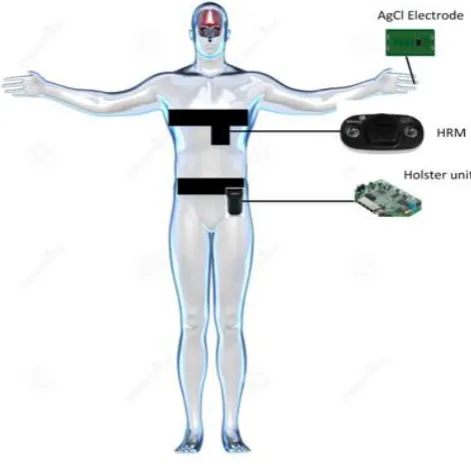
Figure 1. A sketch is shown wearing the proposed sensor system for illustration and demonstration purposes
In the undergoing research, cognitive experiments are performed to compute the variation of stress in both genders, thus highlighting the severity of response and difference in reaction time male and female subjects. To monitor stress, a wearable sensor system is developed that records various physiological changes in a person’s body in response to a stressful condition. Wireless sensor platform can be used for long term monitoring and does not hinder daily routine activities. The stress monitoring system needs to assess both the physiological and psychological impact of stress on an individual and provide an accurate quantitative metric that is of value to physicians. This quantitative metric should be able to correlate the individual’s perceived psychological
stress indices with their physiological measures. The cognitive experiments for inducing stress were designed with a protocol approved by authorized physicians. To relax a person and bring back his physiological system into its normal state, deep breathing technique is used. From recorded physiological parameters, various features including HRV, EDA and respiration signals are extracted and used in a support vector machine (SVM) classifier to compute the stress levels in participating subjects.
2. Materials (Hardware Devices)
Heart rate activity can be recorded by various devices. The gold standard for recording is ECG but it requires two electrodes and wiring which is unsuitable for long term measurements [22]. Pulse oximetry can also be used to measure HRM but it is very sensitive to motion artifacts. The optimal solution is heart rate monitor (HRM) that is used to record heart rate variations in cardiovascular activities or in stressor’s response [23]. It contains a strap which is worn around the chest. A wireless transmitter is connected to the strap that transmits heart rate to holster unit. Polar Elecro Inc. manufactures Polar Wearlink HRM which was used in our experiments. In Figure 1 a human body is presented which shows complete wearable sensor platform containing HRM to monitor heart rate variation, EDA sensor to monitor skin conductance and holster unit for transmitting and storing data.
Figure 2. Holster unit containing wireless sensors and batteries
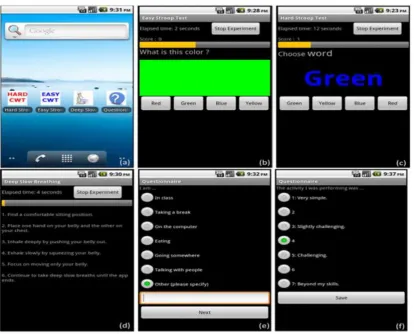
Figure 4. A Screen shot for CWT (Color Word Test) mental challenge
Respiration contributes significantly in heart rate variations and there is a need to record respiration effects. There is a number of sensing technologies that can be used to monitor breathing effects [24]. The change in thoracic or abdominal cross section is measured by Respiratory Inductive Pletthysmography (RIP) using an abdominal strap that measures changes in the magnetic fields of embedded coils. Placing two electrodes in the rib cage that records impedance changes in the alternating current variations due to respiration are recorded in Impedance Pneumography (IP). For long term monitoring, both these sensors are unsuitable due to postural changes and motion artifacts [25]. In our study, a pressure based respiration sensor made by Thought Technology Ltd. (SA9311M). It is insensitive to motion artifacts and is easily integrated to chest strap with HRM.
A low level electrical voltage is applied to the skin to monitor changes in skin conductance using electrodermal activity (EDA) [26]. In case of stress, body glands release sweat in palms and fingers which in turn increases the skin conductance. EDA can be monitored in palms of the hands but for long term use, they are unsuitable. In our experiments, two AgCl electrodes are attached to middle and index fingers of non-dominant hand to record skin conductance. These electrodes are made by Vivo Metric Systems Corp. (E243). In Figure 2, a snapshot of holster unit is presented that is used to control various wireless sensors and power consumption of the system.
An abdominal strap contains holster unit with three components integrated to it, a data processing unit, a sensor hub and a battery. A 2 GB mini SD flash card is used for data storage and is mounted on a Vertex Pro motherboard with 400 MHz processing speed (Gunstix Inc.). A sensor hub is also connected to the holster unit which is made up of a 3D accelerometer from STMicroelectronics, a GPS unit form Linx Technologies Inc. and a clock unit from Dallas semiconductor Inc. A HRM receiver module is also connected to sensor hub along with a wireless transceiver used for communication with wireless sensors. A built in charging module is attached in the sensor hub that charges the 3000 mAh Li-Po battery that can be used for continuous data collection upto thirteen hours.
3. Experimental Setup
To assist the experiments, a protocol was designed to induce mental stress in controlled indoor conditions. There are six deep breathing exercises five mental challenges for the participants. First of all, the system is calibrated for each individual and an initial deep breathing activity is performed to form a baseline. Each deep breathing session is performed for three minutes. In that session, a subject has to inhale for 4 seconds and then exhale for 6 seconds. The procedure is repeated and continued for 3 minutes. After the first deep breathing session, a mental challenge of memory search has to be performed by the subject. There is another deep breathing session after each mental challenge to relax the subject and bring back the body to a normal condition. The second mental challenge was colour word test that lasted for 5 minutes. A 3rd deep breathing session was performed again to prepare the subject for the next challenge. Next challenges consist of mirror trace, dual task and public speech. The duration of each challenge was 5 minutes. At the end, a final session of deep breathing is performed. Subjects had to rate each mental challenge with various difficulty levels following a Linkert scale, where a minimum difficulty is rated as 1 and extreme stressful challenge is rated as 7. In Figure 4, screenshot for CWT is presented. In CWT, user has to choose the colour from the menu. There are random questions to determine the colour based on sound, typing or shown colour of a bar. The user gets confused as there is a very little time to concentrate what form of question he/she has to reply as sound, picture and word, all three are depicting different colours.
4. Feature Selection
Six parameters are extracted from physiological signals
obtained by various wireless sensors. At 500 Mhz, heart rate signals were sampled using a peak detection algorithm. The resulting signal was re-sampled at 4 Hz. Very low frequency (VLF) component was removed from the signal using a band -pass filter between 0.04 Hz and 0.4 Hz. The Butterworth digital bandpass filter was used for its superior performance. The method using Matlab software tool employed second order transfer function for two stage filter such that mean square was minimized to less than 0.01%. Four features were extracted from heart rate variation (HRV) analysis. First extracted feature was AVNN which was an average of time interval between normal heart beats. The second feature was pNN25 which showed the percentage difference greater than 25 msec for adjacent NN intervals. The 3rd feature was root mean square of successive difference (RMSDD) and the 4th was HRV-HF for high frequency power of HRV. For respiration, Resp-LF showed low frequency respiratory power. Finally skin conductance was monitored in SCR that recorded few seconds of short time intervals whereas SCL was ignored that captures the skin conductance impedance for longer time periods.
The EDA features are selected as representative physiological parameters for the proposed model as they are linearly proportional to stress levels in comparison to HRV features which vary inversely. To form a representative signature for EDA, principal component analysis is performed on EDA features and its first principal component is extracted which contains more than 90% variance of these features. There are two components of EDA. Skin conductance level (SCL) is the slowly changing offset and skin conductance response (SCR) is a series of transient peaks.
Two features, mean and standard deviation, are computed from SCL as follows,
µ𝑆𝐿=1𝑁 𝑅𝑆𝐿(𝑡 − 𝑖)
𝑁
𝑖=1 (1)
where µ_SL is the average SCL trend for N samples of signature R_SL.
The standard deviation is computed as follows,
𝜎𝑆𝐿 = [ 𝑁1 𝑅𝑆𝐿 (𝑡 − 𝑖)
𝑁
𝑖=1 ]
1/2
(2) where σ_SL is standard deviation of the conductance signature R_(SL ). Similarly µ_SR and σ_SR are computed from residual SCR. In our experiments, SCL is used as it maps accurately the perspiration level in a human palm and fingers.
Stress and brain activity has a directly proportional relation. In these experiments, we have extracted features from electroencephalography (EEG) signals that are used to record brain activities. Positive and negative electrodes are placed at right and left corners of scalp. EEG signals records the brain signals with high resolution and low cost as compared to other signal processing modalities. The analysis of EEG signals is performed using frequency, amplitude and shape of the scalp. In negative emotional activities, signals in the right side of brain are more dominating than signals in the left side of the brain hemisphere. Thus the right side of the brain hemisphere is used to determine stress and its intensity. EEG signals are characterized by computing frequency and amplitude of the waveform. A state of a person depends on the combination of different waveforms. Alfa and Beta waves denote conscious state whereas Theta and Delta waves represent unconscious state. Rapid beta waves frequencies and decrease in Alfa waves show stress. For a person’s non dominant side, Alpha waves are slightly higher in amplitude. The analysis of EEG signals is performed using band pass filtering.
For the analysis of EEG in time, spatial and frequency domains, Fourier transform and wavelet packets are extracted from the waves and signals. Stress is computed using the ratios of power spectral densities of Alpha and Beta bands. They are determined as follows,
𝑟𝛼 = 𝛼𝛼𝑅− 𝛼𝐿
𝑅+ 𝛼 𝐿 (3) 𝑟𝛽 = 𝛽𝛽𝑅− 𝛽𝐿
𝑅− 𝛽𝐿 (4)
where αR and αL are Alpha bands on the right and left
hemispheres of the brain and similarly βR and βL are beta
bands. To determine relaxation levels, sum of Alpha and Theta and sum of Alpha, Beta and Theta measures are used.
5. Results and Discussion
The extracted features are employed in a SVM model for classification. SVM is more efficient when there is a non linear boundary between two classes. SVM uses kernel mappings and projects the data into higher dimensions. In higher projected dimensions, non linear boundaries are re
oriented and become linear. It is easier to separate the classes with a linear hyper plane using a few support vectors. A cost function is defined which is based on the support vectors of the training data. The optimum value of the cost function ‘C’ and its error function ‘ϒ’ is found with the technique of cross validation. In this method, a grid search algorithm is used. Various pairs of C and ϒ are used in an iterative search and the pair that gives the highest accuracy is chosen. The radial kernel is used in SVM which is trained on four sets of the data subsets and 5th subset is used for testing. In cross validation, tuning of kernel parameters is also performed. The value of ϒ is found to be 0.14 and cost of error C is computed as 0.15. In these experiments, representation of participants from both the genders is equal. The conclusion that which gender takes more stress is made on the basis of a series of cognitive activities for male and female subjects in equal conditions [27]. Same set of exercises were imposed on both the participants and their physiological signals were monitored. At the classification model, comparisons and conclusions are reported.
Wireless sensors are used in a designed form so that a person can perform his daily routine activities without tangling of wires that hinder his free movement. A chest strap is used that can be worn under the shirt. It contains a heart rate monitor that records the beating frequencies of a heart. It is connected to the holster unit without any wires. A pressure sensor is also included in the chest strap for monitoring the respiration activity. To record EDA, two electrodes are worn at the fingers of non-dominant hand. The objective is that the person may perform his needs with the hand that he is used to and in case of needs he can use the hand with electrodes attached to it. Thus the wireless sensor system records all the required physiological signals in the body without taking extra measures or disturbance to the needs of a person. Although in the initial phase, we have designed laboratory controlled experiments that are performed inside the building but the purpose is to use wireless network protocol in the outside as well so that in future, real stress scenes such as breaking of fire and trapped people or fire-fighters in the fire, designed system can be used. In case of real scenes, stress levels and intensity can be used as ground truth values and it will be compared with laboratory induced levels to show the effectiveness of cognitive challenges’ protocol.
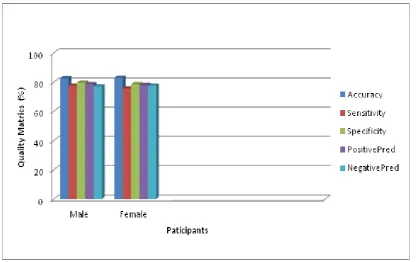
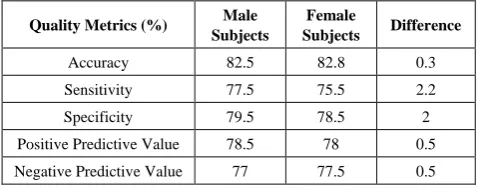
each category is counted. It is found that the number of samples is same for both male and female subjects that show that in same conditions, the affect of stressor is same for both subject classes. In Table 1 and Figure 5, classification metrics for both the genders is presented. The correct rate and error rate are almost same for both genders whereas there is a little difference in sensitivity and specificity for male and female categories. As stressor experiments are same for both genders, the induced stress is also same. The proposed system predicts correct values for both genders and the participants who are stressed are labelled in stress class. The error rates are almost the same for both genders and there is a little error in accuracy metrics as a few participants, male or female, do not feel stress in a few cognitive experiments such as mirror image test or dual task. The reason might be that they were more confident on those tasks. Although for a few cognitive experiments, male participants perceived a little less stress than their female counterparts but this does not affect the overall results.
Table 1. Accuracy Values for male and female participants and their net differences
Quality Metrics (%) Male
Subjects
Female
Subjects Difference
Accuracy 82.5 82.8 0.3
Sensitivity 77.5 75.5 2.2
Specificity 79.5 78.5 2
Positive Predictive Value 78.5 78 0.5
Negative Predictive Value 77 77.5 0.5
6. Conclusions
A stress prediction model based on a cognitive protocol is designed and employed on equal number of male and female participants. Although there is a little difference in accuracy rate of both the categories but the number of samples in high stress class is equal for both genders. The notion that both genders take same stress level from same mental challenges is hold to be true. The various experimental results and quality indices are almost same for both genders. Induction of mental stress is subjective and is based on physiological and psychological strength of a person. It can be interpreted from the experiments that the affect of stressors in same conditions is equal for both male and female participants.
The wireless network platform is designed such that it will not hinder the daily routine activities of a person. The person is free to move and can perform his needs. The advantage is that in future, the designed platform can be used in real scenes where real stressors may create panic in the participants. For classification model, SVM is used. The machine learning methods can capture the non-linearity in the input classes and can train the classifier that can predict the separating boundaries and hence may improve the efficiency of the proposed model.
Although the experiments are carefully designed, there is a need to introduce more challenging tasks. The overall
sample size is medium and it needs to be a little big in next set of experiments. In future, it is proposed that real life stressors should be introduced in experiments. The stress conditions during driving or during academic examination can be monitored using our wearable sensor platform. Various physiological signals would be recorded and transmitted to a central server for processing. In classification model, neural network algorithms can also be used to test the model and for improvement in classification accuracies.
ACKNOWLEDGEMENTS
This work was supported by the Deanship of Scientific Research (DSR), King Abdulaziz University, Jeddah. The author is thankful to Dr Riccardo Guiterrez-Osuna and Dr Beena Ahmed for their support in provision of the data and their valuable feedback for preparation of the manuscript.
REFERENCES
[1] H. Seyle, The Stress of Life, Mcgraw-Hill, 1956.
[2] T. Steckler, Handbook of Stress and the Brain, Amsterdam: Elsevier Science, 2005.
[3] J. L. Burns, E. Labbe, B. Arke, K. Capeless, B. Cooksey, A. Steadman and C. Gonzales, "The Effects of different types of Music on perceived and physiological measures of stress," Journal of Music Therapy, vol. 28, pp. 104-116, 2002. [4] U. R. Acharya, "Heart Rate Variability: A Review," Medical
and Biological Engineering and Computing, vol. 44, pp. 1031-1051, 2006.
[5] U. Lundberg, "Psychophysiological Stress and EMG Activity of the Trapezius Muscle," International Journal of Behavioral Medicine, vol. 1, pp. 354-370, 1994.
[6] S. Knobloch and D. Zilman, "Mood management via the digital Jukebox," Journal of Communication, pp. 351-366, 2002.
[7] E. Labbe, "Coping with Stress, the Effectiveness of Different Types of Music," Applied Psychophysiology and Bio feedback, vol. 32, pp. 163-168, 2007.
[8] D. U. Silverthorn, C. W. Garrison, A. C. Silverthorn and B. R. Johnson, Human Physiology: An Integrated Approach, Pearson/Benjamin Cummings, 2009.
[9] C. D. Katsis, "Towards Emotion Recognition in Car racing Drivers: A Biosignal processing Approach," IEEE Transactions on Systems, Man and Cybernetics, vol. 38, pp. 502-512, 2008.
[10] L. M. Rothkrantz, "Voice Stress Analysis," Lecture Notes in Computer Science, vol. 3206, pp. 449-456, 2004.
[12] D. A. Hennesy and D. L. Wiesenthal, "Traffic Congestion, Driver Stress and Driver Aggression," Aggressive Behavior, vol. 25, pp. 409-423, 1999.
[13] J. Zhai and A. Barreto, "Stress recognition using non-invasive technology," in Proceedings of 19th International Florida Artificial Intelligence Research Society Conference FLAIRS, 2006.
[14] J. F. Thayer, S. S. Yamamoto and J. F. Brosschot, "The relaionship of Autonomic Imbalance, Heart rate Variability and Cardiovascular Disease Risk Factors," International Journal of Cardiology, vol. 141, no. 2, pp. 122-131, 2010. [15] J. Zhai and A. Barreto, "Stress Detection in Computer Users
based on digital signal procesing of non-invasive physiological variables," in Proceedings of 28th IEEE EMBS Annual International conference on System Sciences (HICSS 05), 2005.
[16] T. Lin, "Do physiological data relate to traditional usability
indexes," in Proceedings of the 17th Australia conference on Computer-Human Interaction: Citizens Online, Australia, 2005.
[17] G. Weicher, "Hostility and Cardiovascular Reactivity to Stress in Women and Man," Psychosomatic Medicine, vol. 51, pp. 36-45, 1989.
[18] L. K. McCorry, "Physiology of the Autonomic Nervous System," American Journal of Pharmaceutical Education, vol. 71, no. 4, 2007.
[19] D. S. Bakewell, "The Autonomic Nervous System," Update in Anaesthesia, vol. 5, 1995.
[20] W. Liao, "A Real-time Human Stress monitoring system using dynamic Bayesian Network," in Computer Vision and Pattern Recognition Workshops, CVPR, 2005.