DEPARTMENT OF INFORMATION ENGINEERING AND COMPUTER SCIENCE
ICT International Doctoral School
Infrastructuring Knowledge as
Participatory Intervention
Technologically Enhanced Environment
Teresa Macchia
Advisor
Prof. Vincenzo D’Andrea
Universit`a degli Studi di Trento
Abstract
Over the last twenty years, Digital Interactive Technology (DIT) has been extensively introduced in museum contexts. Providing guidelines for aware introduction of DIT in museum, this thesis aims to encourage a participa-tory experience regarding the creation of knowledge in museum.
Believing that creating knowledge is a complex process that simultaneously involves multiple actions, actors, actants, and situations, I adopt the con-cept of Infrastructuring Knowledge for describing the participatory dynam-ics among human and technology for creating knowledge and for museum to be places for memories, amusing and sharing experience.
Ethnography in museum environment provides first hand information for understanding the museum visiting experience. Such understanding pro-vides three key stimulus for DIT to Infrastructuring Knowledge: firstly, stimulating people’s dialogue; secondly, supporting people’s cooperation and participation by providing occasions for sharing information and creating knowledge; thirdly, people re-frame the use of DIT when needed.
Designing DIT for museum may follow some specific lines and princi-ples for addressing challenges related to overwhelming and overstimulating spaces, and for promoting a sustainable future in respect of the produc-tion (or not) of new technology. Following lines and principles for reacting to the overwhelming and overstimulating adoption of technology in pub-lic space, I propose an -ing approach to design. This approach aims to stimulate a design for people to adopt a subjective and participatory inter-pretation of Digital Interactive Technology.
Keywords
Contents
1 Creating Knowledge through Technologically Enhanced
Environment (TEE) 1
1.1 Dealing with computing and information research 2
1.2 Attempting knowledge 4
1.2.1 Knowledge as contextual: the discourse of museum 6 1.3 DITs for TEE and sustainable design 8 1.3.1 TEE and the ecology of technology 9 1.3.2 Design and the ecology of DITs 11
1.4 The thesis in a nutshell 12
2 Enduring Knowledge: Infrastructuring in museums 15
2.1 Making sense of information 16
2.1.1 Dive in TEE 19
2.1.2 Cyborgs and feminism for understanding Knowledge in
TEE 20
2.1.3 Feminism and HCI: methodology for designing DIT for
TEE 23
2.2 Intellectual tools for understanding knowledge: from
infras-tructure to infrastructuring 26
2.2.1 Looking at museums through the lens of Infrastructure 29 2.2.2 Infrastructuring Knowledge in Cultural Infrastructure 33 2.3 Summing up the Infrastructuring process 35
3 HCI and Museums 37
3.1 The evolution of HCI and implications for museums 38
4 Research method: Techniques to go through TEE 47
4.1 Ethnography and museums 49
4.1.1 About doing ethnography 52
4.2 Ethnography at the MUSE 53
4.3 Research Material: transcribing, storing, analyzing 64 4.3.1 The fuzziness of universal matrix of relationships 68
5 Opening a Dialogue through Inter/Action 71
5.1 Crafting Dialogues 72
5.1.1 Making use of a space through DIT 79 5.2 Organic Installation and Collaborative trajectory 87 5.3 Guidelines for designing DIT for public spaces: setting the
stage 92
6 Infrastructuring Knowledge: a participatory experience 97
6.1 Looking at Knowledge creation 98
6.2 Bodily Knowledge Creation 99
6.2.1 Creative Interpretation: socializing and participating
together 101
6.3 Infrastructuring knowledge through senses 108 6.3.1 Narrating through DITs: the case of 109 6.3.2 Sharing space and actions for developing a common
meaning 112
6.4 Guidelines for Designing DIT for Public Space: the
Interac-tion and the Space 115
7 People’s interventions: design as rethinking interaction 119
7.1 Sustainability, HCI and CSCW 120
7.1.1 Interaction Design and the silence of DIT 123
7.2 The experience of interacting 126
7.3 Appropriating the environment: moving in the space 131 7.3.1 Maxi Ooh: rhythmic interaction 134 7.3.2 Discovering each other in the Discovery 136 7.4 Guidelines for Designing DIT for Public Space: Sustainable
8 Addressing Interactive Design Challenges 145
8.1 Looking behind the scene 146
8.1.1 Practicing community 150
8.2 Facing design challenges 152
8.2.1 Constructing a link; Maintaining the link; Making sense
of the link 152
8.3 Designing Challenges 158
8.3.1 The -ing Design 159
9 Infrastructuring Knowledge: principles for designing TEE 163
9.1 The other way around 164
9.1.1 When it comes to support Infrastructuring Knowledge 165 9.2 Taking time: Infrastructuring Knowledge 168
List of Tables
2.1 Evolution of feminist theories: between rights and needs. 21
2.2 Description of Infrastructure 28
3.1 Guidelines for understanding the main differences between
the HCI paradigms 39
3.2 Description of themes of interactive design 40
4.1 Summary of the ethnography with list of ethnographic extracts 61
4.2 Themes and Nodes 66
4.3 ”Spare” nodes and themes 67
5.1 Node Relationship 73
5.2 Node Space 81
5.3 Node In and Out 96
6.1 Relationships between nodes: Experimentation, Relationship,
Discovering 100
6.2 Node Understanding 102
7.1 Design is about futuring 121
7.2 Relationships between nodes: Sustainability and Interpretation132
8.1 Guidelines for understanding effects of designing DIT for
List of Figures
2.1 Cultural Infrastructure: relationships, components and
struc-ture 29
4.1 Non-interactive area and the entrance in the Tactile room of
the Maxi Ooh 54
4.2 Installations in the area of Maxi Ooh 56
4.3 People in the Discovery 58
4.4 Elements of the Discovery 59
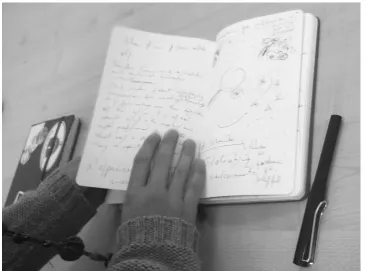
4.5 Ethnographic tools: diary and pen 60 4.6 Visualization of nodes in an ethnographic extract 64
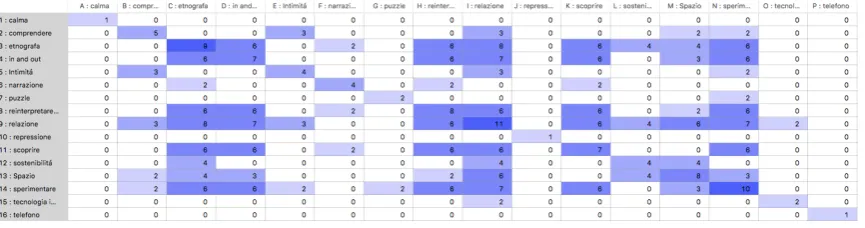
4.7 Universal Matrix of nodes 68
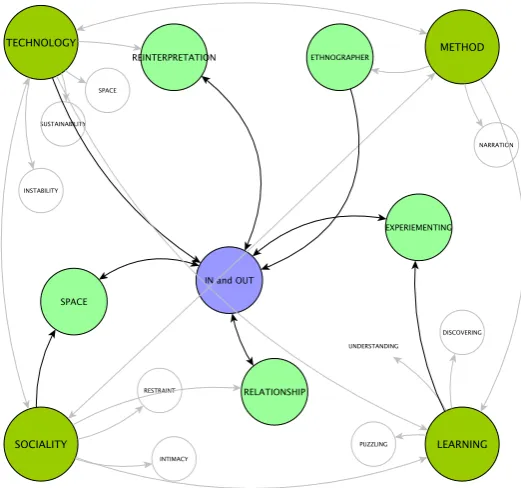
4.8 Relations and connections between nodes focusing on In and
Out 69
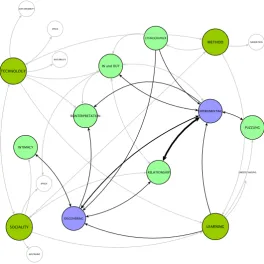
4.9 Relations and connections between nodes focusing on
Discov-ering and Experimenting 70
5.1 The magic Tree projeted in the Tactile Room 74 5.2 Visitors play with Acchiappa la Pappa (ALP) in the Discovey 77 5.3 The Labyrinth in the third floor of MUSE 78 5.4 The fairy-like forest interactive projected environment in the
Tactile Room 84
5.5 The Kinect for one of the installation in the Maxi Ooh 85 5.6 Relations and connections between nodes focusing on In and
Out 89
5.7 Installation for drawing with the voice in the Maxi Ooh 94
7.1 How people move in the Maxi Ooh and in the Discovery 133 7.2 How people spend time in the Maxi Ooh 134 7.3 Discovery form the perspective of the stairs 137
Preface
This thesis is the outcome of combined theoretical and empirical studies on the pervading con-tribution of Digital Interactive Technology (DIT) to trigger information, support knowledge, improve social life. A critical topic for the Human-Computer Interaction community lays on in-teractions among DIT, humans, and context. Very often research discourses focus on designing new technologies rather than on ways people potentially can re-interpret, use and adapt DITs for their needs. In this direction, this thesis provides an interpretation of design that aims to encourage participatory and interpretative interactions among people. Underlining the dynamic features of interpreting technology, this interpretation of design stresses the -ing side of peo-ple’s interactions. This interpretation of design is informed by an ethnography conducted at the Museum of Science (MUSE) of Trento. At the MUSE, I could observe how DIT potentially enhances and challenges interactions among people and I could develop some guidelines for de-signing DIT to collaboratively interpret information.
Working at the museum was a wonderful professional and human experience. For this, I shall thank the visitors with whom I talked and from whom I learnt a lot; the Pilots of the museum, who are brilliant scientists and people; and, the museum management, particularly represented by Rosaria Viola and Samuela Calliari.
However, this thesis wouldn’t be like this without numbers of talks and discussions with re-searchers with very different point of views and backgrounds. I may thank: Lily Diaz, from whom I got to know museums from the very inside; Jesper Simonsen for informal chatting and for having organized Designing Human Technology - Summer School; Judith Gregory and Ge-offrey Bowker for precious hints; Bonnie Nardi for inspiring to use ”technology with heart”. I should thank my colleagues and my desk mates for the coffees and the useful discussions; special thanks go to Giacomo Poderi, Michela Cozza, Cristhian Daniel; to Jyrki Messo and Mariana Salgado; to Sen Hirano, Lynn Dombrowski and Six Silberman. Last but not least, my advisor, for having advised me and for letting me to learn to deal with flexible time-schedules.
Chapter 1
Creating Knowledge through
Technologically Enhanced
Environment (TEE)
[...] Kindness and good nature unite men more effectually and with greater strength than any agreements whatsoever [...].
Thomas More -Utopia
A big question I have in mind is about understanding if/how/where/when new technology is pushing us - humanity. A question like this is more
science-fiction than actual research. Thus, I shrink my research question in a smaller box, and focus on designing Digital Interactive Technology (DIT) for people creating knowledge in museums Technologically Enhanced En-vironment (TEE). For identifying guidelines for designing DIT for TEE, I conducted my research with the aim to understand the role played by DIT in supporting the creation of knowledge in museums. In this direction, I identify an interpretation of interaction design that I will present as -Ing design.
The focus on museums comes from the current extensive introduction of a broad variety of DIT in museum spaces, meant to engage visitors and to improve the educational and amusement purposes of museums.
on the importance of computing and information technology; therefore, the chapter follows with the introduction of the core issues related to knowl-edge, TEE and sustainability, and design (a theme I delve into Chapter 2). The chapter concludes with a summary of the structure of the thesis.
1.1
Dealing with computing and information research
Nowadays, questions about the implication of technology in human’s life are flying around academics. Importantly enough for dealing with this kind of questions, the implications of social changes, related to the computeri-zation of society, spread across environments, context, people and research disciplines. Moreover, the implications of the computerization of the social life rise questions related to the affection of Information Communication Technology (ICT) in respect to sustainability, design, and, broadly speack-ing, policies [Kling et al., 2005, Klspeack-ing, 2000, Fry, 2009, 1999, Tomlinson, 2010, Bardzell, 2010].
Welcoming multidisciplinary questions in the direction of understanding and (re)designing computerized environments has been the base of the So-cial Informatics (SI) discipline that, indeed, investigates the implications of design, development and the use of ICT into a societal context.
ICT facilitates the collection and the creation of data, and supports the transformation of data (information) into knowledge [Hakken, 2003]. In fact, computing technology intervenes in dynamics of social and cultural preservation and regeneration providing spaces for increasing amount of differentiated contents while creating occasions for people to create a net-work for making sense of raw data. In this direction, ICT provides new ways and opportunities to impact cultural reproduction. Thus, while infor-mation systems and the cyberspace represent the evidence for networking information and support for creating knowledge, DIT happen to be more than tools for storing raw data. In this context, I refer to DITs as comput-ing enhanced objects ”with some level of interactivity”, [Stolterman et al., 2008].
DITs embed potential, in-time and contextualized actions for supporting people’s participation to the creation of knowledge. In this respect, DITs have a core role in stimulating and supporting people’s actions for improv-ing the present and lookimprov-ing forward to the future. The effects of current DITs on the future can be considered in relation to the sustainability of designing and using technology [Fry, 2009]. However, as Tomlinson [2010] underlines the most problematic aspects of discussions about sustainability are about ”comparing the impacts of different types of actions”. Follow-ing Fry [2009] and Tomlinson [2010], the sustainability of DIT deals with culture, knowledge and practice. Certainly, interrogations about sustain-ability are countless and might touch several aspects of knowledge issues, nevertheless linked to the productive and economic process [Knorr-Cetina, 1981]. Thus, willing to overcome the current economical distress around knowledgecreation, I attempt to disentangle the process of sharing and cre-ating knowledge in the specific context of museum, an environment that over the last ten years faced a quite substantial technological evolution (see Chapter 3).
How does knowledge occur in museums? Which kind of context is the one of museums? Who participates in creating knowledge in museums? Which are the dynamics that influence the creation of knowledge? Does the design of the environment influence the creation of knowledge?
stim-ulating, motivating, or even interrupting interaction, aim to unpack the following research question:
How to design DIT for actively supporting the creation of knowl-edge in public environments?
Going through the above questions provides understanding for informatics researchers and interaction designers to responsibly foster upcoming oppor-tunities for designing - or not - DITs. The massive and pervasive incidence of DITs in people’s everyday life stimulates and encourages an increasing number of scholars to investigate the long-term effect of the frenetic phe-nomenon of designing and producing new technologies [Fry, 2009].
While this first section builds on the overall frame of discussion for this thesis, the following sections focus on the concept of knowledge and on the conceptual tools that I adopt to go through the research question above.
1.2
Attempting knowledge
Knowledge is a complex domain that matters and crosses different disci-plines. Researchers adopted multiple theories and concepts such as bound-ary objects, actor network, intermediary objects for dealing with social processes that happen among people, technology and context. Looking at knowledge as a social process intersects features that I hereby describe through the notion of Infrastructuring. In this direction, Infrastructuring Knowledge (IK) links together physical and tangible aspects of knowledge and, values, cultural and social features.
specifically, Infrastructuring refers to processes, actions and dynamics of the Infrastructure that happens to be a changing and evolving thing. Thus Infrastructuring refers to”thing and on strategies for making this thing pub-lic” [Ehn, 2008] and to empowering connections and participation among agents and, the so called, actants in a specific context. Even though the term actants describes ”something that acts or to which activity is granted by others” [Latour, 1996], I shall underline the involvement of people in the creation of knowledge through the use (or not) of DIT. In this respect,
Infrastructuring is about enacting the infrastructure itself. Therefore, IK
intersects the ability and the power of creating knowledge in and through
infrastructures, and of people being part and participating within museum activities.
My understanding on knowledge suggests to consider this topic a uni-versal and inclusive effect of human beings, with personal and collective intellectual abilities and skills. Should we consider this as Utopia? Can knowledge be such a thing that is or can be universally and equally dis-tributed and improved?
context for storing artifacts. Knowledge artifacts are ”discreet, observable, namable representations of ideas” that might be books, digital files, maps, web pages [Hess and Ostrom, 2007]. Additionally, the represented ideas are intangible concepts, mental images, visions, and information.
1.2.1 Knowledge as contextual: the discourse of museum
As introduced previously, I approach the concept of knowledge as a contex-tualized, ongoing and in-time realization. I share David Hakken’s opinion about the ”social process through which something becomes acknowledged as known”[Hakken, 2003]. Thus, the focus is on the participatory process of sharing knowledge and creating knowledge through interactive technolo-gies.
When thinking about computing environments, there are uncountable ways and methods and techniques for making something visible. Moreover, re-lationships between people and human practices blur with DIT occupying an influent role in the creation of knowledge and configuring the space as a TEE.
Academic interest on the implication DITs in our society spreads across communities, including theoretical approaches that support shared analysis of people and technology participating to the sustainability - reproduction
- of society. Therefore, research fields on museums are extremely poly-hedric and conducted under multiple lights. Multiple extended projects include the design, the production and the introduction of ICTs and DITs in the context of museum (see Chapter 3), that aim to amuse and entertain visitors [Schavemaker et al., 2011]. Additionally, a variety of projects are meant to stimulate the participation of visitors to the creation of virtual and non virtual exhibition (see for example the work on virtual exhibition by Ciolfi [2013] or the participative exhibition design experiences described by Simon [2010]).
dynamic for sharing and creating knowledge between people in the context of museum.
Still, through uncountable ways and forms, museums have the responsi-bility to maintain and preserve culture, and to stimulate the creation of knowledge [Bennett, 1995]. Moreover, these institutions are challenged to follow the changing rhythm of an historical moment in which computing and evolving media pervade the everyday life modifying and influencing traditional and new platforms for stimulating and triggering knowledge. Museums are involved in a technology rush, visitors and museum staff are participating in creating and sustaining knowledge that in many different cases can be supported (...or not?) by the introduction interactive tech-nologies. Interactive technology, as considered in this work, is everywhere, it exists, has a form, a time, and a reason for extending human capacity [Gibson, 1986, Latour, 2002]. According to this description, interactive technology enables and allows a connective experience.
This work is about tracking node paths for looking at thecreation of knowl-edge as in-use and everyday and while-using design. Reasons for empha-sizing features of making and crafting as essential activities for creating
knowledge focus on people’s competences and skills of making of everyone the author of each other knowledge. Creating knowledge, implies embed-ded and contextualized experiences, skills, and competences, that through common and shared practices produce novelties [Cor`o and Micelli, 2006]. Thus, design and knowledge refer to the complex and potentially collective action of sharing knowledge for looking at things through new perspectives and create novelty. Thus knowledge is a commons that belongs to everyone and that silently carries a sustainable future.
The concept of sustainability commonly refers to desired and desirable futures that are informed by a comprehensive overview of collective and integrative actions, rather economical, social, technological and ecological [Robinson et al., 2006]. In such terms, sustainability is hanging around with development and, in the beginning of 1980s, recalled and emphasized the struggle of connecting ”environmental concerns about the increasingly evident ecological consequences of human activities and socio-political con-cerns about human development issues” [Robinson, 2004].
relation to the constant creation of knowledge that we can make through multiple channels.
1.3
DITs for TEE and sustainable design
The concept of sustainability fits with the need to look at Infrastructuring Knowledge (IK) as a process that interweaves human, technologies and environment.
IK address an enduring construction of a basic need for integrating and sharing knowledge for combining idiosyncrasies over people with different expertise and competences. The concept of sustainability moves steps fur-ther from the relation to conservation and balance of resources for avoiding resources depletion. Rather, sustainability refers to the need to incorporate and embed new forms of resources and knowledge frames, for contributing to the general wellbeing, affecting future changes. In this respect, sus-tainability refers to multiple aspects of everyday life and social changes, including economical and environmental changes, or else technological and educational [Reed, 1996, DiSalvo et al., 2010].
Following the map proposed by DiSalvo et al. [2010], this work shares the principles of sustainability as a conceptual tool for rethinking the role of design. DiSalvo et al. [2010] identify a cluster of research on sustainabil-ity that set methods and approach applied to interaction design. In this cluster of application, designers are actively involved in reducing waste
and designing, otherwise, endurable products, meant for avoiding immedi-ate dissipation and contain the effects of ”built-in obsolescence” [Woolley, 2003]. As Woolley [2003] underlines, several products have a life-span of five years that dramatically impacts the innovation cycle.
para-dox of choice”. The ”paradox of choice” includes the concept of informa-tion overload, that describe a deficit of efficiency for using in a relevant and useful manner the information available. However, Hakken [2003] and Bawden and Robinson [2009] mainly refer to the web sphere rather than to a physicaloff-line context. The ”paradox of choice” and the overload of information link also in our everyday environment. In this frame, relating to the overload of information is a stimulating challenge in relation to the theme of IK.
IK relates to the inclusive and relevant role played by the introduction of Information Communication Technologies (ICTs) in our everyday life that amplifies both, the production and the access to Knowledge. Additionally, Interactive and ICTs impact and inform the way in which people relate, share and create Knowledge. In this respect, there is the need for examin-ing and analyzexamin-ing the involvement of interactive technologies in connectexamin-ing people and generating fertile ground for sharing expertise, experiencing and understanding. In this respect, we look at TEE as potential stimulator and conductor of sharing knowledge.
1.3.1 TEE and the ecology of technology
For designing and coordinating DITs for a specific space, there is the need for understanding the relationship between human and interactive technol-ogy in respect to the environment. Hence, the core idea that interweaves this approach more than designing something new, refers to the interac-tion and the ways to design and introduce DITs into a specific environment [Kaptelinin and Bannon, 2012].
and allow transformations on the interpretation and use of a space through situated configuration of technologies.
What is called ecological turn deals with a vision of interaction design that faces and explores strategies and methods for introducing and using inter-active technologies while improving possibilities of a specific environment and encouraging different vision about it. The different vision and inter-pretation of the space is rather possible since
”people are adaptable and resourceful creatures - they invent many workarounds and quick fixes to problems, and then forget they invented the workaround.” [Holtzblatt and Beyer, 1993]
This discussion related to TEE takes into account the potential space changes embedded in interactive technologies: the embedded changes in DIT are about the support provided by technologies in structuring and probing activities in the space. We can comment that every space is an ”op-portunity space” [Hornecker et al., 2006] that has potential for augmenting and enhancing common and recognized practices. The concept of ”oppor-tunity space” supports and helps designers to understand the implication of introducing interactive technology spaces where embedded opportunities - in terms of relationships and values - provide a new interpretation of the space itself. Meanwhile, the concept of TEE includes a likely change and potential re-configuration of the organization of the space, and describes the space as active here and now because of people and of technologies. In some respect, a concept of TEE inscribes a reinterpretation of a place. There is a moment in which a space, provided by things and objects and perimeters, becomes a place, since the space become alive, reinterpreted and reconfigured by people [Harrison and Dourish, 1996, Dourish, 2006, Binder et al., 2011]. TEE is about integration of practices and construc-tion of new configuraconstruc-tion of the space.
1.3.2 Design and the ecology of DITs
From a personal point of view, intersecting and crossing design and re-search is very often about mediating dialogue between two voices. This is because both research and design are ways of knowing in the first case about”natural world” and in the second case about the so called”artificial world” [Cross, 2006].
In this context the Participatory Design tradition embeds the interrela-tion between research and design, while emphasizing mutual competences and responsibilities for looking at the future. To go through this thesis, I adopt a Participatory Design theoretical framework, based on an evident and manifested political implication [Ehn, 1992] of equality and social in-clusion. In this perspective, Participatory Design provides an intellectual framework for informing the discussion on IK. Participatory Design is de-scribed as
”a process of investigating, understanding, reflecting upon, es-tablishing, developing, and supporting mutual learning between multiple participants in collective ’reflection-in-action’. The par-ticipants typically undertake the two principal roles of users and designers where the designers strive to learn the realities of the users’ situation while the users strive to articulate their desired aims and learn appropriate technological means to obtain them.”
[Simonsen and Robertson, 2013]
Moreover, Participatory Design focuses on the relationship between people and DIT, which is the effect of re-configuration and re-interpretation of the hierarchical vision of organizations. Thus, the Participatory Design supports and serves as an intellectual tool that describes and inscribes the notion of power in the mutual process of making knowledge in a TEE.
The process of understanding and figuring out how knowledge arises in Technological Enhanced Environment, points out some main key elements that contribute in terms of: (1) methodology for the study of TEE; (2)
everyday life and is a contextualized experience for IK. In this context, this research contributes on two main directions: on one side, in terms of methods and methodologies applied in the context of museum rather other cultural institutions; to the relation between human and technologies; to provide additional understanding on role of technologies.
1.4
The thesis in a nutshell
Through this research I build an understanding of TEE adopting the lines of Infrastructuring (see Chapter 2) for developing a set of guidelines for designing DITs for public spaces. However, the concept of Infrastructur-ing rather than being a material description of museums as mere institu-tions, is a methodological outstanding that, growing from identities and
differences, takes into account design as an everyday and participatory experience [Macchia et al., 2015b]. The everyday and participatory ex-perience involves daily actions and dynamics through which humans and DIT attempt on creating knowledge. This idea poses a challenge for a critical interpretation of design as a collaborative, mutually experienced, and in-time activity, more than an exclusive and only professional activ-ity. I propose to discuss this interpretation of design in respect to the -ing feature of it (please, consider Chap 8). The main feature of the -ing lays on the suggestion of a network of relationships that connects to the prin-ciples of Participatory Design, adopting additional emphasis on mutuality of the interactions (for details on these principles please consider Chapter 3). Moreover, this emphasis aims to stimulate an open (and active) in-terpretation of design as enduring within and for sustainable environment (for details on this consider Chapter 5). This interpretation of Infrastruc-turing is endorsed by the analysis of the dynamics that influence and lead the museum context. The influence that DIT might have in supporting knowledge is discussed in Chapter 7 and Chapter 6.
ac-tivity, the role of designers blurs with the role of the other stakeholders and of users to whom I refer over this thesis as people rather than users, indeed.
To go through the domain of investigation in the context of museum, I intersect the intellectual frameworks of:
Knowledge Infrastructuring in order to stress the networking relation-ships between objects and people, in continuous interchange that oc-curs through practices and mutual interdependence;
Technologically Enhanced Environment to emphasize first, the stress on the ”ecological turn” in the field of interaction design, that empha-sizes the correlation between the space/place, artifacts, practices and people; second, to focus on the need to face and explore design strate-gies for the future;
Participatory Design to underline the political and participatory in-volvement of people for creating knowledge - adopting a design per-spective.
Chapter 2
Enduring Knowledge:
Infrastructuring in museums
I am talking about human race, people. If I say man kind or human kind, he/she or it, I am still talking about human being. Margaret Mead - The Future as Frame for the Present
7th July 1977
This Chapter describes the main theoretical lines of this work. I adopt studies on infrastructure and infrastructuring as intellectual tools for un-derstanding dynamics around information and knowledge. Thus, consid-ering knowledge as a grounding subject of this work, this Chapter begins with an overview on the concept of knowledge from the point of view of Technologically Enhanced Environment (TEE) and illustrates the concep-tual framework and the tools that I adopt for unpacking the complexity of the discussion about TEE and Knowledge.
sociality of science and technology, both historically and as contemporary projects” [Suchman, 2008]. As the author recalls, the feminist approach focuses on issues rather than disciplinary conventions, and ”comprises an open-ended and heterodox body of work”, providing a reading language for complex phenomena and conditions.
The following Section 2.1 unpacks the concept of knowledge as a result of the process of making sense of information in multifaceted context, such as museums. Further on, the discussion continues on the relation between insider and outsider through the feminist approach that goes to-ward ”agency, fulfillment, equality, identity, empowerment and social jus-tice” [Bardzell and Blevis, 2010] (see Section 2.1.2 Page 20). The Chapter continues with Section 2.2 with the focus on infrastructure and infrastruc-turing for providing a conceptual tool able to explain relationships and balances in museum ecology.
This Chapter means to provide a cross-section of the growing interpretation of interaction design for a better future.
2.1
Making sense of information
Knowledge, as a process that combines different research perspectives and interpretations, is a multifaceted and messy subject that can be observed, considered and explained through different areas of study. Struggling around the concept of knowledge, over the centuries, scholars studied and defined knowledge in different ways, underlining the various nuances and features that characterize the concept of knowledge1. Each discipline has a slightly different definition of knowledge and deals with its complexity focusing on different aspects. In this work, I adopt an interpretation of
knowledge that takes into account the social and collective construction of heritage [Gheradi and Nicolini, 2001]. Moreover, I am adopting a frame for discussing knowledge as people’s ”own local ecology that is inaccessible to anyone outside them” [Nardi and O’Day, 1999]. Following Nardi and
1Countless scholars focused on knowledge, from Plato with his Allegory of the cave, or Kant with his
O’Day [1999], knowledge is about impacting and being active in a par-ticular local environment providing opportunities for framing the way of using and interpreting the environment. Nardi and O’Day [1999] continue pointing out the role of ICT in supporting the creation of information and providing occasions for shaping knowledge while enhancing environment. The introduction of ICTs and interactive technology in various environ-ments, impacts the policies around which an environment is organized, valued, perceived. Thus, knowledge, that is making sense of information, depends on multiple factors: personal idiosyncrasies and ecological factors as well.
Making sense of information is about questioning, reflecting, and creating connections to previous experiences and knowledge. In some respects, mak-ing knowledge is a creative and critical thinkmak-ing. Creativity is an ”imag-inative process” [Fisher, 2002] that realizes ideas and new values [Gruber and Wallace, 1999]. Therefore, making sense of information implies cre-ative and critical components for understanding the nature of problems, where criticality concerns the ability to analyze and evaluate [Cross, 1982]. Creating knowledge is a reflective process that implies analysis, evaluation and the creation of new values [Forrest, 2008]. Making knowledge inter-weaves creative and critical thinking, it is about reflectiveness. Reflection is a common situated learning process that is about evaluating the current conditions and re-framing and accommodating the evaluations in respect to new purposes and contexts [Sch¨on, 1983, Boud et al., 1985, Eraut, 2004]. Reflectiveness is part of the learning experience
”in which individuals engage to explore their experiences in order to lead to new understandings and appreciations. It may take place in isolation or in association with others.”[Boud et al., 1985]
to know. Following the description of Polanyi [1966], knowledge depends on what we already know, on external inputs and on others’ knowledge. Hence, knowledge is a complicated subject that into an analytic chain of process is about ”verify information” [Hakken, 1999]. Moreover, the no-tion of knowledge is situated and related to individual interpretano-tion. In fact, Haraway [1988] describes knowledge as a ”condensed node in an an-tagonistic power field”. Thus, what counts in knowledge, Haraway [1988] continues, is more than ”describing and discovering”, knowledge rather oc-curs through contexts and mediation between experiences and objects. In her description of knowledge, Haraway [1988] takes into account the intri-cate, confuse, divergent, contrasting relationship between insiders and out-siders, arguing that ”no insider’s perspective is privileged”. This definition of knowledge features is relevant in terms of connections and translations among different ”and power-differentiated communities” [Haraway, 1988]. Thus, knowledge is a subjective translation - e.g. interpretative, critical and partial - that occurs through interpretations among groups and de-scribes collaborative creations rather than individual production.
Knowledge is about community and situations, and describes a unique and multidimensional body that
”is partial in all its guises, never finished, whole, simply there and original; it is always constructed and stitched together imperfectly, and therefore able to join with another to see together without claiming to be another.”[Haraway, 1988]
bodies that ”possess relevant knowledge that non-experts lack [Sismondo, 2008]. Thus, context meant for stimulating the process of creating knowl-edge - e.g, educational institutions - stresses on the balance of legitimacy, since expertise is real and embeds genuine knowledge within its domains [Collins and Evans, 2003].
Meanwhile, knowledge embeds and is related to the convergence of different interpretations of the context [Haraway, 1988]. Knowledge is contextual-ized in respect to the potential inputs the environment can offer to groups of people, and reflects the experience and the interactions that can happen in a specific situation that is not standard. The non-standard-knowledge rises when situation might be puzzled and new [Sch¨on, 1983]. Thus the figure of the expert has to relate to the context and to the response to the puzzled situation. In this context, the role of designers and experts is about affordance of artifacts and services that provide people with new stimuli [Norman, 1988]. In the case of museum the experience - and the creation of knowledge - is about materials and about the iterative dialogue that arises between multiple actors [Haldrup and Bærenholdt, 2010].
2.1.1 Dive in TEE
and membership. This theoretical framework brings the research into an inclusive political agenda and investigate for improving and changing -issues that impact social and everyday life, as such can be climate change, work environment, alienation or inequality, health. However, the current feminist tradition refers to multiple subject, the basis is about ”to clear the ground in order to plant the seeds for other ways of configuring technology futures” [Suchman, 2008].
The adoption of a feminist approach helps to underline and emphasize de-sign as a shared process in which no one should be identified as an insider or an outsider. More precisely, the process of knowing includes museum pro-fessional expertise as well the everyday life knowledge. Hence, the focus is on people who participate to the museum experience as equal participants to the collective creation of knowledge.
2.1.2 Cyborgs and feminism for understanding Knowledge in TEE
This Section of the Chapter, I focus on the feminist perspective that un-derlines both inclusion and exclusion of group’s participants. According with Felski [1997], Postcolonial Feminism addresses dynamics of cultural understanding and maturation of identity that seeks to ”crystallize the con-ceptual and political ambiguities of differences”. The postcolonial feminism deals with difference and sameness that challenge the status of community
Consciousness and needs
Feminism is about minority concerns consciousness and recognition. The thoughts that led to revolutionary feminism begun in the earlier eighteen century mainly crit-icizing the wedding connection of women’s life. This first consciousness step brought to the recognition of similarities between men and women, in the earlier nineteen, which connect with liberal ideologies and revolutionary challenges.
Currently, feminist approaches broadly operate into the liberal movement and in-tellectual recognition taking into account the differentiation of people’s rights rising questions that relate to groups of people that include gender issues but to not ex-hausted on it. Yet, the notion of feminism refers to”formal properties of an abstract collective entity” [Assiter, 2011]. Thus, feminist theories aim to reinforce discussions on equality and power conditions that rather fits better withneeds conditions instead of right conditions that still connect with colonialist approach [Hamilton, 2007].
Table 2.1: Evolution of feminist theories: between rights and needs.
a creature of fiction” [Haraway, 1991]. The cyborg is metaphor of change and consciousness of self identity. Moreover, the author emphasizes the cyborg as a representation of the ”appropriation of nature as resource for the productions of culture”. This mythological figure recalls an organic in-tegration between natural and technological differences. The cyborg at the same time is about consciousness of exclusion, being human rather than
being machine, and of inclusion, being human and machine. It is about
identities and contradictions, similarities and differences.
the evident assemblage and interconnection between human and technol-ogy. The aim of such exploration is about understanding the intimate connection between subjective needs and technological reaction. Accord-ing with Schull [2005], who discusses about gamblAccord-ing games in Las Vegas, the intimate connection between human and technology translates input and feedback maintaining the connection between the body’s movements and actions and technologies.
The cyborg figure of human and technological assemblage helps to keep as-sociations between humans and technologies as the basic unit of analysis; interweaving the mutual interdependency in terms of action in the rela-tion intra-action, and between the relation inter-action. This relationship emphasizes connections between artifacts, social practices, relationships, systems of knowledge, institutions, and so on. The complexity of blurring artifacts, social practices relationships, systems of knowledge, institutions, and so on, interweave the observer perception Barad [2003].
””[P]henomena do not merely mark the epistemological insepa-rability of observer and observed, or the result of measurement; rather, phenomena are the ontological inseparability of agen-tially intra-acting components.That is, phenomena are ontolog-ically primitive relations without preexisting relata. The notion of intra-action (in contrast to the usual ”interaction”, which pre-sumes the prior existence of independent entities/relata) repre-sents a profound conceptual shift. It is through specific agential intra-actions that the boundaries and properties of the ”compo-nents” of phenomena become determinate and that particular em-bodied concepts become meaningful.” [Barad, 2003]
to unfold and disentangle the complexity of sociotechnical systems [Such-man et al., 1999]. However, the figure of cyborg recognizes the intimate connections between culture, social construction, materiality, and technol-ogy. In the meanwhile the sociotechnical systems configure a particular way to incorporate, design and use together humans and machines.
Thus, recognizing systems and relationships between human and technol-ogy finds room in the Human Computer Interaction (HCI) agenda, stim-ulating a critical interpretation of the subject of interaction and interac-tivity. DIT pervades people’s life engaging critical research and design perspectives for revealing the ”unspoken values within the HCI’s domain”
[Bardzell, 2010].
2.1.3 Feminism and HCI: methodology for designing DIT for TEE
As introduced in the beginning of this Section, the feminist tradition fo-cuses on differences, identities, connections, relations and later on on the relation between human and technologies. This tradition emphasizes the relationship between researcher and researched subject. The analysis of social world as a mixture of contextual relationships and values, which in-tegrate unstructured data to the place and the human ecology [Clarke and Star, 2008] understandings the composition of groups and communities, and revealing maps of actions and interactions.
Therefore, feminist approaches bears the tough and evolving researches on digital interaction technology and on interaction design that is deeply re-lated to multiple disciplines. Human Computer Interaction deals with the concept of pluralism, envisioning design processes in respect toequality and
needs of human [Bardzell, 2010]. The feminist approach goes through the democratization of design that faces potential ”challenges of hegemony”
Binder et al. [2011]. Thus, bending feminism and HCI deals with poly-phonies of groups, with culture and the qualities of computing technology that blurs into everyday life [Bell et al., 2003, Weiser, 1993].
Differentiation and multiple perspectives encourage multiple viewpoints and stands engaging towards the multiplicity of them. Relating multi-ple expertise constituted a relevant intellectual source for understanding needs and design potentials [Campbell and Eubanks, 2004]. Thus, adopting feminist approach for looking at HCI domains helps to understand social phenomena that include multiple people and supports the identification of differences, equalities and spatial needs, as well. In this respect, the know-ers’ experience grounds on contexts and on differences taking distances from universal approaches [Bardzell, 2010]. Feminist instances argue that
”the crux of value-explicit design is that there is no neutral position or ”view from nowhere” untouched by materiality, context, and identity” [Hamraie, 2013]. Thus, universal approaches delegitimate and reduce differentiation and identities, preferring a design meant for all people. This discussion re-calls the still open debate described by Felski [1997] that refers to the focus on both: community membership and individual identity. Thus, personally I argue for universal approaches to illuminate equalities and to emphasize differences that matter.
Participation, mutual understanding of needs and democratic approach to design DIT and information systems carry conflicts that nevertheless stim-ulate the dialogue and the ecological interconnection between and within people and technology, triggering differentiation of opinion [Bodker et al., 2004].
The extension of feminist theory to enhance the participatory design ac-tivity embeds the relevance of the ecology of technology. For instance, the feminist approach informs and looks through the relationships among technology in the specific context, underlining and emphasizing connec-tions between features of artifacts and people related to the artifacts. The feminist approach focuses on understanding differences and acknowledging differences among communities understanding different needs. Thus, de-sign application within the feminist theory aims to balance and equalize rights among groups [Coleman et al., 2003]. For instance, inclusive design and universal design rebuild groups and memberships reframing needs as-suring rights and fulfilling needs. While the universal design expands the
”target group of product or service to include as many users as possible”, the inclusive design aims to understand and respect the needs of a diverse range of users” [Coleman et al., 2003]. Yet, the meaning of other to-gether with the notion of power, refers to the broad group rather than to the peculiarity and the valuable differentiations between people. Including feminist approaches within design research helps and supports the shift of mentality and the change our evolving society needs. In this frame, femi-nist approaches reconfigure design understanding of human and technology interaction concerning ethical limits of using technology [van der Velden, 2009].
Feminism and design experience advocate political features with the aim to open dialogue between different groups of people for bringing new valu-able insights and benefiting from each others contributions to the design process. The contribution of feminist approaches deals with the analysis and understanding of design rather than to generate contributions focusing on the ecologies of differences and equality.
that characterize relationships between context, technology and humans. Through our experience at the Museum of Science in Trento (Italy) (see Chapter 4), we observed commonalities on participatory behaviors between people. People in museums act and stimulate each other for understand-ing the surroundunderstand-ing environment. Additionally, people in the museum are open to unstructured re-interpretation of the environment through the use of technology. The following Section of the Chapter focuses on the concept of infrastructure and infrastructuring as a conceptual tool for integrat-ing feminist approaches within the field of critiques-based design. The
infrastructure tool provides understandings upon human and technology relationships, power, rights and needs.
2.2
Intellectual tools for understanding knowledge:
from infrastructure to infrastructuring
This Section delves with the intellectual tools of infrastructure and infras-tructuring, which provide an interpretative frame for integrating design and feminist approaches in relation to museum contexts.
As Bardzell [2010] underlines, the feminist approach has huge potential for understanding the potential of Human-Computer Interaction. In the mean-while, the intellectual tool of infrastructure and infrastructuring stress on relationships, and environmental and time context, which are elements the feminist approach cares about. In the context of museums, the infrastruc-tural approach deals with the complexity of the interaction in culinfrastruc-tural and relational hubs - such museum is. The description of infrastructure encour-ages the exploration of social worlds as a unique nature of differentiated social arenas [Star and Ruhleder, 1996, Neumann and Star, 1996], provid-ing an interpretation of museums as factor of an infrastructure and of the knowledge and cultural elicitation as a set of processes and dynamics that I discuss as Infrastructuring. Thus, the discussion about the intellectual tool of infrastructure and infrastructuring focuses on
the concept of Infrastructuring Knowledge (IK) stresses on activi-ties, relationships and interactions that happen in the CI.
This twofold approach helps to simplify the discussion about designing for museum institutions, which are an ensemble of artificial and natural subjects involved and joined in a whole [Le Moigne, 2015, 1977]. More-over, looking at CI and KI helps to understand the social factors and the interconnections between agents (human and technology) emphasizing con-textual relationships: time and place.
During the last twenty years, infrastructure and infrastructuring have been used to address information systems and interactive experiences. In this direction, this intellectual tool provides useful interpretation about the impact of information systems to the interaction between human and non-humans. Various scholars focus on multiple features of infrastructure and infrastructuring. For instance, Bowker and Star [2002] trace guidelines and directions for understanding and studying Information Systems (see Table 2.2 Page 28). Marttila et al. [2013] propose an explanatory understanding adopting the concept of commons to underline the socially connected and belonging nature of infrastructure to make sense of infrastructure. Binder et al. [2011] focus on thedesignerly nature of infrastructuring as an expres-sion of sociomaterial relationships. Similarly, Karasti and Syrj¨anen [2004] and Simonsen et al. [2015] discuss infrastructuring as ”community design and processes through everyday materials” [Macchia et al., 2015b].
Features of Infrastructure
Embeddedness Infrastructure is ”sunk” into, inside of, other structures, social arrange-ments and technologies;
Transparency Infrastructure is transparent to use, in the sense that it does not have to be reinvented each time or assembled for each task, but invisibly supports those tasks;
Reach or Scope This may be either spatial or temporal infrastructure has reach beyond a single event or one-site practice;
Learned as part of membership The taken-for-grantedness of artifacts and organiza-tional arrangements is a sine qua non of membership in a community of practice (Lave and Wenger 1992; Star, in press). Strangers and outsiders encounter in-frastructure as a target object to be learned about. New participants acquire a naturalized familiarity with its objects as they become members;
Links with conventions of practice Infrastructure both shapes and is shaped by the conventions of a community of practice, e.g. the ways that cycles of day-night work are affected by and affect electrical power rates and needs. Generations of typists have learned the QWERTY keyboard; its limitations are inherited by the computer keyboard and thence by the design of today’s computer furniture [Becker, 1982];
Embodiment of standards Modified by scope and often by conflicting conventions, infrastructure takes on transparency by plugging into other infrastructures and tools in a standardized fashion.
Built on an installed base Infrastructure does not grow de novo: it wrestles with the ”inertia of the installed base” and inherits strengths and limitations from that base. Optical fibers run along old railroad lines; new systems are designed for backward compatibility; and failing to account for these constraints may be fatal or distorting to new development processes [Monteiro and Hanseth, 1996]
Becomes visible upon breakdown The normally invisible quality of working infras-tructure becomes visible when it breaks; the server is down, the bridge washes out, there is a power blackout. Even when there are back-up mechanisms or procedures, their existence further highlights the now-visible infrastructure.
2.2.1 Looking at museums through the lens of Infrastructure
Discussing museums in the domain of Infrastructure aims to stress those traits that characterize and standardize these cultural institutions. The recognized standards are associated with convenient and shared practices and, in the opposite, to sanctions [Busch, 2011]. Therefore, Cultural Infras-tructure (CI) refers to the ”context, norms, customs, processes, members (who is in and who is out), and language” [Macchia et al., 2014]. This ap-proach to museum investigation and understanding serves to represent and make explicit the features of the institution (see Figure 2.1 Page 29). For
Figure 2.1: Cultural Infrastructure: relationships, components and structure developed through the arrangement of Hess and Ostrom [2007] of the Institutional Analysis and Development framework and the empirical observations of the Museum of Science in Trento (see Chapter 4 Page 47)
interweaves literature about museum together with the analysis done by Hess and Ostrom [2007] on institutions. The Figure 2.1 Page 29 describes museums as one of those cultural institutions that participate to the de-velopment of the society, and embeds norms and practices that mutually impact the social and museum growth. Thus, the concept of CI implies ”a process of association, estimation, and judgment about the elements that characterized the infrastructures themselves and the circumstance” [Mac-chia et al., 2014]. This understanding of Infrastructures recalls a ready-to-hand interpretation of theories that depend on practical relationships. Positioning the interpretation of standards in connection with the notion of ready-to-hand, I emphasize the process of curating and designing within and for museum, to reproduce the meaning of the institution. Curating and designing museum exhibitions relates to the embedded features and components of the infrastructure (see Table 2.2 Page 28 and Figure 2.1 Page 29). Combining ”social, political and economic work” [Bowker and Star, 2002] and the actual components that involve social, political and economic works make the infrastructure possible and sustainable in rela-tion to the context in which it exist. The infrastructure is tangled into the context and it evolves as a whole of different component and relationships; it is visible in the very moment it broke, or in other worlds, when standard values and understanding change and are not mutually recognized. In-frastructures embed shared meanings and purposes; meanwhile dynamics of infrastructure stimulate and self-involve to the creation of community of practices shaping the infrastructure itself. The concept of community of practice describes arrangements of people with common and collective practices, and shared identity [Wenger, 1998]2.
The components of infrastructures hold various functions: for instance museums deal with educational and amusement purposes. Moreover, the function of components of infrastructure, for the nature of the infrastruc-ture itself, changes over time. Purposes of museums changed together with the evolving processes museum institution faced over the last cen-tury, which emphasize new ethical values and inclusive purposes of the
2The concept of infrastructure includes informal grouping of participants based on people’s engagement
modern state [Bennett, 2013]. New Digital Interactive Technology (DIT), like digital tabletop, interactive walls, kiosks and mobile applications, goes in this direction engaging and connecting different actors through alter-native interpretations of the exhibition (further discussion about this in Chapter 3). The introduction of ICTs fulfills the request for additional information and stimulates collaboration between visitors for sharing con-cepts, ideas and new understanding[van Dijk et al., 2012] stimulating our critical and creative skills to build ex novo interpretation of the context [Boud, 2006]. In fact, dialogues and collaborations museum environment encourages creative and critical thinking: while creative thinking triggers new values and ideas, critical thinking concerns analysis and evaluation. Together, creative and critical thinking stimulate new assessments and sit-uations [Baumer et al., 2009]. Combining creative and critical thinking people can re-interpret the context and are stimulated to re-configure the context and are able to re-designing future actions [Boud, 2006]. Hence, experience grows through the re-interpretation of the context and is about reframing puzzling situations [Binder et al., 2011, Dewey, 1969]. Reflec-tivness, the cognitive process of reconfiguration and reframing of present conditions, is a social activity that involves sharing, collaborating, inter-acting, interpreting and reconfiguring [Sch¨on, 1983, Boud, 2006, Macchia et al., 2015a].
em-bedded structure of museum institutions in the social context that includes written and non-written norms conventionally recognized by the commu-nity [Hess and Ostrom, 2007]. Thus, analyzing an Infrastructure deals with understanding of the role of the institution and the evolving/designing pro-cess of the institution itself. The evolving/design propro-cess of an institution depends on ”collective actions and self-governing behaviors; trust and reci-procity; and the continual design and/or evolution of appropriate rules”
[Hess and Ostrom, 2007]. Moreover, the collective participation of people facilitates the sustainability and the reproduction of the institution. In this respect, the collective and relational configurations of museums can be ex-plained in terms of CI stressing mechanisms and object and subjects and norms in the range of cultural prompt and maintenance. The sustainabil-ity of CI is related to the participatory and collective activities around the cultural context. The success of CI depends on the infrastructuring pro-cess that makes possible the connection between the different components of the Cultural Infrastructure (see Figure 2.1 Page 29): (a) people partic-ipation; (b) museum artifacts; (c) common recognition of the institution; (d) set of practices; (e) introduction of ICT; (f) stimulation of knowledge. Thus, people, as citizens without differentiation between groups of people such as museum staff, visitors, exhibition designers, who participate and mutually understand norms preserve and maintain museum institution. The term people- as citizens, emphasizes the collective participation of each person and of each different role to the reproduction of the CI. However, the term people recalls the current adoption of the term public for dis-cussing infrastructure and infrastructuring suggests the term public [Ehn, 2008, Le Dantec and DiSalvo, 2013]. While the concept of public addresses participants struggling for a better future, the adoption of the term people
aims to underlines shared identities together with the concept community and of common needs (see Section 2.1.2 Page 20).
2.2.2 Infrastructuring Knowledge in Cultural Infrastructure
This paragraph discusses and describes this ongoing process as the process of Infrastructuring Knowledge (IK): a shared activity for creating knowl-edge between people and through the infrastructure. As discussed in the previous Section the concept of infrastructure includes multiple features and aspects of a social phenomenon and is about a pulsating system of people, artifacts, materials and contexts that causes novelty in the en-vironment of discussion [Edwards et al., 2007]. Thus, the infrastructure helps ready-to-hand and contextual needs tocommunicate, move or inform
[Macchia, 2015]. Reframing museum as infrastructure I aim to emphasize the cultural role of museums, for endorsing those features that belong to museums.
The notion of culture refers to what we know, or perceive, and believe to know, to effectively relate with other members of the society [Ingold, 2010]. Moreover, cultural institutions negotiate the cultural process across formal or informal rules. On this topic, Bennett [1995] describes the role of mu-seum institutions for preserving, bestowing and stimulating tangible and intangible cultural heritage, and to support and stimulate knowledge and social identity. The adoption of the CI concept stresses on the cultural and dynamic character of this institution, and implicitly recognizes practices, languages and signals commonly assumed and kept by a community. The dynamic condition and the on-going process for maintaining and as well stimulating the improvement of Infrastructures emphasizes the role of the context [Binder et al., 2011]. In fact, Infrastructures cannot be de-contextualized and condensed into a simple platform, because they exist because of practices and relationships between the structural elements. In respect to CIs, practices and relationships aim to transmit cultural prop-erty, and ”express and preserve visual and concrete representations of cul-ture” [Macchia et al., 2014]. Therefore, as Diaz, D’Andrea and I wrote [Macchia et al., 2014], museums practices configure and design the mu-seum context as a space for interactions. In this respect Infrastructuring distresses and constantly associates people, objects, practices and activi-ties.
dynami-cally participate through the environment to configure and re-configure CIs [Macchia et al., 2015b]. People contribute in ”designing a future, in preparing the ground for a collective and democratic participation” [Mac-chia et al., 2015b]. Still, Infrastructuring describes participatory experi-ences between people, who implicitly adjust power relationships in respect to the context and following recognized practices.
In the context of museum people contribute and participate with the pur-pose to create knowledge, they share ideas, opinion and experiences in the context of museum. Hence, IK is a participatory process that occurs in the frame of a CI. As my colleagues and I underlined [Macchia et al., 2015b], the Infrastructuring in CI process implies democratic and commons value, and shared responsibility in respect to the production of knowledge . Processes and dynamics involved in and through museum institutions offer the opportunity through space and technology to share knowledge between people. The sharing experience rooted in museums bonds within the lit-erature on infrastructure embedding the visiting experience as a dynamic
ongoing process even though asynchronous and associated to the circum-stances process. This is the infrastructuring process that highlights the interactive nature of museum institutions. Therefore, infrastructuring is a process designed to create and appropriate the space through interacting, doing, making, using objects and technology. In the setting of museum the process of infrastructuring is very often about touching and experimenting scientific objects or natural phenomenon representations that combine and enrich previous knowledge with new information (See Chapter 6). In this perspective, infrastructuring is an intellectual tool for understanding the dynamics of the museum experience.
The practicality of Infrastructuring involves actions; relationships and di-alogues in museums that are meaningful through the use (and non use) of technology in a specific space. However, the process of IK embeds a com-plex combination of approaches and theoretical perspectives that while helping to underline specific issues and to highlight particular features, combine shades and details..
2.3
Summing up the Infrastructuring process
In order to help the understanding of the combined conceptual and the-oretical details provide in these pages, this Section provides an outline of the core points discussed over the Chapter. This Chapter includes two main perspectives for dealing with design for museum: feminism in HCI and Infrastructuring. Building this work on reflections for designing DITs for museums, I found easy to loose the direction of what designing DIT implies and where the responsibility of design lays. Thus, I wrote this Chapter with the intention to organize thoughts and theoretical hints for understanding implications and the meanings of designing for people to share and create knowledge together; and providing the guidelines of my research.
The process of creation knowledge occurs through activities in which peo-ple reconfigure contextual conditions and envision alternative possibilities for the context itself. Thus, the participatory experience of creating knowl-edge in a museum is a ”design process [that] arises by the sharing practice”
[Macchia et al., 2015b].
The participation of people to the process of creating knowledge lays on combined perspectives and factors contributing to the interpretation of this process in relation to the concept of infrastructuring. The concept of in-frastructuring indeed emphasizes the participatory and equal contribution of people’s activities and interaction in creating knowledge. However, dis-cussing participation and equality between people in the area of designing is a tough challenge. Designing DITs has to take into account the embod-iment of the interactive processes, simultaneously highlighting similarities and differences between people. In this respect, designing DIT embeds and inscribes relational-actions impacting the process of creating knowledge in the context of museum. The way through which DIT re-shapes the context changes the ecology and the perception of the space requiring distribution of power in the relationship between technology and people. In this direc-tion, the need for unpacking the relationships and the values that connect technology, people and the environment is growing in the HCI community. The increasing interest of the HCI community on relationships and values of people, technology and space is to learn critiques of design and promot-ing social changes and inclusions.
Chapter 3
HCI and Museums
[...] The borderline work of culture demands an encounter with ”newness” that is not part of the continuum of past and present. It creates a sense of the new as an insurgent act of cultural translation. [...]
Homi K. Bhabha -The Location of Culture
This Chapter investigates and discusses the implications of Digital In-teractive Technology (DIT) in the field of Human Computer Interaction (HCI) in relation to museum. It first disentangles and explains what the evolution of the HCI community is coping with, focusing in the so called
3.1
The evolution of HCI and implications for
muse-ums
The evolution of Human-Computer Interaction includes different levels of the discipline: frameworks, models, theories, and paradigms [Rogers et al., 2011]. Frameworks describe ”the questions intended to inform specific do-main areas”, while models are simplified representations of an area for helping explanation and evaluation [Rogers et al., 2011]. Theories aim to explain phenomena, and paradigms aim to provide guidelines for a research community to approach and deal with their own field [Khun, 1962, Rogers et al., 2011].
The HCI community is increasingly recognizing the value of socio-technical systems and of implications of technology for the society. For instance, Dourish and Bell [2011] describe computing technology as processes rather than objects. The authors unfold technology in respect to cultural prac-tices and environment. This re-interpretation of technology as actively embedded and performing in the social context, reframes the field of HCI, re-viewing the HCI paradigm. The latest 3rd Paradigm of HCI provides a set of theoretical and methodological tools for dealing with interactive technology [Harrison et al., 2007, 2011]. At the top of this shared under-standing of HCI is the meaning of interaction
”not as a form of information processing but as a form of meaning making in which the artifact and its context at all levels are mu-tually defining and subject to multiple interpretations”. [Harrison et al., 2007]
re-Paradigms in HCI
1st Paradigm
![Fig ur e2 .1 : C ult ur a l I nf r a s t r uc t ur e : r e la t io ns hips , c o mpo ne nt s a nd s t r uc t ur et hr o ug h t heD e v e lo pme ntT r e nt ode v e lo pe da r r a ng e me nto f He s sa nd O s t r o m [2 0 0 7 ] o f t heI ns t it ut io na l Ana ly s isa ndf r a me w o r ka nd t hee mpir ic a l o bs e r v a t io nso f t heMus e um o f Sc ie nc ein( s e e C ha pt e r 4P a g e 4 7 )](https://thumb-us.123doks.com/thumbv2/123dok_us/534883.2053254/43.595.91.554.319.609/fig-ult-hips-hed-hei-ana-mpir-hemus.webp)