R E S E A R C H
Open Access
High order of accuracy difference schemes for
the inverse elliptic problem with Dirichlet
condition
Charyyar Ashyralyyev
**Correspondence: [email protected] Department of Mathematical Engineering, Gumushane University, Gumushane, 29100, Turkey TAU, 2009 Street, 143, Ashgabat, 744000, Turkmenistan
Abstract
The overdetermination problem for elliptic differential equation with Dirichlet boundary condition is considered. The third and fourth orders of accuracy stable difference schemes for the solution of this inverse problem are presented. Stability, almost coercive stability, and coercive inequalities for the solutions of difference problems are established. As a result of the application of established abstract theorems, we get well-posedness of high order difference schemes of the inverse problem for a multidimensional elliptic equation. The theoretical statements are supported by a numerical example.
MSC: 35N25; 39A14; 39A30; 65J22
Keywords: difference scheme; inverse elliptic problem; high order accuracy; well-posedness; stability; almost coercive stability; coercive stability
1 Introduction
Many problems in various branches of science lead to inverse problems for partial dif-ferential equations [–]. Inverse problems for partial differential equations have been investigated extensively by many researchers (see [–] and the references therein).
Consider the inverse problem of finding a functionuand an elementpfor the elliptic equation
⎧ ⎨ ⎩
–utt(t) +Au(t) =f(t) +p, <t<T,
u() =ϕ, u(T) =ψ, u(λ) =ξ, <λ<T
(.)
in an arbitrary Hilbert spaceHwith a self-adjoint positive definite operatorA. Here,λis a known number,ϕ,ξ, andψ are given elements ofH.
Existence and uniqueness theorems for problem (.) in a Banach space are presented in []. The first and second accuracy stable difference schemes for this problem have been constructed in []. High order of accuracy stable difference schemes for nonlocal bound-ary value elliptic problems are presented in [–].
Our aim in this work is the construction of the third and fourth order stable accuracy difference schemes for the inverse problem (.).
In the present paper, the third and fourth orders of accuracy difference schemes for the approximate solution of problem (.) are presented. Stability, almost coercive stability,
and coercive stability inequalities for the solution of these difference schemes are estab-lished.
In the application, we consider the inverse problem for the multidimensional elliptic equation with Dirichlet condition
⎧ ⎪ ⎪ ⎪ ⎪ ⎪ ⎨ ⎪ ⎪ ⎪ ⎪ ⎪ ⎩
–utt(t,x) –
n
r=(ar(x)uxr)xr+σu=f(t,x) +p(x), x= (x, . . . ,xn)∈, <t<T,
u(,x) =ϕ(x), u(T,x) =ψ(x), u(λ,x) =ξ(x), x∈, u(t,x) = , x∈S, ≤t≤T.
(.)
Here,= (,L)× · · · ×(,L) is the open cube in then-dimensional Euclidean space with boundaryS,=∪S,ar(x) (x∈),ϕ(x),ξ(x),ψ(x) (x∈),f(t,x) (t∈(, ),x∈) are
given smooth functions,ar(x)≥a> (x∈), and <λ<T,σ> are given numbers.
The first and second orders of accuracy stable difference schemes for equation (.) are presented in []. We construct the third and fourth orders of accuracy stable difference schemes for problem (.).
The remainder of this paper is organized as follows. In Section , we present the third and fourth order difference schemes for problem (.) and obtain stability estimates for them. In Section , we construct the third and fourth order difference schemes for prob-lem (.) and establish their well-posedness. In Section , the numerical results are given. Section is our conclusion.
2 High order of accuracy difference schemes for (1.1) and stability inequalities
We use, respectively, the third and fourth order accuracy approximate formulas
u(λ) =
λ τ –
λ
τ +
λ τ –
λ τ
u
λ
τ –
τ
+
–
λ τ –
λ τ
u
λ
τ τ
+
–
λ τ –
λ
τ +
λ τ –
λ τ
u
λ
τ +
τ
+oτ, (.)
u(λ) =
–
λ τ –
λ
τ +
λ τ –
λ τ
u
λ
τ –
τ
+
λ τ –
λ
τ +
λ τ –
λ τ
–
λ τ –
λ τ
u
λ
τ –
τ
+
–
λ τ –
λ τ
u
λ
τ τ
+
–
λ τ –
λ
τ +
λ τ –
λ τ
+
λ τ –
λ τ
u
λ
τ –
τ
+
λ τ –
λ
τ –
λ τ –
λ τ
u
λ
τ +
τ
foru(λ). Here,l= [λτ], [·] is a notation for the greatest integer function. Applying formulas (.) and (.) tou(λ) =ξ, we get, respectively,
⎧ ⎪ ⎪ ⎪ ⎪ ⎪ ⎪ ⎨ ⎪ ⎪ ⎪ ⎪ ⎪ ⎪ ⎩
–τ–(uk+– uk+uk–) +Auk+τ
A
u
k=θk+p,
θk=f(tk) +τ
(
f(tk+)–f(tk)+f(tk–)
τ +Af(tk)),
tk=kτ, ≤k≤N– ,Nτ=T,u=ϕ,uN=ψ,
((λτ –l) +(λτ –l))ul–+ ( –(λτ –l) )u
l
+ (–(λτ –l) +(λτ –l))u
l+=ξ,
(.)
the third order of accuracy difference problem and
⎧ ⎪ ⎪ ⎪ ⎪ ⎪ ⎪ ⎪ ⎪ ⎪ ⎪ ⎪ ⎪ ⎪ ⎨ ⎪ ⎪ ⎪ ⎪ ⎪ ⎪ ⎪ ⎪ ⎪ ⎪ ⎪ ⎪ ⎪ ⎩
–τ–(uk+– uk+uk–) +Auk+τ
A
u
k=θk+p,
θk=f(tk) +τ
(
f(tk+)–f(tk)+f(tk–)
τ +Af(tk)), tk=kτ, ≤k≤N– ,Nτ=T,u=ϕ,uN=ψ,
((λτ –l) –(λτ –l))u
l– + (–(λτ –l) +(λτ –l)+
( λ τ –l)
)u
l– + ( – (λ
τ –l) )u
l
+ ( (
λ τ –l) +
(
λ τ –l)
– (
λ τ –l)
)u
l+ + (–(λτ –l) +(λτ –l))ul+=ξ,
(.)
the fourth order of accuracy difference problem for inverse problem (.).
For solving of problems (.) and (.), we use the algorithm [], which includes three stages. For finding a solution{uk}Nk=–of difference problems (.) and (.) we apply the substitution
uk=vk+A–p. (.)
In the first stage, applying approximation (.), we get a nonlocal boundary value differ-ence problem for obtaining{vk}Nk=. In the second stage, we putk= and findv. Then, using the formula
p=Aϕ–Av, (.)
we define an elementp. In the third stage, by using approximation (.), we can obtain the solution{uk}Nk=–of difference problems (.) and (.). In the framework of the above mentioned algorithm for{vk}Nk=, we get the following auxiliary nonlocal boundary value difference scheme:
⎧ ⎪ ⎪ ⎪ ⎪ ⎪ ⎪ ⎪ ⎪ ⎪ ⎪ ⎪ ⎨ ⎪ ⎪ ⎪ ⎪ ⎪ ⎪ ⎪ ⎪ ⎪ ⎪ ⎪ ⎩
–τ–(v
k+– vk+vk–) +Avk+τ
Avk=θk,
θk=f(tk) +τ
(
f(tk+)–f(tk)+f(tk–)
τ +Af(tk)),
tk=kτ, ≤k≤N– ,Nτ=T,
v– ((λτ –l) +(λτ –l))vl–– ( –(λτ –l))vl
– (– (
λ τ –l) +
(
λ τ –l)
)v
l+=ϕ–ξ, vN– ((λτ –l) +
(
λ τ –l)
)v
l–– ( –(τλ–l) )v
l
– (–(λτ –l) +(λτ –l))v
l+=ψ–ξ
for the third order of accuracy difference problem (.) and ⎧
⎪ ⎪ ⎪ ⎪ ⎪ ⎪ ⎪ ⎪ ⎪ ⎪ ⎪ ⎪ ⎪ ⎪ ⎪ ⎪ ⎨ ⎪ ⎪ ⎪ ⎪ ⎪ ⎪ ⎪ ⎪ ⎪ ⎪ ⎪ ⎪ ⎪ ⎪ ⎪ ⎪ ⎩
–τ–(vk+– vk+vk–) +Avk+τ
A
v
k=θk,
θk=f(tk) +τ
(
f(tk+)–f(tk)+f(tk–)
τ +Af(tk)),
tk=kτ, ≤k≤N– ,Nτ=T,
v– ((λτ –l) – (
λ τ –l)
)v
l–– (–(λτ –l) + (
λ τ –l)
+(λτ –l))vl–– ( – (λτ –l) )v
l– ((τλ–l) + (
λ τ –l)
–(λτ –l))v
l+– (–(λτ –l) + (
λ
τ –l))vl+=ϕ–ξ, vN– ((λτ –l) –(λτ –l))vl–– (–(λτ –l) +(λτ –l)
+(λ τ –l)
)v
l–– ( – (λτ –l) )v
l– ((τλ–l) + (
λ τ –l)
–(λτ –l))vl+– (–(λτ –l) + (
λ τ –l)
)v
l+=ψ–ξ
(.)
for the fourth order of accuracy difference problem (.).
For a self-adjoint positive definite operator A, it follows that [] D = (τC +
√
C+τC) is a self-adjoint positive definite operator, whereC=A+τ A
,R= (I+τD)–,
I is the identity operator. Moreover, the bounded operatorDis defined on the whole
spaceH.
Now we give some lemmas that will be needed below.
Lemma . The following estimates hold[]:
exp–kτA–Rk
H→H≤
M(δ)τ
τk , k≥, I–R
N–
H→H≤M(δ),
kτDRkH→H≤M(δ), RkH→H≤M(δ)( +δτ)–k, k≥,δ> , DβRk+r–RkH→H≤M(δ) (rτ)
α
(kτ)α+β, ≤k<k+r≤N, ≤α,β≤. Lemma . The following estimate holds[]:
N–
j=
τDRjH→H≤M(δ)Y(τ,δ),
where
Y(τ,δ) =min
ln
τ, +lnBH→H
.
Lemma . For≤l≤N– ,the operator
S=I–RN–
λ τ –l
+
λ τ –l
Rl–+RN–l+–RN–l++RN+l–
–
–
λ τ –l
Rl+RN–l–RN–l+RN+l
–
–
λ τ –l
+
λ τ –l
Rl++RN–l––RN–l–+RN+l+
has an inverse such that
and the estimate
GH→H≤M(δ) (.)
is valid.
Proof We have
G–G=GGK, (.)
where
G=I–RN–Rl+RN–l–RN–l+RN+l, (.)
K= –
λ τ –l
+
λ τ –l
Rl–+RN–l+–RN–l++RN+l–
–
–
λ τ –l
Rl+RN–l–RN–l+RN+l–
–
λ τ –l
+
λ τ –l
×Rl++RN–l––RN–l–+RN+l+.
Applying estimates of Lemma ., we have
KH→H =
–
λ τ –l
+
λ τ –l
Rl–+RN–l+–RN–l++RN+l–
–
–
λ τ –l
Rl+RN–l–RN–l+RN+l
–
–
λ τ –l
+
λ τ –l
Rl++RN–l––RN–l–+RN+l+
H→H
≤M(δ)τ. (.)
By using the triangle inequality, formula (.), estimates (.), (.), and Lemma . of paper [], we obtain
GH→H=GH→H+GH→HGH→H≤M(δ) +GH→HM(δ)M(δ)τ
for any small positive parameter τ. From that follows estimate (.). Lemma . is
proved.
Lemma . For≤l≤N– ,the operator
S=I–RN–
λ τ –l
–
λ τ –l
×Rl–+RN–l+–RN–l++RN+l––
–
λ τ –l
+
λ τ –l
+
λ τ –l
Rl–+RN–l+–RN–l++RN+l–+
λ τ –l
×Rl+RN–l–RN–l+RN+l–
λ τ –l
+
λ τ –l
–
λ τ –l
×Rl++RN–l––RN–l–+RN+l+–
–
λ τ –l
+
λ τ –l
×Rl++RN–l––RN–l–+RN+l+
has an inverse
G=S–
and the estimate
GH→H≤M(δ) (.)
is satisfied.
Proof We can get
G–G=GGK, (.)
whereGis defined by formula (.) and
K= –
λ τ –l
–
λ τ –l
Rl–+RN–l+–RN–l++RN+l–
–
–
λ τ –l
+
λ τ –l
+
λ τ –l
×Rl–+RN–l+–RN–l++RN+l–+
λ τ –l
Rl+RN–l–RN–l+RN+l
–
λ τ –l
+
λ τ –l
–
λ τ –l
×Rl++RN–l––RN–l–+RN+l+
–
–
λ τ –l
+
λ τ –l
Rl++RN–l––RN–l–+RN+l+.
Applying estimates of Lemma ., we have
KH→H≤M(δ)τ. (.)
Using the triangle inequality, formula (.), estimates (.), (.), and Lemma . of paper [], we get
GH→H=GH→H+GH→HGH→H≤M(δ) +GH→HM(δ)M(δ)τ
for any small positive parameter τ. From that follows estimate (.). Lemma . is
LetCτ(H) andCα,α
τ (H) be the spaces of allH-valued grid functions{θk}Nk=–in the corre-sponding norms,
{θk}Nk=–Cτ(H)=≤maxk≤N–θkH,
{θk}Nk=–Cα,α
τ (H)={θk} N–
k=Cτ(H)
+ sup
≤k<k+n≤N–
(kτ+nτ)α(T–kτ)αθ
k+n–θkH
(nτ)α .
Theorem . Assume that A is a self-adjoint positive definite operator,ϕ,ψ,ξ∈D(A)and
{θk}Nk=–∈Cτα,α(H) ( <α< ).Then,the solution ({uk}Nk=–,p) of difference problem(.)
obeys the following stability estimates: {uk}Nk=–Cτ(H)≤M(δ)
ϕH+ψH+ξH+{θk}Nk=–Cτ(H)
, (.)
A–pH≤M(δ)ϕH+ψH+ξH+{θk}kN=–Cτ(H)
, (.)
pH≤M(δ)
AϕH+AψH+AξH+
α( –α){θk}
N–
k=
Cα,α τ (H)
. (.)
Proof We will obtain the representation formula for the solution of problem (.). Apply-ing the formula [], we get
vk=
I–RN–
Rk–RN–kv+
RN–k–RN+kvN
–RN–k–RN+k(I+τD)(I+τD)–D–
N–
i=
RN–i–RN+iθiτ
+ (I+τD)(I+τD)–D–
N–
i=
R|k–i|–Rk+iθiτ. (.)
By using formula (.) and nonlocal boundary conditions
v=
λ τ –l
+
λ τ –l
vl–+
–
λ τ –l
vl
+
–
λ τ –l
+
λ τ –l
vl++ϕ–ξ,
vN=v+ψ–ϕ,
we get the system of equations
v=
λ τ –l
+
λ τ –l
I–RN–
×
Rl––RN–l+v+
RN–l––RN+l–vN
–RN–l+–RN+l–
×(I+τD)(I+τD)–D–
N–
i=
RN–i–RN+iθiτ
×D–
N–
i=
R|l––i|–Rl–+iθiτ
+
–
λ τ –l
I–RN–
×
Rl–RN–lv+
RN–l–RN+lvN
–RN–l–RN+l(I+τD)
×(I+τD)–D–
N–
i=
RN–i–RN+iθiτ
+ (I+τD)(I+τD)–D–
×
N–
i=
R|l–i|–Rl+iθiτ
+
–
λ τ –l
+
λ τ –l
I–RN–
–RN–l––RN+l+(I+τD)(I+τD)–D–
Rl+–RN–l–v
+RN–l––RN+l+vN
N–
i=
RN–i–RN+iθiτ
+ (I+τD)(I+τD)–D–
N–
i=
R|l+–i|–Rl++iθiτ
+ϕ–ξ, (.)
vN=v+ψ–ϕ.
Solving system (.), we obtain
v=
λ τ –l
+
λ τ –l
G
RN–l+–RN+l–(I+τD)
×(I+τD)–D–
N–
i=
RN–i–RN+iθiτ+G
I–RN(I+τD)
×(I+τD)–D–
N–
i=
R|l––i|–Rl–+iθiτ+
–
λ τ –l
G
×RN–l––RN+l+(I+τD)(I+τD)–D–
N–
i=
RN–i–RN+iθiτ
+G
I–RN(I+τD)(I+τD)–D–
N–
i=
R|l+–i|–Rl++iθiτ
+
–
λ τ –l
+
λ τ –l
G
RN–l––RN+l+(I+τD)
×(I+τD)–D–
N–
i=
RN–i–RN+iθiτ+G
I–RN(I+τD)
×(I+τD)–D–
N–
i=
R|l+–i|–Rl++iθiτ+G
I–RN(ϕ–ξ)
+G
λ τ –l
+
λ τ –l
RN–l+–RN+l–
+
–
λ τ –l
+
–
λ τ –l
+
λ τ –l
RN–l––RN+l+(ψ–ϕ), (.)
vN=v+ψ–ϕ. (.)
Therefore, difference problem (.) has a unique solution{vk}Nk=which is defined by for-mulas (.), (.), and (.). Applying forfor-mulas (.), (.), (.), and the method of the monograph [], we get
{vk}Nk=–Cτ(H)≤M(δ)
ϕH+ψH+ξH+{θk}Nk=–Cτ(H)
. (.)
The proofs of estimates (.), (.) are based on formula (.) and estimate (.). Us-ing formula (.) and estimates (.), (.), we obtain inequality (.). Theorem . is
proved.
Theorem . Suppose that A is a self-adjoint positive definite operator,ϕ,ψ,ξ ∈D(A) and{θk}Nk=–∈Cτα,α(H) ( <α< ).Then,the solution({uk}Nk=–,p)of difference problem(.) obeys the stability estimates(.), (.),and(.).
Proof By using the representation formula (.) for the solution of (.), formula (.), and the nonlocal boundary conditions
v=
λ τ –l
–
λ τ –l
vl–
+
–
λ τ –l
+
λ τ –l
+
λ τ –l
vl–
+
–
λ τ –l
vl+
λ τ –l
+
λ τ –l
–
λ τ –l
vl+
+
–
λ τ –l
+
λ τ –l
vl++ϕ–ξ,
vN=v+ψ–ϕ,
we obtain the system of equations
v=
λ τ –l
–
λ τ –l
I–RN–
×
Rl––RN–l+v+
RN–l––RN+l–vN
–RN–l+–RN+l–(I+τD)
×(I+τD)–D–
N–
i=
RN–i–RN+iθiτ
+ (I+τD)(I+τD)–D–
×
N–
i=
R|l––i|–Rl–+iθ iτ
–RN–l––RN+l+(I+τD)
×(I+τD)–D–
N–
i=
×
N–
i=
R|l+–i|–Rl++iθiτ+
–
λ τ –l
+
λ τ –l
+
λ τ –l
×
I–RN–
Rl––RN–l+v+
RN–l––RN+l–vN
–RN–l+–RN+l–(I+τD)(I+τD)–D–
N–
i=
RN–i–RN+iθiτ
+ (I+τD)(I+τD)–D–
N–
i=
R|l––i|–Rl–+iθiτ
+
–
λ τ –l
I–RN–
Rl–RN–lv+
RN–l–RN+lvN
–RN–l–RN+l(I+τD)(I+τD)–D–
×
N–
i=
RN–i–RN+iθiτ
+ (I+τD)(I+τD)–D–
N–
i=
R|l–i|–Rl+iθiτ
+
λ τ –l
+
λ τ –l
–
λ τ –l
I–RN–
×
Rl+–RN–l–v+
RN–l––RN+l+vN
–RN–l––RN+l+(I+τD)
×(I+τD)–D–
N–
i=
RN–i–RN+iθiτ
+ (I+τD)(I+τD)–D–
×
N–
i=
R|l+–i|–Rl++iθiτ
+
–
λ τ –l
+
λ τ –l
I–RN–
×
Rl+–RN–l–v+
RN–l––RN+l+vN
–RN–l––RN+l+
×(I+τD)(I+τD)–D–
N–
i=
RN–i–RN+iθiτ
+ (I+τD)(I+τD)–D–
N–
i=
R|l+–i|–Rl++iθiτ
+ϕ–ξ, (.)
vN=v+ψ–ϕ.
Solving system (.), we have
v=
λ τ –l
–
λ τ –l
G
RN–l+–RN+l–(I+τD)
×(I+τD)–D–
N–
i=
RN–i–RN+iθ iτ+G
I–RN(I+τD)
×(I+τD)–D–
N–
i=
+
–
λ τ –l
+
λ τ –l
+
λ τ –l
G
RN–l+–RN+l–
×(I+τD)(I+τD)–D–
N–
i=
RN–i–RN+iθiτ+G
I–RN(I+τD)
×(I+τD)–D–
N–
i=
R|l––i|–Rl–+iθiτ+
–
λ τ –l
G
×RN–l–RN+l(I+τD)(I+τD)–D–
N–
i=
RN–i–RN+iθiτ
+G
I–RN(I+τD)(I+τD)–D–
N–
i=
R|l–i|–Rl+iθiτ
+
λ τ –l
+
λ τ –l
–
λ τ –l
G
RN–l––RN+l+
×(I+τD)(I+τD)–D–
N–
i=
RN–i–RN+iθiτ+G
I–RN(I+τD)
×(I+τD)–D–
N–
i=
R|l+–i|–Rl++iθiτ+
–
λ τ –l
+
λ τ –l
×G
RN–l––RN+l+(I+τD)(I+τD)–D–
N–
i=
RN–i–RN+iθiτ
+G
I–RN(I+τD)(I+τD)–D–
N–
i=
R|l+–i|–Rl++iθiτ
+G
I–RN(ϕ–ξ) +G
λ τ –l
–
λ τ –l
RN–l––RN+l+
+
–
λ τ –l
+
λ τ –l
+
λ τ –l
RN–l+–RN+l–
+
–
λ τ –l
RN–l–RN+l
+
λ τ –l
+
λ τ –l
–
λ τ –l
RN–l––RN+l+
+
–
λ τ –l
+
λ τ –l
RN–l––RN+l+(ψ–ϕ), (.)
vN=v+ψ–ϕ. (.)
So, the difference problem (.) has a unique solution{vk}Nk=, which is defined by for-mulas (.), (.), and (.). By using forfor-mulas (.), (.), (.), and the method of the monograph [], we can get the stability estimate (.) for the solution of difference problem (.). The proofs of estimates (.), (.) are based on (.) and (.). Applying formula (.) and estimates (.), (.), we get estimate (.). Theorem . is proved.
Theorem . Assume that A is a self-adjoint positive definite operator,ϕ,ψ,ξ∈D(A)and
the following almost coercive inequality:
τ–(uk+– uk+uk–)
N–
k=Cτ(H)+
A+τ
A
uk
N–
k=
Cτ(H)
+pH
≤M(δ)
min
ln
τ, +lnBH→H
{θk}Nk=–C
τ(H)
+
A+τ
A
ϕ
H
+
A+τ
A
ψ
H
+
A+τ
A
ξ
H
. (.)
Theorem . Assume that A is a self-adjoint positive definite operator,ϕ,ψ,ξ∈D(A)and
{θk}Nk=–∈Cτα,α(H) ( <α< ).Then,the solutions({uk}Nk=–,p)of difference problems(.)
and(.)obey the following coercive inequality:
τ–(uk+– uk+uk–)
N–
k=Cα,α τ (H)
+
A+τ
A
uk
N–
k=
Cα,α τ (H)
+pH
≤M(δ)
α( –α){θk}
N–
k=
Cα,α τ (H)
+
A+τ
A
ϕ
H
+
A+τ
A
ψ
H
+
A+τ
A
ξ
H
. (.)
The proofs of Theorems . and . are based on formulas (.), (.), (.), (.), (.), (.), Lemmas . and ..
3 High order of accuracy difference schemes for the problem (1.2) and their well-posedness
Now, we consider problem (.). The differential expression [, ]
Axu(x) = –
n
r=
(ar(x)uxr)xr+σu
defines a self-adjoint strongly positive definite operatorAxacting onL() with the do-main
DAx=u(x)∈W(),u(x) = ,x∈S
.
The discretization of problem (.) is carried out in two steps. In the first step, we define the grid spaces
h=
x=xm= (hm, . . . ,hnmn);m= (m, . . . ,mn),
mr= , . . . ,Nr,hrNr= ,r= , . . . ,n
,
h=h∩, Sh=h∩S.
To the differential operatorAxgenerated by problem (.) we assign the difference
opera-torAx
hdefined by the formula
Axhuh(x) = –
n
r=
ar(x)uhxr
xr,jr+σu
acting in the space of grid functions uh(x), satisfying the condition uh(x) = for all
x∈Sh.
To formulate our results, letLh=L(h) andWh=W(h) be spaces of the grid
func-tionsζh(x) ={ζ(hm, . . . ,hnmn)}defined onh, equipped with the norms
ζLh=
x∈h ζh(x)
h· · ·hn
/ ,
ζh
W h=
ζh
Lh+
x∈h
n
r=
ζh
xr
h· · ·hn
/
+
x∈h
n
r=
ζh(x)x rxr,mr
h· · ·hn
/ .
Applying formula (.) to Axh, we arrive for vh(t,x) functions, at auxiliary nonlocal boundary value problem for a system of ordinary differential equations
⎧ ⎪ ⎪ ⎨ ⎪ ⎪ ⎩
–dvdth(t,x)+Axhvh(t,x) =fh(t,x), <t<T,x∈h,
vh(,x) –vh(λ,x) =ϕ(x) –ξ(x), x∈ h
vh(T,x) –vh(λ,x) =ψ(x) –ξ(x), x∈h.
(.)
We define functionph(x) by formula
ph(x) =Axhϕh(x) –Ahxvh(,x), x∈h. (.)
In the second step, auxiliary nonlocal problem (.) is replaced by the third order of accuracy difference scheme
–v
h
k+(x) – vhk(x) +vhk–(x)
τ +A
x hvhk(x) +
τ
Axhvhk(x) =θkh(x),
θkh(x) =fh(tk,x) +
τ
fh(t
k+,x) – fh(tk,x) +fh(tk–,x)
τ +A
x hfh(tk,x)
,
vh(x) –
λ τ –l
+
λ τ –l
vhl–(x) –
–
λ τ –l
vhl(x)
–
–
λ τ –l
+
λ τ –l
vhl+(x) =ϕh(x) –ξh(x), x∈h, (.)
vhN(x) –
λ τ –l
+
λ τ –l
vhl–(x) –
–
λ τ –l
vhl(x)
–
–
λ τ –l
+
λ τ –l
vhl+(x) =ϕh(x) –ξh(x), x∈h,
l=
and by the fourth order of accuracy difference scheme
–v
h
k+(x) – vhk(x) +vhk–(x)
τ +A
x hv
h k(x) +
τ
Axhvhk(x) =θkh(x),
θkh(x) =fh(tk,x) +
τ
fh(t
k+,x) – fh(tk,x) +fh(tk–,x)
τ +A
x hfh(tk,x)
,
tk=kτ, ≤k≤N– ,x∈h,
vh(x) –
λ τ –l
–
λ τ –l
vhl–(x)
– – λ τ –l
+
λ τ –l
+
λ τ –l
vhl–(x) –
–
λ τ –l
vhl(x)
– λ τ –l
+
λ τ –l
–
λ τ –l
vhl+(x) (.)
– – λ τ –l
+
λ τ –l
vhl+(x) =ϕh(x) –ξh(x), x∈h,
vhN(x) –
λ τ –l
–
λ τ –l
vhl–(x)
– – λ τ –l
+
λ τ –l
+
λ τ –l
vhl–(x) –
–
λ τ –l
vhl(x)
– λ τ –l
+
λ τ –l
–
λ τ –l
vhl+(x)
– – λ τ –l
+
λ τ –l
vhl+(x) =ϕh(x) –ξh(x), x∈h.
Letτ and|h|=
h+· · ·+h
nbe sufficiently small positive numbers.
Theorem . The solutions of difference schemes(.)and(.)obey the following stability estimates:
uhkN–C
τ(Lh)≤M(δ)ϕ
h Lh+ψ
h Lh+ξ
h Lh+f
h k
N– Cτ(Lh)
,
phL
h≤M(δ)
AϕhW h+
AψhW h+
AξhW h+
α( –α)f
h k
N– Cα,α
τ (Lh) .
Theorem . The solutions of difference schemes(.)and(.)obey the following almost coercive stability estimate:
uhk+– uhk+ukk–
τ
N–
Cτ(Lh) +
A+τ
A uk N– k=
Cτ(Wh)
+phL h
≤M(δ)
ln
τ+h
fkhNC
τ(Lh)+
A+τ
A
ϕh
Wh
+
A+τ
A
ψh
Wh
+
A+τ
A
ξh
Wh
Theorem . The solutions of difference schemes(.)and(.)obey the following coercive stability estimate:
uhk+– uhk+ukk–
τ
N–
Cα,α τ (Lh)
+{uk}Nk=–Cα,α τ (Wh)+
phL h
≤M(δ)
α( –α)f
h k
N
Cτα,α(Lh)+ϕ
h
Wh+ψ h
Wh+ξ h
Wh .
The proofs of Theorems .-. are based on the abstract Theorems .-., symmetry properties of the operatorAx
hinLhand the following theorem on the coercivity inequality
for the solution of the elliptic difference problem inLh.
Theorem .[] For the solution of the elliptic difference problem
⎧ ⎨ ⎩
Axhuh(x) =ωh(x), x∈ h,
uh(x) = , x∈S h,
the following coercivity inequality holds:
n
r=
uhkx
rxr,jrLh≤Mω
h Lh,
where M does not depend on h andωh.
4 Numerical results
In this section, by using the third and fourth order of the accuracy approximation, we obtain an approximate solution of the inverse problem
⎧ ⎪ ⎪ ⎪ ⎪ ⎪ ⎪ ⎪ ⎪ ⎨ ⎪ ⎪ ⎪ ⎪ ⎪ ⎪ ⎪ ⎪ ⎩
–∂∂ut(t,x)– ∂ ∂x(
∂u(t,x)
∂x ) +u(t,x) =f(t,x) +p(x), <x<π, <t<T,
f(t,x) = (exp(–t) + t)sin(x), u(,x) = sin(x), ≤x≤π,
u(T,x) = (exp(–T) +T+ )sin(x), ≤x≤π, u(λ,x) = (exp(–λ) +λ+ )sin(x), ≤x≤π, u(t, ) =u(t,π) = , ≤t≤T(T= ,λ=T)
(.)
for the elliptic equation. Note thatu(t,x) = (exp(–t) +t+ )sin(x) andp(x) = sin(x) are the exact solutions of equation (.).
For the approximate solution of the nonlocal boundary value problem (.), consider the set of grid points
[,T]τ×[,π]h
=(tk,xn) :tk=kτ,k= , . . . ,N– ,xn=nh,n= , . . . ,M–
,
Applying approximations (.) and (.), we get, respectively, the third order of the ac-curacy difference scheme
⎧ ⎪ ⎪ ⎪ ⎪ ⎪ ⎪ ⎪ ⎪ ⎪ ⎪ ⎪ ⎪ ⎪ ⎪ ⎪ ⎪ ⎪ ⎪ ⎪ ⎪ ⎪ ⎪ ⎪ ⎪ ⎪ ⎪ ⎪ ⎪ ⎪ ⎨ ⎪ ⎪ ⎪ ⎪ ⎪ ⎪ ⎪ ⎪ ⎪ ⎪ ⎪ ⎪ ⎪ ⎪ ⎪ ⎪ ⎪ ⎪ ⎪ ⎪ ⎪ ⎪ ⎪ ⎪ ⎪ ⎪ ⎪ ⎪ ⎪ ⎩
–vkn+–vkn+vkn–
τ –
vkn+–vk n+vkn–
h +vkn
–τ[–h(–
vkn+–vkn++vk n
h +vkn+) +h(–
vkn+–vk n+vkn–
h +vkn)
–h(
vk
n–vkn–+vkn–
h +vkn–) –
vkn+–vk n+vkn–
h +vkn]
= (exp(–tk) + tk)sin(xn) +τ
(exp(–tk) + tk)sin(xn), k= , . . . ,N– ,n= , . . . ,M– ,
vk=vkM= , vk=vk–vk, vkM–=vkM––vkM–, k= , . . . ,N,
v
n– (( λ τ –l) +
(
λ τ –l)
)vl–
n – ( –( λ τ –l)
)vl n
– (– (
λ τ –l) +
(
λ τ –l)
)vl+
n = ( –exp(–λ) –λ)sin(xn),
n= , . . . ,M, vN
n – (( λ τ –l) +
(
λ
τ –l))vln–– ( –( λ τ –l))vln
– (–(λ τ –l) +
(
λ τ –l)
)vl+
n
= (exp(–tN) –exp(–λ) +tN–λ)sin(xn),
n= , . . . ,M,
(.)
and the fourth order of the accuracy difference scheme ⎧ ⎪ ⎪ ⎪ ⎪ ⎪ ⎪ ⎪ ⎪ ⎪ ⎪ ⎪ ⎪ ⎪ ⎪ ⎪ ⎪ ⎪ ⎪ ⎪ ⎪ ⎪ ⎪ ⎪ ⎪ ⎪ ⎪ ⎪ ⎪ ⎪ ⎪ ⎪ ⎪ ⎪ ⎪ ⎪ ⎪ ⎪ ⎨ ⎪ ⎪ ⎪ ⎪ ⎪ ⎪ ⎪ ⎪ ⎪ ⎪ ⎪ ⎪ ⎪ ⎪ ⎪ ⎪ ⎪ ⎪ ⎪ ⎪ ⎪ ⎪ ⎪ ⎪ ⎪ ⎪ ⎪ ⎪ ⎪ ⎪ ⎪ ⎪ ⎪ ⎪ ⎪ ⎪ ⎪ ⎩
–vkn+–vkn+vkn–
τ –
vk
n+–vkn+vkn–
h +vkn
–τ[–h(–
vkn+–vkn++vk n
h +vkn+) +h(–
vkn+–vk n+vkn–
h +vkn)
–h(
vk
n–vkn–+vkn–
h +vkn–) –
vkn+–vk n+vkn–
h +vkn]
= (exp(–tk) + tk)sin(xn) +τ
(exp(–tk) + tk)sin(xn), k= , . . . ,N– ,n= , . . . ,M– ,
vk=vkM= , vk=vk–vk, vkM–=vkM––vkM–, k= , . . . ,N,
v
n– (( λ τ –l) –
(
λ τ –l)
)vl–
n
– (–(λτ –l) +(λτ –l)+(λτ –l))vln–– ( – (λτ –l))vln – ((λτ –l) +(λτ –l)–
( λ
τ –l))vln+
– (–(λτ –l) +(λτ –l))vl+
n
= ( –exp(–λ) –λ)sin(xn), n= , . . . ,M,
vN n – ((
λ τ –l) –
(
λ τ –l)
)vl–
n
– (–(λτ –l) +(λτ –l)+(λτ –l))vln–– ( – (λτ –l))vln – ((λτ –l) +(λτ –l)–
( λ
τ –l))vln+
– (–(λ τ –l) +
(
λ τ –l)
)vl+
n
= (exp(–tN) –exp(–λ) +tN–λ)sin(xn), n= , . . . ,M
(.)
for the approximate solutions of the auxiliary nonlocal boundary value problem (.). Ap-plying approximation (.) and the second order of the accuracy inxin the approximation ofA, we get the following values of thepfunction in the grid points:
pn= –
h
ϕn+–vn+
– ϕn–vn
+ϕn––vn–
+ϕn–vn
In this step, applying to the boundary value problem for the functionw(t,x) for the third and fourth order approximation in the variablet, we get, respectively, the third order of the accuracy difference scheme
⎧ ⎪ ⎪ ⎪ ⎪ ⎪ ⎪ ⎪ ⎪ ⎪ ⎪ ⎪ ⎪ ⎪ ⎪ ⎪ ⎪ ⎪ ⎪ ⎪ ⎪ ⎪ ⎪ ⎪ ⎪ ⎪ ⎪ ⎪ ⎪ ⎨ ⎪ ⎪ ⎪ ⎪ ⎪ ⎪ ⎪ ⎪ ⎪ ⎪ ⎪ ⎪ ⎪ ⎪ ⎪ ⎪ ⎪ ⎪ ⎪ ⎪ ⎪ ⎪ ⎪ ⎪ ⎪ ⎪ ⎪ ⎪ ⎩
–wkn+–wkn+vkn–
τ –
wkn+–wkn+wkn–
h +wkn
–τ [–
h(–
wkn+–wkn++wkn
h +wkn+) +h(–
wkn+–wkn+wkn–
h +wkn) –h(
wkn–wkn–+wkn–
h +wkn–) –wkn+–wkn+wkn–
h +wkn] =p(xn) +τ
p(xn), k= , . . . ,N– ,n= , . . . ,M– , wk=wkM= , wk=w
k
–w
k
, wkM–=w
k M––w
k M–, k= , . . . ,N,
w
n= (exp(–λ) +λ+ )sin(xn) – ((λτ –l) + (
λ
τ –l))vln–
– ( –(λ τ –l)
)vl n– (–(
λ τ –l) +
(
λ τ –l)
)vl+
n ,
n= , . . . ,M,
wNn = (exp(–λ) +λ+ )sin(xn) – ((λτ –l) + (
λ τ –l)
)vl–
n
– ( –(λτ –l))vl n– (–(
λ τ –l) +
(
λ
τ –l))vln+,
n= , . . . ,M,
(.)
and the fourth order of the accuracy difference scheme
⎧ ⎪ ⎪ ⎪ ⎪ ⎪ ⎪ ⎪ ⎪ ⎪ ⎪ ⎪ ⎪ ⎪ ⎪ ⎪ ⎪ ⎪ ⎪ ⎪ ⎪ ⎪ ⎪ ⎪ ⎪ ⎪ ⎪ ⎪ ⎪ ⎪ ⎪ ⎪ ⎪ ⎪ ⎪ ⎪ ⎪ ⎪ ⎨ ⎪ ⎪ ⎪ ⎪ ⎪ ⎪ ⎪ ⎪ ⎪ ⎪ ⎪ ⎪ ⎪ ⎪ ⎪ ⎪ ⎪ ⎪ ⎪ ⎪ ⎪ ⎪ ⎪ ⎪ ⎪ ⎪ ⎪ ⎪ ⎪ ⎪ ⎪ ⎪ ⎪ ⎪ ⎪ ⎪ ⎪ ⎩
–wkn+–wkn+vkn–
τ –
wkn+–wkn+wkn–
h +wkn
–τ [–
h(–
wkn+–wkn++wkn
h +wkn+) +h(–
wkn+–wkn+wkn–
h +wkn) –h(
wkn–wkn–+wkn–
h +wkn–) –wkn+–wkn+wkn–
h +wkn] =p(xn) +τ
p(xn),
k= , . . . ,N– ,n= , . . . ,M– ,
wk=wkM= , wk=wk–wk, wkM–=wkM––wkM–, k= , . . . ,N,
w
n= (exp(–λ) +λ+ )sin(xn) – ((λτ –l)
–(λ τ –l)
)vl–
n – (–( λ τ –l) +
(
λ τ –l)
+(λτ –l))vnl–– ( – (λτ –l))vln – ((λτ –l) +(λτ –l)–
( λ
τ –l))vln+
– (–(λτ –l) +(λτ –l))vl+
n ,
wN
n = (exp(–λ) +λ+ )sin(xn) – ((λτ –l)
– (
λ τ –l)
)vl–
n – (–( λ τ –l) +
(
λ τ –l)
+(λτ –l))vnl–– ( – (λτ –l))vln – ((λτ –l) +(λτ –l)–
( λ
τ –l))vln+
– (–(λ τ –l) +
(
λ τ –l)
)vl+
n .
(.)
We can rewrite the difference scheme (.) in the following matrix form:
AVn++BVn++CVn+DVn–+EVn–=Iθn, n= , . . . ,M– , (.)
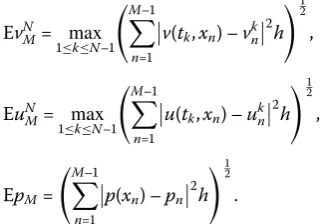
V=, VM=,
V= V–
V, VM–= VM––