Volume 2, Issue 3, March 2013
Page 299
ABSTRACT
Mobile commerce has received a lot of interests from both the industry and academy. Among them, one of the active topic areas is the mining and prediction of users such as their movements and purchase transactions. In this paper we propose a novel framework, called Mobile Commerce Explorer for mining and prediction of mobile user movements and purchase transactions under the context of mobile commerce. The MCE framework consists of three major components:1) Similarity Inference Model (SIM) ,2)Personal Mobile Commerce Pattern Mine(PCMP-mine) algorithm for efficient discovery of mobile users and 3)Mobile Commerce Behavior Predictor(MCBP) for prediction of possible mobile user behaviors.
Keywords: Mobile commerce explorer, similarity inference model, pattern mining, behavior prediction, F-transaction.
1.
INTRODUCTION
With the rapid advance of wireless communication technology and the increasing popularity of powerful portable devices, mobile users not only can access worldwide information from anywhere at any time but also use their mobile devices to make business transactions easily, e.g., via digital wallet. Meanwhile, the availability of location acquisition technology, e.g., Global Positioning System (GPS), facilitates easy acquisition of a moving trajectory, which records a user movement history. Thus, we envisage that, in the coming future of Mobile Commerce (M Commerce) age, some m-commerce services will be able to capture the moving trajectories user rewards and offers when users check-in in stores and on items. Anticipating that some users may be willing to exchange their locations and transactions.
In this paper, we aim at developing pattern mining and prediction techniques that explore the correlation between the moving behavior and purchasing transactions of mobile prediction techniques that explore the correlation between the moving behavior and purchasing transactions of mobile users to explore potential M-Commerce features.
Owing to the rapid development of the web 2.0 technology, many stores have made their store information, e.g., business hours, location, and features available online, e.g., via mapping services such as Google Map. Additionally, user trajectories can be detected by GPS-enabled devices, when users move around. For example, when a user enters a building, the user may lose the satellite signal until returning to the outdoors. By matching user trajectories with store location information, a user’s moving sequence among stores in some shop areas can be extracted. Fig. 1 shows a scenario, where a user moves among stores while making some purchase transactions (or transactions in short). Fig. 1a shows a moving sequence, where underlined store labels indicate some transactions being made there. Fig. 1b shows the transaction records of a user, where item i1 was purchased when this user is in store A. The mobile transaction sequence generated by this user is {(A, {i1}), (B,ᴓ), (C, {i3}),(D, {i2}), (E,ᴓ), ({, {i3, i4}), (I,ᴓ), (K, {i5})}. There usually is an entangling relation between moving patterns and purchase patterns since mobile users are moving between stores to shop for desired items [7]. The moving and purchase patterns of a user can be captured together as mobile commerce patterns for mobile users. For example, the user taking the shopping trip shown in Fig. 1 may exhibit a moving pattern ABC and two purchase patterns (A, {i1}) and (C, {i3}). This pattern, which can be expressed as f(A, {i1})--> B (C, {i3})}, indicates that the user usually purchases item i1 in store A and then purchases item i3 in store C on the specific path ABC. Armed with knowledge of this pattern, an m-commerce service could push some discount coupons of item i3 to the user to boost the sales of store C when the user purchases item i1 in store A. To provide this mobile ad hoc advertisement, mining mobile commerce patterns of users and accurately predicts their potential mobile commerce behaviors obviously are essential operations that require more research. They are also presented in this paper. To capture and obtain a better understanding of mobile users’ mobile commerce behaviors, data mining has been widely used for discovering valuable information from complex data sets.
Volume 2, Issue 3, March 2013
Page 300
Fig. 1. An example for a mobile transaction sequence.(a) Moving trajectory (b) Transactions
Targeted patterns in these prior works are typically different. For example, Tseng and Tsui, studied the problem of mining associated service patterns in mobile web environments. They also proposed SMAPMine [3] for efficient mining of users’ sequential mobile access patterns, based on the FP-Tree. Yun and Chen [7] proposed a method for mining mobile sequential pattern (MSP) by taking moving paths of users into consideration. Jeung et al. proposed a prediction approach called Hybrid Prediction Model (HPM) [1] for mining the trajectory pattern of a moving object. While the aforementioned studies have been conducted for discovery of mobile patterns, few of them consider the personalization issue. Since patterns mined in these studies are typically from all users, they do not reflect the personal behaviors of individual users, especially when the mobile behaviors may vary a lot among different mobile users. In this paper, we aim at mining mobile commerce behavior of individual users to support m-commerce services at a personalized level. As mentioned earlier, in addition to mining mobile patterns, predicting the next mobile.
A behavior of a user is a critical research issue. Existing work on mobile behavior prediction can be roughly divided into two categories. The first category is vector-based prediction and the second category is pattern-based prediction [1], [3], [7]. The idea of vector-based prediction is to predict the next location of an object according to its moving direction and velocity. Vector-based predictions assume that the predictive mobile behaviors of a user can be represented by mathematical models based on his recent movement in the form of geographic information. Pattern-based prediction models, on the other hand, capture semantic patterns that match the user’s recent mobile behaviors well. Pattern-based predictions are more precise than vector-based predictions [1]. Hybrid Prediction Model [1] represents the state of the art in the field of movement prediction for moving objects. HPM integrates both ideas of the pattern-based prediction and vector-based prediction. We argue that the
Volume 2, Issue 3, March 2013
Page 301
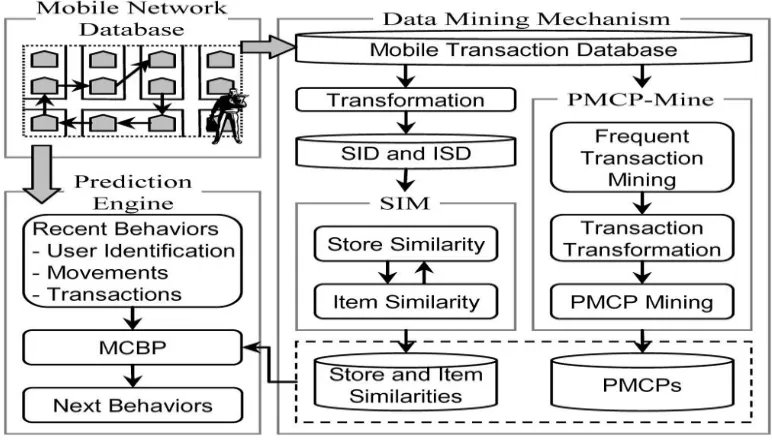
“online” engine for mobile commerce behavior prediction. When mobile users move between the stores, the mobile information which includes user identification, stores, and item purchased are stored in the mobile transaction database. Table 2 shows an example of mobile transaction database which contains four users and 14 mobile transaction sequences. In the offline data mining mechanism, we develop the SIM model and the PMCPMine algorithm to discover the store/item similarities and the PMCPs, respectively. In the online prediction engine, we propose a MCBP based on the store and item similarities as well as the mined PMCPs. When a mobile user moves and purchases items among the stores, the next steps will be predicted according to the mobile user’s identification and recent mobile transactions. The framework is to support the prediction of next movement and transaction. Fig. 2. The mobile commerce explorer framework. TABLE 2 An Example of Mobile Transaction Database.TABLE 1 : SID and ISD
2.1 Similarity Inference Model
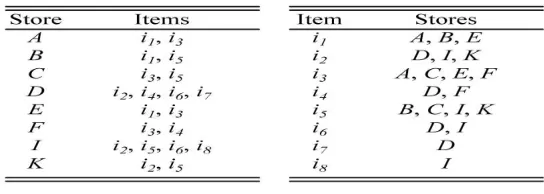
An essential task in our framework is to determine the similarities of stores and items. The problem may be solved by using store and item category ontology. However, the store or item ontology may not match with the mobile transaction database. Our goal is to automatically compute the store and item similarities from the mobile transaction database, which captures mobile users’ moving and transactional behaviors (in terms of movement mong stores and purchased items). From the database, we have the following information available: 1) for a given store, we know which items are available for sale, 2) for a given item; we know which stores sell this item. The information can help us to infer which stores or items are similar. As we observe that people usually purchase similar items in certain stores, these stores may be considered as similar. For example, people may purchase hamburgers, French fries, or Cokes in McDonalds and Burger King, we consider them as similar stores. We propose a parameter-less data mining model, named Similarity Inference Model, to tackle this task of computing store and item similarities. Before computing the SIM, we derive two databases, namely, SID and ISD, from the mobile transaction database. An entry SIDpq in database SID represents that a user has purchased item q in store p, while an entry ISDxy in database ISD represents that a user has purchased item x in store y. Table 3 shows the transformed SID and ISD from mobile transaction database in Table 2.
Volume 2, Issue 3, March 2013
Page 302
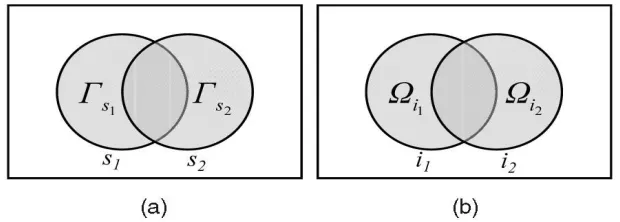
Fig. 3. The basic concept of SIM. (a) Store similarity inference. (b) Item similarity inferencee.g., hamburger and shirt. Although Sim Rank which is similar to SIM , it is not applicable to the store similarity inference. In Sim Rank, the similarity between two given objects is measured based on the average similarities between other objects linked with the given two objects. As a result, two supermarkets selling a number of different items may be considered as dissimilar in Sim Rank. In SIM, we use two different inference heuristics for the similarity of stores and items because some stores, such as supermarkets, may provide various types of items.
If we apply the same similarity inference heuristics to both of stores and items, various types of items may be seen as similar since different supermarkets are seen as similar. Based on our heuristics, if two stores provide many similar items, they are likely to be similar, if two items are sold by many dissimilar stores, they are unlikely to be similar. Since the store similarity and item similarity are interdependent, we compute them iteratively. In the following, we discuss the computational model. For the store similarity, we consider that two stores are more similar if their provided items are more similar. Given two stores sp and sq , we compute their similarity sim( sp, sq ) by calculating the average similarity of item sets provided by sp and sq. For every item sold in sp (and, respectively, sq), we first find the most similar item sold in sq (and, respectively, sp)
.
Then, the store similarity can be obtained by averaging all similar item pairs. Therefore, sim(sp, sq) is defined as where MaxSim(e,E) =MaxѐϵEsim(e, ѐ) represents the maximal similarity between e and the element in E. ┌sp and ┌sq are the sets of items sold in sp and sq, respectively. On the other hand, for the item similarity, we consider that two items are less similar if they are sold by many dissimilar stores. Given two items ix and iy, we compute their similarity sim(ix, iy) by calculating the average dissimilarity of store sets that provide ix and iy. For every store providing ix (and, respectively, iy), we first find the most dissimilar store that provides iy (and, respectively, ix) to obtain the item similarity by averaging all dissimilar store pairs.Therefore, sim(ix, iy) is defined as
Where MinSim(e,E) = MinѐϵE (1 _ sim(e, ѐ)) represents the minimal dissimilarity between e and the element in E. ┌ix and ┌iy are the sets of stores sell ix and iy, respectively. As discussed above, the store similarity can be inferred if we know the item similarity, and vice versa. Based on the inference, we compute both the store similarity and the item similarity iteratively. Initially, the similarities between the same stores and the same items both are 1, otherwise, they are 0. In each iterative computation, SIM first uses the item similarity to compute store similarity, and then recomputes the item similarity from the store similarity. Then, all the values in the store or item similarity matrix are normalized to the value range between 0 and 1. The inference process stops when the computation reaches a stable state, which is decided by the differences of store similarity and item similarity. If the differences only change a little after an iteration step, SIM will stop. Since the numbers of stores or items may be large, the computation cost of SIM may be high. To reduce the running time, the efficiency of SIM can be improved by parallel processing techniques.
2.2 Discovery Of PMCPs
Volume 2, Issue 3, March 2013
Page 303
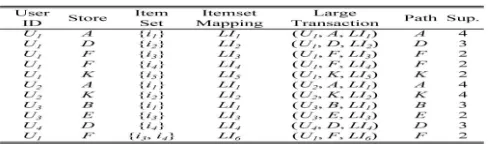
In this phase, we first discover all Frequent-Transactions for each user. 2) Mobile Transaction Database Transformation. Based on the all Frequent-Transactions, the original mobile transaction database can be reduced by deleting infrequent items. The main purpose is to increase the database scan efficiency for pattern support counting. 3) PMCP Mining. This phase is mining all patterns of length k from patterns of length k -1 in a bottom-up fashion. 2.2.1 Frequent-Transaction MiningIn this phase, we mine the frequent transactions (F Transactions) for each user by applying a modified Apriority algorithm [2]. Table 2 shows the mobile transaction database. At first, the support of each (store, item) pair is counted for each user. The patterns of frequent 1-transactions are obtained when their support satisfies the user-specified minimal support threshold TSUP (TSUP is set as 2 in this example).
A candidate 2-transaction, indicating that two items are purchased together in the transaction, is generated by joining two frequent 1-transactions where their user identifications and stores are the same. For example, the candidate 2-transaction (F, {i3, i4}) is generated by joining (F, {i3}) and (F, {i4}), because the user identifications and purchased stores of them both are U1 and F, respectively. Thus, we keep the patterns as frequent 2-transactions, when their support is larger than TSUP. Finally, the same procedures are repeated until no more candidate transaction is generated. The frequent transactions are shown in Table 2 .
In the table, we use an item mapping table to relabel item sets in order to present F-Transactions in Table 2. For each unique item set, we use a symbol LIi (Large Item set i) to represent it, where i indicates a running number. The mapping procedure can reduce the time required to check if a mobile commerce pattern is contained in a mobile transaction sequence. Finally, the frequent 1-PMCPs (same as the F-Transaction) are obtained in Table
2.2.2 Mobile Transaction Database Transformation
TABLE 3 :Frequent-1 PMCPs
Volume 2, Issue 3, March 2013
Page 304
2.2.3 PMCP MiningIn this phase, we mine all the PMCPs from the frequent mobile transaction database. Frequent 1-PMCPs are obtained in the frequent-transaction mining phase, as described earlier. In the mining algorithm, we utilize a two-level tree, named Personal Mobile Commerce Pattern Tree (PMCP-Tree) to maintain the obtained PMCPs. Fig. 4 illustrates the PMCP-Tree. As shown, the upper level of the PMCP-Tree keeps track of the frequent mobile transactions. On the other hand, the lower level of the PMCP-Tree maintains the users and paths where PMCPs occurs. Thus, all the PMCPs are captured in the PMCPTree. Take the path <1> in Fig. 4a as an example, a PMCP (A,LI1)_BCDEFI_--> (K,LI5) of user U1 can be identified by the F-Transactions (A, LI1) and (K,LI5) along with the path ABCDEFIK. The procedure of the PMCP-Tree generation is as follows
Step 1. PMCP-Mine generates candidate 2-PMCPs by hashing each combination of frequent transactions from the frequent mobile transaction sequence for each user, and then stores the results in the PMCP-Tree. The two frequent transactions in MTS 9 and 11, i.e., (B, LI1) and (E,LI3), are the same and thus can be combined as candidate 2-PMCP, because their user identifications are also the same. The candidate 2-PMCP and its path are inserted to the path <5> of PMCP-Tree.
Step 2. To identify frequent 2-PMCPs, PMCP-Mine
checks the candidate patterns whose support is larger than the minimal support threshold. Fig. 4a shows the part of frequent 2-PMCPs. Next, PMCP-Mine generates candidate 3-PMCPs with the path trimming technique [7] from frequent 2-PMCPs. A candidate 3-PMCP can be generated from two frequent 2-PMCPs, if one of moving paths in two frequent 2-PMCPs contains another. For example, the candidate pattern <6> in Fig. 4b is joined by <1> and <2> in Fig. 4a, because the path ABCDEFIK contains DEFIK and their user identifications are the same.
Step 3. PMCP-Mine counts the support of candidate 3- PMCPs and identifies the frequent 3-PMCPs. There is an efficient method that generates candidate patterns in this step [7]. A candidate pattern CPk : Ui : (X1)(X2) . . . (Xk-1)(Xk) and its path m1,m2, . . .,mq, is joined by Ui : (X1)(X2) . . . (Xk-3)(Xk-1)(Xk) and Ui : the centro-subtransactionset (D, LI2) and (F,LI3), because the first and the last transaction of <6> and <7> are the same, and their moving paths and user identifications (X1)(X2) . . . (Xk-3)(Xk-2)(Xk) and their paths are the same as CPK. Explicitly, (X2)(X3) . . . 2)1) is joined by centro-subtransactionsets (X2)(X3) . . . 3)2) and (X2)(X3) . . . (Xk-3)(Xk-1) [7]. In Fig. 4c, the pattern <8> is generated by joining are the same. The goal of a PMCP-Tree is to efficiently generate candidate mobile commerce patterns because PMCP-Tree can quickly compare two patterns to check whether they have the same first and last transactions.
Step 4. Repeat Step 3 until no more candidate patterns can be generated.
3.
MOBILE COMMERCE BEHAVIOR PREDICTOR
In this section, we describe how to use the discovered PMCPs to predict the users’ future mobile commerce behaviors which include movements and transactions. In existing pattern-based prediction models, the pattern selection strategy is based on exact matching, i.e., the similarity between different locations is treated as 0. Such prediction strategy may lead to prediction failures if there is no existing pattern to match. To overcome this problem, we integrate the similarities of stores and items which are obtained from SIM into the mobile commerce behavior prediction.
The most basic pattern-based prediction strategy is to choose the pattern with highest support from all the patterns whose premise matches the user’s recent mobile commerce behavior. Such a prediction strategy is named Support Only (SO) in this paper. We propose MCBP, which measures the similarity score of every PMCP with a user’s recent mobile commerce behavior by taking store and item similarities into account. In MCBP, three ideas are considered: 1) the premises of PMCPs with high similarity to the user’s recent mobile commerce behavior are considered as prediction knowledge; 2) more recent mobile commerce behaviors potentially have a greater effect on next mobile commerce behavior predictions; and 3) PMCPs with higher support provide greater confidence for predicting users’ next mobile commerce behavior. Based on the above ideas, we propose a weighted scoring function to evaluate the scores of PMCPs.
4.
CONCLUSIONS
Volume 2, Issue 3, March 2013
Page 305
[4] V.S. Tseng and K.W. Lin, “Efficient Mining and Prediction of User Behavior Patterns in Mobile Web Systems,”Information and Software Technology, vol. 48, no. 6, pp. 357-369, June 2006.
[5] V.S. Tseng, H.C. Lu, and C.H. Huang, “Mining Temporal Mobile Sequential Patterns in Location-Based Service Environments,” Proc. Int’l Conf. Parallel and Distributed Systems, pp. 1-8, Dec. 2007.
[6] D. Xin, J. Han, X. Yan, and H. Cheng, “Mining Compressed Frequent-Pattern Sets,” Proc. Int’l Conf. Very Large Data Bases, pp. 709-720, Aug. 2005.