Development and optimization of pyrolysis unit for
producing charcoal
Gitanjali Jothiprakash
1*and Venkatachalam Palaniappan
21Department of Bioenergy, AEC&RI, Tamil Nadu Agricultural University, Coimbatore-641003, India
2Department of Agricultural Engineering, AC&RI, Tamil Nadu Agricultural University, Madurai-625104, India *Corresponding author: [email protected]
Paper No. 278 Received: 4 June, 2014 Accepted: 17 October, 2014 Published: 20 December, 2014
Abstract
The Developed system is designed to produce the charcoal from biomass samples like Jatropha seed husk, Melia Dubia and Prosopis juliflora. The technology adopted is hybrid by combining both direct and indirect method of heating the biomass based on pyrolysis. The temperature is in the range of 300 °C to 500 °C. In results of the proximate analysis showed the fixed carbon content is increased in this pyrolysis unit charcoal whereas biomass sample and existing pyrolysis unit charcoal showed lower fixed carbon content. The charcoal yield efficiency is 34.84% whereas in conventional method of charcoal making the charcoal yield efficiency is about 20%. The mass and energy closure were found to be 72.72% and 80.30%.
Highlights
• Pyrolysis unit is first of its kind in using semi in direct heating method
• Creating an economic value and local opportunity to create and use charcoal as charcoal yield is 34% which is higher than conventional method (20%)
• Charcoal was produced with the use of biomass displaces fuel oil and natural gas in domestic heating applications
• It promotes distributed local agriculture productivity and energy production
Keywords: Pyrolysis, charcoal production, charcoal yield efficiency, mass balance, energy balance Biomass represents the renewable resource with the
largest potential to affect energy-related greenhouse gas emissions. The problems caused by solid and liquid waste can be significantly mitigated through the adoption of environmentally waste to energy technologies such as biomethanation, combustion, pyrolysis etc. (Sarbjeet et al., 2013) There are many possible scenarios by which biomass could influence the current energy consumption options and this analysis will attempt to put those options in perspective (Urmila et al., 2013). In general, biomass can replace fossil fuels in energy consuming
heating), where the biomass fuel is considered “carbon-neutral”, but the overall application is actually “carbon-negative” if one includes the fossil fuels displaced (Lehman et al., 2006).
Charcoal is a carbon product derived from biomass that can enhance soils, sequester or store carbon, and provide useable energy. Charcoal presents the ability to produce usable energy during its production while concurrently creating a solid carbon product, which has many value-added uses. (Lehmann, 2007). When biomass is burnt in the absence of oxygen,
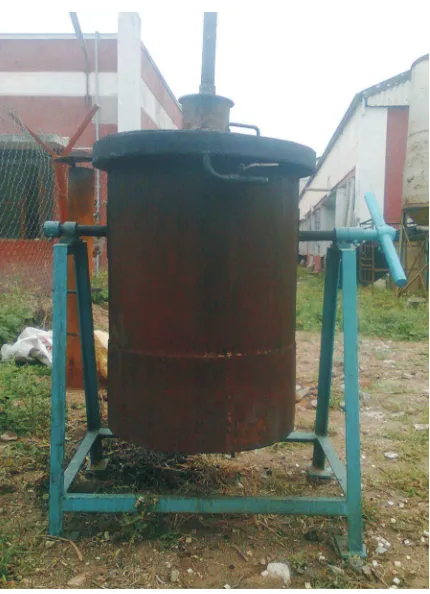
Pyrolysis Unit Inner view of pyrolysis unit
Figure 1. Pyrolysis Unit and Inner view of pyrolysis unit
a liquid (‘bio-oil’), a gas and a high-carbon, fine-grained residue: Charcoal. Charcoal has been made from jatropha husk, Melia dubia and Prosopis juliflora. However, experimentation with Charcoal has typically been on wood because of its consistency as a material and its relatively low ash content (Spokas
et al., 2009)
Materials and Methods
Carbonization procedure (Pyrolysis unit)
This developed pyrolysis unit follows semi – indirect heating method. This pyrolysis unit consists of the black coated cylindrical drum equipped with a removable wire meshed structure of pore size 5 mm,
The optimization of energy input in terms of charcoal weight is done taking Jatropha husk, Melia dubia and
Prosofis juliflora as a feed material and trials with replication is done.
Characterization of Biomass and charcoal
Jatropha Husk, Melia dubia and Prosopis juliflora
were used in charcoal production. Characteristics of these materials and its charcoal were analyzed as per ASTM standards and given in the table 1. The procedures followed were given as follows. The moisture content of the samples was carried out in a hot air oven at 103 ± 2°C upto the arrival of standard weight. The volatile matter (ASTM-E 872) was found out using the dried biomass/charcoal in a muffle furnace at 650°C for 10 minutes. The ash content (ASTM-E 830) of the biomass/charcoal was determined in muffle furnace at 750°C for 2 hours. The fixed carbon content was found from the weight difference. Calorific value was determined by bomb calorimeter (Jain and Jain, 1991). The mass and energy balance of the pyrolysis unit was calaculated by considering the mass and energy flow along with the loss at each stage (Charles et al., 2010).
Characterization of Biomass and charcoal Proximate Analysis of Biomass and Charcoal
Results and Discussion
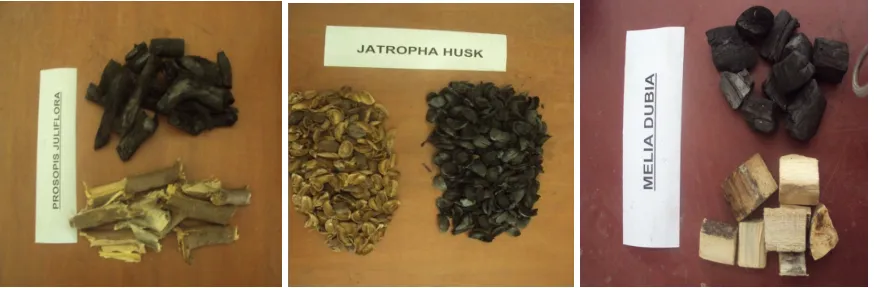
The selected biomass i.e. Jatropha Husk, Melia dubia and Prosopis juliflora used for preparation of
charcoal the pyrolysis unit. The selected biomass and its charcoal are showed in Figure 2. The comparative study between biomass and their charcoal with their performance is discussed under characterization of biomass and charcoal, charcoal yield efficiency, mass and energy balance.
Table 1. Proximate analysis
Parameters BiomassJatropha HuskCharcoal BiomassMelia DubiaCharcoal BiomassProsopis JulifloraCharcoal
Fixed Carbon,% 15.24 37.2 21.07 47.95 28.72 51.25
Volatile Matter,% 70.38 56.3 56.03 36.7 59.57 43.5
Moisture Content,% 9.95 3.1 8.07 3.7 7.29 1.4
Ash Content, % 4.43 3.4 14.83 11.65 4.42 3.85
Table 2. Calorific value Thermal Characteristics - Calorific Value
No. Feedstock’s Calorific value, MJ kg-1
Jatropha seed husk – biomass 19.11 Jatropha seed husk - Charcoal 36.74
Melia dubia– Biomass 18.26
Melia dubia - Charcoal 32.64
Prosopis Juliflora – Biomass 22.31
Prosopis Juliflora- Charcoal 46.60
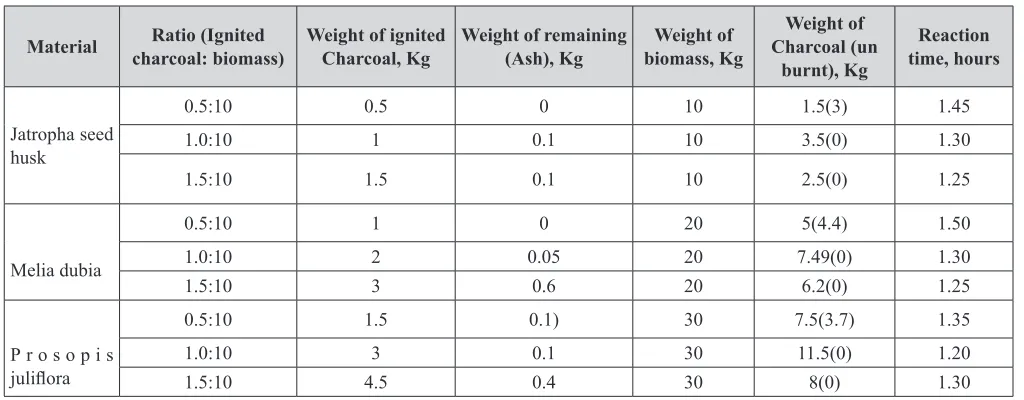
Table 3. Optimization trails of selected biomass in charcoal production
Material charcoal: biomass)Ratio (Ignited Weight of ignited Charcoal, Kg Weight of remaining (Ash), Kg biomass, KgWeight of Charcoal (un Weight of burnt), Kg
Reaction time, hours
Jatropha seed husk
0.5:10 0.5 0 10 1.5(3) 1.45
1.0:10 1 0.1 10 3.5(0) 1.30
1.5:10 1.5 0.1 10 2.5(0) 1.25
Melia dubia
0.5:10 1 0 20 5(4.4) 1.50
1.0:10 2 0.05 20 7.49(0) 1.30
1.5:10 3 0.6 20 6.2(0) 1.25
P r o s o p i s juliflora
0.5:10 1.5 0.1) 30 7.5(3.7) 1.35
1.0:10 3 0.1 30 11.5(0) 1.20
1.5:10 4.5 0.4 30 8(0) 1.30
Parikh et al. (2005) analyzed the higher heating value of biomass would be 16-22 MJ kg-1 The calorific value
of biomass was found to be in the range of 18.26 to 22.31 MJ kg-1 with the results of Parikh et al. (2005).
The calorific values of charcoal’s came in the range of 32.64 to 46.60 MJ/kg and matches with the results of (Erol et al., 2010), which is more when compared with the calorific value of biomass sample. It shows that to
enhance the energy in the biomass; the biomass can be converted into charcoal.
Optimization Trials
efficient and environmental friendly process. This process can be used in industries where charcoal production is carried out using electricity.
Charcoal Yield Efficiency
The charcoal yield efficiency of the pyrolysis unit is calculated as follows.
Mass of charcoal produced = 11 to 12, i.e 11.5 Kg Mass of ignited charcoal used = 3 Kg
Mass of biomass taken = 30 Kg
Charcoal Yield efficiency = (11.5/(30 + 3)) x 100 = 34.84 %
This efficiency is found to be increased when compared with the traditional method of producing
Figure 3. Mass balance pictorial representation
charcoal and pictorial representation is represented
Mass Balance and Energy Balance
Mass balance closure was found out to represent the accuracy of the system and methodology adopted. Mass input = Mass of Biomass + Mass of Ignited charcoal = 11 kg
Mass output = Mass of charcoal + Mass of Ash + Mass of Flue gas + Mass of Unburnt = 8 kg
Mass closure, per cent = 72.72
Thus the mass closure for the pyrolysis unit is found to be 72.72%.
An energy study makes an attempt to critically evaluate the studies to make a breakthrough in agricultural sector (Murugan, 2011). Energy balance closure was found out to represent the efficiency of the system and methodology adopted.
Energy input = Energy content in Biomass + Energy content in ignited charcoal = 132 MJ
Energy output = Energy content in (Charcoal + Ash + Flue gas + Un burnt) = 106 MJ
Energy closure, per cent = 80.30
Thus the energy closure for the pyrolysis unit is found to be 80.30%.
This mass closure and energy closure efficiency coincides with the result of Chew and Doshi (2011). As he stated that pyrolysis is a thermal treatment of biomass typically in the temperature range of 200 - 300°C with reactor residence time from 15 minutes to 3 hours. The process typically retains 70% of the mass closure and 85% of energy closure efficiency. The mass lost during pyrolysis are high oxygen content and low energy content compounds, which improves the fuel quality of the biomass.
Conclusion
The present study was undertaken to preparation of charcoal from the Jatropha seed husk, Melia Dubia
at optimum level and utilized to make charcoal. During this work different characteristics such as proximate analysis and thermal property are studied. These characteristics were studied with the help of these instruments such as muffle furnace, bomb calorimeter and hot air oven.
Conclusions are as following,
(1) In results of the proximate analysis showed the fixed carbon content is increased in developed pyrolysis unit charcoal whereas biomass sample showed lower fixed carbon content.
(2) Calorific values of charcoal’s came in the range of 32.64to 46.60 MJ/kg, which is more when compared with the calorific value of biomass sample.
(3) Charcoal yield efficiency is increased from 19.69 (conventional method) to 34.84% (developed unit).
(4) The mass and energy closure were found to be 72.72% and 80.30%.
References
Antal, M.J., and Gronli, M. 2003. The art, science and technology of charcoal production. Industrial and Engineering Chemistry Research 42(8): 1619-1640.
Charles, A. M., Akwasi, A.B. Neil, M.G. Isabel, M. L. David, A.L. and Kevin, B.H. 2010. Biooil and biochar Production from corn cobs and stover by fast pyrolysis. Biomass and Bioenergy 34(1): 67 – 74.
Chew, J.J., and Doshi, V. 2011. Recent advances in biomass pretreatment – Torrefaction fundamentals and technology. Renewable Sustainable Energy Review 15: 4212-4222.
Erol M., Acma, H. H. and Kucukbayrak, S. 2010. Calorific value estimation of biomass from their proximate analyses data. Renewable Energy 35: 170-173.
Jain, M., and Jain, K. 1991. In: A Textbook of Engineering Chemistry 104 - 106.
Jeguirim, M., and Trouve, G. 2009. Pyrolysis characteristics and kinetics of Arundodonax using thermogravimetric analysis. Bioresource Technology 100: 4026-4031.
Lehmann, J., Gaunt, J., Rondon and Marco. 2006. Bio-char sequestration in terrestrial ecosystems – A review. Mitigation and Adaptation Strategies for Global Change 11: 403–427.
Lehmann, J. 2007. Handful of Carbon. Nature Publishing Group 143-144.
Murugan, D., 2011. Studies on energy consumption in agricultural production in India: A critical Evaluation. International Journal of Agriculture, Environment and Biotechnology 4(1): 89-94.
Ogawa, M., Okimori, Y. and Takahashi, F. 2006. Carbon sequestration by carbonisation of biomass and forestation: Three case studies. Mitigation Adaption Strategy - global change 11: 421-436.
Parikh, J., Channiwala, S.A. and Ghosal, G.K. 2005. A correlation for calculating HHV from proximate analysis of solid fuels. Fuel 84: 487-494.
Rondon, M., Lehmann, J. Ramirez, J. and Hurtado, M. 2007. Biochar characteristics. Clean Air task 43: 699-708.
Sarbjeet S. S., and Anand, G. 2013. Present Status of Renewable Energy Sources in Punjab. International Journal of Agriculture, Environment and Biotechnology 6(2): 317-333. Spokas, K. A., Koskinen, W. C. Baker, J.M. and Reicosky,
D. C. 2009. Impacts of woodchip biochar additions on greenhouse gas production adsorption/degradation of two herbicides in Minnesota soil. Chemosphere 77: 574-581. Urmila, G. P., Anand, G. and Kaur, K. 2013. Performance
Evaluation of Solid State Digester for Biogas Production using Biologically Pretreated Straw. International Journal of Agriculture, Environment and Biotechnology 6(4): 691-694 Yin, C.Y. 2011. Prediction of higher heating values of biomass