Genetic Approach Based Clustering for Increasing Energy Efficiency
in Wireless Sensor Network
Prakash Kumar Singh
Computer Science & Engineering Rewa Institute of Technology, Rewa[email protected] 9990760997
Abstract— The availability of sensor devices allows a wide variety of applications to emerge. However, the resource constrained nature of sensors raises the problem of energy: how to maximize network lifetime despite a very limited energy budget. This paper proposed a new approach of finding the cluster center of WSN (Wireless Sensor Network) for improving energy efficiency method. Here genetic algorithm was used which was named as TLBO (Teacher Learning Based optimization). Basic reason for the use of this algorithm was that it can adopt dynamic situation without any training. So based on the current node position and energy value with data transfer units one can easily configure WSN by finding good cluster center set among various nodes in very less time. Proposed work was compared with previous algorithm LEACH and it was obtained that proposed work of genetic algorithm have improved different evaluation parameters.
Keywords— Cloud Computing, Load balancing, Machine Learning, Soft Computing, Virtual machines.
I. INTRODUCTION
Wireless Sensor Networks (WSN) is an emerging technology that could revolutionize the way wireless network access is provided. The interconnection of different wireless devices using wireless links exhibits great potential in addressing different connectivity issue. Wireless Sensor Network (WSN) is a wireless network consisting of small nodes with sensing, computation, and wireless communications capabilities [1]. Each sensor collects data from the monitored area (such as temperature, sound, vibration, pressure, motion or pollutants) and then it routes data back to the base station [2-3]. Data transmission is usually a multi- hop, from node to node toward the base station. To realize this vision, it is imperative to provide efficient resource management. Resource management encompasses a number of different issues, including routing. As wireless sensor networks consist of hundreds to thousands of low-power multi functioning sensor nodes, operating in an unattended environment, with limited computational and sensing capabilities, sensor nodes are equipped with small, often irreplaceable batteries with limited power capacity. WSN consist of hundreds or thousands of small, cheap, battery-driven, spread-out nodes bearing a wireless modem to accomplish a monitoring or control task jointly. Then a set of criteria is defined against which the existing routing protocols from ad hoc, sensor, and
WSN can be evaluated and performance metrics identified. This will serve as the basis for deriving the key design features for routing in wireless sensor networks. An important concern is the network lifetime: as nodes run out of power, the connectivity decreases and the network can finally be partitioned and become dysfunctional [2-3].
Routing algorithms having self-organizing capabilities and consist of different sensors namely seismic, low sampling rate magnetic, thermal, visual, infrared and acoustic sensors. WSNs were used in various applications like military applications, environment monitoring and detecting wild life in a dense forest area. Designing of sensor nodes having some constraints like the small size, low weight, energy consumption, multi functional, communicate with short distance and low price and minimum transmission cost. Most known applications are target tracking, habit monitoring, surveillance and security (Bandyopadhyay and Coyle, 2003). Cluster based approach is useful for environment monitoring. WSN is the combination of wireless communication and environmental perception. It is a special form of wireless ADHOC network. This can construct the network without any infrastructure. Energy efficient routing algorithms are mainly divided in to the following categories. (1) Reduction of the communication energy consumption by adopting multi-hop transmission strategy. (2) Balancing the network load by adopting the cluster-based routing protocols and optimizing the location of cluster head. (3) Adopting the sleep and wake-up mechanism to avoid the unnecessary energy consumption.
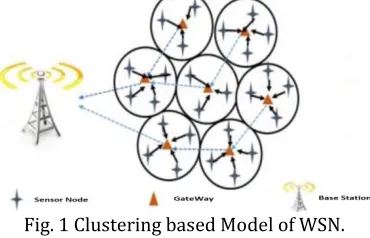
Fig. 1 Clustering based Model of WSN.
important role for packet transmission and also considers the Network balance.
II. RELATED WORK
Ahmad, A., Latif, K. Javaid N. Khan et. al. (2013) [5] investigated on clustering procedure which is most well recognized directing strategy in WSNs. Because of differing need of WSN application productive vitality use in directing conventions is very still a potential field of research. Authors presented new energy efficient directing technique in this research. This strategy is utilized to defeat the fundamental trouble of energy hole and coverage hole. In their strategy, they have controlled these issues by presenting density controlled uniform circulation of hubs and settled an ideal number of Cluster Heads in each round.
Lohan, P. and Chauhan, R. et. al.(2012) [6] presented the Geography Informed Sleep Scheduling and Chaining Based Routing (GSSC) algorithm in wireless sensor network. As detector nodes are power restraint, the system lifetime improved by utilizing the energy of nodes very proficiently. GSSC saves power by discovering alike nodes from routing perspective by using their geological information, it senses nearly similar information and then turning off needless nodes to eliminate data redundancy. This chaining based routing can lessen energy spending of data transferring with the help of multi-hop routing technique. Their simulation outcome (using MATLAB) demonstrates that GSSC achieved considerable increment in network lifespan than LEACH and PEGASIS.
CHs. Gherbi Chirihane & Aliouat Zibouda et al. (2015) [7] proposed a distributed energy efficient adaptive clustering protocol with Data Gathering for WSN reduces the energy consumption and network lifetime is extended. The clustering techniques are used efficiently with distributed cluster heads. The node’s ratio is turned off for fixed time period and sleep control laws are designed to reduce the cost function. The scenario displays random deployment of nodes and the total simulation time is decomposed using resource reservation. The technique distributed energy efficient adaptive clustering protocol with Data Gathering (DEACP) reduced the overall network energy consumption, balance the energy consumption among the sensors and extend the lifetime of the network by making the clustering efficient in complexity of message and time, well distributing the cluster-heads across the network, the load balancing done well and as a result transmission power of the node is reduce which subsequently reduces the energy consumption .
Bouachir Ons (2016) et. al present that an ORP and data dissemination protocol for energy harvesting WSN (EH-WSN) depend on cross-layer constructs that allow across the layers synchronization and coordination among the
routing protocol and the application layer service. The OMNET++ based extensive simulation of this protocol showed promising results in terms of meeting application requirements of handling urgent traffic and delay tolerant traffic seamlessly and ensuring energy usage efficiency [3].
In Chun-Wei Tsai, Zhen-An Liy , 2017 [4] this paper, a high performance met heuristic algorithm, called search-economics-based clustering algorithm (SECA), is presented. One of the basic ideas of SE-based algorithms [7] is to depict the solution space to “avoid searching the same regions too many times” and to “search the potential regions that have not been searched as often as possible.” The SECA is proposed for reducing the energy consumption of a WSN to prolong its lifetime.
III. PROPOSED WORK
a. Preprocessing:- Develop a region and count number of nodes present in the region and find their initial energy level before transmitting and receiving any packets. Here energy consumption per unit node is required to be estimate. The transmission energy (ETx) and receiving energy (ERx) can be computed as follows:
where L is the data size in bits; d the distance between source and destination, Eelec the energy consumption per bit. The values of a and b depend on the value of d. If d <= d0, a and b will be afs and 2. Otherwise, they will be aamp and 4.
Fig. 2 Proposed work Block diagram.
of a WSN is to maximize “the alive nodes” and “the remaining energies” of all the sensors.
b. Generate Population:- Here assume some cluster set that are the combination of different nodes. This is generating by the random function which select fix number of pattern cluster for the centroid. This can be understood as let the number of centroid be Cn and number of patterns are N then one of the possible solution is {C1, C2, …..Cn}. In the similar fashion other possible solutions are prepared which can be utilizing for creating initial population represent by ST matrix.
ST[x] Random(N, Cn)
Selection Phase:- Here some set of probable solutions are select from the population which have good energy level at starting point of the network. As this increase the efficiency of the overall network.
Fitness Function:- For finding difference two chromosomes function are use first is total energy consumption required to while transmitting and receiving packets in region under selected cluster set. The objective function is a variant of that described in [22], which can be divided into two parts. The first part is the normalized energy consumption. The energy consumption for non-CHs is defined as
Enon-CH = ∑i=1∑ j=1 ( ETx (L, d(CHi, Nj)) x Xij (8)
where k is the number of CHs; N the number of nodes; l the packet size; and d(CHi;Nj) the distance between the ith CH and the jth node. The value of xij will be set to 1:0 if Nj belongs to CHi; otherwise, it will be set 0:0. The energy consumption for CHs is defined as
ECH = ∑i=1(Lx|Cij|x(EDA+ERx)+ETx(L, d(CHi, BS)) (9)
where jCij is the number of members belonging to the ith CH, and EDA is the energy consumption for data aggregation. In this study, we assume that data from different nodes can be compressed and aggregated into l bits.
D = ECH + Enon-CH
So the matrix D contain all the values of the centriod distance from the nodes present in one cluster then find the minimum distance which will evaluate specify best possible solution.
Teacher Phase:- Top possible solution after sorting will act as the teacher for other possible solutions. Now selected teacher will teach other possible solution by replacing fix number of centroid as present in teacher solution. By this all possible solution which acts as student will learn from best solution which acts as teacher. Main motive of this step is to find best solution from the generated population. Here each possible
solution is evaluated for finding the distance from each centroid pattern so that pattern closer to the centroid is cluster together. Then calculate the fitness value which gives overall rank of the possible solution. This difference modifies the existing solution according to the following expression
Xnew,i = Xold, i + Replacing Cluster value
Where Xnew,i is the updated value of Xold,i. Accept Xnew,i if it gives better function value.
Student Phase:- In this phase all possible solution after teacher phase are group for self learning from each other. This can be understand as let group contain two student then each student who is best as compare to other will teach other solution. Teaching is similar as done in teacher phase, here replacing fix number of centroid is done which is similar as in best student of the group.
1.For i <= 1 to P
2.Haphazardly make combination of two chromosomes Xi and Xj,
3.If fitness(Xj)> fitness (Xi)
4.Xj,x = Difference (Xi,x, Xj,x) // x: position of the cluster center in population vector
5.Else
6.Xi,x = Difference (Xj,x, Xi,x) 7.End If
8.End For
Once student phase is over then check for the maximum iteration for the teaching if iteration not reach to the maximum value then GOTO step of teacher phase else stop learning and the best solution from the available population is consider as the final centroid of the work. Now image are cluster as per centroid.
Final Solution:- In this work after sufficient number of iteration best possible cluster centers are obtained and assign nodes to those clusters. Here each cluster is represent by its cluster center.
IV. EXPERIMENT AND RESULT
while transfer packet in each round to cluster node and base station.
Execution Time: Total time required finding best dynamic cluster center node for WSN by the algorithm, here time was evaluated in second.
Packet Transfer: This is the number of packet transfer done in the WSN while all the node get discharge, so wireless arrangement having maximum number of packet transfer is good solution.
Results:- Results of the proposed work are comparing with the existing method in [11].
Table 1 Comparison of number of rounds for 100x100m area of proposed and previous work.
Nodes
Number of Rounds for 100x100 m
Previous Work Proposed work
50 16585 20109
100 18545 21483
150 17297 19195
Above table 1shows that number of rounds value of proposed work was high as compared to previous work[11]. It has been observed that proposed work centroid selection method is efficient as compare to the previous. Here iteration in both work increase the this evaluation parameter value but selection different set of features for clustering make high number of rounds value of proposed work.
Table 2 Comparison of Execution time in second for 100x100m area of proposed and previous work.
Nodes
Execution Time (sec.) for 100x100 m
Previous Work Proposed work
50 1.8833 0.1082
100 3.7195 0.9267
150 6.2472 0.2072
Above table 1shows that number of rounds value of proposed work was low as compared to previous work [11]. Here TLBO algorithm makes double phase learning in single iteration so population gets update very soon. Due to this execution time of the proposed work was low.
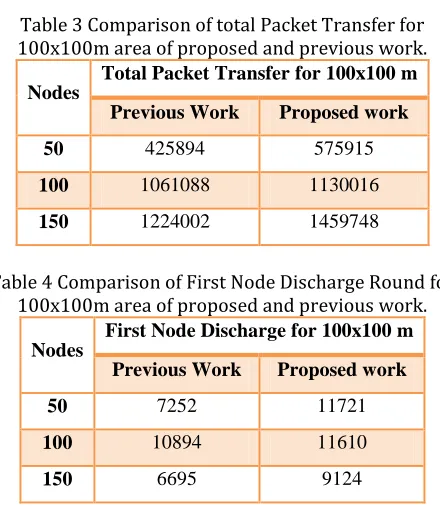
Table 3 shows that total packet transfer value of proposed work was high as compared to previous work[11]. It has been observed that proposed work centroid selection method is efficient as compare to the previous. Here iteration in both work increase this evaluation parameter value but selection different set of
features for clustering increase total packet transfer value of proposed work.
Table 3 Comparison of total Packet Transfer for 100x100m area of proposed and previous work.
Nodes
Total Packet Transfer for 100x100 m
Previous Work Proposed work
50 425894 575915
100 1061088 1130016
150 1224002 1459748
Table 4 Comparison of First Node Discharge Round for 100x100m area of proposed and previous work.
Nodes
First Node Discharge for 100x100 m
Previous Work Proposed work
50 7252 11721
100 10894 11610
150 6695 9124
Table 4 shows that First Node Discharge Round value of proposed work was high as compared to previous work[11]. It has been observed that proposed work centroid selection method is efficient as compare to the previous. Here iteration in both work increase this evaluation parameter value but selection different set of features for clustering increase First Node Discharge Round value of proposed work.
Fig.2 Comparison of 100 node energy loss in 100x100 area.
Fig.3 Comparison of 50 node energy loss in 100x100 area.
Fig.4 Comparison of 150 node energy loss in 100x100 area.
V. CONCLUSIONS
The wireless sensor networks continue to grow and become widely used in many applications. So, the need for security becomes vital. However, the wireless sensor network suffers from many constraints such as limited energy, processing capability, and storage capacity, etc. Consequently, many innovative security protocols and techniques have been developed to meet this challenge. In future a flawless calculation is with great component blend is wanted by investigating new load balancing calculations which adjusts the load much better and furthermore helps in green processing.
REFERENCES
[1]. Faheem khan, Sohail abbas, Samiullah khan, An Efficient and Reliable Core-Assisted Multicast Routing Protocol in Mobile Ad-Hoc Network, International Journal of Advanced Computer Science and Applications, vol7:5, 2016.
[2]. M. J. Usman, Z. Xing, H. Chiroma, A. Y. U. Gital, A. I. Abubakar, A. M. Usman and Herawan, Modified Low-Energy Adaptive Clustering Hierarchy Protocol for Efficient Energy Consumption in Wireless Sensor Networks for Healthcare Applications, International Review on Computers and Software, vol. 9, no. 11, pp. 1904-1915, 2014.
[3]. Bouachir Ons, Mnaouer Adel Ben, Touati Farid, Cresciniy Damiano, “Opportunistic Routing and Data Dissemination Protocol for Energy Harvesting
Wireless Sensor Networks”, 978-1-5090- 2914-3/16©2016 IEEE.
[4]. Chun-Wei Tsai, Zhen-An Liy, Ming-Chao Chiang and Chu-Sing Yang. “A novel clustering algorithm for wireless sensor network based on search economics”. 2017 IEEE International Conference on Systems, Man, and Cybernetics (SMC) Banff Center, Banff, Canada, October 5-8, 2017.
[5]. Ahmad A., Latif, K., Javaid, N., Khan, A. and Qasim U., "Density controlled divide-and-rule scheme for energy efficient routing in Wireless Sensor Networks," Electrical and Computer Engineering (CCECE), 2013 26th Annual IEEE Canadian Conference on, vol., no., pp.1,4, 5-8 May 2013. [6]. Lohan P. and Chauhan R., "Geography-informed
sleep scheduled and chaining based energy efficient data routing in WSN," Electrical, Electronics and Computer Science (SCEECS), 2012 IEEE Students' Conference on, vol., no., pp.1,4, 1-2 March 2012. [7]. Gherbi Chirihane & Aliouat Zibouda, "Distributed
energy efficient adaptive clustering protocol with data gathering for large-scale wireless sensor networks", Programming and Systems (ISPS), 12th International Conference, IEEE,2015.
[8]. T. Camilo, C. Carreto, J. S. Silva, F. Boavida, “An Energy Efficient Ant-Based Routing Algorithm for Wireless Sensor Networks”, 2006 Springer.
[9]. J. Zhao, A. T. Erdogan., “A Novel Self-organizing Hybrid Network Protocol for Wireless Sensor Networks” Proceedings of the First NASA/ESA Conference on Adaptive Hardware and Systems (AHS'06) 0-7695-2614-4/06 2006 IEEE.
[10].R. C. Shah and J. M. Rabaey, “ Energy Aware Routing for Low Energy Ad Hoc Sensor Networks”, IEEE wireless Communications and Networking Conf. (WCNC), March 17- 21, 2002, Orlando, FL