_____________________________________________________________________________________________________
*Corresponding author: E-mail: [email protected]; [email protected];
Isolation of Pathogenic and Non-pathogenic
Microbial Stains from Different Types of Sea Fish
Samples and their Quality Assessment with
Antibiogram Properties
Asif Shahriar
1,
Taheera Akter
1,
Anina Tul Kobra
1, Talha Bin Emran
2*,
Jewel Mallick
2and Mycal Dutta
21
Department of Microbiology, Stamford University Bangladesh, 51 Siddeswari Road, Dhaka-1217, Bangladesh.
2Department of Pharmacy, BGC Trust University Bangladesh, Chandanaish, Chattogram-4381,
Bangladesh.
Authors’ contributions
This work was carried out in collaboration among all authors. Authors AS, TA, ATK, TBE, JM and MD together planned and designed the research. Authors AS, ATK and TBE arranged the whole facilities for the research. Authors AS, TA and ATK conducted the entire laboratory works. Author AS imparted in study design and interpreted the results putting efforts on statistical analysis with authors JM, MD and TBE. All authors read and approved the final manuscript.
Article Information
DOI: 10.9734/JAMB/2019/v19i130185 Editor(s): (1). Dr. C. Ike, Anthony, Senior Lecturer, Department of Microbiology, University of Nigeria, Nsukka, Enugu State, Nigeria. Reviewers: (1). Forcep Rio Indaryanto, University of Sultan Ageng Tirtayasa, Indonesia. (2). Ir. F. Feliatra, University of Riau, Indonesia. Complete Peer review History: http://www.sdiarticle4.com/review-history/52114
Received 17 August 2019 Accepted 22 October 2019 Published 22 November 2019
ABSTRACT
Aims: The contamination of sea fish and seafood by bacteria of fecal origin along with various pathogenic drug-resistant microorganisms are widely documented as the cause of several human diseases. Our present studies aim to determine the comparative microbiological quality among raw, cooked and cooked-frozen fish along with antimicrobial profiling of those isolated pathogenic and non-pathogenic microbes with potential drug modelling and increasing the awareness of taking unnecessary antibiotics. The objective of the present study was to investigate the status of fish in cold condition after cooking.
Methodology: We collected a total of four sea fish species (Rupchada, Koral, Tuna, and Poma)
from the local shops in Dhaka city. Raw, cooked, and frozen fish samples were analyzed for the existence of pathogenic bacteria through conventional cultural techniques and the confirmatory biochemical identification procedures. Kirby-Bauer disk diffusion method was performed to demonstrate the antibiotic susceptibility pattern of isolated microorganisms.
Results: Total viable bacteria were present in all four fish samples in raw, cooked, and frozen condition up to 8.5 log CFU/ml. Most of the raw fish samples were found to harbour a vast population of microorganisms up to 7 log CFU/ml, including fecal coliforms. Several specific bacterial species like Escherichia coli, Klebsiella spp., Salmonella spp., Shigella spp., Staphylococcus spp., Pseudomonas spp. and Vibrio spp. were noticed to be present in raw samples. The microbial loads were reduced in cooked samples, and the status was static in frozen samples. The study of antibiogram showed several pathogenic isolates to be drug-resistant against second-line drugs.
Conclusion: Thus, the incidence of fecal coliforms in raw fish may be considered as a severe threat to public health upon consumption of such fishes. Such a prevalence of pathogens in the studied fish samples, including antibiotic-resistant strains of pathogenic microorganisms, can lead to severe public health risk and are the significant findings of this study.
Keywords: Sea fish; pathogens; antibiotic resistance; microbiological quality; health risk.
1. INTRODUCTION
Animal protein, highly unsaturated fatty acid (HUFA), polyunsaturated fatty acid (PUFA), minerals, and vitamin are source of complete nutrients which play a spectacular rule human and animal growth along with as other nutritional value. These types of nutritional source highly comes from fish and different types of fish products. Marine fish oil is a good source of omega-3 fatty acids [1-3]. In Bangladesh, research have shown that about 60% of the total animal protein intake is derived from fishery products [4,5]. Marine water of Bangladesh also has 442 species of fish and 36 species of marine shrimps and which is widely consumed by Bangladeshi people and tourists [6]. Because of its advanced nutritive value, sea fishes constitute a significant substance for pathogenic and non-pathogenic microorganisms. Fishes can be contaminated by both aquatic environment and post-harvesting condition [7]. Due to the colonization of drug resistant pathogenic bacteria and fungi a wide ranges of sea fish’s spoilage occurs, which adversely affect the economic condition in Bangladesh, as well as public health. Contamination of sea fishes can take places at several stages of transport, handling, processing, packaging, and storage condition by both bacteria and fungi. Previous investigation has revealed that processing materials, water, and ice could be a source of contamination [8].
However, normal flora of fish contributes to spoilage due to inappropriate packaging [9-11].
Aeromonas, Vibrio spp., Pseudomonas spp.,
Staphylococcus spp., Salmonella spp., Listeria
spp., Clostridium perfringens spp. are major
cause of various foodborne illness when they enter and colonized into our intestine through contaminated sea fishes [12-15]. Along with bacteria and fungi, seafood-associated illness can be caused by viruses (Norovirus and Hepatitis A) and certain parasites. Most outbreaks of food poisoning associated with fish and seafood derive from consumption of raw or inadequately cooked food, and cross-contamination during processing [16]. Several types of pathogenic and non-pathogenic bacteria along with fungus are naturally associated with raw fishes, that can be opportunistic and cause foodborne infections rapidly if it is left for several hours at room temperature without processing.
Pathogenic bacteria, especially Salmonella spp.
and Vibrio spp. are the primary concern of food safety concerning seafood. When seafood is processed with uncontaminated water and cooked properly, it lowers the risk of food poisoning. Lack of proper temperature control is significant factors that can lead to pathogen growth and foodborne illness. Frozen fish are prone to contaminated by Listeria spp. [17,18]. Some thermostable enterotoxin of S. aureus and
E. coli would not be destroyed completely even
and chemical properties can be changed. Presence of Staphylococcus aureus and Bacillus
cereus was recorded in some cooked-frozen fish
and meat as they can grow at refrigeration temperatures though at a lower growth rate [25-27]. Along this line, it was clear that microbes can be found in any of the three conditions. Also, drug resistance and virulent genes of the spoiling microflora are another important concern as they can be transferred to the pathogens colonizing the fish which may pose serious health threat especially in case of disease medication [28-31]. The extensive misuse of antibiotics led to the development of serious problems of resistance and hence limited the usefulness of antibiotics to eliminate bacterial infections [32,33]. A study showed that more than 70% of infecting pathogens were resistant against at least one of the commonly used antibiotics [34]. A habitual conductance of antibiogram thus claims its importance from the view of public health importance. Our present studies aim to determine the comparative microbiological quality among raw, cooked and cooked-frozen fish along with antimicrobial profiling of those isolated pathogenic and non-pathogenic microbes which will be useful for potential drug modelling and increasing the awareness of taking unnecessary antibiotics.
2. MATERIALS AND METHODS
2.1 Study Area and Sample Collection
For the analysis of microbial load, four fish samples (Rupchada, Koral, Tuna, and Poma) were collected from the local market in Dhaka city during August using a sterile aseptic container together with ice. The scientific name of Rupchada, Koral, Tuna, and Poma are
Pampus chinensis, Lates calcarifer, Thunnus
albacores and Argyrosomus amoyensis
respectively. The experiment was conducted in triplicate and fish samples were taken from four different traders. Twenty (20) gm of raw, cooked, and cooked-frozen samples of each fish was homogenized with 180 gm of sterile normal saline. The homogenized suspension was subjected to serial dilutions (10-fold) up to 106 with normal saline [35].
2.2 Enumeration of Total Viable Bacteria and Fungus
For enumerating total viable bacteria (TVB) and total fungal count 0.1 ml of each sample was spread onto Nutrient agar (NA) and Sabouraud
dextrose agar (SDA). For TVB, plates were incubated at 37ºC. For the fungal assay, plates were incubated at 25ºC for 3 days [36].
2.3 Isolation of Total Coliform and Fecal Coliform
For isolation of coliforms, fecal 0.1 ml suspension was spread over MacConkey agar and MFC agar. For the isolation of Escherichia coli and
Klebsiella spp., plates were incubated at 37ºC for
18-24 hours. Presence of E. coli was further confirmed by the appearance of bluish-black colonies with green metallic sheen on eosin-methylene blue (EMB) agar. While for fecal coliforms, plates were incubated at 44.5ºC for 24 hours [36].
2.4 Assay of Other Pathogenic Bacterial Loads
For the isolation of Salmonella spp., Shigella
spp., Vibrio spp. and Staphylococcus spp., 0.1 ml of suspension was spread onto Xylose Lysine Deoxycholate (XLD) and
Thiosulphate Citrate Bile Salt Sucrose (TCBS) agar plates and Mannitol salt agar (MSA) respectively. After incubation at 37ºC for 24 h, characteristic colonies were enumerated [36].
2.5 Biochemical Analysis of Pathogenic Strains
Several biochemical tests (TSI, Indole production, MR, VP, Citrate Utilization, Catalase, Oxidase)
were performed to determine and confirm the isolates by following the standard protocol for further confirmation of the presence of pathogenic bacteria [37,38].
2.6 Determination of Drug Susceptibility
Pattern of Pathogenic
Micro-organisms
The pathogenic isolates (Shigella spp., Klebsiella spp., Pseudomonas spp., Vibrio spp. and
Staphylococcus spp.) were examined for
Trimethoprim-sulfamethoxazole (25 µg), Gentamycin (10 µg), Nalidixic acid (30 µg).
2.7 Statistical Analysis
All the experiments were performed in triplicate. Statistical analyses were performed by determining the p-value through t-test.
3. RESULTS
3.1 Prevalence of Pathogenic Bacteria and Fungi in Fish Samples
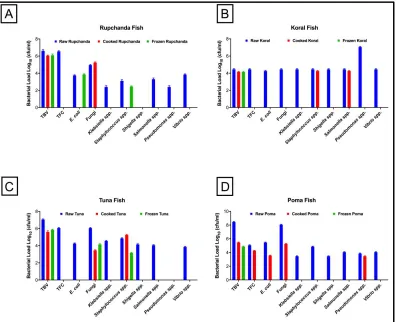
The bacterial contamination was very high in raw fish samples more than the cooked and frozen fish. The total viable bacterial and fungal growth were found in raw fish (Poma fish), nearly 8.5 log CFU/ml. Total viable bacteria were also present in cooked and frozen Poma fish up to 5.5 log and 4.9 log CFU/ml respectively. In case of specific
pathogens like E. coli, Klebsiella, Staphylococcus
spp., Shigella spp., Salmonella spp.,
Pseudomonas spp. and Vibrio spp. were present
within the range of 3.5-5.0 log CFU/ml. Frozen Poma fish was contamination-free in case of all pathogens, but E. coli and Pseudomonas were present in cooked Poma fish. Both raw and cooked Poma fish were found to be fecally contaminated (Fig. 1A).
In the case of Rupchanda fish, raw, cooked, and frozen samples were found to be contaminated by viable bacteria up to 6.5 log CFU/ml. Specific pathogens were noticed in raw Rupchanda fish up to 6 log CFU/ml whereas E. coli and
Staphylococcus were present in frozen
Rupchanda within the range of 2.5 log-3.9 log CFU/ml. The growth of Shigella was absent in all three categories of Rupchanda fish. Raw Rupchanda fish showed the existence of fecal bacteria (Fig. 1B).
Fig. 1. Microbiological status of different sea fish in a different state like Raw fish, Cooked fish and Frozen fish. Panel A is indicating the Rupchanda fish, panel B indicating the Koral fish,
5
Table 1. Biochemical identification of the pathogenic isolates from sea fish
Identified microorganisms
TSI Motility Indole
Production
MR VP Citrate Utilization
Catalase Oxidase Slant But Gas H2S M
E. coli Y Y + - + + + - - +ve -ve
Klebsiella spp. Y Y + - + - - - + +ve -ve
Vibrio spp. R Y - - + - + - - +ve +ve
Staphylococcus spp. Y Y - - + - + - - +ve -ve
Pseudomonas spp. R Y - - + - + - - +ve +ve
Salmonella spp. R Y + + + - + - + -ve -ve
Shigella spp. R Y - - - +/- + - - -ve -ve
All the experiments have been done three times and the results were reproducible. One representative data have been shown. TSI=Triple Sugar Iron Test, Y=Yellow (Acid), R=Red (Alkaline), MR=Methyl red,
Meanwhile, the raw Koral fish exhibited the massive array of E. coli, Klebsiella,
Staphylococcus, Shigella, Salmonella,
Pseudomonas and Vibrio to 4.5 log CFU/ml. Only
Staphylococcus and Salmonella were present in
cooked Koral samples up to 4.3 log CFU/ml. All three categories exhibited total viable bacteria. Only raw Koral fish exposed to fungal load (Fig. 1C).
The raw tuna fish showed massive fungal contamination as well as total viable bacteria which was recorded within the range of 5.5 to 7 log CFU/ml (Fig. 1D). In case of specific bacteria,
E. coli, Klebsiella, Staphylococcus, Shigella,
Salmonella, and Vibrio were present in raw tuna
fish up to 4.8 log CFU/ml while Pseudomonas
was absent in raw, cooked & frozen tuna.
Staphylococcus spp. was present in raw, cooked,
and frozen samples within the range of 3.2 log to 5.3 log CFU/ml (Fig. 1D). Only the raw tuna showed fecal contamination. However, fungal growth was observed in both categories of samples.
3.2 Biochemical Identification of
Pathogenic Stains
In the current study, higher pathogenic loads were found in all the category of four sea fish samples employed and biochemical examination such as TSI, Indole Production, MR
Utilization, Catalase, Oxidase were performed to identify the pathogenic bacteria strains. In total, seven different types of pathogenic
0% 20% 40% 60% 80% 100% 120% Shigella spp.
Meanwhile, the raw Koral fish exhibited the
E. coli, Klebsiella,
Staphylococcus, Shigella, Salmonella,
to 4.5 log CFU/ml. Only were present in cooked Koral samples up to 4.3 log CFU/ml. All three categories exhibited total viable bacteria. Only raw Koral fish exposed to fungal load (Fig.
The raw tuna fish showed massive fungal contamination as well as total viable bacteria which was recorded within the range of 5.5 to 7 log CFU/ml (Fig. 1D). In case of specific bacteria,
E. coli, Klebsiella, Staphylococcus, Shigella,
were present in raw tuna
Pseudomonas
was absent in raw, cooked & frozen tuna. was present in raw, cooked, and frozen samples within the range of 3.2 log to 5.3 log CFU/ml (Fig. 1D). Only the raw tuna wed fecal contamination. However, fungal growth was observed in both categories of
Biochemical Identification of
In the current study, higher pathogenic loads were found in all the category of four sea fish samples employed and biochemical examination TSI, Indole Production, MR-VP, Citrate were performed to ic bacteria strains. In total, seven different types of pathogenic
microorganisms including E. coli, Klebsiella spp. Vibrio spp.; Staphylococcus spp.;
spp.; Salmonella spp.; Shigella
isolated and all the isolates were biochemically identified (Table 1).
3.3 Antibiotic Susceptibility Patterns of Bacteria
Most of the pathogenic isolates showed higher rates of resistance against ampicillin, ciprofloxacin, amoxicillin, chloramphenicol, and trimethoprim-sulfamethoxazole (Fig. 2A). On other hand, the strains were found to be sensitive against imipenem, gentamycin, piperacillin, nalidixic acid, and ceftriaxone (Fig. 2B).
4. DISCUSSION
Spoilage of sea fish caused by different type bacterial and fungal strain, that’s not very infrequent therefore it is very essential to ensure the quality of fish as well as the consumer's safety. Some pathogenic strains such as Pseudomonas spp., Staphylococcus
Vibrio spp. were found in Poma, Rupchanda, Koral and Tuna fishes which were b
identified by performing TSI, Indole Production, MR-VP, Citrate Utilization, Catalase, Oxidase test. These pathogenic strains were also assayed for drug-resistant activity on first line and second-line antibiotics. In the previous study, researchers were able to identify a vast array of microbial growth in different sea fish samples of which most were drug-resistant [43].
Panel A
Antibiotic Resistance Isolates
Klebsiella spp. Pseudomonas spp.
Klebsiella spp.; ; Pseudomonas Shigella spp. were all the isolates were biochemically
Antibiotic Susceptibility Patterns of
Most of the pathogenic isolates showed higher rates of resistance against ampicillin, ciprofloxacin, amoxicillin, chloramphenicol, and sulfamethoxazole (Fig. 2A). On the other hand, the strains were found to be sensitive against imipenem, gentamycin, piperacillin, nalidixic acid, and ceftriaxone (Fig. 2B).
Spoilage of sea fish caused by different type of that’s not very ent therefore it is very essential to ensure the quality of fish as well as the consumer's safety. Some pathogenic strains such as Staphylococcus spp. and were found in Poma, Rupchanda, Koral and Tuna fishes which were biochemically identified by performing TSI, Indole Production, VP, Citrate Utilization, Catalase, Oxidase . These pathogenic strains were also resistant activity on first line In the previous study, rchers were able to identify a vast array of microbial growth in different sea fish samples of
Fig. 2. Antibiogram of the pathogenic isolates of sea fish. resistance of pathogenic microorganisms;
All the experiments were done three times and the results were reproducible. One representative data have been shown. All data
Drug resistance genes in pathogenic strains are becoming a serious and alarming problem for developing countries where antibiotic misuse is very common. These kinds of drug resistance of the pathogens may also be a significant threat and create difficult obstacles for the treatment of diseases, even in the developed countries [44 46]. Drug resistance developments are brought about by several mechanical, epidemiologic, and genetic factors which are gradually increasing in developing countries nowadays.
The present investigation of antibiogram revealed that the most of the pathogens were found to be resistant against commonly used antibiotics including ampicillin, ciprofloxacin, amoxicillin, chloramphenicol, trimethoprim sulfamethoxazole, while sensitive against imipenem, piperacillin, nalidixic acid, gentamycin and ceftriaxone (Fig. 2) which was found quite similar as vice-versa in previously described study [43].
In additional, the cooked and frozen samples were entirely satisfactory more than the raw samples. This study tried to sort out the cooking effects on the reduction of existence microorganism in the fish samples as well as the various consequences that may happen during the frozen condition. The bacterial load was remarkably reduced after cooking, and even the
0% 20% 40% 60% 80% 100% 120%
Shigella spp. Klebsiella spp.
Panel B
Fig. 2. Antibiogram of the pathogenic isolates of sea fish. Panel A: indicate the a
resistance of pathogenic microorganisms; Panel B: indicate the antibiotic sensitivity of
pathogenic microorganisms
All the experiments were done three times and the results were reproducible. One representative data have been shown. All data were found to be significant (p < 0.1)
Drug resistance genes in pathogenic strains are becoming a serious and alarming problem for developing countries where antibiotic misuse is very common. These kinds of drug resistance of y also be a significant threat and create difficult obstacles for the treatment of diseases, even in the developed countries [44-46]. Drug resistance developments are brought about by several mechanical, epidemiologic, and ly increasing in
The present investigation of antibiogram revealed that the most of the pathogens were found to be resistant against commonly used antibiotics including ampicillin, ciprofloxacin, chloramphenicol, trimethoprim-sulfamethoxazole, while sensitive against imipenem, piperacillin, nalidixic acid, gentamycin
which was found quite versa in previously described
In additional, the cooked and frozen samples were entirely satisfactory more than the raw samples. This study tried to sort out the cooking effects on the reduction of existence microorganism in the fish samples as well as the happen during the frozen condition. The bacterial load was remarkably reduced after cooking, and even the
quality was sustained in the frozen state. On the other hand, it's essential to evaluate the drug resistance traits of the fish pathogens to ensure consumers health through disease prevention and treatment possibility. However, the major outcome of this study is the finding that cooking at the proper temperature may reduce the microbial spoilage in food and fish. Besides the misuse of antibiotics should be prohibited to control the drug-resistant pathogens.
5. CONCLUSION
The present investigation confirmed the existence of contaminating microorganisms in sea fish, especially in raw samples. Several factors may affect the overall quality of food and fish such as contaminated ice, transportation and poor storage condition or due to cross contamination from other fish and the misuse of antibiotics are the major reasons which drastically increase the resistance genes of pathogens against multi-drug therapy
be alarming for future medication and treating the various bacterial and fungal infection in both human and animal community.
ACKNOWLEDGEMENTS
We thank Stamford University Bangladesh for providing us with the facilities to carry out the
Antibiotic Sensitive Isolates
Klebsiella spp. Pseudomonas spp. Vibrio spp. Staphylococcus spp.
the antibiotic ntibiotic sensitivity of
All the experiments were done three times and the results were reproducible. One representative data have been
quality was sustained in the frozen state. On the other hand, it's essential to evaluate the drug resistance traits of the fish pathogens to ensure onsumers health through disease prevention and treatment possibility. However, the major outcome of this study is the finding that cooking at the proper temperature may reduce the microbial spoilage in food and fish. Besides the d be prohibited to resistant pathogens.
The present investigation confirmed the existence of contaminating microorganisms in sea fish, especially in raw samples. Several factors may affect the overall quality of food and sh such as contaminated ice, transportation and poor storage condition or due to cross-contamination from other fish and the misuse of antibiotics are the major reasons which drastically increase the resistance genes of drug therapy which will be alarming for future medication and treating the various bacterial and fungal infection in both
We thank Stamford University Bangladesh for providing us with the facilities to carry out the
experiments. However, the authors received no specific funding for this work.
COMPETING INTERESTS
Authors have declared that no competing interests exist.
REFERENCES
1. Huynh MD, Kitts DD, Hu C, Trites AW. Comparison of fatty acid profiles of spawning and non-spawning Pacific herring, Clupea Harengus Pallasi. Comparative Biochemistry and Physiology Part B: Biochemistry and Molecular Biology. 2007;146(4):504–511.
DOI: 10.1016/j.cbpb.2006.11.023
2. Dhaneesh KV,Noushad KM,Kumar TTA. Nutritional evaluation of commercially important fish species of Lakshadweep
Archipelago, India. PLoS One.
2012;7(9):e45439.
DOI: 10.1371/journal.pone.0045439 3. Belton B, Van Asseldonk IJM, Thilsted SH.
Faltering fisheries and ascendant aquaculture: implications for food and nutrition security in Bangladesh. Food Policy. 2014;44:77–87.
DOI: 10.1016/j.foodpol.2013.11.003 4. Bogarda JR, Thilsted SH, Marks GC,
Wahab MA, Hossain MAR, Jakobsen J, Stangoulis J. Nutrient composition of important fish species in Bangladesh and potential contribution to recommended nutrient intakes. Journal of Food Composition and Analysis. 2015;42:120– 133.
DOI: 10.1016/j.jfca.2015.03.002
5. Eizenberga I, Terentjeva M, Valciņ O, Novoslavskij A, Strazdiņa V, Ošmjana J, Bērziņs A. Microbiological quality of raw fish at retail market in Latvia. Food Quality and Safety. 2015;6:16-18.
6. Quader O. Coastal and marine biodiversity of Bangladesh (Bay of Bengal) FB08. Proc
of International Conference on
Environmental Aspects of Bangladesh (ICEAB 10). Japan. 2010;83-86.
7. Al-Sheraa AS. Microbial quality of three imported fresh locally produced marine fishes in al-faw city, Basrah, Iraq. Journal
of Aquaculture Research and
Development. 2018;9(4):12-17. DOI: 10.4172/2155-9546.1000531
8. Sanjee SA, Karim ME. Microbiological quality assessment of frozen fish and fish
processing materials from Bangladesh. International Journal of Food Science. 2016;8605689:6.
DOI:10.1155/2016/8605689
9. Okonko IO, Ogunjobi AA, Fajobi EA, Onaja BA, Babalola ET, Adedeji AO. Comparative studies and different assessment of Ready-to-Eat (RTE) frozen sea foods processed in Ijola-Olopa Lagos State. African Journal of Biotechnology. 2008;7(16):2898– 2901.
10. Okonko IO, Ogun AA, Adejoye OD, Ogunjobi AA, Nkang AO, Adebayo-Tayo BC. Hazards analysis critical control points (HACCP) and microbiology qualities of sea-foods as affected by handler’s hygiene in
Ibadan and Lagos, Nigeria. African Journal of Food Sciences. 2009;3(1):35-
50.
11. Bryan FL. Epidemiology of food borne diseases transmitted by fish, shellfish and marine crustaceans in the United States 1970–1978. Journal of Food Protection. 1980;43(11):859–876.
12. Feldhusen F. The role of seafood in bacterial foodborne diseases. Microbes and Infection. 2000;2(13):1651-1660. DOI: 10.1016/S1286-4579(00)01321-6 13. Vazquez-sanchez D, Lopez-cabo M,
Saa-Ibusquiz P, Rodriguez-herrera JJ. Incidence and characterization of Staphylococcus aureus in fishery products marketed in Galicia (Northwest Spain). International Journal of Food Microbiology. 2012;157(2):286-296.
DOI:10.1016/j.ijfoodmicro.2012.05.021 14. Zarei M, Maktabi S, Ghorbanpour M.
Prevalence of Listeria monocytogenes, Vibrio parahaemolyticus, Staphylococcus aureus, and Salmonella spp. in seafood products using multiplex polymerase chain reaction. Foodborne Pathogens and Disease. 2012;9(2):108-112.
DOI:10.1089/fpd.2011.0989
15. Falaise C, François C, Travers MA, Morga B, Haure J, Tremblay R, Turcotte F, Pasetto, P, Gastineau R, Hardivillier Y, Leignel V, Mouget JL. Antimicrobial compounds from eukaryotic microalgae against human pathogens and diseases in aquaculture. Marine Drugs. 2016;14(9):20-26.
DOI: 10.3390/md14090159
Alexandria Journal of Veterinary Sciences. 2017;52(1):166-172.
DOI: 10.5455/ajvs.233057
17. Reij MW, Den Aantrekker ED. ILSI Europe Risk Analysis in Microbiology Task Force. Recontamination as a source of pathogens in processed foods. International Journal of Food Microbiology. 2004;91(1):1–11. DOI:10.1016/S0168-1605(03)00295-2 18. Jelena K, Ruzica A, Baltic M, Misic D,
Mirjana D, Marija S, Asanin N, Kovacevic I. Presence of Listeria spp in fish samples, fish products and sea products. Acta Veterinaria (Beograd). 2011;61(2-3):193-203.
DOI: 10.2298/AVB1103193K
19. Ayulo AM, Machado RA, Scussel VM. Enterotoxigenic Escherichia coli and Staphylococcus aureus in fish and seafood from the southern region of Brazil. International Journal of Food Microbiology. 1994;24(1-2):171-178
20. Beleneva IA. Incidence and characteristics of Staphylococcus aureus and Listeria monocytogenes from the Japan and South China seas. Marine Pollution Bulletin, 2011;62(1):382- 387.
DOI:10.1016/j.marpolbul.2010.09.024 21. Vieira RHSF, Rodrigues DP, Gocalves FA,
Menezes FGR, Aragao JS, Sousa OV. Microbicidal effect of medicinal plant extracts (Psidiumguajava Linn. and Carica papaya Linn.) upon bacteria isolated from fish muscle and known to induce diarrhea in children. Revista do Instituto de Medicina Tropical de São Paulo. 2001;43(1):145-148.
DOI:10.1590/s0036-46652001000300005 22. Omoe K, Dong-Liang H, Takahashi-Omoe
H, Nakane A, Shinagawa K.
Comprehensive analysis of classical and newly described staphylococcal super antigenic 17 toxin genes in Staphylococcus aureus isolates. FEMS Microbiology Letters. 2005;246(2):191-198.
DOI:10.1016/j.femsle.2005.04.007
23. Simon SS, Sanjeev S. Prevalence of enterotoxigenic Staphylococcus aureus in fishery products and fish processing factory workers. Food Control. 2007;18(12):1565- 1568.
DOI:10.1016/j.foodcont.2006.12.007 24. Tango CN, Hong SS, Wang J, Oh DH.
Assessment of enterotoxin production and cross-contamination of Staphylococcus aureus between food processing materials and Ready-To-Eat cooked fish paste.
Journal of Food Science.
2015;80(12):2911-2916. DOI:10.1111/1750-3841.13143
25. Nyati H. An evaluation of the effect of storage and processing temperatures on the microbial status of sous vide extended shelf life products. Food Control. 2000;11(6):471–476.
DOI:10.1016/S0956-7135(00)00013-X 26. Rybka S, Kailasapathy K, Bergan J,
Poniman S, Mikhail S, Gunasekara C, Lin Y, Ferraris J. Storage characteristics of extended shelf life cook-chill meals. Food Australia. 2011;53(5):191–195.
27. Shakila RJ, Raj BE, Felix N. Quality and safety of fish curry processed by sous vide cook chilled and hot filled technology process during refrigerated storage. Food Science and Technology International. 2011;18(3):261–269.
DOI:10.1177/1082013211415177
28. Tenover FC. 2006. Mechanisms of antimicrobial resistance in bacteria. American Journal of Medicine. 2006;119(2):3-10. DOI:10.1016/j.amjmed.2006.03.011 29. Bennett PM. Plasmid encoded antibiotic
resistance: Acquisition and transfer of antibiotic resistance genes in bacteria. British Journal of Pharmacology. 2008;153(1):347-357.
DOI:10.1038/sj.bjp.0707607
30. Canton R. Antibiotic resistance genes from the environment: A perspective through newly identified antibiotic resistance mechanisms in clinical setting. European Society of Clinical Microbiology and Infectious Diseases. 2009;15(1):20-25. DOI: 10.1111/j.1469-0691.2008.02679.x 31. Hung DT, Kaufman BB. The Fast track to
multi-drug resistance. International Molecular Cell Biology. 2010;37(3):297-298.
DOI:10.1016/j.molcel.2010.01.027
32. Mathew AG, Cissell R, Liamthong S. Antibiotic resistance in bacteria associated with food animals: A United States perspective of livestock production. Foodborne Pathogens and Diseases, 2007;4(2):115-133.
DOI:10.1089/fpd.2006.0066
33. Allerberger F, Mittermayer H. 2008. Antimicrobial stewardship. Clinical Microbiology and Infection. 2008;14(3):197-199.
DOI:10.1111/j.1469-0691.2007.01929.x 34. Jilani MSA, Murshed M, Sultana L, Hasan
pattern of Dhaka city and its vicinity. Bangladesh Medical Collage Journal, 2008;14:66-71.
35. APHA. Standard methods for the examination of water and wastewater. 20th
Edition, American Public Health
Association, American Water Works Association and Water Environmental Federation, Washington DC; 1998.
36. Sharmin M, Nur IT, Acharjee M, Munshi SK, Noor R. Microbiological profiling and the demonstration of in vitro anti-bacterial traits of the major oral herbal medicines used in Dhaka Metropolis. Springer Plus. 2014;3:739.
DOI: 10.1186/2193-1801-3-739
37. Cappuccino JG, Sherman N. Microbiology:
A laboratory manual, The
Benjamin/Cummings Publishing Co., Inc., Menlo Park, California; 1996.
38. Alfrad EB. Bensons microbiological applications. New York. Mcgraw-Hill Book Company; 2007.
39. Bauer AW, Kirby WMM, Sherris JC, Tierch M. Antibiotic susceptibility testing by a standardized single disc method. American Journal of Clinical Pathology. 1966;45(4): 493-496.
40. Ferraro MJ, Craig WA, Dudley MN. Performance standards for antimicrobial
susceptibility testing. 11th Ed. NCCLS, Pennsylvania, USA; 2011.
41. Acharjee M, Fatema K, Jahan F, Siddiki SJ, Uddin MA, Noor R. Prevalence of Vibrio cholerae in different food samples in the city
of Dhaka, Bangladesh. International Food Research Journal. 2013;20(2):1017-1022. 42. Munshi SK, Rahman MM, Noor R.
Detection of virulence potential of diarrheagenic Escherichia coli isolated from surface water of rivers surrounding Dhaka City. Journal of Bangladesh Academy of Sciences. 2012;36(1):109-122.
DOI:10.3329/jbas.v36i1.10927
43. Noor R, Acharjee M, Ahmed T, Das KK, Paul L, Munshi SK, Urmi NJ, Rahman F, Alam MZ. Microbiological study of major sea fish available in local markets of Dhaka city, Bangladesh. Journal of Microbiology Biotechnology and Food Sciences. 2013;2(4):2420-2430.
44. Gubala AJ, Proll DF. Molecular-beacon multiplex real-time PCR assay for detection of Vibrio cholerae. Applied Environmental Microbiology. 2006;72(9):6424–6428. DOI: 10.1128/AEM.02597-05
45. Bhatta DR, Bangtrakulnonth A, Tishyadhi gama P, Saroj SD, Bandekar JR, Hendriksen RS, Kapadnis, BP. Serotyping, PCR, phage-typing and antibiotic sensitivity testing of Salmonella serovars isolated from urban drinking water supply systems of Nepal. Letters in Applied Microbiology. 2007;44(6):588-594.
DOI:10.1111/j.1472-765X.2007.02133.x 46. Jakee JE, Moussa EI, Mohamed KF,
Mohamed G. Using moleculartechniques for characterization of Escherichia coli isolated from water sources in Egypt. Global Veterinaria. 2009;3(5):354-362.
_________________________________________________________________________________
© 2019 Shahriar et al.; This is an Open Access article distributed under the terms of the Creative Commons Attribution License
(http://creativecommons.org/licenses/by/4.0), which permits unrestricted use, distribution, and reproduction in any medium,
provided the original work is properly cited.
Peer-review history: