Journal of Machine Learning Research 18 (2018) 1-5 Submitted 7/17; Revised 4/18; Published 4/18
tick
: a Python Library for Statistical Learning, with an
emphasis on Hawkes Processes and Time-Dependent Models
Emmanuel Bacry [email protected]
Martin Bompaire [email protected]
Philip Deegan [email protected]
St´ephane Ga¨ıffas [email protected]
Søren V. Poulsen [email protected]
Centre de Math´ematiques Appliqu´ees ´
Ecole polytechnique
UMR 7641, 91128 Palaiseau, France
Editor:Geoff Holmes
Abstract
This paper introducestick, is a statistical learning library for Python 3, with a particular emphasis on time-dependent models, such as point processes, tools for generalized linear models and survival analysis. The core of the library provides model computational classes, solvers and proximal operators for regularization. It relies on a C++ implementation and state-of-the-art optimization algorithms to provide very fast computations in a single node multi-core setting. Source code and documentation can be downloaded from https:// github.com/X-DataInitiative/tick.
Keywords: Statistical Learning; Python; Hawkes processes; Optimization; Generalized linear models; Point Process; Survival Analysis
1. Introduction
The aim of the tick library is to provide for the Python community a large set of tools
for statistical learning, previously not available in any framework. Though tick focuses
on time-dependent modeling, it actually introduces a set of tools that go way beyond this particular set of models, thanks to a highly modular optimization toolbox. It benefits from thorough documentation (including tutorials with many examples), and a strongly tested Python API that brings to the scientific community cutting-edge algorithms with a high level of customization. Optimization algorithms such as SVRG (Johnson and Zhang, 2013) or SDCA (Shalev-Shwartz and Zhang, 2013) are among the several optimization algorithms available in tick that can be applied (in a modular way) to a large variety of models. An emphasis is placed on time-dependent models: from the Cox regression model (Andersen et al., 2012), a very popular model in survival analysis, to Hawkes processes, used in a wide range of applications such as geophysics (Ogata, 1988), finance (Bacry et al., 2015) and more recently social networks (Zhou et al., 2013; Xu et al., 2016). To the best of our knowledge,tick is the most comprehensive library that deals with Hawkes processes, since it brings parametric and nonparametric estimators of these models to a new accessibility level.
c
2. Existing Libraries
The tick library follows, whenever possible, scikit-learn’s API (Pedregosa et al., 2011; Buitinck et al., 2013) which is well-known for its completeness and ease of use. However,
while scikit-learn targets a wide spectrum, tick has a more specific objective:
imple-menting highly-optimized algorithms with a particular emphasis on time-dependent
mod-eling (not proposed in scikit-learn). The tick optimization toolbox relies on
state-of-the-art optimization algorithms, and is implemented in a very modular way. It allows more possibilities than otherscikit-learnAPI based optimization libraries such aslightning1.
A wide variety of time-dependent models are taken care of by tick, which makes it
the most comprehensive library that deals with Hawkes processes for instance, by including the main inference algorithms from the literature. Despite the growing interest in Hawkes models, very few open source packages are available. There are mainly three of them. The librarypyhawkes2 proposes a small set of Bayesian inference algorithms for Hawkes process.
hawkesR3 is an R-based library that provides a single estimation algorithm, and is hardly
optimized. Finally,PtPack4 a C++ library which proposes parametric maximum likelihood
estimators, with sparsity-inducing regularizations. However, sincetickis a Python library, it addresses a different community to PtPack. Moreover, as illustrated below,tickprovides
better performance than PtPack.
3. Package Architecture
Theticklibrary has four main modules: tick.hawkesfor Hawkes processes (see Section 4
for a detailed review), tick.linear_model with linear, logistic and Poisson regression,
tick.robust for robust linear models and tick.survival for survival analysis. Each of these modules provide simulation tools and learners to easily learn from data. The core of
tick is made of easy to combine penalization techniques (tick.prox module) and several
convex solvers (tick.solver), to train almost any available model in the library, see Table 1 for a non-exhaustive list of possible combinations. An exhaustive list is available on the documentation web page5, and is given in Figure 7 of the supplementary material.
4. Hawkes
Distributing a comprehensive open source library for Hawkes processes is one of the
pri-mary aims of thetick library: it provides many non-parametric and parametric estimation
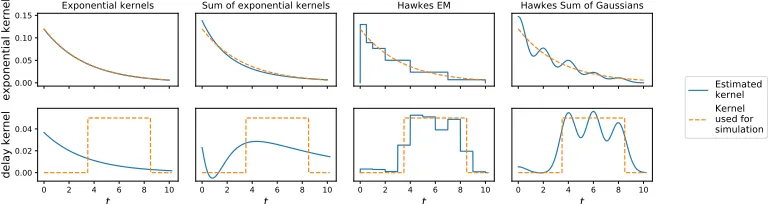
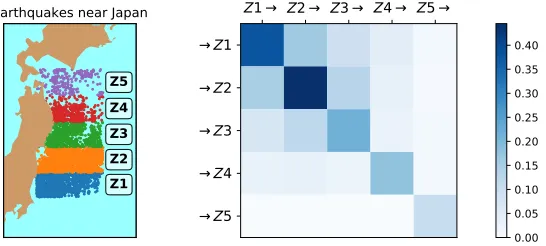
algorithms that are listed in Table 2 as well as simulation tools for many kernel types as shown in Figure 5 of the supplementary material. This diversity of algorithms is illustrated in Figure 1 in which we show how two kernels of different shapes are estimated by four different algorithms. A first use case for modeling high-frequency financial data is given in Figure 2 (with the associated Python code), while a second use-case about propagation analysis of earthquake aftershocks can be found in Figure 3.
1.http://contrib.scikit-learn.org/lightning 2.https://github.com/slinderman/pyhawkes
3.https://cran.r-project.org/web/packages/hawkes/hawkes.pdf 4.https://github.com/dunan/MultiVariatePointProcess
tick: a Python Library for Statistical Learning
Model Proximal operator Solver
Linear regression SLOPE Gradient Descent
Logistic regression L1 (Lasso) Stochastic Variance Reduced Gradient Poisson regression Total Variation Stochastic Gradient Descent
Cox regression Group L1 Accelerated Gradient Descent Hawkes with exp. kernels L2 (Ridge) Stochastic Dual Coordinate Ascent
Table 1: tick allows the user to combine many models, prox and solvers
Non Parametric Parametric
EM (Lewis and Mohler, 2011) Single exponential kernel Basis kernels (Zhou et al., 2013) Sum of exponentials kernels Wiener-Hopf (Bacry and Muzy, 2014) Sum of gaussians kernels (Xu et al., 2016)
NPHC (Achab et al., 2017) ADM4 (Zhou et al., 2013)
Table 2: Models and estimation techniques for Hawkes processes available in tick
5. Benchmarks
In Figure 4, we benchmark computational times for both simulation and estimation of
Hawkes processes (with exponential kernels) using hawkes R (where only simulation is
available),PtPackandtickon respectively 2, 4 and 16 cores. The model fits in plots “Fit” and “Multicore fit” are compared on simulated 16-dimensional Hawkes processes, with an increasing number of events: small=5×10⁴, medium=2×10⁵, large=106, xlarge= 5×10⁷, while 200, 400 and 750 dimensional Hawkes processes are fitted in plot “High-dimensional
fitting”. We observe thattickoutperforms by several orders of magnitudes bothhawkesR
andPtPack, in particular for large datasets. Benchmarks againstscikit-learnfor logistic regression are also provided in Figure 6 from the supplementary material.
Acknowledgments
The authors thank the Data-science Initiative of ´Ecole polytechnique and IntelR
for
sup-porting tick development
0.00 0.05 0.10 0.15
exponential kernel
Exponential kernels Sum of exponential kernels Hawkes EM Hawkes Sum of Gaussians
0 2 4 6 8 10 t 0.00
0.02 0.04
delay kernel
0 2 4 6 8 10
t 0 2 4 t 6 8 10 0 2 4 t6 8 10
Estimated kernel Kernel used for simulation
timestamps_list = fetch_hawkes_bund_data()
hawkes_learner= HawkesConditionalLaw(
claw_method="log", quad_method="log", n_quad=50,
delta_lag=0.1, min_lag=5e-4, max_lag=500,
min_support=1e-4, max_support=1, n_threads=4)
hawkes_learner.fit(timestamps_list)
plot_hawkes_kernel_norms(
hawkes_learner, node_names=["P_u", "P_d", "T_a", "T_b"])
Figure 2: Kernel norms of a Hawkes process fitted on high-frequency financial data from the Bund market (Bacry et al., 2016) wherePu (resp. Pd) counts the number of upward (resp. downward)
mid-price moves andTa (resp. Tb) counts the number of market orders at the ask (resp. bid) that
do not move the price.
Figure 3: Modeling of earthquake propagation with Hawkes processes on a dataset from Ogata (1988). The left hand side gives the location of the earthquakes while right hand side illustrates the propagation matrix, namely how likely an earthquake in a given zone will trigger an aftershock in another zone.
Acknowledgments
The authors thank the Data-science Initiative of ´Ecole polytechnique and IntelR
for
sup-portingtickdevelopment.
Figure 4: Computational timings oftick versusPtPackandhawkesR.tickstrongly outperforms both libraries for simulation and fitting (note that the “Fit” graph is in log-scale). “Multicore fit” and “High-dimensional fitting” plots show thattickbenefits from multi-core environments to speed up computations.
Figure 2: Kernel norms of a Hawkes process fitted on high-frequency financial data from the Bund market (Bacry et al., 2016) where Pu (resp. Pd) counts the number of
upward (resp. downward) mid-price moves andTa (resp. Tb) counts the number
of market orders at the ask (resp. bid) that do not move the price.
Figure 3: Modeling of earthquake propagation with Hawkes processes on a dataset from Ogata (1988). The left hand side gives the location of the earthquakes while right hand side illustrates the propagation matrix, namely how likely an earthquake in a given zone will trigger an aftershock in another zone.
medium large Number of simulated events 0.00
0.25 0.50 0.75 1.00
time (s)
Simulation
small medium large Number of events in train set 100
101 102 103
time (s), in log scale
Fit
large xlarge Number of events in train set 0
50 100
time (s)
Multicore fit
200 400 750 Dimension 0
2000 4000 6000 8000
time (s)
High-dimensional fitting
PtPack hawkes R tick (1 core) tick (4 cores) tick (16 cores)
Figure 4: Computational timings of tickversusPtPackandhawkesR.tick strongly
out-performs both libraries for simulation and fitting (note that the “Fit” graph is in log-scale). “Multicore fit” and “High-dimensional fitting” plots show that tick
tick: a Python Library for Statistical Learning
References
M. Achab, E. Bacry, S. Ga¨ıffas, I. Mastromatteo, and J.-F. Muzy. Uncovering causality
from multivariate hawkes integrated cumulants. In International Conference on Machine
Learning, pages 1–10, 2017.
P. K. Andersen, O. Borgan, R. D. Gill, and N. Keiding.Statistical Models based on Counting Processes. Springer Science, 2012.
E. Bacry and J.-F. Muzy. Second order statistics characterization of hawkes processes and non-parametric estimation. arXiv preprint arXiv:1401.0903, 2014.
E. Bacry, I. Mastromatteo, and J.-F. Muzy. Hawkes processes in finance. Market
Mi-crostructure and Liquidity, 1(01):1550005, 2015.
E. Bacry, T. Jaisson, and J.-F. Muzy. Estimation of slowly decreasing hawkes kernels:
application to high-frequency order book dynamics. Quantitative Finance, 16(8):1179–
1201, 2016.
L. Buitinck, G. Louppe, M. Blondel, F. Pedregosa, A. Mueller, O. Grisel, V. Niculae, P. Prettenhofer, A. Gramfort, J. Grobler, R. Layton, J VanderPlas, A. Joly, B. Holt, and G. Varoquaux. API design for machine learning software: experiences from the
scikit-learn project. In ECML PKDD Workshop: Languages for Data Mining and Machine
Learning, pages 108–122, 2013.
R. Johnson and T. Zhang. Accelerating stochastic gradient descent using predictive variance
reduction. In Advances in Neural Information Processing Systems, pages 315–323, 2013.
E. Lewis and G. Mohler. A nonparametric em algorithm for multiscale hawkes processes.
preprint, pages 1–16, 2011.
Y. Ogata. Statistical models for earthquake occurrences and residual analysis for point processes. Journal of the American Statistical Association, 83(401):9–27, 1988.
F. Pedregosa, G. Varoquaux, A. Gramfort, V. Michel, B. Thirion, O. Grisel, M. Blon-del, P. Prettenhofer, R. Weiss, V. Dubourg, J. Vanderplas, A. Passos, D. Cournapeau, M. Brucher, M. Perrot, and E. Duchesnay. Scikit-learn: Machine learning in Python.
Journal of Machine Learning Research, 12:2825–2830, 2011.
S. Shalev-Shwartz and T. Zhang. Stochastic dual coordinate ascent methods for regularized
loss minimization. Journal of Machine Learning Research, 14(Feb):567–599, 2013.
H. Xu, M. Farajtabar, and H. Zha. Learning granger causality for hawkes processes. In
Proceedings of International Conference on Machine Learning, pages 1717–1726, 2016.
K. Zhou, H. Zha, and L. Song. Learning social infectivity in sparse low-rank networks using