184
Insert Title Here
Author
1and Author
21University, 2University
Corresponding email:
Sustainable Economic Development through Service-Learning:
The Revised Theory of Planned Behavior in Predicting Behavioral
Intent to Serve the Community
Vinitha Guptan
1and Shahimi Mohtar
21Taylor’s Business School, Taylor’s University, No. 1, Jalan Taylor’s,
47500 Subang Jaya, Selangor, Malaysia.
2School of Technology Management and Logistics, Universiti Utara Malaysia,
06010 UUM Sintok, Kedah Darul Aman, Malaysia.
Corresponding email: 1[email protected] and 2[email protected]
Article Information
Abstract
Keywords
Service Learning, Sustainable Economic Development, Theory of Planned Behavior, Behavioral Intent
The strive for economic development must focus on community inclusiveness, which must begin with the role education in transforming the mindsets of the youth to take their productive roles in ensuring sustainability. Thus, there is a need to understand what determines the behavioral intent to participate in community service. Based on the extended theory of planned behavior (TPB) and the educational theories of constructivism and social learning, this study develops a research model to identify how curriculum connections and attitude can influence undergraduates’ behavioral intent to serve the community today and in the future, with the hope that they become empowered to take control of their communities and transformatively advance sustainability in their lifetimes. Based on a survey of 256 undergraduates who participated in service learning projects, this study uses structural equation modeling (SEM) approach to investigate the research model. The results indicate that curriculum connections and attitude significantly influenced their behavioral intent to serve the communities in future. Finally, this study discusses the implications of these findings and offer directions for future research.
INTRODUCTION
Policy makers must have a holistic view of how all stakeholders of the economy play their respective roles in achieving sustainable economic development. The strive for economic development must focus on community inclusiveness, which must begin with the role education in transforming the mindsets of the youth to take their productive roles in ensuring sustainability. Starik, Rands, Marcus & Clark (2010) aptly pointed out that “Integrative coursework and beyond-classroom projects that produce real and beneficial results in all these fields (of management and business) need to be developed to empower students to “take over” the instruments of societal power and influence to transformatively advance sustainability in their lifetimes.” (p. 381)
185
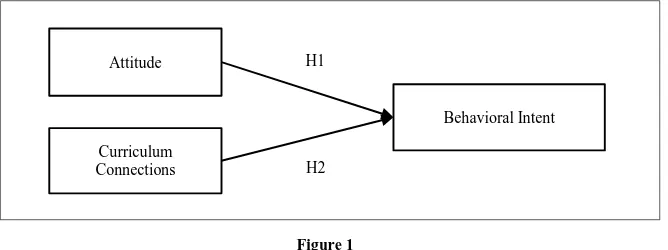
translate into economic development that is more sustainable, as more people gain deeper awareness of their community at large and the need for mindful economic development that advances sustainability. Higher Education Institutions play a pivotal role in community engagement and economic development through the incorporation of community issues into the curriculum delivered, so that undergraduates get hands-on service-learning experience that will develop and enhance their graduate capabilities.This study aims to develop a research model (Figure 1) to reveal the application of the theory of planned behavior model in predicting the intention to serve the community, by examining the curriculum connections and attitude predictors of behavioral intent. A specially designed questionnaire was employed to elicit information pertaining to how integrating service learning into the business curriculum and attitude influenced undergraduates’ behavioral intent to serve the community. Data from 256 valid questionnaires were analyzed using the variance-based Partial Least Squares-Structural Equation Modeling (PLS-SEM) method.
Figure 1 Research Model
LITERATURE REVIEW AND HYPOTHESES
A number of studies on service-learning have mostly focused on the American perspective, while there is a lack of such studies in Malaysia. In Malaysia, the National Higher Education Strategic Plan 2007-2020 (Ministry of Higher Education, 2006) made calls for higher education institutions to have a more focused community orientation via learning and civic action. Malaysia’ sustainable economic growth depends very much on a new vision of higher education that places community orientation at the forefront of every graduate. Taking the cue from the Ministry of Higher Education, and realizing the lack of such studies in Malaysia, this paper is in the right direction. The study adds a fresh perspective to service learning by applying a revised version of the theory of planned behavior (Ajzen, 1991) in examining how behavioral intent is predicted. The Service Learning and Curriculum Framework is utilised to provide the platform for connecting service learning activities within the classroom curriculum. Butin (2010) and Clayton, Bringle, & Hatcher (2013) validate the importance of service-learning as a part of a formal academic curriculum.
Ajzen (1991), in the TPB model posits that attitude, subjective norms and perceptions of behavioral control can generally predict behavioral intentions of individuals. However, this study only looks at the influence of attitude towards behavioral intent, but extends the model to also focus on the influence of curriculum connections on behavioral intent to serve the community. The TPB theory has been applied in many disciplines, but not many service-learning studies have applied the TPB model (Hyde & Knowles, 2013; Greenslade & White, 2005; Warburton & Terry, 2000). This study there develops a research model that uses attitudinal construct of the TPB model within the service-learning and curriculum framework to hypothesize the following:
H1: Attitude is positively associated with Behavioral Intent.
H2: Curriculum Connections is positively associated with Behavioral Intent.
METHODOLOGY
Data and Statistical Analysis
To test the proposed hypotheses, a self-administered questionnaire-based survey of business undergraduate students in a private institution of higher education was utilised to collect data. 300 questionnaires were distributed among the students undertaking service-learning activities in a private institution of higher learning, out of which only 256 valid questionnaires were used in the analysis, a response rate of 85.33%. The questionnaire utilized a 1–6 Likert scale format. To test the hypothesis of this study, Partial Least Squares-Structural Equation Modeling (PLS-SEM) method using SmartPLS 2.0 (Ringle et al., 2005) was employed. The sample size for this study is considered sufficient to achieve the desired statistical power (Hair, Hult, Ringle &
Attitude
Curriculum Connections
Behavioral Intent H1
186
Sarstedt, 2014). In employing PLS algorithm, the path coefficients are estimated and by means of bootstrapping with 1000 samples, the hypotheses are tested.FINDINGS
Validity of the Measures
Structural equation modelling (SEM) was employed in this study to test the hypotheses. Anderson and Gerbing (1988) recommended that the two-stage approach be adopted to perform the SEM analysis: the measurement model stage and the structural model stage. . The measurement model involved specifying the causal relationships between the observed variables and the underlying theoretical constructs. For this purpose, confirmatory factor analysis using SmartPLS 2.0 was performed. As for the structural model stage, the paths or causal relationships between the underlying exogenous and endogenous constructs were specified.
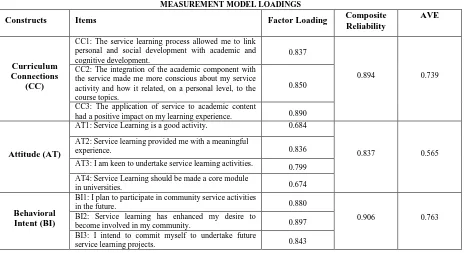
In order to evaluate the convergent validity for all variables, the study tested the overall model specification by examining the Average Variance Extracted (AVE), the composite reliability, the item factor loadings (as suggested by Fornell & Larcker, 1981) and the significance of the outer loadings (Gefen & Straub, 2005). The details of the measurement properties of the model depicting curriculum connections, perceived usefulness and behavioral intent, are reported in Table 1. The results demonstrate strong evidence of convergent validity as the AVE for each construct is greater than 0.5 (Chin, 1998; Fornell & Larker, 1981), the composite reliability for each construct is greater than 0.7, while the loadings of the items on their respective construct is greater than 0.6 (Gefen & Straub, 2005).
Based on the evidence show, it can be concluded that the items of a particular scale do indeed measure the same construct. As per Hair, Black, Babin, & Anderson (2010), there is evidence to support the existence of high internal consistency and reliability of all 3 constructs of curriculum connections, perceived usefulness and behavioral intent, based on their respective composite reliability (0.894, 0.837 and 0.906). The results also confirms the convergent validity of curriculum connections, perceived usefulness and behavioral intent to serve, as shown in the average variance extracted (AVE) scores of 0.739, 0.565 and 0.763 respectively, as per Hair et al. (2010).
TABLE 1
MEASUREMENT MODEL LOADINGS
Constructs Items Factor Loading Composite
Reliability
AVE
Curriculum Connections
(CC)
CC1: The service learning process allowed me to link personal and social development with academic and cognitive development.
0.837
0.894 0.739
CC2: The integration of the academic component with the service made me more conscious about my service activity and how it related, on a personal level, to the course topics.
0.850
CC3: The application of service to academic content
had a positive impact on my learning experience. 0.890
Attitude (AT)
AT1: Service Learning is a good activity. 0.684
0.837 0.565
AT2: Service learning provided me with a meaningful
experience. 0.836
AT3: I am keen to undertake service learning activities.
0.799 AT4: Service Learning should be made a core module
in universities. 0.674
Behavioral Intent (BI)
BI1: I plan to participate in community service activities
in the future. 0.880
0.906 0.763
BI2: Service learning has enhanced my desire to
become involved in my community. 0.897
BI3: I intend to commit myself to undertake future
service learning projects. 0.843
187
constructs, as recommended by Gefen and Straub (2005). Having established the construct validity of the outer model, it is assumed that the obtained results pertaining to the hypotheses testing should be valid and reliable.TABLE 2
DISCRIMINANT VALIDITY
Behavioral Intent Curriculum Connections Attitude
Behavioral Intent 0.873
Curriculum Connections 0.653 0.860
Attitude 0.588 0.653 0.752
Using the PLS bootstrapping technique with 1000 samples to analyse the structural model, Table 3 reveals that both curriculum connections and attitude are significant predictors of behavioral intent. The bootstrap procedure in PLS (Chin, 1998) generated the t-statistics, which reflects significance of the path coefficients in the structural model. Hypothesis 1 is supported as the results show that attitude has a significant positive effect on behavioral intent (standardized estimate = 0.282, p < 0.05). Curriculum connections is also found to have a significant positive effect on behavioral intent (standardized estimate = 0.4687, p < 0.05), hence supporting Hypothesis 1. This indicates that embedding service learning activities into the curriculum provides undergraduates with opportunities to strengthen their competencies, empowering them to take charge of social change in their communities. Their service-learning experience transformed their attitudes and enhanced their behavioral intent to serve the communities and bring about sustainable economic development. The model in this study also demonstrated predictive power (R-square), as curriculum connections and attitude explained 47.2% of the variance in behavioral intent.
TABLE 3 PATH ESTIMATES
Hypotheses Beta S. Error T-Statistic Decision
H1 Attitude -> Behavioral Intent 0.468 0.103 4.543 Supported
H2 Curriculum Connections -> Behavioral Intent 0.282 0.105 2.680 Supported
CONCLUSION
This study had applied a revised version of the theory of planned behavior in predicting intention to serve the community through volunteerism. Based on the data analysis carried out using partial least square (PLS), the results show evidence that attitudes toward service learning and curriculum connections with the community have significantly influenced the behavioral intent of the undergraduates to serve the community in the future. This augurs well with the Malaysian Ministry of Higher Education’s call for universities to not function as ivory towers, but to be committed to the community. Our findings on the influence of curriculum connections and attitude on behavioral intent to serve the community, is in line with the needs of the Malaysian Higher Education Blue-Print (2015) which states that:
Every graduate will have the relevant disciplinary knowledge and skills (ilmu), ethics and morality (akhlak), as well as the appropriate behaviours, mindsets, cultural, and civilisational literacy (beradab) to advance them to a high level of personal well-being. They will be global citizens with a strong Malaysian identity, ready and willing to contribute to the harmony and betterment of the family, society, nation, and global community. Such holistic, entrepreneurial, and balanced graduates are a natural extension of the goal of the Malaysian basic education system to develop values-driven Malaysians. (p.1-15)
188
REFERENCES
Ajzen I. (1991). The theory of planned behaviour. Organizational Behav Human Decision Processes. 50:179– 211.
Anderson, J., & Gerbing, W., (1988). Structural equation modelling in practice: A review and recommended two stage approach. Psychological Bulletin, 27(1), 5-24.
Butin, D. W. (2010). Service-learning in theory and practice: The future of community engagement in higher education. Palgrave Macmillan.
Chin, W. W. (1998). The Partial Least Squares Approach to Structural Equation Modeling. In G.A. Marcoulides,G. A. (ed.). Modern Methods for Business Research. Mahwah (pp. 295-336). NJ: Lawrence Erlbaum Associates, Inc.
Clayton, P. H., Bringle, R. G., & Hatcher, J. A. (Eds.). (2013). Research on Service Learning: Conceptual Frameworks and Assessment (2 vols.). Sterling, VA: Stylus.
Fornell, C., & Larcker, D.F. (1981). Evaluating structural equation models with unobservable variables and measurement error. Journal of Marketing Research, 18(1), 39-50.
Gefen, D., & Straub, D.W. (2005). A Practical Guide to Factorial Validity Using PLS-Graph: Tutorial and Annotated Example. Communications of AIS, 16 (1), 91-109. Gibson, M.; Hauf, P.; Long, B.S. and Sampson, G. (2011). Reflective practice in service-learning: possibilities and limitations. Education & Training 53(4), 284-296.
Greenslade, J. H., & White, K. M. (2005). The prediction of above average participation in volunteerism: A test of the theory of planned behavior and the volunteer functions inventory in older Australian adults. The Journal of Social Psychology, ¡45, 155-172. doi:10.3200/SOCP.145.2.155-172
Hair, J.F., Black, W.C., Babin, B.J., & Anderson, R.E. (2010), Multivariate Data Analysis, Englewood Cliffs, NJ: Prentice Hall.
Hair, J. F., Hult, G. T. M., Ringle, C. M., & Sarstedt, M. (2014). A Primer on Partial Least Squares Structural Equation Modeling (PLS-SEM). Thousand Oaks, CA: Sage.
Hyde, M. K., & Knowles, S. R. (2013). What predicts Australian university students' intentions to volunteer their time for community service? Australian Journal of Psychology, 65(3), 135-145. doi:10.1111/ajpy.12014
Kronick, R.F., & Cunningham, R.B. (2013). Service-learning: Some academic and community recommendations. Journal of Higher Education Outreach and Engagement, 17(3), 139-152.
Malaysia Education Blueprint 2015 - 2025 (Higher Education) Executive Summary (2015). Ministry of Education. [online]. Available at: https://www.um.edu.my/docs/default-source/about-um_document/media-centre/um-magazine/4-executive-summary-pppm-2015-2025.pdf?sfvrsn=4
[Accessed on 10th September 2016].
Pavlova, M. K., & Silbereisen, R. K. (2015). Supportive Social Contexts and Intentions for Civic and Political Participation: An Application of the Theory of Planned Behaviour. Journal of Community & Applied Social Psychology, 25(5), 432-446. doi:10.1002/casp.2223
Ringle, C., Wende, S., & Will, A. (2005). SmartPLS 2.0 (Beta). Hamburg, (www.smartpls.de).
Sandaran, S.C. (2012). Service-learning: Transforming Students, Communities and Universities, The 8th International Language for Specific Purposes (LSP) Seminar - Aligning Theoretical Knowledge with Professional Practice. Procedia - Social and Behavioral Sciences, 66, 380 – 390.
Starik, M., Rands, G., Marcus, A.A., & Clark, T.S. (2010). Guest Editorial: In Search of Sustainability in Management Education. Academy of Management Learning & Education. 9(3), 377-383.