3D Face Recognition system Based on Texture
Gabor Features using PCA and Support
Vector Machine as a Classifier
Rajesh Yadav 1, Dr. Chandra kumarJha 2
Assistant Professor, Department of Computer Science, Gurgaon Institute of Technology &Management, Gurgaon, Haryana, India1
Associate Professor, Department of Computer Science &Engineering, AIM & ACT, Banasthali University, Jaipur, Rajasthan, India2
ABSTRACT: Pioneer 2D face recognition based on intensity or color images encounters many challenges, like variation in illumination, expression, and pose variation. In fact, the human face generates not only 2D texture information but also 3D shape information. In this paper, the main objective is to analyze what contributions depth and intensity with texture information make to the solution of face recognition problem when expression and pose variations are taken into account, and a new proposed system is introduced for combining depth, texture and intensity information in order to improve face recognition performance. In the proposed approach, local features based on Gabor wavelets are extracted from depth, texture and intensity images, which are obtained from 3D data after fine alignment. Then a novel hierarchical selecting scheme embedded in symbolic principal component analysis (Symbolic PCA). Then a Support vector classifier is used for classification of the extracted features. All the Experiments are performed on the Bhosphorus 3D face database, which contain images of faces with various complex variations, including expressions, poses and long time lapses between two scans. The experimental result demonstrates the effectiveness in the performance of the proposed method.
KEYWORDS: 3D face recognition, Radon transform, Symbolic PCA, Gabor Filter, SVM
1. INTRODUCTION
Face recognition is one of the most active research areas in the study of pattern recognition and computer vision. Over the past several decades, much work is focused on two-dimensional images. Due to the complexity of the face recognition, it is still difficult to develop a robust automatic face recognition system. The difficulties mainly include the complex variations in many aspects, such as poses, expressions, illuminations, aging and subordinates, of these problems. The pose variations and illuminations commonly influence the accuracy of 2D face recognition. According to evaluations of commercially available and mature prototyped face recognition systems provided by face recognition vendor tests (FRVT), the recognition results under the unconstrained conditions are not satisfactory.
Face recognition based on 3D information is not a new topic. Studies have been conducted since the end of the last century [1-7]. The representative methods use features extracted from the facial surface to characterize an individual. Lin et al., [8] extracted semi local summation invariant features in a rectangular region surrounding the nose of a 3D facial depth map. Then the similarity between them was computed to determine whether they belonged to the same person. Al-osaimiet al., [9] integrated local and global geometrical cues in a single compact representation for 3D face recognition. In another method, the human face is considered as a 3D surface, and the global difference between two surfaces provides the distinguishability between faces. Brumieret al., [31] constructed some central and lateral profiles to represent an individual and proposed two methods of surface matching and central/lateral profiles to compare two instances. Medioniet al., [32] built a complete and automatic system to perform face authentication by modeling 3D faces using stereo vision and analyzing the distance map between gallery and probe models. Lu et al., [12] used the hybrid iterative closest point (ICP) algorithm to align the reference model with the scanned data and adopted registration errors to distinguish between different faces. Chang et al., [8] divided the whole facial surface into sub regions. The rigid regions around the nose area were matched and combined to perform the recognition. Following the idea of dividing the sub-regions, Faltermoieret al., [6] introduced a system for 3D face recognition based on the fusion of results from a group of regions that had been independently matched. Russ et al., [7] presented an approach enabling a good alignment of 3D face point clouds while preserving face size information. All of these studies illustrated the feasibility of 3D face recognition. However, perhaps due to illumination of data, the above schemes only use the shape features of facial surfaces while ignoring the texture information. Wang et al., [3] described facial feature points by using Gabor filter responses in a 2D domain and point signatures in a 3D domain. Chang et al., [5] evaluated the recognition scheme with different combinations of 2D and 3D information, which showed that the combination of 2D and 3D information was most effective in characterizing an individual face. Cook et al., [34] proposed a new method combining intensity and range images that was insensitive to expression variation based on log gabor templates. Maurer et al., [33] analyzed the performance of the Geometrix Active ID Biometric Identity system, which fused shape and texture information.
The face recognition based on combination of 3D shape information and 2D intensity/color information is a novel approach, which provides an opportunity to improve face recognition performance. In the present paper, the objective is to investigate how depth and intensity information contributes to face recognition when expression and pose variations are taken into account. Further, a robust and accurate face system is designed by selecting and fusing the most effective depth and intensity features. All the processes included in the training and test phases of the proposed approach are fully automated.
II. BOSPHORUS 3D FACE DATABASE
The Bosphorus 3D face database consists of 105 subjects in various poses, expressions and occlusion conditions. The 18 subjects have beard/moustache and the 15 subjects have hair. The majority of the subjects are aged between 25 and 35. There are 60 men and 45 women in total, and most of the subjects are Caucasian. Two types of expressions have been considered in the Bosphorus database. In the first set, the expressions are based on action units. In the second set, facial expressions corresponding to certain emotional expressions are collected. These are: happiness, surprise, fear, sadness, anger and disgust.
III. PROPOSED METHODOLOGY
The proposed methodology employs the following: (i) Radon transform, (ii) Gabor wavelets, (iii) Symbolic PCA (Principal Component Analysis), and (iv) Support Vector Machine as a classifier which are explained in the following sections.
3.1. Radon Transform
The Radon Transform (RT) is a fundamental tool in many areas. The 3D radon Transform is defined using 1D projections of a 3D object f(x,y,z) where these projections are obtained by integrating f(x,y,z) on a plane, whose orientation can be described by a unit vector Geometrically, the continous 3D Radon transform maps a function into the set of its plane integrals in . Given a 3D function and a plane whose representation is given using the normal and the distance s of the plane from the origin, the 3D continuous Radon Transform of for this plane is defined by
Where and Dirac’s delta function defined by
The Radon transform maps the spatial domain (x,y,z) to the domain . The 3D continuous Radon Transform satisfies the 3D Fourier slice theorem.
3.2. 2D Gabor Filter
The 2D Gabor filters of depth and intensity images of faces are used to characterize an individuals’ face. The Gabor wavelets represent the properties of spatial localization, orientation selectivity, spatial frequency selectivity and quadrature phase relationships, and these have been experimentally verified to be a good approximation to the response of cortical neurons. The Gabor wavelet based representation of faces has been successfully tested in 2D face recognition. Such representation of an image describes the facial characteristics of both the spatial frequency and spatial relations. The 2D Gabor wavelets are defined as follows:
Where z = (x, y), and define the orientation and scale of the Gabor wavelets, respectively. The wave vector is defined as follows:
Where and . The constant is the maximum frequency and is the spacing factor between kernels in the frequency domain. The Gabor kernels in the above equation are self-similar, since they can be generated from the mother wavelet by scaling and rotation via the wave vector . More scales or rotations can increase the dependencies of neighbor samples.
represent the facial characteristics in terms of spatial locality and orientation selectivity. The Gabor representation of an image, called the Gabor image, is the convolution of the image with Gabor kernels as defined by Eq(1). For each image pixel, it has two Gabor parts: the real part and imaginary part, which are transformed into two kinds of features: Gabor magnitude features and Gabor phase features. Herein, it is proposed to use the Gabor magnitude features to represent the facial features, since the Gabor transformation strongly responds to edges [19-21].
The depth Gabor images are smoother in comparison with the intensity Gabor images due to the fact that the value of the pixels in the depth image changes less than does the value in the intensity images. The smoother depth Gabor image can reduce the influence of noise, but it cannot describe the facial features in detail. This is why the face recognition is performed by combining depth and intensity information [14-16].
3.3. Principal Component Analysis (PCA)
Consider the 3D face images each of size , from a 3D face image database. Let be the collection of n face images of the database, which are first order objects. Each object is described by a feature vector of length p=NM, where each component is a single valued variable representing the values of the 3D face image . An image set is a collection of 3D face images of m different subjects; each subject has same number of images but with different facial expressions and illuminations. There are m number of second order objects (face classes) denoted by c1, c2, …..cm, each consisting of different individual images
and The feature vector of each face class is described by a vector of p interval variables Y1, Y2,…..Ypand is of length p= NM. The interval variable Yj of face class ci is
declaredby where are minimum and maximum intensity values, respectively, among jthvalues of all the images of face class ci . This interval incorporates information of the variability of jthfeature inside the ithface
class. Let The vector of symbolic variables is recorded for each and can be described by a symbolic data vector which is called as symbolic face :
where (17-18).Let the m symbolic faces be represented m×p by a matrix ;
The symbolic PCA takes as input the matrix containing symbolic faces pertaining to the given set of images[27]. It is proposed to use centers method, which essentially applies the conventional PCA method to the centers of the interval that is
Where j = 1,…., p and I = 1,….m. The m X p data matrix , which contains the centers of the intervals for
msymbolic faces, is given by:
magnitude: . Further, and the corresponding orthonormalized eigenvectors of the covariance matrix Care obtained. The eigenvectors of the symbolic PCA can be obtained as , where is the m x m matrix with column y1, y2,….ymand Vmis the p x m matrix with corresponding eigenvectors
v1,v2,….vm and its columns. The subspace is extracted from the p x m dimensional space by selecting number of
eigenvectors s, which contain maximum variance and are denoted by v1, v2,….vs corresponding to eigenvalues
. The weights for ith symbolic face , I = 1,2, …..,m, are computed as
Where k = 1,2,….,s. The weights of ithsymbolic face form the feature vector of the ithsymbolic face (28, 29). The weights of test image I test are computed by projecting the test image into face subspace of s dimension as :
3.4. SVM and Multi-class SVM classification
The basics of SVMs for binary classification are explained first. Then we discuss how this technique can be further extended to deal problems with general multi-class classification.
Binary Classification
SVMs belong to the class of maximum margin classifiers. They perform pattern recognition between two classes. They find a decision surface that has maximum distance with the closest points in the training set. These are termed as support vectors. We are taking a training set of points € , where each point belongs to one of two classes
identified by the label €{−1,1} .we are assuming linearly separable data1, the goal of maximum margin classification
is to distinguish the two classes by a hyperplane such that the distance to the support vectors is maximized. The hyperplane is known as the optimal separating hyperplane (OSH). The OSH has the form[24]:
( ) = + (8)
The coefficients and b in Eq. (9) are the solutions of a quadratic programming problem . Classification of a new data point is performed by computing the sign of the right side of Eq. (8). In the following we will use[24]
( ) =∑ +
∑ ‖ (9)
to perform multi-class classification. The sign of d is the classification result for x. | |is the distance from to the hyperplane. The farther away a point is from the decision surface, i.e. as the larger | |, the moreconsistent the classification result.
The complete construction can be comprehended to the nonlinear separating surfaces case[24]. Every point in the input space has been mapped to a point =∅( )of a advanced dimensional space which is known as the feature space. It is the feature spacewhere the data are separated by a hyperplane. The main property in this structure is that the mapping ∅(. ) is subject to the condition that the dot product of two points in the characteristic space∅( . )∅( ) can be rewritten as a kernel function ( , ) . The equation for decision surface is given as[24]:
( ) = ( , ) + (10)
There are two basic methods to solve class problems with SVMs. These are:
(2). The machines are trained in the pairwise approach. Every single SVM separates a pair of classes. The pair-wise classifiers are arranged in trees where each SVM is represented by tree node. A bottom-up tree was proposed in [16] for recognition of 3-D objects .It was applied to face recognition in [7]. Recently, a top-down tree structure has been published in [15].
There is no notional analysis for the two strategies with respect to classification performance. With regards to the training effort, the one-vs-all approach is more preferred because only SVMs have to be trained as compared with SVMs in the second approach. The run-time complexity of both the methods is almost alike. Recently, experiments have been performed on person recognition to show similar classification performances for the two methods [13]. Since the number of classes in face recognition can be large enough, we have opted the one-vs-all method instead of pair-wise, because the number of SVMs used is linear with the number of classes.
3.5. Proposed Method
The proposed methodology comprises the following steps:
(i) Radon transform is applied to the input depth and intensity images of a 3D face, which yields binary images that are used to crop the facial areas in the corresponding images.
(ii) Gabor filter are applied to the cropped facial images, which yield Gabor magnitude features as facial feature vectors.
(iii) PCA is applied to the facial Gabor features in order to achieve dimensionality reduction and obtain subsampled feature vectors
(iv) Lastly, SVM multi class function as a classifier is used to perform face recognition based on subsampled feature vectors.
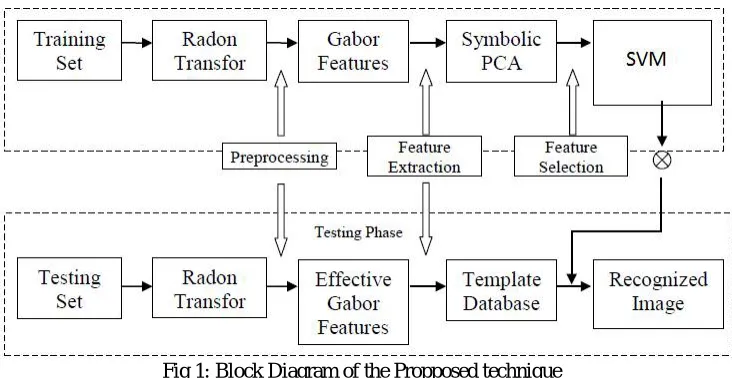
The Figure 1 shows the Block diagram of the proposed framework.
Fig 1: Block Diagram of the Propposed technique
The algorithms of the training phase and the testing phase of the proposed method are given below:
Algorithm 1: Training Phase
1. Input the depth, texture and intensity images of a face from the training set containing M depth imagesand M
intensity images corresponding to M Faces.
3. Superpose the binary images obtained in the Step 2 on the corresponding input images to obtain the cropped facial images.
4. Repeat the Steps 1 to 3 for all the M facial images in the training set and build the set M1 of cropped facial
images
5. Apply Gabor wavelet filter on M1set to extract Gabor magnitude features.
6. Apply Symbolic PCA to subsample the Gabor feature set to reduce the dimensionality of the feature set. Let be the reduced dimensionality of feature set. P
7. Compute the weights w1,w2,….wp for each training image as its facial features
and store these values in the Symbolic PCA feature library of the face database.
8. Training is done using the multi class SVM classifier with proper training data and its corresponding label.
Algorithm 2: Testing Phase
1. Input the depth and intensity images from the probe set containing P images. 2. Apply Radon transform, from 00 to 1800 orientations (in steps of h), to the input images yielding the binary images.
3. Superimpose the binary images on the corresponding input depth and intensity images to obtain the cropped facial images.
4. Apply Gabor wavelet filter on cropped facial images to extract effective Gabor features
5. Compute the symbolic weights , for the extracted Gabor magnitude features by projecting the test image on the Symbolic PCA feature
subspace of dimension p.
6. Apply the svm prediction algorithm with one vs rest logic to identify the said sample belongs to which class.
IV. EXPERIMENTAL RESULTS AND DISCUSSION
As in typical biometric systems, the proposed method includes two phases: the training phase and the testing phase as illustrated in the Figure 1. The proposed method is implemented using Intel Core 2 Quad processor @ 2.66 GHz machine and MATLAB 2013. The 1000 images of Bhosphorus 3D face database which is divided into two subsets, that is the training set, and testing set. The training set contains 700 images. The testing set contains 300 images which are randomly chosen from the set dataset.
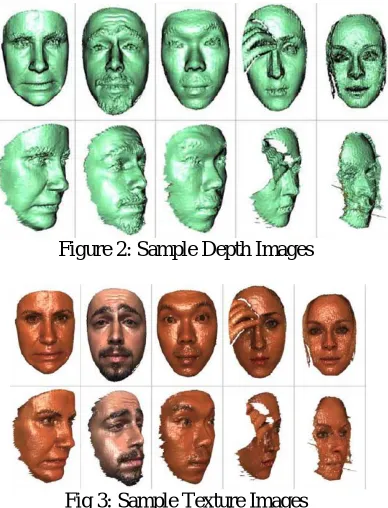
so. The sample training depth images which are used for the experimentation are shown in the Figure 2, and their corresponding texture images are shown in the Figure 3.
Figure 2: Sample Depth Images
Fig 3: Sample Texture Images
To demonstrate the performance of the proposed algorithm, comparison of experimental results that have been reported in recent literature, has been done. The Table 1 shows the performance comparison of the proposed method with other methods.
Table 1. The Performance Comparison of Proposed Method with other Methods
Method Recognition Rate
Proposed Method 98.50% H. usken et al.[19] 97.30% Maurer et al.[20] 95.80% Faltemier et al.[6] 94.90% Kakadiaris et al.[13] 97.00%
IV. CONCLUSION
the classification is also done accurately and fast enough. The recognition accuracy can be further improved by considering a larger training set and a better classifier.
REFERENCES
[1] W. Zhao, R. Chellappa, P. J. Phillips and A. Rosenfeld, “Face recognition: a literature survey”, ACM Computing Surveys (CSUR), Archive, vol. 35, no. 4, (2003), pp. 399-458.
[2] K. Bowyer, K. Chang and P. Flynn, “A survey of approaches and challenges in 3D and multi-modal 3D+2D face recognition”, Computer Vision and Image Understanding, vol. 101, no. 1, (2006), pp. 1-15.
[3] Y. Wang, C. Chua and Y. Ho, “Facial feature detection and face recognition from 2D and 3D images”, Pattern Recognition Letters, vol. 23,
(2002), pp. 1191-1202.
[4] K. I. Chang, K. W. Bowyer and P. J. Flynn, “An evaluation of multi-model 2D+3D biometrics”, IEEE Transactions on Pattern Analysis and Machine Intelligence, vol. 27, no. 4, (2005), pp. 619-624.
[5] K. I. Chang, K. W. Bowyer and P. J. Flynn, “Multiple nose region matching for 3D face recognition under varying facial expression”, IEEE Transactions on Pattern Analysis and Machine Intelligence, vol. 28, no. 10, (2006), pp. 1695-1700.
[6] T. C. Faltemier, K. W. Bowyer and P. J. Flynn, “A region ensemble for 3-D face recognition”, IEEE Transactions on Information Forensics and Security, vol. 3, no. 1, (2008), pp. 62-73.
[7] T. Russ, C. Boehnen and T. Peters, “3D face recognition using 3D alignment for PCA”, Proceedings of the CVPR'06, (2006), pp. 1391-1398. [8] W. Lin, K. Wong, N. Boston and Y. Hu, “Fusion of summation invariants in 3D human face recognition”, Proceedings of the CVPR'06, (2006), pp. 1369-1376.
[9] F. R. Al-Osaimi, M. Bennamouna and A. Miana, “Integration of local and global geometrical cues for 3D face recognition”, Pattern Recognition, vol. 41, no. 3, (2008), pp. 1030-1040.
[10] P. J. Phillips, P. J. Flynn, T. Scruggs and K. W. Bowyer, “Overview of the face recognition grand challenge”, Proceedings of the IEEE Conference on Computer Vision and Pattern Recognition, (2005), pp. 947-954.
[11] F. Tsalakanidou, S. Malassiotis and M. G. Strintzis, “Face localization and authentication using color and depth images”, IEEE Transactions on Image Processing, vol. 14, no. 2, (2005), pp. 152-168.
[12] X. Lu, A. K. Jain and D. Colbry, “Matching 2.5D face scans to 3D models”, IEEE Transactions on Pattern Analysis and Machine Intelligence, vol. 28, no. 1, (2006), pp. 31-43.
[13] I. A. Kakadiaris, G. Passalis, G. Toderici, N. Murtuza, Y. Lu, N. Karampatziakis and T. Theoharis, “3D face recognition in the presence of facial expressions: an annotated deformable model approach”, IEEE Transactions on Pattern Analysis and Machine Intelligence, vol. 29, no. 4, (2007), pp. 640-649.
[14] T. S. Lee, “Image representation using 2D Gabor wavelets”, IEEE Transactions on Pattern Analysis and Machine Intelligence, vol. 18, no. 10,
(1996), pp. 959-971.
[15] C. J. Liu and H. Wechsler, “Gabor feature based classification using the enhanced Fisher linear discriminant model for face recognition”, IEEE Transactions on Image Processing, vol. 11, no. 4, (2002), pp. 467-476.
[16] D. H. Liu, K. M. Lam and L. S. Shen, “Optimal sampling of Gabor features for face recognition”, Pattern Recognition Letters, vol. 25, (2004), pp. 267-276.
[17] M. Turk and A. Pentland, “Eigenfaces for recognition”, Journal of Cognitive Neuroscience, vol. 3, no. 1, (1991), pp. 71-86.
[18] P. N. Belhumur, J. P. Hespanha and D. J. Kriegman, “Eigenfaces vs. Fisherfaces: recognition using class specific linear projection”, IEEE Transactions on Pattern Analysis and Machine Intelligence, vol. 19, no. 7, (1997), pp. 711-0720.
[19] M. H. usken, M. Brauckmann, S. Gehlen and C. Malsburg, “Strategies and benefits of fusion of 2D and 3D face recognition”, IEEE Workshop on Face Recognition Grand Challenge Experiments, (2005), pp. 174-181.
[20] T. Maurer, D. Guigonis, I. Maslov, B. Pesenti, A. Tsaregorodtsev, D. West and G. Medioni, “Performance of geometrixActiveID TM 3D face recognition engine on the FRGC data”, IEEE Workshop on Face Recognition Grand Challenge Experiments, (2005), pp. 154-160.
[21] J. Cook, C. Mccool, V. Chandran and S. Sridharan, “Combined 2D/3D face recognition using log-Gabor templates”, IEEE Conference on Video and Signal Based Surveillance, (2006), pp. 83-90.
[22] S. Gupta, M. K. Markey and A. C. Bovik, “Anthropometric 3D Face Recognition”, International Journal of Computer Vision, vol. 90, no. 3,
(2010), pp. 331-349.
[23] S. Gupta, K. R. Castleman, M. K. Markey and A. C. Bovik, “Texas 3D Face Recognition Database”, IEEE Southwest Symposium on Image Analysis and Interpretation, Austin, TX, (2010) May, pp. 97- 100.
[24] S. Gupta, K. R. Castleman, M. K. Markey and A. C. Bovik, “Texas 3D Face RecognitionDatabase”,
URL:http://live.ece.utexas.Edu/research/texas3dfr/ index.htm.
[25] C. Xu, Y. Wang, T. Tan and L. Quan, “Automatic 3D Face Recognition Combining Global Geometric Features with Local Shape Variation Information”, Proc. The 6th IEEE International Conference on Automatic Face and Gesture Recognition (FG), (CASIA 3D Face Database), (2004), pp. 308-313.
[26] N. Alyüz, B. Gökberk, H. Dibeklioğlu, A. Savran, A. A. Salah, L. Akarun and B. Sankur, “3D Face Recognition Benchmarks on the Bosphorus Database with Focus on Facial Expressions”, The First COST 2101 Workshop on Biometrics and Identity Management (BIOID 2008), Roskilde University, Denmark, (2008) May.
[27] H. H. Bock and E. Diday, “Analysis of Symbolic Data”, Springer Verlag, (2000).
[28] C. N. Lauro and F. Palumbo, “Principal Component Analysis of Interval Data: a Symbolic Data Analysis Approach”, Computational Statistics, vol. 15, no. 1, (2000), pp. 73-87.
[30] Y. Freund and R. E. Schapire, “A Decision-Theoretic Generalization of On-Line Learning and an Application to Boosting”, Journal of Computer and System Sciences, vol. 55, (1997), pp. 119-139.
[31] C. Beumier and M. Acheroy, “Automatic 3D face authentication”, Image and Vision Computing, vol. 18, no. 4, (2000), pp. 315-321. [32] G. Medioni and R. Waupotitsch, “Face modeling and recognition in 3-D”, Proceedings of the AMFG'03, (2003), pp. 232-233.
[33] T. Maurer, D. Guigonis, I. Maslov, B. Pesenti, A. Tsaregorodtsev, D. West and G. Medioni, “Performance of geometrixActiveID TM 3D face recognition engine on the FRGC data”, IEEE Workshop on Face Recognition Grand Challenge Experiments, (2005), pp. 154-160.
[34] J. Cook, C. Mccool, V. Chandran and S. Sridharan, “Combined 2D/3D face recognition using log-Gabor templates”, IEEE Conference on Video and Signal Based Surveillance, (2006), pp. 83-90.