Dr. R. SRIDEVI et al, International Journal of Computer Science and Mobile Applications, Vol.6 Issue. 4, April- 2018, pg. 222-230 ISSN: 2321-8363
UGC Approved Journal Impact Factor: 5.515
Information Security through Compression
and Cryptography Techniques
1. Dr. R. SRIDEVI
Assistant professor in Department of Computer Science PSG College of Arts & Science Coimbatore2. SOWMIYA P R
MPhil Research Scholar Department of Computer Science PSG College of Arts & Science CoimbatoreAbstract - Data security is a type protecting the stored digital information. It also protects data from corruption. It is used in order to escape from the unauthorized users accessing in computers, internet websites as well as in databases of data. cryptography is a method used to encrypt and decrypt the data. A technique encryption (hiding information) data will be encoded which is used to provide secure data to prevent from fraud user and hackers where decryption is used to convert the encoded data into user readable format. It is also used for storage and transmission compression is a reduction in the number of bits needed to represent data. In this paper cryptography algorithm is user for the purpose of securing the data. It flows from compressing the data first by compression and encryption technique. When these two techniques are done at the same time data can transfer with high speed and takes less time for accessing and also for storage space.
Keywords: Cryptography, Compression, Run length, Huffman, LZW, Arithmetic coding, RC4, Caesar Cipher, AES.
1. INTRODUCTION
Dr. R. SRIDEVI et al, International Journal of Computer Science and Mobile Applications, Vol.6 Issue. 4, April- 2018, pg. 222-230 ISSN: 2321-8363
UGC Approved Journal Impact Factor: 5.515
1.1 CRYPTOGRAPHY
Cryptography is a method of storing and transmitting data in a particular form so that only those for whom it is intended can read and process it .It is the art of protecting information by transforming it (encrypting it) into an unreadable format, called cipher text. Only those who possess a secret key can decipher (or decrypt) the message into plain text. Cryptography not only protects data from theft or alteration, but can also be used for user authentication.
Encryption key decryption key
Encryption decryption
1.2 DATA COMPRESSION
A common data compression technique removes and replaces repetitive data elements and symbols to reduce the data size. Data compression for graphical data can be lossless compression or lossy compression, where the former saves all replaces but save all repetitive data and the latter deletes all repetitive data. In this uncommon information is not vague to compacted information that recommends there is some calamity e.g. Piece Truncation Coding, Transform Coding, etc Lossless Compression utilized for pack any printed information. In this uncommon information and pounded information are measure up to that finds there is no incident e.g. Run Length Coding, Huffman Coding, LZW, Arithmetic Coding.
Dr. R. SRIDEVI et al, International Journal of Computer Science and Mobile Applications, Vol.6 Issue. 4, April- 2018, pg. 222-230 ISSN: 2321-8363
UGC Approved Journal Impact Factor: 5.515
2. COMPRESSION METHODOLOGIES
2.1 RLE (run length encoding)
Run length encoding is a very simple form of lossless data compression which runs on sequences having same value occurring many consecutive times and it encode the sequence to store only a single value and its counts. RLE works by reducing the physical size of a repeating string of characters. This repeating string, called a run, is typically encoded into two bytes. The first byte represents the number of characters in the run and is called the run count.
2.2 Huffman coding
Dr. R. SRIDEVI et al, International Journal of Computer Science and Mobile Applications, Vol.6 Issue. 4, April- 2018, pg. 222-230 ISSN: 2321-8363
UGC Approved Journal Impact Factor: 5.515
2.4 Variable length encoding
Variable-length codes can allow sources to be compressed and decompressed with zero error (lossless data compression) and still be read back symbol by symbol. With the right coding strategy an independent and identically-distributed source may be compressed almost arbitrarily close to its entropy. This is in contrast to fixed length coding methods, for which data compression is only possible for large blocks of data, and any compression beyond the logarithm of the total number of possibilities comes with a finite (though perhaps arbitrarily small) probability of failure.
3. CRYPTOGRAPHIC TECHNIQUES
3.1 Rc4(Rivest Cipher 4)
In cryptography, RC4 (Rivest Cipher 4 also known as ARC4 or ARCFOUR meaning Alleged RC4, see below) is a stream cipher. While remarkable for its simplicity and speed in software, multiple vulnerabilities have been discovered in RC4, rendering it insecure. It is especially vulnerable when the beginning of the output keystream is not discarded, or when nonrandom or related keys are used.
3.2 Ceaser cipher
Dr. R. SRIDEVI et al, International Journal of Computer Science and Mobile Applications, Vol.6 Issue. 4, April- 2018, pg. 222-230 ISSN: 2321-8363
UGC Approved Journal Impact Factor: 5.515
3.3 AES
Advanced Encryption Standard (AES) is a cipher, meaning that it is a method or process used to change raw information (usually human readable) into something that cannot be read. This part of the process is known as encryption. The method uses a known, external piece of information, called a key, to uniquely change the data. An example might be your computer login password, or the password to your account on a bank machine. Further, the process is reversible, meaning that it can be applied again to put the information back into its original form. This part is known as decryption.
4. IMPLEMENTATION
Run length encoding
Huffman coding
lzw arithmetic
Rc4 AES
Caeser cipher
Plain text Input data (text file)
compression
Dr. R. SRIDEVI et al, International Journal of Computer Science and Mobile Applications, Vol.6 Issue. 4, April- 2018, pg. 222-230 ISSN: 2321-8363
UGC Approved Journal Impact Factor: 5.515
Mix of pressure and encryption calculations are connected on content record are as per the following:
Four pressure methods which are RLE (Run Length Encoding), Huffman coding, LZW, Arithmetic and three cryptographic methods which are RC4, Caesar Cipher and AES are utilized. To secure the information more we utilize mix of pressure and cryptographic methods on content document.
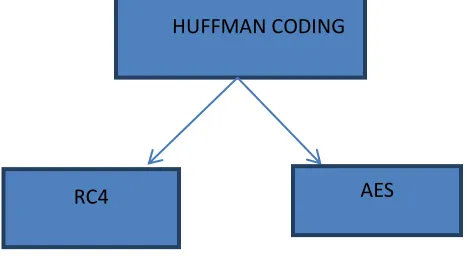
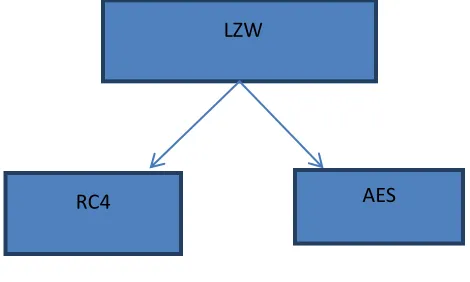
So here the mix which are utilized to secure information are: RLE + (RC4 and Caesar Cipher), Huffman + (RC4 and AES), LZW + (RC4 and AES), Arithmetic + (RC4 and AES) with their comparing document measure, pressure proportion and execution time.
Fig : RLE + (RC4/Caesar Cipher)
Run length encoding with RC4 and Caesar Cipher will apply on five distinctive size of content document and result will be done. This mix is great when two or then again more continuous character will happen in any content document. On the off chance that there are less number of back to back character in any content record at that point result will be bad as near to different methods.
Fig : Huffman + (RC4/AES) RUN LENGTH
RC4 CAESER
CIPHER
HUFFMAN CODING
Dr. R. SRIDEVI et al, International Journal of Computer Science and Mobile Applications, Vol.6 Issue. 4, April- 2018, pg. 222-230 ISSN: 2321-8363
UGC Approved Journal Impact Factor: 5.515
Huffman with RC4 and AES will apply on those five diverse size of content document. This mix is best finished any pressure methods. Their pressure proportion is exceptionally great. In the event that Huffman coding is utilized to pack a record then the document measure is simply half and it regards send the more information on web.
Fig : LZW + (RC4/AES)
LZW and Arithmetic with RC4 and AES will apply on those five diverse size of content document. It pack a record furthermore, give result that is great however not as a decent as Huffman will give. There are minor distinction in values after pressure of both the strategies (Arithmetic and LZW). After pressure, encryption will perform and there isn't to such an extent contrast in values.
In the wake of applying the mix following outcome will be completed. Here we take five distinctive content record which are diverse in measure. After the outcome we examination that higher the record measure better the pressure proportion. After the pressure we perform encryption to give better security. Different blend which are utilized on content record that shows which mix we will use for better security and better pressure proportion.
5. CONCLUSION
LZW
Dr. R. SRIDEVI et al, International Journal of Computer Science and Mobile Applications, Vol.6 Issue. 4, April- 2018, pg. 222-230 ISSN: 2321-8363
UGC Approved Journal Impact Factor: 5.515
REFERENCES:
1. “A Study on Elliptic Curve Cryptography” in International Journal on Research Innovations in Engineering Science and Technology (IJRIEST), (ISSN 2455-8540), Volume 2, Issue 7, July-2017, pp: 546 – 550.
2. T.SubhamastanRao, M.Soujanya, T.Hemalatha, T.Revathi, “Simultaneous data compression and encryption” (IJCSIT) International Journal of Computer Science and Information Technologies, ISSN 0975-9646, Volume2(5), 2011.
3. Senthil Shanmugasundaram, Robert Lourdusamy “A Comparative Study Of Text Compression Algorithms” International Journal of Wisdom Based Computing, Vol. 1 (3), December 2011.
4. “A Survey on Cryptographic Cloud Storage Techniques” in International Journal of Engineering Sciences & Research Technology(IJESRT), ISSN: 2277-9655, July 2017, pp: 602-605.(Impact Factor:4.116)
5. “An Implementation of Hybrid Cryptographic Protocol for Facial Image Security” in International Journal of current research in science and technology (ISSN: 2394-5745), Volume 1 Number 8 (2015).
6. T.D.B Weerasinghe “Analysis of a Modified RC4 Algorithm” International Journal of Computer Applications, ISSN0975 – 8887, Volume 51– No.22, August 2012.
7. “Secured Transmission of Data in cloud Environment Using Elliptic curve Cryptography” in International Journal of Innovative Research in Computer and Communication Engineering (IJRCCE) (ISSN (online): 2320-9801), Vol. 3, Issue 8, August 2015(impact factor: 5.618). 8. “A Secured Asymmetric Cryptosystem for Multi-Biometric Security” in International Journal of Trend in Research and Development (IJTRD) (ISSN (online): 2394-9333), Vol. 2, Issue 5, September-October 2015(impact factor : 0.924).
9. “Protection of Private Data over the Transmission through Electronic Gadgets using RSA Algorithm” in International Journal of Computer Science and Information Security (IJCSIS)(ISSN (online): 1947-5500), Vol. 13, Special Issue , July 2015, pp.40 – 43, (Impact factor:0.74).
Dr. R. SRIDEVI et al, International Journal of Computer Science and Mobile Applications, Vol.6 Issue. 4, April- 2018, pg. 222-230 ISSN: 2321-8363
UGC Approved Journal Impact Factor: 5.515
11. “A Novel Scheme for Remote Data Storage – Dual Encryption” in an International Journal of Research in Information Technology (IJRIT) ISSN: 2001-5569 Volume 2 Issue 4 April 2014.(Impact factor:1.738)
12. “An Approach for Secure Data Storage in Cloud Environment” in an International Journal of Computer and Communication Engineering (ISSN: 2010-3743) as one volume, and indexed by World Cat, Google Scholar, and Engineering & Technology Digital Library, Ulrich's Periodicals Directory.
13. Ms. Ayushi Aggarwal, Anju “Enciphering Data for Larger Files” International Journal of Advanced Research in Computer Science and Software Engineering, ISSN: 2277 128X, Volume 3, Issue 5, May 2013.
14. Ms. Ayushi Aggarwal, Anju “Enciphering Data for Larger Files” International Journal of Advanced Research in Computer Science and Software Engineering, ISSN: 2277 128X, Volume 3, Issue 5, May 2013.