Biogeosciences, 7, 2129–2145, 2010 www.biogeosciences.net/7/2129/2010/ doi:10.5194/bg-7-2129-2010
© Author(s) 2010. CC Attribution 3.0 License.
Biogeosciences
Impacts of exotic mangrove forests and mangrove deforestation on
carbon remineralization and ecosystem functioning in marine
sediments
A. K. Sweetman1,*, J. J. Middelburg2,3, A. M. Berle4, A. F. Bernardino5, C. Schander4, A. W. J. Demopoulos6, and C. R. Smith7
1Norwegian Institute for Water Research (NIVA), Thormøhlensgate 53D, 5006 Bergen, Norway
2Centre for Estuarine and Marine Ecology, Netherlands Institute of Ecology, P.O. Box 140, 4400 AC Yerseke,
The Netherlands
3Faculty of Geosciences, Utrecht University, P.O. Box 80021, 3508 TA Utrecht, The Netherlands 4Department of Biology, University of Bergen, P.O. Box 7800, 5020 Bergen, Norway
5Departamento de Oceanografia e Ecologia, Universidade Federal do Espirito Santo (UFES), Vit´oria, ES, Brazil 6US Geological Survey, Florida Integrated Science Center, FISC-Gainesville, 7920 NW 71st Street, Gainesville,
Florida, 32653, USA
7Department of Oceanography, University of Hawaii at Manoa, 1000 Pope Road, Honolulu, Hawaii, 96822, USA *formerly at: Department of Oceanography, University of Hawaii at Manoa, 1000 Pope Road, Honolulu, HI 96822, USA
Received: 28 March 2010 – Published in Biogeosciences Discuss.: 9 April 2010 Revised: 19 June 2010 – Accepted: 23 June 2010 – Published: 8 July 2010
Abstract. To evaluate how mangrove invasion and re-moval can modify short-term benthic carbon cycling and ecosystem functioning, we used stable-isotopically labeled algae as a deliberate tracer to quantify benthic respiration and C-flow over 48 h through macrofauna and bacteria in sediments collected from (1) an invasive mangrove for-est, (2) deforested mangrove sites 2 and 6 years after re-moval of above-sediment mangrove biomass, and (3) two mangrove-free control sites in the Hawaiian coastal zone. Sediment oxygen consumption (SOC) rates averaged over each 48 h investigation were significantly greater in the man-grove and manman-grove removal site experiments than in con-trols and were significantly correlated with total benthic (macrofauna and bacteria) biomass and sedimentary man-grove biomass (SMB). Bacteria dominated short-term C-processing of added microalgal-C and benthic biomass in sediments from the invasive mangrove forest habitat and in the 6-yr removal site. In contrast, macrofauna were the most important agents in the short-term processing of microalgal-C in sediments from the 2-yr mangrove removal site and con-trol sites. However, mean faunal abundance and C-uptake rates in sediments from both removal sites were significantly
Correspondence to: A. K. Sweetman ([email protected])
higher than in control cores, which collectively suggest that community structure and short-term C-cycling dynamics of sediments in habitats where mangroves have been cleared can remain fundamentally different from un-invaded mudflat sediments for at least 6-yrs following above-sediment man-grove removal. In summary, invasion by manman-groves can lead to dramatic shifts in benthic ecosystem function, with sed-iment metabolism, benthic community structure and short-term C-remineralization dynamics being affected for years following invader removal.
1 Introduction
2130 A. K. Sweetman et al.: Ecosystem functioning in exotic and deforested mangrove sediments (Manson et al., 2005), and as nesting habitats for a variety of
birds (Nagelkerken et al., 2008). Mangroves also act as ma-jor ecosystem engineers by reducing water flow and trapping sediments, which can lead to enhanced densities of deposit feeding fauna (Demopoulos, 2004; Demopoulos and Smith, 2010), as well as limiting coastal erosion, and providing a buffer to tropical storms and tsunamis (Environmental Jus-tice Foundation report 2006). They also effectively sequester nutrients (Middelburg et al., 1996; Bouillon et al., 2008), and may enhance water quality in surrounding habitats by reduc-ing eutrophication and turbidity (Valiela and Cole, 2002; Vic-tor et al., 2004).
Despite suitable seawater temperatures (>20◦C), the ge-ographic isolation of the Hawaiian Archipelago excluded mangroves from the Hawaiian Islands until 1902, when the red mangrove, Rhizophora mangle, was introduced from Florida to Moloka’i to stabilize coastal erosion from pastures and sugarcane fields (Chimner et al., 2006). Mangroves have now invaded large portions of the intertidal and high subtidal zone along the island of O’ahu, and in 2001, the total area of mangroves on O’ahu was 1500 km2(Chimner et al., 2006).
Recent studies have examined the effects of marine vas-cular plant invasions on coastal habitats, in partivas-cular in salt-marshes (Talley and Levin 1999, Levin et al., 2006). It is now known that invasive marine vascular plants can cause local species extinctions (Grosholz, 2002) and habitat modi-fication (Bromberg-Gedan et al., 2009). In Hawaii, the es-tablishment of R. mangle has dramatically altered macro-faunal species and food-web structure, facilitating greater dominance by sub-surface deposit feeders, and creating new niches for other exotic species in mangrove sediments (De-mopoulos, 2004; Demopoulos et al., 2007; Demopoulos and Smith, 2010). However, the impacts of R. mangle invasion on benthic ecosystem functioning, in particular, how mangroves modify sediment metabolism and C-remineralization pro-cesses in the Hawaiian coastal zone, remain essentially unex-plored. Rhizophora mangle detritus is rich in tannins, which can be toxic to benthic detritivores, interfering with digestive enzymes (Mahadevan and Muthukumar, 1980; Neilson et al., 1986; Alongi, 1987; Sessegolo and Lana, 1991). Therefore, we postulate that mangrove invasion will favor microbial C-remineralization processes by limiting macrofaunal con-sumption and assimilation of detrital carbon (Alongi, 1987; Boto et al., 1989; Tietjen and Alongi, 1990; Robertson et al., 1992).
Because invasive species can considerably damage natural and managed ecosystems, strategies have been developed to control, contain and/or eradicate invasive species. However, eradication or removal of invasive species alone may not al-low ecosystems to rapidly or even completely recover orig-inal ecosystem function because invaders can substantially alter physical, chemical and biological conditions (Zavaleta et al., 2001). In Hawaii, the success of R. mangle has created a suite of environmental problems (e.g. clogging of streams and fish ponds, invasion of bird sanctuaries), leading to
nu-merous removal projects in the coastal zone. Typical man-grove clearing practices in Hawaii include the removal of the above-sediment mangrove biomass, but leaving intact the prop roots and the root-fiber mat within the sediment (Sweet-man personal observations). Mangrove roots and fiber-mats are also rich in tannins and bind sediments, which may ham-per faunal movement and impede bioturbation. Few data are available concerning benthic ecosystem functioning in de-forested, native mangrove forests worldwide (Sj¨oling et al., 2005), and we know of no data on the effects of the removal strategy employed in Hawaii on benthic ecosystem function-ing and recovery. However, we postulate that benthic C-cycling processes may be dominated by microbes, and that sediment ecosystem function will be altered, long after man-grove removal if the toxic, nutrient trapping, root-fiber mat is not removed along with the emergent mangrove structures.
In recent years, tracer experiments with stable isotopes have proved extremely powerful in quantifying benthic ecosystem functioning in a variety of marine environments (Middelburg et al., 2000; Moodley et al., 2000; Evrard et al., 2005; van Oevelen et al., 2006). In short, an isotopi-cally labeled substrate (e.g.13C-labeled algae) is deposited over an enclosed area of seafloor and the uptake of labeled elements tracked into sediment-dwelling organisms and abi-otic components (e.g. dissolved inorganic carbon), making it possible to quantify the uptake of specific elements into specific organisms and thus, identify the pathways through which certain elements cycle. In this case-study, we used stable-isotopically labeled algae as a deliberate tracer as one means to explore benthic ecosystem functioning in sediments from (1) an invasive mangrove forest, (2) mangrove removal sites 2- and 6-yrs after removal of above-sediment mangrove biomass, and (3) two mangrove-free control sites. We eval-uated the effects of intact mangroves, as well as sediment root-fiber complexes remaining after mangrove removal, on respiration and C-flow though the sediment-dwelling macro-fauna and bacteria. Because of the relatively short duration of each experiment (48 h) and the addition of algal-C to the sediment surface, our experiments primarily addressed near-surface processes, and tested the following hypotheses: (1) Biogeochemical cycling in mangrove sediments favors bac-terial pathways, yielding lower macrofaunal uptake of labile organic matter than in adjacent mudflats. (2) Due to the persistence of a dense root-fiber mat, bacterial metabolism is enhanced, and macrofaunal uptake of newly added la-bile organic matter reduced, in sediments for years following above-sediment mangrove removal.
2 Methods
2.1 Study sites
A. K. Sweetman et al.: Ecosystem functioning in exotic and deforested mangrove sediments 2131 between January and May of 2008. Three sites were
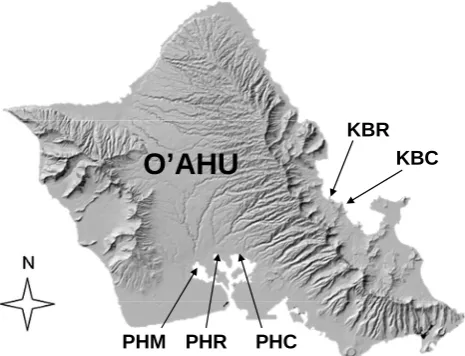
lo-cated in the high subtidal zone of Pearl Harbor (PH) and were all sampled in January 2008 (water temperature:∼23– 27◦C). The mangrove site (PHM) was located 8 m inside a healthy R. mangle mangrove forest in Pouhala Marsh, Pearl Harbor. The 2-yr post-removal site (PHR) was located at the fringe of a former mangrove forest in the Pearl Har-bor National Wildlife Refuge. Most living above-sediment mangrove biomass was removed from the PHR site in 2006. The third Pearl Harbor site was a mangrove-free control site (PHC) located on a mudflat at the southern end of Neal S. Blaisdell Park, approximately 60 m away from the nearest mangrove stand. The remaining two sites were located in the Kaneohe Bay (KB) low intertidal zone and were sampled at the beginning of May 2008 (Water temperature: ∼27–28
◦C), with the fourth site located several meters into a former
R. mangle stand (live above sediment mangrove biomass re-moved in 2002) in Kahaluu, Kaneohe Bay (KBR). The fifth site was a mangrove-free, mudflat control site (KBC) located approximately 60 m away from the nearest mangrove stand (Fig. 1). Despite being suitable habitats for mangrove colo-nization, both control sites remained free of mangroves be-cause of active seedling removal programs in the State of Hawaii. Tidal range at all sites was approximately 0.4 m. Because of logistical constraints imposed by the Pearl Har-bor naval base and the laHar-bor-intensive nature of these exper-iments, we were forced to study a single mangrove site in Pearl Harbor. Only single 2-yr and 6-yr removal sites were available on O’ahu, so this investigation constitutes a case study of the various habitat types.
2.2 Experimental design
At each sampling site, four replicate, 15 cm deep sediment cores were collected in 19 cm (i.d.) clear, acrylic benthic chambers at random locations along a 15 m long transect run-ning parallel to the water’s edge, so that substantial habitat heterogeneity along the shoreline was incorporated into the design. Mangrove leaf litter was only found on top of sed-iments from the PHM site and was not removed from sedi-ment cores. Subtidal sedisedi-ments from all Pearl Harbor sites were collected from approximately 15 cm water depth at low tide, and those collected at the PHM site were sampled be-tween prop roots at a distance of approximately 0.5 m from individual emergent roots. Intertidal sediment cores from both Kaneohe Bay sites were collected along a 15 m long transect line at an identical tidal elevation above the low tide mark at low tide. Immediately after collection, all cored sed-iments were covered with 25 cm of top water and transported to Waikiki Aquarium where they were placed in a tempera-ture controlled water bath (24◦C). Sediments were allowed to settle, and conditions in each chamber allowed to equili-brate for 24 h prior to the start of the experiments. Pilot stud-ies revealed that 24 h was sufficient time to allow settlement of sediments re-suspended during chamber transport.
38
922
923
924
925
926
927
928
929
930
931
932
933
934
935
936
937
938
939
Figure 1
940
941
942
943
944
945
946
947
948
KBR KBC PHR PHM PHCO’AHU
KBR KBC PHR PHM PHCO’AHU
Fig. 1. Location of the 5 sampling sites on the island of O’ahu, Hawaii.
A non-axenic clone of the green alga Chlorella spp. (Chlorophyta), initially sampled off the coast of Hawaii, was used as a food source in our experiments. Whilst this la-bile C-source is physically and biochemically distinct from relatively refractory mangrove material, labile algal-C is known to continuously enter and support mangrove ecosys-tems through natural processes including phytodetritus de-position and benthic microalgal production (Bouillon et al., 2008; Oakes et al., 2010). This type of addition is there-fore not entirely artificial and allowed us to realistically trace the fate of labile algal-C in mangrove type environments and therefore, quantify various aspects of ecosystem functioning in the sites studied. Phytoplankton was cultured for 3 weeks at 24◦C under a 16: 8 h light: dark cycle in artificial sea-water modified with F/2 algal culture medium (Grasshoff et al., 1999), and labeled by replacing 25% of 12C bicarbon-ate in the culture medium with NaH13CO3. For harvest,
in-ocula were concentrated by centrifugation (404×g, 5 min), washed 5 times in a isotonic solution to remove excess la-beled bicarbonate, and freeze dried. Algae samples pos-sessed a13C-content,δ13C-signature, and molar C:N ratio of 23.40±0.20 atom % (SE,n=4), 26 330±303‰ (SE,n=4) and 6.45±0.20 (SE,n=4), respectively.
To start the experiments,13C-labeled Chlorella spp. were injected into three of the four chambers (T =0 h) and stir-rers mounted 5 cm beneath the chamber lids were activated to homogeneously distribute the algae over the enclosed sed-iment surface. Approximately 1.8 g algal-C m−2was added
[image:3.595.311.544.64.242.2]2132 A. K. Sweetman et al.: Ecosystem functioning in exotic and deforested mangrove sediments revealed that stirring at 3 rpm maintained a sufficiently thin
diffusive sub-layer (<1 mm) to ensure that O2 flux into the
sediments within each chamber was not diffusion limited. To avoid contaminating the control chamber (used for back-ground isotopic signatures) with labeled algae or labeled dis-solved inorganic carbon (DIC), the control chamber was hy-draulically (but not thermally) isolated from the water bath with an acrylic chamber.
2.3 Chamber sampling
Water samples used to calculate fluxes of oxygen (sediment O2consumption) and DIC were extracted with a 140 ml
sy-ringe from each chamber at 12 h intervals throughout the duration of each 48 h study, through stop-cock valves fixed within the chamber lids. Simultaneously, 140 ml of replace-ment water from a freshly filled, filtered seawater reservoir (maintained at 24◦C) was added to each chamber through a second stop-cock mounted downstream of the extraction valve. Two 60 ml samples of chamber water were imme-diately transferred into gas-tight glass B.O.D. bottles via a 10 cm tube attached to the syringe nozzle, and fixed for dis-solved O2 Winkler analysis. This was followed by a 2 ml
water sample, which was passed through a 0.25 µm sterile, cellulose acetate filter into gas tight 4 ml borosilicate glass vials (Labco, UK) and fixed with 5 µl of 6% HgCl2for total
DIC and13C isotope-ratio mass-spectrometry (IRMS) anal-yses. Reservoir water that was used as a replacement was also sampled and fixed for O2and DIC analyses thereby
al-lowing concentrations and flux rates through time to be cor-rected for dilution effects. After sampling for O2 and DIC
and prior to the start of the next incubation, chamber wa-ters were re-oxygenated. Bubbles were then removed from beneath each chamber lid, lids were replaced, new samples for O2and DIC taken and the incubations continued. Flux
rates of O2 (hence SOC) and rates of DIC efflux were
cal-culated from algae amended chambers from linear changes in the concentration of O2 (down to 150 µmol l−1 or 70%
saturation) and DIC through time. The presented SOC data are mean rates (±1 SE,n=3) calculated from average SOC rates measured from each algae-amended chamber over each 48 h experiment.
At the end of each 48 h experiment, the chambers were removed from the water bath and immediately processed for sedimentary mangrove biomass (SMB), macrofauna and bac-terial phospholipid derived fatty acid (PLFA) analyses. Three 6.5 cm (i.d.) coring tubes were inserted into sediment (one each for SMB, macrofauna and PLFA), removed and the sed-iment core sample sectioned into 0–2 and 2–5 cm sedsed-iment slices using an extruder. Sectioned samples for SMB and PLFA were transferred to 50 ml Corning Vials ® and pre– washed (methanol: dichloromethane in a 1:1 ratio) brown glass bottles, respectively, and frozen at−20◦C until analy-sis. Macrofaunal samples were fixed whole with 4% buffered formaldehyde seawater.
2.4 Analysis
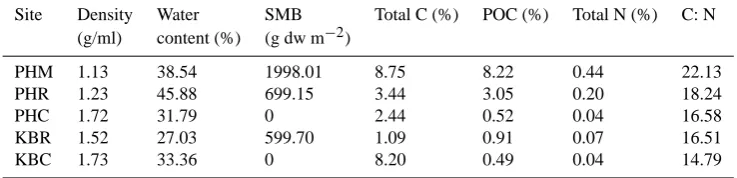
To measure SMB, frozen sediment sub-core samples were thawed, sieved with freshwater on nested 250 µm and 1 mm mesh sieves, the mangrove leaf litter, roots and fibrous ma-terial picked out at 150×magnification under a dissecting microscope and then dried at 35◦C for 4 days. Dried ma-terial was weighed on an electronic balance. As a result of a positive, highly significant correlation between SMB and sediment particulate organic carbon (POC) (r=0.967, P=0.007,n=5) SMB has been used as a readily measured first order proxy for sediment POC content in this study. Sed-iment characteristics from all sites are shown in Table 1.
Frozen sediment samples for bacterial analysis were freeze dried (with no oil used for sealing) and subsequently ground with a mortar and pestle. Stones were removed using a 500 µm mesh sieve, and sediment was ground-up again. Lipids were extracted from approximately 3 g of dried sedi-ment by a Bligh and Dyer extraction procedure (Middelburg et al., 2000), in which the lipids were sequentially isolated by rinsing on a silicic acid column with chloroform, acetone and methanol. The lipid extract was then derivatized to volatile fatty acid methyl esters (FAME) and measured by gas chro-matography isotopic ratio mass spectrometry (GC-IRMS) for PLFA concentration andδ13C-signatures (Middelburg et al., 2000). The C-isotopic ratios were corrected for the one methyl group inserted during derivatization. Bacterial biomass was measured by GC-IRMS, and bacterial biomass was calculated as PLFA (aiC17:0,iC17:0, aiC15:0,iC14:0, 10
Methyl-C16:0, see Boschker and Middelburg 2002)
concen-tration (µmol) ml−1sediment/ (a×b), wherea is the aver-age PLFA concentration in bacteria of 0.056 g C PLFA g−1 biomass (Brinch-Iversen and King, 1990), andbis the aver-age fraction-specific bacterial PLFA encountered in sediment dominated by bacteria (0.18; calculated after Rajendran et al., 1993). The prefixes “i” and “ai” refer to “iso”and “an-tiso”, respectively.
Faunal samples fixed in formaldehyde were gently sieved on a 500 µm mesh sieve in cool, filtered seawater in the lab and macrofauna picked out and identified under a dissect-ing microscope. Organisms were identified to major taxon, with polychaetes and crustaceans identified to the lowest tax-onomic level possible. Separate picking utensils were used for unlabeled and labeled samples to avoid contamination with stable isotopes. Single organisms were washed of at-tached organic debris in cooled, filtered seawater, placed in tin cups and dried at 35–40◦C for 4 days. Calcareous shelled organisms were decalcified in double boated silver caps us-ing the methods of Sweetman et al. (2009). In order to obtain sufficient biomass for isotope measurements, some individ-ual organisms were combined.
A. K. Sweetman et al.: Ecosystem functioning in exotic and deforested mangrove sediments 2133
Table 1. Summary of sediment characteristics (averaged over top 5 cm of sediment) from single un-amended cores collected at all 5 sites. Water content was determined by weight loss upon drying at 60◦C and total C and N were measured by CHN analysis (Middelburg et al., 2000). POC was analyzed by CHN analysis following acidification to remove inorganic C as in Middelburg et al. (2000).
Site Density Water SMB Total C (%) POC (%) Total N (%) C: N (g/ml) content (%) (g dw m−2)
PHM 1.13 38.54 1998.01 8.75 8.22 0.44 22.13
PHR 1.23 45.88 699.15 3.44 3.05 0.20 18.24
PHC 1.72 31.79 0 2.44 0.52 0.04 16.58
KBR 1.52 27.03 599.70 1.09 0.91 0.07 16.51
KBC 1.73 33.36 0 8.20 0.49 0.04 14.79
(15 m×0.53 mm ID, 25◦C, 3 ml min−1)at UC Davis, after acidification with 1 ml of 85% phosphoric acid. The isotopic measurements and biomass of macrofauna organisms were measured using both Europa Integra (enriched isotopes) and Hydra 20/20 (natural isotopes) isotope ratio mass spectrome-ters at UC Davis, USA. The total amount of DI13C produced from the added tracer (mmol13C m−2)was calculated as the
product of excess13C (E) (expressed as atom %13C) and the total DIC concentration, and subsequently converted to mg13C m−2. E is the difference between the labeled frac-tion F of a sample and the background sampled from the un-amended control chamber:
E=Fsample−Fbackground (1)
where
F=13C/(13C+12C)=R/(R+1) (2) and
R=(δ13C/1,000+1)×RVPDB (3)
whereRVPDB=0.0112372.
Uptake of13C after 48 h by macrofauna (mg13C m−2)was calculated as the product of the excess13C and C-content in the animal (expressed as unit weight). If ‘background’ sam-ples of certain taxa were unavailable in the control cham-ber for calculating13C-uptake,Ewas calculated using back-ground F−values from closely related organisms or from fauna within the same feeding guild. Polychaete feeding modes were determined from Fauchald and Jumars (1979). For bacteria, total uptake (mg13C m−2)of13C (U) after 48 h
was calculated according to Moodley et al. (2000) from la-bel incorporation into bacterial fatty acids (aiC17:0, iC17:0,
aiC15:0,iC14:0, 10 Methyl-C16:0, Boschker and Middelburg
2002) as:
Ubact=6bact fatty acids/(a×b) (4)
To calculate the daily production rate of DIC (mg C m−2d−1) from the added tracer, the amount of DI13C produced (mg13C m−2) was divided by 2, and
adjusted to account for the fractional abundance of 13C in the added algae as:
DIC produced d−1=DI13C produced d−1/
fractional abundance of13C in algae (5) DIC produced d−1refers to only the DIC derived from the
added microalgal-C. Total C-uptake per day (mg C m−2d−1) by fauna and bacteria was calculated from faunal and bacte-rial13C-uptake data in the same way. The amount of algal-C added to each experiment contributed only 0.2–2% to the C-standing stock in the top 5 cm of sediment (85–929 g C m−2, based on data in Table 1). Nevertheless, because different amounts of algal-C were added to the KBC study compared to all the other experiments as previously stated, total daily DIC efflux, daily DIC production from added algal-C and C-uptakes rates by fauna and bacteria have been normal-ized by the amount of algal-C added (g C m−2). As such, all DIC production and C-uptake rates are given in units of mg g C m−2d−1.
2.5 Statistics
2134 A. K. Sweetman et al.: Ecosystem functioning in exotic and deforested mangrove sediments
39 949
950
951
952
953
954
955
956
957
958
Figures 2 A to B 959
960
961
962
963
964
965
966
[image:6.595.128.469.63.218.2]967
Fig. 2. Total sedimentary mangrove biomass (A) and vertical distribution of sedimentary mangrove biomass (B) within cores from the PHM, PHR and KBR sites. Bars denote mean±1 SE (n=3), unless otherwise stated.
and bi-variate normality of correlation data and applying a square root transform, if necessary (Zar, 1999). Anα-level of 0.05 was chosen as the criterion for statistical significance. All data was analysed using Sigma-Stat (Version 3.5, Systat) software.
3 Results
3.1 Sedimentary mangrove biomass
Leaf material was only found at the sediment surface in cores collected from the PHM site. SMB was significantly lower (by 60%) in sediment cores from the PHR compared to the PHM site (P =0.003, Fig. 2a). This equates to a SMB loss rate of ∼36% yr−1 assuming that the SMB in the original mangrove stand at the PHR location averaged 3550 g dw m−2 as found by Demopoulos and Smith (2010)
(Fig. 2a). SMB in sediment cores from the KBR site (Fig. 2a) was reduced by approximately 70% after 6-yr (decomposi-tion rate of 12% yr−1)assuming SMB down to 5 cm depth in the original mangrove forest at the KBR site was approx-imately 2000 g dw m−2 as found by Demopoulos (2004). Mean SMB increased with sediment depth in cores from all sites (Fig. 2b). No SMB was found in sediment cores from either the PHC or KBC sampling locations.
3.2 Benthic biotic structure
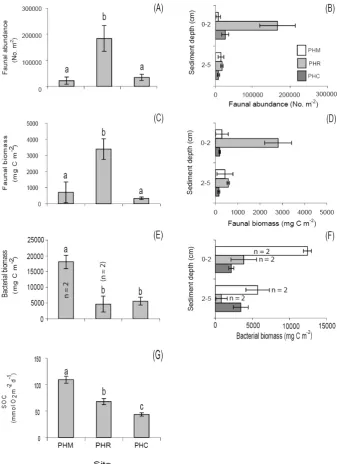
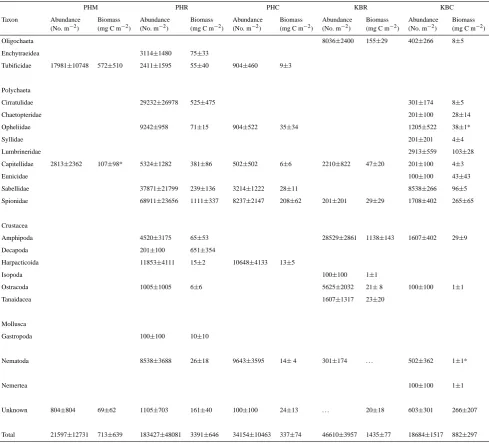
Macrofauna abundance and biomass from Pearl Harbor were significantly different between sites (P =0.014 and P =0.012, respectively), with greater abundance (183 427±48 081 m−2, SE, n=3) and biomass (3391±646 mg C m−2, SE,n=3) in sediment cores from the PHR site compared to the PHM and PHC locations (Figs. 3a and c, Table 2). Mean macrofauna abundance and biomass in sediment collected from the PHR and PHC sites was higher in the top 2 cm of sediment compared to the bottom
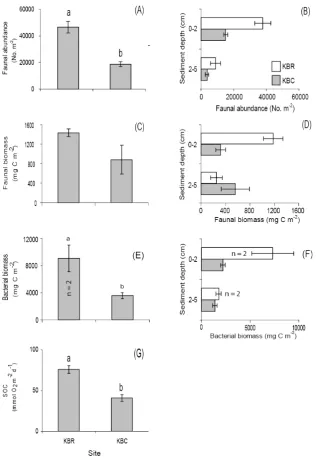
sediment layer (Fig. 3b and d). Bacterial biomass was significantly higher (P =0.010) in sediment cores from the PHM site (18 154±2004 mg C m−2, range,n=2) compared to the other Pearl Harbor locations (Fig. 3e). Mean bacterial biomass was higher in surficial sediments in cores from both the PHM and PHR sites (Fig. 3f). In Kaneohe Bay, faunal abundance estimates were significantly higher (P =0.003, Fig. 4a) in sediments from the KBR (46 610±3957 m−2, SE,
n=3) compared to the KBC site (18 684±1517 m−2, SE,
n=3), but despite higher mean faunal biomass being found in sediment cores from the KBR site (Fig. 4c, Table 2), no significant difference in faunal biomass between the two sites could be detected (P=0.146). Mean faunal abundances in sediments collected from the KBR and KBC sites, as well as mean faunal biomass in cores from the KBR site, decreased with sediment depth (Fig. 4b and d). The same pattern was found for mean bacterial biomass, which was higher in surficial sediments in cores collected from both Kaneohe Bay sites (Fig. 4f). Total bacterial biomass was significantly higher in sediments recovered from the KBR compared to the KBC site (P=0.036, Fig. 4e).
3.3 Macrofauna community structure
A. K. Sweetman et al.: Ecosystem functioning in exotic and deforested mangrove sediments 2135
40 968
969
Figures 3 A to G 970
971
Fig. 3. Total and vertical distribution of macrofauna abundance (A and B, respectively), biomass (C and D, respectively), and bacterial biomass (E and F, respectively) in cores from all Pearl Harbor sites. Sediment oxygen consumption rates in cores from all Pearl Harbor sites is shown in (G). Significant differences (P <0.05) in parameters between sites are designated by different letters. Error bars denote±1 SE (n=3), unlessn=2, where error bars denote±range of two samples because of insufficient sample for PLFA analysis from a 3rd replicate chamber.
terms of abundance (45%) in cores recovered from the KBC site (Table 2). Spionid polychaetes as well as unidentified taxa (i.e. poorly preserved fauna) contributed more to faunal biomass (31% and 30%, respectively) in sediments sampled at the KBC site (Table 2).
3.4 Sediment oxygen consumption (SOC)
[image:7.595.128.470.63.528.2]2136 A. K. Sweetman et al.: Ecosystem functioning in exotic and deforested mangrove sediments
41 972
973
Figures 4 A to G 974
975
Fig. 4. Total and vertical distribution of macrofauna abundance (A and B, respectively), biomass (C and D, respectively), and bacterial biomass (E and F, respectively) in cores from all Kaneohe Bay sites. Sediment oxygen consumption rates in cores from all Kaneohe Bay sites is shown in (G). Significant differences (P <0.05) in parameters between sites are designated by different letters. Error bars denote
±1 SE (n=3) unlessn=2, where error bars denote±range of two samples because of insufficient sample for PLFA analysis from a 3rd replicate chamber.
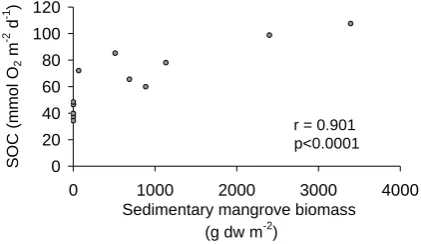
was greater in the KBR experiments compared to the Ka-neohe Bay control (P =0.005, Fig. 4g). SOC was strongly correlated with both total benthic (macrofauna and bacteria) biomass (r=0.876, P =0.0002, n=12, Fig. 5) as well as SMB (r=0.901,P <0.0001,n=13, Fig. 6).
3.5 DIC production and C-uptake from added algae
[image:8.595.140.462.60.520.2]A. K. Sweetman et al.: Ecosystem functioning in exotic and deforested mangrove sediments 2137
Table 2. Mean abundance (Number m−2±1 SE,n=3) and biomass (mg C m−2±1 SE,n=3) estimates of major macrofauna taxa from sediment cores collected from all 5 sites. Star (∗) denotes mean± range of 2 samples when a single replicate sample was lost prior to biomass analysis. Total macrofauna abundance (Number m−2±1 SE,n=3) and biomass (mg C m−2±1 SE,n=3) is also shown.
PHM PHR PHC KBR KBC
Taxon Abundance Biomass Abundance Biomass Abundance Biomass Abundance Biomass Abundance Biomass (No. m−2) (mg C m−2) (No. m−2) (mg C m−2) (No. m−2) (mg C m−2) (No. m−2) (mg C m−2) (No. m−2) (mg C m−2)
Oligochaeta 8036±2400 155±29 402±266 8±5
Enchytraeidea 3114±1480 75±33
Tubificidae 17981±10748 572±510 2411±1595 55±40 904±460 9±3
Polychaeta
Cirratulidae 29232±26978 525±475 301±174 8±5
Chaetopteridae 201±100 28±14
Opheliidae 9242±958 71±15 904±522 35±34 1205±522 38±1*
Syllidae 201±201 4±4
Lumbrineridae 2913±559 103±28
Capitellidae 2813±2362 107±98* 5324±1282 381±86 502±502 6±6 2210±822 47±20 201±100 4±3
Eunicidae 100±100 43±43
Sabellidae 37871±21799 239±136 3214±1222 28±11 8538±266 96±5
Spionidae 68911±23656 1111±337 8237±2147 208±62 201±201 29±29 1708±402 265±65
Crustacea
Amphipoda 4520±3175 65±53 28529±2861 1138±143 1607±402 29±9
Decapoda 201±100 651±354
Harpacticoida 11853±4111 15±2 10648±4133 13±5
Isopoda 100±100 1±1
Ostracoda 1005±1005 6±6 5625±2032 21±8 100±100 1±1
Tanaidacea 1607±1317 23±20
Mollusca
Gastropoda 100±100 10±10
Nematoda 8538±3688 26±18 9643±3595 14±4 301±174 . . . 502±362 1±1*
Nemertea 100±100 1±1
Unknown 804±804 69±62 1105±703 161±40 100±100 24±13 . . . 20±18 603±301 266±207
Total 21597±12731 713±639 183427±48081 3391±646 34154±10463 337±74 46610±3957 1435±77 18684±1517 882±297
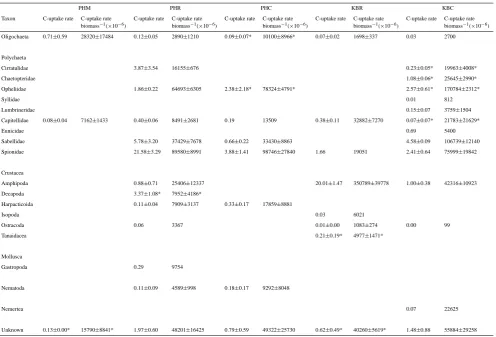
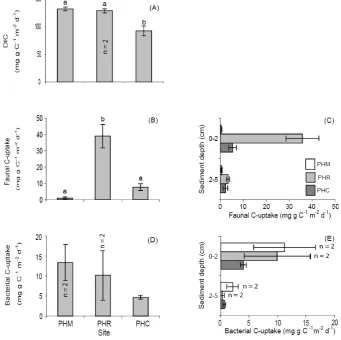
being significantly lower in the PHC experiments compared to the other Pearl Harbor studies (Fig. 7a). No signifi-cant difference in the amount of DIC produced from algal-C could be detected between the KBR and KBalgal-C experiments (P=0.250, Fig. 8a). On average, macrofauna in the PHR and both control site experiments took up approximately 1.6–3.8 times as much algal-C as the bacteria (Table 3). These pat-terns contrasted with the benthic response observed in the PHM and KBR experiments, where mean bacteria C-uptake rates were approximately 15.3 and 1.4 times greater than for the macrofauna, respectively (Table 3). Short-term
2138 A. K. Sweetman et al.: Ecosystem functioning in exotic and deforested mangrove sediments
Table 3. Mean rate (mg g C−1m−2d−1±1 SE,n=3) and percentage (±1SE,n=3) of DIC production, faunal C-uptake and bacterial C-uptake from added algal-C in experiments from all 5 sites. Total amount of C processed d−1(mg g C−1m−2d−1±1 SE,n=3) and the percentage of total added C which was processed is also shown. Numbers in bold denote mean total daily DIC efflux normalized to algal-C (mg g C−1m−2d−1±1 SE,n=3) and were calculated using a molar mass weight for C of 12. Star (∗) denotes mean±range of 2 samples when there was insufficient water or sediment sample for accurate DIC and PLFA measurements from a 3rd replicate chamber.
Site PHM PHR PHC KBR KBC
Rate % Rate % Rate % Rate % Rate %
DIC 130.94±3.17 90.09±2.98* 128.38±3.47* 75.13±5.87* 92.05±8.55 88.37±1.86 127.08±17.85* 70.75±5.84* 147.01±3.36 89.41±1.43 (3149.86±1159.26) (1981.89±496.86)* (2840.77±898.48) (1092.24±674.89)* (1914.99±970.08)
Macrofauna 0.87±0.64 0.83±0.56* 39.05±7.04 19.09±2.64* 7.55±1.89 7.18±1.73 21.58±0.63 11.76±0.75* 12.51±1.32 7.62±0.86
Bacteria 13.34±4.41* 9.08±2.42* 10.20±6.06* 5.78±3.23* 4.64±0.42 4.45±0.14 30.73±7.27* 17.49±5.09* 4.86±1.24 2.96±0.77
Total amount 144.17±10.27* 171.57±8.80* 104.24±9.75 178.77±10.47* 164.37±1.23 processed d−1
% of total amount 14.42±1.03* 17.16±0.88* 10.42±0.97 17.88±1.05* 16.44±0.12 of added C processed
Table 4. Mean C-uptake rate (mg g C−1m−2d−1±1 SE,n=3) and mean C-uptake rate normalized to biomass (mg g C−1m−2d−1mg C biomass−1±1 SE,n=3) of major macrofauna taxa from sediments collected from all 5 sites. Star (∗) denotes mean±range of 2 samples when only 2 replicate chambers contained a specific taxon for C-uptake analysis.
PHM PHR PHC KBR KBC
Taxon C-uptake rate C-uptake rate C-uptake rate C-uptake rate C-uptake rate C-uptake rate C-uptake rate C-uptake rate C-uptake rate C-uptake rate biomass−1(×10−6) biomass−1(×10−6) biomass−1(×10−6) biomass−1(×10−6) biomass−1(×10−6) Oligochaeta 0.71±0.59 28320±17484 0.12±0.05 2890±1210 0.09±0.07* 10100±8966* 0.07±0.02 1698±337 0.03 2700
Polychaeta
Cirratulidae 3.87±3.54 16155±676 0.23±0.05* 19963±4008*
Chaetopteridae 1.08±0.06* 25645±2990*
Opheliidae 1.86±0.22 64693±6305 2.38±2.18* 78324±4791* 2.57±0.61* 170784±2312*
Syllidae 0.01 812
Lumbrineridae 0.15±0.07 3759±1504
Capitellidae 0.08±0.04 7162±1433 0.40±0.06 8491±2681 0.19 13509 0.38±0.11 32882±7270 0.07±0.07* 21783±21629*
Eunicidae 0.69 5400
Sabellidae 5.78±3.20 37429±7678 0.66±0.22 33430±8863 4.58±0.09 106739±12140
Spionidae 21.58±3.29 89580±8991 3.88±1.41 98746±27840 1.66 19051 2.41±0.64 75999±19842
Crustacea
Amphipoda 0.88±0.71 25406±12337 20.01±1.47 350789±39778 1.00±0.38 42316±10923
Decapoda 3.37±1.08* 7952±4186*
Harpacticoida 0.11±0.04 7909±3137 0.33±0.17 17859±8881
Isopoda 0.03 6021
Ostracoda 0.06 3367 0.01±0.00 1083±274 0.00 99
Tanaidacea 0.21±0.19* 4977±1471*
Mollusca
Gastropoda 0.29 9754
Nematoda 0.11±0.09 4589±998 0.18±0.17 9292±8048
Nemertea 0.07 22625
[image:10.595.51.548.331.668.2]A. K. Sweetman et al.: Ecosystem functioning in exotic and deforested mangrove sediments 2139 more microalgal-C in 48 h than any other taxon found in this
study (Table 4), and together with surface feeding cirratulid and sabellid polychaetes, were responsible for the majority of microalgal-C-uptake after 48 h in sediments from the re-moval and control habitats (Table 4). When C-uptake rates were normalized to biomass, corophiid amphipods were re-sponsible for the highest C-uptake rates measured (Table 4). Interestingly, mean C-uptake rates (normalized to biomass) of spionids and oligochaetes fluctuated as a function of sam-pling site with spionid and oligochaete C-uptake rates being higher in both control experiments relative to the PHR and KBR studies (Table 4). Mean C-uptake rates by sedimen-tary bacteria within both control site experiments were ap-proximately 16–45% of those found in sediments collected from the PHM and both removal habitats (Figs. 7d and 8d, Table 3), yet mean bacterial C-uptake was not significantly different between the Pearl Harbor studies (P=0.286). Bac-terial C-uptake was significantly higher in the KBR versus the KBC experiments (P =0.013, Fig. 8d). Mean bacterial C-uptake decreased with sediment depth in cores in all Pearl Harbor (Fig. 7e) and Kaneohe Bay studies (Fig. 8e).
4 Discussion
Numerous studies have shown that invasive marsh grass and mangroves can modify essential habitat properties (e.g. pore-water salinity, organic C-content, detrital food-supply), ben-thic biodiversity, and trophic structure through alterations in habitat complexity by the production of above and below-ground biomass (Demopoulos, 2004; Neira et al., 2005; Levin et al., 2006; Demopoulos et al., 2007; Demopoulos and Smith, 2010). But to the best of our knowledge, this is the first study to address how an invasive vascular plant can modify sediment metabolism, as well as examine changes to benthic ecosystem processes as a function of the removal of above-sediment invasive mangrove biomass. In the inva-sive mangrove sediments sampled in this case study, macro-fauna biomasses were reduced relative to microbial biomass, the macrofauna community was dominated by sub-surface feeding tubificid oligochaetes, and C-uptake of labile C was dominated by bacteria. Thus, in agreement with our hy-pothesis (1), biogeochemical cycling in the mangrove sed-iments favored bacterial pathways, yielding lower macro-fauna uptake of labile organic matter than in the control ex-periments. Bacterial C-uptake and bacterial biomass were significantly enhanced in sediments from the KBR site com-pared to Kaneohe Bay control, but not in sediments recov-ered from the PHR site (relative to the PHC study). Thus, hypothesis (2) is partially supported. Nonetheless, SMB per-sisted in sediments from mangrove removal sites for at least 6-yrs, and additional ecosystem functioning parameters in both removal site experiments differed significantly from the controls by exhibiting higher SOC rates, higher macrofauna C-uptake rates, and higher macrofauna abundances. There
42 976 977 978 979 980 981 982 983 984 985 0 20 40 60 80 100 120 140
0 5000 10000 15000 20000 25000
Total benthic biomass (mg C m-2)
SOC (
mmo
l O
2
m
-2 d
-1 )
r = 0.876 p = 0.0002
[image:11.595.327.535.67.189.2]986 Figure 5 987 988 989 990 991 992 993 994 995
Fig. 5. Relationship between SOC (mmol O2m−2d−1) and total benthic (macrofauna and bacteria) biomass (mg C m−2).
43 996 997 998 999 1000 1001 1002 1003 1004 1005 0 20 40 60 80 100 120
0 1000 2000 3000 4000 Sedimentary mangrove biomass
(g dw m-2)
SO C ( m m o l O 2 m
-2 d
-1 )
r = 0.901 p<0.0001 1006 Figure 6 1007 1008 1009 1010 1011 1012 1013 1014 1015
Fig. 6. Relationship between SOC (mmol O2m−2d−1) and
sedi-mentary mangrove biomass (g dw m−2).
are limitations associated with this case-study as a result of the short duration of each experiment (i.e. only 48 h) and algal-C only being added to the sediment surface. These limitations therefore only allowed clarification of differences in near-surface processes in the different sediments studied. However, the experiments revealed dramatic differences be-tween mangrove, mangrove removal and control sites in the depth distribution of labeled C-uptake by fauna and bacteria. Therefore, our results collectively show that major aspects of ecosystem function in sediments from an invasive mangrove forest can differ from those in un-invaded habitats, as well as highlight that ecosystem functioning in sediments from mangrove removal sites can differ substantially from those in control sites 2–6 yrs after above-sediment mangrove re-moval.
[image:11.595.322.533.247.369.2]2140 A. K. Sweetman et al.: Ecosystem functioning in exotic and deforested mangrove sediments to 12.25±0.28 (SE,n=3) mmol C m−2d−1in the controls,
based on a molar mass weight for C of 12. Assuming a res-piratory quotient between DIC and O2of 1 (Middelburg et
al., 2005), this transfer of algal-C into daily respired DIC corresponded to approximately 10 to 17% of the SOC (or 4–12% of the mean total daily DIC efflux) in the mangrove and removal site experiments compared to 18 to 30% of the SOC (or 3–8% of the mean total daily DIC efflux) in the PHC and KBC site studies. These results highlight the very labile nature of the added algal-C-source and suggest that the measured SOC and total daily DIC efflux values may be higher than background values without algal addition. Nev-ertheless, SOC rates measured in the PHM experiments were quite similar to those found in previous mangrove studies (Nedwell et al., 1994; Middelburg et al., 1996; Alongi et al., 2000; Alongi, 2009), and overall rates were strongly corre-lated with total benthic (macrofauna and bacteria) biomass, which is consistent with other studies (e.g., Bolam et al., 2002). This strong correlation suggests that the significantly elevated bacterial biomass in sediment cores from the PHM and KBR sites, in addition to the large macrofauna biomasses found in sediments from both removal sites, played a ma-jor role in stimulating sediment O2demand in the mangrove
and removal site experiments. In addition, sediment O2
con-sumption was strongly correlated with SMB. We hypothe-size that the presence of leaf litter and root-fiber material in sediments from the mangrove and removal habitats promoted sediment community metabolism, most likely because the re-lease of DOC and DON from SMB provided microbial sub-strates (Boto et al., 1989; Alongi et al., 1989; Alongi and Sasekumar 1992; Robertson et al., 1992; Alongi, 2009). Be-cause of the high heterogeneity of mangrove habitats (Kris-tensen, 2007), and the fact that sediments were recovered from only a relatively small area at each site (i.e. along a 15 m long transect), we are cautious to generalize the results of our case study to a wide geographic area. However, if the SOC results from this study are representative of other removal sites in Hawaii, the presence of SMB and the apparent en-hancement of SOC in the removal site experiments (relative to the controls) after 6-yrs suggests that restoration of native sediment ecosystem function following mangrove clearing could require many years in Hawaii. Because root-fiber mats in native stands of the mangrove R. mangle in Florida and central America show similar decomposition rates (ranging from∼17 to 60% of biomass lost yr−1[McKee et al., 2007; Poret et al., 2007; Alongi, 2009]) to those estimated here for Hawaii (∼12–36% of biomass lost yr−1), we hypothesize
that sediment ecosystem function may be impacted for years following above-sediment mangrove removal even in native R. mangle stands.
With the exception of mangroves trees, bacteria dominate biomass and are the primary players in terms of energy-flow in native mangrove ecosystems (Alongi, 2002), deriving en-ergy from autochthonous and allochthonous particulate and dissolved organic material (Bouillon et al., 2002), such as
tannins, sugars and ligninocelluloses (Benner and Hodson, 1985; Boto et al., 1989; Alongi et al., 1989; Alongi, 2009). Our findings that the bacteria accounted for approximately 25-fold greater benthic biomass and 15-fold greater short-term C-uptake rates than the macrofauna in sediments from the invasive mangrove habitat are consistent with the bacte-rial dominance documented for sediments within native man-grove forests (e.g. Alongi, 2002, 2008; Kristensen, 2007; Kristensen et al., 2008). The addition of labile algal-C to the sediment surface in each experiment was, in all likeli-hood, one of the main factors driving the high algal-C-uptake rates by bacteria at 0–2 cm in each experiment. In exper-iments using cores collected from the PHM site and from both mangrove removal sites, upward diffusion of DOC from sub-surface root material may have also stimulated bacte-rial growth at the sediment surface (Boto et al., 1989; Kris-tensen and Alongi, 2006), which may have contributed to the elevated bacterial biomasses (and C-uptake rates) in sur-ficial sediment layers in the mangrove and removal site ex-periments (especially the KBR study). The high bacterial biomass and activity in surface sediments of cores from the PHM site may also have been stimulated by the mangrove leaves at the sediment surface, which are known to be capa-ble of hosting abundant bacterial populations (Mfilinge et al., 2003).
A. K. Sweetman et al.: Ecosystem functioning in exotic and deforested mangrove sediments 2141
44 1016
1017
1018
1019
1020
Figures 7 A to E 1021
1022
1023
Fig. 7. Total production of DIC (A) from added algal-C in cores collected from all Pearl Harbor sites. Total and vertical distribution of macrofauna C-uptake (B and C, respectively) and bacterial C-uptake (D and E, respectively) in cores from all Pearl Harbor sites are shown. Significant differences (P <0.05) in parameters between sites are designated by different letters. Error bars denote±1 SE (n=3) unless
n=2, where error bars denote±range of two samples because of insufficient sample for analysis from a 3rd replicate chamber.
pattern suggests the presence of intermediate stages of re-colonization and recovery from organic loading in sediments from the PHR site, which are often associated with biomass maxima (e.g., Pearson and Rosenberg, 1978; Hyland et al., 2005). The KBR sediments also showed enhanced macro-fauna abundance, capitellid abundance, SMB, and POC con-centrations relative to control sediments in Kaneohe Bay, suggesting that this community was still at an intermedi-ate stage of recovery 6-yrs after removal of above-sediment mangrove vegetation.
In the present study, macrofauna from the mangrove site were dominated by sub-surface deposit feeding tubifi-cid oligochaetes (Ciutat et al., 2006; Giere, 2006), which agrees with previous mangrove and salt-marsh studies show-ing dominance by tubificids (Schrijvers et al., 1995; Levin et al., 2006). Their dominance in the community may be a func-tion of their ability to cope with hypoxic and sulphidic con-ditions (Giere, 2006). However, the small, slender body size of tubificids may also allow them to easily inhabit the dense,
root fiber network present in mangrove sediments (Levin et al., 1998; Demopoulos, 2004).
Faunal-mediated uptake of added C was significantly lower in sediment cores collected from the PHM site than in the PHR study (Fig. 7b, Table 3), and appeared to be partly attributable to the low (relative to the PHR exper-iments) macrofauna biomasses found in these cores (Bo-lam et al., 2002). However, faunal communities in cores from the PHM site were dominated by sub-surface feed-ing taxa (e.g. oligochaetes and capitellid polychaetes), and more fauna were found deeper in the sediment column (14365±6833 m−2, SE, n=3, see Fig. 3b) compared to
[image:13.595.128.470.72.412.2]2142 A. K. Sweetman et al.: Ecosystem functioning in exotic and deforested mangrove sediments
45 1024
1025
1026
1027
1028
Figures 8 A to E 1029
[image:14.595.127.468.65.413.2]1030
Fig. 8. Total production of DIC (A) from added algal-C in cores collected from all Kaneohe Bay sites. Total and vertical distribution of macrofauna C-uptake (B and C, respectively) and bacterial C-uptake (D and E, respectively) in cores from all Kaneohe Bay sites are shown. Significant differences (P <0.05) in parameters between sites are designated by different letters. Error bars denote±1 SE (n=3) unless
n=2, where error bars denote±range of two samples because of insufficient sample for analysis from a 3rd replicate chamber.
1982; Levin et al., 1997). In the PHR and PHC experiments, no leaf litter occurred atop sediments and a much higher proportion of the macrofauna belonged to surface and sus-pension feeding guilds (e.g. spionids, cirratulids, and sabel-lids, see Table 2). These factors likely explain the signifi-cantly higher C-uptake rates by macrofauna in the mangrove removal and control sediments compared to the mangrove site experiments. Likewise, suspension and surface feed-ing macrofauna (e.g. corophiids, sabellids, see Table 2) were highly abundant and made up a major part of the biomass (e.g. corophiids, spionids, see Table 2) in sediments recov-ered from the Kaneohe Bay sites, and contributed heavily to the large (relative to the PHM study) faunal C-uptake rates measured here (Table 4). In terms of C-uptake rates normal-ized to biomass, the apparent increase in response to labile C by similarly related taxa (e.g. oligochaetes, spionids, see Table 4) in the control studies, relative to the removal sites, may have resulted from lower faunal densities in control sed-iments (see Table 2) stimulating deposit feeding as seen in
previous studies (Miller and Jumars, 1986; Wheatcroft et al., 1998). Altogether, these results suggest that both habitat and macrofauna-community structure may be important in regu-lating the fate of sedimented phytodetritus in invasive man-grove forests and other shallow marine ecosystems along the Hawaiian coastal zone (cf. Josefson et al., 2002; Kamp and Witte, 2005).
A. K. Sweetman et al.: Ecosystem functioning in exotic and deforested mangrove sediments 2143 the higher macrofauna standing stock near the sediment
sur-face, macrofauna likely had the ability to cycle through and process newly deposited organic matter more rapidly in the removal site experiments, than communities residing in sed-iment cores recovered from the control sites, and is possibly the main factor behind the significantly different faunal C-uptake rates measured between the removal site experiments and controls.
Overall, the faunal and bacterial C-uptake results sug-gest that surface-living bacteria rather than deeper-dwelling macrofauna can contribute significantly more to the short-term cycling of labile organic matter, such as phytodetritus (Bouillon et al., 2002, 2004, 2008), in sediments from in-vasive mangrove forests in Hawaii as well as in specific re-moval areas (i.e. the KBR site). The opposite appears to be true for sediments from the Pearl Harbor removal habitat and un-invaded mudflats on O’ahu, where macrofauna ap-peared to be more dominant players in the early diagenesis of microalgal-C. However, our data from the PHR and KBR experiments suggest that mangrove invasion and removal in Hawaii can have a major, lasting effect on benthic biotic structure and C-cycling dynamics, and we hypothesize that in Hawaii, and other areas where native mangrove species ranges are increasing (e.g. the New Zealand coast), ecosys-tem recovery following mangrove removal may involve in-termediate stages in which macrofauna, as well as bacterial standing stocks, and contributions to short-term microalgal-C-cycling are substantially enhanced compared to adjacent un-vegetated mudflats. In order to apply these results to other areas with mangroves in Hawaii, more exhaustive short- and long-term feeding studies using different types of labeled phytoplankton and mangrove detritus (Oakes et al., 2010) must now be undertaken in a diverse range of mangrove habi-tats (i.e. high intertidal to subtidal, areas of extreme vs. little burrowing activity) over a variety of temporal scales to better quantify the variability in C-cycling dynamics in sediments in invasive mangrove forests and deforested habitats.
5 Conclusions
Invasive mangroves in Hawaii can significantly elevate sed-iment O2demand, and elevated SOC rates can persist for at
least 6-yrs after above-sediment mangrove removal. Bacte-rial C-processing can become enhanced, relative to macro-fauna, in near-surface sediments from intact mangrove habi-tats, suggesting that bacteria dominate short-term C-cycling in sediments within invasive mangrove forests in Hawaii. Bacterial dominance of short-term C-cycling in sediments from Hawaiian mangrove forests is similar to early diage-netic processes in native mangrove forests (Alongi, 2002, 2008; Kristensen, 2007; Kristensen et al., 2008). In sedi-ments from the Pearl Harbor mangrove removal area, macro-fauna dominated short-term microalgal-C remineralization, similarly to mangrove-free mudflats. However, key benthic
ecosystem properties in sediments from mangrove removal sites such as macrofauna abundance, bacterial biomass, short-term microalgal-C-uptake by macrofauna and bacteria, and SOC can remain significantly different compared to con-trols for up to 6-yrs following mangrove-tree removal. This case study demonstrates that invasive mangroves can have large and persistent impacts on ecosystem function in the Hawaiian coastal zone, and highlights the need for further work to determine the generality of these findings.
Acknowledgements. We thank Roy Tom and Mike Cole (UH) for
their help in building our benthic chambers and stirring system, and Fabio DeLeo, Pavica Srsen, Elizabeth Galley, and Iris Altimira (UH) for all their help in carrying out experiments. We express deep gratitude to Andy Rossiter and Jerry Crow and others at Waikiki Aquarium for their time and patience while we conducted our experiments in 2008. Thanks to Randy Miyashiro, the US Navy Pacific Fleet and the Pearl Harbor Wildlife Refuge for help with sampling permits and to Dave Karl for use of his titration equipment. We are indebted to Robert Toonen and Ruth Gates at the Hawaii Institute for Marine Biology for use of their laboratory, and David Harris (UC Davis) and Pieter van Rijswijk (Netherlands Institute of Ecology) for help in sample analyses. We would also like to thank Steve Bouillon, Rod Connolly, Erik Kristensen, Mark Huxham, Kylie Pitt and two anonymous reviewers whose comments assisted us in improving the manuscript. This research was funded by a University of Hawaii Sea Grant Project (NOAA Grant #: NA05OAR4171048) to AKS and CRS. Use of trade, product, or firm names does not imply endorsement by the US Government. This is publication no. 7918 from the School of Ocean and Earth Science and Technology, UH.
Edited by: S. Bouillon
References
Alongi, D. M.: The influence of mangrove derived tannins on inter-tidal meiobenthos in tropical estuaries, Oecologia, 71, 537–540, 1987.
Alongi, D. M., Boto, K. G., and Tirendi, F.: Effect of exported man-grove litter on bacterial productivity and dissolved organic car-bon fluxes in adjacent tropical nearshore sediments, Mar. Ecol. Prog. Ser., 56, 133–144, 1989.
Alongi, D. M. and Sasekumar, A.: Benthic communities, in: Tropi-cal mangrove ecosystems, American GeophysiTropi-cal Union, Wash-ington DC, USA, 137–171, 1992.
Alongi, D. M., Tirendi, F., and Clough, B. F.: Below-ground de-composition of organic matter in forests of the mangroves
Rhi-zophora stylosa and Avicennia marina along the arid coast of
Western Australia, Aquat. Bot., 68, 97–122, 2000.
Alongi, D. M.: Present state and future of the world’s mangrove forests, Environ. Conserv., 29, 331–349, 2002.
Alongi, D. M.: Energetics of Mangrove Forests, Springer, New York, USA, 2009.
Benner, R., and Hodson, R. E.: Microbial degradation of the leach-able and lignocellulosic components of leaves and wood from
Rhizophora mangle in a tropical mangrove swamp, Mar. Ecol.
2144 A. K. Sweetman et al.: Ecosystem functioning in exotic and deforested mangrove sediments
Bolam, S. G., Fernandes, T. F., and Huxham, M.: Diversity, biomass and ecosystem processes in the marine benthos, Ecol. Monogr., 72, 599–615, 2002.
Boschker, H. T. S. and Middelburg, J. J.: Stable isotopes and biomarkers in microbial ecology, FEMS. Microbial. Ecol., 40, 85–95, 2002.
Bosire, J. O., Dahdouh-Guebas, F., Kairo, J. G., and Koedam, N.: Colonization of non-planted mangrove species into restored mangrove stands in Gazi Bay, Kenya, Aquat. Bot., 76, 267–279, 2003.
Boto, K. G., Alongi, D. M., and Nott, A. L. J.: Dissolved organic carbon-bacteria interactions at sediment-water interface in a trop-ical mangrove system, Mar. Ecol. Prog. Ser., 51, 243–251, 1989. Bouillon, S., Koedam, N., Raman, A. V., and Dehairs, F.: Primary producers sustaining macro-invertebrate communities in inter-tidal mangrove forests, Oecologia, 130, 441–448, 2002. Bouillon, S., Moens, T., Overmeer, I., Koedam, N., and Dehairs, F.:
Resource utilization patterns of epifauna from mangrove forests with contrasting inputs of local versus imported organic matter, Mar. Ecol. Prog. Ser., 278, 77–88, 2004.
Bouillon, S., Connolly, R. M., and Lee, S. Y.: Organic matter ex-change and cycling in mangrove ecosystems: recent insight from stable isotope studies, J. Sea. Res., 59, 44–58, 2008.
Brinch-Iversen, J., and King, G. M.: Effects of substrate concen-tration, growth state, and oxygen availability on relationships among bacterial carbon, nitrogen and phospholipids phospho-rous content, FEMS. Microbiol. Ecol., 74, 345–356, 1990. Bromberg-Gedan, K., Silliman, B. R., and Bertness, M. D.:
Cen-turies of human-driven change in salt marsh ecosystems, Annu. Rev. Mar. Sci., 1, 117–141, 2009.
Chimner, R. A., Fry, B., Kaneshiro, M. Y., and Cormier, N.: Cur-rent extent and historical expansion of introduced mangroves on O’ahu, Hawaii, Pac. Sci., 60, 377–383, 2006.
Ciutat, A., Weber, O., G´erino, M., and Boudou, A.: Stratigraphic ef-fects of tubificids in freshwater sediments: a kinetic study based on X-ray images and grain size analysis, Acta. Oecol., 30, 228– 237, 2006.
Demopoulos, A. W. J.: Aliens in paradise: a comparative as-sessment of introduced and native mangrove benthic commu-nity composition, food-web structure, and litter-fall production, Ph.D. thesis, University of Hawaii, USA, 252pp., 2004. Demopoulos, A. W. J., Fry, B., and Smith, C. R.: Food-web
struc-ture in exotic and native mangroves: a Hawaii-Puerto Rico com-parison, Oecologia, 153, 675–686, 2007.
Demopoulos, A. W. J. and Smith, C. R.: Invasive mangroves al-ter macrofaunal community structure and facilitate opportunistic exotics, Mar. Ecol. Prog. Ser., 404, 51–67, 2010.
Dobbs, F. C., and Whitlatch, R. B.: Aspects of deposit-feeding by the polychaete Clymenella torquata, Ophelia, 21, 159–166, 1982.
Mangroves: Nature’s defence against Tsunamis – A report on the impact of mangrove loss and shrimp farm development on coastal defences, Env. Just. Foun., London, UK, 30pp., 2006. Evrard, V., Kiswara, W., Bouma, T. J., and Middelburg, J. J.:
Nu-trient dynamics of seagrass ecosystems: 15N evidence for the importance of particulate organic matter and root systems, Mar. Ecol. Prog. Ser., 295, 49–55, 2005.
Fauchald, K. and Jumars., P. A.: The diet of worms: A study of polychaete feeding guilds, Oceanogr. Mar. Biol. Ann. Rev., 17,
193–284, 1979.
Giere, O.: Ecology and biology of marine oligochaeta – an inven-tory rather than another review, Hydrobiologia, 564, 103–116, 2006.
Grasholz, E.: Ecological and evolutionary consequences of coastal invasions, Trends. Ecol. Evol., 17, 22–27, 2002.
Grasshoff, K., Kremling, K., and Ehrhardt, M.: Methods of seawa-ter analysis. Wiley, Hoboken, New Jersey, USA, 1999.
Harley, C. D. G., Randall Hughes, A., Hultgren, K. M., Miner, B. G., Sorte, C. J. B., Thornber, C. S., Rodriguez, L. F., Tomanek, L., and Williams, S. L.: The impacts of climate change in coastal marine systems, Ecol. Lett., 9, 228–441, 2006.
Hyland, J., Balthis, L., Karakassis, I., Magni, P., Petrov, A., Shine, J., Vestergaard, O., and Warwick, R.: Organic carbon content of sediments as an indicator of stress in the marine benthos, Mar. Ecol. Prog. Ser., 295, 91–103, 2005.
Josefson, A. B., Forbes, T. L., and Rosenberg, R.: Fate of phytode-tritus in marine sediments: functional importance of macrofauna community, Mar. Ecol. Prog. Ser., 230, 71–85, 2002.
Kamp, A. and Witte, U.: Processing of13C-labeled phytoplankton in a fine-grained sandy-shelf sediment (North Sea): relative im-portance of different macrofauna species, Mar. Ecol. Prog. Ser., 297, 61–70, 2005.
Kristensen, E. and Alongi, D. M.: Control by fiddler crabs (Uca
vocans) and plant roots (Avicennia marina) on carbon, iron,
and sulfur biogeochemistry in mangrove sediment, Limnol. Oceanogr., 51, 1557–1571, 2006.
Kristensen, E.: Carbon balance in mangrove sediments: the driv-ing processes and their controls, in: Greenhouse Gas and Car-bon Balances in Mangrove Coastal Ecosystems, Gendai Tosho, Kanagawa, Japan, 61–78, 2007.
Kristensen, E., Bouillon, S., Dittmar, T., and Marchand, C.: Organic carbon dynamics in mangrove ecosystems: A review, Aquat. Bot., 89, 201–219, 2008.
Levin, L. A., Blair, N., DeMaster, D., Plaia, G., Fornes, W., Martin, C., and Thomas, C.: Rapid subduction of organic matter by mal-danid polychaetes on the North Carolina Slope, J. Mar. Res., 55, 595–611, 1997.
Levin, L. A., Talley, T. S., and Hewitt, J.: Macrobenthos of Spartina
foliosa (Pacific cordgrass) salt marshes in southern California:
community structure and comparison to a Pacific mudflat and a
Spartina alterniflora (Atlantic smooth cordgrass) marsh,
Estuar-ies, 21, 129–144, 1998.
Levin, L. A., Neira, C., and Grosholz, E. D.: Invasive cordgrass modifies wetland ecosystem function, Ecology, 87, 419–432, 2006.
Mahadevan, A. and Muthukumar, G.: Aquatic microbiology with reference to tannin degradation, Hydrobiologia, 72, 73–79, 1980. McKee, K. L., Cahoon, D. R., and Feller, I. C.: Caribbean man-groves adjust to rising sea level through biotic controls on change in soil elevation, Global. Ecol. Biogeog., doi:10.1111/j.1466-8238.2007.00317.x., 2007.
A. K. Sweetman et al.: Ecosystem functioning in exotic and deforested mangrove sediments 2145
M. J., Moens, T., and Heip, C. H. R.: The fate of inter-tidal mi-crophytobenthos carbon: An in situ13C-labeling study, Limnol. Oceanogr., 45, 1224–1234, 2000.
Middelburg, J. J., Duarte, C. M., and Gattuso, J. P.: Respiration in coastal benthic communities, in: Respiration in Aquatic Ecosys-tems, Oxford University Press, Oxford, UK, 206–224, 2005. Miller, D. C. and Jumars, P. A.: Pellet accumulation, sediment
sup-ply and crowding as determinants of surface deposit-feeding rate in Pseudopolydora kempi japonica Imajima and Hartman (Poly-chaeta: Spionidae), J. Exp. Mar. Biol. Ecol., 99, 1–17, 1986. Moodley, L., Boschker, H. T. S., Middelburg, J. J., Pel, R., Herman,
P. M. J., De Deckere, E., and Heip, C. H. R.: Ecological signif-icance of benthic foraminifera: 13C-labeling experiments, Mar. Ecol. Prog. Ser., 202, 289–295, 2000.
Nagelkerken, I., Blaber, S. J. M., Bouillon, S., Green, P., Haywood, M., Kirton, L. G., Meynecke, J. O., Pawlik, J., Penrose, H. M., Sasekumar, A., and Somerfield, P. J.: The habitat function of mangroves for terrestrial and marine fauna: a review, Aquat. Bot. 89., 155–185, 2008.
Nedwell, D. B., Blackburn, T. H., and Wiebe, W. J.: Dynamic nature of the turnover of organic carbon, nitrogen and sulphur in the sediments of a Jamaican mangrove forest, Mar. Ecol. Prog. Ser., 110, 223–231, 1994.
Neilson, M. J., Giddins, R. L., and Richard, G. N.: Effects of tannins on the palatability of mangrove leaves to the tropical sesarminid crab Neosarmatium smithi, Mar. Ecol. Prog. Ser., 34, 185–186, 1986.
Neira, C., Levin, L. A., and Grosholz, E. D.: Benthic macrofauna communities of three sites in San Francisco Bay invaded by hybrid Spartina, with comparison to un-invaded habitats, Mar. Ecol. Prog. Ser., 292, 111–126, 2005.
Nilsson, H. C. and Rosenberg, R.: Benthic habitat quality assess-ment of an oxygen stressed fjord by surface and sediassess-ment profile images, J. Mar. Sys., 11, 249–264, 1997.
Nilsson, H. C. and Rosenberg, R.: Succession in marine benthic habitats and fauna in response to oxygen deficiency: analysed by sediment profile-imaging and by grab samples, Mar. Ecol. Prog. Ser., 197, 139–149, 2000.
Oakes, J. M., Connolly, R. M., and Revill, A. R.: Isotope enrich-ment in mangrove forests separates microphytobenthos and de-tritus as carbon sources for animals, Limnol. Oceanogr., 55, 393– 402, 2010.
Pearson, T. H. and Rosenberg, R.: Macrobenthic succession in rela-tion to organic enrichment and pollurela-tion of the marine environ-ment, Oceanog. Mar. Biol. Annu. Rev., 16, 229–311, 1978. Poret, N., Twilley, R. B., Rivera-Monroy, V. H., and
Coronado-Molina, C.: Below-ground decomposition of mangrove roots in Florida coastal everglades, Estuar. Coasts., 30, 491–496, 2007. Rajendran, N., Suwa, Y., Urushigawa, Y., and Simidu, U.:
Distribu-tion of phospholipid ester-linked fatty acid biomarkers for bac-teria in the sediments of Ise Bay, Japan, Mar. Chem., 42, 39–56, 1993.
Robertson, A. I., Alongi, D. M., and Boto, K. G.: Food chains and carbon fluxes, in: Tropical mangrove ecosystems, American Geophysical Union, Washington DC, USA, 293–326, 1992. Schrijvers, J., Van Gansbeke, D., and Vincx, M.: Macrobenthic
infauna of mangroves and surrounding beaches of Gazi Bay, Kenya, Hydrobiologia, 306, 53–66, 1995.
Sessegolo, G.C. and Lana, P.C.: Decomposition of Rhizophora
mangle, Avicennia schaueriana and Laguncularia racemosa
leaves in a mangrove of Paranagua Bay (southeastern Brazil), Bot. Mar., 34, 285–289, 1991.
Sj¨oing, S., Mohammed, S. H., Lyimo, T. J., and Kyaruzi, J. J.: Ben-thic bacterial diversity and nutrient processes in mangroves: im-pacts of deforestation, Estuar. Coast. Shelf. Sci., 63, 397–406, 2005.
Sweetman, A. K., Sommer, S., Pfannkuche, O., and Witte, U.: Re-tarded response by macrofauna-size foraminifera to phytodetri-tus in a deep Norwegian fjord, J. Foram. Res., 39, 15–22, 2009. Talley, T. S. and Levin, L. A.: Modification of sediments and
macro-fauna by an invasive marsh plant, Biol. Invas., 3, 51–68, 1999. Tietjen, J. H. and Alongi, D. M.: Population growth and effects of
nematodes on nutrient regeneration and bacteria associated with mangrove detritus from northeastern Queensland (Australia), Mar. Ecol. Prog. Ser., 68, 169–179, 1990.
Valiela, I. and Cole, M.L.: Comparative evidence that salt marshes and mangroves may protect seagrass meadows from land-derived nitrogen loads, Ecosystems, 5, 92–102, 2002.
Van Oevelen, D., Moodley, L., Soetaert, K., and Middelburg, J. J.: The trophic significance of bacterial carbon in a marine inter-tidal sediment: Results of an in-situ stable isotope labeling study, Limnol. Oceanogr., 51, 2349–2359, 2006.
Victor, S., Golbuu, Y., Wolanksi, E., and Richmond, R. H.: Fine sediment trapping in two mangrove-fringed estuaries exposed to contrasting land-use intensity, Palau, Micronesia, Wet. Ecol. Manage., 12, 277–283, 2004.
Wardle, D. A., Bardgett, R. D., Klironomos, J. N., Set¨al¨a, H., van der Putten, W. H., and Wall, D. H.: Ecological linkages between above-ground and below-ground biota, Science, 304, 1629–1633, 2004.
Wheatcroft, R. A., Starczak, V. R., and Butman, C. A.: The im-pact of population abundance on the deposit-feeding rate of a cosmopolitan polychaete worm, Limnol. Oceanogr., 43, 1948– 1953, 1998.
Weston, D. P.: Quantitative examination of macrobenthic commu-nity changes along an organic enrichment gradient, Mar. Ecol. Prog. Ser., 61, 233–244, 1990.
Zar, J. H.: Biostatistical Analysis, Prentice Hall, New Jersey, USA, 1999.