M
EMOIRS
OF THE
Q
UEENSLAND
M
USEUM
B
RISBANE© Queensland Museum
PO Box 3300, South Brisbane 4101, Australia Phone 06 7 3840 7555
Fax 06 7 3846 1226 Email [email protected] Website www.qm.qld.gov.au National Library of Australia card number
ISSN 0079-8835
NOTE
Papers published in this volume and in all previous volumes of the Memoirs of the Queensland Museum maybe reproduced for scientific research, individual study or other educational purposes. Properly acknowledged quotations may be made but queries regarding the republication of any papers should be addressed to the Editor in Chief. Copies of the journal can be purchased from the Queensland Museum Shop.
A Guide to Authors is displayed at the Queensland Museum web site
A Queensland Government Project
Couper, P.J., Schneider, C.J., Hoskin, C.J. & Covacevich, J.A. 2000 06 30: Australian leaf-tailed geckos: phylogeny, a new genus, two new species and other new data. Memoirs of the Queensland Museum 45(2): 253-265. Brisbane. ISSN 0079-8835.
Phylogenetic analyses of the leaf-tailed geckos, based on DNA sequences from the mitochondrial cytochrome b gene, show that Saltuarius, as currently constituted, is paraphyletic. Saltuarius cornutus, S. salebrosus, S. wyberba and S. swami form a well-supported monophyletic group which is the sister group to the apparently monophyletic Phyllurus. Saltuarius' occultus is the sister group to the clade containing Phyllurus and all other Saltuarius spp. Thus, Saltuarius' occultus represents a long, independent, evolutionary lineage within the leaf-tailed geckos and is recognised from both morphological and molecular data as distinct at the generic level (Orraya gen. nov.). Orraya gen. nov. can be distinguished from all other Australian padless carphodactylines by a combination of four apomorphies, the most obvious being greatly elongated cervical vertebrae. The phylogenetic analyses also revealed genetically distinct populations from Chaelundi State Forest, New South Wales and Oakview State Forest, southeast Queensland. These specimens are assigned to S. wyberba and P caudiannulatus respectively, pending examination of more material. Description of Phyllurus amnicola sp. nov. and P championae sp. nov. brings to 12 the number of leaf-tailed geckos from eastern Australia. The former, known only from Mt Elliot, NEQ, is separated from its congeners by a combination of characters (large size; very small, spinose body tubercules; a leaf-shaped tail with the anterior-most band broken, but spanning full tail width; and a partially-divided rostral with 5-6 scales along its dorsal margin). Phyllurus championae sp. nov. from only two localities (Cameron Ck and Blue Mtn, MEQ), is the only Phyllurus species with a leaf-shaped tail and a fully divided rostral scale. Large genetic distances between P amnicola sp. nov., P championae sp. nov. and previously recognised Phyllurus spp. further support the recognition of these species. They join a long list of rainforest reptile taxa known from only single localities or very narrow ranges. The distribution of leaf-tails' reflects the preservation of ancient taxa in relictual rainforest and elevated heath fragments in eastern Australia. Despite these narrow ranges, and because all collection localities for leaf-tails are in reserves, for conservation purposes under IUCN definitions, they should be classed 'Data Deficient'. 0 Reptilia, Gekkonidae, Phyllurus spp., Saltuarius spp., Orraya gen. nov.; phylogeny; eastern Australia.
Patrick Couper & Jeanette Covacevich, Queensland Museum, PO Box 3300, South Brisbane 4101, Australia; Christopher J. Schneider, Department of Biology, Boston University, Boston M4 02215, USA; Conrad Hoskin, Department of Zoology & Entomology, University of Queensland, St Lucia 4072, Australia; 7 February 2000.
Australia's rainforests and adjoining moist sclerophyll forests and heaths are well known for their high diversity and for many species con-fined to either single localities, or very narrow ranges. Leaf-tailed geckos from such forests well illustrate these characteristics. For nearly 200 years of discovery and description of Australia's reptiles, only two species of 'leaf-tails',
Phyllurus platurus (Shaw, 1790) and P cornutus
(Ogilby, 1892) = Saltuarius cornutus
(Ogilby,1892), were known. Morphological studies since 1975 have resulted in the recognition of many new species and the genus
Saltuarius Couper, Covacevich & Moritz, 1993
— P caudiannulatus Covacevich, 1975; P isis
Couper, Covacevich & Moritz, 1993; P nepthys
Couper, Covacevich & Moritz, 1993; P ossa
Couper, Covacevich & Moritz, 1993; S. salebrosus (Covacevich, 1975); Saltuarius occultus Couper, Covacevich & Moritz, 1993 and S. swami (Wells & Wellington, 1985). Eight of the 12 presently known species have narrow distributions with four confined to single localities. Molecular analyses, which have both confirmed and refined previous morpho-logically-based taxonomic work on these padless Australian carphodactyline geckos, commenced in the mid-1990s. For the first time, a combination of both methods was used in the description of S. wyberba Couper, Schneider &
100 88 100 81 100 86 100 95 00 59 100
Covacevich, 1997. From joint morphological/molecular com-parisons and field work in previously unexplored rainforests, we can now present a phylogeny (based on DNA sequences from the mitochondrial cytochrome b gene), erect a new genus to accommodate `Saltuarius' occultus and provide substantial new data (including descriptions of two new species) on Phyllurus spp.
METHODS
GENETICS. A 399 base pair fragment of the mitochondrial cytochrome b gene, corresponding to codons 1-133, was amplified and se-quenced from at least two individuals from each species of leaf-tailed gecko (Appendix 1). Protocols for amplifi-cation and sequencing follow those outlined in Couper et al. (1997). Sequences were aligned by eye using the translated amino acid sequences. For phylogenetic analyses, each nucleotide position was treated as a single character with up to four unordered states. The most parsimon-ious tree was found using equal-weights parsimony (all characters equally weighted and unordered), as well as a variety of weighting schemes. Additionally, maximum likelihood analyses, with a variety of models of nucleotide substitution were performed. In all analyses, sequences from Carphodactylus laevis Gtinther, 1897 were used as an outgroup to root the tree. Bootstrap
resampling and parsimony criteria were used to assess support for the recovered phylogeny. PAUP* 4.0b2 (Swofford, 1999) was used for all phylogenetic analyses.
MORPHOMETRICS. All specimens examined are held in the Queensland Museum. Measure-ments were taken using Mitutoyo electronic callipers. Supralabials, infralabials and subdigital lamellae were counted on both sides of specimens examined. External morphological characters follow Covacevich (1975) and Couper et al. (1993). Skeletal definitions follow Bauer (1990). Abbreviations: SVL, snout to vent length; T, tail length, from posterior margin of cloaca to tip of tail; TT, attenuated tip of original tail; HL, head
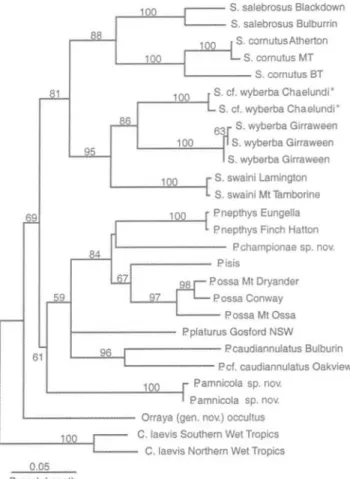
^ S. salebrosus Blackdown ^ S. salebrosus Bulburrin 100 I • cornutusAtherton L S. cornutus MT ^ S. cornutus BT f S. cf. wyberba Chaelundi. L S. cf. wyberba Chaelundr 631, - S. wyberba Girraween S. wyberba Girraween S. wyberba Girraween S. swain i Lamington S. swami Mt Tamborine fi Pnepthys Eungella I- Pnepthys Finch Hatton ^ Pchampionae sp. nov. ^ Pisis 8
r
-- Possa Mt Dryander Possa Conway ^ Possa Mt Ossa Pplaturus Gosford NSW 96 Pcaudiannulatus Bulburin ^ Pcf. caudiannulatus Oakview 100^r
Parnnicola sp. nov. I Pamnicola sp. nov. Orraya (gen. nov.) occultus C. laevis Southern Wet Tropics^
C. laevis Northern Wet Tropics
length; HW, head width; S, snout length; Li, length of front leg, axilla to tip of longest digit; L2, length of hind leg, groin to tip of longest digit; NL, neck length, axilla to posterior margin of ear. PHYLOGENY. The mitochondrial cytochrome b DNA sequence data contained 183 parsimony-informative characters which provided good resolution of the phylogenetic relationships among species of leaf-tailed geckos. One hundred heuristic searches with random taxon addition and all characters unordered and equally weighted resulted in three equally parsimonious trees of 620 steps (C.I = 0.463). The strict consensus of these trees, which differed only in the placement of P platurus, is shown in Fig. 1. Bootstrap support for the clade containing all 69 61 8 67 97 0.05 Branch Length
FIG. 1. Phylogeny of leaf-tailed geckos based on a 399 base pair fragment of MtDNA cytochrome b gene. Sequences from
Carphodactylus laevis were used as an outgroup to root the tree and bootstraps >50% are presented (see Appendix 1 for specimen details). * Possible new species; here referred to Saltuarius cf.
Saltuarius, except `Saltuarius' occultus (here recognised as generically distinct) is relatively high, while support for the monophyly of Phyllurus is somewhat weaker. Phylogenetic analyses and bootstrap resampling with various weighting schemes to account for differences among codon positions in rates of substitution and transition/transversion ratios resulted in the identical topology with similar bootstrap support to the equal weights bootstrap tree. Similarly, maximum likelihood analyses under a wide range of nucleotide substitution models (Jukes-Cantor, HKY85G, General time reversible) resulted in trees that did not differ from the equal weights parsimony tree. Species in the genus Phyllurus, exclusive of P. amnicola, are characterised by a derived karyotype as well as a number of morphological synapomorphies (see Phyllurus spp. nov.). The karyotype ofP amnicola is unknown but morphological synapomorphies are consistent with the DNA sequence data in supporting the inclusion of P amnicola in the genus Phyllurus.
Authorships for three sections of this paper (Orraya gen. nov., Phyllurus amnicola sp. nov. and Phyllurus championae sp. nov.) do not follow that of the paper as a whole.
Orraya gen. nov.
Couper, Covacevich, Schneider & Hoskin (Fig. 2)
Saltuarius occultus Couper, Covacevich Se Moritz, 1993. A parsimony analysis of morphological and karyotypic characters performed by Couper et al. (1993) resulted in the recognition of two mono-phyletic subgroups within the leaf-tailed geckos —Phyllurus Goldfuss, 1820 (P caudiannulatus, P isis, P nepthys, P ossa and P platurus) and Saltuarius Couper, Covacevich & Moritz, 1993 (S. cornutus, S. occultus, S. salebrosus and S. swami). These clades were strongly supported in a bootstrap analysis present in 98% of pseudoreplicates. However, Couper et al. (1993) also observed `... evidence for grouping of S. swami, S. cornutus and S. salebrosus to the exclusion of S. occultus ...' and that Saltuarius occultus has skeletal characters (elongation of the cervical vertebrae and 3 lumbar vertebrae) that are unique amongst its congeners. Derived characters, including elongate cervical vertebrae, along with DNA sequences from the mito-chondrial cytochrome b gene (Fig. 1, Table 1), support the recognition of a new genus to accommodate `Saltuarius' occultus. In our phylogenetic analyses, this taxon is the sister
group to the clade containing Phyllurus spp and Saltuarius spp.
TYPE SPECIES. Orraya occultus (Couper, Covacevich & Moritz, 1993).
ETYMOLOGY `Orraya' is the Morrobalama language word for 'older brother' (Gunnawarra, N. & Kullakulla, M., 1994) refering to the phylogenetic relationship between occu/tus and its Phyllurus and Saltuarius
'siblings'. Peach Ck, the type locality of Orraya occultus
drains the Mcllwraith Ra. the traditional land of the Morrobalama.
DIAGNOSIS. Orraya gen. nov. can be separated easily from all other Australian padless carpho-dactyline genera by the following combined apomorphies: cervical vertebrae greatly elongated; three lumbar vertebrae (defined as non-rib-bearing vertebrae, immediately anterior to sacrum); male preanal organs greatly enlarged; regrown tail with broad, spinose tubercules on margins. A detailed description of Orraya occultus (as Saltuarius occultus) was provided by Couper et al., 1993: 104-106. For details of original tail, see Lethbridge et al., 1994.
Phyllurus spp.
NEW SPECIES. The new species (from Mt Elliot, NEQ and Cameron Ck/Blue Mtn, MEQ) are assigned to Phyllurus by the following synapo-morphies: anterior-most autotomy septum in fifth caudal vertebra; no enlarged postmental scales; tail finely- attenuated and terminating in a small knob; rostral scale partially, or totally divided; males without preanal pores (polarity determined by Bauer, 1990). This assignment is supported further by the following character states (after Couper et al., 1993): nostril not in contact with rostral scale; anterior margin of interclavicle with a distinct process; axilla invaginated; epipubic cartilage small to moderate and original tail simply flared.
Phyllurus amnicola sp. nov. Hoskin, Couper, Schneider & Covacevich
(Fig. 3)
ETYMOLOGY. From the Latin 'dwelling by a river', a reference to the type locality.
MATERIAL. HOLOTYPE: QMJ64408 , Alligator Ck, Mt Elliot, Bowling Green Bay NP (19°28'S, 146°59'E) NEQ, C. Hoskin & J. Gratten, 1 Feb 1998. PARATYPES: QMJ64406-07, J67852 as for holotype.
DIAGNOSIS. P amnicola can be separated from its congeners by the following combined char-acters: large size (maximum SVL >110 mm);
FIG. 2. Orraya occultus (QMJ62596), Peach Ck, McIlwraith Ra., Cape York Peninsula (13°45'S, 143°19'E) NEQ. (Jeff Wright)
spinose body tubercules very small; leaf-shaped tail with anterior-most band broken but spanning full tail width; rostral partially divided with 5-6 scales along its dorsal margin. (Note: SVL includes three specimens measured by one of us (CJH) in the field (26 104mm, 113mm). These measurements have been included in the diagnosis but not in the morphometrics for the species description.) DESCRIPTION. SVL (mm): 90.3-103 (n = 4, mean = 96.5). Proportions as % SVL: Li 43.9-45.1 (n= 4, mean = 44.6); L2 53.8-58.9(n = 4, mean = 56.2); T 86.1 (n = 1); TT 36.9 (n = 1); HL 27.7-29.1 (n = 4, mean = 28.2); HW 20.7-21.4 (n = 4, mean = 21.1); S 12.4-13.2 (n = 4, mean = 12.7); NL 20.7-23.3 (n = 4, mean = 21.6).
Head large, depressed, triangular, distinct from neck; covered in small granules which are intermixed with larger conical tubercles; skin of head not co-ossified with skull; deep, vertical groove partially dividing rostral scale (n = 4); rostral excluded from nostril; 5-6 scales along the dorsal margin of rostra! shield (n = 3); ear opening elliptical, vertical, much less than half as large as eye; supralabials 15-16 (n = 8, mean = 15.5); infralabials 13-15 (n = 8, mean = 13.9). Neck broad. Body depressed, covered in small granules; dorsal granules intermixed with larger conical tubercles; tubercles very small on back, flanks and sides of neck; basal scales surrounding flank tubercules not enlarged; no enlarged tubercules or granules on ventral surface of body. Preanal pores absent. Axilla moderately to deeply invaginated. Limbs long, covered in small pointed tubercles dorsally; lacking enlarged tubercules on ventral surface, except on upper forelimb; digits strong, strongly compressed
distally; subdigital lamellae (fourth toe) 22-25 (n = 8, mean = 20.3). Original tail (n = 1) depressed, flared, contracted at base and attenuated at tip, terminating with a minute rounded knob; dorsal surface of flared portion with prominent enlarged spinose tubercules on basal 1/3rd and along margins; 6 rows of minute spines across basal portion of attenuated tail-tip; attenuated tip accounts for 42.9% of total tail length; ventral surface smooth with a slight depression along midline (excluding attenuated tip). Regenerated tail (n = 3) depressed, broad and strongly flared, contracted at base and attenuated at tip; covered with uniform granules, except on basal margin which has small spinose tubercules; ventral surface without groove along midline.
Pattern. In spirit, dorsal base colour beige with irregular dark brown blotches on head, body and limbs; blotches on body tend to be aligned trans-versely. Limbs banded; digits strongly banded; inner anterior digit with reduced pigment. Body and limbs ventrally off-white to cream (immaculate); labials off-white, mottled with brown. Original tail dorsally tan/grey, marked with irregular dark brown blotches; six cream bands on tail, only those on attenuated portion (4) extending to ventral surface; ventrally cream, peppered with brown specks. Regenerated tail lacking cream bands; dorsally tan/grey, mottled with dark brown blotches; ventral surface similar, but with reduced pigmentation.
Skeletal Features. Material examined: (radio-graphs) QMJ64406-08; (alizarin stained) QMJ67852. Supraocular portion of frontal grooved; anterior process of interclavicle pronounced; epipubic cartilage moderately expanded; presacral vertebrae 26; sacral vertebrae 2; lumbar vertebrae 2; first autotomy
FIG. 3. Phyllurus amnicola sp. nov. (holotype, QMJ64408; QM photographic collection, image ref. NW982), Mt Elliot, NEQ. (Jeff wright)
septum on postsacral vertebra 5; abdominal vertebrae bearing reduced ribs 4; rib-free cervi-cals 3; sternal ribs 3; mesosternal ribs 2. Holotype Data. QMJ64408, ; SVL 90.3mm; Ll 40.6mm; L2 53.2mm; T 77.8mm; TT 33.4mm; HL 25.1mm; HVV 18.8mm; S 11.3mm; NIL 19.0mm; supralabials 15/16; infralabials 15/14; subdigital lamellae 22/22.
COMPARISON. Phyllurus amnicola can be confused with only its congeners. P amnicola is distinguished from P. caudiannulatus by tail shape (flared vs cylindrical); from P platurus by pattern of original tail (flared portion with distinct white bands vs without white bands); from P. isis by pattern of original tail (anterior-most band spanning full width of tail vs anterior band reduced, with two narrowly-spaced midline blotches); from P nepthys by colour/ pattern of ventral surface (immaculate vs pep-pered with brown specks); from P champ ionae by spinosity of original tail (enlarged spinose tubercules restricted to anterior third of tail and tail margins vs tail covered with spinose tubercules) and from P. ossa by the rostral groove/s (one groove partially dividing rostral vs 1-3 grooves, usually 3, only rarely 1 or 2, partially dividing rostral). P. amnicola is further distinguished from P. isis and P. ossa by the
number of scales along dorsal margin of rostral shield (5-6 vs 9-11 and 8-11, respectively). GENETICS. Phyllurus amnicola shows a 21-27% sequence divergence from all other Phyllurus spp. for the cytochrome b portion of mtDNA (Table 1, Fig. 1). The phylogenetic position of P amnicola as the sister group to the remaining Phyllurus is not strongly supported by the cytochrome b data (Fig. 1), but morphological characters support its placement in a mono-phyletic Phyllurus.
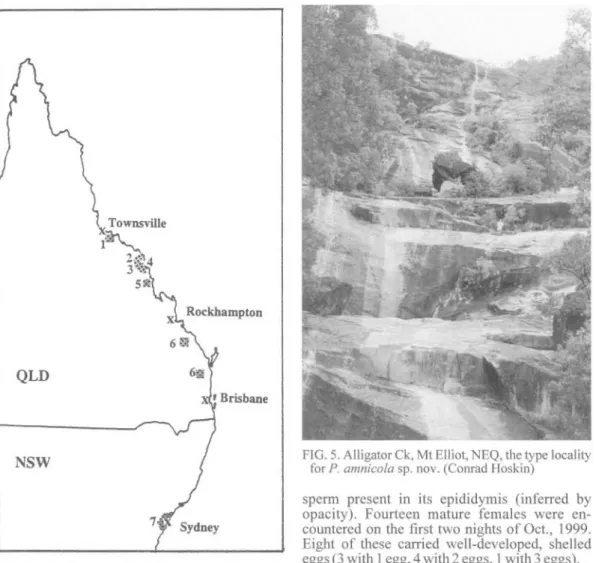
HABITAT & DISTRIBUTION. Mt Elliot, Bowling Green Bay NP, 30kms SE of Townsville (19°28'S, 146°59'E) NEQ (Fig. 4). Found amongst boulders at 450m, in a moist 'tongue' of forest along a creek running from the rainforested upper slopes of Mt Elliot (Fig. 5). Dense rain-forest is the dominant vegetation above 750m. A recent survey (CJH and J. Gratten, Oct., 1999) showed P amnicola to be relatively common between 400-1000m along a major drainage line. Surveys on the summit of Mt Elliot have failed to locate this species.
HABITS. Most specimens were found head down, on granite boulders close to permanent water. Several were foraging on rocks directly above flowing water and one was observed
Townsville
Rockhampton
QLD
NSW
FIG. 4. Occurrence of Phyllurus spp. in eastern Australia; 1 =P. amnicola, 2 P. ossa, 3 =P. nepthys,
4 =P. isis,5= P. championae, 6 =P. caudiannulatus, 7 = P. platurus.
foraging in a thin film of water in the splash zone of a cascade. All specimens, but one, have been found on rocks. The exception was on a thin tree trunk amongst boulders. Activity began soon after dark, even during persistent rain. Of 27 specimens (14d 's, 11 's and 2 juveniles) en-countered during two nights (Oct., 1999), 70% had regenerated tails. This proportion was similar in both sexes.
REPRODUCTION. One gravid female, captured and released (4 Feb., 1998), contained a single, shelled egg. A male (QMJ67852) that died in captivity (Dec., 1998) was sexually mature, with
FIG. 5. Alligator Ck, Mt Elliot, NEQ, the type locality for P. amnicola sp. nov. (Conrad Hoskin)
sperm present in its epididymis (inferred by opacity). Fourteen mature females were en-countered on the first two nights of Oct., 1999. Eight of these carried well-developed, shelled eggs (3 with 1 egg, 4 with 2 eggs, 1 with 3 eggs). CONSERVATION. P amnicola is one of the most narrowly restricted reptile species in Queensland. However, it is well protected. The only known locality for this species is in Bowling Green Bay NP which is not subject to any known threatening processes. The potential effect of fire on pockets of riparian rainforest at and near the type locality is not known.
Phyllurus championae sp. nov. Schneider, Couper, Hoskin & Covacevich
(Fig. 6)
ETYMOLOGY. Named for Irene Champion, a Resource Ranger with Queensland Parks and Wildlife Service, Mackay, MEQ, who focussed the attention of one of us (CJS) on Cameron Ck/Black Mtn, as a phytogeo-graphically interesting area, possibly pointing to the presence of unusual fauna.
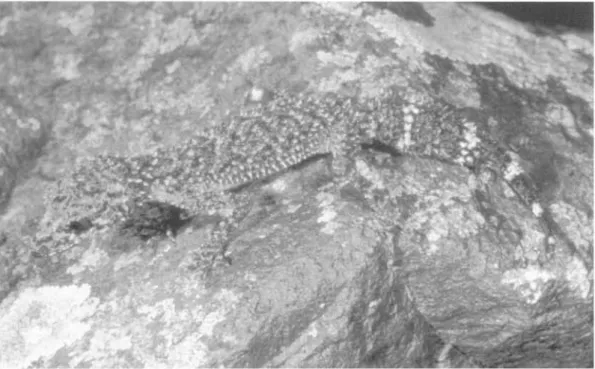
FIG. 6. Phyllurus championae sp. nov. (QM photographic collection, image ref. NX758) Cameron Ck, MEQ. (Jeff Wright)
MATERIAL. HOLOTYPE: QMJ64847 , Cameron Ck, 6.51cm WN W Koumala (21°34'24"S, 149°11'06"E) MEQ, P. Couper & C. Hoskin, 18 April 1998. PARATYPES: QMJ62757-58, J62766, J63907, J64845-46, J64848, locality as for holotype; J64854-64 Blue Mtn (21°36'S, 148°58'E) MEQ.
DIAGNOSIS. P championae almost invariably (18/19) has a fully divided rostral scale. This feature, combined with a leaf-shaped tail, distinguish it from all other Phyllurus spp. A specimen of P championae with an only partially divided rostral could be confused with some specimens of P. ossa which have a rostral partially divided by a single groove. (This is a rare state in P ossa which usually has 2 or 3 partial grooves). From such specimens ofP. ossa,
'partial single groove' specimens ofP championae
can be distinguished readily by a straight groove vs a Y-shaped groove. DESCRIPTION. SVL(mm): 33.3-80.6 (n = 19, mean = 61.5). Proportions as % SVL: L 1 41.2-48.0 (n = 19, mean = 44.0); L2 52.5-60.5 (n = 19, mean = 56.50); T 64.2-81.7 (n = 8, mean = 75.7); TT 28.9-40.7 (n = 8, mean = 35.7); HL 28.9-31.8 (n = 19, mean = 30.1); HW 23.1-26.4 (n = 19, mean = 24.40); S 12.4-14.6 (n = 19, mean = 13.1): NL 18.8-23.6 (n = 19, mean = 20.6).
Head large, depressed, triangular, distinct from neck; covered in small granules which are inter-mixed with larger, conical tubercles, extremely prominent on snout; skin of head co-ossified with skull; deep, vertical groove totally dividing rostral scale (n=18) or (rarely) partially dividing rostra! scale (n=1); rostral excluded from nostril; 5-8 scales along dorsal margin of rostral shield (n = 10); ear opening elliptical, vertical, much less than half as large as eye: supralabials 12-14 (n=38, mean= 13.3, mode= 14); infralabials 11-15 (n=38, mean=12.7, mode=13). Neck broad. Body depressed, covered in small granules; dorsal granules intermixed with larger, conical tubercles; tubercles small on back, pronounced on flanks, most prominent on sides of neck; basal scales surrounding flank tubercules only slightly enlarged; no enlarged tubercules or granules on ventral surface of body. Preanal pores absent. Axilla deeply invaginated. Limbs long, covered in large pointed tubercles dorsally; without enlarged tubercules on ventral surface, except on upper forelimb; digits strong, compressed distal-ly; subdigital lamellae (fourth toe) 16-20 (n = 38, mean = 17.9, mode = 17). Original tail (n = 8) depressed, flared to carrot-shaped, contracted at base and attenuated at tip, terminating with a
FIG. 7. A, Cameron Ck, MEQ, the type locality for P. championae sp. nov. B, dry rainforest below the summit of Blue Mtn, MEQ, the second known locality for P championae sp. nov. (Conrad Hoskin)
minute rounded knob; covered dorsally with numerous moderate-sized, spinose tubercules which become smaller along the vertebral line; tubercles terminate approximately half-way along the attenuated tip which is long; 8 rows of enlarged spines across the basal portion of attenuated tail-tip; attenuated tip accounts for 38-52% of total tail length; ventral surface smooth, or with slight depression along midline. Regenerated tail: (n = 10) depressed, broad and strongly flared, contracted at base and attenuated at tip; with small, spinose tubercules which are most prominent around the edges; ventral surface without groove along midline. The Cameron Ck specimens are significantly smaller than those from Blue Mtn (max SVL = 69mm, n = 7, small juveniles excluded, mean = 61.9mm vs max SVL = 81mm, n = 9, small juveniles excluded, mean = 69.6mm; Student's T-Test, t1,14 = 2.14, 0.05> P>0.025).
Pattern. In spirit, dorsal base colour mid brown with irregular, black blotches on head, body and
limbs. Digits obscurely banded; inner anterior digit not significantly lighter than others. Body and limbs ventrally off-white to cream; labials off-white, mottled with brown. Original tail dorsally tan, heavily mottled with black (almost entirely black in hatchlings); five white bands on tail, only those (2-3) on attenuated portion ex-tending to ventral surface; ventrally cream with grey mottling. Regenerated tail lacking cream bands; dorsally, tan/grey with black blotches; ventral surface similar, but with reduced pig-mentation.
Skeletal Features. Material examined: (radiographs) QMJ63907, J64845-48, J64854-55, J64858-59, J64864; (alizarin stained) QMJ64863. Supra-ocular portion of frontal flat; anterior process of interclavicle pronounced; epipubic cartilage not expanded; presacral vertebrae 26; sacral vertebrae 2; lumbar vertebrae 2; first autotomy septum on postsacral vertebra 5; abdominal vertebrae bearing reduced ribs 4; rib-free cervicals 3; sternal ribs 2; mesosternal ribs 3.
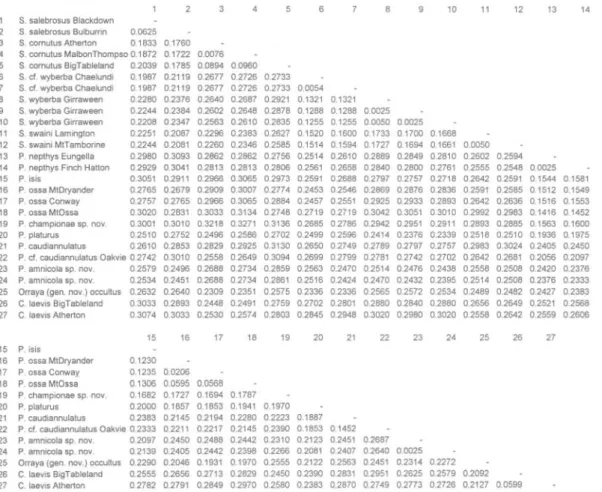
TABLE 1. Kimura 2-parameter distance estimates (Kimura, 1980) between species and populations within species for 399bp cytochrome b sequence data. Species are numbered in the same order across the top ofthe data matrix. See Appendix 1 for specimen details.
1 2 3 4 5 6 7 8 9 10 11 12 13 14 1 S. salebrosus Blackdown 2 S. salebrosus Bulburrin 0.0625 3 S. cornutus Atherton 0.1833 0.1760 4 S. cornutus MalbonThompso 0.1872 0.1722 0.0076 5 S. cornutus BigTableland 0.2039 0.1785 0.0894 0.0960 6 S. cf. wyberba Chaelundi 0.1987 0.2119 0.2677 0.2726 0.2733 7 S. cf. wyberba Chaelundi 0.1987 0.2119 0.2677 0.2726 0.2733 0.0054 8 S. wyberba Girraween 0.2280 0.2376 0.2640 0.2687 0.2921 0.1321 0.1321 9 S. wyberba Girraween 0.2244 0.2384 0.2602 0.2648 0.2878 0.1288 0.1288 0.0025 10 S. wyberba Girraween 0.2208 0.2347 0.2563 0.2610 0.2835 0.1255 0.1255 0.0050 0.0025 11 S. swami Lamington 0.2251 0.2087 0.2296 0.2383 0.2627 0.1520 0.1600 0.1733 0.1700 0.1668 12 S. swami MtTamborine 0.2244 0.2081 0.2260 0.2346 0.2585 0.1514 0.1594 0.1727 0.1694 0.1661 0.0050 13 P. nepthys Eungella 0.2980 0.3093 0.2862 0.2862 0.2756 0.2514 0.2610 0.2889 0.2849 0.2810 0.2602 0.2594
14 P. nepthys Finch Hatton 0.2929 0.3041 0.2813 0.2813 0.2806 0.2561 0.2658 0.2840 0.2800 0.2761 0.2555 0.2548 0.0025
15 P. isis 0.3051 0.2911 0.2966 0.3065 0.2973 0.2591 0.2688 0.2797 a 2757 0_2718 0.2642 0.2591 0.1544 01581 16 P. ossa MtDryander 0.2765 0.2679 0.2909 0 3007 0.2774 0.2453 0.2546 0.2869 0.2876 0.2836 0.2591 0.2585 0.1512 0.1549 17 P. ossa Conway 0.2757 0.2765 0.2966 0.3065 0.2884 0.2457 0.2551 0.2925 0.2933 0.2893 0.2642 0.2636 0.1516 0.1553 18 P. ossa MtOssa 0.3020 0.2831 0.3033 0.3134 0.2748 0.2719 0.2719 0.3042 0.3051 0.3010 0.2992 0.2983 0.1416 0.1452 19 P. championae sp. nov. 0.3001 0.3010 0.3218 0.3271 0.3136 0.2685 0.2786 0.2942 0.2951 0.2911 0.2893 0.2885 0.1563 0.1600 20 P. platurus 0.2510 0.2752 0.2496 0.2586 0.2702 0.2499 0.2596 0.2414 0.2376 0.2339 0.2518 0.2510 0.1936 0.1975 21 P. caudiannulatus 0.2610 0.2853 0.2829 0.2925 0.3130 0.2650 0.2749 0.2789 0.2797 0.2757 0.2983 0.3024 0.2405 0.2450 22 P. cf. caudiannulatus Oakvie 0.2742 0.3010 0.2558 0.2649 0.3094 0.2699 0.2799 0.2781 0.2742 0.2702 0.2642 0.2681 0.2056 0.2097 23 P. amnicola sp. nov. 0.2579 0.2496 0.2688 0.2734 0.2859 0.2563 0.2470 0.2514 0.2476 0.2438 0.2558 0.2508 0.2420 0.2376 24 P. amnicola sp. nov. 0.2534 0.2451 0.2688 0.2734 0.2861 0.2516 0.2424 0.2470 0.2432 0.2395 0.2514 0.2508 0.2376 0.2333
25 Orraya (gen. nov.) occultus 0.2632 0.2640 0.2309 0.2351 0.2575 0.2336 0.2336 0.2565 0.2572 0.2534 0.2489 0.2482 0.2427 0.2383
26 C. laevis BigTableland 0.3033 0.2893 0.2448 0.2491 0.2759 0.2702 0.2801 0.2880 0.2840 0.2880 0.2656 0.2649 0.2521 0.2568 27 C laevis Atherton 0.3074 0.3033 0.2530 0.2574 0.2803 0.2845 0.2948 0.3020 0.2980 0.3020 0.2558 0.2642 0.2559 0.2606 15 16 17 18 19 20 21 22 23 24 25 26 27 15 P. isis 16 P. ossa MtDryander 0.1230 17 P. ossa Conway 0.1235 0.0206 18 P. ossa MtOssa 0.1306 0.0595 0.0568 19 P. championae sp. nov. 0.1682 0.1727 0.1694 0.1787 20 P. platurus 0.2000 0.1857 0.1853 0.1941 0.1970 21 P. caudiannulatus 0.2383 0.2145 0.2194 0.2280 0.2223 0.1887 22 P. cf. caudiannulatus Oakvie 0.2333 0.2211 0.2217 0.2145 0.2390 0.1853 0 1452 23 P. amnicola sp. nov. 0.2097 0.2450 0.2488 0.2442 0.2310 0.2123 0.2451 0.2687 24 P. amnicola sp. nov. 0.2139 0.2405 0.2442 0.2398 0.2266 0.2081 0.2407 0.2640 0 0025
25 Orraya (gen. nov.) occultus 0.2290 0.2046 0.1931 0.1970 0.2555 0.2122 0.2563 0.2451 0.2314 0.2272
26 C. laevis BigTabletand 0.2555 0.2656 0.2713 0.2829 0.2450 0 2390 0.2831 0.2951 0.2625 0.2579 0.2092 27 C. laevis Atherton 0.2782 0.2791 0.2849 0.2970 0.2580 0.2383 0.2870 0.2749 0.2773 0.2726 0.2127 0.0599 Holotype Data. QMJ64847, d; SVL 59.28mm; Li 25.57mm; L2 32.80mm; T 48.13mm; TT 24.13mm; HL 17.81mm; HW 14.20mm; S 7.77mm; NL 11.34mm; supralabials 13/14; infralabials 13/13; subdigital lamellae 18/17. COMPARISON. P championae can be confused with only its congeners. P. championae is distinguished from P caudiannulatus by tail shape (leaf-like vs cylindrical); from P platurus
by colour pattern of anterior portion of original tail (with white bands vs without white bands); from P amnicola by spinosity of original tail (tail covered with spinose tubercules vs enlarged spinose t-ubercules restricted to anterior 1/3rd of
tail and tail margins); from P. isis by spinose flank tubercules (pronounced vs very small); from P nepthys by colour/pattern of ventral surface (plain vs peppered with brown specks)
and from P ossa by rostra] groove/s (usually one groove dividing rostral, or a straight vertical groove partially dividing rostral vs 1-3 grooves, usually 3, only rarely 1 or 2, partially dividing rostral).
GENETICS. P championae shows 16-24% sequence divergence from all other Phyllurus
spp. for the cytochrome b portion of mtDNA (Table 1). The Cameron Ck and Blue Mtn populations showed no within, or between, population polymorphism. Phylogenetic analyses firmly place P championae within the monophyletic MEQ species group of Phyllurus (P isis, P nepthys and P ossa, Fig. 1), though its precise relationship to these taxa is not well resolved.
HABITAT & DISTRIBUTION. P championae is known from only two localities, Cameron Ck (2103424S, 149°11'06"E) and (211cm to the west) Blue Mtn (21°36'S, 148°58'E) MEQ, (Fig. 4). The type specimens were collected at altitudes between 200m (Cameron Ck) and 700m (Blue Mtn) in notophyll rainforest/microphyll rainforest.
HABITS. All specimens have been on rocks or on the trunks of trees near rocks. The Cameron Ck (21°34'24"S, 149°11'06"E) specimens were collected on the edges of a permanent creek on the eastern side of Black Mtn (Fig. 7a). Blue Mtn (21°36'S, 148°58'E) specimens were active on a scree slope, in dry rainforest, just below the summit (Fig. 7b). Activity began soon after dark. REPRODUCTION. Gravid females were present in the Cameron Ck population during Dec., 1996/Jan., 1997. A female measuring 68.7mm SVL and weighing 6.2g (QMJ62757) laid two oval-shaped eggs on 6 Jan., 1997. These measured 18.35 x 9.01mm and 17.72 x 8.90mm and weighed 1.0g and 0.9g, respectively. The relative clutch mass (RCM (1) after Greer, 1989) equalled 30.6%. This corresponds closely with that of P. platurus (29%, Greer, 1989).
A male (QMJ64863, SVL 72.3mm) from Blue Mtn, collected on 19 Apr., 1998, was in peak reproductive condition with sperm present in its epididymis (inferred by opacity) and a turgid testis. From this we infer that mating may occur in autumn and that females store sperm through winter. A similar reproductive strategy has been suggested for P platurus (Greer, 1989).
CONSERVATION. P championae appears to be common at both localities from which it is known. Suitable similar habitat in adjacent areas may support this species. Blue Mtn is freehold and thus, potentially, could be cleared. However, given that the known leaf-tail site is on an elevated scree slope, the chance that this area would be further disturbed by stock or humans seems remote. Cameron Ck, the type locality, is in State Forest and may be subject to timber harvesting.
Phyllurus caudiannulatus
The discovery of specimens treated tentatively as P caudiannulatus (QMJ62817, J63849-53, J63857) at Oakview SF (26°07'23"S, 152°19'01"E), SEQ extends the range of this species 1951cm south of the only other known population (Bulburin SF, 24°31'S, 151°29'E), SEQ.
Morphological differences between the Oakview and Bulburin populations cannot be fully assessed presently, due to small sample size. Surveys in the intervening areas should help assess the significance of these differences. For conservation purposes, the Oakview population of 'P. caudiannulatus' must be recognised as a genetically distinct unit (Fig. 1), given its geographic and genetic isolation and its uncertain taxonomic status.
KEY TO AUSTRALIAN LEAF- TAILED GECKOS
1.Nostril in contact with rostra] scale ^ 2 Nostril not in contact with rostral scale ^ 6 2. Neck extremely elongate and slender . . . . 0. occultus
Neck broad ^ 3
3. Throat strongly tuberculate^ S. salebrosus
Throat smooth^ 4
4. Lower flank tubercules hooked and surrounded by spinose,
basal scutes^ S. cornutus
Lower flank tubercules not as above^ 5 5. Original tail bluntly tipped with large tubercules
^ S. swami
Original tail finely tipped with only minute tubercules
^ S. wyberba
6. Tail cylindrical^P caudiannulatus
Not as above (leaf-shaped)^ 7 7. Anterior portion of original tail without white crossbands
or blotches ^ P. platurus
Not as above (with white crossbands) ^ 8 8. Venter distinctly 'peppered' with brown . . . P. nepthys
Not as above (plain) ^ 9
9. Rostral scale completely divided^P championae
Not as above (partially divided) ^ 10 10. Rostral scale partially divided by 2 or 3 grooves, occasionally by a single Y-shaped groove . . P. ossa
Not as above (partially divided by a straight groove) . . 11 11. Anterior flared portion of original tail uniformly covered
with enlarged spinose tubercules . . . . P. championae
Not as above ^ 12
12. Tail predominantly black, with distinct white blotches present on either side of the vertebral line . . . . P. isis
Not as above (tail predominantly tan/grey, with anterior-most bands broken, but spanning tail width)
^ P amnicola
DISCUSSION
Twelve species of leaf-tailed geckos in three genera occur in eastern Australia (13°45'S -33053' S). Nine are obligatory rainforest/adjacent wet sclerophyll forest species: McIlwraith Ra., NEQ, Orraya occultus (Couper, Covacevich & Moritz, 1993); Wet Tropics (Big Tableland -Paluma), NEQ, S. cornutus (Ogilby, 1892); Mt Elliot, NEQ, Phyllurus amnicola Hoskin, Couper, Schneider & Covacevich, 2000; Mt
Dryander - Mt Ossa, MEQ, P ossa Couper, Covacevich & Moritz, 1993; Mt Blackwood and Mt Jukes, MEQ, P. isis Couper, Covacevich & Moritz 1993; Clarke Ra. (Mt David - Crediton), MEQ, P nepthys Couper, Covacevich & Moritz, 1993; Black Mountain and Blue Mountain, MEQ, P championae Schneider, Couper, Hoskin & Covacevich, 2000; Many Peaks Ra. and Oakview State Forest, SEQ, P caudiannulatus Covacevich, 1975; Great Dividing Range and foothills and Border Ranges (Mt Tamborine -Buladelah), SEQ-MENSW, S. swami Wells & Wellington, 1985. Two species are confined to heaths associated with either sandstone or granites: Girraween National Park, SEQ, S. wy-berba Couper, Schneider & Covacevich, 1997; and Hawkesbury R. region, MENSW, P platurus (Shaw, 1790). One species, S. salebrosus, occurs amongst sandstone in open forests: Blackdown Tableland - Cracow, MEQ. It is also found in rainforest in the Many Peaks Range (24°31'S, 151°29'E), where it is sympatric with P caudi-annulatus. This is the only known area to support more than one species of leaf-tail.
The genetic analyses (Fig. 1, Table 1) show that the depth of divergence amongst leaf-tails is high and that more-than-trivial differences between some taxa/populations remain to be clarified. Relative rates tests show that substitution rates among lineages do not differ significantly suggesting that a molecular clock may apply. By using the break-up of Gondwanaland to estimate substitution rates in this portion of cytochrome b among carphodactyline geckos from Australia, New Zealand and New Caledonia (Schneider, unpublished) it is estimated that the Kimura two-parameter distance between two lineages accrues at a rate of ca. 0.0042 ± 0.0002 per million years (0.0021 per lineage per million years). Using this calibration, the split between Saltuarius sensu stricto and Phyllurus is ca. 58-74mya. The divergence among species in MEQ is ca. 31-38mya, and this is nearly identical to the estimated time of divergence between the Oakview and Bulburin populations of P caudi-annulatus. Estimating genetic distances among taxa using only transversions (which are more likely to accrue linearly with time) does not sub-stantially change these time estimates. Saltuarius wyberba' populations from Chaelundi SF, NSW (30°01'07"S, 152°30'02"E) and Girraween, SEQ (28°50'S, 151°56.04E, the type locality) differ to the same degree as P isis (from Mt Blackwood, 21°02'S, 148°56'E) and P. ossa (Mt Ossa, 20°56'S, 148°49'E, only 14km to the
north). However, more specimens must be examined before the status of the Chaelundi Saltuarius specimens can be determined.
Recognition of Orraya occultus as distinct from the other large leaf-tails (Saltuarius spp.) is significant given the general paucity of endemism in the reptiles of the McIlwraith Ra. rainforest isolate. (Couper et al., 1993 observed this in relation to the Wet Tropics rainforests where 2/3 of the rainforest reptile species are endemic to the area). Orraya is the sole terrestrial vertebrate genus not represented in rainforest isolates further south.
The discovery of P amnicola on Mt Elliot, NEQ is noteworthy for two reasons. First, recog-nition of this species brings to two the number of vertebrate species endemic to Mt Elliot (the other species is the microhylid frog, Cophixalus mcdonaldi Zweifel, 1985), highlighting the evolutionary uniqueness of this rainforest isolate. Second, it extends the range of Phyllurus some 200km NW of its previously-known, northern limit of occurrence (Mt Dryander, 20°15'S, 148°33'E, MEQ), across what has been termed the `Burdekin Gap' (Joseph et al., 1993). This expanse of dry woodland between Mt Elliot (19°30'S, 146°58'E), NEQ and Bowen (20°01'S, 148°15'E), MEQ has separated the faunas of two major zoogeographic regions, the Wet Tropics and Central Mackay Coast, for an 'evolutionarily long period' (Joseph et al., 1993). There is a deep divergence between P amnicola and its congeners immediately south of the Burdekin Gap (ca. 50-60 mya). The mtDNA sequence divergence between P amnicola on the one hand, and P championae, isis, P nepthys, P ossa, on the other, is thus nearly as great as that between these species and those ofSaltuarius spp. With the recognition of P. amnicola, there is now an overlap in the max SVL between the largest member of Phyllurus (P amnicola, max SVL = 113mm) and the smallest species of Saltuarius (S. wyberba, max SVL =
109mm).
Description ofP championae brings to four the number of Phyllurus species known to be confined to rainforests of the Central Mackay Coast Biogeographic Region, MEQ. Couper et al. (1993) commented on aspects of the zoogeography of the other species confined to this area, all within 100km of each other (P isis, P nepthys and P ossa). It is now clear that the species of leaf-tailed geckos in rainforests of MEQ represent the relictual distribution of an ancient group. It has been thought that
Pleistocene ice age contraction of rainforest resulted in speciation among rainforest endemics, but the deep genetic divergence among leaf-tailed geckos precludes any role for Pleistocene speciation.
Whether P caudiannulatus (sensu stricto) occurs between Bulburin and Oakview State Forests, SEQ or is confined to the northernmost locality, remains to be ascertained. If the latter is the case, the Oakview 'P. caudiannulatus' may represent another new species, pointing to a replication of patterns of relictual isolation already observed in MEQ.
Most leaf-tails (Phyllurus spp., Saltuarius spp. and Orraya occultus) are very narrowly dis-tributed. Several (Orraya occultus, P amnicola, P isis and P nepthys) are known from only single localities. Four other species (S. cornutus, S. swami, S. wyberba and P caudiannulatus) are narrowly distributed, being confined to small rainforest or rainforest and heath blocks. Under IUCN (1994) criteria, notwithstanding narrow distributions, all species should be categorised 'Data Deficient'. Higher IUCN categories, which reflect concerns based on such single locality/ narrow ranges are all tied to knowledge of declines in populations and/or potential threaten-ing processes. Virtually all known leaf-tail localities are in state conservation or timber reserves where, generally speaking, threats are presently low. Impacts of possible future timber harvest in some areas are not known. However, most of the known, still healthy leaf-tail localities have, in the past, already been selectively logged, some extensively.
ACKNOWLEDGEMENTS
This work was supported financially by the Queensland Museum, Co-operative Research Centre for Tropical Rainforest Ecology and Management (University of Queensland), Centre for Conservation Biology (University of Queens-land) and the Forest Ecosystem Research and Assessment Unit of the Department of Natural Resources (Comprehensive Regional Assessment Project). We are grateful for assistance in the preparation of this paper from Robert Adlard, Gary Cranitch, Ben Hamley, Luke Hogan, John Hooper, Michael Koch, Jacob Gratten, Heather Janetzki, Keith McDonald, Edward Meyer, Geoff Monteith, Craig Moritz, Geoff Smith, Joanna Sumner and Steve Wilson. Andrew Amey and Lauren Keim helped to improve the key.
LITERATURE CITED
BAUER, A.M. 1990. Phylogenetic systematics and biogeography of the Carphodactylini (Reptilia: Gekkonidae). Bonner Zoologische Mono-graphien 30: 1-217.
COUPER, P.J., COVACEVICH, J.A. & MORITZ, C. 1993. A review of the leaf-tailed geckos endemic to eastern Australia: a new genus, four new species, and other new data. Memoirs of the Queensland Museum 34(1): 95-124.
COUPER, P.J., SCHNEIDER, C.J. & COVACEVICH, J.A. 1997. Anew species ofSaltuarius (Lacertilia: Gekkonidae) from granite-based, open forests of eastern Australia. Memoirs of the Queensland Museum 42(1): 91-96.
COVACEVICH, J. 1975. A review of the genus
Phyllurus (Lacertilia: Gekkonidae). Memoirs of the Queensland Museum 17(2): 293-303. GREER, A.E. 1989. The biology and evolution of
Australian lizards. (Surrey Beatty & Sons: Chipping Norton, Sydney).
GUNNAWARRA, N. & KULLAKULLA, M. 1994. Morrobalama - English. In Ogilvie, S. (compiler) . A wordlist of the Morrobalama (Umbuygamu) language of Cape York, Australia. (Umagico Council: Umagico).
IUCN SPECIES SURVIVAL COMMISSION, 1994. IUCN Red List Categories. Prepared by the IUCN Species Survival Commission as approved by the 40th meeting of the IUCN Council, Gland, Switzerland, 30 Nov., 1994. (IUCN Council: Gland).
KIMURA, M. 1980:A simple method for estimating evolutionary rate of base substitutions through comparative studies of nucleotide sequences. Journal of Molecular Evolution 16: 111-120. LETHBRIDGE, P.J., HAWKES, T.A., ANTHONY, M.
& MCGREGOR, M. 1994. New data on
Saltuarius occultus, a recently described, poorly known leaf-tailed gecko. Memoirs of the Queensland Museum 37(1): 194.
SWOFFORD, D.L. 1999. PAUP*. Phylogenetic Analysis Using Parsimony (* and other methods). Version 4. (Sinauer Associates Inc: Sunderland, Massachusetts).
APPENDIX 1
SPECIMENS EXAMINED. The following have been examined in addition to other material cited in Couper et al., 1993. Morphology: P. eaudiannulatus - QMJ15619 (holotype), J33684-86, J33706, J33709, J62817, J63849-53, J63857 P. isis - QMJ53511 (holotype), J53485-86, J53518, J53480, J53591, J53602-3 P. nepthys - QMJ34058 (holotype), J34057, J35114, J57031, J65511, J65575, J65578, J65580, J65582, J65584, J65674 P. ossa - QMJ53444 (holotype), J53389, J53392, J53426, J53428, J53443, J53445, J53447, J56311, J56773, J56791 P. platurus - QMJ160, J31978, J56880-81, J56895
Orraya occultus - QMJ37040 (holotype), J37037, J37038-9 J60717, J62596
C. laevis - QMJ31004, J65410-11, J65419 Genetics:
Phyllurus amnicola - liver samples from QMJ64406-7 (Mt Elliot - 19°28'S, 146°59'E).
P. caudiannulatus - (Bulburin SF - 24°31'S, 151°29'E) liver sample from QMJ51103.
P. caudiannulatus (Oakview 26°07'23"S, 152°19'01"E) -liver sample from QMJ62817.
P. championae - liver samples from QMJ62757-58, J62766, J63907 (Cameron Ck - 21°34'24"S, 149°11'06"E) and 4 liver samples from the following series:- J64854, J64857, J64859, J64861-62 (Blue Mtn - 21°36'S, 148°58'E).
P. isis - tail tips from Mt Blackwood ( 21°02'S, 148°56'E).
P. nepthys - liver samples from QMJ51101 & J51098 ( Finch Hatton NP - 21°06'S, 148°38'E).
P. ossa - tail tips from Mt Ossa (20°56'S, 148°49'E), Brandy Ck (20°21'S, 148°41'E) and Mt Dryander (20°15'S, 148°33'E).
P. platurus - liver samples from QMJ568801 (via Gosford -33°24'S, 151°21'E).
Saltuarius cornutus - liver samples from QMJ51632 (Malbon Thompson Ra.- 17°07'S, 145°54'E) and tail tips from Atherton (17°16'S, 145°29'E) and Big Tableland ( 15°43'S, 145°17'E).
S salebrosus - liver samples from QMJ51091 (Blackdown Tableland - 23°46'S, 149°06'E) and J51090 (Bulburin SF-24°31'S, 151°29'E).
S - liver samples from QMJ51640 ( Lamington NP28°14'S, 153°08'E) and J51095 (Mt Tamborine -27°58'S, 153°11'E).
S. wyberba - liver sample from QMJ51633 and tail tips (Gir-raween NP - 28°50'S, 151°55'E)
S cf. wyberba - (Chaelundi SF population - 30°01'07"S, 15230'02"E & 30°03'04"S, 152°21'36"E) tissues from AMR141964-5.
Orraya occultus - tissues from QMJ60717, J62596 (McIlwraith Ra. - 13°45'S, 143°19'E).
Carphodactylus laevis - tails from Big Tableland (15°43'S, 145°17'E) and Mt Bartle Frere (17°24'S, 145°49'E).