Copyright © 2019 (Yixin Chen). Licensed under the Creative Commons Attribution Non-commercial No Derivatives (by-nc-nd). Available at http://ijoc.org.
How Does Communication Anxiety Influence Well-Being?
Examining the Mediating Roles of Preference for
Online Social Interaction (POSI) and Loneliness
YIXIN CHEN
Sam Houston State University, USA
I proposed a conceptual model that assumes communication anxiety leads to preference for online social interaction (POSI), which in turn leads to loneliness, resulting in a negative influence on well-being. I collected data from college students (N = 336) taking an introductory communication course at a public university in the U.S. and analyzed the model using PROCESS. Findings revealed that communication anxiety increases POSI and loneliness but reduces well-being; POSI is positively associated with loneliness but is not associated with being. The one-mediator path from communication anxiety to well-being via POSI is not significant, but the one-mediator path from communication anxiety to well-being via loneliness is significant. The two-mediator path from communication anxiety to well-being through POSI and then through loneliness is also significant. I also conducted path analyses to examine the fit indices of a modified optimal model and an alternative model and found that the former is superior to the latter. Thus, I concluded that the mediation path from communication anxiety to well-being is more likely to be first through POSI and then through loneliness.
Keywords: communication anxiety, preference for online social interaction (POSI), loneliness, well-being
Although the age of social media may make people more connected with each other (Ellison, Gray, Lampe, & Fiore, 2014), one of its downsides is that it can lead to less confidence in or less comfort with face-to-face communication (Drago, 2015). This is especially true among young Americans. An online survey conducted within the U.S. by OnePoll (a market research company) between January 3 and January 10, 2017, reported that among 2,000 young Americans ages 18 and older, 65% of participants reported that they don’t feel confident when it comes to face-to-face social interactions (SWNS Digital, 2017). The same survey also reported that participants canceled or didn’t attend about 30% of social events to which they were invited because of fear of face-to-face social interactions, a fear that can be perpetuated by a lack of practice.
This fear is called communication anxiety (or communication apprehension) and is defined as fear or anxiety associated with face-to-face (FtF) oral communication with others (McCroskey, 1982b). It describes specific anxiety or fear that an individual experiences when having to give a speech, talk in a
dyadic interaction, or speak up in small and large groups in FtF encounters (McCroskey, 1982a). An alternative communication channel for individuals who have problems with FtF interactions is online social interaction, also called online communication or computer-mediated communication (CMC), which refers to any text-based human communication that occurs through the use of electronic devices (McQuail, 2005; Thurlow, Lengel, & Tomic, 2004). With the availability of social media as an alternative, young Americans with FtF oral communication anxieties (hereafter shortened as “communication anxieties”) are likely to favor online social interactions over real-time FtF interactions (Lee-Won, Herzog, Park, 2015). This disposition is called preference for online social interaction (POSI) and is a key component of Caplan’s (2003) theory of problematic Internet use (PIU). Although both communication anxiety and POSI individually represent important areas in the communication discipline, the relationship between the two has not been explored, and their joint influences on psychosocial outcomes remain unknown among young Americans. The present study is an important next step in addressing this gap in the literature on FtF and online social interactions.
Research on communication anxiety since the 1980s has demonstrated that it is positively related to loneliness (Downs, Javidi, & Nussbaum, 1987, 1988) and other indices of poor psychological health (Oommen, 2013). Studies on POSI have likewise linked it to negative outcomes such as Internet addiction (Caplan, 2010; Fioravanti, Dèttore, & Casale, 2012). Surprisingly, although each of these two lines of research have been developed, no study has ever examined the influence of both constructs together on important health outcomes such as well-being, which represents a more comprehensive assessment of psychological health than Internet addiction. Well-being is an indicator of psychological health involving optimal experience and functioning (Ryan & Deci, 2001). Unlike psychopathological symptoms (e.g., depression), which represent negative psychological health outcomes and focus on human problems, illness, and weaknesses (Derogatis & Cleary, 1977), well-being represents positive psychological health outcomes and focuses on human strengths and potential (Seligman, 2002). There are many conceptualizations of well-being in the extant literature. In the present study, I focus on subjective well-being, which refers to individuals’ self-evaluations of their lives, because subjective well-being is considered an essential element of positive psychological health (Diener, Sapyta, & Suh, 1998).
The present study has three goals. The first is to examine the unique effects of communication anxiety and POSI on well-being. The second is to test whether POSI serves as a theoretical mechanism between communication anxiety and well-being. Finally, I aim to explore whether loneliness can account for the relationship between communication anxiety/POSI and well-being, as loneliness is closely associated with both communication anxiety (Downs et al., 1987, 1988) and POSI (Caplan, 2003; Ye & Lin, 2015) and has been recognized as a proximal predictor of well-being (Chen & Feeley, 2014). In the following sections, I first review theoretical foundations related to the present study. Then I summarize empirical findings about the relationships among communication anxiety, POSI, loneliness, and well-being. Finally, I propose a conceptual model to guide my data collection.
Theoretical Foundations
Theory of PIU and the Social Skill Deficit Model of PIU
preference may facilitate compulsive Internet use that results in negative outcomes. Theory of PIU proposes that individuals with psychosocial health problems (e.g., loneliness, depression) tend to develop POSI, which leads them to excessive use of online social interactions that, in turn, worsen their preexisting problems (Caplan, 2003). Caplan later (2005) proposed the social skill deficit model of PIU, which predicts that individuals who lack social skills in FtF contexts are likely to prefer online social interaction over FtF communication, and that this preference leads to addictive Internet use, which results in negative outcomes. In other words, individuals who perceive themselves as lacking social competence are likely to develop POSI (Caplan, 2005), which refers to a “cognitive individual-difference construct characterized by beliefs that one is safer, more efficacious, more confident, and more comfortable with online interpersonal interactions and relationships than with traditional face to face (FtF) social activities” (Caplan, 2003, p. 629). The model further suggests that POSI could be a mechanism that partly accounts for the relationship between the perception of deficient social skills and the negative outcomes arising from one’s Internet use (Caplan, 2005). A number of psychosocial factors have been found to be positive predictors of POSI, including loneliness, depression (Caplan, 2003), social anxiety (Caplan, 2007), and low self-esteem (Fioravanti et al., 2012). Additionally, the mediating role of POSI in the relationship between these psychosocial predictors and negative outcomes resulting from one’s Internet use has been supported (Caplan, 2003, 2007; Fioravanti et al., 2012). Based on the two theoretical frameworks above (Caplan, 2003, 2005), it appears that both psychosocial problems and social skills deficits can be conceptualized as antecedents of POSI.
Loneliness and Health
Loneliness is a state of emotional distress accompanying perceived deficiencies in the quantity or quality of one’s social relationships (Peplau & Perlman, 1982). Although research on loneliness tends to focus on older adults (e.g., Hawkley & Kocherginsky, 2018; Newall & Menec, 2019), loneliness can occur at any life stage—that is to say, any age group can experience loneliness (Luhmann & Hawkley, 2016). In fact, Generation Z (adults aged 18–22) is the loneliest generation alive today, based on a new study by Cigna (2018), a global health service company. With nearly half of all Americans experiencing loneliness (Cigna, 2018), it has been increasingly recognized as a significant public health problem (Cacioppo & Cacioppo, 2018; Gerst-Emerson & Jayawardhana, 2015).
According to the findings of a series of studies on loneliness and health conducted by Cacioppo et al. (2002), loneliness has a unique and deleterious effect on physical and psychological health. Additional studies on loneliness have demonstrated that loneliness leads to depression (Cacioppo, Hawkley, & Thisted, 2010) and suicidal ideation (Bennardi et al., 2019), predicts an increased risk for morbidity and mortality (Hawkley & Cacioppo, 2010), and deteriorates positive psychological functions such as well-being (Kearns, Whitley, Tannahill, & Ellaway, 2015). Additionally, loneliness has been found to be a full or partial mediator linking psychosocial predictors, such as self-esteem (He, Shi, & Yi, 2014) and social support (Chen & Feeley, 2014), to well-being.
Communication Anxiety and POSI
of online communication platforms (e.g., Facebook and Twitter) in recent years, it is no longer true that avoiding FtF communication necessarily results in less communication with others. The asynchronicity of many online communication platforms can allow users the time to carefully craft and edit their messages, which may subsequently increase their perception of control over online social interactions (Walther & Parks, 2002). The absence or reduction of nonverbal cues in online communication platforms may also offer users a decreased social threat perception (Amichai-Hamburger & Furnham, 2007). These two unique features of online communication can make it more appealing to individuals with communication anxiety, given the choice between online social interactions and FtF communication.
Although many features of online communication may predispose individuals with communication anxiety to prefer online social interactions, no research has explored the association between communication anxiety and POSI. It seems that scholars on Internet use, including those from the communication discipline (e.g., Caplan, 2007; Lee-Won et al., 2015), have generally ignored the communication anxiety construct and have instead focused on the social anxiety (also called social phobia) construct, which refers to the fear of and anxiety about being negatively judged and evaluated by other people in social contexts (Schlenker & Leary, 1982). This construct is much more recognized in social science disciplines and has been studied more extensively than communication anxiety. For example, Caplan (2007) found a positive relationship between social anxiety and POSI/PIU. Lee and Stapinski (2012) confirmed social anxiety to be a significant predictor of POSI//PIU after controlling for depression and general anxiety. Furthermore, a recent meta-analysis showed that social anxiety is correlated positively with PIU (Prizant-Passal, Shechner, Aderka, 2016).
Communication anxiety is conceptually distinct from social anxiety (Liebowitz, 1987; McCroskey, 1982b), though they are positively and moderately correlated (Amsbary & McCroskey, 2010). Communication anxiety is a form of anxiety that occurs in situations when an individual has to engage in public speaking, dyadic conversations, or discussions in either small or large groups (McCroskey, 1982a). In contrast, social anxiety is a form of anxiety that occurs in social contexts when an individual has to behave (i.e., perform any task) in the presence of other people; it focuses on an individual’s fear of receiving negative judgement and evaluation for his or her behaviors (e.g., eating or urinating) performed in social contexts that may not involve oral communication (Daly, 1978; Schlenker & Leary, 1982).
I propose to study communication anxiety as a direct predictor of POSI for three reasons. First, numerous activities related to Internet use are essentially communicative. Users rely on many online communication platforms to communicate their thoughts, feelings, needs, and purposes with others. Thus, it appears more appropriate to use communication anxiety, which “focuses exclusively on communication-related situations,” (McCroskey & Beatty, 1986, p. 284), rather than social anxiety as an antecedent of POSI to explain why certain individuals turn to the Internet for social interaction purposes.
has a clear operational definition and offers a comprehensive assessment of communication apprehension in four specific communication contexts: public speaking, dyadic interaction, small groups, and large groups (McCroskey, 2006).
Third, in doing so, the present study shifts the focus of research on POSI from psychosocial predictors (e.g., social anxiety) to communication factors. This shift has the potential to reveal an additional risk factor for POSI and to advance the theoretical development of the online communication area. Based on the findings reviewed and the rationale stated above, I propose:
H1: Higher communication anxiety predicts higher POSI.
Communication Anxiety, Loneliness, and Well-Being
McCroskey and Payne (1986) argued that “theoretically, the high apprehensive may feel compelled to withdraw from situations that continually magnify his/her psychological experience of loneliness” (p. 65). Studies conducted in the 1980s had confirmed this theoretical argument. For example, Zakahi and Duran (1985) reported that dyadic communication apprehension contributed to loneliness among undergraduate students. Downs et al. (1987) found that communication apprehension is positively related to feelings of loneliness within an older adult population. Their later research confirmed that communication apprehension consistently and significantly predicts loneliness for non-nursing home residents (Downs et al., 1988). A close inspection of extant literature revealed that very few studies have examined the link between communication anxiety and loneliness, and no such study had been conducted after 2000. It is unclear whether the positive relationship found between these two constructs by studies conducted in the 1980s persists today, when there are many online communication platforms available to serve as alternatives to FtF communication.
There is also a scarcity of research on communication anxiety and well-being. For instance, Oommen (2013) found that intercultural communication apprehension is related to mental well-being among international students. Her later research suggested that a decrease in the level of intercultural communication apprehension may facilitate international students’ cultural adaptation (Oommen, 2014). The experience of communication apprehension is not unique to this population: it probably affects a large percentage of young Americans (e.g., 65% of 2,000 young Americans surveyed; see SWNS Digital, 2017). As little research has specifically examined the association between communication anxiety and loneliness and well-being, I propose the following:
H2: Higher communication anxiety predicts higher loneliness.
H3: Higher communication anxiety predicts lower well-being.
POSI, Loneliness, and Well-Being
It is not clear whether POSI has an impact on other important indices of psychological health like loneliness and well-being. However, there is evidence that young adults who use social media heavily (an indicator of PIU) tend to feel more socially isolated than those who do not (Primack et al., 2017). Nowland, Necka, and Cacioppo (2018), in their review, suggested that generally there is a positive association between social Internet use and loneliness among late adolescent and young adult and adult populations. Extant studies also found that PIU negatively affects the well-being status of individuals (e.g., Mei, Yau, Chai, Guo, & Potenza, 2016). Furthermore, a meta-analysis on the effect of Internet use on well-being reported that PIU had a significant and negative influence on well-being (Çikrıkci, 2016). As POSI is a cognitive symptom of PIU (Caplan, 2005), it is likely that POSI also leads to loneliness and poor well-being.
In terms of empirical findings specifically on the relationship between POSI and loneliness and being, Ye and Lin (2015) reported that POSI is positively related to loneliness and negatively related to well-being. However, their study was not able to determine the effect of POSI on loneliness and well-being, as POSI was treated as an outcome rather than a predictor of loneliness and well-being. I propose to examine loneliness and well-being as outcome variables of POSI, as this modification to the original social skill deficit model of PIU (Caplan, 2005) may reveal a more extensive influence of POSI. Thus, I propose the following two hypotheses:
H4: Higher POSI predicts higher loneliness.
H5: Higher POSI predicts lower well-being.
The Mediating Roles of POSI and Loneliness
To my knowledge, no study has examined the mediating roles of POSI and loneliness in the relationship between communication anxiety and well-being. Relying on the social skill deficit model of PIU (Caplan, 2005), it is possible that communication anxiety, which may be attributed to self-perceptions of inadequate communication skills (McCroskey & Beatty, 1986), may lead to POSI, which, in turn, may result in negative health outcomes, such as poor well-being. Thus, I pose:
RQ1: Does higher POSI mediate the relationship between higher communication anxiety and lower well-being?
Based on the findings of studies on loneliness and health outcomes, loneliness is likely to be a proximal predictor of well-being (Cacioppo et al., 2002; Chen & Feeley, 2014). The influences of other factors (e.g., communication anxiety) on well-being are likely to be filtered through loneliness. Thus, I pose:
RQ2: Does higher loneliness mediate the relationship between higher communication anxiety and lower well-being?
likely to trigger loneliness (Nowland et al., 2018; Primack et al., 2017), which itself is detrimental to health or well-being (Kearns et al., 2015; Segrin & Domschke, 2011). Thus, I pose the following question:
RQ3: Does higher communication anxiety lead to higher POSI, which subsequently leads to higher loneliness, resulting in lower well-being?
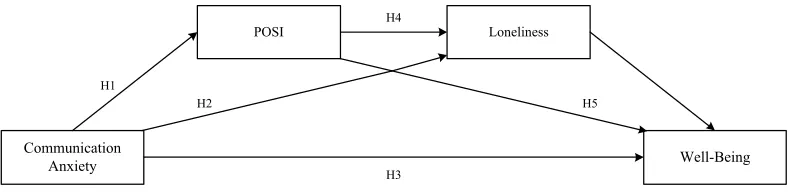
Figure 1 shows a conceptual model predicting well-being, with communication anxiety as the independent variable, POSI as the first mediator, and loneliness as the second mediator.
Figure 1. The hypothesized model. POSI = Preference for Online Social Interaction.
Method
Survey Procedure and Participants
I conducted an online survey measuring all variables in the hypothesized model (Figure 1) and individual characteristics. Participants were undergraduate students taking an introductory communication class at a public university in the U.S. After the study received the IRB approval, I made an announcement in class to invite participation. Then the instructor of the class posted the link to the survey on the class website. At the beginning of the survey, participants were informed of the definition of online communication: “Online communication refers to any text-based human communication that occurs through the use of electronic devices (McQuail, 2005; Thurlow, Lengel, & Tomic, 2004). This includes e-mail, text messaging, instant messaging, chat rooms, online forums, and messaging through social network sites.” Each participant received one point of extra credit for his or her participation. The following section describes measures for variables. Sample characteristics and descriptive statistics are reported in the Results section.
Measures
Individual characteristics including gender, age, and ethnicity were measured.
Communication anxiety was measured by the Personal Report of Communication Apprehension scale, which consists of 24 items (McCroskey, 1982a). Sample items included: “Ordinarily I am very tense and nervous in conversations” and “I dislike participating in group discussions.” The response options
H1
H2
H3 POSI
Communication Anxiety
Loneliness
Well-Being
H4
[image:7.612.110.504.236.332.2]ranged from 1 = Strongly Disagree to 5 = Strongly Agree (α = .919). Higher scores indicate higher communication anxiety.
Preference for online social interaction was assessed by a measure developed by Caplan (2003), which consists of four items: (1) I am more confident socializing online than I am offline; (2) I feel safer relating to other people online rather than face-to-face; (3) I prefer communicating with other people online rather than to-face; (4) Meeting and talking with people is better when done online rather than in face-to-face situations. The response options ranged from 1 = Strongly Disagree to 5 = Strongly Agree (α = .822). Higher scores indicate higher POSI.
Loneliness was measured by the UCLA Loneliness Scale (Version 3), which consists of 10 items (Russell, 1996). Sample items included: “How often do you feel that you lack companionship?” and “How often do you feel isolated from others?” The response options ranged from 1 = Never to 5 = Always (α = .887). Higher scores indicate higher loneliness.
Well-being consists of three indices: positive affect, negative affect, and life satisfaction. Positive affect was measured by a six-item positive affect scale developed by Mroczek and Kolarz (1998). A sample item was: “How often do you feel cheerful?” Negative affect was measured by a six-item negative affect scale also developed by Mroczek and Kolarz (1998). A sample item was: “How often do you feel so sad that nothing could cheer you up?” The response options for both positive affect and negative affect ranged from 1 = Never to 5 = Always (α = .858 for positive affect; α = .764 for negative affect). Life satisfaction was measured by the Satisfaction with Life Scale (Diener, Emmons, Larsen, & Griffin, 1985), which consists of five items. A sample item was “I am satisfied with my life.” The response options ranged from 1 = Strongly disagree to 5 = Strongly agree (α = .855). The measure of well-being was created by the following formula: (positive affect) – (negative affect) + (life satisfaction). Higher scores indicate higher well-being.
Analysis Plan
I used Hayes’s (2013) PROCESS macro to test the hypotheses and answer the research questions. I first ran a mediation model (Model 6 in PROCESS), with well-being as the outcome variable, communication anxiety as the independent variable, POSI as the first mediator, loneliness as the second mediator, and demographic factors as the control variables (see Figure 1). The number of bootstrap samples for bias-corrected confidence interval was set as 1,000. I then conducted path analyses of a modified optimal model and an alternative model to determine if the modified model is indeed superior.
Results
Sample Characteristics, Descriptive Statistics, and Correlations
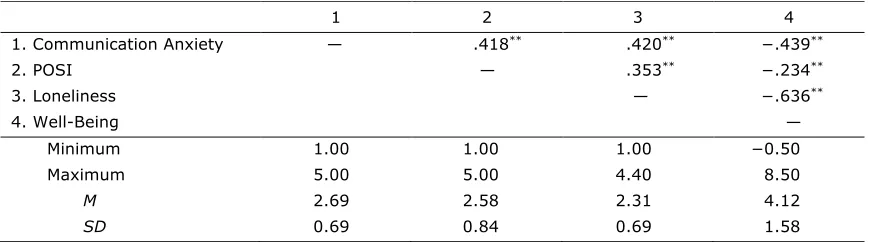
Native American, and 13 (3.9%) were “Other Ethnicities.” Table 1 presents descriptive statistics and a correlation matrix of study variables in the hypothesized model.
Table 1. Descriptive Statistics and Zero-Order Correlation Matrix of Study Variables.
Note. **p < 0.01; POSI = Preference for Online Social Interaction
Testing Hypotheses and Addressing Research Questions: The Hypothesized Mediation Model
The proposed mediation model (see Figure 1) predicting well-being was significant: R2 = .457, F(6, 329) = 46.11, p < .001. The regression analyses showed that: Communication anxiety is significantly and positively related to POSI (B = .555, p < .001), thus H1 was supported. Communication anxiety is significantly and positively related to loneliness (B = .348, p < .001), thus H2 was supported. Communication anxiety is significantly and negatively related to well-being (B = −.534, p < .001), thus H3 was supported.
The regression analyses also showed that: POSI is significantly and positively related to loneliness (B = .156, p < .001), thus H4 was supported. POSI is not significantly related to well-being (B = .087, p = .326), thus H5 was not supported.
Loneliness is significantly and negatively related to well-being (B = −1.245, p < .001), in agreement with previous studies (e.g., Chen & Feeley, 2014; Kearns et al., 2015).
The bootstrap mediation analyses found that the mediational path from communication anxiety to well-being via POSI is not significant (B = .048, 95% CI: [−.047, .178]), answering RQ1. The mediational path from communication anxiety to well-being via loneliness is significant (B = −.433, 95% CI: [−.607, −.283]), answering RQ2. The mediational path from communication anxiety to well-being through POSI and then through loneliness is significant (B = −.108, 95% CI: [−.205, −.047]), answering RQ3.
A Modified Optimal Model
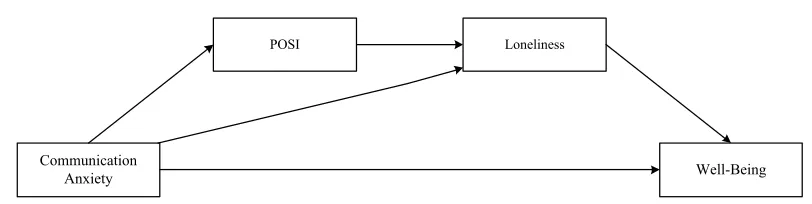
Based on the PROCESS macro output of the proposed mediation model, the path from POSI to well-being is not significant. Thus, I removed this path and obtained a modified model. (see Figure 2).
1 2 3 4
1. Communication Anxiety — .418** .420** −.439**
2. POSI — .353** −.234**
3. Loneliness — −.636**
4. Well-Being —
Minimum 1.00 1.00 1.00 −0.50
Maximum 5.00 5.00 4.40 8.50
M 2.69 2.58 2.31 4.12
Figure 2. A modified optimal model. POSI = Preference for Online Social Interaction.
Path analyses of the modified model showed that it provided an excellent fit to the data. Chi-square was not significant at χ2(1) = 1.70, p = .192, and χ2/df = 1.70; CFI = .998, TLI = .987, and RMSEA = .046. Overall, the modified model accounted for approximately 44.1% of the variance in well-being (R2 = .441).
The modified model, which assumed POSI as the first mediator and loneliness as the second mediator, is theory driven and is in line with the findings of most extant empirical studies. Additionally, it has excellent fit indices after a minor and optimal revision. Thus, it is likely to be the most appropriate model accounting for the relationships among communication anxiety, POSI, loneliness, and well-being.
An Alternative Mediation Model
There are two studies (Caplan, 2003; Ye & Lin, 2015) that have found support for the claim that loneliness is a predictor rather than an outcome of POSI. Thus, I also examined an alternative mediation model that reverses the order of the mediators: communication anxiety influences well-being first through loneliness and then through POSI. Path analyses of the alternative model showed that it provided a poor fit to the data. Chi-square was significant at χ2(1) = 123.32, p < .001, and χ2/df = 123.32; CFI = .636, and RMSEA = .604. Since the modified model has excellent fit indices, it is evident that the modified model is superior to the alternative model and is therefore the most appropriate one accounting for the relationships among communication anxiety, POSI, loneliness, and well-being.
Discussion
POSI/PIU has been a focus of research on Internet use in recent years (e.g., Lee & Stapinski, 2012; Ye & Lin, 2015). It is unrealistic to try to include too many potential predictors and outcomes of POSI in a single study. In the current study, based on the social skill deficit model of PIU (Caplan, 2005), the findings of studies on loneliness and health (e.g., Cacioppo et al., 2002), and other extant empirical findings, I identified communication anxiety as a probable risk factor for POSI, I identified loneliness and poor well-being as two likely outcomes of POSI, and then I hypothesized an appropriate conceptual model (see Figure 1). The model was tested by using data collected from undergraduate students (N = 336) taking an introductory communication course at a public university in the U.S. Findings suggested that communication anxiety increases POSI and loneliness but diminishes well-being; POSI is significantly and positively associated with loneliness but is not significantly associated with well-being. The one-mediator path from communication anxiety to well-being via POSI is not significant. The one-mediator path from communication
POSI
Communication Anxiety
Loneliness
anxiety to well-being via loneliness is significant. The two-mediator path from communication anxiety to well-being through POSI and then through loneliness is significant. Path analyses were also conducted to examine the fit indices of a modified optimal model and an alternative mediation model, and results suggested that the former is superior to the latter. Thus, I concluded that the mediation path from communication anxiety to well-being is more likely to be first through POSI and then through loneliness. Below I discuss implications of my findings.
An important finding of this study is that individuals with communication anxiety are more likely to prefer online social interactions over FtF communication. Communication anxiety has been a major focus of communication research since the 1970s (Edwards & Walker, 2007). However, few empirical studies have been conducted on this area since 2000. This finding may direct researchers on Internet use to attend to the potential influence of communication anxiety and to further explore its role in individuals’ online communication, including preferences for, motives for, actual usages of, and needs fulfilled by online communication. This finding also complements previous research results that reported low self-esteem (Fioravanti et al., 2012) and social anxiety (Caplan, 2007) as antecedents of POSI and provides an initial support for communication anxiety as another risk factor for POSI. In fact, communication anxiety is more likely to be a root cause for POSI than social anxiety, as communication anxiety is a factor contributing to social anxiety rather than an effect of social anxiety (McCroskey & Beatty, 1986).
A second important finding is that communication anxiety has profound influences on health outcomes, including increasing loneliness and reducing well-being. Extant studies have reported that a lack of social support or perceived control can lead to loneliness, poor health (Segrin & Domschke, 2011), or poor well-being (Chen & Feeley, 2012). Perhaps individuals with communication anxiety have difficulties engaging in FtF social interactions, which are important for establishing and maintaining meaningful social relationships or seeking out social support, thus resulting in their high levels of loneliness or low levels of well-being. It is also possible that individuals with communication anxiety perceive an overall lack of control over their lives, which then causes their poor well-being status. Additionally, this finding suggests that, with the current pervasiveness of online communication platforms, oral communication anxiety is a serious issue among young Americans. If those with communication anxiety often opt for online social interactions over FtF communication, then they may never gain experience with FtF communication, which may reinforce or even intensify their preexisting anxiety over FtF communication.
A third important finding is that POSI affects only loneliness directly; it is not directly related to well-being. Individuals with POSI are likely to devote a lot of time to online social interactions, which may take time away from their regular FtF interactions, according to the time displacement hypothesis (Putnam, 1995a, 1995b). Compared with online social interactions, which completely lack physical touch, FtF interactions are more likely to incur a sense of physical touch, which has been important in building intimate relationships among human beings and other primates (Dunbar, 2010). As such, relationships built by individuals with POSI through online social interactions may lack the level of intimacy of those established through FtF interactions. As a result, individuals with POSI may be more likely to experience feelings of loneliness.
well-being. One possible reason is that their study did not examine the influences of communication anxiety and loneliness on well-being. Perhaps the significant relationship between POSI and well-being is spurious and, after controlling for the influences of these other factors, it no longer appears significant. This finding also indicates that either communication anxiety or loneliness may have a much stronger impact on well-being than POSI. Moreover, this finding suggests that loneliness is more likely to be a direct negative outcome of POSI than poor well-being.
Finally, that the one-mediator path from communication anxiety to well-being via POSI is not significant, while the one-mediator path from communication anxiety to well-being via loneliness is significant, suggests that loneliness is the more appropriate theoretical mechanism accounting for the relationship between communication anxiety and well-being. Specifically, individuals with higher communication anxiety are more likely to experience loneliness that, in turn, will impair their well-being. The finding that the two-mediator path in the hypothesized model (from communication anxiety to well-being through POSI and then through loneliness) is significant suggests that loneliness is a proximal predictor of well-being. Comparing the modified optimal model (which has excellent fit indices) with the alternative model (which has poor ones) suggests that the causal path is more likely that POSI increases loneliness, which reduces well-being, rather than loneliness increasing POSI. Additionally, the significance of the two-mediator path in the hypothesized model suggests that POSI may have a limited effect on well-being: only when POSI creates loneliness can it diminish well-being, because loneliness resulting from POSI is detrimental to well-being.
Theoretical Implications
This study has three important implications for theoretical developments related to online communication, loneliness, and well-being. First, communication anxiety is an important predictor that should be included in the social skill deficit model of PIU (Caplan, 2005). Communication anxiety may be a reflection of perceived social skill deficit; thus, its inclusion may improve the predictive ability of the original model. Second, as communication anxiety was found to be a robust predictor of both loneliness and poor well-being, it appears necessary for scholars studying the loneliness-health association to consider the detrimental effect of communication anxiety. Incorporating communication variables into investigations of loneliness and health promises to provide a fuller understanding of potential risk factors for loneliness, in addition to poor self-esteem (He et al., 2014) and lack of social support (Chen & Feeley, 2014; Segrin & Domschke, 2011). Third, the present findings challenge some existing studies on POSI/PIU that considered loneliness, depression, and poor well-being as antecedents and claimed that, either loneliness and depression together (Caplan, 2003) or loneliness and poor well-being together (Ye & Lin, 2015), contribute to POSI. I believe it is more appropriate for theory of PIU or the social skill deficit model of PIU to theorize loneliness, depression, or poor well-being as psychological health outcomes directly or indirectly resulting from POSI, rather than as contributing factors of POSI, though more rigorous longitudinal studies are needed to confirm my findings.
Practical Implications
predisposition that is likely to develop among students with communication anxiety. Although online social interactions may serve as an alternative to FtF interactions for such students, it may not alleviate their preexisting problems with communication anxiety, but instead lead to poor psychological health directly (e.g., high loneliness) or indirectly (e.g., low well-being). More importantly, this study indicates that loneliness is more likely to be an outcome, rather than a driving force, of POSI. In other words, it is more likely that preferring to use online interactions as their primary communication channel makes students with communication anxiety feel lonely, rather than that feeling lonely motivates them to turn to online interactions. Although the present study does not suggest a practical approach to assist students with communication anxiety to maintain psychological health, its findings do suggest that they should be discouraged from an excessive reliance on online social interactions.
Limitations
This study has some limitations that should be noted. First, I assessed all variables based on self-report. Some participants might over- or under-report scores to some questions because of social desirability. However, the questions in the designed survey were closely related to college students’ daily experiences and not very sensitive, thus it is probable that most participants would have provided truthful responses. It is worth mentioning that individuals’ self-reports provide “the only potentially valid measures of CA [communication anxiety],” as it is experienced only internally (McCroskey & Beatty, 1986, p. 286). Second, participants in the study are a sample of college students taking the introduction to communication class, which limits the generalizability of my findings. Third, although the hypothesized model accounts for substantial variance (R2 = .457) in the outcome variable (well-being), including other antecedents, such as social support (Chen & Feeley, 2012; Segrin & Domschke, 2011) or time spent interacting online, may improve the predictability of the model. Fourth, although POSI and loneliness were found to be mediators between communication anxiety and well-being, other psychological constructs, such as stress or self-esteem (Chen & Bello, 2017; He et al., 2014), may also serve as pathways linking communication anxiety to well-being. Fifth, although I employed a theory-driven approach and tested two competing models, my findings should be interpreted with caution because of the cross-sectional nature of the study design. Finally, research may generate fruitful results by asking participants more detailed questions, such as whether their online interactions are primarily with people known in real life, or those they have met and interact with only online.
Conclusion
communication platforms, exploring other potential mediators, and conducting longitudinal studies to further investigate the relationships among communication anxiety, POSI, loneliness, and well-being.
References
Amichai-Hamburger, Y., & Furnham, A. (2007). The positive net. Computers in Human Behavior, 23(2), 1033–1045. doi:10.1016/j.chb.2005.08.008
Amsbary, J. H., & McCroskey, J. C. (2010). Communication traits and social phobia. Human Communication, 12(4), 485–492.
Beatty, M. J. (1987). Communication apprehension as a determinant of avoidance, withdrawal and performance anxiety. Communication Quarterly, 35(2), 202–217.
doi:10.1080/01463378709369681
Bennardi, M., Caballero, F. F., Miret, M., Ayuso-Mateos, J. L., Haro, J. M., Lara, E., . . . Cabello, M. (2019). Longitudinal relationships between positive affect, loneliness, and suicide ideation: Age-specific factors in a general population. Suicide and Life-Threatening Behavior, 49(1), 90–103.
doi:10.1111/sltb.12424
Cacioppo, J. T., & Cacioppo, S. (2018). The growing problem of loneliness. The Lancet, 391(10119), 426. doi:10.1016/S0140-6736(18)30142-9
Cacioppo, J. T., Hawkley, L. C., Crawford, L. E., Ernst, J. M., Burleson, M. H., Kowalewski, R. B., . . . Berntson, G. G. (2002). Loneliness and health: Potential mechanisms. Psychosomatic Medicine, 64(3), 407–417. doi:10.1097/00006842-200205000-00005
Cacioppo, J. T., Hawkley, L. C., & Thisted, R. A. (2010). Perceived social isolation makes me sad: 5-year cross-lagged analyses of loneliness and depressive symptomatology in the Chicago Health, Aging, and Social Relations Study. Psychology and Aging, 25(2), 453–463. doi:10.1037/a0017216
Caplan, S. E. (2003). Preference for online social interaction: A theory of problematic Internet use and psychosocial well-being. Communication Research, 30(6), 625–648.
doi:10.1177/0093650203257842
Caplan, S. E. (2005). A social skill account of problematic Internet use. Journal of Communication, 55(4), 721–736. doi:10.1111/j.1460-2466.2005.tb03019.x
Caplan, S. E. (2010). Theory and measurement of generalized problematic Internet use: A two-step approach. Computers in Human Behavior, 26(5), 1089–1097. doi:10.1016/j.chb.2010.03.012
Chen, Y., & Bello, R. S. (2017). Does receiving or providing social support on Facebook influence life satisfaction? Stress as mediator and self-esteem as moderator. International Journal of Communication, 11, 2926–2939.
Chen, Y., & Feeley, T. H. (2012). Enacted support and well-being: A test of the mediating role of perceived control. Communication Studies, 63(5), 608–625. doi:10.1080/10510974.2012.674619
Chen, Y., & Feeley, T. H. (2014). Social support, social strain, loneliness, and well-being among older adults: An analysis of the Health and Retirement Study. Journal of Social and Personal Relationships, 31(2), 141–161. doi:10.1177/0265407513488728
Cigna. (2018, May 1). New Cigna study reveals loneliness at epidemic levels in America: Research puts spotlight on the impact of loneliness in the U.S. and potential root causes. Retrieved from http://cigna.newshq.businesswire.com/press-release/new-cigna-study-reveals-loneliness-epidemic-levels-america
Çikrıkci, Ö. (2016). The effect of Internet use on well-being: Meta-analysis. Computers in Human Behavior, 65, 560–566. doi:10.1016/j.chb.2016.09.021
Daly, J. (1978). The assessment of social-communicative anxiety via self-reports: A comparison of measures. Communication Monographs, 45(3), 204–218. doi:/10.1080/03637757809375966
Derogatis, L., & Cleary, P. A. (1977). Confirmation of the dimensional structure of the SCL-90: A study in construct validation. Journal of Clinical Psychology, 33(4), 981–989.
doi:10.1002/1097-4679(197710)33:4<981::AID-JCLP2270330412>3.0.CO;2-0
Diener, E., Emmons, R. A., Larsen, R. J., & Griffin, S. (1985). The satisfaction with life scale. Journal of Personality Assessment, 49(1), 71–75. doi:10.1207/s15327752jpa4901_13
Diener, E., Sapyta, J. J., & Suh, E. (1998). Subjective well-being is essential to well-being. Psychological Inquiry, 9(1), 33–37. doi:10.1207/s15327965pli0901_3
Downs, V. C., Javidi, M., & Nussbaum, J. F. (1987). Communication apprehension and loneliness in older adults: An empirical test of socio-environmental theory. Communication Research Reports, 4(2), 38–42.
Downs, V. C., Javidi, M., & Nussbaum, J. F. (1988). A comparative analysis of the relationship between communication apprehension and loneliness for elderly nursing home and non-nursing home residents. Western Journal of Speech Communication, 52(4), 308–320.
Drago, E. (2015). The effect of technology on face-to-face communication. Elon Journal of Undergraduate Research in Communications, 6(1), 13–19.
Dunbar, R. (2010). How many friends does one person need? Dunbar’s number and other evolutionary quirks. Cambridge, MA: Harvard University Press.
Edwards, C., & Walker, S. (2007). Using public speaking learning communities to reduce communication apprehension. Texas Speech Communication Journal, 32(1), 65–71.
Ellison, N. B., Gray, R., Lampe, C., & Fiore, A. T. (2014). Social capital and resource requests on Facebook. New Media & Society, 16(7), 1104–1121. doi:10.1177/1461444814543998
Fioravanti, G., Dèttore, D., & Casale, S. (2012). Adolescent Internet addiction: Testing the association between self-esteem, the perception of Internet attributes, and preference for online social interactions. CyberPsychology, Behavior & Social Networking, 15(6), 318–323.
doi:10.1089/cyber.2011.0358
Gerst-Emerson, K., & Jayawardhana, J. (2015). Loneliness as a public health issue: The impact of loneliness on health care utilization among older adults. American Journal of Public Health, 105(5), 1013–1019. doi:10.2105/AJPH.2014.302427
Hawkley, L. C., & Cacioppo, J. T. (2010). Loneliness matters: A theoretical and empirical review of consequences and mechanisms. Annals of Behavioral Medicine, 40(2), 218–227.
doi:10.1007/s12160-010-9210-8
Hawkley, L. C., & Kocherginsky, M. (2018). Transitions in loneliness among older adults: A 5-year follow-up in the National Social Life, Health, and Aging Project. Research on Aging, 40(4), 365–387. doi:10.1177/0164027517698965
Hayes, A. F. (2013). Introduction to mediation, moderation, and conditional process analysis. New York, NY: Guilford Press.
He, D., Shi, M., & Yi, F. (2014). Mediating effects of affect and loneliness on the relationship between core self-evaluation and life satisfaction among two groups of Chinese adolescents. Social Indicators Research, 119(2), 747–756. doi:10.1007/s11205-013-0508-3
Heimberg, R. G., Horner, K. J., Juster, H. R., Safren, S. A., Brown, E. J., Schneier, F. R., Liebowitz, M. R. (1999). Psychometric properties of the Liebowitz Social Anxiety Scale. Psychological Medicine, 29(1), 199–212. doi:10.1017/s0033291798007879
Lee, B. W., & Stapinski, L. A. (2012). Seeking safety on the Internet: Relationship between social anxiety and problematic Internet use. Journal of Anxiety Disorders, 26(1), 197–205.
doi:10.1016/j.janxdis.2011.11.001
Lee-Won, R. J., Herzog, L., & Park, S. G. (2015). Hooked on Facebook: The role of social anxiety and need for social assurance in problematic use of Facebook. CyberPsychology, Behavior & Social
Networking, 18(10), 567–574. doi:10.1089/cyber.2015.0002
Liebowitz, M. R. (1987). Social phobia. Modern Problems of Pharmacopsychiatry, 22, 141–173. doi:10.1159/000414022
Luhmann, M., & Hawkley, L. C. (2016). Age differences in loneliness from late adolescence to oldest old age. Developmental Psychology, 52(6), 943–959. doi:10.1037/dev0000117
McCroskey, J. C. (1982a). An introduction to rhetorical communication (4th ed.). Englewood Cliffs, NJ: Prentice-Hall.
McCroskey, J. C. (1982b). Oral communication apprehension: A reconceptualization. In M. Burgoon (Ed.), Communication Yearbook, 6, (pp. 136–170). Beverly Hills, CA: SAGE Publications.
McCroskey, J. C. (2006). An introduction to rhetorical communication: A western cultural perspective (9th ed.). Boston, MA: Allyn and Bacon.
McCroskey, J. C., & Beatty, M. J. (1986). Oral communication apprehension. In W. H. Jones, J. M. Cheek, & S. R. Briggs (Eds.), Shyness: Emotions, personality, and psychotherapy. Boston, MA: Springer.
McCroskey, J. C., & Payne, S. K. (1986). The impact of communication apprehension on student retention and success: A preliminary report. Association for Communication Administration Bulletin, 56, 65–69.
McQuail, D. (2005). McQuail’s mass communication theory (5th ed.). London, UK: SAGE Publications.
Mei, S., Yau, Y. H. C., Chai, J., Guo, J., & Potenza, M. N. (2016). Problematic Internet use, well-being, self-esteem and self-control: Data from a high-school survey in China. Addictive Behaviors, 61, 74–79. doi:10.1016/j.addbeh.2016.05.009
Mroczek, D. K., & Kolarz, C. M. (1998). The effect of age on positive and negative affect: A developmental perspective on happiness. Journal of Personality and Social Psychology, 75(5), 1333–1349. doi:10.1037/0022-3514.75.5.1333
Nowland, R., Necka, E. A., & Cacioppo, J. T. (2018). Loneliness and social Internet use: Pathways to reconnection in a digital world? Perspectives on Psychological Science, 13(1), 70–87. doi:10.1177/1745691617713052
Oommen, D. (2013). The relationship among social identification with religion, mental well-being, and intercultural communication apprehension (ICA). Journal of Communication & Religion, 36(1), 108–126.
Oommen, D. (2014). The relationships among perceptions of social support, intercultural communication apprehension (ICA), and conflict management preferences in the context of cultural adaptation. Journal of Intercultural Communication Research, 43(3), 215–237.
doi:10.1080/17475759.2014.935797
Peplau, L. A., & Perlman, D. (Eds.). (1982). Loneliness: A sourcebook of current theory, research, and therapy. New York, NY: Wiley-Interscience.
Primack, B. A., Shensa, A., Sidani, J. E., Whaite, E. O., Lin, L. Y., Rosen, D., . . . Miller, E. (2017). Social media use and perceived social isolation among young adults in the U.S. American Journal of Preventive Medicine, 53(1), 1–8. doi:10.1016/j.amepre.2017.01.010
Prizant-Passal, S., Shechner, T., & Aderka, I. M. (2016). Social anxiety and Internet use—A
meta-analysis: What do we know? What are we missing? Computers in Human Behavior, 62, 221–229. doi:10.1016/j.chb.2016.04.003
Putnam, R. D. (1995a). Bowling alone: America’s declining social capital. Journal of Democracy, 6(1), 65– 78. doi:10.1353/jod.1995.0002
Putnam, R. D. (1995b). Tuning in, tuning out: The strange disappearance of social capital in America. PS: Political Science and Politics, 28(4), 664–683. doi:10.2307/420517
Russell, D. W. (1996). UCLA Loneliness Scale (Version 3): Reliability, validity, and factor structure. Journal of Personality Assessment, 66(1), 20–40. doi:10.1207/s15327752jpa6601_2
Ryan, R., & Deci, E. (2001). On happiness and human potentials: A review of research on hedonic and eudaimonic well-being. Annual Review of Psychology, 52(1), 141–166.
doi:10.1146/annurev.psych.52.1.141
Schlenker, B. R., & Leary, M. R. (1982). Social anxiety and self-presentation: A conceptualization model. Psychological Bulletin, 92(3), 641–669. doi:10.1037/0033-2909.92.3.641
Segrin, C., & Domschke, T. (2011). Social support, loneliness, recuperative processes, and their direct and indirect effects on health. Health Communication, 26(3), 221–232.
Seligman, M. E. P. (2002). Authentic happiness: Using the new positive psychology to realize your potential for lasting fulfillment. New York, NY: Free Press.
SWNS Digital. (2017, May 29). Young Americans lack key social skills, avoid the phone, and fear small talk. Retrieved from https://www.swnsdigital.com/2017/03/young-americans-lack-key-social-skills-avoid-the-phone-and-fear-small-talk/
Thurlow, C., Lengel, L. & Tomic, A. (2004). Computer mediated communication: Social interaction and the Internet. London, UK: SAGE Publications.
Walther, J. B., & Parks, M. R. (2002). Cues filtered out, cues filtered in: Computer mediated
communication and relationships. In M. L. Knapp & J. A. Daly (Eds.), Handbook of interpersonal communication (3rd ed., pp. 529–563). Thousand Oaks, CA: SAGE Publications.
Ye, Y., & Lin, L. (2015). Examining relations between locus of control, loneliness, subjective well-being, and preference for online social interaction. Psychological Reports, 116(1), 164–175.
doi:10.2466/07.09.PR0.116k14w3