Exploring the Relationship Between Modality and
Readability Across Different Text Types
Esmaeel Abdollahzadeh
Iran University of Science and Technology [email protected]
Fatemeh Zolfaghari-Erdechi Iran University of Science and Technology
Abstract
With regard to the relationship between the use of modality and readability levels of texts, 2 opposing views have been raised. The first view endorses direct positive relationship between modality and readability in the sense that the use of modality increases textual understandability. The second view is that the use of modality leads to an increase in the number of words, resulting in readability reduction of the texts. Hence, the present study tries to first compare argumentative, expository, and narrative text types in terms of the use of modalities; then, it explores the possible interplay between metadiscourse use and readability indices of the texts. To this end, 33 representative texts from different discourse modes were analyzed in terms of the degrees of idea density and the frequencies of metadiscourse signals. The results of Spearman rank correlation coefficients did not show any statistically significant go-togetherness between metadiscourse use and readability. Moreover, the focused text types were not significantly different in terms of the use of metadiscourse modalities, except for shift topic and hedging markers. Targeting intelligibility indices and stylistic devices as dimensions of textual quality, the present study offers implications for writing research and materials design purposes.
Keywords: Modality; Metadiscourse; Readability; Idea density; Text type
1. Introduction
modality markers (i.e., metadiscourse markers) as markers whose contributions lead to the establishment of coherence in English texts (Hyland, 2005; Jones, 2011; Lee, 2002; Vande Kopple, 1985).
Examining the grammatical and lexical features of texts cannot guarantee the high quality of a piece of writing; some other factors such as the functions that a written text is intended to fulfill need to be examined. Considering the functional and pragmatic aspects of texts, one main issue is the structural and logical relationships among different segments of a text which is referred to as coherence at semantic and cohesion at syntactic level. One way for establishing such organizational associations is through the appropriate use of modality.
Being aware of cohesion and coherence as two principal elements of texts and as main features of good writing (Halliday & Hasan, 1976), the writers try to produce well-established pieces of writing. In Halliday and Hasan’s (1976) terms, cohesion refers to meaning relations within a text and can be created in a text by those linguistic devices that link parts of that text to each other. They believe that a text or discourse can be cohesive when the interpretation of one part is dependent on the other parts. Halliday and Hasan believe that coherence can be established in two ways: One aspect is with regard to the situational context or register consistency, and the other is the text itself, that is, cohesion in the text. According to McNamara, Louwerse, and Graesser (2005), the concepts of coherence and cohesion contribute to the establishment of connection between words and ideas in the texts. Connections associated to cohesion are interpreted in a social or cultural community. They are linguistic components such as words, phrases, and their combinations. On the other hand, coherence is determined by the interaction between the text and its readers. One fundamental problem is that the concepts of cohesion and coherence are not considered in the development of readability formulae (McNamara, et al., 2005).
interpersonal meanings. Theoretically, they are rooted in Halliday’s interpersonal and textual metafunctions. According to Hyland (2005), metadiscourse can either create interactions between addressers and their addressees (i.e., interactive metadiscourse) or establish relationships between addressers and the texts (i.e., interactional metadiscourse). Similarly, readability establishes interactions among texts, their addressees, and addressers. Therefore, there is a need for future studies to consider the potential interconnections of metadiscourse with readability (Crismore & Abdollahzadeh, 2010).
So far, scholars have dealt with the concepts of readability and modality separately. Studies addressing metadiscourse have investigated this concept in terms of its contributions in professional and student writings (e.g., Simin & Tavangar, 2009), its impacts on reading comprehension (e.g., Camiciottoli, 2003; Nemati & Parvaresh, 2008), and its various uses across different cultures (e.g., Abdollahzadeh, 2003, 2011). On the other hand, research studies on readability have focused on specific reader factors (e.g., Jones, 1994), writer factors (e.g., Horning, 1991) and text factors (e.g., Covington, 2008) as having influences and interrelations with the ease of textual readings. Nonetheless, there has been a dearth of studies dealing with the impact of metadiscourse presence in texts with different modes on readers’ textual comprehension or on their perceptions of readability of the texts. In this regard, modality especially metadiscourse signals which establish relationships among readers, texts, and writers make the texts meet parts of the prerequisites of high understandability and have the potentiality to be investigated together with readability. The strong focus on shallow textual features like vocabulary and syntax is one of the shortcomings of the traditional readability formulae that have detracted attention from structural features like cohesion and coherence. Therefore, there is a need to reconsider the traditional readability approaches and investigate their relationship with internal features of the texts like their levels of coherence and cohesion and their discourse modes. Accordingly, the present study is an attempt to investigate the potential interplay between metadiscourse and idea density to discover if any possible relationship could be postulated between metadiscourse use and readability. More specifically, it probes into claims about the positive and negative effects of metadiscourse on textual intelligibility. To this end, the following research questions were investigated:
1. Are there any significant relationships between readability and use of modality across expository, argumentative, and narrative text types? 2. Are there any significant differences between expository, argumentative, and
2. Literature Review
2.1 Modality and Metadiscourse
Various definitions of modality, each focusing on some specific dimensions, have been proposed. Based on Fintel (2006), modality is the meaning through which some possibility or necessity is expressed. Modality is mainly carried by a group of auxiliary verbs known as modals such as will, would, can, could, may, and should. Some other expressions such as possibly, probably, have (got) to, and need to can also lead to identification of modality (Griffiths, 2006). Further, Lyons (1977) defined modality as the grammatical expression of the subjective opinions, viewpoints, and attitudes of the speakers or writers. As Fintel (2006) states, in addition to auxiliary verbs, the categories addressing evidentiality, mood, and propositional attitude as well as illocutionary force are considered as modals. In this regard, metadiscourse which covers evidentiality, possibility, and necessity (e.g., hedging) is recognized as representative of modality.
Definitions of metadiscourse have focused on its nonpropositional nature. These definitions are interrelated and help us in constructing a comprehensive understanding of the term. Hyland (2005) introduces metadiscourse as the way through which writers express their presence in the text and interact with their readers. He considers metadiscourse as signs by which persuading, informing, engaging and entertaining the addressees are possible. In Hyland’s terms, metadiscourse can reflect the social nature of language. This view is supported by some other scholars as well (e.g., Crismore, Markkanen, & Steffenson, 1996; Hyland & Tse, 2004; Taboada, 2006; Vande Kopple, 1985). Based on Fuertes-Olivera, Velasco-Sacristan, Arribas-Bano, and Samaniego-Fernandez (2001), metadiscourse is a central pragmatic feature and a device that makes solidarity between writer and reader. Dafouz-Milne (2008) considers metadiscourse as those features that can help in decoding the messages, sharing the writer’s view points, and showing the particular cultural conventions. Blagojevich (2004) considers metadiscourse as a rhetorical feature of academic discourse. As Adel (2006) argued, metadiscourse is a fuzzy and multidimensional concept which is categorized functionally and is dependent on context; therefore, many categorizations of metadiscourse have been put forth (e.g., Crismore, 1990; Hyland, 2005; Vande Kopple, 1985).
category refer to the organization of discourse and the extent to which the text has been organized based on the needs of the readers. Interactive resources include transitions, frame markers, endophoric markers, evidentials, and code glosses. Transitions (e.g., in addition, and) establish relations among main clauses, frame markers (e.g., finally, my purposes is) mainly refer to the sequences of actions, endophoric markers (e.g., see Figure 2) refer to information expressed in the same text, evidentials (e.g., according to Einstein) refer to information expressed in other texts, and code glosses (e.g., namely, meaning that) clarify the propositional meanings.
Interactional resources include hedges, boosters, attitude markers, and self- mentions. Hedges (e.g., possible, might, and perhaps) are devices that refer to the level of certainty or uncertainty of the writer. These markers show that a statement is based on the writer’s way of reasoning and has not been mentioned anywhere else. Boosters (e.g., clearly, obviously, and demonstrate) help writers show their certainty among several possible and presented alternatives. These markers indicate the involvement of the writer in the passage. They help authors to make use of mutual experiences of the readers and those of themselves to gain conclusions. Hyland (2005) believes that the degree of commitment to the text and the respect toward its readers are determined by the use of hedges and boosters. Attitude markers refer to the emotional mood of the writer (e.g., tiredness, interest, and surprise). They can be expressed in different ways including attitude verbs (e.g., agree and prefer), sentential adverbs (e.g., unfortunately and hopefully), and adjectives (e.g., appropriate, logical, and remarkable). Self-mentions refer to the extent of the writer’s presence that can be realized by the use of personal pronouns and possessive adjectives (e.g., me, mine, we, our, and ours). Self-mentions include those markers that help the writer explicitly addresses the reader and determine the degree of engagement. Using self-mentions, writers can show the presence of their readers in the text. This focus on readers may have two main functions or goals. First, it meets the expectations of the readers and increases the possibility of readers’ involvements in the text. It can also help writers address the readers and consider them as participants of the reading process by the use of some pronouns and interjections such as you, your, by the way, you may notice, and so on. Second, it puts the readers in the discourse to understand what their views and interpretations are about it. To put it in another way, it gets the writers understand whether the readers agree or disagree and guide them toward an acceptable interpretation. These aforementioned functions can be performed by questions, directives (mainly imperatives such as see, note and consider), obligation modals (such as should, must, and have to), and references to shared knowledge.
2.2 Readability
Apart from metadiscourse, another determining factor affecting the quality and comprehension of a piece of writing is readability that can also help writers match the levels of the texts to the abilities of the learners. DuBay (2004) refers to readability as what makes a text easier to read, and McLaughlin (1969) defines readability as the degree to which a specific group of people consider a text to be necessary and understandable.
One principal approach to readability measurement is the idea density of the text (AKA proposition density or P-density). This concept is syntactically defined as the number of expressed propositions divided by the number of words (Brown, Snodgrass, Kemper, Herman, & Covington, 2008; McLaughlin, 1968). However, in terms of semantics, idea density is a measure of the extent to which the speaker is making assertions (or asking questions) rather than just referring to entities. Idea density is a formula which is applicable for all types of texts—from basic to advanced level and from technical to nontechnical types. Moreover, unlike other readability formula (e.g., lexical density or Flesch-Kincaid readability formula), it is not solely based on word count and sentence length (Covington, 2008). This formula is mainly based on the speed of textual processing in a way that its higher degrees indicate more complexity and slower pace in reading progress.
Two main levels for idea density have been recognized: low and high. Eom (2006) states that low propositional density refers to short texts that have less than 10 major units of speech which have only one major pitch change (i.e., tone units), whereas high density refers to longer passages that have more than 10 tone units. Lidwell, Holden, and Butler (2010) believe that high propositional density includes expressions of multiple meanings within a single phrase which make a text more memorable and easier. Accordingly, propositional density can be estimated by dividing the number of deep propositions by the number of surface propositions. Similarly, McLaughlin (1968) refers to some factors such as typographical, motivational, and logical variables that can affect readability. He puts idea density in the category of logical variables.
linguistic rules, the world knowledge, and semantic memories of the readers (Kintch & van Dijk, 1978).
3. Materials
To select appropriate texts, a large sample of instructional ESP/EAP texts used in the EFL context of Iran was collected. Then, they were screened and analyzed with reference to the features related to each text type. Finally, the most representative texts were selected for analysis. The first instrument of the study comprised a corpus of 33 texts including 11 narrative, 11 argumentative, and 11 expository texts. The first criterion for text selection was the discourse mode of the texts. We focused on narrative, expository, and argumentative texts as the most commonly used text types. Secondly, to ensure the representativeness of the texts without manipulations on the part of the researchers, a range but not a fixed number of propositions as the second criterion for text selection was considered. This range was found to be between 249 and 299 propositions based on a pilot analysis of the target texts. The range of words across the texts was from 512 to 609, 505 to 610, and 488 to 551 for the selected argumentative, expository, and narrative texts, respectively. Table 1 summarizes the features of the analyzed texts:
E1 E2 E3 E4 E5 E6 E7 E8 E9 E10 E11 Average 251 269 259 260 272 277 280 282 285 292 299 275 .461 .53 .481 .483 .474 .549 .534 .462 .52 .531 .517 .503 545 508 538 538 574 505 524 610 548 550 578 547 N1 N2 N3 N4 N5 N6 N7 N8 N9 N10 N11 Average 267 263 271 271 272 271 276 275 281 287 292 275 .536 .539 .54 .541 .544 .527 .541 .536 .547 .521 .532 .536 498 488 502 501 500 514 510 513 514 551 549 513
Note: A: argumentative text type; E: expository text type; N: narrative text type
Descriptive statistics on the total number of the words, propositions, and degrees of idea density related to each category of text types is also presented in Table 2:
Table 2. Descriptive Statistics on the Features of the Selected Text Types
Text Type
Number of Propositions
Degree of Idea Density
Number of Words
Argumentative 3026 5.486 6072
Expository 3026 5.542 6018
Narrative 3026 5.904 5640
validation against human raters indicated a high correlation of 0.97 between the propositional count of the software and that of 80 human raters. The input of this software is either typed or copy-pasted text, and its propositional count is based on the definition of Liu (2004) who defined propositions as items corresponding to verbs, adjectives, adverbs, prepositions, and conjunctions.
3.1 Procedure
Initially, the discourse mode and number of propositions were considered as the criteria for text selection. Doing a pilot analysis of the most commonly used instructional texts—some of which were digitally available—the researchers selected 150 texts from different discourse modes. These texts were categorized into narrative, expository, and argumentative text types based on their relevant features, and their representativeness was judged based on the expert opinion of two of the researchers’ colleagues. Then, the number of propositions for each of these texts was counted applying the CPIDR software. In the pilot analysis, the researchers came up with a range of 249 to 299 propositions as the second criterion for text selection. Then, 33 comparable texts including 11 narrative, 11 argumentative, and 11 expository texts were selected for the analyses and comparisons. These texts which formed a relatively large sample constituted the main corpus of the study.
After the selection of the texts, the metadiscourse markers of the interactive and interactional types and their relevant subcategories were recognized and tabulated for each text type. The model used for the determination of these markers was adapted from Hyland (2005). The texts were functionally analyzed by one of the researchers and an independent rater who had sufficient knowledge of metadiscourse use and function. The two raters’ lack of agreement on certain features was sorted out by holding one-on-one meetings to reach a consensus on their judgments about the functions of metadiscoursal elements. The interrater reliability of their ratings was found to be .97.
Finally, readability indices (i.e., idea density) of the three text types were determined applying the CPIDR software. Then, the correlation between the frequencies of metadiscourse modalities and idea densities was calculated through Spearman rank correlation coefficient. Further, chi-square comparisons were made across the three text types in terms of using metadiscoursal features.
4.Results
4.1Correlations Between Modality and Idea Density
Table 3. Overall Spearman Rank Correlation Coefficient Between Metadiscourse Use and Idea Density of the Text Types
Spearman’s rho Metadiscourse Idea Density
Metadiscourse
Correlation Coefficient 1.000 -.096
Sig. (2-tailed) . .596
N 33 33
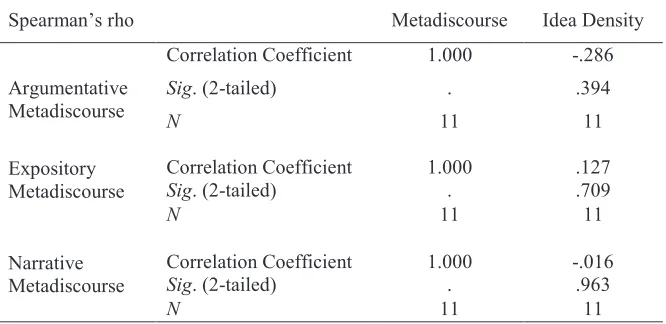
Three other Spearman rank correlation coefficients were run to investigate the possible relationships between idea densities and metadiscourse use across the different text types (see Table 4):
Table 4. Spearman Rank Correlation Coefficient Between Metadiscourse Use and Idea Density Across the Different Text Types
Spearman’s rho Metadiscourse Idea Density
Argumentative Metadiscourse
Correlation Coefficient 1.000 -.286
Sig. (2-tailed) . .394
N 11 11
Expository Metadiscourse
Correlation Coefficient 1.000 .127
Sig. (2-tailed) . .709
N 11 11
Narrative Metadiscourse
Correlation Coefficient 1.000 -.016
Sig. (2-tailed) . .963
N 11 11
As can be seen in Table 4, there is a weak negative correlation between the use of metadiscourse and idea density in the argumentative texts which is not statistically significant, r (11) = -.286, p = .394 > 0.05. In the same vein, weak correlations between the use of metadiscourse and idea density in the expository and narrative texts were found (for the expository texts: r [11] = .127, p = .709 > 0.05 and for the narrative texts: r [11] = -.016, p = .963 > 0.05).
4.2 Text Type Comparisons in Terms of Modality
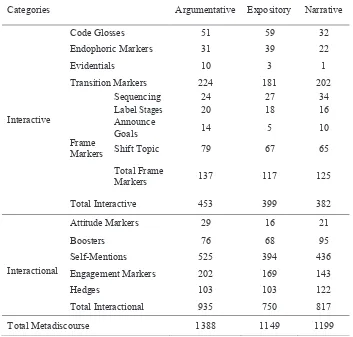
Table 5. Frequencies of Metadiscoursal Modalities in the Argumentative, Expository, and Narrative Texts
Categories Argumentative Expository Narrative
Interactive
Code Glosses 51 59 32
Endophoric Markers 31 39 22
Evidentials 10 3 1
Transition Markers 224 181 202
Frame Markers
Sequencing 24 27 34
Label Stages 20 18 16
Announce
Goals 14 5 10
Shift Topic 79 67 65
Total Frame
Markers 137 117 125
Total Interactive 453 399 382
Interactional
Attitude Markers 29 16 21
Boosters 76 68 95
Self-Mentions 525 394 436
Engagement Markers 202 169 143
Hedges 103 103 122
Total Interactional 935 750 817
Total Metadiscourse 1388 1149 1199
Table 6. Comparison of Argumentative, Expository, and Narrative Text Types in Terms of Metadiscourse
Categories
Chi-Square
Value
df Sig. (2-tailed)
Interactive
Code Glosses *Text Type 21.533 18 .253
Endophoric Markers *Text Type 17.852 14 .214
Evidential *Text Type 8.627 8 .375
Transition Markers *Text Type 34.095 24 .083
Frame Markers
Sequencing *Text
Type 14.687 12 .259
Label stages *Text
Type 5.820 8 .667
Announce Goals
*Text Type 12.506 8 .130
Shift Topic *Text Type
28.044 16 .031
Total Frame
Markers *Text Type 34.774 28 .177 Total Interactive *Text Type 46.509 38 .162
Interactional
Attitude Markers *Text Type 19.302 14 .154
Boosters *Text Type 24.673 26 .538
Self-Mentions *Text Type 42.690 38 .277 Engagement Markers *Text Type 36.639 28 .127
Hedges *Text Type 40.458 26 .035
Total Interactional *Text Type 54.826 46 .175
Total Metadiscourse *Text Type 53.780 46 .201
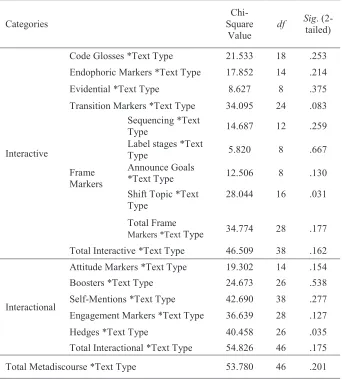
The results indicate that the text types under investigation do not have any significant differences in terms of the use of interactive and interactional metadiscourse and their related subcategories except for shift topic (Sig.= .031, p < .05) and hedging markers (Sig.= .035, p < .05). Post-hoc analyses were conducted to exactly locate the points of difference in the use of shift topic and hedging markers among the expository, argumentative, and narrative texts types (see Table 7):
Table 7. Post-Hoc Analyses of Text Types in Terms of the Use of Shift Topic and Hedging Markers
Compared Texts Categories Pearson Chi-Square Value df
Sig. (2-tailed) Argumentative
and Expository
Shift Topic
*Text Type 16.130 8 .041
Hedging
*Text Type 14.266 8 .075
Argumentative and Narrative
Shift Topic
*Text Type 14.909 6 .021
Hedging
*Text Type 23.907 12 .021
Expository and Narrative
Shift Topic
*Text Type 6.994 5 .221
Hedging
*Text Type 18.903 11 .063
As can be seen, compared with the expository texts, the argumentative texts had significantly higher use of shift topic markers (Sig. = .041, p < 0.05). Similarly, the argumentative texts had significantly higher use of shift topic markers compared with the narrative texts (Sig. = .021, p < .05). In addition, the narrative texts had significantly higher use of hedging devices compared with the argumentative texts (Sig. = .021, p < .05).
5. Discussion and Conclusion
The problems connected with misunderstanding of the textual propositional messages are partly because of their low degrees of reading easiness. Writers, however, need to be concerned with the possible methods for presenting their different mental postures towards their expressed propositions to increase understandability of the texts. In so doing, focus on the nonpropositional discourse mainly represented by modality and its various subtypes acts as a prerequisite for guaranteeing textual intelligibility.
interpretations of the utterances are more important than the evidences brought for their reliabilities (Hyland, 2004).
Frame markers are used to connect the sequences in the arguments (Hyland, 2004). These sequences may be announced using markers of sequencing, label staging, announcing goals, and shifting topics. In this study, shift topic markers showed significantly higher use in the argumentative texts compared with the narrative and expository ones. This is somehow connected to the arguers’ attempts to win the argument by creating more topics to be discussed than focusing on understanding of the original topic. This acts as a way for getting rid of the probable concerns (Jefferson, 1984). Further, the skill and expertise of the arguer to have some new topics at hand and change the original topic into another one seems to be another technique that makes the argument be continued creatively (Albert & Healey, 2012). Meanwhile, one main point is that higher changes in topics decrease understanding the writers’ attitudes by their readers and, thus, endangers coherence (Audrey, 2004). Therefore, any shift in topics should be explicitly pointed using different rhetorical signals. Argumentative texts provide their readers with some claims to be assessed by negotiation and consideration of the existing evidences. Closely related to this feature is the claim posed by Albert and Healey (2012) referring to some gradual shifts that occur between conversational topics in every kind of such assessments; hence, the higher use of shift topic markers in the argumentative texts.
Weak and negative correlations were found between metadiscourse use and idea density in all the three text types. We discovered that, except for the use of hedges and shift markers, the three text types had a rough balance between interactive and interactional forms. Readability formulas are typically employed to estimate text difficulty based on surface-level features (i.e., vocabulary and syntax). The formulas failed to consider structure-level features such as inference load, argument structure, or story line that also influence text difficulty and readers’ interpretation of the text. The results of the present study confirm that surface-level and structure-level features are uncorrelated and independent. Thus, using information on surface-level difficulty to estimate structure-level difficulty may not be a justified attempt (Lu, 2002). Nonetheless, this preliminary finding needs to be corroborated with larger corpora to come up with a firm conclusion.
It should be noted that in studies conducted on the relationship between the uses of modality and reading comprehension, some researchers have overgeneralized the findings of reading comprehension studies to those of readability. This interchangeable use of readability and reading comprehension is not acceptable because of two reasons. First, in reading comprehension studies mostly the text (e.g., input propositions, the size) and reader factors (e.g., selection of reading strategies, short term memory) are taken into consideration (Kintch & van Dijk, 1978), whereas readability is the result of the interactions between writers, readers, and the texts. Closely related to the writer’s part is the use of modality and its contribution in increasing coherence and cohesion. Second, comprehension can be strengthened through increasing the textual clues as a result of increasing the length of the texts, whereas, as we found in this study, increase in the lengths of the texts decreases readability. Therefore, it is recommended that future studies focus on the relationships between comprehension and readability as two related but different concepts.
References
Adel, A. (2006). Metadiscourse in L1 and L2 English. Philadelphia: John Benjamins. Abdollahzadeh, E. (2011). Poring over the findings: Interpersonal authorial engagement in applied linguistics papers. Journal of Pragmatics, 43(1), 288-297.
Abdollahzadeh, E. (2003). Interpersonal metadiscourse in ELT papers by Iranian and Anglo-American academic writers. Paper presented in the International Conference on Multiculturalism in ELT Practice, Baskent University, Turkey.
Albert, S., & Healey, P. G. T. (2012). The pragmatics of aesthetic assessment in conversation. Proceedings of SemDial (SeineDial): The 16th Workshop on the Semantics and Pragmatics of Dialogue, Université Paris-Diderot, Paris Sorbonne-Cité, Paris.
Alijanian, E., & Vahid Dastjerdi, H. (2012).The use of indirectness devices in Persian and English argumentative written discourse: A cross-cultural perspective. International Journal of Linguistics, 4(3), 60-70.
Audrey, E. (2004). A study of topical strategies and topic shift markers at Lec of Petra Christian University. Undergraduate thesis, Universitas Kristen Petra, Surabaya, Indonesia.
Brown, C., Snodgrass, T., Kemper, S. J., Herman, R., & Covington, M. A. (2008). Automatic measurement of propositional idea density from part-of-speech tagging. Behavioral Research Methods, 40(2), 540-545.
Camiciottoli, B. C. (2003). Metadiscourse and ESP reading comprehension: An exploratory study. Reading in a Foreign Language, 15(1), 15-33.
Covington, M. A. (2008). Idea density—A potentially informative characteristic of retrieved documents. Proceedings of IEEE Southeast Conference, University of Georgia.
Crismore, A., & Abdollahzadeh, E. (2010). A review of recent metadiscourse studies: The Iranian context. Nordic Journal of English Studies, 9(2), 195-219. Crismore, A., Markkanen, R., & Steffenson, M. (1993). Metadiscourse in persuasive
writing: A study of texts written by American and Finnish university students. Written Communication 10(1), 39-71.
Dafouz-Milne, E. (2008). The pragmatic role of textual and interpersonal metadiscourse markers in the construction and attainment of persuasion: A cross-linguistic study of newspaper discourse. Journal of Pragmatics, 40, 95-113.
Degand, L., Lefèvre, N., & Bestgen, Y. (1999). The impact of connectives and anaphoric expressions on expository discourse comprehension. Document Design, 1, 39-51.
DuBay, W. H. (2004). The principles of readability. California: Impact Information. Eom, E. M. (2006). An investigation of operationalized constructs of second language
listening tests. Unpublished doctoral dissertation, Iowa, University of Iowa.
Fintel, K. V. (2006). Modality and language. In D. M. Borchert (Ed), Encyclopedia of philosophy (2nd ed.). Detroit: MacMillan Reference USA.
Fuertes-Olivera, P. A., Velasco-Sacristan, M., Arribas-Bano, A., & Samaniego-Fernandez, E. (2001). Persuasion and advertising English: Metadiscourse in slogans and headlines. Journal of Pragmatics, 33(8), 1291-1307.
Georgakopoulou, A., & Goutsos, D. (2004). Discourse analysis: An introduction. Edinburgh: Edinburgh University Press.
Griffiths, P. (2006). An introduction to English semantics and pragmatics. Edinburgh: Edinburgh University Press.
Halliday, M. A. K., & Hasan, R. (1976). Cohesion in English. Hong Kong: Longman. Horning, A. (1991). Readable writing: The role of cohesion and redundancy. Journal
Hyland, K. (1996). Writing without conviction: Hedging in scientific research articles. Applied Linguistics, 17, 433-454.
Hyland, K. (2004). Disciplinary interactions: Metadiscourse in L2 postgraduate writing. Journal of Second Language Writing, 13(2), 133-151.
Hyland, K. (2005). Metadiscourse: Exploring interaction in writing. Oxford: Continuum.
Hyland, K., & Tse, P. (2004). Metadiscourse in academic writing: A reappraisal. Applied Linguistics, 25(2), 156-177.
Jefferson, G. (1984). On stepwise transition from talk about a trouble to inappropriately next-positioned matters. In J. M. Atkinson & J. C. Heritage (Eds.), Structures of social action: Studies of conversation analysis (pp. 191-222).Cambridge: Cambridge University Press.
Jones. J. F. (2011). Using metadiscourse to improve coherence in academic writing. Language Education in Asia, 2(1), 1-14.
Kintch, W., & van Dijk, T. A. (1978). Toward a model of text comprehension and production. Psychological Review, 85(5), 363-394.
Kuhi, D., & Behnam, B. (2010). Generic variations and metadiscourse in the writing of applied linguistics: A comparative study and preliminary framework. Written Communication, 20(10), 1-45.
Lee, I. (2002). Helping students develop coherence in writing. English Teaching Forum, 40, 32-39.
Lidwell, W., Holden, K., & Butler, J. (2010). Universal principles of design: 125 ways to enhance usability, influence perception, increase appeal, make better design decisions, and teach through design. Massachusetts: Rockport Publishers.
Liu, H. (2004). MontyLingua: An end-to-end natural language processor with common sense [computer software and documentation]. Retrieved June 10,
2010, from the World Wide Web:
http://web.media.mit.edu/~hugo/montylingua
Lu, Z. (2002). Readability in reading materials selection and course book design for college books in China. Unpublished doctoral dissertation, University of Nottingham.
Lyons, J. (1977). Semantics. Cambridge: Cambridge University Press.
Markkanen, R. & Schroder, H. (1997). Hedging: A challenge for pragmatics and discourse analysis. In R., Markkanen, & H., Schroder (Eds.), Hedging and discourse: Approaches to the analysis of a pragmatic phenomenon in academic texts (pp. 3-18). New York: De Gruyter.
McLaughlin, G. H. (1968). Proposals for British readability measures. In J. Downing & A. L. Brown (Eds.), The third international reading symposium (pp. 186-205). London: Cassell.
McLaughlin, G. H. (1969).SMOG grading: A new readability formula. Journal of Reading, 12(8), 639-646.
McNamara, D. S., & Kintsch, W. (1996). Learning from texts: Effects of prior knowledge and text coherence, Discourse Processes, 22, 247-288.
McNamara, D., Louwerse, M. X., & Graesser, A. C. (2005). Coh-Metrics: Automated cohesion and coherence scores to predict text readability and facilitate comprehension. Project funded by the Office of Educational Research and Improvement Reading Program, University of Memphis, Memphis, Tennessee, USA.
Myers, G. (2004). Matters of opinion: Talking about public issues. Public Opinion Quarterly,70(3), 409-412.
Parvaresh, V., & Nemati, M. (2008). Metadiscourse and reading comprehension: The effects of language and proficiency. Electronic Journal of Foreign Language Teaching, 5(2), 220-239.
Rahimi, M. (2011). Discourse markers in argumentative and expository writing of Iranian EFL learners. World Journal of English Language, 1(2), 68- 78. Simin, S, & Tavangar, M. (2009). Metadiscourse knowledge and use in Iranian EFL
writing. Asian EFL Journal, 11(1), 230-255.
Taboada, M. (2006). Discourse markers as signals (or not) of rhetorical relations. Journal of Pragmatics, 38(4), 567-592.
Thomas, J. (1983). Cross-cultural pragmatic failure. Applied Linguistics, 4, 91-112. Vande Kopple, W. (1985). Some exploratory discourse on metadiscourse. College