IT and CRM: A case study of State Bank of India
Kumar, Santosh
ICBM – SBE, Attapur, Hyderabad, India
Malyadri, Pacha
Government Degree college, Rayalaseema University, India ([email protected])
Received: 20 October 2015 Revised: 27 December 2015 Accepted: 8 February 2016
Available Online: 9 February 2016 DOI: 10.5861/ijrsm.2016.1358
ISSN: 2243-7770 Online ISSN: 2243-7789
OPEN ACCESS
Abstract
Information Technology (IT) is a revolutionary technology which is sweeping every field of
human activity. The technology has immense application in the banking industry, of particular
interest is bringing together the banks and their customers into an immediate and close
relationship. Accordingly, the new technology is expected to enable the banks to render more
and better services to their customers, who are the very foundation of the banking system. SBI
is the largest commercial bank in India and is providing good services to its esteemed
customers by making use of modern technology and Customer Relationship Management
(CRM). The implementation of CRM has helped the bank to come closer to its customers and
the emphasis has shifted from sales to customers IT and CRM are considered as powerful
tools in the banking industry and moreover the business of banking is very much dependent
on the customer goodwill, for which IT is believed to open a new window of great
opportunity by way of good CRM. The present case is mainly concerned with the use of IT
and CRM in the India’s largest public sector bank – SBI.
Keywords:
information technology; customer relationship management; too big to fail; point
IT and CRM: A case study of State Bank of India
1. Introduction
Information Technology is the technology sweeping the world and is said to be benefiting each and every sector of human activity including banking. The new technology has radically altered the traditional ways of doing banking business. The banking sector in India adopted the use of computers only in the early 1980’s , however it was only by the end of that decade that the adoption to computerization started growing and many branches have begun using computers in view of the ongoing development process in the economy. Use of modern, state of the art technology in banking is increasingly seen as an essential ingredient not only of good customer service, but also of good housekeeping. The good old manual system on which the Indian banking industry has depended upon for centuries are perhaps unable to deliver the goods any more. Hence this repeated outcry for the use of modern technology is seen as panacea for the ills that afflict the banking sector today. The banking industry is very much dependent on the customer goodwill, for which IT is believed to open a new window of great opportunity by way of good CRM (Anil, 2007). The main objective of the case study is to analyze IT and CRM in the India’s largest commercial bank – SBI.
When IT-Banking-CRM literature which is taken care or reviewed, which may be called the new IT-Banking-CRM literature, which is relatively a new literature, yet on which there is an outpouring of studies. The then RBI (Reserve Bank of India) governor in his address to the 25th Bank Economists conference, he first noted the phenomenon of globalization is something like a free-for-all world of business and enterprise, the world is brought together due to developments in the field of technology or technological field and changes also in the financial sector such as cross-border flows of capital. The governor future viewed that Indian banks are not up to world standards and in this regard it is noted that banks in India very much fall short of foreign banks in technology and it called upon to bridge this gap.
In another exercise, Chowdhury (2005) mentioned that there is a problem with the introduction of IT in banking such as infrastructure, power, trained manpower, training, etc., and the prospects of keen competition. That is IT offers a wide competing area for banking, according to him IT, among other things, calls for a close CRM, which is good relationship banking. In another seminal study an intimate field view of the problem for nearly a decade, finds customer services particularly in the public sector banks anything but respectful and satisfactory and he makes out his point by a number of case studies; according to which the Indian commercial banks are quite away from IT and good customer services. There is thus a broad national angle and development perspective to IT, Banking and CRM, According to which the theme has to come from the confines of banks to the national and social arena.
SBI is the main commercial bank of the nation, its importance in the banking system is next only to that of RBI. The bank is a trend setter in the new banking practices. The Reserve Bank of India (RBI) designated SBI as Domestic Systemically Important Bank (D-SIB) on August, 2015. SBI was designated as D-SIB because of its size, sustainability cross jurisdictional activities and interconnectedness. Systemically important banks are perceived as banks that are too big to fail (TBTF) (Alexander, 2006). This perception of TBTF creates an expectation of government support for these banks at the time of distress. Due to this perception, SBI enjoy certain advantages in the funding markets and moreover it builds the confidence of various stakeholders including investors and customer.
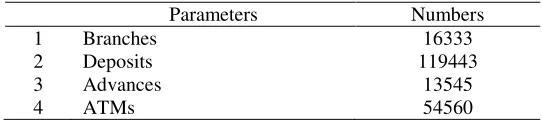
productivity and ultimately facilitate banks to maximize profits. SBI is the oldest and number one in the country with respect to many parameters of banking, such as branches, deposits, advances, ATMs and many others.
Table 1
SBI’s journey through numbers
Parameters Numbers
1 Branches 16333
2 Deposits 119443
3 Advances 13545
4 ATMs 54560
Source. SBI annual report 2014-15
2. IT Services
Services are vital link between the customers and the banks, SBI introduced customer friendly services to its large customer base, some of them are Automated Teller Machines (ATMs) , Internet Banking (IB), Mobile Banking (MB), Point of Sale Terminals (POST) and others to name a few.
Table 2 IT Services
Services Figures
1 Internet Users 2.70
2 Mobile Banking Users 1.35
3 Daily average ATM transactions 99.95 4 Point of Sale Machines 2.00
5 No. of ATMs 54560
6 Cash Deposit machines 1849
7 Kiosks 2595
Source. SBI Annual Report: 2015
According to RBI data, the number of ATMs in the country stood at 166894 out of which SBI has the largest number of ATM network to the tune of 54560 as on 31st March 2015. Rapid growth in the number of Internet connections and users has opened up a large market of cyber consumers. It is expected, overtime, the internet will have far reaching consequences for the banking industry and will evolve into one of the main environments in which business and individual customers will choose to conduct their daily account transactions. SBI has 2.70 Lakhs Internet Banking users as on June 2015.
On the other hand there are more people using a mobile phone than a bank account in India. And setting up bank branches is not only expensive but time consuming. According to some studies it could easily take more than two decades for bank branches to reach the entire 1.2 billion populations. The way out is clearly Mobile banking – using handsets to enable some of the banking functions like payments, money transfer and so on. SBI has 1.35 crores registered mobile banking users and this is increasing by 2 Lakh new mobile banking users per month. SBI has also activated nearly 2 Lakh Point of sale terminals and as a result, debit card spends over point of sale and e-commerce of SBI group crossed Rs.30000 Crores for the FY 2015.
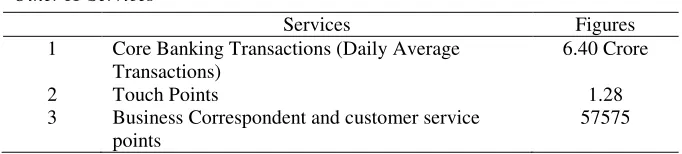
Table 3
Other IT Services
Services Figures
1 Core Banking Transactions (Daily Average Transactions)
6.40 Crore
2 Touch Points 1.28
3 Business Correspondent and customer service points
57575
Source. SBI Annual Report: 2014-15
As the premier bank of the country, a great responsibility devolves upon the SBI to set tone for the rest of banking in every banking aspect. The SBI need to assume this race, at least in respect of PSBs, hence, the need is to push IT to the fullest extent and push forward banking services and CRM to commensurate levels for the real take-off of the banking sector
3. CRM
CRM is defined as a company’s ability to continuously maximize the value of its customers franchise by effectively allocating scarce resources to specific customers or customer segments in those areas viewed as having a significant impact on the profit imparting behavior of customers. The purpose of IT in banking is to provide full satisfaction to the customers, while increasing profitability, decreasing risk and fraud to the bank. At the same time it is to be noted that where culture in not conducive, even brilliant strategies will fail to get translated into action
Customer satisfaction is a growing concern for the banks who want to grow in this competitive world of today, the concept of CRM is now growing wide acceptance and is recognized as a powerful tool for business development and to have an edge over the competitors on account of universal traits of human behavior. organizations have earlier focused on their products as the starting point and then looked around for customers to sell it, but the approach of CRM is different, it starts with the customer not the totality of the customers, because each customer has to dealt individually to find out what they need and want and to design the product as per their need and supply. In a nut shell CRM is about growing enduring relationship with profitable customers.
It is a known fact that nearly 70% of the customers leave the branch/bank because of wrong/bad attitude of staff at branch. If banks take reasonable care to the following aspects, there is no question why a customer should not be satisfied, delighted and remain loyal to the bank. Following are the measures for good CRM
Skill Willingness
Systems and procedures Latest Technology Good Infrastructure Quality of Service Standard of Performance Fundamentals of Marketing
Marketing Research Publicity
Advertisements Merchandising Distribution
Customer service and Support
and a high degree of competition, efficiency, productivity and customer services, thus, CRM appears as essential for successful functioning, profitability and customer retention and extension of the banks.
CRM is of prime importance, particularly in the case of the banking industry, which is so much customer based and for its expansion, growth and profitability. The conceptual relationship of IT- Banking-CRM is the inevitable adoption of IT by banking, which among other things, impacts upon banks- customer relationship. IT in banking among other things leads to a good CRM. The IT-Banking-CRM relationship is positive.
The CRM measures in the SBI appear to consists of the following
Extended Banking Hours Punctuality
Prompt Computerized accounts information Banking Ombudsman
ATMs
Suggestion – grievance boxes Information Desks
Computerization KYC
Staff courtesy
Yet, it does not appear to extend to reach out to the wider public and special services to the poverty-stricken, which should be perceived as the real CRM in our poverty- stricken country.
Thus, as rightly noted, CRM represent a new way of doing business for banks. It is seemingly a democratic and customer driven banking, in which each and every customer counts, not just the High Net-worth Individuals (HNIs). The heart of it appears to be good customer service and a favorable customer opinion regarding them.
4. Conclusion
The perceptions regarding IT services is a favorable and IT is given out to have improved the image of banks (specially SBI), banking services still are not anywhere to the levels of excellence and high customer satisfaction, it means that IT does not mean automatic improvement in banking services to the levels of excellence and high satisfaction and it seems that there is a need for attitudinal changes. The implementation of CRM has helped the bank to come closer to its customers and the emphasis has shifted from sales to customers. But, as against the expectation of IT, banking services and CRM are perceived to be falling short of full customer satisfaction in excellence and not any significant CRM is perceived in the commercial banks. The case study will definitely guide other lagging Indian banks and even other non-banking service sector firms to go for comprehensive deployment of CRM best practices.
5. References
Alexander, G. S. (2006, June). The good in small thing. The economic times, p. 7. Anil, K. (2007). Banking and technology. Indian Management, 45, 48.