Modeling the Network of Municipal Solid Waste Separation
Factors using Fuzzy Cognitive Mapping: A Case Study in Tehran
Hossein Bazargani a, Mostafa Zandieh b, Mohammadreza Taghizadeh-Yazdi a,*
a Faculty of Management, University of Tehran, Tehran, Iran
b Management and Accounting Faculty, Shahid Beheshti University, G. C., Tehran, Iran
Received: 5 April 2019 /Accepted: 1 December 2019
Abstract
Municipal solid waste management is a major challenge, especially in metropolises. This research focuses on a non-technical issue in municipal solid waste management named municipal solid waste separation at the source and seeks to find the best policy in terms of model results. Source separation for recycling has been recognized as a way to achieve sustainable municipal solid waste (MSW) management. The research questions are what factors affect municipal solid waste separation at the source, what the relationships between them are, and which the best policy to increase municipal solid waste separation at the source is. In this research delphi analysis and fuzzy cognitive mapping are used. After identifying 29 factors affecting the waste separation at the source and adjusting them to 9 factors according to the experts' opinions, due to direct causal relationships between the factors and their analysis with the fuzzy cognitive mapping, the factors network affecting the generation of waste were designed. By delphi analysis and expert gathering, three policies were applied to increase waste separation at the source. After analyzing each of the policies, the percentage of change in waste separation was calculated using fuzzy cognitive mapping and the most favorable policy, respectively, was the second policy (Emphasis on culturing), the first policy (Emphasis on encouragement and fines) and, ultimately, The third policy (Emphasis on physical infrastructure) was identified. Indeed as it turns out, the most favorable policy is the second
with an increase of 13% in waste separation at the source.The innovation of this study is to
study all the factors affecting the separation of municipal solid waste in one place and adjust them according to Tehran. In addition, this research for the first time brought the relationships between these factors into a holistic network. In this study, a tool has been designed to measure the impact of different policies on waste separation rate.
Keywords: Municipal Solid waste management, separation at the source, Fuzzy Cognitive Mapping
Introduction
Waste management (WM) is one of the most difficult and problematic areas by local governments, but was traditionally regarded as an isolated environmental problem requiring technical engineering solutions before 2000. Techniques tended to focus on dealing with one type of waste, leading to a focus on single technologies instead of the waste management
system. Consequentially, one waste problem can be solved, but other waste problems are often generated (Dijkema et al., 2000). As a complex adaptive system, WM requires a systematic approach which integrates environmental effectiveness, social acceptability, and economic affordability. However, compared to technical issues, social-economic dimensions of municipal solid waste (MSW) management have not attracted sufficient attention from researchers around the globe (Ma and Hipel, 2016). The effectiveness of waste management directly affects the sustainability of a city (Othman, Zainon Noor, Abba, Yusuf, & Abu Hassan, 2013), but waste management in many developing countries only becomes a priority for urban politician when basic requirements have already been met (Marshall and Farahbakhsh, 2013). In addition, among socio-environmental concerns, more attention is usually given to water distribution and drainage. While waste management receives less public attention and support, and is usually one of the least developed urban public sectors (Cavé, 2014).
Numerous studies have addressed the issues of waste management in different aspects, For example, how to manage solid waste (Vahidi et al., 2017; Vahidi and Rastikerdar, 2018), appropriate disposal methods which are the combinations that originate from a wide range of solid waste management systems (Akhavan Limoodehi et al., 2017), evaluation of waste to energy methods (Majidi & Kamalan, 2017), Environmental impacts of different waste management and disposal strategies (Daryabeigi Zand and Rabiee Abyaneh, 2018; Daryabeigi Zand et al., 2019), environmental impacts of municipal solid waste transfer stations (Daryabeigi Zand et al., 2019), economic assessment of municipal solid waste management infrastructure improvement (RiyaziNejad et al., 2018), and etc.
Waste separation at the source is also one of the most important issues in municipal solid waste management that is taken into consideration in the most cities in the world. Separation of waste before the recycling process is essential to prevent the occurrence of residual contamination and impairment of a recycled material (Basri et al., 2017). The composition of solid waste is influenced by several factors such as the level of economic development, culture, geography, energy resources and also the weather (Sheau-Ting et al., 2016). Solid waste needs be managed properly and failing to do so will attract other issues such as expensive operation costs, environmental pollution, land scarcity, etc. Recycling is one of the most effective methods used to reduce waste (Mrema, 2008).
Similar to other countries, MSW has been a major environmental problem in Tehran. Unfortunately According to official statistics, the share of waste separation at source in Tehran is 5%. Landfills is the most common method of solid waste disposal currently being used in Tehran. One of the main causes of the recycling industry's weakness is the lack of separation at the source in this city. We consider the factors that influence the separation of waste at source and their relationship to each other.
Local governments nowadays face a dilemma in source separation. Public participation is recognized as the main path toward sustainable WM and plays a vital role in environmental conflict management as it can bridge the gap between government and citizens (Joseph, 2006). WM strategies based on waste separation and recycling will only be successful if they achieve widespread public support (Ma et al., 2018) and every program’s success relies on the cooperation of the people and its community.
contexts. The explicit, simple and neutral terminology employed by Mental Modeler in the creation of FCMs serves as an excellent platform for stakeholder knowledge integration and conflict resolution as exemplified in the Irish coastal adaptation case study.
A number of other researchers (Mrema, 2008) present the steps involved in constructing an FCM of an ecosystem, interpreting FCM output using multivariate statistics, and portraying the information in an easily communicated fashion. To illustrate these ideas, the paper relies on a complex (160 variables) ecosystem model built for the Lake Erie watershed under the auspices of the Lake Erie Lakewide Management Plan. Based on experiences in building this model, the authors also offer recommendations for increasing the efficiency of the model development and interpretation process. Use of the FCM method in this case promoted constructive interaction among dozens of scientists, managers, and the public, as well as providing insights concerning the potential effects of broad classes of management actions upon the Lake Erie ecosystem. The analysis focused the attention of participants on four broad alternatives for the Lake. One represents present conditions, and another results from a decrease in nutrient inputs but an increase in stresses from land use and human disturbance. The two others involve reduced stress from nutrients and land use, with one having relatively more nutrients and less human disturbance and fishing.
Material and Methods
Fuzzy Cognitive Map
Political scientist Robert Axelrod introduced cognitive maps as a formal way of representing social scientific knowledge and modeling decision-making in social and political systems (Axelrod, 2015). In real life situations, hazy relations between concepts dominate. In order to include fuzziness, fuzzy logic was integrated into cognitive maps resulting to Fuzzy Cognitive Maps (FCM) (Kosko, 1986). FCM are extensions of cognitive maps used for modelling complex chains of casual relationships. The first scholar (Kosko, 1986 and 1992) who extend cognitive maps by adding fuzzy logic used to incorporate vague knowledge and qualitative descriptions, thus FCMs. In other words, Fuzzy Cognitive Map is a soft computing technique for modeling systems. It combines synergistically the theories of neural networks and fuzzy logic. The methodology of developing FCMs is easily adaptable but relies on human experience and knowledge, and thus FCMs exhibit weaknesses and dependence on human experts. The critical dependence on the expert’s opinion and knowledge, and the potential convergence to undesired steady states are deficiencies of FCMs. In order to overcome these deficiencies and improve the efficiency and robustness of FCM a possible solution is the utilization of learning methods. This research work proposes the utilization of the unsupervised Hebbian algorithm to nonlinear units for training FCMs. Using the proposed learning procedure, the FCM modifies its fuzzy causal web as causal patterns change and as experts update their causal knowledge (Papageorgiou et al., 2003).
effect or = 0 indicating no causal relation between the concepts (Papageorgiou and Kontogianni, 2012). The main advantages of FCMs that have led to their wide use are (van Vliet et al., 2010):
– easy to understand by stakeholders
– easy to instruct by interviewers
– easy to incorporate uncertainty
– high ability to demonstrate complexity
– not demanding in terms of funds and time
Due to the aforementioned characteristics, FCMs have gained considerable interest in a wide range of fields (Misthos et al. 2017).
A fuzzy cognitive map can be constructed by a group of experts and/or system stakeholders who are familiar with the FCM formalism. At first, the number and kind of concepts are determined. Secondly, each causal relationship among these concepts is described by them either with an if-then rule that infers a fuzzy linguistic variable from a determined set T{influence} = { negatively very very strong, negatively very strong, negatively strong, negatively medium, negatively weak, negatively very weak, zero, positively very weak, positively weak, positively medium, positively strong, positively very strong, positively very very strong} or with a direct fuzzy linguistic weight from set T{influence}.
Combining the individual maps can be accomplished by different aggregation techniques (Gray et al., 2014):
1st - by average individual FCMs together; assessing the expertise and weighting individual FCMs may be required for small sample sizes (Cannon-Bowers and Salas, 2001)
2nd - researcher subjectively condenses/clusters individuals mental model concepts in more generic (because most of them present the same meaning with a different word) (Özesmi and Özesmi, 2004) and then average individual mental models together to produce a group model (Papageorgiou and Kontogianni, 2012).
In the second case, several sub graphs are substituted with a single unit by making use of the most central variables with their weighted connections (Papageorgiou et al., 2017; Papageorgiou and Kontogianni, 2012).
Taking the above mentioned a step further, it was realized that causal relations between two concepts come with obscurity (fuzziness); as(Kosko, 1986) notes, causality admits of vague degrees and may occur partially, sometimes, very little, more, less, usually, etc. FCMs quantified these fuzzy causal relations by adding a causal weight on the connecting arc, thus explaining the strength and direction (positive/negative) of the relations. These weighted values comprise the weight matrix of the FCM. The entries of this matrix can be of any numerical
value within the interval [-1,1]. A link weight between concepts Ci and Cj takes a value in the
interval (0,1], if there is a causal connection from concept Ci to concept Cj and a positive change
in concept Ci leads to an increase in the value of concept Cj. Otherwise, the link weight takes a
value in the interval [-1,0), if a positive change in concept Ci leads to a decrease in concept Cj.
After the design of the FCM, which is usually carried out with the help of stakeholders, causality is traced through simulations (Young and Silvern, 2012), driven by different scenarios as shocks to the system. In order to capture this causal propagation, a simulation driver function and a transfer function are employed. These simulations can converge to a fixed point, or lead to an undesired outcome (Dickerson and Kosko, 1994), depending on the model structure, the link weights and the initial state vector. The analysis then stress-tests the system under multiple what-if scenarios by changing one of the above-mentioned dimensions at a time.
In this paper, we use the mentalmodeler software that calculates the value Aj(t) of a concept
Cj at the end of an iteration t as the sum of its value Aj(t−1) at the beginning of the iteration and
the contributions of its causal concepts Aj(t−1) wij at the beginning of the iteration:
( ) ( 1) ( 1)
1
( )
n
t t t
j i ij j
i i j
A f A w A
(1)Finally, the hyperbolic tangent function is used as a threshold function squashing all values at the end of each iteration into the desired interval (Nikas et al., 2019).
Delphi method
The Delphi method is a technique that involves a group of anonymous experts who are given questionnaires and controlled feedback to obtain consensus on a topic (Ziglio, 1996). Delphi is a tool to build knowledge, explore critical ideas and support informed decision-making grounded on a collective basis (Linstone and Turoff, 1975). The Delphi method enables the involvement of a large number of individuals across diverse locations and areas of expertise, thus enables to avoid domination in the consensus process which ensures the transparency of the process (Boulkedid et al., 2011). It can be a particularly helpful way to identify options, and to solve problems under conditions of uncertainty, and inadequate information (Hasson et al., 2000). The Delphi method is a structured technique that consists of several “rounds” (Quayle and Cariola, 2019):
- In the first round, participants are tasked to answer a set of open-ended survey questions. - The second round is informed by the data from the first round and involves a summary of themes that were most frequently mentioned in the survey. The themes are presented in the form of statements which participants are asked to rank in relation to their importance (Bennouna et al., 2017).
- Delphi studies often require up to three rounds to reach consensus where participants adjust their initial ratings of statements in relation to responses of other participants where agreement was not reached.
The Delphi method has also been shown to produce sufficient reliability and validity when results are based on both qualitative and quantitative measurement (Hasson and Keeney, 2011).
Research method structure
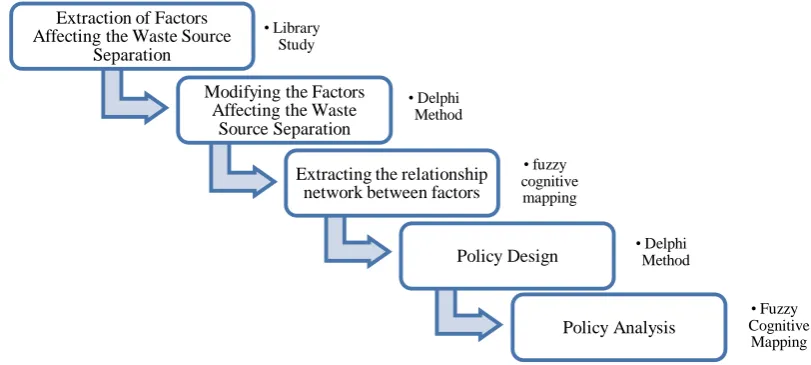
In this research, library research methods, Delphi analysis and fuzzy cognitive mapping are used in each step of the research as shown in Figure 1:
Figure 1. Font Research method structure
Extraction of Factors Affecting the Waste Source
Separation
• Library Study
Modifying the Factors Affecting the Waste
Source Separation
• Delphi Method
Extracting the relationship network between factors
• fuzzy cognitive mapping
Policy Design • Delphi Method
Policy Analysis
• Fuzzy Cognitive
The innovation of this study is to study all the factors affecting the separation of municipal solid waste in one place and adjust them according to Tehran. In addition, this research for the first time brought the relationships between these factors into a holistic network. In this study, a tool has been designed to measure the impact of different policies on waste separation rate.
Results and Discussions
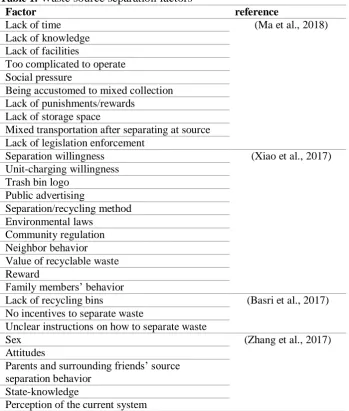
Factors affecting waste source separation were identified from previous studies according to the table 1:
Table 1. Waste source separation factors
Factor reference
Lack of time (Ma et al., 2018)
Lack of knowledge Lack of facilities
Too complicated to operate Social pressure
Being accustomed to mixed collection Lack of punishments/rewards
Lack of storage space
Mixed transportation after separating at source Lack of legislation enforcement
Separation willingness (Xiao et al., 2017) Unit-charging willingness
Trash bin logo Public advertising
Separation/recycling method Environmental laws
Community regulation Neighbor behavior Value of recyclable waste Reward
Family members’ behavior
Lack of recycling bins (Basri et al., 2017) No incentives to separate waste
Unclear instructions on how to separate waste
Sex (Zhang et al., 2017)
Attitudes
Parents and surrounding friends’ source separation behavior
State-knowledge
Perception of the current system
With the Delphi technique, these factors were presented to ten identified experts; the same factors are merged, the factors with little or no relation are removed. So we found the underlying nine factors:
1. Public advertising
2. Mixed transportation after separating at source
3. Being accustomed to mixed disposal
4. Social pressure and Neighbor behavior
5. Lack of storage space
7. Lack of facilities
8. Lack of knowledge
9. Lack of time
Then, by identifying the direct causal relationships between the factors and analysis them using fuzzy cognitive mapping method, based on the opinion of experts, the network of the factors affecting waste source separation were extracted as shown in figure 2:
Figure 2. The network of the factors affecting waste separation at the source
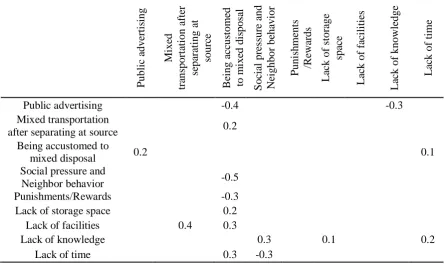
The yellow factors are variables that can be manipulated directly by the municipality. Also orange factors are variables that can’t be manipulated directly by the municipality. The effect percentage of the components shown in Fig. 2 on each other is shown in the table 2.
Table 2. The rate of positive or negative affects
By Delphi analyzing and the experts community, applicable policies to improve waste separation at the source have been designed:
P ubl ic a dve rt is ing Mi xe d tr anspor ta ti on af te r se pa ra ti ng at sour ce B ei ng ac cust om ed to m ixe d di sposa l S oc ia l pr ess ur e and N ei ghbor be ha vi or P uni sh m ent s /R ew ar ds La ck of st or age spa ce La ck of f ac il it ie s La ck of know le dge La ck of t im e
Public advertising -0.4 -0.3
Mixed transportation
after separating at source 0.2 Being accustomed to
mixed disposal 0.2 0.1
Social pressure and
Neighbor behavior -0.5
Punishments/Rewards -0.3
Lack of storage space 0.2
Lack of facilities 0.4 0.3
Lack of knowledge 0.3 0.1 0.2
The first policy: Emphasis on encouragement and fines
The second policy: Emphasis on culturing
The third policy: Emphasis on physical infrastructure
The effect of each policy on the waste separation at the source was evaluated using fuzzy
cognitive map in the mentalmodeler software.To this end, the expert team evaluated the impact
of each policy on the controllable variables by the municipality.
Table 3. The change percentage in variables with direct municipality manipulating The first
policy
The second policy
The third policy
Public advertising - 0.2 -
Mixed transportation after separating at source - - 0.3
Being accustomed to mixed disposal - - -
Social pressure and Neighbor behavior - - -
Lack of storage space - - -
Punishments/Rewards 0.5 0.2 -
Lack of facilities - - 0.1
Lack of knowledge - - -
Lack of time - - -
Waste separation at the source - - -
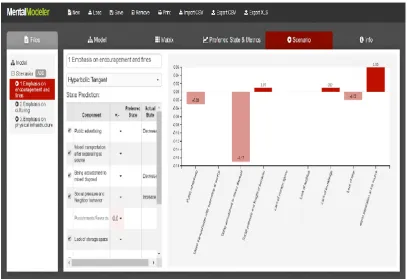
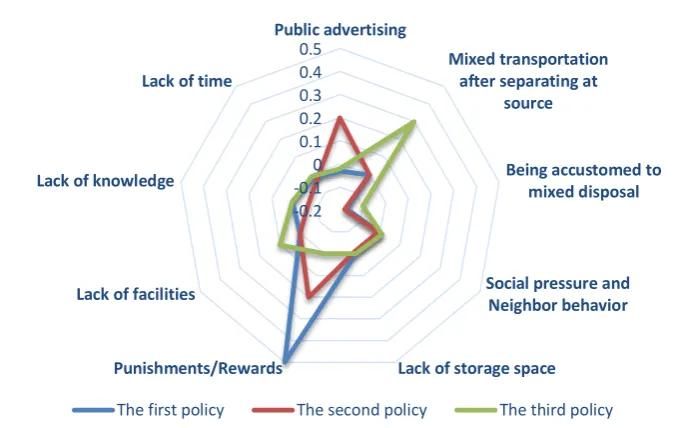
By entering the percentage of the change of the controllable variables in each policy to the software, the percentage of the change in other variables was calculated with fuzzy logic.
Figure 3. Variables sensitivity analysis in the mentalmodeler software
After sensitivity analyzing in each of the policies, the percent change in the variables of the
Figure 4. Variables change percent in each policy
After sensitivity analyzing in each of the policies, the percent change in the variables of the
model was calculated as shown in Figure 5:
Figure 5. Waste separation at the source change percent in each policy
Conclusion
Waste management is one of the most difficult and problematic areas by local governments. Waste separation at the source is also considered to be a necessary treatment method for municipal solid waste in waste management cycle and local governments nowadays face a dilemma in source separation. Similar to other countries, MSW has been a major environmental problem in Tehran. And that has caused that landfills is the most common method of solid waste disposal currently being used in Tehran. In this paper, the factors affecting the waste separation at the source are investigated. As it turns out, the most favorable policy is the second with an
increase of 13% in waste separation at the source.Second place in policies belongs to the first
that leads to increase the waste separation at the source by 6%. The last rank in the policies is
also in the third, which increases the waste separation at the source by 3%.Therefore, in order
to achieve the goal of increasing solid waste separation at the source, the second (emphasis on culturing), the first (emphasis on encouragement and fines), and the third (emphasis on physical infrastructure) policies are prioritized. The innovation of this study was that all the factors affecting the separation of municipal solid waste in one place studied and adjusted according to Tehran. In addition, this research for the first time brought the relationships between these
-0.2 -0.1 0 0.1 0.2 0.3 0.4 0.5
Public advertising
Mixed transportation after separating at
source
Being accustomed to mixed disposal
Social pressure and Neighbor behavior
Lack of storage space Punishments/Rewards
Lack of facilities Lack of knowledge
Lack of time
The first policy The second policy The third policy
0.06
0.13
0.03
0 0.02 0.04 0.06 0.08 0.1 0.12 0.14
factors into a holistic network. In this study, a tool has been designed to measure the impact of different policies on waste separation rate as shown in figure 6.
Figure 6. Waste separation and its factors change percent in each policy
The results of this paper are more comprehensive than the analysis presented in other papers and consider all factors affecting the solid waste separation at the source. At the same time, these factors were adjusted according to the canvas of Tehran. Finally, the two-way relationship between the factors was analyzed and their effect on each other was considered.
In fact, the output of this article is a decision support tool that helps policymakers find their focal point in decision making complexity; because the issue for municipal policymakers is, with their limited resources, what factors are most likely to focus on separation at the source.
References
Akhavan Limoodehi, F., Tayefeh, S. M., Heydari, R., & Abdoli, M. A. (2017). Life Cycle Assessment of Municipal Solid Waste Management in Tehran. Environmental Energy and Economic Research, 1(2), 207–218.
Axelrod, R. (2015). Structure of decision: The cognitive maps of political elites. Princeton university press.
Basri, N. E. A., Ghani, S. F. A., Zain, S. M., & Ghee, T. K. (2017). Waste generation and students’ perception on waste separation program at cafeterias UKM Bangi campus. Journal of Engineering Science and Technology, 12, 80–90.
Bennouna, C., Mansourian, H., & Stark, L. (2017). Ethical considerations for children’s participation in data collection activities during humanitarian emergencies: A Delphi review. Conflict and Health, 11(1), 5.
Boulkedid, R., Abdoul, H., Loustau, M., Sibony, O., & Alberti, C. (2011). Using and reporting the Delphi method for selecting healthcare quality indicators: A systematic review. PloS One, 6(6), e20476.
Cannon-Bowers, J. A., & Salas, E. (2001). Reflections on shared cognition. Journal of Organizational Behavior, 22(2), 195–202.
Cavé, J. (2014). Who owns urban waste? Appropriation conflicts in emerging countries. Waste Management & Research, 32(9), 813–821.
Daryabeigi Zand, A., & Rabiee Abyaneh, M. (2018). Application of Life Cycle Assessment for Techno-Economic Evaluation of Rural Solid Waste Management Strategies: Significance of CO2 Emission
-0.2 -0.1 0 0.1 0.2 0.3 0.4 0.5 P u b lic a d v er tis in g M ix ed tra n sp o rt a tio n a ft e r se p a ra tin g a t s o u rc e Be in g a c cu st o m e d to m ix e d d is p o sa l S o c ia l p re ss u re a n d N ei g h b o r b eh a v io r L a c k o f st o ra g e sp a c e P u n is h m e n ts /Re w a rd s L a c k o f fa c ili tie s L a c k o f k n o w le d g e L a c k o f tim e w a st e s e p ar at io n a t t h e s o u rc e
The first policy
The second policy
Control from Waste Management Sector in Abyaneh Village, Isfahan Province. Environmental Energy and Economic Research, 2(1), 1–12.
Daryabeigi Zand, A., Rabiee Abyaneh, M., & Hoveidi, H. (2019). Environmental and Economic Evaluation of Municipal Solid Waste Management using WAGS Model–Air Pollutant Emission and Fuel Economy in Waste Collection Sector. Environmental Energy and Economic Research, 3(1), 37– 44.
Daryabeigi Zand, A., Vaeziheir, A., & Hoveidi, H. (2019). Comparative Evaluation of Unmitigated Options for Solid Waste Transfer Stations in North East of Tehran Using Rapid Impact Assessment Matrix and Iranian Leopold Matrix. Environmental Energy and Economic Research, 3(3), 189–202. Dickerson, J. A., & Kosko, B. (1994). Virtual Worlds as Fuzzy Cognitive Maps. Presence: Teleoperators
and Virtual Environments, 3(2), 173–189.
Dijkema, G. P. J., Reuter, M. A., & Verhoef, E. V. (2000). A new paradigm for waste management. Waste Management, 20(8), 633–638.
Gray, S. A., Gray, S., Cox, L. J., & Henly-Shepard, S. (2013). Mental Modeler: A Fuzzy-Logic Cognitive Mapping Modeling Tool for Adaptive Environmental Management. 2013 46th Hawaii International Conference on System Sciences, 965–973.
Gray, S. A., Zanre, E., & Gray, S. R. J. (2014). Fuzzy Cognitive Maps as Representations of Mental Models and Group Beliefs. In E. I. Papageorgiou (Ed.), Fuzzy Cognitive Maps for Applied Sciences and Engineering: From Fundamentals to Extensions and Learning Algorithms (pp. 29–48).
Hasson, F., & Keeney, S. (2011). Enhancing rigour in the Delphi technique research. Technological Forecasting and Social Change, 78(9), 1695–1704.
Hasson, F., Keeney, S., & McKenna, H. (2000). Research guidelines for the Delphi survey technique. Journal of Advanced Nursing, 32(4), 1008–1015.
Hoornweg, D., & Bhada-Tata, P. (2012). What a Waste: A Global Review of Solid Waste Management. Retrieved from https://openknowledge.worldbank.org/handle/10986/17388
Joseph, K. (2006). Stakeholder participation for sustainable waste management. Habitat International, 30(4), 863–871.
Kosko, B. (1986). Fuzzy cognitive maps. International Journal of Man-Machine Studies, 24(1), 65–75. Kosko, B. (1992). A dynamical systems approach to machine intelligence. Neural Networks and Fuzzy
Systems, 38–108.
Linstone, H. A., & Turoff, M. (1975). The delphi method. Addison-Wesley Reading, MA.
Ma, J., & Hipel, K. W. (2016). Exploring social dimensions of municipal solid waste management around the globe – A systematic literature review. Waste Management, 56, 3–12.
Ma, J., Hipel, K. W., & Hanson, M. L. (2018). An evaluation of the social dimensions in public participation in rural domestic waste source-separated collection in Guilin, China. Environmental Monitoring and Assessment, 190(1), 35.
Majidi, S. S., & Kamalan, H. (2017). Economic and environmental evaluation of waste to energy through gasification; case study: Tehran. Environmental Energy and Economic Research, 1(1), 113– 124.
Marshall, R. E., & Farahbakhsh, K. (2013). Systems approaches to integrated solid waste management in developing countries. Waste Management, 33(4), 988–1003.
Misthos, L.-M., Messaris, G., Damigos, D., & Menegaki, M. (2017). Exploring the perceived intrusion of mining into the landscape using the fuzzy cognitive mapping approach. Ecological Engineering, 101, 60–74.
Mrema, K. (2008). An assessment of students’ environmental attitudes and behaviors and the effectiveness of their school recycling programs. Unpublished Master’s Thesis), University of Dalhouse, Halifax.
Nikas, A., Ntanos, E., & Doukas, H. (2019). A semi-quantitative modelling application for assessing energy efficiency strategies. Applied Soft Computing, 76, 140–155.
Othman, S. N., Zainon Noor, Z., Abba, A. H., Yusuf, R. O., & Abu Hassan, Mohd. A. (2013). Review on life cycle assessment of integrated solid waste management in some Asian countries. Journal of Cleaner Production, 41, 251–262.
Papageorgiou, E. I., Hatwágner, M. F., Buruzs, A., & Kóczy, L. T. (2017). A concept reduction approach for fuzzy cognitive map models in decision making and management. Neurocomputing, 232, 16–33. Papageorgiou, E., & Kontogianni, A. (2012). Using fuzzy cognitive mapping in environmental decision making and management: A methodological primer and an application. International Perspectives on Global Environmental Change, 427–450.
Papageorgiou, E., Stylios, C., & Groumpos, P. (2003). Fuzzy Cognitive Map Learning Based on Nonlinear Hebbian Rule. In T. (Tom) D. Gedeon & L. C. C. Fung (Eds.), AI 2003: Advances in Artificial Intelligence (pp. 256–268). Springer Berlin Heidelberg.
Quayle, E., & Cariola, L. (2019). Management of non-consensually shared youth-produced sexual images: A Delphi study with adolescents as experts. Child Abuse & Neglect, 95, 104064.
RiyaziNejad, M., Fakhri, S. A., & Moosavirad, S. M. (2018). Economic Appraisal of the Rapid Catalytic Cracking Development Scheme for Municipal Solid Waste. Environmental Energy and Economic Research, 2(4), 237–249.
Sheau-Ting, L., Sin-Yee, T., & Weng-Wai, C. (2016). Preferred attributes of waste separation behaviour: An empirical study. Procedia Engineering, 145, 738–745.
Stach, W., Kurgan, L., & Pedrycz, W. (2010). Expert-Based and Computational Methods for Developing Fuzzy Cognitive Maps. In M. Glykas (Ed.), Fuzzy Cognitive Maps: Advances in Theory, Methodologies, Tools and Applications (pp. 23–41).
Vahidi, H., Nematollahi, H., Padash, A., Sadeghi, B., & RiyaziNejad, M. (2017). Comparison of rural solid waste management in two central provinces of Iran. Environmental Energy and Economic Research, 1(2), 195–206.
Vahidi, H., & Rastikerdar, A. (2018). Evaluation of the Life Cycle of Household Waste Management Scenarios in Moderate Iranian Cities; Case Study Sirjan City. Environmental Energy and Economic Research, 2(2), 111–121.
van Vliet, M., Kok, K., & Veldkamp, T. (2010). Linking stakeholders and modellers in scenario studies: The use of Fuzzy Cognitive Maps as a communication and learning tool. Futures, 42(1), 1–14. Xiao, L., Zhang, G., Zhu, Y., & Lin, T. (2017). Promoting public participation in household waste
management: A survey based method and case study in Xiamen city, China. Journal of Cleaner Production, 144, 313–322.
Young, S., & Silvern, S. (2012). International Perspectives on Global Environmental Change. BoD – Books on Demand.
Zhang, H., Liu, J., Wen, Z., & Chen, Y.-X. (2017). College students’ municipal solid waste source separation behavior and its influential factors: A case study in Beijing, China. Journal of Cleaner Production, 164, 444–454.
Ziglio, E. (1996). The Delphi method and its contribution to decision-making. Gazing into the Oracle: The Delphi Method and Its Application to Social Policy and Public Health, 5, 3–33.