Patron: Her Majesty The Queen Rothamsted Research Harpenden, Herts, AL5 2JQ
Telephone: +44 (0)1582 763133 Web: http://www.rothamsted.ac.uk/
Rothamsted Repository Download
A - Papers appearing in refereed journals
Davidson, J. 1927. On some Aphides infesting Tulips. Bulletin of
Entomological Research. 18 (1), pp. 51-62.
The publisher's version can be accessed at:
•
https://dx.doi.org/10.1017/S0007485300019672
The output can be accessed at:
https://repository.rothamsted.ac.uk/item/96vy1/on-some-aphides-infesting-tulips
.
© Please contact [email protected] for copyright queries.
ON SOME APHIDES INFESTING TULIPS.
By J. DAVIDSON, D . S C ,
Rothamsted Experimental Station, Harpenden.
(PLATE III.)
During 1925-1926 a number of tulip bulbs and iris corms infested with Aphides were received from various sources, as well as Aphides from growing tulips. These species were reared and observations made on the progress of the infestation on tulips. It is evident that one species Anuraphis tulipae (B. de Fonsc.) is a serious pest of stored bulbs, especially tulips, and another species, Rhopalosipkoninus tulipaella (Theo.), may also be of importance in this respect. Since these two species are not well known, it may be desirable to give detailed drawings of the species together with some notes on the obseivations made. It is hoped that the complete life-cycles and alternative food-plants of these species may be traced later.
In addition to the two species mentioned above, Macrosiphum get (Koch) and
Myzus persicae (Sulz.) were also found infesting tulips.
Anuraphis tulipae (B. de Fonsc).
1841. Aphis tulipae, B. de Fonsc, Ann. Soc Ent. Fr., x, p. 167. 1908. Aphis sp. on Gladioli bulbs, Felt, Jl. Econ. Ent., i, p. 330.
1909. Aphis gladioli, Felt, New York State Mus. Bull. 134, 24th. Rept. (1908) State Entomologist, p. 19, figs. 6-9.
1923. Anuraphis tulipae (B. de Fonsc.) Theobald, Bull. 3, S. E. Agric. Coll., Wye (Advisory and Research Dept.) pp. 1-7.
Alate viviparous female (fig. 1).
Head and thorax brown to dark brown ; abdomen dirty yellowish to dirty white, often exhibiting a faint shade of pink, a dark irregularly shaped area extending over three or four segments ; the ventral surface of abdomen is a dirty yellowish-white. HEAD. Eyes dark (dark red in earlier stages) ; two well defined pores situated
between the eyes, near the median line ; (there are also two of these pores on pro-thorax and two or four near extremity of abdomen). Antennae fuscous, sometimes quite dark, about five-sevenths length of body, segt. i wider than ii, ii slightly longer than i, iii about five times length of ii, iv about half length of iii, v slightly shorter than iv, and vi about as long as i i + i h ; segt. iii is somewhat broad and bears about 45 sensoria distributed over its length ; segt. iv also bears 8-12 sensoria ; a few hairs on all segments. THORAX. Wings comparatively large, nervures and stigmatic
areas greyish brown. Legs dirty yellowish-brown, distal ends of femora and tibiae darker, also tarsi. ABDOMEN. Usually 4 pairs of small, blunt tubercles can be seen on lateral margins ; two well-defined circular pores (and often two smaller ones) situated near median line, behind cauda. Cauda dark, short (about length of basal portion of antennal segt. vi), spinose, bearing two long, curved hairs on each side and one median sub-apical hair. Anal plate strongly rounded, spinose, bearing several long stout hairs ; genital plate round and furnished with stout, short bristles near distal border. Cornicles dark, imbricated, short (about as long as antennal segt. iv), nearly twice length of cauda, cylindrical, sometimes faintly expanded towards base, with a marked local constriction at base, particularly on inner face.
52 J. DAVIDSON.
Fig. 1. Anuraphis tulipae (B. de Fonsc.) : A, winged v. $ ; B, antenna ; C, cauda (dorsal view) ; D, anal and genital plates (ventral view) ; E, cornicle.
Apterous viviparous female (fig. 2).
Dirty yellowish-white to greyish-white with darker head and thorax ; the younger stages are soft, velvety greyish-white, sometimes pale pink; abdominal segments with darker transverse areas and a few small, dark spots in rows down the body; the venter is a pale, dirty yellowish-white, somewhat velvety.
HEAD. TWO circular pores in line with the eyes, near median line ; Eyes black.
Antennae slightly less than half length of body ; greyish brown to fuscous ; distal end
of segts. iii-v darker and also segt. vi; segt. i much stouter than ii, but ii a little longer, iii about four times length of ii, iv nearly three times length of ii, v longer than iv but not as long as iii, vi about as long as iv+v ; a few hairs on all segts. THORAX.
Legs dirty greyish-white, tarsi dark as also coxae and distal end of tibiae. ABDOMEN.
Fig. 2. Anuraphis tulipae (B. de Fonsc.) ; A, apterous v. $ ; B, antenna ; C, cauda (dorsal view) ; D, anal and genital plates (ventral view) ; E, cornicle ; F, tarsus of 3rd leg;
G, facets of wax glands.
cylindrical, short (about 3 times length of cauda, and width at base about one-third of length), sometimes faintly expanding towards the base, but slightly constricted at the apex.
Male.
I did not find any sexual forms in my material, so reproduce here the description given by Theobald (1923).
54 J. DAVIDSON.
three times as long as hind tarsi. Cauda small, scarcely projecting, with two hairs each side. Penis blunt, yellow; claspers black. Wings large. Proboscis not reaching the second coxae.
Length 1-5 mm."
Sexual female. Unknown.
This species, first recorded in 1841 by Boyer de Fonscolombe, has received little attention in the literature, except by Felt in 1908 and 1909 and Theobald in 1923. The food-plants and localities from which it has been collected are given by the latter author. The writer received a number of tulip bulbs from a London store house (7th November 1925) and again in 1926 and also some iris corms (21st November 1925), which were infested with this species. There were a few Aphids on most of the bulbs, and they rapidly increased in numbers when the latter were planted in sand in the glasshouse. The insects were found beneath the dried outside sheath covering
Fig. 3. Anuraphis tulipae (B. de Fonsc), first stage larva born from apterous v. ?, dorsal
view.
severe, and by 13th January, in some cases, the green shoot became brown and died, and in others only a badly distorted shoot developed. This is well shown in the photograph (Plate iii). Many of the winged forms reproduced on the tulip bulbs and produced apterous v. females. The insects prefer the bulb portion of the plants and do not infest the leaves of growing tulips, and the colonies died out as spring advanced. Infested iris corms were also grown, and the Aphids reproduced in large numbers on them, masses of winged v. females being produced.
Many hundreds of alate forms were examined from the material, but no males were found. Alate v. females were isolated and their progeny observed, but in all cases they produced apterous v. females, and no sexual females were recorded, the alate forms consisting only of virginoparae.
Boyer found this aphis on tulip bulbs lifted for storing in November, and Theobald
(l.c) recorded males being produced at end of November.
The evidence available strongly indicates that this species is a migrating form of the usual APHIDINI type, tulip bulbs being one of its intermediate food-plants. The alienicolae have semi-subterranean habits and are able to carry on parthenogenetic reproduction freely throughout winter, under favourable conditions. Such conditions are fulfilled in the case of tulip and other bulbs stored in warehouses.
Since males have been recorded in the colonies on bulbs at the normal period when males and alate sexuparae return to the primary host, one might reasonably expect that some of the alate v. females produced at the same time would be sexuparae and would produce sexual females. These have not been recorded however, and it may be that the sexual females are not produced or fail to develop on this (intermediate) food-plant.
It would appear that normally the bulbs are infested in the field before they are lifted for storing, and the primary host of this aphis remains as yet unknown. It is possible that, as a result of the insects being transported on infested bulbs from one country to another, in some countries the association with the primary host may have been lost owing to the absence of the latter.
It is clear that this species is an important consideration for bulb-growers and importers of bulbs. It is often difficult to say whether a particular bulb is infested or not, owing to the habit of the Aphids in getting into the dark crevices of the bulb, and one or two individuals, if present, will soon produce a large colony under suitable temperature conditions. Treatment of infested bulbs and isolation from clean ones is desirable where possible.
Rhopalosiphoninus tulipaella (Theo.).
1916. Rhopalosiphum tulipaella, Theo., The Entomologist, xlix, pp. 146-9. 1926. Rhopalosiphoninus tulipaella, Theo., British Aphides, i, pp. 220-3.
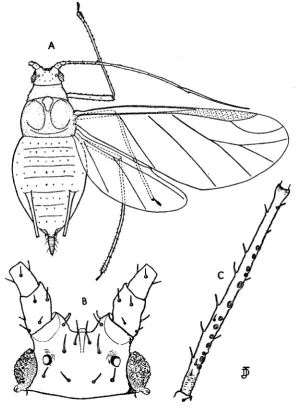
Alate viviparous female (fig. 4)
Head and thorax black, shiny, with a pale yellowish-green, transverse band anterior and posterior of pronotum ; abdomen with black transverse patches, the intervening areas being a pale, dirty yellowish-green; these dark areas fuse more or less irregularly in the posterior region, which thus appears brownish- black and shiny; small dark patches along lateral margins of abdomen ; on the ventral side meso-and meta-thorax black and shiny, remainder of body dusky yellowish-green, sometimes with small transverse darker areas extending from margins of abdomen.
56
Fig. 4. Rhopalosiphoninus tulipaella (Theo.) : A, winged v. § ; B, head (dorsal view) ; C, segments 3 and 4 of antenna ; D, first stage larva born from apterous v. $, dorsal view.
shorter than iii and slightly longer than v, v about five times length of ii, vi about as long as i -f-ii-f-iii; a few short, faintly capitate hairs on all segments ; a varying number of about 12-18 sensoria along inner margin of segt. iii and about 2-5 on basal portion of segt. iv. THORAX. Wings. Veins dark, well defined, bordered on each
side with a faint narrow, dusky area; stigma dark. Legs with coxae dark, distal half of femora dark, tarsi and tibae dark, basal portion of femora and tibiae paler.
ABDOMEN dark, 4 longitudinal rows of small, facetted areas (wax glands). Cauda dusky brown, conical, finely spinose, about as long as basal part of antennal segt. vi; two pairs of lateral hairs and one median sub-apical hair. Anal plate rounded, bearing a few hairs; genital plate normal. Cornicles dark with irregular lighter patches, about length of antennal segt. iv or v, prominently vasiform, being swollen about one-third length from distal end, usually particularly on the internal face, basal portion narrow, cylindrical, a few well marked reticulations at the apex.
Apterous viviparous female (fig. 5).
bands, more or less segmentally arranged and running together in the region of the cornicles ; a row of small dark patches along lateral margins of the body ; sometimes the insect looks quite dark owing to the dark areas on the abdomen ; venter paler, dirty yellowish green, shiny.
HEAD. Frontal lobes well developed ; head with several small, finely capitate hairs; eyes dark. Antennae slightly longer than the body, pale ochreous to dirty yellowish-green, apices of segts. darker, as also proximal portion of segt. vi; segt. i wider and slightly longer than ii, iii about eight times length of ii, iv about four times length of i, v slightly shorter than iv, vi about as long as iv+v ; segt. iii with 2-3
Fig. 5. Rhopalosiphoninus tulipaella (Theo.) : A, apterous v. $ ; B, segment 3 of antenna ; C, cauda and anal plate (dorsal view) ; D, cornicle.
sensoria near its base ; a few faintly capitate hairs on all segments. THORAX. Legs
pale to dirty yellowish-green, tarsi darker, as also distal end of femora and tibiae.
ABDOMEN. Four longitudinal rows of small facetted areas (wax glands) faintly developed. Cauda pale yellowish-green to brownish-green, conical, finely spinose, about one-fifth length of cornicles and about length of antennal segt. i, with two strong hairs on each side, and one median subapical hair. Anal plate rounded, with a few hairs ; genital plate normal. Cornicles dark at base and apex, paler about the middle, as long as or slightly longer than antennal segt. iii, prominently vasiform, usually slightly more swollen on internal face, narrow and cylindrical towards proximal end, with a few reticulations at the apex.
Male. Unknown.
58 J. DAVIDSON.
This species was first described by Theobald in 1916 (I.e.) from tulips and violets. Tulip bulbs received by the writer from Wisbeach on 7.xii.l925 were slightly infested with a few immature forms. The bulbs were planted in sand in a glasshouse, and by the 18th December several adults were present and small colonies going well. By 13th January 1926 the leaves of the bulbs were well forward and the Aphids developed readily on the young leaves, the plants being heavily infested, as is shown in the photograph (Plate iii). In many cases the leaves were distorted as they unfolded, owing to the effects produced by the Aphids, and were brown and shrivelled at the tips. By the 27th January most of the plants were heavily infested with winged and apterous forms and were severely damaged by them; in some cases the leaves of the tulips failed to open and became discoloured, eventually dying. At the end of October 1925, some tulip bulbs were received from Llandudno ; it was stated that the bulbs had been in a sack for about three weeks ; they were slightly infested with R. tulipaella. Tulip bulbs slightly infested with this species were also received from Merton in December 1925.
In the case of this species, only a few isolated Aphids were found on the bulbs, which contrasts with the case of infestation with Anuraphis tulipae. The fact that colonies of R. tulipaella progressed so readily on the leaves indicates that this is the more normal habit (which contrasts with the habits of A. tulipae), although they can live on the dormant bulbs and by this means are readily distributed. Theobald records that this species also lives in the tulip blossoms.
The alate v. females produced apterous v. females and, as Theobald has pointed out, the offspring of the former are yellowish white in colour, while those of the apterous v. females are darker.
Although large numbers of the insects were reared, no sexual forms were obtained, and it is evident that the species is able to reproduce parthenogenetically throughout the winter. Like A. tulipae, it is able to live on the stored bulbs during winter and start the infestation of the developing leaves, in the spring.
Macrosiphuoi gei (Koch).
1855. Siphonophora gei, Koch, Die Pflanzenlause Aphiden, p. 171. 1926. Macrosiphum gei (Koch), Theobald, British Aphides, i, p. 108.
Winged viviparous female (fig. 6.).
Body light to dark green, head somewhat darker with a narrow dark border along posterior margin, thorax dark green to brownish, abdomen yellowish green ; the ventral surface light green with thorax darker green.
HEAD. Somewhat narrow, with many finely capitate hairs ; eyes black ; ocelli
well developed. Antennae with the two basal segments pale green, remainder dark or fuscous ; as long as or longer than the body ; segt. i wider and a little longer than ii, iii about ten times length of ii, iv about eight times length of ii, v slightly shorter than iv, vi nearly as long as iv+v ; iii with about 14 sensoria in a row along its internal face, extending about three-fourths of length of segt.; several small, faintly capitate hairs on all segments. THORAX. Wings with well-defined dark veins and
greenish-brown stigma. Legs, coxae and trochanters green, femora and tibiae somewhat darker green and darker at distal ends, tarsi dark. ABDOMEN. Elongate, with
rows of short hairs on all segments. Cauda not quite half length of cornicles, pale green, ensiform, finely spinose and bearing several lateral hairs and one or two
sub-apical, median hairs. Anal plate rounded, spinose and bearing a few long hairs;
genital plate normal. Cornicles yellowish green basally, darker on distal portion,
about as long as antennal segt. iii, slender, tapering distally, reticulate at distal end
Apterous viviparous female.
Body green to yellowish green, more or less uniformly yellowish green on the venter.
HEAD green, bearing a few short hairs; eyes black; rostrum yellowish green, darker at distal end, reaching to coxae ii. Antennae as long as or longer than the
Fig. 6. Macrosiphum gei (Koch), from tulips : A, winged v. $ ; B, head (dorsal view) ; C, segment 3 of antenna.
body, fuscous, apex of segments darker and also the whole of segt. vi; segt. i wider and slightly longer than ii, iii about nine times length of ii, iv about eight times length of ii, v about seven times length of ii, vi about as long as iv+v ; iii with a few (about 3) round sensoria on inner face, near its base ; all segts. with a few faintly capitate hairs. THORAX. Legs yellowish green with dark tarsi and distal end of tibiae and
60 J. DAVIDSON.
slightly less than half length of cornicles, pale green, ensiform, finely spinose, bearing several lateral hairs and one or two sub-apical, median hairs. Anal plate and genital
plate as in w.v. female. Cornicles pale green basally, darker on distal portion, about
as long as antenna! segt. iii, reticulate at distal end for about one-fifth of the length.
Fig. 7. Macrosiphum gei (Koch), from tulips : A, apterous v. $ ; B, segment 3 of antenna ; C, cauda and anal plate (dorsal view) ; D, cornicle.
Male. See Theobald (I.e., p. 110).
Oviparous female. See Theobald (I.e., p. 111).
infested by the end of April. This Aphid was also collected by myself on tulips at Harpenden, 9.vi.l926, and the same species was received through Mr. Stenton from tulips at Spalding, Lines., 15.iii.1926.
The insect fits Koch's description of gei, which Theobald (I. c.) has shown to be the same species as Macrosiphum solanifolii (Ashmead). This widely polyphagous species has many varied food-plants and can reproduce parthenogenetically throughout winter under favourable conditions. Miss Patch (Maine Agric. Expt. Sta. Bull., no. 242, 1915, pp. 205-223) shows that in America, rose trees are the normal winter host for the overwintering eggs of solanifolii. Theobald (Jl. Roy. Hort. Soc, 1925, i, p. 33) records solanifolii as common on tulips. I have not found this insect on dormant bulbs, the species having been collected only from the aerial portions of the plant.
Myzus persicae (Sulz).
1776. Aphis persicae, Sulzer, Abgek. Gesch. Ins. p. 105, pi. xii.
This widely polyphagous species frequently occurs on tulips, and its presence on many glasshouse plants and the fact that it readily reproduces parthenogenetically throughout the winter under favourable conditions, account for its presence on tulips in early spring. The writer has received specimens taken from tulips in March. This species has received considerable attention in the literature, and a good account is given by Theobald (British Aphides, 1926, i, p. 318).
Control Measures.
Anuraphis tulipae and Rhopalosiphoninus tulipaella are the two most important
species associated with stored bulbs, and owing to the numbers of alate virginoparae which develop, it is evident that infested bulbs should be isolated and subjected to treatment in order to prevent widespread infestation of other bulbs in the warehouse. Theobald (1923, Bull. 3, p. 7) recommends half an hour's fumigation with tobacco shreds. Two minutes' immersion of infested bulbs in a bath of nicotine and soft soap (\ oz. nicotine, 95-90 p. c. and 2 oz. soft soap to 10 gals, of water) and afterwards allowing them to dry gradually was also found effective.
Recently Stenton (Jl. Min. Agric. 1926, xxxii, pp. 1037-1401) obtained good results by fumigating infested bulbs with dry crystals of paradichlorbenzene. The bulbs are placed in a fumigating box or chamber and exposed to the vapours of the paradichlorbenzene for not less than 48 hours; the quantity of crystals found to be effective was 4 oz. to a square foot for a single layer of bulbs. The fumigation was found to be more efficient when a cloth or blanket was dipped into a solution of paradichlorbenzene in carbon tetrachloride and, after being dried for a few minutes, placed between layers of bulbs in the fumigation box, instead of the loose crystals between sacking as in the former method.
Essig (Insects of Western North America, 1926, p. 236) states that infested bulbs should be soaked for several hours in 1 part of 40 p.c. nicotine sulphate solution to 1,000 parts of water, or thoroughly covered for a like period in 2 p.c. pure nicodust.
In any case a close inspection of bulbs when received for storage in the warehouse is desirable, so that infested bulbs may be isolated for appropriate treatment.
Clean bulbs may become infested not only by the alate forms, but also by the apterous forms crawling from one bulb to another.
62 J. DAVIDSON.
SUPPLEMENTARY NOTE :—Essig (Insects of Western North America, 1926, p. 236) states that Anur aphis tulipae is common throughout California, being a European species which has been carried over the country on tulips, iris plants and bulbs.
Aphis viridis, Del Guercio, is given as a synonym; presumably the latter species is