in the population sciences published by the Max Planck Institute for Demographic Research Konrad-Zuse Str. 1, D-18057 Rostock · GERMANY www.demographic-research.org
DEMOGRAPHIC RESEARCH
VOLUME 20, ARTICLE 16, PAGES 377-402
PUBLISHED 16 APRIL 2009
http://www.demographic-research.org/Volumes/Vol20/16/ DOI: 10.4054/DemRes.2009.20.16
Research Article
The decline of son preference and rise of gender
indifference in Taiwan since 1990
Tin-chi Lin
© 2009 Tin-chi Lin.
This open-access work is published under the terms of the Creative Commons Attribution NonCommercial License 2.0 Germany, which permits use, reproduction & distribution in any medium for non-commercial purposes, provided the original author(s) and source are given credit.
1 Introduction 378
2 Son preference in Taiwan 379
3 Theory and literature review 382
4 Data, measurement, and summary statistics 384
4.1 Data 384
4.2 The dependent variables and a measurement issue 384 4.3 Independent and control variables 386
4.4 Summary statistics 387
5 Descriptive analysis 388
6 Multivariate analysis 390
7 Explaining the whole society’s shift in the preference 393
8 Discussion 396
9 Conclusion 398
10 Acknowledgements 398
The decline of son preference and rise of gender indifference
in Taiwan since 1990
Tin-chi Lin1
Abstract
This study explores the change of married women’s sex preference for children in Taiwan since 1990, finding that there was a substantial decline of son preference and rise of “gender indifference”, defined as feeling indifferent about children’s sex (as opposed to desiring an equal number of boys and girls, in which the sex of children is still a primary consideration). Results show that at the individual level female education was the strongest predictor for the preference; education was negatively associated with son preference and positively with gender indifference. Cohort difference was noticeable as well. Younger cohorts were better educated than older ones hence they were more neutral about the sex and less adherent to the traditional male preference. In addition from 1992 to 2002 there was a universal intra cohort movement toward gender neutrality and away from son preference. When the younger cohorts gradually replaced the older ones as the main child bearers in Taiwanese society, at the aggregate level son preference declined and gender indifference rose.
1. Introduction
In addition to “daughter preference”, two forms of parental sex preference are likely to emerge to replace the traditional son preference as it has declined: “gender indifference” or “gender balance”. Gender balance is defined as desiring an equal number of boys and girls, in which the “sex” is still a main consideration. By contrast, gender indifference indicates a situation in which parents feel that the sex does not matter, where a boy is as good as a girl (or vice versa); therefore no particular sex combinations are desired.
Theoretically, when gender inequality has been eliminated or gender roles have become identical in a society, one sex would not be treated more favorably than the other, and parents would have little incentive to prefer one sex to the other. However, the transition of fertility preference may go the other way: the gender system was once so entrenched in the culture that even when differentiation of sex roles has been erased, new parents still want children of both sexes because their perception about gender is not synchronized with the “actual” social change. In the West, both types of transition – gender indifference (Pollard and Morgan 2002) and gender balance (Kippen, Evans, and Gray 2007) – have been observed.
However, no existing demographic research has addressed “gender indifference” or “gender balance” as an issue of Asian populations or explored the recent development of parental sex preference in Asian societies (with Chung and Das Gupta (2007) being an exception). Son preference in many newly industrialized Asian societies is expected to have declined and a new form of parental sex preference is expected to have emerged, because these societies have experienced substantial social development for more than two decades. As an example, Chung and Das Gupta (2007) found that son preference in Korea had declined since 1990, although the authors did not investigate which type of preference was replacing it.
2. Son preference in Taiwan
Over the past thirty years there has been a rapid economic growth, a rise in women’s status, and even a dramatic change in the political system in Taiwan, all of which may have fundamentally changed traditional social values, including the preference to have a son.
Taiwan is a society with a strong Confucian heritage; high fertility and preference of male children were viewed as normative in Confucian ethics (Tang 1995). In addition, men had higher social status than women, and presumably only boys could continue the family lineage, which was considered the fundamental principle of filial piety, the starting point of all human relationships defined in Confucianism. Thus, it is not surprising that son preference in Taiwan was “pervasive and extreme” (Arnold and Liu 1986) and well documented in the literature prior to 1990 (Coombs and Sun 1981; Williamson 1976).
After 1990, however, a new sex preference for children may have emerged to replace the traditional male preference. First, the economy grew rapidly after 1970 and large-scale urbanization ensued, both of which reshaped the social structure and traditional social norms; the GDP per capita increased from $394 in 1970 to more than $14000 in 2000 (National Statistics, Taiwan, 2008). Second, fertility dropped dramatically, indicating that families were developing new reproductive preferences to adapt to the newly industrialized society; TFR decreased from 4.53 in 1970 to 1.34 in 2002 (Ministry of Interior, Taiwan, 2007). Concurrent with the economic expansion and fertility decline was a rise in female socioeconomic status, characterized by a growing proportion of female students in college (Figure 1), a growing female labor participation rate, and a shrinking gap between female and male labor participation (Figure 1).
Figure 1: Rising female socioeconomic status in Taiwan after 1980
Female & male labor participation rates, Taiwan
0% 20% 40% 60% 80% 100%
1980 1985 1990 1995 2000
year
Male Female
(Source: Macroeconomic Database, National Statistics, Taiwan)
Percentage of college students who are female, Taiwan
0 10 20 30 40 50 60
1980 1985 1990 1995 2000 2005
year
%
Table 2: Son preference of Taiwanese married women at childbearing age:
“If you had your ideal number of children, but no boys, would you try to have more children in hopes of having at least one boy?
Would you stop after a certain number of girls?”
NO YES
stop after a certain number try regardless
1973 48.20% 15.40% 36.40%
1979 66.90% 18.07% 15.03%
1986 77.95% 16.92% 5.43%
Source: KAP (Knowledge, Attitudes and the Practice of Contraceptives) surveys, 1973, 1979 and 1986.
The desire to have a son declined. In 1973 almost half of the women would have tried for more children in order to have at least one boy even if they already had their desired number of children; in 1986, less than one-fourth would have done so. Furthermore, the intensity of son preference also diminished. In 1973, over 30% would have tried to have at least one son regardless of the number of additional pregnancies; while in 1986 the comparative figure was 5%. The figures also suggest that son preference, once strong in Taiwan, seems to have begun to decline well before 1990.
The ideal sex combination of children provides another way to measure son preference; here son preference can be defined as desiring more boys than girls. Below is the change in the ideal sex combination derived from the same series of surveys:
Table 3: The ideal sex combination of children of Taiwanese married women at childbearing age
More boys Equal numbers Sex doesn't matter More girls
1973 48.03% 48.45% 2.75% 0.77%
1979 44.79% 46.45% 7.68% 1.08%
1986 33.78% 54.46% 9.80% 1.95%
1992 27.28% 46.92% 22.43% 3.37%
1998 22.62% 43.66% 29.22% 4.50%
2002 12.44% 45.88% 35.15% 6.54%
The proportion of women desiring more sons than daughters declined substantially, from 48% in 1973 to 12% in 2002. Meanwhile, a new type of preference seems to have emerged; more and more women responded that the sex did not matter when asked of their ideal sex combination of children. In this study, such neutrality is called “gender indifference”. The proportion of gender indifference rose substantially, from 3% in 1973 to 35% in 2002.
Compared with gender indifference, “gender balance” – desiring an equal number of boys and girls – shows only moderate variation over 30 years except perhaps 1986. Thus this study will focus on the categories that have undergone the most dramatic change, i.e. son preference and gender indifference. I hypothesize that the rising female socioeconomic status drives the change, based on the following spelled out theory.
3. Theory and literature review
The key hypothesis of this study is that a rise in female socioeconomic status leads to a decline in son preference and a rise in gender indifference. For an individual woman, a better socioeconomic standing can be used to break the unequal status between women and men prescribed in a traditional society, which is a fundamental cause of son preference . For a society, when women’s status improves through education or employment, the role of men and women becomes less traditional and the society is expected to be more neutral about the gender of an individual and the sex of children. Since men no longer dominate all social arenas, sons are not as absolutely non-substitutable as before. Son preference thus declines.
The concept that rising female socioeconomic status would reduce son preference and increase gender indifference is consistent with a large body of sociological literature on rising female socioeconomic status and diminished traditional gender role attitudes. Thus, in this study, sociological literature is used to support the argument that improvement in female socioeconomic status will bring about change in sex preference for children. The relationship between “female SES and gender ideology” should be similar to the relationship between “female SES and sex preference” because:
(1) gender ideology is a concept broader than sex preference for children, and therefore (2) a woman of more equal gender role attitudes is expected to be less submissive to the traditional parental gender preference for children.
non-traditional gender attitudes in the other three dimensions. Studies focusing on areas other than China also support the idea that higher socioeconomic status brings about less-traditional gender attitudes (Molm 1978, Huber and Spitze 1981, Thornton, Alwin, and Camburn 1983, Tallichet and Willits 1986, Cassidy and Warren 1996, Harris and Firestone 1998, Bolzendahl and Myers 2004, Corrigall and Konrad 2007). Overall, these studies maintain that a shift toward equal gender role occurs because of the pragmatic interest of gender equality (especially for women) or because of more exposure to a non-traditional role through employment and education. The results of above seven studies are robust; five of them utilize panel data, where the causal role of schooling or employment on attitudinal change is ascertained; rising socioeconomic status contributes to non-traditional gender roles. In these studies, socioeconomic status is represented by labor participation or education, and the effect on women is usually stronger than on men.
With regards to the causal mechanism, more employment experience and higher occupational position are expected to weaken traditional gender ideology because working skills provide women with confidence and economic independence from men. The experience of increasing skills and rising confidence also “dispel the myths about women’s capabilities to perform in the work place” (Bolzendahl and Myers 2004: 762), and hence fosters the belief for equal gender roles. Women of higher occupational position are expected to have a less traditional view about gender roles because they are more likely to participate in a less gendered social environment than their counterparts, who have less occupational prestige. Similarly, education is expected to make women less conforming to traditional gender roles due to empowerment and enlightenment. Empowerment occurs since education provides better employment opportunity for the female. Enlightenment takes place through mixing with people of more equal gender belief such as informed teachers. Moreover, when gender equality has become more acceptable, it will be reflected in the education system, which then would influence students to meet the expectations of a more equal society.
4. Data, measurement, and summary statistics
4.1 Data
To investigate social change over time, repeated cross-sectional data is favored because it covers different cohorts over time. Three waves of cross-sectional data will be used: the 1992 and 1998 KAP (Knowledge, Attitudes, and Practice of Contraceptives) Surveys of Taiwan, and the 2002 National Survey on Knowledge, Attitudes and Practice of Health Promotion in Taiwan. (All the surveys were conducted by the Bureau of Health Promotion of Taiwan.) The 2002 NSKAP survey is the most recent for which data are publicly available. All the surveys were conducted via in-person interviews with a special focus on married women’s fertility history and preference. The response rates were 90%, 75% and 82% in 1992, 1998 and 2002, respectively.
All the surveys selected national representative households through multiple-stage sampling and used the preceding census as the sample frame. The currently married women sample, consisting of 11690 women aged 20-44, 2269 ever married women aged 20-49, and 3651 ever married women aged 17-43, were interviewed in 1992, 1998 and 2002, respectively. To make data comparable across the three waves, only data for women aged 20-44 in 1992 and 1998 and those aged 20-43 in 2002 will be used for the descriptive and multivariate analyses that follow.
This study will not investigate the preference of divorced/widowed women because divorce/widow rates in Taiwan prior to 2000 were low. The 1992 survey interviewed only currently married women; for the other two surveys, after divorced/widowed women are dropped from the sample, there are 2118 and 3561 cases remaining, representing 93.3% and 97.53% of the original ever married women in 1998 and 2002, respectively. The preference of non marital union women is not addressed in this study; birth out of wedlock is still associated with a stigma and remains uncommon, and marriage instead of cohabitation is the expected norm of union formation in Taiwan.
4.2 The dependent variables and a measurement issue
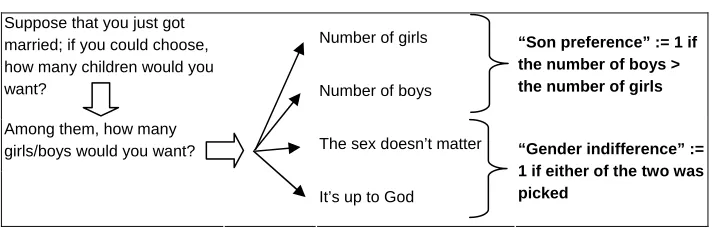
also dichotomous. It is coded as one if the respondent does not show preference for either sex when asked of the ideal number of children, and zero otherwise, as shown in Figure 4. It should be noted that “gender indifference” is not the complement of “son preference”; the full array of sex preferences constitutes four categories, as shown in Table 3.
Figure 4: Definitions for son preference and gender indifference: for Taiwan
Number of girls Suppose that you just got
married; if you could choose, how many children would you
want? Number of boys
“Son preference” := 1 if the number of boys > the number of girls
The sex doesn’t matter Among them, how many
girls/boys would you want?
It’s up to God
“Gender indifference” := 1 if either of the two was picked
While other subjective measures exist for son preference in some of the KAP surveys, only the one this study plans to use was used in all waves. For example, one can measure son preference by inquiring as to a respondent’s willingness to bear another child and note how the response differs by the sex of existing children; if stronger willingness is shown among women who have two girls than those who have two boys, then son preference is indicated. However, this question was asked only in 1992.
4.3 Independent and control variables
There are two key independent variables that measure women’s socioeconomic status – educational attainment and employment. Income is not incorporated into the model because in 1992 the individuals were not asked about their income, and preliminary analysis found that in cross-section, neither income nor the square of income predicted son preference or gender indifference in 1998 and 2002 (result not shown).
Better education and higher employment status are expected to neutralize sex preference and reduce son preference (Chung and Das Gupta 2007). For employment status, “not working” is the reference category, “white-collar” is an indicator for working in a professional or managerial position or other typical white-collar job, and “blue-collar” refers to any occupation other than “white-collar”. Education is coded in years, but for summary statistics and descriptive analysis, educational attainment is grouped into (1) junior high school or less (years of education <=9), (2) high school (10-12 years), and (3) higher education (year of education > 12). The first nine years of education is compulsory.
Table 5 displays the association between education and employment; it would be redundant to incorporate both of them into the analysis if they were highly correlated:
Table 5: Association between education attainment and working status of Taiwanese married women at primary childbearing age
< High school High school Higher edu.
Not working Other occupation
White- collar
Not working Other occupation
White- collar
Not working Other occupation
White-collar
1992 40.3% 45.5% 14.2% 36.9% 22.5% 40.6% 20.3% 3.7% 76.0% 1998 32.1% 52.1% 15.8% 34.0% 22.7% 43.3% 18.0% 3.8% 78.2% 2002 45.4% 39.3% 15.7% 35.7% 23.0% 41.3% 20.8% 3.3% 75.9%
The Spearman’s correlation statistics between education and employment are 0.286, 0.324 and 0.368 in 1992, 1996 and 2002, respectively (all significant at 0.05 level). Therefore, employment status is generally associated with education, but the association is not perfect and working status and education attainment should still be examined individually. In particular, among the college-educated women, about one- fifth were unemployed, indicating the necessity to incorporate information from both education and occupation into the analysis.
cities is expected to be associated with a more neutral preference because of a greater exposure to new ideas and to weaker traditional values (Weinstein et al. 1990).
There are two categories for living arrangement: living with the husband’s parents (a three-generation family) or not (a two-generation family). Living arrangement may correlate with a sex preference for children, because a woman might be subject to more pressure from the husband’s parents to continue the family lineage in a three-generation family. Alternatively, since a traditional society expects a married woman to live with the husband’s family, living with the husband’s parents may suggest a woman’s stronger conformity to traditional values (Weinstein et al. 1990), including son preference.
It should be noted that while the measurement for living arrangement used by the three surveys is not identical, this does not pose a concern for the analysis. The 1992 measurement counts those living only with the husband’s parents, while in 1998 and 2002 the measurement includes women living with their own parents or the husbands’ parents. Since it is still uncommon for a wife to live with her original family, the author would still view the “living with parents” indicator as a reasonable proxy for living with the husbands’ parents in the surveys.
4.4 Summary statistics
All the summary statistics and discrete inferences use the weights provided by the surveys.
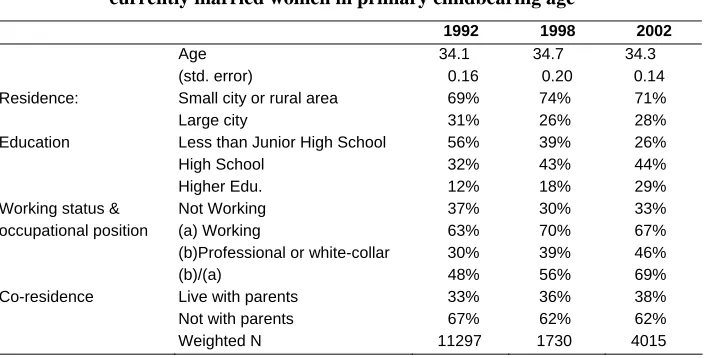
Table 6 summarizes the independent variables. The most dramatic changes are the Taiwanese women’s educational attainment and working status. The proportion of junior high school graduate or less dropped from 56% in 1992 to 26% in 2002, a decline of over 50%. Meanwhile, the percentage of women with at least some college education increased by over twofold, from 12% to nearly 30%.
Table 6: Summary statistics of independent and control variables (weighted): currently married women in primary childbearing age
1992 1998 2002
Age 34.1 34.7 34.3
(std. error) 0.16 0.20 0.14
Residence: Small city or rural area 69% 74% 71%
Large city 31% 26% 28%
Education Less than Junior High School 56% 39% 26%
High School 32% 43% 44%
Higher Edu. 12% 18% 29%
Not Working 37% 30% 33%
Working status &
occupational position (a) Working 63% 70% 67%
(b)Professional or white-collar 30% 39% 46%
(b)/(a) 48% 56% 69%
Co-residence Live with parents 33% 36% 38%
Not with parents 67% 62% 62%
Weighted N 11297 1730 4015
Source: the KAP (Knowledge, Attitudes, and Practice of Contraception) in Taiwan, 1992 and 1998, and the 2002 National Survey on Knowledge, Attitudes and Practice of Health Promotion. All the surveys are conducted by Bureau of Health Promotion, Taiwan.
5. Descriptive analysis
Tables 7 and 8 present weighted statistics on married Taiwanese women’s socio-economic status and their sex preference for children at three points in time. As the theory predicts, higher socioeconomic status of women is associated with weaker son preference and stronger gender indifference. In addition, the two tables reveal several patterns worth noting: (1) in every socioeconomic group over time, there was a ubiquitous decline in son preference and a rise in gender indifference; (2) the gap in the sex preference between higher and lower socioeconomic groups diminished over time; and (3) education seems to have a larger effect than employment – the difference between women of various educational backgrounds was greater than the difference between women of different employment statuses.
across employment status is similar but in a smaller magnitude. In 1992, 21 % of white-collar women had son preference compared with 30% of blue-white-collar or homemakers, but over time the difference decreased from 9 percentage points in 1992 to 3 percentage points in 2002.
Regarding gender indifference, Table 8 shows that in 1992, 27% of women with high school education or more showed indifference about the sex, while only 19% of women with less than high school did. Over time the gap between the two groups of women diminished – from 8 percentage points in 1992 to 2 percentage points in 2002. The difference in gender neutrality across employment status is similar. In 1992, 26 % of white-collar women showed gender indifference while 21% of blue-collar or homemakers showed this tendency. In 2002, the difference between the two groups became statistically non significant, though.
Table 7: Weighted proportion of Taiwanese currently married women at primary childbearing age with son preference by education and by occupational position over years
At least high school
(Less than high school)
White-collar, professional, administrative
(Other occupation & homemaker)
Weighted N
1992 *19.80% 33.07% *21.20% 29.88% 11297
1998 *18.48% 29.02% *18.52% 25.24% 1730
2002 *11.41% 15.24% *10.57% 14.01% 4015
Note: “*” indicates significant proportional difference (p<0.05) with respect to the reference group; reference group is in parenthesis
Table 8: Weighted proportion of currently married Taiwanese women at primary childbearing age showing gender indifference by education and by occupational position over years
At least high school
(Less than high school)
White-collar, professional, administrative
(Other occupation & homemaker)
Weighted N
1992 *26.67% 19.15% *25.74% 20.99% 11297
1998 29.74% 28.42% 30.72% 28.30% 1730
2002 35.73% 33.57% 35.89% 34.52% 4015
6. Multivariate analysis
To estimate the relationship between SES and preference, I use logistic regression with sample weights2 designated from the surveys. The dependent variable, son preference (or gender indifference) is dichotomous. To assess the effect of education properly, I exclude women younger than 20, because it is likely that they haven’t completed their education. Regarding the goodness-of-fit test, the usual Hosemer-Lemeshow method does not apply because observations are not independent in a complex survey design. I use an alternative test (Archer and Lemeshow 2006) that takes into account sample weights and survey design; a p-value of the test below 0.05 indicates lack of fit.
Regarding the fitness of the model, the p-values of the Archer-Lemeshow test for model II are 0.58 and 0.06 for son preference and gender indifference, indicating no evidence of lack of fit. Excluding cohorts as predictors leads to a poorer fit (model I); the p-values for son preference and gender indifference are 0.007 and 0.009, indicating fitted values’ departure from observed data. Thus only the estimation in model II will be interpreted.
Consistent with the previous bivariate analysis, in the multivariate model education remains strongly associated with non-traditional sex preference, and the association is stronger than the association between sex preference and working status/occupation, substantively and statistically. Notice that all the educational effects are statistically significant at the 0.001 level. High school education reduces the odds of son preference by 34% and increases the odds of gender indifference by 26%, net of other covariates. The difference between the reference group and the most educated group is even larger; other things being equal, college education reduces the odds of son preference by 50% and increases the odds of gender indifference by 45%.
Higher occupation status is only associated with lessened son preference; the odds of white-collar women having son preference are 83% of the odds of women who are not working, net of other variables. Higher occupational status does not predict a higher level of gender indifference.
How sensitive is the explanatory power of education to the particular statistical model that I chose? To enhance the robustness of the inference, I use an ordered-logistic model to examine education and employment’s predictive power on the preference.
2 I incorporate sample weights into the analysis because the weights are informative (Winship and Radbill
Table 9: Effect of socioeconomic status on son preference/gender indifference of Taiwanese married women in primary childbearing age; weighted logistic regression on three cross-sectional national fertility surveys – 1992, 1998 and 2002
Taiwan Son preference Gender indifference
Model (I) (II) (I) (II)
odds ratio odds ratio odds ratio odds ratio
Education (< High school)
High school 0.618*** 0.659*** 1.243*** 1.261***
College or above 0.476*** 0.502*** 1.426*** 1.447*** Working status (Not working )
Blue-collar 0.940 0.922 * 0.928 0.924
White-collar 0.846** 0.831** 1.006 1.001
Residence (Rural area or small cities)
Big cities 0.718** 0.705 ** 1.241# 1.234#
(Not with parents) Living
arrangement Live with parents 1.171 ** 1.232*** 0.844 ** 0.860** Survey years (year 1992)
year 1998 0.850 0.932 1.390 # 1.424*
year 2002 0.448*** 0.535*** 1.739 ** 1.866***
Cohort (before 1951)
1952-1956 0.899 1.174 #
1957-1961 0.897* 1.104
1962-1966 0.765*** 1.134
1967-1971 0.716 ** 0.985
after 1972 0.520*** 0.891
Weighted N 16734 16734 16734 16734
Archer-Lemeshow test
Statistic
4.332 0.862 4.167 2.551
p-value 0.007 0.577 0.009 0.056
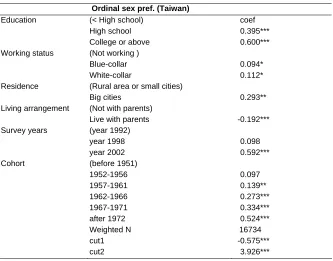
Table 10: Ordered logistic regression on Taiwanese married women’s sex preference for children (0= son preference, 1 = equal preference or indifference about gender, 2 = daughter preference)
Ordinal sex pref. (Taiwan)
(< High school) coef
High school 0.395***
Education
College or above 0.600***
(Not working )
Blue-collar 0.094* Working status
White-collar 0.112* (Rural area or small cities)
Residence
Big cities 0.293**
(Not with parents) Living arrangement
Live with parents -0.192***
Survey years (year 1992)
year 1998 0.098
year 2002 0.592***
(before 1951)
1952-1956 0.097 1957-1961 0.139** 1962-1966 0.273*** 1967-1971 0.334*** Cohort
after 1972 0.524***
Weighted N 16734
cut1 -0.575***
cut2 3.926***
An alternative “sex preference” index is defined as follows:
“sex preference” = 0 if a woman desires more boys than girls (son preference) “sex preference” = 1 if a woman is indifferent about the sex (gender indifference),
or an equal number of girls and boys is desired (“balanced” preference) “sex preference” = 2 if a woman desires more girls than boys (daughter preference)
The order presents a continuous shift from son preference to “indifference” or “balanced preference”, and then daughter preference. Ordered logistic regression is applied to the same data with the same covariates as follows:
The result reaffirms that education is the strongest predictor for non-traditional sex preference. Other things being equal, high school/higher education increases the latent sex preference (toward gender indifference or daughter preference) by 0.40 and 0.60 units, respectively; the educational effect is also significant at 0.001 level. By contrast, the effect of occupation/employment status is much smaller than the effect of education and its significant level is only at the 0.05 level.
7. Explaining the whole society’s shift in the preference
Regression analysis has shown that education is strongly associated with married women’s sex preference for children, but this result was conducted at the individual level and it is unclear to what extent this individual-level finding is relevant to the aggregate-level change in sex preference as shown in Table 3 – another issue that this study aimed to address. Thus the remaining task is to relate the finding at the individual level to the change in the whole society between 1992 and 2002.
Figure 11: Years of schooling of Taiwanese married women at childbearing age
6
8
10
12
14
y
e
ar
o
f ed
u
ca
ti
on
c
o
mp
lete
d
1940 1950 1960 1970 1980
year of birth
Data: the KAP survey in1992, 1998, and the 2002 National Survey on Knowledge, Attitudes and Practice of Health Promotion. Note: only women over 25 years old are included because otherwise they may not have completed their education.
Figure 11 indicates that the younger cohorts were much better educated than the older ones. For example, the cohorts born after 1970 had on average no less than twelve years of education, while the pre-1950 cohorts had only eight years or less.
Figure 12: Lexis diagram of son preference of Taiwanese married women at childbearing age 12% 18%
·
·
·
After 1972 12% 21% 23%·
·
1967-1971 13% 20% 25% 25%·
1962-1966 17% 26% 27% 28% 48% 1957-1961·
28% 28% 32% 43% 1952-1956·
32% 31% 42% 42% 1947-1951 2002 1998 1992 1986 1980 Year CohortSource: KAP Surveys V – VIIII
Figure 13: Lexis diagram of “gender indifference” of Taiwanese married women at childbearing age
32% 24%
·
·
·
After 1972 37% 29% 18%·
·
1967-1971 38% 31% 23% 12%·
1962-1966 33% 32% 23% 10% 8% 1957-1961·
26% 24% 11% 10% 1952-1956·
24% 20% 9% 8% 1947-1951 2002 1998 1992 1986 1980 Year CohortThe shaded in area in Figure 12 indicates the timing in which the 1957-61, 1962-66, 1967-1971, and the after 1972 cohorts entered childbearing age, respectively; alternatively it indicates the youngest cohort in each survey year. When the 1957-61 cohorts entered childbearing age, 48% of them desired more boys than girls, while the comparative figures for the other three cohorts were 25%, 23% and 18%, respectively, reflecting a steady decrease in son preference that is consistent with an increase in education at the cohort level (Figure 11). A similar but opposite trend is observed when it comes to gender indifference (Figure 13). As the 1957-61 cohorts entered childbearing age, only 8% of them felt indifference about the sex, but the comparative figures for the other three cohorts are 12%, 18% and 24%, respectively.
In addition to the inter-cohort difference, for all cohorts there had been a ubiquitous intra-cohort movement toward gender neutrality and away from son preference over time. Take the 1962-1966 cohorts for example. When they arrived at childbearing age in 1986, only 12% of them were indifferent about the sex (Figure 13). But the proportion grew to 23%, 31% and 38% in 1992, 1998 and 2002, respectively, attesting the within-cohort preferential change over time. The son preference of the same cohorts also declined concurrently. In 1986, 25% of them desired more sons than girls but the percentage decreased by about a half to 13% in 2002 (Figure 12).
The inter-cohort difference and intra-cohort change altogether resulted in the society’s shift in the preference between 1992 and 2002. In 2002 the population was composed of the four youngest cohorts who had less traditional sex preference than their older counterparts. By contrast, in 1992 the population included the 1947-1951 and 1952-1956 cohorts, both of which were less educated and more adherent to the traditional preference than the younger ones. In addition to the compositional difference, over time all cohorts’ son preference had been weakening and gender indifference had been strengthening. As the younger cohorts gradually replaced the older cohorts from 1992 to 2002, the society’s son preference declined and gender indifference rose.
8. Discussion
The author has also conducted a parallel analysis on the Korean population, another newly industrialized Asian society that had strong son preference, as examined by Park and Cho (1995). The result is similar: son preference was declining and gender indifference was rising; education, rather than occupation or employment status, was associated with the change. The result regarding Korean son preference is consistent with Chung and Das Gupta’s finding (2007) in which they utilized the same data set but another subjective measure for son preference.
Does the change in fertility preference always translate into the change in fertility behavior? This seems to be the case in Korea but not quite true in Taiwan. The Korean sex ratio at birth has steadily declined from 113.6 in 1992 to 110.2 in 2002 (National Statistical Office, Korea, 2008), consistent with the preferential change in this time period. But the sex ratio at birth in Taiwan had not changed significantly; it was 109.9, 108.7 and 109.8 in 1992, 1998 and 2002 (Ministry of Interior, Taiwan, 2007), respectively.
There are several explanations for this seeming inconsistency: (1) the measurement utilized by this study was invalid, (2) the women simply reported an ideal of their own which was inconsistent with their behavior because the actual childbearing decision was pressured by the husbands and their family who had son preference, or (3) the measurement is valid but there was a polarization in fertility behavior; for the majority of the population son preference declined, but the remaining minority with strong son preference utilized sex-selective abortion more frequently, particularly at high parity, so that the overall sex ratio at birth remained unchanged.
9. Conclusion
This study investigates the change in sex preference for children among Taiwanese married women at childbearing age. The proportion of desiring more boys than girls declined from 27% in 1992 to 12% in 2002, and the proportion of gender indifference increased from 22% in 1992 to 35% in 2002. Education is strongly associated with the sex preference while employment or occupation is generally not; education reduces son preference and leads to a higher degree of gender neutrality.
Cohort difference and intra-cohort change leads to the shift in the preference at the aggregate level. The younger cohorts acquired much more education than their older counterparts and hence had weaker son preference and stronger gender neutrality. In addition, there was a ubiquitous shift toward gender neutrality across all social groups between 1992 and 2002. As the younger cohorts gradually built up their families and replaced the older cohorts as the main child bearers, preference of the younger cohorts dominated the society and eventually the society’s son preference declined and gender indifference rose.
10. Acknowledgements
References
Archer, K. and Lemeshow, S. (2006). Goodness-of-fit test for a logistic regression model fitted using survey sample data. The STATA Journal 6(1): 97-105.
Arnold, F. and Liu, Z. (1986). Sex preference, fertility and family planning in China. Population and Development Review 12(2): 221-246. doi:10.2307/1973109.
Bolzendahl, C. I. and Myers D. J. (2004). Feminist Attitudes and Support for Gender Equality: Opinion Change in Women and Men, 1974–1998. Social Forces 83(2): 759-790. doi:10.1353/sof.2005.0005.
Brockmann, H. (2001). Girls preferred? Changing patterns of sex preferences in the two German states. European Sociological Review 17(2): 189-202.
doi:10.1093/esr/17.2.189.
Cassidy, M. L. and Warren, B.O. (1996). Family Employment Status and Gender Role Attitudes: A Comparison of Women and Men College Graduates. Gender and Society 10(3): 312-329. doi:10.1177/089124396010003007.
Chen, J., Xie, Z., and Liu, H. (2007). Son preference, use of maternal health care, and infant mortality in rural China, 1989–2000. Population Studies 61(2): 161-183.
doi:10.1080/00324720701340194.
Chung, W. and Das Gupta, M. (2007). The decline of son preference in South Korea: the roles of development and public policy. Population and Development Review 33(4): 757-783. doi: 10.1111/j.1728-4457.2007.00196.x.
Clark, S. (2000). Son preference and sex composition for children: Evidence from India. Demography 37(1): 95-108. doi:10.2307/2648099.
Coombs, L. and Sun, T. (1981). Familial values in a developing society: A decade of change in Taiwan. Social Forces 59(4): 1229-1255. doi:10.2307/2577991.
Corrigall, E. A. and Konrad, A. M. (2007). Gender role attitudes and careers: A longitudinal study. Sex Roles 56(11-12): 847-855. doi:10.1007/s11199-007-9242-0.
Das Gupta, M. (1987). Selective discrimination against female children in rural Punjab, India. Population and Development Review 13(1): 77-100.
doi:10.2307/1972121.
Graham, M. J., Larsen, U., and Xu, X. (1998). Son Preference in Anhui Province, China. International Family Planning Perspectives 24(2): 72-77.
Harris, R. J. and Firestone, J. M. (1998). Changes in predictors of gender role ideologies among women: A multivariate analysis. Sex Roles 38(3-4): 239-252.
doi:10.1023/A:1018785100469.
Huber, J. and Spitze, G. (1981). Wives' employment, household behaviors, and sex-role attitudes. Social Forces 60(1): 150-169. doi:10.2307/2577937.
Kippen, R., Evans, A., and Gray, E. (2007). Parental preference for sons and daughters in a Western industrial setting: Evidence and limitations. Journal of Biosocial Science 39: 583-597. doi:10.1017/S0021932006001477.
Leone, T., Matthews, Z., and Dalla Zuanna, G. (2003). Impact and determinants of sex preference in Nepal. International Family Planning Perspectives 29(2): 69-75.
doi:10.2307/3181060.
Ministry of Interior, Taiwan. (2007). Database of the Department of Household Registration (in Chinese). [electronic resource]. Taipei: Ministry of Interior, Taiwan. Available at http://www.ris.gov.tw/version96/stpeqr00.html.
Molm, L.D. (1978). Sex role attitudes and the employment of married women: The direction of causality. Sociological Quarterly 19(4): 522-533.
doi:10.1111/j.1533-8525.1978.tb01196.x.
National Statistical Office, Korea (2008). Korean Statistical Information Service. [electronic resource]. Seoul: Korea Statistical Office, Republic of Korea. Available at: http://www.kosis.kr/eng/index.htm.
Park, C. B. and Cho, N. H. (1995). Consequences of son preference in a low-fertility society: Imbalance of the sex ratio at birth in Korea. Population and Development Review 21(1): 59-84. doi:10.2307/2137413.
Pollard, M. S. and Morgan, S. P. (2002). Emerging parental gender indifference? Sex composition of children and the third birth. American Sociological Review 67(4): 600-613. doi:10.2307/3088947.
Schoen, R., Astone, N.M., Kim, Y. J., Nathanson, C.A., and Fields, J.M. (1999). Do fertility intentions affect fertility behavior? Journal of Marriage and the Family 61(3): 790-799. doi:10.2307/353578.
Shu, X. (2004). Education and gender egalitarianism: The case of China. Sociology of Education 77(4): 331-336.
Tang, Z. (1995). Confucianism, Chinese culture, and reproductive behavior. Population and Environment 16(3): 269-284. doi:10.1007/BF02331921.
Thornton, A., Alwin, D.F., and Camburn, D. (1983). Causes and Consequences of Sex-Role Attitudes and Attitude Change. American Sociological Review 48(2): 211-227. doi:10.2307/2095106.
Weinstein, M., Sun, T. H., Chang, M. C., and Freedman, R. (1990). Household composition, extended kinship, and reproduction in Taiwan: 1965–1985. Population Studies 44(2): 217-239. doi:10.1080/0032472031000144566.
Williamson, N.E. (1976). Sons or daughters: A cross-cultural survey of parental preferences. Beverly Hills: Sage Publications.
Winship, C. and Radbill, L. (1994). Sampling weights and regression analysis. Sociological Methods & Research 23(2): 230-257.