DEMOGRAPHIC RESEARCH
VOLUME 32, ARTICLE 50, PAGES 1383
−
1408
PUBLISHED 3 JUNE 2015
http://www.demographic-research.org/Volumes/Vol32/50/ DOI: 10.4054/DemRes.2015.32.50
Research Article
Public transfers and living alone among the
elderly:
A case study of Korea’s new income support
program
Erin Hye-Won Kim
This publication is part of the Special Collection on “Living alone: One-person households in Asia,” organized by Guest Editors Wei-Jun Jean Yeung and Adam Ka-Lok Cheung.
©2015 Erin Hye-Won Kim.
This open-access work is published under the terms of the Creative Commons Attribution NonCommercial License 2.0 Germany, which permits use, reproduction & distribution in any medium for non-commercial purposes, provided the original author(s) and source are given credit.
1 Introduction 1384
2 Past literature and the current study 1385
3 The Korean context 1387
3.1 Living arrangements of the elderly in Korea 1387
3.2 Introduction to the Basic Old-Age Pension 1388
4 Data and variables 1390
4.1 Data 1390
4.2 Outcome variable 1390
4.3 Independent variable 1391
5 Research design 1391
6 Results 1395
6.1 Summary of key variables 1395
6.2 Simple difference-in-difference analysis 1396
6.3 Difference-in-difference multivariate regression analyses 1398
7 Discussion 1400
8 Acknowledgments 1404
Public transfers and living alone among the elderly:
A case study of Korea’s new income support program
Erin Hye-Won Kim1
Abstract
BACKGROUND
Despite the significant implications of older adults’ living arrangements for their well-being, it is not clear whether public transfers for the elderly will increase or decrease their independent living. A few natural experiments in the U.S. show that such support increases elders’ living alone owing to their preferences for privacy. There has been little quasi-experimental evidence in Asia, where multigenerational coresidence is prevalent and norms and preferences for that form of living arrangement remain strong.
OBJECTIVE
In 2008 the Korean government introduced the Basic Old-Age Pension (BOAP), a means-tested income support program for elders. This article examines how the program affects unmarried Korean elders’ likelihood of living alone.
METHODS
I analyze the 2005, 2007, 2009, and 2011 waves of the Korean Retirement and Income Study, a longitudinal survey of nationally representative Koreans. The analysis takes a difference-in-difference approach, which compares changes in the living arrangements of two elderly groups, one that received BOAP benefits and the other that did not.
RESULTS
Overall, the program has a negative, not positive, impact on elders’ living alone. A closer look reveals that the transfers helped non-coresident elders to continue living alone and prevented coresident elders from forming one-person households.
CONCLUSIONS
Ambivalent attitudes towards living alone in the transitional Korean society, together with the modest amount of BOAP benefits, appear to explain the mixed results. These findings are particularly relevant to other rapidly changing societies where public elder-support systems are expanding and norms of familial elder elder-support are weakening.
1. Introduction
Older adults who live alone are of particular concern to policymakers. Spouses or younger family members are often natural providers of economic support and physical care for coresident elders, particularly in places where the government old-age security system is immature. Compared to coresident elders, those living alone tend to belong to poorer households and report worse health status (see Casey and Yamada 2002; Young and Grundy 2009, for example). They are also more likely to be socially isolated and to report lower subjective well-being than coresident elders (Diener et al. 2000; Pinquart and Sörensen 2001; Do and Malhotra 2012).
The expansion of social welfare systems is often offered as a key reason for the rise in living alone in developed Western countries (Klinenberg 2012). Accordingly, estimating how the public provision of financial support for the elderly affects their likelihood of living alone is critical to predicting the trend in one-person households, particularly in countries where public elder-support systems are expanding. Despite these significant implications, it is not clear whether public old-age income support increases or decreases independent living among the elderly. Current knowledge of the relationship comes mostly from descriptive cross-sectional studies, which are by nature limited in their ability to make causal inferences due to confounding factors and reverse causality.
To bypass such problems, a handful of studies have utilized natural experiments. A few studies from the U.S. show that such support increases elders’ living alone owing to their preference for privacy (Costa 1997, 1999; McGarry and Schoeni 2000; Engelhardt, Gruber, and Perry 2005; Engelhardt and Greenhalgh-Stanley 2010). By contrast, the expansion of public pensions in South Africa was estimated to have no significant impact (Jensen 2003; Edmonds, Mammen, and Miller 2005). There has been no quasi-experimental study in Asia, where multigenerational coresidence is prevalent and norms and preferences for that form of living arrangement remain strong.
nationally-representative longitudinal survey. The first four waves of the KReIS data this study analyzed were collected in 2005, 2007, 2009, and 2011.
The DD analysis based on the new pension program and the longitudinal data in Korea contributes to the causal evidence. Unlike observational studies using cross-sectional data, using information on both recipients and non-recipients and from both before and after the policy intervention substantially rules out plausible alternative explanations and, hence, enables us to make a causal inference about the effect of BOAP pensions. The results show that elders’ independent living decreased, not increased, as a result of the program. Detailed analysis shows that BOAP benefits helped non-coresident elders to keep living alone but, at the same time, prevented coresident elders from forming one-person households. In the discussion that follows, I interpret these mixed findings in the context of Korea and draw implications for other transitional societies.
2. Past literature and the current study
Considering the negative impact of elders’ living alone on their well-being in the context of less familial support, theories about the impact of public transfers on elders’ living alone can be borrowed from the literature on what motivates private elder support. One hypothesized motive is children’s natural concern for the well-being of their elderly parents (Becker 1974, 1991). The altruism hypothesis posits that one’s utility depends not only on one’s own well-being but also on that of family members. According to the hypothesis, a public transfer displaces or “crowds out” private support by lowering a recipient’s need (Barro 1974). An alternative hypothesis claims that people are selfish, and therefore support, even among family members, occurs only as an exchange (Cox 1987). Along the same lines, elderly parents might use their resources strategically to get more care and attention from their children (Bernheim, Shleifer, and Summers 1985).
(Aassve, Cottini, and Vitali 2013; Kim and Song 2013; Lee and Painter 2013; Matsukura, Retherford, and Ogawa 2011; Mykyta 2012).
Individual preferences and social norms may also play a role. If independent living is the preferred arrangement among older adults, its increased affordability owing to public transfers should cause the arrangement to increase (Edmonds, Mammen, and Miller 2005). Imagine the opposite case where elders who do not receive customary support from children feel dejected. Lundberg and Pollak (1993) argue that providing additional income to an individual may increase his or her influence within the family. In that case, public transfers might help elders to align their actual living arrangement with the one they prefer. In a situation where children who violate the norm of caring for parents are stigmatized and punished (see Bianchi et al. 2008 for a discussion of social norms in familial elder support), an increase in parents’ financial resources from public transfers and the ‘warm glow’ from performing filial duty may act as a double incentive to provide further support.
Some empirical studies have examined how public transfers affect elders’ living alone. However, current knowledge of the relationship is based mostly on descriptive cross-sectional studies, which are by nature limited in their ability to make the causal inferences due to reverse causality and confounding factors. For example, public transfers targeted at older adults, especially if they are means-tested, often counter an elder’s living arrangement as an eligibility criterion for the provision. Some studies ignore the possibility that elderly recipients’ own income prior to public transfers is endogenous, in the sense that elders’ decisions about how much to work or how much wealth to transfer to children may be influenced by their expectation of receiving the benefits.
To bypass such problems, a handful of studies have utilized natural experiments. Quasi-experimental studies from the U.S. unanimously support that expanded public transfers caused an increase in American elders’ independent living. Furthermore, the studies attribute the finding to elders’ preference for privacy. For example, Costa (1999) and McGarry and Schoeni (2000) showed that among widows, Old Age Assistance and Social Security caused a rise in independent living. Costa (1997) also found that a Union Army Pension lowered the likelihood of elders living with extended family members. Using an instrumental variable approach, Engelhardt, Gruber, and Perry (2005) estimated the elasticity of the proportion of elders in coresidence with non-elderly household members, with respect to Social Security benefits, as -1.4 for the unmarried and -0.4 for the married. Engelhardt and Greenhalgh-Stanley (2010) found that Medicare home health care benefits significantly decreased extended living among unmarried elders with an estimated elasticity of -0.9.
testing the research question in the context of developing, non-Western countries. Their studies examined the expansion of public pensions in South Africa and found that the expansion had no significant impact. There has been no such quasi-experimental study in Asia, where coresidence with adult children is prevalent and norms of multi-generational coresidence remain strong (Jamieson and Simpson 2013; United Nations 2005). In sum, using the new natural experiment created by the introduction of the BOAP in Korea, this study contributes quasi-experimental evidence on the impact of public financial provision on elders’ living arrangements. In addition, the setting of this study in Korea extends the geographic scope of the literature, thereby providing a better understanding of how cultural context mediates the impact.
3. The Korean context
3.1 Living arrangements of the elderly in Korea
According to Korean Population and Housing Censuses, one-person households have been increasing rapidly, from 4.8% in 1980 to 9.0% in 1990, 15.5% in 2000, and 23.9% in 2010 (Statistics Korea 1980, 1990, 2000, 2010). The proportion is expected to rise continuously, reaching 45.0% in 2035 (Korean Statistical Research Institute 2012). Throughout all census years, people aged 65 or older (elderly people or older adults hereafter) were more likely to live alone than any other age group (Chung et al. 2012a). Moreover, while elders accounted for 17.1% of one-person households in 1980, the proportion increased to 28.4% in 2010.
About one in every five elders lived alone in 2011. Elders reported being widowed and having their children get married as the most common reasons for living alone. In fact, coresident elders lived mostly with their spouses or children (Chung et al. 2012a, 2012b). Almost 50% lived with spouses without a child (hereafter ‘living with spouses’) and 27.3% lived with children with or without spouses (hereafter ‘living with children’). Consistently, elders’ living alone is a dominant phenomenon among the unmarried: while 60% of the unmarried lived alone (and 35.8% lived with children) most married elders lived either with spouses (71.8%) or with children (23.2%). Females lived alone in old age more than males: in 2010 26.3% of the former and 9.8% of the latter lived alone (Statistics Korea 2010). Living arrangements seem to have an impact on elders’ well-being in Korea also. Compared to coresident elders, those living alone tend to belong to poorer households and report lower satisfaction with life (Chung et al. 2012b).
multigenerational coresidence (United Nations 2011). Over the 17-year period between 1994 and 2011, the proportion of older adults living alone increased substantially by 13.6 percentage points, the proportion living with spouses almost doubled, and the proportion living with a child decreased by half. In the 1970s, over 90% of elders coresided with children (Gibler 2001). Such widespread coresidence was based in part on the East Asian Confucian philosophy in which adult children play the dominant role in providing old-age security. Children living with elderly parents was considered a sign of conforming to the norms of filial piety, and sons, especially first sons, were subject to the norms, due to the patriarchal family system (Chui 2007). With the industrialization and modernization of society, the normative ideal of multi-generational coresidence has been weakening, although it still exists.
For these reasons, older adults’ attitudes towards coresidence seem ambivalent. About a quarter of elders still want to live with married children. This preference tends to be stronger among the unmarried, females, and the less educated (Chung et al. 2012b). Interestingly, household income is positively associated with the preference, and in 2011, over 40% of elders in the highest quintile wanted to coreside with their children. At the same time, Korean elders value privacy, as do older adults in the West. Over 60% of people aged 60 or above in one-person households said there were some positive aspects of living apart, and a majority mentioned freedom as the most positive (Chung et al. 2012a).
3.2 Introduction to the Basic Old-Age Pension
Since January 2008 the BOAP program has been providing poor elders with non-contributory pension income. Eligibility for the BOAP depends on age and financial means. In the beginning, the program covered people aged 70 or above, but in 2008 the age limit was lowered to 65. To meet the financial qualifications, the sum of an elder’s annual income and 5% of his/her net assets should be lower than a poverty line. Since the sum excludes transfers from private sources and other means-tested transfers from the government, hereafter I will refer to the sum as ‘own income’.
In 2008 the poverty line was 400,000 Korean won (or 400 kW) per month for unmarried individuals and 640 kW for couples (Korean Ministry of Health and Welfare (KMOHW) 2008).2 With this poverty line, the BOAP aimed to cover about 60% of
2
elders. In 2009, the program expanded further to cover 70% of elders by raising its poverty line to 700 kW for unmarried individuals and 1,120 kW for couples (KMOHW 2009). Since then, the poverty line has been adjusted only marginally, with 780 kW for unmarried individuals and 1,248 kW for couples in 2011 (KMOHW 2011). With active promotion and wide coverage, most eligible elders took up the benefit: 57.2% of all elders aged 65 and older received it in 2008 and the numbers reached 68.9% in 2009 and 67.0% in 2011 (KMOHW 2013).
Roughly speaking, the BOAP fills the gap between the poverty line and own income, with a cap. Since the beginning of the program, the cap has remained largely the same; in 2011 it was 91.2 kW per month for unmarried individuals and 145.9 kW for couples. The program is structured so that the amount of benefits reduces with an increase in own income. In 2011, the minimum benefit was set at 20 kW per month for unmarried individuals and 40 kW for couples. (See Figure 1 for the exact structure of the BOAP for unmarried elders.) The amount of BOAP benefit is substantial compared to the low pre-BOAP income of elderly Koreans. In 2005, the median value of the total monthly income, including public and private transfers, of elderly Koreans was 210 kW in 2011 constant values (Kim and Cook 2011).
Figure1: Structure of BOAP benefits at a given level of unmarried elders’ own income
Source: Korean Ministry of Health and Welfare (2008, 2009, 2011).
Before the introduction of the BOAP, the government provided little financial support for elders, partly relying on the tradition of family support. The National Pension started only in 1988, and about a quarter of elders received some benefits in
2008 (Statistics Korea 2009). As for means-tested programs, the Basic Living Security (BLS) provides supplemental income to poor households below a pre-determined poverty line at the household level. The Pension for Elders (PE) offered monthly cash benefits ranging from 30 kW to 50 kW to elders living in poor households. With the introduction of the BOAP, the government abolished the PE. In addition, the BLS has been partly replaced, as BOAP benefits are considered as a source of household income. Due to these changes in other programs, the income of about 12% of elders, who were the poorest, was estimated to have remained the same despite the introduction of the BOAP (Newsis 2008).
4. Data and variables
4.1 Data
For the empirical analysis, I used data from the Korean Retirement and Income Study (KReIS), a nationally representative survey of individuals of age 50 or older. The KReIS is a longitudinal survey. This study analyzed data from the first four waves, collected in 2005, 2007, 2009, and 2011. The surveys collected rich information on older adults. In particular, elders’ income and assets, reported by detailed sources, made it possible to estimate the impact of the BOAP. Each wave contains data on stock variables (e.g., living arrangements and assets) on the survey date, and on flow variables (e.g., earned income and public transfers) for the previous calendar year.
For the purpose of this study, the analysis sample was restricted to individuals aged 59 or older in the first wave, that is, those at age 65 and older in 2011. As mentioned, most married elders in Korea live with their spouses, most unmarried elders who do not live alone cohabit with their children, and childless elders are very few. Accordingly, I focused on those who had at least one child and were unmarried, including the widowed (the majority in Korea), divorced, and never-married, in the first wave.
4.2 Outcome variable
4.3 Independent variable
The independent variable is the amount of BOAP. Concerns, explained below, made using the actual amount elders receive, which may vary across waves for an elder, less than ideal. First, there may be endogeneity in the actual amount. For example, to be eligible for benefits, elders might reduce their workload or transfer their assets to adult children. Such strategic behaviors reduce elders’ own incomes and, subsequently, increase BOAP benefits. Second, the actual amount overestimates an increase in recipients’ income for those who previously received benefits from the BLS and the PE, which were replaced by the BOAP.
To address these concerns, the analysis used, not the actual, but the expected amount of BOAP benefits. Regarding the endogeneity issue, the first wave of the KReIS data on income (in the calendar year 2004) and assets (at the time of the survey in 2005) is free from the endogenity concerns, since both elders and their families had no anticipation of the BOAP. In contrast, the second wave is subject to the concerns due to the passage of the BOAP law and active promotion of the program in 2007. Therefore, using elders’ own income from the first wave and the aforementioned benefit structure of the BOAP in 2011, I assigned elders the expected amount of BOAP benefits in 2011.3 Accordingly, one’s eligibility for BOAP benefits and the expected amount remain constant across waves, since they are based on the elder’s own income in the first wave.
To account for cases involving the simple replacement of BLS and PE benefits by the BOAP, I further adjusted the expected amount: I deducted the income received from these old programs in the first wave from the expected amount if the former was equal to or smaller than the latter, and I substituted the expected amount for zero otherwise.
5. Research design
This paper estimates the causal impact of the BOAP by using a quasi-experimental research design called a difference-in-difference (DD) model. In this section, I first introduce the basic setup of the design, and then apply it to the analysis of the BOAP. A randomized experiment assigns subjects to a treatment group or a control group
3
randomly. The randomness ensures that before the treatment group receives treatment, the two groups are probabilistically similar or, on average, differ only by chance. In turn, this enables researchers to attribute post-treatment differences in the groups’ averages of an outcome (Y) solely to the treatment. In natural experiments, which lack such randomization, the groups may differ systematically in the pre-treatment period, and the preexisting differences may confound the differences in Y after treatment. In this case, if the pre-treatment differences in Y are known, subtracting them from their post-treatment values can substantially alleviate the concerns (Shadish, Cook, and Campbell 2002).
𝑌=𝛼0 +𝛼1 𝑋+𝛼2 Post+𝛼3 𝑋×Post
This framework of the DD design translates into the estimation model above. It pools each subject’s two observations from two periods, such that a subject-period is the unit of analysis. Here, X is a dummy variable equal to 1 for the treatment group, and Post is a dummy variable equal to 1 for the post-treatment period. 𝛼1 is the outcome difference on average between the treatment and control groups before treatment (i.e., when Post = 0) from (𝛼0 +𝛼1)− 𝛼0. Analogously, 𝛼1 +𝛼3 is the outcome difference after treatment (i.e., when Post = 1) from (𝛼0 +𝛼1 +𝛼2 +𝛼3)−(𝛼0 +𝛼2). Differencing the between-group differences over periods yields 𝛼3 (i.e., the coefficient of the interaction term between X and Post), a DD estimator of the treatment effect.
The equation below summarizes how I applied this basic setup to the analysis of the effects of the BOAP. In the equation, 𝑖 indicates each person, and year identifies each survey year. I pooled the observations of elders across four survey years, so a person-year is the unit of analysis.
𝐿𝑖𝑣𝑖𝑛𝑔𝑎𝑙𝑜𝑛𝑒𝑖, year
=𝛽0 +𝛽1 𝑃𝑜𝑜𝑟𝐶𝑜𝑛𝑡𝑟𝑜𝑙𝐺𝑟𝑜𝑢𝑝𝑖
+𝛽2 𝑅𝑖𝑐ℎ𝐶𝑜𝑛𝑡𝑟𝑜𝑙𝐺𝑟𝑜𝑢𝑝𝑖+𝛽3 𝑦2007year+𝛽4 𝑦2009year
+𝛽5 𝑦2011year+𝛽6 𝐵𝑂𝐴𝑃 ∗ 𝑦2007𝑖, year+𝛽7 𝐵𝑂𝐴𝑃 ∗y2009𝑖, year
+𝛽8 𝐵𝑂𝐴𝑃 ∗ 𝑦2011𝑖, year+𝜷𝟗𝑾𝑖, year+𝜷𝟏𝟎𝒁𝑖+𝜀𝑖, year
Group. Nonetheless, I used BOAP in the estimation models, since it captures the exact expected amount. Elders in the treatment group had positive values for BOAP.
The control group comprised elders whose income was not expected to change despite the policy. As with the treatment group, whether one belonged to the control group was based on the expected amount of BOAP benefit and hence the group assignment did not change across waves. The control group was further divided into two. Poor Control Group (denoted by the dummy variable Poor Control Group) consisted of elders who were eligible for the BOAP, but whose income was not expected to increase because of the simple displacement of BLS and PE benefits by the BOAP benefit. Rich Control Group (denoted by the dummy variable Rich Control Group) consisted of elders who were ineligible for the BOAP because their own income exceeded the BOAP eligibility threshold. In ascending order of own income, the three groups ranked as follows: Poor Control Group, Treatment Group, and Rich Control Group. Because I deducted the BLS and PE benefits in the first wave from BOAP, not only the elders in Rich Control Group, but also those in Poor Control Group had a 0 for BOAP.
Unlike the treatment in randomized experiments, the amount of BOAP benefit was not randomly assigned but was determined based on elders’ own income. To ensure that the estimations captured the effect of the program per se rather than the effect of being poor, I controlled for elders’ own income in the first wave. In addition to BOAP, I controlled for Poor Control Group and Rich Control Group. Then I omitted BOAP to prevent its high multicollinearity with the dummy variables.
To deal with the non-random assignment, I also controlled for covariates. For time-variant covariates, denoted by the vector W, I controlled for the elders’ number of children (1, 2, 3, 4+) and for whether elders had at least one son. In regard to the vector of covariates that did not change over time, Z, I controlled for the elders’ characteristics in the last wave, including their gender, age (65–69, 70–74, 75–79, 80+), educational attainment (less than middle school, middle school, high school, more than high school), whether they had a single child, and whether they had any children aged below 30.4 I also tested models with individual fixed effects (FEs), which controlled for any characteristics of an elder which remains the same over time, including the elders’ characteristics in the last wave aforementioned. For both models, with and without the FEs, I estimated another specification with additional time-varying covariates, including whether self-reported health was either bad or very bad, whether the person lived in a rural area, and what form of employment was involved (unemployed, wage worker, non-wage worker).
4
With regard to the pre- and post-treatment difference, the government started providing BOAP benefits in 2008. Therefore 2005 was the pre-treatment year, and 2009 and 2011 were the post-treatment years. The year 2007 gave rise to some anticipation surrounding the BOAP as that was the year the government passed the BOAP law and applications for the program began. y2007, y2009, and y2011 in the equation are dummy variables for each year, and y2005 was omitted to prevent perfect multicollinearity.
BOAP * y2007, BOAP * y2009, and BOAP * y2011 are interaction terms between expected BOAP benefits and year dummy variables. I omitted BOAP * y2005. Based on the basic DD design, the coefficient of y2009 * BOAP (β7) and the coefficient of y2011 * BOAP (β8) capture the effect of BOAP benefits in 2009 and in 2011, respectively. The coefficient of y2007 * BOAP (β6) serves as a falsification test in 2007 when the program did not exist, unless the anticipation of future benefits per se had an effect on living arrangements. Drawing upon the basic model, BOAP × y2005 was included to eliminate the initial difference in 2005 for the average likelihood of living alone, and thereby to estimate the treatment effects in 2009 and 2011.
The analysis sample is further restricted to elders who reported the dependent variable in both the first and fourth waves, that is, elders in a balanced panel. This is because attrition rates varied by own income groups: proportionately more elders in the control groups participated in the last wave than elders in the treatment group (column 1, Table 1). Accordingly, the effect of the BOAP without such sample restriction could be biased, as elders in the treatment group are represented less in the post-treatment periods.
Table 1: Sample attrition and analysis sample by groups
Attrition rate in the entire sample
Number of individuals in the analysis sample (%, weighted) Poor Control Group
BOAP-eligible in 2011 but BOAP is not expected to increase income
29.9% 61
(8.6%)
Treatment Group
BOAP-eligible in 2011 and BOAP is expected to increase income
39.3% 673
(80.6%)
Rich Control Group
BOAP-ineligible in 2011 26.1%
88 (10.8%)
All 37.5% 822
(100.0%)
Source: Original analysis of data from the 2005, 2007, 2009, and 2011 Korean Retirement and Income Study
Notes: The entire sample includes individuals who were unmarried, aged 59+ (and hence aged 65+ in 2011), had at least one child, and reported living arrangements in wave 1. The attrition rate is the percentage of participants that did not report the dependent variable in wave 4. The analytic sample excludes individuals with attrition from the entire sample. The unit of regression analysis is a person-year, and the total number of observations over four waves is 3,088.
6. Results
6.1 Summary of key variables
As for the distribution across own income groups, 8.6% of elders in the analysis sample belong to the Poor Control Group, 80.6% to the Treatment Group, and 10.8% to the Rich Control Group (Table 1). According to the official statistics for the number of unmarried elders and the number of BOAP recipients, about 86% of unmarried elders received BOAP benefits in 2010 (Statistics Korea 2010; KMOHW 2013). This proportion is fairly close to but slightly lower than 89.2% (that is, 80.6% + 8.6%), suggesting that the group assignment using the expected amount of BOAP benefits based on income and assets data in the KReIS is reliable to some extent.
Table 2: Difference-in-difference analysis of the likelihood of living alone among unmarried Koreans at age 65 or above
Prevalence (%) Difference between 2005 and 2011
(percentage points)
Diff.-in-diff. compared to control groups
(percentage points) 2005 2007 2009 2011
Poor Control Group
BOAP-eligible in 2011 but BOAP is not expected to increase income
72.9 74.9 81.8 80.1 7.2 -1.5
compared to Poor Control
Group
-0.6 compared to Rich Control
Group
Treatment Group
BOAP-eligible in 2011 and BOAP is expected to increase income
43.6 46.2 48.1 49.3 5.7
Rich Control Group
BOAP-ineligible in 2011 39.8 37.9 41.7 46.1 6.3
All 45.7 47.8 50.3 51.6 5.9 –
Source: Original analysis of data from the 2005, 2007, 2009, and 2011 Korean Retirement and Income Study Notes: The analyses were restricted to individuals in the analysis sample described in Table 1. All numbers are weighted.
6.2 Simple difference-in-difference analysis
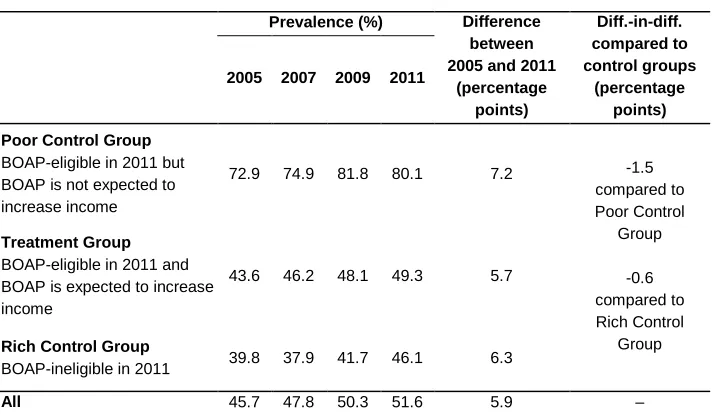
Before presenting the DD multivariate regression results, Table 2 presents the simple DD analysis, which compared changes in living arrangements over time across own income groups. This approach not only provided cross-sectional relationships between elders’ own income and the dependent variable, but also predicted the effects of the BOAP estimated from the DD regression analyses later.
In all four waves, the prevalence of independent living was the highest in the Poor Control Group and lowest in the Rich Control Group. The relatively poorer elders in the Poor Control Group lived alone more than their relatively richer counterparts in the Treatment Group. This observation makes sense, since the BLS and the PE are means-tested programs at the household level, and therefore elders coresiding with adult children are less likely to be eligible for the programs.
the Treatment Group also rose, but to a lesser extent, by 5.7PP. Hence, the change in the Treatment Group was lower by 1.5PP compared to the Poor Control Group and by 0.6PP compared to the Rich Control Group. Accordingly, the overall effect of BOAP income on elders’ independent living was negative.
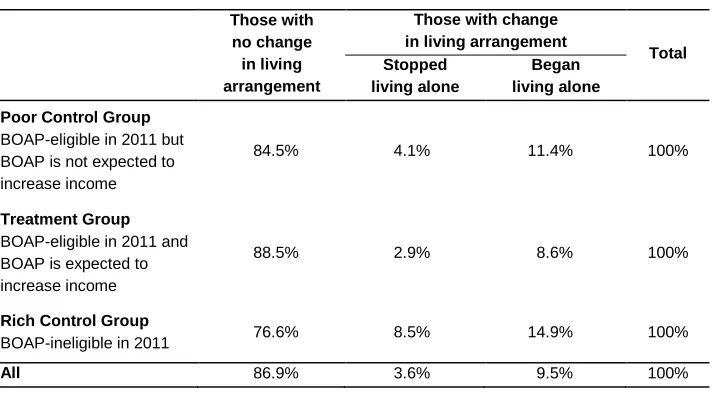
To better understand the mechanism through which the negative impact operates, I tabulated the elders’ transitions in living arrangements between 2005 and 2011 by own income groups (Table 3). Among those who experienced no change in living arrangements over the six-year period, elders belonged to the Treatment Group proportionately more than to both control groups. Conversely, among those who experienced changes in living arrangements, elders belonged to the Treatment Group proportionately less than to both control groups: elders in the Treatment Group were less likely to stop living alone, as well as less likely to begin living alone. These findings imply that the BOAP benefits helped elders to maintain their living arrangements, that is, enabled non-coresident elders to continue to live apart and coresident elders to continue to live with others. Accordingly, the impact of the pension income seems mixed: the BOAP benefits affected living alone positively for non-coresidents and negatively for non-coresidents. The latter effect outweighed the former effect, leading to a net negative effect in the DD analysis above.
Table 3: Transitions in living arrangements of unmarried Koreans at age 65 or above between 2005 and 2011, by group
Those with no change in living arrangement
Those with change in living arrangement
Total Stopped
living alone
Began living alone
Poor Control Group
BOAP-eligible in 2011 but BOAP is not expected to increase income
84.5% 4.1% 11.4% 100%
Treatment Group
BOAP-eligible in 2011 and BOAP is expected to increase income
88.5% 2.9% 8.6% 100%
Rich Control Group
BOAP-ineligible in 2011 76.6% 8.5% 14.9% 100%
All 86.9% 3.6% 9.5% 100%
6.3 Difference-in-difference multivariate regression analyses
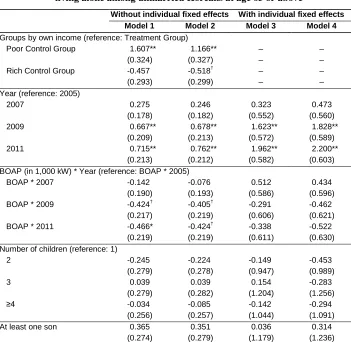
Table 4 summarizes the DD logit regression analyses for elders’ likelihood of living alone. For both models, with and without individual FEs, I present the results of two specifications with limited and full sets of time-varying covariates. BOAP benefits are in 1,000 kW, which is about equal to the maximum amount of annual benefits.
Table 4: DD logit estimates of the effect of the BOAP on the likelihood of living alone among unmarried Koreans at age 65 or above
Without individual fixed effects With individual fixed effects Model 1 Model 2 Model 3 Model 4
Groups by own income (reference: Treatment Group)
Poor Control Group 1.607** 1.166** – –
(0.324) (0.327) – –
Rich Control Group -0.457 -0.518† – –
(0.293) (0.299) – –
Year (reference: 2005)
2007 0.275 0.246 0.323 0.473
(0.178) (0.182) (0.552) (0.560)
2009 0.667** 0.678** 1.623** 1.828**
(0.209) (0.213) (0.572) (0.589)
2011 0.715** 0.762** 1.962** 2.200**
(0.213) (0.212) (0.582) (0.603)
BOAP (in 1,000 kW) * Year (reference: BOAP * 2005)
BOAP * 2007 -0.142 -0.076 0.512 0.434
(0.190) (0.193) (0.586) (0.596)
BOAP * 2009 -0.424† -0.405† -0.291 -0.462
(0.217) (0.219) (0.606) (0.621)
BOAP * 2011 -0.466* -0.424† -0.338 -0.522
(0.219) (0.219) (0.611) (0.630)
Number of children (reference: 1)
2 -0.245 -0.224 -0.149 -0.453
(0.279) (0.278) (0.947) (0.989)
3 0.039 0.039 0.154 -0.283
(0.279) (0.282) (1.204) (1.256)
≥4 -0.034 -0.085 -0.142 -0.294
(0.256) (0.257) (1.044) (1.091)
At least one son 0.365 0.351 0.036 0.314
Table 4: (Continued)
Without individual fixed effects With individual fixed effects Model 1 Model 2 Model 3 Model 4
Health: bad or very bad – 0.280** – -0.288
– (0.104) – (0.297)
Area of residence: rural – 0.325* – 2.068*
– (0.148) – (0.830)
Form of employment (reference: Unemployed)
Wage worker – 0.866** – 0.220
– (0.215) – (0.489)
Non-wage worker – 0.747** – 0.535
– (0.205) – (0.584)
Male 0.103 0.063 – –
(0.272) (0.279) – –
Age in 2011 (reference: 65–69)
70–74 0.112 0.250 – –
(0.220) (0.221) – –
75–79 -0.209 -0.056 – –
(0.223) (0.225) – –
≥80 -0.847** -0.614** – –
(0.223) (0.230) – –
Education in 2011 (reference: <Middle school)
Middle school -0.195 -0.123 – –
(0.270) (0.276) – –
High School 0.415 0.544† – –
(0.300) (0.308) – –
>High School -0.589 -0.225 – –
(0.544) (0.566) – –
Any single child in 2011 -1.056** -1.111** – –
(0.187) (0.190) – –
Any child aged below 30 in 2011
-1.080† -0.916 – –
(0.638) (0.618) – –
Constant -0.158 -0.850** – –
(0.328) (0.353) – –
Sample size 3,088 3,088 454 454
Wald chi2 or LR chi2 102.62 131.92 51.49 59.83
Source: Original analysis of data from the 2005, 2007, 2009, and 2011 Korean Retirement and Income Study
Notes: The analyses are restricted to individuals in the analysis sample described in Table 1. BOAP indicates imputed amount of BOAP benefits in 2011 based on income and assets in wave 1. One thousand Korean won, abbreviated 1 kW, approximates to one U.S. dollar ($1). Standard errors are clustered within each individual and in parentheses. †
Overall, the results are consistent with the findings from the simple DD analysis. In Model 1 with the limited set of covariates and without FEs, the effect of the BOAP was negative and statistically significant in both 2009 (β = -.424, p < 0.10) and 2011 (β = -.466, p < 0.05), but not in 2007. With additional controls for elders’ health, area of residence, and form of employment in Model 2, the estimated effects became smaller in size and less significant, but remained negative and significant at 10% in both years. According to the latter model, BOAP benefits of 1,000 kW caused a reduction in the odds of living alone by 33% (𝑒–0.405 = 0.667) in 2009 and 35% (𝑒–0.424 = 0.654) in 2011.
Model 3 and Model 4 present results of the FE models. The estimates on elders’ characteristics in the last wave are omitted from the presentation in Table 4 since the characteristics remain constant over time and hence their effect, together with the effect of other time-invariant characteristics, is captured by the coefficients of individual FEs. After controlling for individual FEs, the effect of the BOAP was not significant at a 10% level in either Model 3 or Model 4. However, the change appears largely driven by increases in standard errors due to the small sample size compared to the large number of time-invariant individual characteristics. After dropping cases with no change in the dependent variable across waves, only 454 observations in person-years remained for estimating the models. In both models with FEs, the signs of the effects remained negative.
7. Discussion
Using a unique natural experiment created by the introduction of the Basic Old-Age Pension (BOAP) in Korea, I examined how non-contributory old-age pensions affected unmarried elders’ likelihood of living alone. With still prevalent but rapidly declining multigenerational coresidence and ambivalent attitudes towards that form of living arrangement in Korea, this paper provides a geographic and cultural extension of the literature.
Interestingly, BOAP benefits caused elders to keep their living arrangements regardless of what their current arrangement was. BOAP benefits helped non-coresident elders to continue to live independently and prevented coresident elders from forming one-person households. The negative impact on living alone in the latter case outweighed the positive impact in the former, resulting, on balance, in a negative impact. Hence, the results are in part consistent with findings in the U.S., where income from public transfers increased independent living among the elderly. Like their American counterparts, Korean elders increasingly value privacy and the free lifestyles of independent living, and this might explain the decline in the transition to coresidence owing to the BOAP.
What explains the negative impact on living alone? Bernheim, Shleifer, and Summers (1985) hypothesize that elderly parents strategically use their financial resources to obtain more care and attention from their children. In Korea, where elders’ preference for coresiding with adult children remains strong, an increase in income owing to the BOAP may increase elders’ bargaining power to match their preferred and actual living arrangements, as suggested by Lundberg and Pollak (1993). Considering the preference for living with their children is stronger among elders with higher income (Chung et al. 2012a), this explanation may be convincing in Korea. From the children’s perspective, additional economic resources might make elders more attractive as household members, while the cultural norm of multigenerational coresidence might prevent children from separating from parents. Another article on Korea by Park and Choi (2015) in this special collection argues the same: “… living together has been a strong cultural norm in Korea for both young and old age groups. In this cultural context, privacy might not be considered as desirable as it is in western societies. Thus, some older people, especially those with economic resources and spacious housing, may prefer ‘buying coresidence’ to ‘buying privacy.’” Along the same lines, in their study of Japan, which has a cultural context similar to that of Korea, Takagi and Silverstein (2011) note that “traditional multigenerational coresidence has become a commodity negotiated within families based on relative resources and needs within and across generations.” Together with the ambivalent attitudes, the modest amount of the BOAP also appears to explain the mixed results. The maximum amount of BOAP, which is about 1,000 kW per year, might be large enough to prevent coresident elders and children from leaving each other. However, the benefits seem too small for coresident elders to form new households.
unmarried elders in this study are likely to experience their children forming new households and leaving them to live alone. Relative to elders in the control groups, those in the treatment group were significantly less likely to become non-coresident in 2009 and 2011, which led to a negative impact of BOAP benefits on living alone.
It should be noted that the economic recession initiated by the bankruptcy of Lehman Brothers affected the Korean economy also, particularly in 2008 and 2009. Studies have found that younger adults are less likely to form households independent from their parents during economic recessions (Aassve, Cottini, and Vitali 2013; Kim and Song 2013; Lee and Painter 2013; Matsukura, Retherford, and Ogawa 2011; Mykyta 2012). While the year dummy variables included in the DD design absorbed the effect of the crisis to the extent that it affected the treatment and control groups equally in a given year, concerns remain regarding the estimated treatment effect. If BOAP pensions were more effective in preventing children from launching their own households than they would be in a counter-factual situation without the economic downturn, the negative effect estimated in this article could be under-estimated (i.e., larger in absolute size). If this were the case, whether, and if so to what extent, the effect of public transfers on elders’ living arrangements would differ between times of economic shock and other times is an important question that remains to be answered.
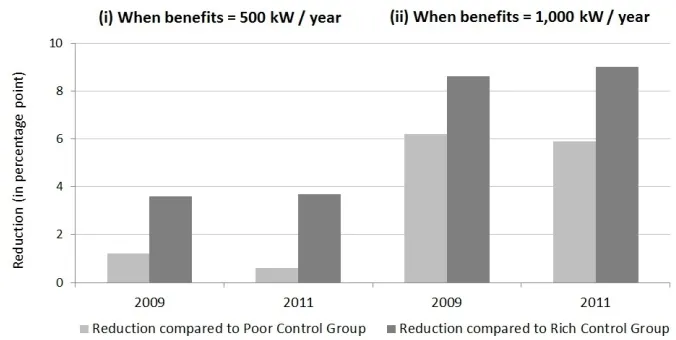
With that caution in mind, to examine how substantive the size of the effect is, Figure 2 shows a reduction in the predicted probability of living alone by annual BOAP benefits of 500 kW and 1,000 kW. The prediction is based on the estimation in Model 2 in Table 4 when all other variables, except dummy variables for own income groups and years, are assumed to be at their mean values. Compared to the Poor Control Group, the benefits of 1,000 kW were predicted to lower the probability of living alone by 6.2PP in 2009 and 5.9PP in 2011. Compared to the Rich Control Group, the same amount of benefits was predicted to lower the probability of living alone by 8.6PP in 2009 and 9.0PP in 2011.
living arrangements and how the effect compares to the estimates in this article remain interesting questions.
Figure 2: Estimated reduction in the predicted probability of living alone in 2009 and 2011 owing to BOAP benefits
Notes: Based on the estimation in Model 2 in Table 4. Except for dummy variables for own income groups and years, all other values are assumed to be at their mean values.
Regarding the remaining limitations of the research design and the data, first, this article cannot examine the actual amount of BOAP benefits. In addition to the aforementioned endogeneity in the amount and displacement of benefits from old programs by the BOAP, the KReIS reports the amount of BOAP benefits received in 2008, while 2009 is the year when the outcome variable was measured. The mismatch is problematic because the BOAP expanded substantially between the two years. Next, due to a lack of information on children, the estimation models in this article failed to control for their characteristics, other than their number and sex composition at each wave and whether elders had a single child or any child aged below 30 in the last wave. Children’s socio-economic characteristics might be an important intervening factor in the relation between public transfers and elders’ living arrangements. Dyad-level analysis using data on individual children’s characteristics is greatly needed to identify the mechanisms through which public transfers affect the arrangements.
using approaches such as replacing missing data with binary variables and imputing values of missing data. In longitudinal surveys of elders, attrition due to death is inevitable, and the KReIS data also show higher attrition among the oldest of the old. According to Zimmer and Korinek (2010), elders’ transition to coresidence is underestimated if longitudinal analysis excludes decedents. However, this did not cause serious concern in this analysis, unless the disproportionately higher attrition among the very old was systematically related to the amount of BOAP benefits after various covariates were controlled for in the regression analysis. Furthermore, using the balanced panel excluded attrition due to death from the sample.
In conclusion, this study provides quasi-experimental evidence concerning the causal effects of public old-age income support on elders’ living alone. Contrary to observational studies using cross-sectional data, the DD approach used in this study substantially eliminated preexisting systematic differences between pensioners and non-pensioners and therefore enabled us to make the causal inference. However, the amount of BOAP benefits, rather than being randomly assigned as in an ideal randomized experiment, was determined based on older adults’ own income. Therefore, I additionally controlled for the income from the pre-treatment period.
The analysis shows that, on balance, the public provision had a negative rather than a positive impact on elders’ living alone. Given the evidence of this overall negative effect, the counter-factual outcome of not providing BOAP pensions in Korea would have led to an even sharper rise of one-person households in the country. Alternatively, this study suggests that public transfers targeted at the elderly may slow down the rise of one-person households. Notably, the transfers cause non-coresident elders to continue to live alone, but at the same time prevent coresident elders from forming one-person households. Together with the modest amount of the BOAP, ambivalent attitudes towards living alone in this transitional society appear to explain the mixed results. These findings are particularly relevant to other rapidly changing societies where public elder-support systems are expanding, and norms of coresidence with adult children remain but are weakening.
8. Acknowledgments
References
Aassve, A., Cottini, E., and Vitali, A. (2013). Youth prospects in a time of economic recession. Demographic Research 29: 949–962. doi:10.4054/DemRes.2013. 29.36.
Barro, R.J. (1974). Are government bonds net wealth? Journal of Political Economy 82(6): 1095–1117. doi:10.1086/260266.
Becker, G.S. (1974). A theory of social interactions. Journal of Political Economy 82(6): 1063–1093. doi:10.2307/1830662.
Becker, G.S. (1991). A Treatise on the Family: Enlarged Edition. Cambridge, MA: Harvard University Press.
Bernheim, B.D., Shleifer, A., and Summers, L.H. (1985). The strategic bequest motive. Journal of Political Economy 93(6): 1045–1076. doi:10.1086/261351.
Bianchi, S., Hotz, J.V., McGarry, K., and Seltzer, J.A. (2008). Intergenerational ties: Alternative theories, empirical findings and trends, and remaining challenges. In: Booth, A., Crouter, A.C., Bianchi, S., and Seltzer, J.A. (eds.). Intergenerational Caregiving. Washington, D.C.: Urban Institute: 3–43.
Casey, B. and Yamada, A. (2002). Getting older, getting poorer?: A study of the earnings, pensions, assets and living arrangements of older people in nine countries. Paris: OECD Publishing. (OECD Labour Market and Social Policy Occasional Papers. 60).
Chui, E. (2007). Changing norms and pragmatics of co-residence in East Asian countries. International Journal of Sociology of the Family 33(1): 1–24.
Chung, K.H., Nam, S.H., Jung, E.J., Lee, J.H., Lee, Y.K., Kim, J.S., Kim, H.Y., and Jin, M.J. (2012a). Policy implications of changes in family structure: Focused on the increase of single person households in Korea. Seoul: Korea Institute for Health and Social Affairs (in Korean).
Chung, K.H., Oh, Y.H., Lee, Y.K., Son, C.K., Park, B.M., Lee, S.Y., Lee, J.H., Kwon, J.D., Kim, S.B., Lee, S.J., Lee, Y.S., Lee, Y.H., Choi, S.J., and Kim, S.Y. (2012b). Survey on the Living Status and Welfare Needs of the Korean Elderly. Seoul: Korea Institute for Health and Social Affairs (in Korean).
Costa, D.L. (1999). A house of her own: Old age assistance and the living arrangements of older nonmarried women. Journal of Public Economics 72: 39–59. doi:10.101 6/S0047-2727(98)00094-2.
Cox, D. (1987). Motives for private income transfers. Journal of Political Economy 95(3): 509–546. doi:10.1086/261470.
Diener, E., Gohm, C.L., Suh, E., and Oishi, S. (2000). Similarity of relations between marital status and subjective well-being across cultures. Journal of Cross-Cultural Psychology 3: 419–436. doi:10.1177/0022022100031004001.
Do, Y.K. and Malhotra, C. (2012). The effect of coresidence with an adult child on depressive symptoms among older widowed women in South Korea: An instrumental variables estimation. Journals of Gerontology: Series B, Psychological Sciences and Social Sciences 67B(3): 384–391 doi:10.1093/geron b/gbs033.
Edmonds, E.V., Mammen, K., and Miller, D.L. (2005). Rearranging the family? Income support and elderly living arrangements in a low-income country. The Journal of Human Resources 40(1): 186–207.
Engelhardt, G.V. and Greenhalgh-Stanley, N. (2010). Home health care and the housing and living arrangements of the elderly. Journal of Urban Economics 67(2): 226– 238. doi:10.1016/j.jue.2009.09.007.
Engelhardt, G.V., Gruber, J., and Perry, C.D. (2005). Social security and elderly living arrangements. Evidence from the social security notch. The Journal of Human Resources 40(2): 354–372.
Gibler, K.M. (2001). Seniors housing in a changing Asian society: South Korea. International Real Estate Review 4(1): 118–134.
Jamieson, L. and Simpson, R. (2013). Living alone: Globalization, identity and belonging. Series: Palgrave Macmillan studies in family and intimate life. Palgrave MacMillan. doi:10.1057/9781137318527.
Jensen, R.T. (2003). Do private transfers ‘displace’ the benefits of public transfers? Evidence from South Africa. Journal of Public Economics 88: 89–112. doi:10.1 016/S0047-2727(02)00085-3.
Kim, C.S. and Song, Y.J. (2013). Intergenerational coresidence as a family strategy in economic crisis. Korean Journal of Sociology 47(3): 77–89.
Klinenberg, E. (2012). Going solo: The extraordinary rise and surprising appeal of living alone. New York: Penguin Books.
Korean Ministry of Health and Welfare (KMOHW) (2008, 2009, 2011). Introduction to Basic Old-Age Pension program. Each year. Seoul, Korea: Korean Ministry of Health and Welfare (in Korean).
Korean Ministry of Health and Welfare (KMOHW) (2013). Statistics on 2012 basic old-age pension program. Seoul, Korea: Korean Ministry of Health and Welfare (in Korean).
Korean Statistical Research Institute (2012). Korean social trends 2012. Daejeon, Korea: Korean Statistical Research Institute (in Korean).
Lee, K.O. and Painter, G. (2013). What happens to household formation in a recession? Journal of Urban Economics 76: 93–109. doi:10.1016/j.jue.2013.03.004.
Lundberg, S. and Pollak, R.A. (1993). Separate spheres bargaining and the marriage market. Journal of Political Economy 101(6): 988–1010. doi:10.1086/261912. Matsukura, R., Retherford, R.D., and Ogawa, N. (2011). Explaining trends in
coresidence of newly married couples with parents in Japan. Asian Population Studies 7(3): 195–218. doi:10.1080/17441730.2011.608981.
McGarry, K. and Schoeni, R.F. (2000). Social security, economic growth, and the rise in elderly widows’ independence in the twentieth century. Demography 37(2): 221–236. doi:10.2307/2648124.
Mykyta, L. (2012). Economic downturns and the failure to launch: The living arrangements of young adults in the US 1995–2011. Washington, D.C.: U.S. Census Bureau. (SEHSD Work Paper. 2012-24).
Newsis. (2008). Basic Old-Age Pension, pie in the sky? [electronic resource]. Seoul: Newsis. [http://news.naver.com/main/read.nhn?mode=LSD&mid=sec&sid1=10 2&oid=003&aid=0002313299]
Pinquart, M. and Sörensen, S. (2000). Influences of socioeconomic status, social network, and competence on subjective well-being in later life: A meta-analysis. Psychology and Aging 15: 187–224. doi:10.1037/0882-7974.15.2.187.
Raymo, J.M. (2015). Living alone in Japan: Relationships with happiness and health. Demographic Research 32(46): 1267–1298. doi:10.4054/DemRes.2015.32.46. Statistics Korea (1980, 1990, 2000, 2010). Population and housing census. Daejeon,
Korea: Korea National Statistical Office (in Korean).
Statistics Korea (2009). Statistics for the elderly. Daejeon, Korea: Korea National Statistical Office (in Korean).
Takagi, E. and Silverstein, M. (2011). Purchasing Piety? Coresidence of Married Children With Their Older Parents in Japan. Demography 48: 1559–1579. doi:1 0.1007/s13524-011-0053-0.
United Nations (2005). Living arrangements of older persons around the world. New York: United Nations.
United Nations (2011). Current status of the social situation, well-being, participation in development and rights of older persons worldwide. New York: United Nations. Young, H. and Grundy, E. (2009). Living arrangements, health and well-being. In:
Stillwell, J., Coast, E., and Kneale, D. (eds.). Understanding population trends and processes: Fertility, living arrangement, care and mobility. Dordrecht: Springer: 127–150. doi:10.1007/978-1-4020-9682-2_7.