Disseminating Civil Engineering through Virtual Reality:
An Immersive Interface
https://doi.org/10.3991/ijoe.v14i05.7788
Fábio Matoseiro Dinis, João Poças Martins, Bárbara Rangel Carvalho, Ana Sofia Guimarães
University of Porto, Porto, Portugal
Abstract—The application of Immersive Virtual Reality (VR) interfaces has shown favourable results for Engineering Education. In fact, VR interfaces pro-vide new practises for improving the transferability of knowledge and commu-nication amongst users. The capacity of current game engines improved by the availability of 3D building models and their components greatly increases the feasibility of 3D scenarios.
The present work includes a description of an immersive VR interface de-veloped for prospective Civil Engineering students. An Immersive Virtual En-vironment (IVE) was developed to display construction elements in a highly visual environment, avoiding the steep learning curve of general modelling software tools. The interface is available online and can be tested using a Head Mounted Display and a VR ready computer. The interface has been developed to disseminate Civil Engineering amongst pre-university students, simultane-ously providing new tools to harness students’ interest for Information Tech-nology applied to a specific field of study.
Keywords—Virtual Reality interfaces, Civil Engineering, Engineering Train-ing, Game Engines
1
Objectives and idea
In the last few years, the development of Virtual Reality (VR) interfaces has shown promising applications in the scope of Engineering Education. Indeed, the literature contains various examples of VR applications to enhance communication, dissemi-nate information, improve students’ lack of experience in real case scenarios, amongst many others. Several authors assert favourable enhancements in the learning experi-ence and knowledge transfer [1-3], stating that traditional methodologies may be supported by technological tools such as VR, providing more effective means to mo-tivate students during teaching activities [4].
case, VR may act as a favourable approach to support teaching activities [3]. Civil Engineering requires students and practitioners to visualize and understand complex geometries, which justifies the use of advanced tools to support them [6]. Thus, users who do not yet realize the full scope of the field may benefit from an immersive envi-ronment where they can actively interact with the virtual scenario and discover differ-ent disciplines of Civil Engineering. This is particularly relevant for pre-university students, prospective applicants to Higher Education Institutions (HEIs), who must have as clear an insight as possible about the course they intend to apply to.
The present work describes the development of an immersive VR interface for pre-university students, where users can navigate through a 3D model of an actual build-ing and discover construction solutions that are normally hidden. The interface is based on a Building Information Model (BIM) of one of the campus buildings, which expedites the process of developing virtual environments. Additionally, the use of a Head Mounted Display (HMD) provides an immersive experience that would other-wise require a visit to the construction site. Therefore, to simulate an experience with-in a real buildwith-ing project, the authors chose to develop an Immersive Virtual Envi-ronment (IVE) so users could promptly navigate the virtual model and interact with construction elements, e.g. columns, slabs, beams and plumbing fixtures. The inter-face is also available online for unrestricted testing.
The paper starts with a brief contextualization about related work on VR applica-tions as well as some identified limitaapplica-tions and challenges (section 2). Chapter 3 de-scribes the interface’s architecture and development details. The paper ends with a discussion about the interface’s potential and applications for Civil Engineering dis-semination and vocational orientation.
2
State-of-the-art
Contemporary research describes VR interfaces as favourable assets not only in Engineering Education, but also in professional application in the Architectural Engi-neering and Construction (AEC) sector.
Messner, et al. [6] confirmed positive results from the use of VR technology and 4D CAD models in Engineering Education, suggesting that these technologies may improve students’ capacities to recognise issues concerning planning in construction design.
Heydarian, et al. [7] compared the performance of regular office related tasks com-pleted in physical environments with the same performed in an IVE. The authors state that their results showed no substantial differences, highlighting the potential of IVEs to attain feedback from end-users as well as improve the performance of infrastruc-ture design.
Dinis and Poças Martins [8] developed an immersive VR prototype interface that allows automatic editing of BIM elements, linking game engine input and BIM au-thoring software.
ning and management. The authors conducted surveys to assess the tool’s effective-ness and results demonstrate improvements in knowledge about construction, plan-ning and resource management [5].
VR developments concerning project design review and decision making are as-serted in [9-11].
Maffei, et al. [12] state applications of Immersive Virtual Reality (IVR) to foster participatory planning. The authors determined that their interface was congruent with the real environment in terms of reproducing visuo-acoustic information.
Acoustic comfort during metro journeys was assessed by [13] using IVR. The au-thors chose IVR for its ability to recreate similar visual and acoustic contexts while also providing an immersive and interactive experience. Additionally, the authors state that IVR could be used as a beneficial tool to set more reliable norms on acoustic comfort.
A VR interface that accepts human-body controls to improve spatial perception and navigation was developed by Roupé, Bosch-Sijtsema, and Johansson M [14].
In sum, VR has been implemented in the AEC sector and Engineering Education related areas in recent years which leads to the identification of current limitations and challenges. For instance, while BIM models can be used to import building geometry and related components increasing the feasibility of developing 3D VR scenarios, there are still interoperability issues that need to be addressed. Material libraries be-tween BIM software and game engines lack compatibility [15], e.g. Autodesk Revit and Unity, resulting in information loss and time-consuming operations.
Paes, Arantes, and J. Irizarry [16] stress that there is no agreement about the extent to which immersive environments improve user’s spatial perception with enough efficacy under all circumstances and compared to more traditional media.
The variety of currently available hardware devices and software tools which may be used to develop immersive interfaces makes the choice for adequate equipment an issue of budget, but also of the interface’s complexity and capabilities requirements [17]. Complex IVR interfaces still require expensive computers and HMDs to ensure adequate performance.
3
Realization
3.1 Main objectives and scope
Within the interface, users may toggle the visibility of groups of construction ele-ments and visualize building eleele-ments that are usually hidden by other layers. As a pedagogical tool, the application requires an immersive, highly visual environment where construction elements can be observed while avoiding the steep learning curve of general modelling software tools. Thus, the goals of the application demand an immersive 3D experience, which vastly justifies the modest efforts required by the development of the 3D environment.
The choice for an HMD was based on the higher level of immersion that it may provide when compared to other VR equipment [3]. Although HMD equipment are not currently ubiquitous, they are becoming increasingly affordable and are thus suit-able for individual or small group work. Since modern game engines provide a cross-platform development environment, the hardware was chosen according to the overall objectives of the project. These goals demand an immersive interface which, in turn requires equipment that has the capability of processing complex 3D graphics. Addi-tionally, similar VR interfaces have shown favourable usability results, as assessed in previous research [18]. Nonetheless, HMD equipment still face limitations. For in-stance, the equipment supports only one user at a time which may lead to frustration during group activities. A CAVE-like facility would suppress the need for a multiuser platform [3], yet it is a costly high-end solution and requires a large-scale room [6]. In terms of portability, low-end solutions such as those based on stereoscopic displays that use mobile devices processing power would seem reasonable. However, these devices do not allow a variety of interactions with the virtual environment given mo-bile devices’ limited support for controllers and processing capability. HMDs may be assembled in different locations if necessary, provide highly immersive detailed inter-faces and are increasingly popular as an interaction solution.
The VR interface is freely available at Online experimentation @ FEUP [19], an online repository comprising open and unrestricted access to several interactive Engi-neering applications. In the website, users may find a demonstration video, a user guide, the requirements to run the application (VR ready computer, HTC VIVE and windows operating system) as well as an executable file available for download.
3.2 Immersive VR application – System setup and features
terrain was modelled to ensure that users could navigate through the building’s sur-roundings.
HTC VIVE was selected as the HMD solution to interact with the virtual environ-ment. This equipment includes two devices (lighthouses) to track the user’s position in real space. However, movement controls were also implemented so the interface could be adapted to smaller spaces where users do not have the option of real walk-ing. The combination of the HMD and corresponding controllers defined a total 6 degrees of freedom for user motion. The headset allowed yaw, roll and pitch, while the controllers granted translations in three-dimensional space (x, y and z axis). C# programming language was used to enable two different movement mechanics: (i) a point target movement system, where users simply point to a target location using the hardware controllers and are instantly transported to this new position and (ii) a more traditional approach using a gamepad joystick (Figure 1).
Fig. 1. Basic workflow scheme of the interface
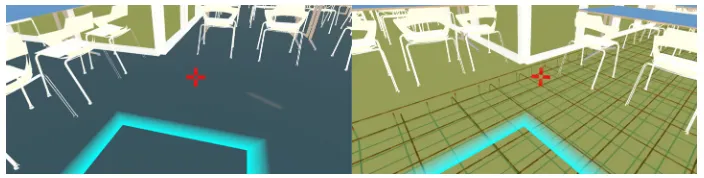
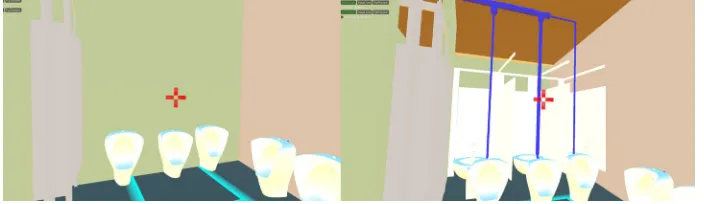
Other scripts were developed to toggle the visibility of groups of building elements (Figures 2 to 4), allowing users to assess systems that are often hidden from view.
While the graphics are far from realistic, the VR interface is able to accomplish its main purpose of displaying different Civil Engineering elements within the context provided by a familiar building. The interface was presented during an open event with a significant number of voluntary participants, over 150 in the course of 4 days, that match the profile of the target user of this application. Although no formal as-sessment was performed, it is important to highlight the considerable number of par-ticipants that reflected the interest towards the application.
Fig. 3. Concrete column materials being toggled on and off to show the reinforcement ele-ments
Fig. 4. Plumbing elements being displayed
4
Conclusion and future work
VR interfaces allow users to experience a wide range of environments overcoming the limitations of real situations, thus improving learning and education activities [22]. Indeed, the immersive interface presented in this article provides virtual access to construction systems which would otherwise require a site visit to be observed within context. Pre-university students and first years are the main target of the inter-face, since their knowledge and experience about Civil Engineering topics are still rather limited.
The application has been made freely available online, as long as the minimum hardware requirements are met.
Additional interfaces will be developed and more thorough assessments will be made in accordance to preliminary trials of the tool [18, 23]. Future work will include statistical analysis to validate the applicability and effectiveness of VR for Civil En-gineering Education applications.
5
Acknowledgments
Commission is not responsible for any use that may be made of the information it contains.
6
References
[1]Abulrub, A.-H.G., A.N. Attridge, and M.A. Williams (2011). Virtual reality in engineering education: The future of creative learning. in Global Engineering Education Conference (EDUCON), 2011 IEEE., pp 751-757 https://doi.org/10.1109/EDUCON.2011.5773223 [2]Deshpande, A.A. and S.H. Huang (2011). Simulation games in engineering education: A
state-of-the-art review. Computer Applications in Engineering Education, 19(3): p. 399-410 https://doi.org/10.1002/cae.20323
[3]Alhalabi, W.S. (2016). Virtual reality systems enhance students’ achievements in engi-neering education. Behaviour & Information Technology, 35(11): p. 919-925 https://doi.org/10.1080/0144929X.2016.1212931
[4]Roca-González, C., et al. (2016). Virtual Technologies to Develop Visual-Spatial Ability in Engineering Students. Eurasia Journal of Mathematics, Science and Technology Educa-tion, 13(2): p. 441-468
[5]Lee, S., D. Nikolic, and J.I. Messner (2014). Framework of the Virtual Construction Simu-lator 3 for construction planning and management education. Journal of Computing in Civ-il Engineering, 29(2): p. 05014008 https://doi.org/10.1061/(ASCE)CP.1943-5487.0000388 [6]Messner, J.I., et al. Using virtual reality to improve construction engineering education. in
Proceedings of the 2003 American Society for Engineering Education Annual Conference & Exposition. 2003
[7]Heydarian, A., et al. (2015). Immersive virtual environments versus physical built envi-ronments: A benchmarking study for building design and user-built environment explora-tions. Automation in Construction, 54: p. 116-126 https://doi.org/10.1016/j.autcon. 2015.03.020
[8]Dinis, F. and J. Poças Martins (2016). Desenvolvimento de interfaces de realidade virtual a partir de BIM e avaliação da sua aplicabilidade, in 1º congresso português de building in-formation modelling, Universidade do Minho, Guimarães, Portugal
[9]Liu, Y., J. Lather, and J. Messner (2014). Virtual Reality to Support the Integrated Design Process: A Retrofit Case Study, in Computing in Civil and Building Engineering, p. 801-808
[10]Majumdar, T., M.A. Fischer, and B.R. Schwegler (2006). Conceptual design review with a virtual reality mock-up model. Joint International Conference on Computing and Decision Making in Civil and Building Engineering
[11]Kumar, S., et al. (2011). Developing an experienced-based design review application for healthcare facilities using a 3D game engine. Journal of Information Technology in Con-struction (ITcon), 16(6): p. 85-104
[12]Maffei, L., et al. (2016). Immersive virtual reality in community planning: Acoustic and visual congruence of simulated vs real world. Sustainable Cities and Society, 27: p. 338-345 https://doi.org/10.1016/j.scs.2016.06.022
[13]Iachini, T., et al. (2012). Multisensory assessment of acoustic comfort aboard metros: a virtual reality study. Applied Cognitive Psychology, 26(5): p. 757-767 https://doi.org/10.1002/acp.2856
[15]Monteiro, M. (2013). Desenvolvimento de interfaces tridimensionais para aplicações mó-veis a partir da tecnologia BIM, in Civil Engineering, Universidade do Porto.
[16]Paes, D., E. Arantes, and J. Irizarry (2017). Immersive environment for improving the un-derstanding of architectural 3D models: Comparing user spatial perception between im-mersive and traditional virtual reality systems. Automation in Construction, 84(Supplement C): p. 292-303 https://doi.org/10.1016/j.autcon.2017.09.016
[17]Kim, M., et al. (2013). Virtual reality for the built environment: a critical review of recent advances. Journal of Information Technology in Construction, 18(2013): p. 279-305 [18]Dinis, F.M., et al. (2017). Development of virtual reality game-based interfaces for civil
engineering education. in 2017 IEEE Global Engineering Education Conference (EDUCON), Athens, Greece https://doi.org/10.1109/EDUCON.2017.7943000
[19]Restivo, M.T. civil virtual reality laboratory - online experimentation @ FEUP. [cited 2018 04 January]; Available from: https://remotelab.fe.up.pt/decivil/dec_vr.php.
[20]GEQUALTEC. Modelo Revit FEUP Edifício Cafetaria (0) - WIQI GEQUALTEC. [cited 2018 04 January]; Available from: https://paginas.fe.up.pt/~gequaltec/w/index.php ?title=Modelo_Revit_FEUP_Edif%C3%ADcio_Cafetaria_(0)
[21]Wu, W. and I. Kaushik (2015). Design for Sustainable Aging: Improving Design Commu-nication Through Building Information Modeling and Game Engine Integration. Procedia Engineering, 118: p. 926-933 https://doi.org/10.1016/j.proeng.2015.08.532
[22]Abdelhameed, W.A. (2013). Virtual Reality Use in Architectural Design Studios: A Case of Studying Structure and Construction. Procedia Computer Science, 25: p. 220-230 https://doi.org/10.1016/j.procs.2013.11.027
[23]Dinis, F.M., et al. (2017). Virtual and augmented reality game-based applications to civil engineering education. in 2017 IEEE Global Engineering Education Conference (EDUCON), Athens, Greece https://doi.org/10.1109/EDUCON.2017.7943075
7
Authors
Fábio Matoseiro Dinis is PhD student at University of Porto, Faculty of Engineer-ing, Department of Civil EngineerEngineer-ing, Rua Dr. Roberto Frias, s/n 4200-465 Porto, Portugal.
João Poças Martins, PhD, is with University of Porto, Faculty of Engineering, Department of Civil Engineering, Rua Dr. Roberto Frias, s/n 4200-465 Porto, Portu-gal.
Bárbara Rangel Carvalho, PhD, is with University of Porto, Faculty of Engineer-ing, Department of Civil EngineerEngineer-ing, Rua Dr. Roberto Frias, s/n 4200-465 Porto, Portugal.
Ana Sofia Guimarães, PhD, is with University of Porto, Faculty of Engineering, Department of Civil Engineering, Rua Dr. Roberto Frias, s/n 4200-465 Porto, Portu-gal.