
R E S E A R C H
Open Access
Automating data extraction in systematic
reviews: a systematic review
Siddhartha R. Jonnalagadda
1*, Pawan Goyal
2and Mark D. Huffman
3Abstract
Background:Automation of the parts of systematic review process, specifically the data extraction step, may be an important strategy to reduce the time necessary to complete a systematic review. However, the state of the science of automatically extracting data elements from full texts has not been well described. This paper performs a systematic review of published and unpublished methods to automate data extraction for systematic reviews. Methods:We systematically searched PubMed, IEEEXplore, and ACM Digital Library to identify potentially relevant articles. We included reports that met the following criteria: 1) methods or results section described what entities were or need to be extracted, and 2) at least one entity was automatically extracted with evaluation results that were presented for that entity. We also reviewed the citations from included reports.
Results:Out of a total of 1190 unique citations that met our search criteria, we found 26 published reports
describing automatic extraction of at least one of more than 52 potential data elements used in systematic reviews. For 25 (48 %) of the data elements used in systematic reviews, there were attempts from various researchers to extract information automatically from the publication text. Out of these, 14 (27 %) data elements were completely extracted, but the highest number of data elements extracted automatically by a single study was 7. Most of the data elements were extracted with F-scores (a mean of sensitivity and positive predictive value) of over 70 %. Conclusions:We found no unified information extraction framework tailored to the systematic review process, and published reports focused on a limited (1–7) number of data elements. Biomedical natural language processing techniques have not been fully utilized to fully or even partially automate the data extraction step of systematic reviews.
Background
Systematic reviews identify, assess, synthesize, and inter-pret published and unpublished evidence, which improves decision-making for clinicians, patients, policymakers, and other stakeholders [1]. Systematic reviews also identify research gaps to develop new research ideas. The steps to conduct a systematic review [1–3] are:
1. Define the review question and develop criteria for including studies
2. Search for studies addressing the review question 3. Select studies that meet criteria for inclusion in
the review
4. Extract data from included studies
5. Assess the risk of bias in the included studies, by appraising them critically
6. Where appropriate, analyze the included data by undertaking meta-analyses
7. Address reporting biases
Despite their widely acknowledged usefulness [4], the process of systematic review, specifically the data extraction step (step 4), can be time-consuming. In fact, it typically takes 2.5–6.5 years for a primary study publication to be included and published in a new systematic review [5]. Fur-ther, within 2 years of the publication of systematic reviews, 23 % are out of date because they have not incorporated new evidence that might change the systematic review’s primary results [6].
Natural language processing (NLP), including text mining, involves information extraction, which is the discovery by computer of new, previously unfound infor-mation by automatically extracting inforinfor-mation from * Correspondence:[email protected]
1Division of Health and Biomedical Informatics, Department of Preventive
Medicine, Northwestern University Feinberg School of Medicine, 750 North Lake Shore Drive, 11th Floor, Chicago, IL 60611, USA
Full list of author information is available at the end of the article
© 2015 Jonnalagadda et al. This is an Open Access article distributed under the terms of the Creative Commons Attribution License (http://creativecommons.org/licenses/by/4.0), which permits unrestricted use, distribution, and reproduction in any medium, provided the original work is properly credited. The Creative Commons Public Domain Dedication waiver (http:// creativecommons.org/publicdomain/zero/1.0/) applies to the data made available in this article, unless otherwise stated.
different written resources [7]. Information extraction primarily constitutes concept extraction, also known as named entity recognition, and relation extraction, also known as association extraction. NLP handles written text at level of documents, words, grammar, meaning, and context. NLP techniques have been used to auto-mate extraction of genomic and clinical information from biomedical literature. Similarly, automation of the data extraction step of the systematic review process through NLP may be one strategy to reduce the time ne-cessary to complete and update a systematic review. The data extraction step is one of the most time-consuming steps of a systematic review. Automating or even semi-automating this step could substantially decrease the time taken to complete systematic reviews and thus de-crease the time lag for research evidence to be translated into clinical practice. Despite these potential gains from NLP, the state of the science of automating data extrac-tion has not been well described.
To date, there is limited knowledge and methods on how to automate the data extraction phase of the systematic reviews, despite being one of the most time-consuming steps. To address this gap in knowledge, we sought to perform a systematic review of methods to automate the data extraction component of the system-atic review process.
Methods
Our methodology was based on the Standards for Systematic Reviews set by the Institute of Medicine [8]. We conducted our study procedures as detailed below with input from the Cochrane Heart Group US Satellite.
Eligibility criteria
We included a report that met the following criteria: 1) the methods or results section describes what entities were or needed to be extracted, and 2) at least one entity was automatically extracted with evaluation results that were presented for that entity.
We excluded a report that met any of the following criteria: 1) the methods were not applied to the data extraction step of a systematic review; 2) the report was an editorial, commentary, or other non-original research report; or 3) there was no evaluation component.
Information sources and searches
For collecting the initial set of articles for our review, we developed search strategies with the help of the Cochrane Heart Group US Satellite, which includes systematic reviewers and a medical librarian. We refined these strategies using relevant citations from related papers. We searched three datasets: PubMed, IEEExplore, and ACM digital library, and our searches were limited between January 1, 2000 and January 6, 2015 (see Appendix 1). We
restricted our search to these dates because biomedical in-formation extraction algorithms prior to 2000 are unlikely to be accurate enough to be used for systematic reviews.
We retrieved articles that dealt with the extraction of various data elements, defined as categories of data that pertained to any information about or deriving from a study, including details of methods, participants, setting, context, interventions, outcomes, results, publications, and investigators [1] from included study reports. After we retrieved the initial set of reports from the search results, we then evaluated reports included in the refer-ences of these reports. We also sought expert opinion for additional relevant citations.
Study selection
We first de-duplicated the retrieve citations. For calibra-tion and refinement of the inclusion and exclusion criteria, 100 citations were randomly selected and independently reviewed by a two authors (SRJ and PG). Disagreements were resolved by consensus with a third author (MH). In a second round, another set of 100 randomly selected ab-stracts was independently reviewed by two study authors (SRJ and PG), whereby we achieved a strong level of agree-ment (kappa = 0.97). Given the high level of agreeagree-ment, the remaining studies were reviewed only by one author (PG). In this phase, we identified reports as“not relevant” or“potentially relevant”.
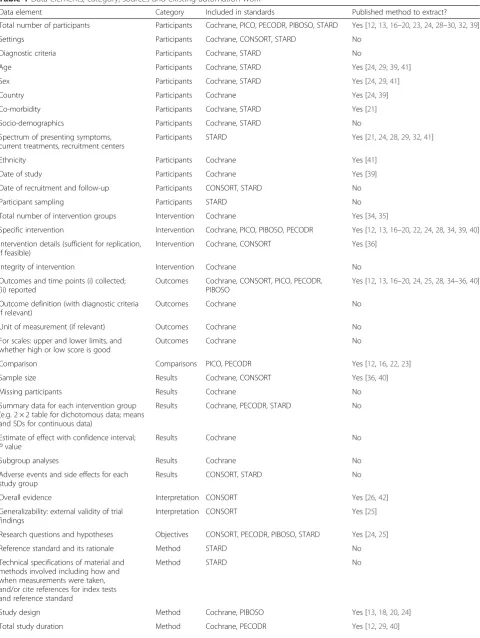
Two authors (PG and SRJ) independently reviewed the full text of all citations (N= 74) that were identified as “potentially relevant”. We classified included reports into various categories based on the particular data element that they attempted to extract from the original, scientific articles. Example of these data elements might be overall evidence, specific interventions, among others (Table 1). We resolved disagreements between the two reviewers through consensus with a third author (MDH).
Data collection process
Two authors (PG and SRJ) independently reviewed the included articles to extract data, such as the particular entity automatically extracted by the study, algorithm or technique used, and evaluation results into a data abstraction spreadsheet. We resolved disagreements through consensus with a third author (MDH).
Data items
We reviewed the Cochrane Handbook for Systematic Reviews [1], the CONsolidated Standards Of Reporting Trials (CONSORT) [9] statement, the Standards for Reporting of Diagnostic Accuracy (STARD) initiative [10], and PICO [11], PECODR [12], and PIBOSO [13] frame-works to obtain the data elements to be considered. PICO stands for Population, Intervention, Comparison, Out-comes; PECODR stands for Patient-Population-Problem,
Table 1Data elements, category, sources and existing automation work
Data element Category Included in standards Published method to extract?
Total number of participants Participants Cochrane, PICO, PECODR, PIBOSO, STARD Yes [12,13,16–20,23,24,28–30,32,39]
Settings Participants Cochrane, CONSORT, STARD No
Diagnostic criteria Participants Cochrane, STARD No
Age Participants Cochrane, STARD Yes [24,29,39,41]
Sex Participants Cochrane, STARD Yes [24,29,41]
Country Participants Cochrane Yes [24,39]
Co-morbidity Participants Cochrane, STARD Yes [21]
Socio-demographics Participants Cochrane, STARD No
Spectrum of presenting symptoms, current treatments, recruitment centers
Participants STARD Yes [21,24,28,29,32,41]
Ethnicity Participants Cochrane Yes [41]
Date of study Participants Cochrane Yes [39]
Date of recruitment and follow-up Participants CONSORT, STARD No
Participant sampling Participants STARD No
Total number of intervention groups Intervention Cochrane Yes [34,35]
Specific intervention Intervention Cochrane, PICO, PIBOSO, PECODR Yes [12,13,16–20,22,24,28,34,39,40]
Intervention details (sufficient for replication, if feasible)
Intervention Cochrane, CONSORT Yes [36]
Integrity of intervention Intervention Cochrane No
Outcomes and time points (i) collected; (ii) reported
Outcomes Cochrane, CONSORT, PICO, PECODR, PIBOSO
Yes [12,13,16–20,24,25,28,34–36,40]
Outcome definition (with diagnostic criteria if relevant)
Outcomes Cochrane No
Unit of measurement (if relevant) Outcomes Cochrane No
For scales: upper and lower limits, and whether high or low score is good
Outcomes Cochrane No
Comparison Comparisons PICO, PECODR Yes [12,16,22,23]
Sample size Results Cochrane, CONSORT Yes [36,40]
Missing participants Results Cochrane No
Summary data for each intervention group (e.g. 2 × 2 table for dichotomous data; means and SDs for continuous data)
Results Cochrane, PECODR, STARD No
Estimate of effect with confidence interval;
Pvalue
Results Cochrane No
Subgroup analyses Results Cochrane No
Adverse events and side effects for each study group
Results CONSORT, STARD No
Overall evidence Interpretation CONSORT Yes [26,42]
Generalizability: external validity of trial findings
Interpretation CONSORT Yes [25]
Research questions and hypotheses Objectives CONSORT, PECODR, PIBOSO, STARD Yes [24,25]
Reference standard and its rationale Method STARD No
Technical specifications of material and methods involved including how and when measurements were taken, and/or cite references for index tests and reference standard
Method STARD No
Study design Method Cochrane, PIBOSO Yes [13,18,20,24]
Total study duration Method Cochrane, PECODR Yes [12,29,40]
Exposure-Intervention, Comparison, Outcome, Duration and Results; and PIBOSO stands for Population, Interven-tion, Background, Outcome, Study Design, Other.
Data synthesis and analysis
Because of the large variation in study methods and mea-surements, a meta-analysis of methodological features and contextual factors associated with the frequency of data extraction methods was not possible. We therefore present a narrative synthesis of our findings. We did not thoroughly assess risk of bias, including reporting bias, for these reports because the study designs did not match domains evaluated in commonly used instruments such as the Cochrane Risk of Bias tool [1] or QUADAS-2 instru-ment used for systematic reviews of randomized trials and diagnostic test accuracy studies, respectively [14].
Results
Study selection
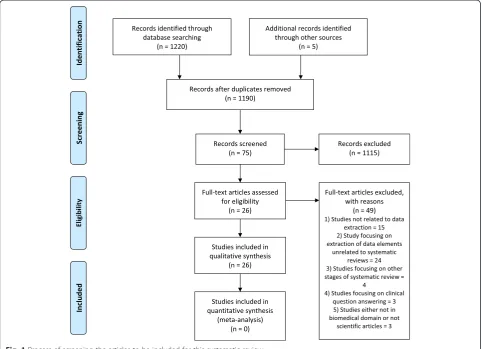
Of 1190 unique citations retrieved, we selected 75 reports for full-text screening, and we included 26 articles that met our inclusion criteria (Fig. 1). Agreement on abstract and full-text screening was 0.97 and 1.00.
Study characteristics
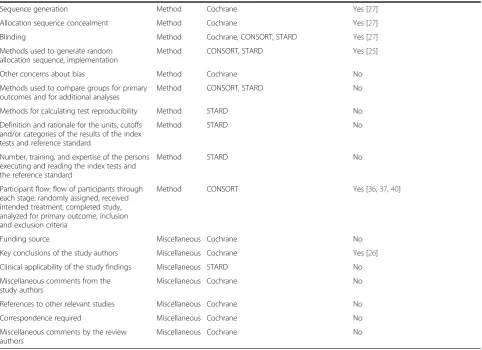
Table 1 provides a list of items to be considered in the data extraction process based on the Cochrane Handbook (Appendix 2) [1], CONSORT statement [9], STARD initia-tive [10], and PICO [11], PECODR [12], and PIBOSO [13] frameworks. We provide the major group for each field and report which standard focused on that field. Finally, we report whether there was a published method to ex-tract that field. Table 1 also identifies the data elements relevant to systematic review process categorized by their domain and the standard from which the element was adopted and was associated with existing automation methods, where present.
Results of individual studies
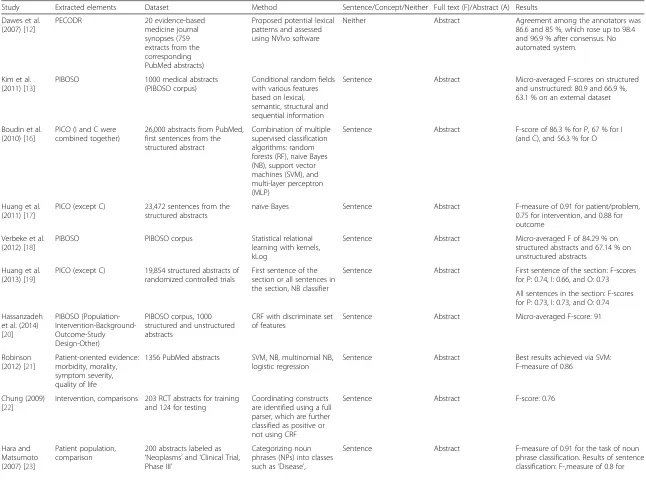
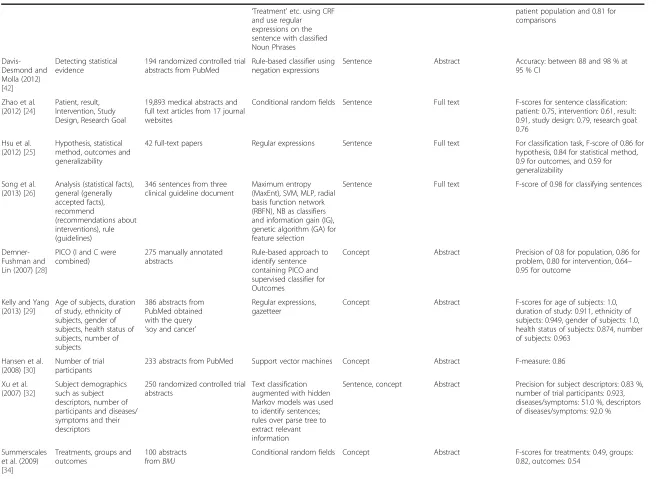
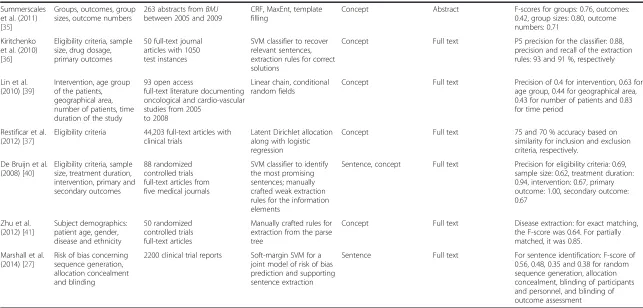
Table 2 summarizes the existing information extraction studies. For each study, the table provides the citation to the study (study: column 1), data elements that the study focused on (extracted elements: column 2), dataset used by the study (dataset: column 3), algorithm and methods used for extraction (method: column 4), whether the study extracted only the sentence containing the data elements, full concept or neither of these (sentence/ Table 1Data elements, category, sources and existing automation work(Continued)
Sequence generation Method Cochrane Yes [27]
Allocation sequence concealment Method Cochrane Yes [27]
Blinding Method Cochrane, CONSORT, STARD Yes [27]
Methods used to generate random allocation sequence, implementation
Method CONSORT, STARD Yes [25]
Other concerns about bias Method Cochrane No
Methods used to compare groups for primary outcomes and for additional analyses
Method CONSORT, STARD No
Methods for calculating test reproducibility Method STARD No
Definition and rationale for the units, cutoffs and/or categories of the results of the index tests and reference standard
Method STARD No
Number, training, and expertise of the persons executing and reading the index tests and the reference standard
Method STARD No
Participant flow: flow of participants through each stage: randomly assigned, received intended treatment, completed study, analyzed for primary outcome, inclusion and exclusion criteria
Method CONSORT Yes [36,37,40]
Funding source Miscellaneous Cochrane No
Key conclusions of the study authors Miscellaneous Cochrane Yes [26]
Clinical applicability of the study findings Miscellaneous STARD No
Miscellaneous comments from the study authors
Miscellaneous Cochrane No
References to other relevant studies Miscellaneous Cochrane No
Correspondence required Miscellaneous Cochrane No
Miscellaneous comments by the review authors
Miscellaneous Cochrane No
concept/neither: column 5), whether the extraction was done from full-text or abstracts (full text/abstract: col-umn 6) and the main accuracy results reported by the system (results: column 7). The studies are arranged by increasing complexity by ordering studies that classified sentences before those that extracted the concepts and ordering studies that extracted data from abstracts before those that extracted data from full-text reports.
The accuracy of most (N= 18, 69 %) studies was measured using a standard text mining metric known as F-score, which is the harmonic mean of precision (posi-tive predic(posi-tive value) and recall (sensitivity). Some studies (N= 5, 19 %) reported only the precision of their method, while some reported the accuracy values (N= 2, 8 %). One study (4 %) reported P5 precision, which indicates the fraction of positive predictions among the top 5 results returned by the system.
Studies that did not implement a data extraction system Dawes et al. [12] identified 20 evidence-based medicine journal synopses with 759 extracts in the corresponding PubMed abstracts. Annotators agreed with the identifi-cation of an element 85 and 87 % for the evidence-based
medicine synopses and PubMed abstracts, respectively. After consensus among the annotators, agreement rose to 97 and 98 %, respectively. The authors proposed vari-ous lexical patterns and developed rules to discover each PECODR element from the PubMed abstracts and the corresponding evidence-based medicine journal synop-ses that might make it possible to partially or fully auto-mate the data extraction process.
Studies that identified sentences but did not extract data elements from abstracts only
Kim et al. [13] used conditional random fields (CRF) [15] for the task of classifying sentences in one of the PICO categories. The features were based on lexical, syntactic, structural, and sequential information in the data. The authors found that unigrams, section head-ings, and sequential information from preceding sen-tences were useful features for the classification task. They used 1000 medical abstracts from PIBOSO corpus and achieved micro-averaged F-scores of 91 and 67 % over datasets of structured and unstructured abstracts, respectively.
Fig. 1Process of screening the articles to be included for this systematic review
Table 2A summary of included extraction methods and their evaluation
Study Extracted elements Dataset Method Sentence/Concept/Neither Full text (F)/Abstract (A) Results
Dawes et al. (2007) [12]
PECODR 20 evidence-based medicine journal synopses (759 extracts from the corresponding PubMed abstracts)
Proposed potential lexical patterns and assessed using NVIvo software
Neither Abstract Agreement among the annotators was 86.6 and 85 %, which rose up to 98.4 and 96.9 % after consensus. No automated system.
Kim et al. (2011) [13]
PIBOSO 1000 medical abstracts (PIBOSO corpus)
Conditional random fields with various features based on lexical, semantic, structural and sequential information
Sentence Abstract Micro-averaged F-scores on structured and unstructured: 80.9 and 66.9 %, 63.1 % on an external dataset
Boudin et al. (2010) [16]
PICO (I and C were combined together)
26,000 abstracts from PubMed, first sentences from the structured abstract
Combination of multiple supervised classification algorithms: random forests (RF), naive Bayes (NB), support vector machines (SVM), and multi-layer perceptron (MLP)
Sentence Abstract F-score of 86.3 % for P, 67 % for I (and C), and 56.3 % for O
Huang et al. (2011) [17]
PICO (except C) 23,472 sentences from the structured abstracts
naïve Bayes Sentence Abstract F-measure of 0.91 for patient/problem, 0.75 for intervention, and 0.88 for outcome
Verbeke et al. (2012) [18]
PIBOSO PIBOSO corpus Statistical relational learning with kernels, kLog
Sentence Abstract Micro-averaged F of 84.29 % on structured abstracts and 67.14 % on unstructured abstracts
Huang et al. (2013) [19]
PICO (except C) 19,854 structured abstracts of randomized controlled trials
First sentence of the section or all sentences in the section, NB classifier
Sentence Abstract First sentence of the section: F-scores for P: 0.74, I: 0.66, and O: 0.73
All sentences in the section: F-scores for P: 0.73, I: 0.73, and O: 0.74
Hassanzadeh et al. (2014) [20]
PIBOSO (Population- Intervention-Background-Outcome-Study Design-Other)
PIBOSO corpus, 1000 structured and unstructured abstracts
CRF with discriminate set of features
Sentence Abstract Micro-averaged F-score: 91
Robinson (2012) [21]
Patient-oriented evidence: morbidity, morality, symptom severity, quality of life
1356 PubMed abstracts SVM, NB, multinomial NB, logistic regression
Sentence Abstract Best results achieved via SVM: F-measure of 0.86
Chung (2009) [22]
Intervention, comparisons 203 RCT abstracts for training and 124 for testing
Coordinating constructs are identified using a full parser, which are further classified as positive or not using CRF
Sentence Abstract F-score: 0.76
Hara and Matsumoto (2007) [23]
Patient population, comparison
200 abstracts labeled as ‘Neoplasms’and‘Clinical Trial, Phase III’
Categorizing noun phrases (NPs) into classes such as‘Disease’,
Sentence Abstract F-measure of 0.91 for the task of noun phrase classification. Results of sentence classification: F-,measure of 0.8 for
Jonnalag
adda
et
al.
Systematic
Reviews
(2015) 4:78
Page
6
of
Table 2A summary of included extraction methods and their evaluation(Continued)
‘Treatment’etc. using CRF and use regular expressions on the sentence with classified Noun Phrases
patient population and 0.81 for comparisons
Davis-Desmond and Molla (2012) [42]
Detecting statistical evidence
194 randomized controlled trial abstracts from PubMed
Rule-based classifier using negation expressions
Sentence Abstract Accuracy: between 88 and 98 % at 95 % CI
Zhao et al. (2012) [24]
Patient, result, Intervention, Study Design, Research Goal
19,893 medical abstracts and full text articles from 17 journal websites
Conditional random fields Sentence Full text F-scores for sentence classification: patient: 0.75, intervention: 0.61, result: 0.91, study design: 0.79, research goal: 0.76
Hsu et al. (2012) [25]
Hypothesis, statistical method, outcomes and generalizability
42 full-text papers Regular expressions Sentence Full text For classification task, F-score of 0.86 for hypothesis, 0.84 for statistical method, 0.9 for outcomes, and 0.59 for generalizability
Song et al. (2013) [26]
Analysis (statistical facts), general (generally accepted facts), recommend
(recommendations about interventions), rule (guidelines)
346 sentences from three clinical guideline document
Maximum entropy (MaxEnt), SVM, MLP, radial basis function network (RBFN), NB as classifiers and information gain (IG), genetic algorithm (GA) for feature selection
Sentence Full text F-score of 0.98 for classifying sentences
Demner-Fushman and Lin (2007) [28]
PICO (I and C were combined)
275 manually annotated abstracts
Rule-based approach to identify sentence containing PICO and supervised classifier for Outcomes
Concept Abstract Precision of 0.8 for population, 0.86 for problem, 0.80 for intervention, 0.64– 0.95 for outcome
Kelly and Yang (2013) [29]
Age of subjects, duration of study, ethnicity of subjects, gender of subjects, health status of subjects, number of subjects
386 abstracts from PubMed obtained with the query ‘soy and cancer’
Regular expressions, gazetteer
Concept Abstract F-scores for age of subjects: 1.0, duration of study: 0.911, ethnicity of subjects: 0.949, gender of subjects: 1.0, health status of subjects: 0.874, number of subjects: 0.963
Hansen et al. (2008) [30]
Number of trial participants
233 abstracts from PubMed Support vector machines Concept Abstract F-measure: 0.86
Xu et al. (2007) [32]
Subject demographics such as subject descriptors, number of participants and diseases/ symptoms and their descriptors
250 randomized controlled trial abstracts
Text classification augmented with hidden Markov models was used to identify sentences; rules over parse tree to extract relevant information
Sentence, concept Abstract Precision for subject descriptors: 0.83 %, number of trial participants: 0.923, diseases/symptoms: 51.0 %, descriptors of diseases/symptoms: 92.0 %
Summerscales et al. (2009) [34]
Treatments, groups and outcomes
100 abstracts fromBMJ
Conditional random fields Concept Abstract F-scores for treatments: 0.49, groups: 0.82, outcomes: 0.54
Jonnalag
adda
et
al.
Systematic
Reviews
(2015) 4:78
Page
7
of
Table 2A summary of included extraction methods and their evaluation(Continued)
Summerscales et al. (2011) [35]
Groups, outcomes, group sizes, outcome numbers
263 abstracts fromBMJ between 2005 and 2009
CRF, MaxEnt, template filling
Concept Abstract F-scores for groups: 0.76, outcomes: 0.42, group sizes: 0.80, outcome numbers: 0.71
Kiritchenko et al. (2010) [36]
Eligibility criteria, sample size, drug dosage, primary outcomes
50 full-text journal articles with 1050 test instances
SVM classifier to recover relevant sentences, extraction rules for correct solutions
Concept Full text P5 precision for the classifier: 0.88, precision and recall of the extraction rules: 93 and 91 %, respectively
Lin et al. (2010) [39]
Intervention, age group of the patients, geographical area, number of patients, time duration of the study
93 open access
full-text literature documenting oncological and cardio-vascular studies from 2005
to 2008
Linear chain, conditional random fields
Concept Full text Precision of 0.4 for intervention, 0.63 for age group, 0.44 for geographical area, 0.43 for number of patients and 0.83 for time period
Restificar et al. (2012) [37]
Eligibility criteria 44,203 full-text articles with clinical trials
Latent Dirichlet allocation along with logistic regression
Concept Full text 75 and 70 % accuracy based on similarity for inclusion and exclusion criteria, respectively.
De Bruijn et al. (2008) [40]
Eligibility criteria, sample size, treatment duration, intervention, primary and secondary outcomes
88 randomized controlled trials full-text articles from five medical journals
SVM classifier to identify the most promising sentences; manually crafted weak extraction rules for the information elements
Sentence, concept Full text Precision for eligibility criteria: 0.69, sample size: 0.62, treatment duration: 0.94, intervention: 0.67, primary outcome: 1.00, secondary outcome: 0.67
Zhu et al. (2012) [41]
Subject demographics: patient age, gender, disease and ethnicity
50 randomized controlled trials full-text articles
Manually crafted rules for extraction from the parse tree
Concept Full text Disease extraction: for exact matching, the F-score was 0.64. For partially matched, it was 0.85.
Marshall et al. (2014) [27]
Risk of bias concerning sequence generation, allocation concealment and blinding
2200 clinical trial reports Soft-margin SVM for a joint model of risk of bias prediction and supporting sentence extraction
Sentence Full text For sentence identification: F-score of 0.56, 0.48, 0.35 and 0.38 for random sequence generation, allocation concealment, blinding of participants and personnel, and blinding of outcome assessment
Jonnalag
adda
et
al.
Systematic
Reviews
(2015) 4:78
Page
8
of
Boudin et al. [16] utilized a combination of multiple su-pervised classification techniques for detecting PICO ele-ments in the medical abstracts. They utilized features such as MeSH semantic types, word overlap with title, number of punctuation marks on random forests (RF), naive Bayes (NB), support vector machines (SVM), and multi-layer perceptron (MLP) classifiers. Using 26,000 abstracts from PubMed, the authors took the first sentence in the struc-tured abstracts and assigned a label automatically to build a large training data. They obtained an F-score of 86 % for identifying participants (P), 67 % for interventions (I) and controls (C), and 56 % for outcomes (O).
Huang et al. [17] used a naive Bayes classifier for the PICO classification task. The training data were generated automatically from the structured abstracts. For instance, all sentences in the section of the structured abstract that started with the term “PATIENT” were used to identify participants (P). In this way, the authors could generate a dataset of 23,472 sentences. Using 23,472 sentences from the structured abstracts, they obtained an F-score of 91 % for identifying participants (P), 75 % for interventions (I), and 88 % for outcomes (O).
Verbeke et al. [18] used a statistical relational learning-based approach (kLog) that utilized relational features for classifying sentences. The authors also used the PIBOSO corpus for evaluation and achieved micro-averaged F-score of 84 % on structured abstracts and 67 % on un-structured abstracts, which was a better performance than Kim et al. [13].
Huang et al. [19] used 19,854 structured extracts and trained two classifiers: one by taking the first sentences of each section (termed CF by the authors) and the other by taking all the sentences in each section (termed CA by the authors). The authors used the naive Bayes classifier and achieved F-scores of 74, 66, and 73 % for identifying participants (P), interventions (I), and outcomes (O), Table 3Checklist of items to consider in data collection or data
extraction from Cochrane Handbook [1]
Source
•Study ID (created by review author)
•Report ID (created by review author)
•Review author ID (created by review author)
•Citation and contact details Eligibility
•Confirm eligibility for review
•Reason for exclusion Methods
•Study design
•Total study duration
•Sequence generationa
•Allocation sequence concealmenta •Blindinga
•Other concerns about biasa Participants
•Total number
•Setting
•Diagnostic criteria
•Age
•Sex
•Country
•[Co-morbidity]
•[Socio-demographics]
•[Ethnicity]
•[Date of study] Interventions
•Total number of intervention groups.
For each intervention and comparison group of interest:
•Specific intervention
•Intervention details (sufficient for replication, if feasible)
•[Integrity of intervention] Outcomes
•Outcomes and time points (i) collected; (ii) reporteda For each outcome of interest:
•Outcome definition (with diagnostic criteria if relevant)
•Unit of measurement (if relevant)
•For scales: upper and lower limits, and whether high or low score is good
Results
•Number of participants allocated to each intervention group. For each outcome of interest:
•Sample size
•Missing participantsa
Table 3Checklist of items to consider in data collection or data extraction from Cochrane Handbook [1](Continued)
•Summary data for each intervention group (e.g. 2 × 2 table for dichotomous data; means and SDs for continuous data)
•[Estimate of effect with confidence interval;Pvalue]
•[Subgroup analyses] Miscellaneous
•Funding source
•Key conclusions of the study authors
•Miscellaneous comments from the study authors
•References to other relevant studies
•Correspondence required
•Miscellaneous comments by the review authors
Items without parentheses should normally be collected in all reviews; items in square brackets may be relevant to some reviews and not to others
a
Full description required for standard items in the‘Risk of bias’tool
respectively, by the CF classifier. The CA classifier gave F-scores of 73, 73, and 74 % for identifying participants (P), interventions (I), and outcomes (O), respectively.
Hassanzadeh et al. [20] used the PIBOSO corpus for the identification of sentences with PIBOSO elements. Using conditional random fields (CRF) with discriminative set of features, they achieved micro-averaged F-score of 91 %.
Robinson [21] used four machine learning models, 1) support vector machines, 2) naive Bayes, 3) naive Bayes multinomial, and 4) logistic regression to identify medical abstracts that contained patient-oriented evidence or not. These data included morbidity, mortality, symptom sever-ity, and health-related quality of life. On a dataset of 1356 PubMed abstracts, the authors achieved the highest accur-acy using a support vector machines learning model and achieved an F-measure of 86 %.
Chung [22] utilized a full sentence parser to identify the descriptions of the assignment of treatment arms in clinical trials. The authors used predicate-argument struc-ture along with other linguistic feastruc-tures with a maximum entropy classifier. They utilized 203 abstracts from ran-domized trials for training and 124 abstracts for testing and achieved an F-score of 76 %.
Hara and Matsumoto [23] dealt with the problem of extracting “patient population” and “compared treat-ments”from medical abstracts. Given a sentence from the abstract, the authors first performed base noun-phrase chunking and then categorized the base noun-phrase into one of the five classes: “disease”, “treatment”, “patient”,
“study”, and “others” using support vector machine and
conditional random field models. After categorization, the authors used regular expression to extract the target words for patient population and comparison. The au-thors used 200 abstracts including terms such as “neo-plasms” and “clinical trial, phase III” and obtained 91 % accuracy for the task of noun phrase classification. For sentence classification, the authors obtained a precision of 80 % for patient population and 82 % for comparisons.
Studies that identified only sentences but did not extract data elements from full-text reports
Zhao et al. [24] used two classification tasks to extract study data including patient details, including one at the sentence level and another at the keyword level. The au-thors first used a five-class scheme including 1) patient, 2) result, 3) intervention, 4) study design, and 5) research goal and tried to classify sentences into one of these five classes. They further used six classes for keywords such as sex (e.g., male, female), age (e.g., 54-year-old), race (e.g., Chinese), condition (e.g., asthma), intervention, and study design (e.g., randomized trial). They utilized conditional random fields for the classification task. Using 19,893 medical abstracts and full-text articles from 17 journal websites, they achieved F-scores of 75 % for identifying
patients, 61 % for intervention, 91 % for results, 79 % for study design, and 76 % for research goal.
Hsu et al. [25] attempted to classify whether a sentence contains the“hypothesis”,“statistical method”,“outcomes”, or “generalizability” of the study and then extracted the values. Using 42 full-text papers, the authors obtained F-scores of 86 % for identifying hypothesis, 84 % for statistical method, 90 % for outcomes, and 59 % for generalizability.
Song et al. [26] used machine learning-based classifiers such as maximum entropy classifier (MaxEnt), support vector machines (SVM), multi-layer perceptron (MLP), naive Bayes (NB), and radial basis function network (RBFN) to classify the sentences into categories such as analysis (statistical facts found by clinical experiment), general (generally accepted scientific facts, process, and methodology), recommendation (recommendations about interventions), and rule (guidelines). They utilized the principle of information gain (IG) as well as genetic algo-rithm (GA) for feature selection. They used 346 sentences from the clinical guideline document and obtained an F-score of 98 % for classifying sentences.
Marshall et al. [27] used soft-margin support vector ma-chines in a joint model for risk of bias assessment along with supporting sentences for random sequence gener-ation, allocation concealment, blinding of participants and personnel, and blinding of outcome assessment, among others. They utilized presence of unigrams in the support-ing sentences as features in their model. Worksupport-ing with full text of 2200 clinical trials, the joint model achieved F-scores of 56, 48, 35, and 38 % for identifying sentences corresponding to random sequence generation, allocation concealment, blinding of participants and personnel, and blinding of outcome assessment, respectively.
Studies that identified data elements only from abstracts but not from full texts
Demner-Fushman and Lin [28] used a rule-based ap-proach to identify sentences containing PICO. Using 275 manually annotated abstracts, the authors achieved an ac-curacy of 80 % for population extraction and 86 % for problem extraction. They also utilized a supervised classi-fier for outcome extraction and achieved accuracy from 64 to 95 % across various experiments.
Kelly and Yang [29] used regular expressions and gaz-etteer to extract the number of participants, participant age, gender, ethnicity, and study characteristics. The au-thors utilized 386 abstracts from PubMed obtained with the query “soy and cancer” and achieved F-scores of 96 % for identifying the number of participants, 100 % for age of participants, 100 % for gender of participants, 95 % for ethnicity of participants, 91 % for duration of study, and 87 % for health status of participants.
Hansen et al. [30] used support vector machines [31] to extract number of trial participants from abstracts of the randomized control trials. The authors utilized fea-tures such as part-of-speech tag of the previous and next words and whether the sentence is grammatically complete (contained a verb). Using 233 abstracts from PubMed, they achieved an F-score of 86 % for identify-ing participants.
Xu et al. [32] utilized text classifications augmented with hidden Markov models [33] to identify sentences about subject demographics. These sentences were then parsed to extract information regarding participant de-scriptors (e.g., men, healthy, elderly), number of trial participants, disease/symptom name, and disease/symp-tom descriptors. After testing over 250 RCT abstracts, the authors obtained an accuracy of 83 % for participant descriptors: 83 %, 93 % for number of trial participants, 51 % for diseases/symptoms, and 92 % for descriptors of diseases/symptoms.
Summerscales et al. [34] used a conditional random field-based approach to identify various named entities such as treatments (drug names or complex phrases) and outcomes. The authors extracted 100 abstracts of randomized trials from the BMJ and achieved F-scores of 49 % for identifying treatment, 82 % for groups, and 54 % for outcomes.
Summerscales et al. [35] also proposed a method for automatic summarization of results from the clinical trials. The authors first identified the sentences that contained at least one integer (group size, outcome numbers, etc.). They then used the conditional random field classifier to find the entity mentions corresponding to treatment groups or outcomes. The treatment groups, outcomes, etc. were then treated as various “events.” To identify all the relevant information for these events, the authors uti-lized templates with slots. The slots were then filled using a maximum entropy classifier. They utilized 263 abstracts from theBMJand achieved F-scores of 76 % for identify-ing groups, 42 % for outcomes, 80 % for group sizes, and 71 % for outcome numbers.
Studies that identified data elements from full-text reports
Kiritchenko et al. [36] developed ExaCT, a tool that assists users with locating and extracting key trial characteristics such as eligibility criteria, sample size, drug dosage, and primary outcomes from full-text journal articles. The au-thors utilized a text classifier in the first stage to recover the relevant sentences. In the next stage, they utilized ex-traction rules to find the correct solutions. The authors evaluated their system using 50 full-text articles describing randomized trials with 1050 test instances and achieved a P5 precision of 88 % for identifying the classifier. Precision
and recall of their extraction rules was found to be 93 and 91 %, respectively.
Restificar et al. [37] utilized latent Dirichlet allocation [38] to infer the latent topics in the sample documents and then used logistic regression to compute the probabil-ity that a given candidate criterion belongs to a particular topic. Using 44,203 full-text reports of randomized trials, the authors achieved accuracies of 75 and 70 % for inclu-sion and excluinclu-sion criteria, respectively.
Lin et al. [39] used linear-chain conditional random field for extracting various metadata elements such as number of patients, age group of the patients, geographical area, intervention, and time duration of the study. Using 93 full-text articles, the authors achieved a threefold cross validation precision of 43 % for identifying number of patients, 63 % for age group, 44 % for geographical area, 40 % for intervention, and 83 % for time period.
De Bruijn et al. [40] used support vector machine classi-fier to first identify sentences describing information elements such as eligibility criteria, sample size, etc. The authors then used manually crafted weak extraction rules to extract various information elements. Testing this two-stage architecture on 88 randomized trial reports, they ob-tained a precision of 69 % for identifying eligibility criteria, 62 % for sample size, 94 % for treatment duration, 67 % for intervention, 100 % for primary outcome estimates, and 67 % for secondary outcomes.
Zhu et al. [41] also used manually crafted rules to extract various subject demographics such as disease, age, gender, and ethnicity. The authors tested their method on 50 articles and for disease extraction ob-tained an F-score of 64 and 85 % for exactly matched and partially matched cases, respectively.
Risk of bias across studies
In general, many studies have a high risk of selection bias because the gold standards used in the respective studies were not randomly selected. The risk of perform-ance bias is also likely to be high because the investigators were not blinded. For the systems that used rule-based ap-proaches, it was unclear whether the gold standard was used to train the rules or if there were a separate training set. The risk of attrition bias is unclear based on the study design of these non-randomized studies evaluating the per-formance of NLP methods. Lastly, the risk of reporting bias is unclear because of the lack of protocols in the develop-ment, implementation, and evaluation of NLP methods.
Discussion
Summary of evidence
Extracting the data elements
a. Participants—Sixteen studies explored the extraction of the number of participants [12,13,16–20,23,24,
28–30,32,39], their age [24,29,39,41], sex [24, 39], ethnicity [41], country [24,39], comorbidities [21], spectrum of presenting symptoms, current treatments, and recruiting centers [21,24,28,29,32, 41], and date of study [39]. Among them, only six studies [28–30,32,39,41] extracted data elements as opposed to highlighting the sentence containing the data element. Unfortunately, each of these studies used a different corpus of reports, which makes direct comparisons impossible. For example, Kelly and Yang [29] achieved high F-scores of 100 % for age of participants, 91 % for duration of study, 95 % for ethnicity of participants, 100 % for gender of subjects, 87 % for health status of participants, and 96 % for number of participants on a dataset of 386 abstracts.
b. Intervention—Thirteen studies explored the
extraction of interventions [12,13,16–20,22,24,28, 34,39,40], intervention groups [34,35], and
intervention details (for replication if feasible) [36]. Of these, only six studies [28,34–36,39,40] extracted intervention elements. Unfortunately again, each of these studies used a different corpus. For example, Kiritchenko et al. [36] achieved an F-score of 75–86 % for intervention data elements on a dataset of 50 full-text journal articles.
c. Outcomes and comparisons—Fourteen studies also explored the extraction of outcomes and time points of collection and reporting [12,13,16–20,24,25, 28,34–36,40] and extraction of comparisons [12, 16,22,23]. Of these, only six studies [28,34–36,40] extracted the actual data elements. For example, De Bruijn et al. [40] obtained an F-score of 100 % for extracting primary outcome and 67 % for secondary outcome from 88 full-text articles. Summerscales [35] utilized 263 abstracts from theBMJand achieved an F-score of 42 % for extracting outcomes. d. Results—Two studies [36,40] extracted sample size
data element from full text on two different data sets. De Bruijn et al. [40] obtained an accuracy of 67 %, and Kiritchenko et al. [36] achieved an F-score of 88 %.
e. Interpretation—Three studies explored extraction of overall evidence [26,42] and external validity of trial findings [25]. However, all these studies only highlighted sentences containing the data elements relevant to interpretation.
f. Objectives—Two studies [24,25] explored the extraction of research questions and hypotheses. However, both these studies only highlighted sentences containing the data elements relevant to interpretation.
g. Methods—Twelve studies explored the extraction of the study design [13,18,20,24], study duration
[12,29,40], randomization method [25], participant flow [36,37,40], and risk of bias assessment [27]. Of these, only four studies [29,36,37,40] extracted the corresponding data elements from text using different sets of corpora. For example, Restificar et al. [37] utilized 44,203 full-text clinical trial articles and achieved accuracies of 75 and 70 % for inclusion and exclusion criteria, respectively. h. Miscellaneous—One study [26] explored extraction
of key conclusion sentence and achieved a high F-score of 98 %.
Related reviews and studies
Previous reviews on the automation of systematic review processes describe technologies for automating the over-all process or other steps. Tsafnat et al. [43] surveyed the informatics systems that automate some of the tasks of systematic review and report systems for each stage of systematic review. Here, we focus on data extraction. None of the existing reviews [43–47] focus on the data extraction step. For example, Tsafnat et al. [43] pre-sented a review of techniques to automate various as-pects of systematic reviews, and while data extraction has been described as a task in their review, they only highlighted three studies as an acknowledgement of the ongoing work. In comparison, we identified 26 studies and critically examined their contribution in relation to all the data elements that need to be extracted to fully support the data extraction step.
Thomas et al. [44] described the application of text mining technologies such as automatic term recognition, document clustering, classification, and summarization to support the identification of relevant studies in systematic reviews. The authors also pointed out the potential of these technologies to assist at various stages of the systematic review. Slaughter et al. [45] dis-cussed necessary next steps towards developing “living systematic reviews” rather than a static publication, where the systematic reviews can be continuously updated with the latest knowledge available. The authors mentioned the need for development of new tools for reporting on and searching for structured data from clinical trials.
Tsafnat et al. [46] described four main tasks in system-atic review: identifying the relevant studies, evaluating risk of bias in selected trials, synthesis of the evidence, and publishing the systematic reviews by generating human-readable text from trial reports. They mentioned text extraction algorithms for evaluating risk of bias and evidence synthesis but remain limited to one particular method for extraction of PICO elements.
Most natural language processing research has focused on reducing the workload for the screening step of systematic reviews (Step 3). Wallace et al. [48,
49] and Miwa et al. [50] proposed an active learning framework to reduce the workload in citation screening for inclusion in the systematic reviews. Jonnalagadda et al. [51] designed a distributional semantics-based relevance feedback model to semi-automatically screen ci-tations. Cohen et al. [52] proposed a module for grouping studies that are closely related and an automated system to rank publications according to the likelihood for meet-ing the inclusion criteria of a systematic review. Choong et al. [53] proposed an automated method for automatic citation snowballing to recursively pursue relevant litera-ture for helping in evidence retrieval for systematic re-views. Cohen et al. [54] constructed a voting perceptron-based automated citation classification system to classify each article as to whether it contains high-quality, drug-specific evidence. Adeva et al. [55] also proposed a classifi-cation system for screening articles for systematic review. Shemilt et al. [56] also discussed the use of text mining to reduce screening workload in systematic reviews.
Research implications
No standard gold standards or dataset
Among the 26 studies included in this systematic review, only three of them use a common corpus, namely 1000 medical abstracts from the PIBOSO corpus. Unfortu-nately, even that corpus facilitates only classification of sentences into whether they contain one of the data ele-ments corresponding to the PIBOSO categories. No two other studies shared the same gold standard or dataset for evaluation. This limitation made it impossible for us to compare and assess the relative significance of the reported accuracy measures.
Separate systems for each data element
Few data elements, which are also relatively straightfor-ward to extract automatically, such as the total number of participants (14 overall and 5 for extracting the actual data elements), have a relatively higher number of stud-ies aiming towards extracting the same data element. This is not the case with other data elements. There are 27 out of 52 potential data elements that have not been explored for automated extraction, even if for highlight-ing the sentences containhighlight-ing them; seven more data ele-ments were explored just by one study. There are 38 out of 52 potential data elements (>70 %) that have not been explored for automated extraction of the actual data ele-ments; three more data elements were explored just by one study. The highest number of data elements extracted by a single study is only seven (14 %). This finding means that not only are more studies needed to explore the remaining 70 % data elements, but that there is an urgent need for a unified framework or system to extract all necessary data elements. The current state of informatics research for data extraction is exploratory,
and multiple studies need to be conducted using the same gold standard and on the extraction of the same data elements for effective comparison.
Limitations
Our study has limitations. First, there is a possibility that data extraction algorithms were not published in journals or that our search might have missed them. We sought to minimize this limitation by searching in multiple biblio-graphic databases, including PubMed, IEEExplore, and ACM Digital Library. However, investigators may have also failed to publish algorithms that had lower F-scores than were previously reported, which we would not have captured. Second, we did not publish a protocol a priori, and our initial findings may have influenced our methods. However, we performed key steps, including screening, full-text review, and data extraction in duplicate to minimize potential bias in our systematic review.
Future work
“On demand” access to summarized evidence and best
practices has been considered a sound strategy to satisfy clinicians’ information needs and enhance decision-making [57–65]. A systematic review of 26 studies con-cluded that information-retrieval technology produces positive impact on physicians in terms of decision en-hancement, learning, recall, reassurance, and confirmation [62]. Slaughter et al. [45] discussed necessary next steps towards developing“living systematic reviews”rather than a static publication, where the systematic reviews can be continuously updated with the latest knowledge available. The authors mention the need for development of new tools for reporting on and searching for structured data from published literature. Automated information extrac-tion framework that extract data elements have the poten-tial to assist the systematic reviewers and to eventually automate the screening and data extraction steps.
Medical science is currently witnessing a rapid pace at which medical knowledge is being created—75 clinical trials a day [66]. Evidence-based medicine [67] requires clinicians to keep up with published scientific studies and use them at the point of care. However, it has been shown that it is practically impossible to do that even within a narrow specialty [68]. A critical barrier is that finding relevant information, which may be located in several documents, takes an amount of time and cogni-tive effort that is incompatible with the busy clinical workflow [69, 70]. Rapid systematic reviews using auto-mation technologies will enable clinicians with up-to-date and systematic summaries of the latest evidence.
Conclusions
Our systematic review describes previously reported methods to identify sentences containing some of the data
elements for systematic reviews and only a few studies that have reported methods to extract these data elements. However, most of the data elements that would need to be considered for systematic reviews have been insufficiently explored to date, which identifies a major scope for future work. We hope that these automated extraction approaches might first act as checks for manual data extraction cur-rently performed in duplicate; then serve to validate manual data extraction done by a single reviewer; then become the primary source for data element extraction that would be validated by a human; and eventually completely automate data extraction to enable living systematic reviews.
Appendix 1
Search strategies
Below, we provide the search strategies used in PubMed, ACM Digital Library, and IEEExplore. The search was conducted on January 6, 2015.
PubMed
(“identification” [Title] OR “extraction” [Title] OR “extracting”[Title] OR“detection”[Title] OR“identifying” [Title] OR “summarization” [Title] OR “learning
ap-proach” [Title] OR “automatically” [Title] OR
“summarization” [Title] OR“identify sections” [Title] OR “learning algorithms”[Title] OR“Interpreting”[Title] OR “Inferring”[Title] OR“Finding” [Title] OR“classification” [Title]) AND (“medical evidence”[Title] OR“PICO”[Title]
OR“PECODR” [Title] OR“intervention arms”[Title] OR
“experimental methods”[Title] OR“study design
parame-ters” [Title] OR “Patient oriented Evidence” [Title] OR “eligibility criteria”[Title] OR“clinical trial characteristics” [Title] OR“evidence based medicine”[Title] OR“clinically important elements”[Title] OR“evidence based practice” [Title] “results from clinical trials” [Title] OR “statistical analyses”[Title] OR“research results”[Title] OR“clinical evidence”[Title] OR“Meta Analysis”[Title] OR“Clinical Research”[Title] OR“medical abstracts”[Title] OR “clin-ical trial literature”[Title] OR”clinical trial characteristics” [Title] OR “clinical trial protocols” [Title] OR “clinical practice guidelines”[Title]).
IEEE
We performed this search only in the metadata.
(“identification”OR“extraction”OR“extracting”OR “de-tection”OR “Identifying” OR “summarization”OR “learn-ing approach”OR“automatically”OR“summarization”OR “identify sections”OR“learning algorithms”OR “Interpret-ing”OR“Inferring”OR“Finding”OR“classification”) AND (“medical evidence” OR “PICO” OR “intervention arms”
OR “experimental methods” OR “eligibility criteria” OR
“clinical trial characteristics”OR“evidence based medicine” OR “clinically important elements” OR “results from clin-ical trials” OR “statistical analyses” OR “clinical evidence”
OR“Meta Analysis”OR“clinical research”OR“medical ab-stracts” OR “clinical trial literature” OR “clinical trial protocols”).
ACM digital library
((Title: “identification” or Title: “extraction” or Title: “extracting” or Title:“detection”or Title:“Identifying” or Title: “summarization” or Title: “learning approach” or Title: “automatically” or Title: “summarization “or Title: “identify sections” or Title:“learning algorithms”or Title: “scientific artefacts”or Title:“Interpreting”or Title: “Infer-ring”or Title:“Finding”or Title:“classification”or “statis-tical techniques”) and (Title: “medical evidence” or Abstract:“medical evidence”or Title:“PICO”or Abstract: “PICO”or Title:“intervention arms”or Title: “experimen-tal methods” or Title:“study design parameters”or Title: “Patient oriented Evidence”or Abstract:“Patient oriented Evidence” or Title:“eligibility criteria”or Abstract: “eligi-bility criteria” or Title: “clinical trial characteristics” or Abstract: “clinical trial characteristics” or Title:“evidence based medicine” or Abstract: “evidence based medicine” or Title:“clinically important elements”or Title:“evidence based practice”or Title:“treatments”or Title:“groups”or Title: “outcomes” or Title:“results from clinical trials” or Title:“statistical analyses”or Abstract:“statistical analyses” or Title: “research results” or Title:“clinical evidence” or Abstract: “clinical evidence” or Title: “Meta Analysis” or Abstract:“Meta Analysis” or Title:“Clinical Research” or Title:“medical abstracts”or Title:“clinical trial literature” or Title: “Clinical Practice” or Title:“clinical trial proto-cols”or Abstract:“clinical trial protocols”or Title:“clinical questions”or Title:“clinical trial design”)).
Abbreviations
NLP:natural language processing; ONSORT: CONsolidated Standards Of Reporting Trials; STARD: Standards for Reporting of Diagnostic Accuracy; PICO: Population, Intervention, Comparison, Outcomes; PECODR: Patient-Population-Problem, Exposure-Intervention, Comparison, Outcome, Duration and Results; PIBOSO: Population, Intervention, Background, Outcome, Study Design, Other; CRF: conditional random fields; NB: naive Bayes;
RCT: randomized control trial; BMJ: British Medical Journal.
Competing interests
The authors declare that they have no competing interests.
Authors’contributions
SRJ and PG had full access to all the data in the study and take responsibility for the integrity of the data and the accuracy of the data analysis. Study concept and design were done by SRJ. SRJ, PG, and MDH did the acquisition, analysis, or interpretation of data. SRJ and PG drafted the manuscript. SRJ, PG, and MDH did the critical revision of the manuscript for important intellectual content. SRJ obtained funding. PG and SRJ provided administrative, technical, or material support. SRJ did the study supervision. All authors read and approved the final manuscript.
Funding/Support
This project was partly supported by the National Library of Medicine (grant 5R00LM011389). The Cochrane Heart Group US Satellite at Northwestern University is supported by an intramural grant from the Northwestern University Feinberg School of Medicine.
Role of the sponsors
The funding source had no role in the design and conduct of the study; collection, management, analysis, or interpretation of the data; preparation, review, or approval of the manuscript; and decision to submit the manuscript for publication.
Disclaimer
The content is solely the responsibility of the authors and does not necessarily represent the official views of the National Library of Medicine.
Additional contributions
Mark Berendsen (Research Librarian, Galter Health Sciences Library, Northwestern University Feinberg School of Medicine) provided insights on the design of this study, including the search strategies, and Dr. Kalpana Raja (Division of Health and Biomedical Informatics, Department of Preventive Medicine, Northwestern University Feinberg School of Medicine) reviewed the manuscript. None of them received compensation for their contributions.
Author details 1
Division of Health and Biomedical Informatics, Department of Preventive Medicine, Northwestern University Feinberg School of Medicine, 750 North Lake Shore Drive, 11th Floor, Chicago, IL 60611, USA.2Department of Computer Science and Engineering, Indian Institute of Technology, Kharagpur 721302 West Bengal, India.3Department of Preventive Medicine, Northwestern University Feinberg School of Medicine, Chicago, USA.
Received: 20 March 2015 Accepted: 21 May 2015
References
1. Higgins J, Green S. Cochrane handbook for systematic reviews of interventions version 5.1. 0 [updated March 2011]. The Cochrane Collaboration. 2011. Available at [http://community.cochrane.org/handbook] 2. Khan KS, Ter Riet G, Glanville J, Sowden AJ, Kleijnen J. Undertaking systematic
reviews of research on effectiveness: CRD’s guidance for carrying out or commissioning reviews, NHS Centre for Reviews and Dissemination. 2001. 3. Woolf SH. Manual for conducting systematic reviews, Agency for Health
Care Policy and Research. 1996.
4. Field MJ, Lohr KN. Clinical practice guidelines: directions for a new program, Clinical Practice Guidelines. 1990.
5. Elliott J, Turner T, Clavisi O, Thomas J, Higgins J, Mavergames C, et al. Living systematic reviews: an emerging opportunity to narrow the evidence-practice gap. PLoS Med. 2014;11:e1001603.
6. Shojania KG, Sampson M, Ansari MT, Ji J, Doucette S, Moher D. How quickly do systematic reviews go out of date? A survival analysis. Ann Intern Med. 2007;147(4):224–33.
7. Hearst MA. Untangling text data mining. Proceedings of the 37th annual meeting of the Association for Computational Linguistics. College Park, Maryland: Association for Computational Linguistics; 1999. p. 3–10. 8. Morton S, Levit L, Berg A, Eden J. Finding what works in health care:
standards for systematic reviews. Washington D.C.: National Academies Press; 2011. Available at [http://www.nap.edu/catalog/13059/finding-what-works-in-health-care-standards-for-systematic-reviews]
9. Begg C, Cho M, Eastwood S, Horton R, Moher D, Olkin I, et al. Improving the quality of reporting of randomized controlled trials: the CONSORT statement. JAMA. 1996;276(8):637–9.
10. Bossuyt PM, Reitsma JB, Bruns DE, Gatsonis CA, Glasziou PP, Irwig LM, et al. Towards complete and accurate reporting of studies of diagnostic accuracy: the STARD initiative. Clin Chem Lab Med. 2003;41(1):68–73.
doi:10.1515/CCLM.2003.012.
11. Richardson WS, Wilson MC, Nishikawa J, Hayward RS. The well-built clinical question: a key to evidence-based decisions. ACP J Club. 1995;123(3):A12–3. 12. Dawes M, Pluye P, Shea L, Grad R, Greenberg A, Nie J-Y. The identification
of clinically important elements within medical journal abstracts: Patient– Population–Problem, Exposure–Intervention, Comparison, Outcome, Duration and Results (PECODR). Inform Prim Care. 2007;15(1):9–16. 13. Kim S, Martinez D, Cavedon L, Yencken L. Automatic classification of
sentences to support evidence based medicine. BMC Bioinform. 2011;12 Suppl 2:S5.
14. Whiting P, Rutjes AWS, Reitsma JB, Bossuyt PMM, Kleijnen J. The development of QUADAS: a tool for the quality assessment of studies of
diagnostic accuracy included in systematic reviews. BMC Med Res Methodol. 2003;3(1):25.
15. Lafferty J, McCallum A, Pereira F. Conditional random fields: probabilistic models for segmenting and labeling sequence data, Proceedings of the Eighteenth International Conference on Machine Learning. 2001. p. 282–9. %L 3140.
16. Boudin F, Nie JY, Bartlett JC, Grad R, Pluye P, Dawes M. Combining classifiers for robust PICO element detection. BMC Med Inform Decis Mak. 2010;10:29. doi:10.1186/1472-6947-10-29.
17. Huang K-C, Liu C-H, Yang S-S, Liao C-C, Xiao F, Wong J-M, et al, editors. Classification of PICO elements by text features systematically extracted from PubMed abstracts. Granular Computing (GrC), 2011 IEEE International Conference on; 2011: IEEE.
18. Verbeke M, Van Asch V, Morante R, Frasconi P, Daelemans W, De Raedt L, editors. A statistical relational learning approach to identifying evidence based medicine categories. Proceedings of the 2012 Joint Conference on Empirical Methods in Natural Language Processing and Computational Natural Language Learning; 2012: Association for Computational Linguistics. 19. Huang K-C, Chiang IJ, Xiao F, Liao C-C, Liu CC-H, Wong J-M. PICO element
detection in medical text without metadata: are first sentences enough? J Biomed Inform. 2013;46(5):940–6.
20. Hassanzadeh H, Groza T, Hunter J. Identifying scientific artefacts in biomedical literature: the evidence based medicine use case. J Biomed Inform. 2014;49:159–70.
21. Robinson DA. Finding patient-oriented evidence in PubMed abstracts. Athens: University of Georgia; 2012.
22. Chung GY-C. Towards identifying intervention arms in randomized controlled trials: extracting coordinating constructions. J Biomed Inform. 2009;42(5):790–800.
23. Hara K, Matsumoto Y. Extracting clinical trial design information from MEDLINE abstracts. N Gener Comput. 2007;25(3):263–75.
24. Zhao J, Bysani P, Kan MY. Exploiting classification correlations for the extraction of evidence-based practice information. AMIA Annu Symp Proc. 2012;2012:1070–8.
25. Hsu W, Speier W, Taira R. Automated extraction of reported statistical analyses: towards a logical representation of clinical trial literature. AMIA Annu Symp Proc. 2012;2012:350–9.
26. Song MH, Lee YH, Kang UG. Comparison of machine learning algorithms for classification of the sentences in three clinical practice guidelines. Healthcare Informatics Res. 2013;19(1):16–24.
27. Marshall IJ, Kuiper J, Wallace BC, editors. Automating risk of bias assessment for clinical trials. Proceedings of the 5th ACM Conference on Bioinformatics, Computational Biology, and Health Informatics; 2014: ACM.
28. Demner-Fushman D, Lin J. Answering clinical questions with knowledge-based and statistical techniques. Comput Linguist. 2007;33(1):63–103. 29. Kelly C, Yang H. A system for extracting study design parameters from
nutritional genomics abstracts. J Integr Bioinform. 2013;10(2):222. doi:10.2390/biecoll-jib-2013-222.
30. Hansen MJ, Rasmussen NO, Chung G. A method of extracting the number of trial participants from abstracts describing randomized controlled trials. J Telemed Telecare. 2008;14(7):354–8. doi:10.1258/jtt.2008.007007. 31. Joachims T. Text categorization with support vector machines: learning with
many relevant features, Machine Learning: ECML-98, Tenth European Conference on Machine Learning. 1998. p. 137–42.
32. Xu R, Garten Y, Supekar KS, Das AK, Altman RB, Garber AM. Extracting subject demographic information from abstracts of randomized clinical trial reports. 2007.
33. Eddy SR. Hidden Markov models. Curr Opin Struct Biol. 1996;6(3):361–5. 34. Summerscales RL, Argamon S, Hupert J, Schwartz A. Identifying treatments,
groups, and outcomes in medical abstracts. The Sixth Midwest Computational Linguistics Colloquium (MCLC 2009). 2009.
35. Summerscales R, Argamon S, Bai S, Huperff J, Schwartzff A. Automatic summarization of results from clinical trials, the 2011 IEEE International Conference on Bioinformatics and Biomedicine (BIBM). 2011. p. 372–7. 36. Kiritchenko S, de Bruijn B, Carini S, Martin J, Sim I. ExaCT: automatic
extraction of clinical trial characteristics from journal publications. BMC Med Inform Decis Mak. 2010;10:56.
37. Restificar A, Ananiadou S. Inferring appropriate eligibility criteria in clinical trial protocols without labeled data, Proceedings of the ACM sixth international workshop on Data and text mining in biomedical informatics. 2012. ACM.
![Table 3 Checklist of items to consider in data collection or dataextraction from Cochrane Handbook [1]](https://thumb-us.123doks.com/thumbv2/123dok_us/9557747.1938770/9.595.59.540.100.721/table-checklist-items-consider-collection-dataextraction-cochrane-handbook.webp)
