R E S E A R C H A R T I C L E
Open Access
Reducing self-objectification: are
dissonance-based methods a possible approach?
Carolyn Black Becker
1*, Kaitlin Hill
1, Rebecca Greif
2, Hongmei Han
3and Tiffany Stewart
3Abstract
Background:Previous research has documented that self-objectification is associated with numerous negative outcomes including body shame, eating disorder (ED) pathology, and negative affect. This exploratory open study investigated whether or not an evidence-based body image improvement program that targets thin-ideal
internalization in university women also reduces self-objectification. A second aim of the study was to determine if previous findings showing that body shame mediated the relationship between self-objectification and eating disorder pathology at a single time point (consistent with self-objectification theory) but did not mediate longitudinally (inconsistent with self-objectification theory) would be replicated in a new sample under novel conditions.
Methods:Ninety-six university women completed a peer-led dissonance-based intervention, along with assessment measures at pre-, post-intervention, 8-week and 8-month follow-up. To address the open trial nature of this study, a planned manipulation check was included to make sure that peer-led dissonance decreased thin-ideal
internalization, body dissatisfaction, eating disorder pathology, and negative affect with effect sizes being similar to past randomized controlled trials. We hypothesized that all three subscales of the Objectified Body Consciousness Scale (i.e., self-surveillance, body shame, and appearance control beliefs) would be reduced. In addition, we hypothesized that body shame would mediate the relationship between self-objectification (i.e., self-surveillance) and eating disorder pathology at a both at a single time point and longitudinally.
Results:The planned manipulation check supported the interpretation that peer-led dissonance in this study largely yielded comparable changes to past controlled trials. In terms of changes in dependent variables, results supported all hypotheses with the exception of body shame, which remained unchanged. With regards to the mediation analyses, our first (cross-sectional) hypothesis but not our second (longitudinal) was supported. Conclusions:Findings provide preliminary support for the use of dissonance interventions in reducing self-surveillance and body control beliefs. Results for body shame and the mediation analyses suggest that greater scrutiny of the body shame construct is warranted.
Keywords:Self-Objectification, Body shame, Cognitive dissonance-based interventions, Eating disorders, Mediation, Sororities
* Correspondence:[email protected] 1
Department of Psychology, Trinity University, One Trinity Place, San Antonio, TX 78212-7200, USA
Full list of author information is available at the end of the article
Background
Objectification theory is a conceptual framework, rooted in feminist theory, regarding women’s experience of their bodies [1-4]. Objectification theory posits that women’s bodies are regularly objectified (i.e., depicted as sexual“ ob-jects to be viewed”) in several cultures, including modern western culture. According to objectification theory, fre-quent experiences of objectification by others socialize women to engage in self-objectification, whereby a woman internalizes the outside perspective, and subsequently as-sesses the value of her body based on how others perceive it. Self-objectification can be viewed as adaptive to some degree in that it allows women to anticipate the social ramifications of their appearance [3]. Yet, when discrepan-cies exist between a female’s body and the external stand-ard she uses to judge her body, negative self-evaluation often ensues [1,4]. Thus, in societies, such as modern western culture, in which the ideal female body type is not only significantly thinner than the average woman but also largely unattainable by virtue of consisting of physically in-compatible body attributes (e.g., low body fat and large breasts [4]), self-objectification often results in negative views of oneself.
Research supports the link between self-objectification and a number of negative outcomes for women [2,4,5]. For instance, consistent with objectification theory, ha-bitual self-monitoring of one’s appearance, which cha-racterizes self-objectification, has been associated with increased body shame and appearance anxiety [1]. Fur-thermore, increased focus on one’s appearance is hy-pothesized to decrease the mental resources utilized for other activities, subsequently decreasing performance on cognitive tasks, such as math [3]. Perpetual external focus also has been linked to decreased awareness of one’s internal states and ability to obtain peak motiv-ational states [6,7]. Finally, self-objectification appears to be associated with psychological disorders, including unipolar depression, sexual dysfunction, and eating dis-orders [1,8]. For instance, there is a large body of research supporting a relationship between self-objectification and eating disorders for women ranging in age from adoles-cence through later adulthood [9-12]. Further, consistent with proposed relationships in objectification theory, body shame appears to at least partially mediate the relationship between self-objectification and measures of eating disor-ders, albeit at a single time-point [13-15].
Objectification theory has been studied in a number of contexts, including sororities, because some evidence suggests that they may attract women with elevated levels of self-objectification and/or perpetuate or exacer-bate this mentality [16,17]. A largely North American tradition, sororities are social institutions for university aged women that aim to meet university women’s need to belong. In a recent study, Rolnik, Engeln-Maddox,
and Miller [17] compared levels of self-objectification, body shame, and eating attitudes and behaviors between undergraduate women who participated in sorority re-cruitment (i.e.,“rush”) and those who did not participate at four time points (5 days before recruitment; 4 days into recruitment; bid day; and 1-month after bid day). Recruitment is a sort of courtship process whereby fe-male students determine to which sorority they wish to apply, and sororities decide whom they wish to invite as new members. Rolnik et al. also examined the relation-ship between BMI and the sorority recruitment process. The authors hypothesized that women who participated in recruitment would show increased levels of self-objectification, body shame, and eating disorder behavior at all time points, as compared to those who did not participate. Further, they predicted that participation in recruitment and joining a sorority would increase self-objectification because recruitment represents a real world example of an objectifying process in that appear-ance (e.g., conforming to the thin-ideal) is often believed to be highly important during recruitment (see http:// sororityrush.webs.com/preparationi.htm). They also pre-dicted that women with higher BMIs would be more likely to drop out of and be less satisfied with recruit-ment. Results were mixed; findings indicated that women who participated in recruitment had increased levels of self-objectification and eating disorder behav-iors and attitudes at all four time points. Evidence did not, however, indicate that recruitment worsened self-objectification. Rolnik et al. also found no difference in body shame between those who did and did not partici-pate in recruitment, although sorority members showed an increase in body shame one month after joining a sorority. BMI negatively correlated with satisfaction with the recruitment process and predicted whether a partici-pant dropped out of recruitment.
Consciousness Scale [2]) did not predict changes in body shame, and that changes in shame did not predict eating disorder attitudes/behavior. In short, a relationship that has been consistently found at a single time point did not hold up when investigated longitudinally. This is an im-portant finding because objectification theory proposes a longitudinal not cross-sectional relationship.
Studying objectification theory under conditions that are likely to increase self-objectification is one approach to investigating this theory. Another approach is to in-vestigate objectification theory and self-objectification under conditions that may reduce self-objectification. For instance, it may be that programs that reduce vari-ables strongly associated with self-objectification (e.g., body dissatisfaction, eating disorder pathology, negative affect [1,2,8-12]) may also reduce self-objectification and offer a novel way to investigate relationships proposed in this theory. Moreover, given the increased recognition about the problematic effects of self-objectification, it is important to begin to study methodologies for reducing self-objectification.
Research supports the use of a peer-led cognitive dissonance-based intervention (PL-DBI) in reducing body dissatisfaction and other eating disorder risk factors in university-based undergraduate communities, like soror-ities. PL-DBI is supported by both the general research on cognitive dissonance-based approaches [18-24] as well as by specific randomized trials conducted within the soror-ity context [25-28]. Cognitive dissonance, a well-studied psychological phenomenon, is an uncomfortable psycho-logical state that occurs when actions and beliefs are misaligned [29]. It typically is resolved by altering beliefs to be consistent with one’s actions. Dissonance-based in-terventions (DBIs) generally aim to induce cognitive dis-sonance with respect to the thin-ideal standard of female beauty by having participants speak and act against the thin-ideal during a series of small group activities and homework assignments. PL-DBI was started in partner-ship with an entire community of local sororities at one university, and then expanded in partnership with a na-tional sorority in the United States. This approach also has been implemented in non-sorority settings on select cam-puses in the United States (e.g., dorms, with intramural trainers; see Becker, Stice, Shaw & Woda [30] for add-itional detail), as well as in the United Kingdom (www. succeedfoundation.org).
To date, PL-DBI has been implemented with at least one group on over 80 undergraduate campuses in the United States and two campuses in the United Kingdom. Prior randomized controlled research has demonstrated that PL-DBI reduces participants’levels of thideal in-ternalization, body dissatisfaction, dietary restraint, nega-tive affect and bulimic pathology [27-29], and that sorority peer-leaders who have greater exposure to the
program show even greater improvement in these do-mains [27]. Importantly, PL-DBI has been found to be superior to alternative, credible interventions at post-intervention [28] and at follow-up [26,31]. Further, PL-DBI has generated 14-month within group effect sizes [28] that are comparable to those found for the original version of dissonance prevention in Stice et al.’s [23] randomized controlled trial at 1-year. Follow-up analyses for this study by Stice et al. [21] also found that DBIs can reduce onset of eating disorders at three years.
As previously noted, self-objectification has been linked to body dissatisfaction and disordered eating. Fur-ther, self-objectification has been implicated as at least partially mediating the relationship between thin-ideal internalization and body dissatisfaction [32], and re-search indicates that self-objectification and thin-ideal internalization may have a bidirectional relationship on one another [33]. Thus, it seems plausible that DBIs, which explicitly seek to reduce thin-ideal internalization and have documented success in reducing body dissatis-faction in controlled trials, might decrease levels of self-objectification. DBIs may be particularly salient given that participants are encouraged to collectively battle the thin-ideal as a form of political body activism, an approach that should fit well with attempts to combat objectifica-tion. Despite this, DBI’s impact on self-objectification largely has not been explored. To date, one study has exam-ined whether or not a modified version of a DBI reduced self-objectification [33]. In this study, the DBI was specific-ally altered to include an increased focus on self-objectification and was found to reduce self-self-objectification. Yet, given that the original DBI (sans the extra focus on self-objectification) has been shown to influence so many factors associated with self-objectification (e.g., eating disor-ders pathology, body dissatisfaction, thin-ideal internaliza-tion, negative affect), it remains possible that the original form of the DBI will impact self-objectification rendering modifications unnecessary.
than self-surveillance and body shame [34], given the exploratory nature of this study we chose to include it.
We investigated three hypotheses in the present study and included a manipulation check to address the open nature of this trial. For the manipulation check, we checked to make sure that, as in controlled studies, PL-DBI participants evidenced reductions in thideal in-ternalization, body dissatisfaction, negative affect, and eating disorder pathology. We also benchmarked effects sizes in the present study against effect sizes in previous controlled trials. Previous trials have demonstrated that DBI reduces these risk factors relative to control condi-tions including alternate intervencondi-tions (i.e., thus ac-counting for demand, regression to the mean, placebo). Thus, if effects in the present study are comparable, we have some, albeit not perfect, evidence that reductions in the present trial are not merely a result of demand, regression to the mean etc. We next hypothesized that participants would show improvements in self-surveillance, body shame and appearance control beliefs (Hypothesis 1). If the manipulation check held and hy-pothesis 1 was supported, we would suggest that self-objectification, body shame, and appearance control beliefs be investigated in future controlled trials.
A secondary aim of this study was to see if the unex-pected longitudinal mediation findings from the above-mentioned Rolnik et al. [17] study would be replicated. To our knowledge, Rolnik et al. conducted the first and only published longitudinal mediation analysis regarding self-objectification, body shame, and disordered eating. Thus, we sought to investigate if results would be similar when we investigated the same relationships longitudin-ally with a different sample that participated in a positive body image program. Like Rolnik et al., we first sought to determine if our sample yielded results consistent with previous cross-sectional research before examining objectification theory longitudinally. If this study does not replicate previous cross-sectional findings, this sug-gests that any longitudinal findings may be sample specific. However, if the study did replicate standard cross-sectional findings, but did not support a longitu-dinal relationship, this would represent a bigger chal-lenge to the theory. For our mediation analyses, we first hypothesized that body shame would mediate the rela-tionship between self-objectification and eating disorder pathology at baseline (Hypothesis 3). We next hypothe-sized that Rolnik et al.’s findings were a random finding, and that we would also find a mediation relationship longitudinally (Hypothesis 4).
Method Participants
Participants were 96 female students at a small south-western university in the United States who received
PL-DBI [35] as part of new sorority member orientation and agreed to participate in a voluntary, associated study. The campus sororities annually and collectively require all new members (i.e., those who have accepted“bids”to join a specific sorority) to complete PL-DBI unless the new members have an excused absence (e.g., class conflict).
Participants’ages ranged from 18 to 21 years (M =18.76, SD = 0.77). The body mass index (BMI) of participants, calculated using self-reported weight and height measure-ments, ranged from 17.33 to 36.32 (M = 22.34, SD = 3.38). We used the NIMH two-question approach to assess eth-nicity and race. Twelve percent of respondents endorsed Hispanic/Latino ethnicity, 72% endorsed not Hispanic/ Latino and 16% did not respond. In response to the sec-ond question, 82% endorsed white, 3% Asian, 2% more than one race, 1% Black, and 12% did not respond. Be-cause the focus of PL-DBI is on prevention and not treat-ment, as in past studies [25,26,28] we removed four participants from analysis for meeting probable eating disorder status based on the Eating Disdisorder Examination -Questionnaire (final analyzed sample N =92).
Procedure
Overview
Because the campus sororities require all new members to participate in the annual “Body Image Program,” the
“program” (i.e., the PL-DBI program) and “study” (i.e., the assessments only) were separated such that new members could attend the required program and opt out of the voluntary study. As appropriate, the program and overarching study were reviewed and approved by the Institutional Review Board (IRB), Sorority Presidents, Greek Council, and Student Affairs at Trinity University (e.g., Greek Council approved both study and program whereas IRB approved only the study).
pretend to fill out the questionnaires and return blank questionnaires in the envelope. After completing ques-tionnaires, participants met with their assigned groups to begin the first session. The second session took place exactly one week after the first session. Sessions were designed to last approximately 105 min plus time to complete questionnaires. Consenting participants filled out post-intervention questionnaires after the comple-tion of the second session. Addicomple-tional quescomple-tionnaires were completed at 8-week and 8-month follow-up dur-ing sororities’weekly meetings.
Participant flow
Of the 92 participants at baseline, 70 (76%) completed questionnaires at post-intervention, 74 (80%) completed questionnaires at 8-week follow-up, and 64 (70%) com-pleted questionnaires at 8-month follow-up.
Peer leader recruitment and training
PL-DBI was led by older sorority members. Active soror-ity members who had previously completed PL-DBI were recruited to be peer-leaders. Interested members were asked to self-screen for body image and eating dis-order issues prior to volunteering and were asked not to volunteer if they felt these issues were severe or prob-lematic. We also emphasized that if someone with an eating disorder or significant body image concerns did volunteer, she risked jeopardizing the entire program by making it appear hypocritical. The sororities take great pride in their annual body image program; thus we ex-plicitly asked members to put the greater good of the program above their individual desire to lead a group. This is the same strategy that we have used in our past controlled trials [25-28].
Training for peer-leaders lasted a total of 9 hrs con-sisting of two 4½ hr sessions held one week apart. Peer-leaders were trained in small groups of 9–12, which were sub-divided into three training teams. Peer-leaders were trained by a doctoral level psychologist (CB) with the assistance of research assistants (RAs). The first ses-sion began with an introduction to the program and an overview of the history and impact of the program. Fol-lowing this introduction, each training team was allotted an equal portion of time to run an abbreviated version of the first session in which they were instructed to fol-low the script provided in the PL-DBI manual [35]. Each team took turns being the peer-leaders while the other groups acted as mock-participants in the session; this allowed the peer-leaders to experience the session mul-tiple times as well as lead it once.
Immediately after each group completed leading their session, they received supervision that focused on re-inforcing group leadership skills and adherence to the manual, corrected any misconceptions or problematic
parts of the session, and highlighted teamwork and indi-vidual group leader strengths and any observed weak-nesses. The second training session was conducted in the exact same manner with each group performing an abbreviated second session while the other groups acted as mock participants.
The program
The PL-DBI began with an initial meeting orienting the new members to the program and the study, informing them about the history and structure of the program. Next, we explained the difference between the semi-mandatory program and the voluntary study. Following this, new members who chose to participate then com-pleted consent forms and baseline questionnaires. The program was delivered to each cohort of new members in two 2-hour sessions that were held one week apart.
All groups were run simultaneously. After the initial orientation meeting, the peer-leaders for each group led their new members to the room designated for their ses-sions. Each room was provided a tape recorder for them to use to record the session; tapes were later used to check adherence. After introductions and icebreakers, the participants discussed the definition and origin of the thin-ideal. They also discussed how various messages from the media, peers, dating partners, families, and cul-ture perpetuate the thin-ideal. Next, participants were given approximately 20 minutes to come up with a list of the costs of pursuing the thin-ideal in their work-books, after which the group worked together to identify and thoroughly discuss the costs specific to six different areas such as self-esteem and academic costs, which were written on a board by a peer-leader.
Participants then identified examples of times where they encountered pressures to be thin and created verbal challenges for the situations. Each participant shared one of her examples with the whole group. Next, partici-pants received a “mirror homework” assignment, which involved standing in front of a mirror wearing as little clothing as tolerable and writing down all of their posi-tive qualities.
perpetuating the thin-ideal and how to challenge it. New members then created a top-10 list of ways to avoid or learn to battle the thin-ideal promoted by the society; this was titled“body activism.”Next, they discussed and listed the ways in which their individual sorority or all of the sororities together could collectively battle thin-ideal; this was referred to as “sorority body activism.”A core aspect of this exercise was to motivate participants to act on the collective sense of political outrage that naturally develops during PL-DBI.
At the end of the final session, members were en-couraged to choose one self-affirmation exercise to participate in, either listed in their workbooks or one of their own, to promote more positive talk about, and behavior towards, their bodies. Finally, participants who volunteered for the study completed the post-intervention questionnaires and were dismissed.
Measures
Self-objectification, Body shame and Control beliefs
Self-objectification in the main analyses was opera-tionalized using the14-item version [36] of the Objectified Body Consciousness Scale [2]. The OBCS is composed of three subscales with a total of 14 statements: self-surveillance (four items), body shame (five items), and ap-pearance control beliefs (five items). The self-surveillance subscale is commonly conceptualized as a key indicator of self-objectification [34] and includes statements such as“I often compare how I look with how other people look.” The body shame subscale identifies the degree to which the individual feels shamed by their evaluation relative to the cultural thin ideal, including such statements as“I feel like I must be a bad person when I don’t look as good as I could.” Statements under the appearance control beliefs subscale focus on the extent that the individual feels that they are in control of their appearance using statements such as “I think I could look as good as I wanted to if I worked at it.” For each statement, the participant uses a 7-point Likert scale ranging fromstrongly agreetostrongly disagreeto rate the degree to which each statement corre-sponds with their own attitude towards their bodies. Re-sponses on the OBCS are averaged for analysis. In college samples, internal consistency for the subscales in the short version of the OBCS (α=.66-.89) has been found to be good and comparable to that of the classic version of the OBCS [34]. Likewise, two-week test-retest reliability has been found to be adequate (r= .62-.81) and subscale scores for the short version have been found to be highly correlated with the classic version (r= .77-.82) [36]. In this study, because of the way we handled reversed scored items for control beliefs, higher scores indicated more fa-vorable appearance control attitudes whereas lower scores represent more positive attitudes with regards to self-surveillance and body shame. In the present sample
internal consistency was good for self-surveillance (α= .86-92 for all time points) and body shame (α= .80-91). Consistent with past research, control beliefs had ac-ceptable though weaker internal consistency (α= .53-79). For the mediation analysis, we followed Rolnik et al.’s [17] approach of using the self-surveillance subscale as a sole indicator of self-objectification and the body shame subscale for the construct of body shame.
Thin-ideal internalization
Thin-ideal internalization was assessed with the Ideal Body Stereotype Scale-Revised (IBSS-R [37]). This scale consists of 10 items, in which participants endorse how much they agree (1 =strongly disagree, 5 =strongly agree; scale range: 1–5) with statements such as“thin women are more attractive.”Scores from the items were averaged. In past studies, this scale has demonstrated adequate internal consistency (α= .89) and test-retest reliability (r= .63) [38,39]. Internal consistency in the present sample was consistent with past research (α= .77-.92).
Body dissatisfaction
We assessed body dissatisfaction with 9 items from the Satisfaction and Dissatisfaction with Body Parts Scale [40] as done in past dissonance trials by Stice et al [21,23]. Re-search supports the internal consistency (α= .94), 3-week test-retest reliability (r= .90), and predictive validity for onset of bulimic symptoms [41]. In this sample, internal consistency was good (α= .89-.94).
Eating disorder pathology
Eating disorder pathology was measured by taking a composite score of the diagnostic items from the Eating Disorder Examination-Questionnaire (EDE-Q [42]) as previously done in related studies [26,28]. The EDE-Q is a self-report version of the Eating Disorder Examination, which is currently considered the “gold standard” for assessing eating disorder pathology (EDE [43]). The EDE-Q, which has been extensively researched and tested for its psychometric properties [44-46] has been widely used. The 10 diagnostic items assess to what de-gree participants engaged in eating disordered behaviors over the past 28 days (e.g., “over the past 28 days, how many times have you taken laxatives as a means of con-trolling your shape or weight?”). Internal consistency for the eating disorder composite was adequate (α= .77-.81) in the present sample.
Negative affect
weeks by providing a rating from 1 =very slightly or not at allto 5 =extremely(scale range: 1–5). Scores from the 17 items were averaged. Prior research with this scale has demonstrated good internal consistency (α= .95), conver-gent validity with affective measures, and predictive valid-ity for bulimic symptom onset [38,47]. In the present study, internal consistency was good (α= .90-94).
Results
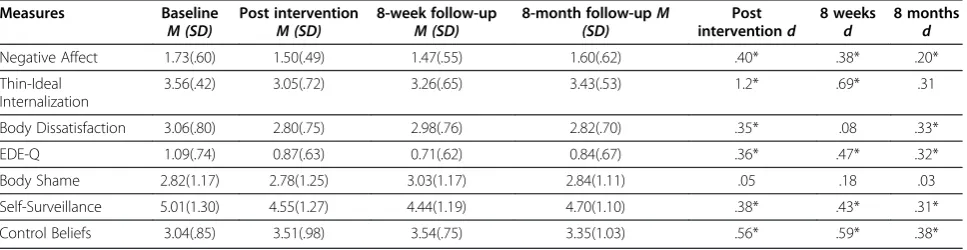
Impact of PL-DBI (Manipulation check and hypothesis 1) All analyses were conducted on an intent-to-treat basis. Missing data points were handled with PROC mixed procedure with maximum likelihood imputation proce-dures in SAS. Analyses of variance (ANOVAs) were conducted with time (pre-, post-, 8-week, and 8-month) as the repeated factor to test our main hypothesis that our intervention would improve all dependent measures at post-intervention and follow-up time points. Because the eating disorder pathology composite was skewed, we normalized using a square root transformation. Skewed PANAS data was normalized using a logarithmic trans-formation. We calculated Cohen’sdeffect sizes for post-intervention and all follow-ups to facilitate comparisons with previous trials (see Table 1 for means, standard de-viations and Cohen’sdeffect sizes).
We first investigated whether our four traditional vari-ables (i.e., thin-ideal internalization, body dissatisfaction, eating disorder pathology, and negative affect) showed the typical and expected reductions over time as a ma-nipulation check. We found a statistically significant effect for all four traditional variables (thin-ideal intern-alization, F (3, 214) = 19.95, p< .0001; body dissatis-faction, F (3, 212) = 5.29, p= .0015; eating disorder pathology, F (3, 213) = 10.35, p< .0001; and negative affect, F (3, 214) = 7.79, p< .0001). Results of post-hoc comparisons for baseline to each follow-up are presented in Table 1. We then examined baseline to 8-month follow-up within group effect sizes from three previous trials to determine if effect sizes in the present
study were comparable. Overall, effects were slightly lower in the present uncontrolled study at 8-months (d= .20 - .33) as compared to previous controlled studies (Becker et al. [26]: d= .19 - .61; Becker et al. [27]:
d= .28-.40; 2010: d= .30 - .59), even though post hoc analyses at 8-months indicated that most effects were significantly different from baseline. Perhaps ironically, the effect size of the one outcome variable that was not significant at 8-months in the present study (see Table 1), thin-ideal internalization (d= .31) was virtually identical to that found in Becker et al. [28] (d= .30), where it was significant. Taken as a whole, results from this open trial were reasonably comparable to past research if slightly smaller, and support the interpretation that PL-DBI yielded a similar effect in this trial to past controlled studies.
We next examined our three new variables, each associ-ated with objectification theory. For self-surveillance, we found a statistically significant improvement,F(3, 211) = 8.04,p< .0001, which was maintained at 8-month follow-up (see Table 1). The magnitude of effect was very similar to our traditional variables. We found a similar pat-tern when we examined control beliefs,F(3, 211) = 10.17,
p< .0001. Thus, our hypotheses were supported with these two novel variables. Our hypothesis for body shame, how-ever, was not supported. Body shame did not evidence any meaningful change (d= .03 at 8 months) during the course of PL-DBI,F(3, 211) = 1.78,p= .1513.
Mediation analyses (Hypotheses 2 & 3)
Mediation analysis tests whether the potential mediator variable (a third variable) influences the relationship be-tween the two primary variables of interest. Mediation analyses were conducted to determine if body shame mediated the relationship between self-objectification (operationalized with the self-surveillance subscale) and eating disorder pathology at baseline (Hypothesis 2). We hypothesized that body shame would reduce the effect of self-objectification on eating disorder pathology, or in
Table 1 Means and standard deviations for dependent measures
Measures Baseline
M (SD)
Post intervention
M (SD)
8-week follow-up
M (SD)
8-month follow-upM (SD)
Post interventiond
8 weeks
d
8 months
d
Negative Affect 1.73(.60) 1.50(.49) 1.47(.55) 1.60(.62) .40* .38* .20*
Thin-Ideal Internalization
3.56(.42) 3.05(.72) 3.26(.65) 3.43(.53) 1.2* .69* .31
Body Dissatisfaction 3.06(.80) 2.80(.75) 2.98(.76) 2.82(.70) .35* .08 .33*
EDE-Q 1.09(.74) 0.87(.63) 0.71(.62) 0.84(.67) .36* .47* .32*
Body Shame 2.82(1.17) 2.78(1.25) 3.03(1.17) 2.84(1.11) .05 .18 .03
Self-Surveillance 5.01(1.30) 4.55(1.27) 4.44(1.19) 4.70(1.10) .38* .43* .31*
Control Beliefs 3.04(.85) 3.51(.98) 3.54(.75) 3.35(1.03) .56* .59* .38*
other words, we hypothesized that the amount of medi-ation (which is called the indirect effect) would be sig-nificant from zero. In order to evaluate if body shame mediated the relationship between self-objectification and eating disorder pathology at baseline, we tested four pathways: (a) self-objectification predicting body shame, (b) self-objectification predicting eating disorder ology, (c) body shame predicting eating disorder path-ology, and (d) body shame mediating the relationship between the other two variables. To facilitate compari-son with Rolnik et al. [17], we used similar analyses and performed a series of regression models to test the above pathways as outlined by Baron and Kenny [40]. Next, a bias-corrected accelerated bootstrapping method was used to test if the indirect effect was zero [49].
At baseline, we tested the above pathways with 91 par-ticipants. First, it was confirmed that objectification significantly predicted body shame (b= .41, t= 4.86,
p< .0001) and self-objectification significantly predicted eating disorder pathology (b= .13, t= 3.92, p= .0002). Next, there was a significant effect of body shame on eating disorder pathology (b= .20, t= 6.12, p< .0001). When controlling for body shame, the effect of self-objectification on eating disorder pathology became non-significant (b= .056, t= 1.72, p= .089). Finally, the indirect effect of self-objectification on eating disorder behavior through body shame was estimated to be .07, with 95% confidence interval from .03 to .12, using a bias-corrected accelerated bootstrap with 5,000 replica-tions [50]. These findings suggest that body shame medi-ated the relationship between self-objectification and eating disorder pathology at baseline.
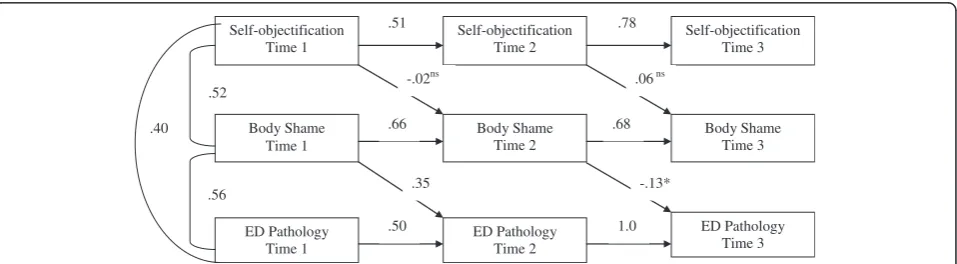
A cross-lagged panel model was constructed using PROC CALIS in SAS to examine whether the above-mentioned relationship existed longitudinally (Hypothesis 3). We used pre-, post-intervention, and 8-week data and chose not to use eight-month data so that data included in the model were more evenly spaced. In this model, each variable was allowed to predict its own occurrence at subsequent time
points; other predictors were examined in addition to those previous effects that had been controlled for, as depicted in Figure 1.
The comparative fit index (CFI) and the standardized root mean square residual (SRMR) were reported. A CFI of .95 or higher and a SRMR of .08 or lower is consid-ered ideal [51]. For the present model, the CFI had a value of .98 and the SRMR had a value of .07, which in-dicated that the model fit the data well. As shown in the Figure 1, objectification at Time 1 predicted self-objectification at Time 2, and the Time 2 value predic-ted self-objectification at Time 3 (all ps < .001). The same findings held for body shame and eating dis-order pathology variables (all ps < .001). However, self-objectification failed to predict body shame when controlling previous occurrence (ps > .05). The results for body shame predicting eating disorder pathology was not consistent over time. Body shame at Time 1 posi-tively predicted eating disorder pathology at Time 2 (p < .001) while body shame at Time 2 negatively predicted eating disorder pathology at Time 3 when previous eating disorder pathology was controlled (p < .01). Since there is no relationship between self-objectification and body shame when controlling for previous occurrence, basic conditions to establish the mediation were not met and the cross-sectional mediation relationship described ear-lier was not replicated for longitudinal data.
Discussion
The purpose of the present study was two-fold. First, we sought to determine whether or not self-objectification as measured by the OBCS was reduced in sorority mem-bers who participated in a PL-DBI program. Second, we wanted to determine if the mediation findings of Rolnik et al. [17] would replicate under very different circums-tances (i.e., during implementation of a positive body image program versus sorority recruitment which could be viewed as increasing body scrutiny).
Self-objectification Time 1
Self-objectification Time 2
Self-objectification Time 3
Body Shame Time 3 Body Shame
Time 2 Body Shame
Time 1
ED Pathology Time 3 ED Pathology
Time 2 ED Pathology
Time 1
.78 .51
.68 .66
.50 1.0
.56 .52
.40
.06ns
-.13* .35
-.02ns
Regarding the first objective, results indicated that self-surveillance, which is commonly viewed as the OBCS subscale most closely linked with the concept of self-objectification, and control beliefs were both reduced du-ring the course of PL-DBI with effects maintained at 8-month follow-up in new sorority members. Although these findings will need to be replicated in controlled trials, this study provides preliminary evidence that DBIs which reduce thin-ideal internalization and body dissatis-faction may also impact self-objectification, with virtually identical effect sizes in this study. It should be noted that that effect size was relatively small, so additional research will be needed to determine the clinical significance of this finding. Importantly, however, the self-objectification effect size was virtually the same in this study (d= .31) at 8-months as in Kroon Van Diest & Perez [33] (d= .29) at 5-months. This strongly suggests that the modifications they made to increase the focus on self-objectification were unnecessary.
The current trial was not controlled; thus it could be argued that significant effects were not a result of the program but some other factor such as maturation or testing. Yet, in this trial, effect sizes for body dissatisfac-tion, thin-ideal internalizadissatisfac-tion, negative affect, and eating disorder pathology were similar to past controlled trials in which dissonance outperformed alternative interven-tions under the same condiinterven-tions (peer-led with new so-rority members: Becker et al. [25-28]). Moreover, in the Rolnik et al. [17] sorority study, they found no statisti-cally significant changes in self surveillance over time in either the sorority recruitment or control group, suggesting that self surveillance does not reduce merely as an effect of repeated testing over time.
Although participation in PL-DBI was associated with a reduction in self-surveillance and control beliefs, it was not associated with a reduction in body shame. This is a particularly interesting finding in that several constructs hypothesized in the literature to be closely related to body shame (e.g., body dissatisfaction, self-surveillance, eating disorder pathology, thin-ideal internalization) all showed significant and sustained reductions during the course of this study, whereas body shame showed absolutely no change. One possible explanation is that this is simply a random chance finding. This seems unlikely, however, in that Greif, Farris, You, Becker and Wilson [52] found a similar result in a small study of PL-DBI conducted with sororities at a university in the northeast section of the United States. In that study, both the self-surveillance and body control subscales improved, whereas body shame showed no improvement.
Alternatively, it could be that body shame would have naturally increased in this population without the PL-DBI program. Body shame was the one construct that significantly increased in sorority members over the
course of Rolnik et al.’s study [17]. Thus, it could be that PL-DBI prevented that increase. This interpretation highlights the need for a follow-up trial that uses a no-intervention control group so that the natural course of body shame is observed.
Yet another explanation is that participants were already fairly low on body shame at baseline with a mean rating of 2.82 which falls betweendisagree and somewhat disagree
on this scale (sample item:“I would be ashamed for people to know what I really weigh”). This is in contrast to the mean rating of 5.01 on the self-surveillance scale at base-line (sample item:“I often compare how I look with how other people look”), which is equivalent to somewhat agree. In other words, this finding could merely indicate a floor effect on this subscale. Interestingly, although base-line scores for self-surveillance are quite similar for the three sorority studies to include this measure (M range 5.01-5.29), mean body shame scores for Rolnik et al. [17] and the present study (M range 2.82-2.97) were quite a bit lower than in Basow et al. [16] which reported a mean of 4.03 in sorority members. This provides some support for a possible floor effect.
Another possible interpretation is that the body shame subscale of the OBCS is operationalizing a construct that does not fully map onto the construct originally concep-tualized by Fredrickson and Roberts [3] and/or that the relationship between self-objectification, body shame, and eating disorder pathology is not as straightforward as previously thought. These latter interpretations are supported by the mediation findings of this present study and those of Rolnik et al. [17]. To review, Rolnik et al. found that body shame partially mediated the rela-tionship between self-objectification (as measured by self-surveillance) and eating disorder pathology when the relationship was tested at a single time point. This finding was consistent with previous studies (see Tiggemann [53] for review) and consistent with self-objectification theory. Yet, when Rolnik et al. conducted, to our knowledge, the first longitudinal evaluation of the mediating role of body shame, the model was not sup-ported. The present study found almost identical fin-dings. Body shame mediated the relationship between self-objectification and eating disorder pathology at baseline. Yet, when we examined the relationship over time, the mediation model was not supported.
self-surveillance. The fact that the mediating role of body shame was not supported longitudinally in either study suggests (a) that Rolnik et al.’s findings likely were not spurious, (b) further longitudinal research with other sam-ples is needed, and (c) that researchers may need to re-think the conclusion that body shame as measured by the OBCS can be definitively said to at least partially mediate the relationship between self-objectification and eating disorder pathology in support of self-objectification the-ory. One interpretation of our study and Rolnik et al.’s is that objectification theory is simply wrong when it comes to the proposed pathway linking self-objectification to eat-ing disorders. This seems a plausible hypothesis but clearly more research is needed before drawing this conclusion, particularly given the potential for floor effects mentioned earlier. It is clear, however, that we cannot assume that cross-sectional support is sufficient for a longitudinal model, and that researchers must begin to study this model longitudinally. Continued cross-sectional research serves little purpose at this point.
Lastly, it may be that body shame is more complex than previously realized. Another way to state this is that factors other than self-objectification may have a significant influ-ence on body shame independent of self-objectification. For instance, Slater and Tiggemann [54] recently found that although time since menarche did not have an influ-ence on self-objectification in adolescent girls, it did have an influence on body shame. More specifically, those girls who began menstruating more recently reported greater body shame. Thus, factors not measured in the present study may have had a significant influence on body shame while not affecting other dependent variables. Even if this is true, however, it suggests that revisions to objectification theory’s proposed eating disorder pathway are likely in need to address this complexity.
This study has a number of limitations. First, as noted above this was an exploratory open trial with respect to the question of the impact of dissonance-based interven-tions on self-objectification. As such, findings need to be replicated in a controlled trial, ideally with a bigger sam-ple, to address concerns about demand and other treats to internal validity. Although we conducted a manipula-tion check to make sure effect sizes were comparable to past trials for the traditional variables, controlled re-search is needed for the new variables. Second, there was some attrition. Although we accounted for that sta-tistically and conducted intent-to-treat analyses, the use of incentives to retain a greater percentage of future samples at follow-up would be beneficial. Third, we were only able to use self-report measures in this study.
Conclusion
The present investigation provides preliminary evidence that DBIs may impact self-objectification, although further
study is needed. This study also adds to a very limited lit-erature suggesting that body shame may not mediate the relationship between self-objectification and eating dis-order pathology longitudinally, despite significant evidence that the proposed mediating model is supported at a single time point. This, combined with the finding that body shame did not reduce over the course of the PL-DBI pro-gram while highly related constructs did improve, suggests that the body shame construct and the subscale of the OBCS deserve further critical scrutiny as does objecti-fication theory and the proposed pathway from self-objectification to eating disorders.
Competing interests
Dr.’s Carolyn Black Becker and Rebecca Greif have received compensation in the past for time spent training people in the use of dissonance-based interventions. Dr. Becker is also co-director of the Body Project Collaborative, LLC which was formed to facilitate dissemination of dissonance-based interventions.
Authors’contributions
CB, RG, KH, and TS conceptualized this paper. CB and KH collected the original data for the paper. CB, RG, KH, and TS all contributed to the writing, editing, formatting of the paper. KH managed and organized the database. HH conducted the statistical analyses and reviewed write up of analyses. HH, CB, and TS reviewed and interpreted the results. All authors read and viewed the final version of this manuscript.
Acknowledgments
The authors thank the sororities of Trinity University for their support of this research.
Author details
1Department of Psychology, Trinity University, One Trinity Place, San Antonio, TX 78212-7200, USA.2Rutgers University, GSAPP, New Brunswick, NJ, USA. 3Pennington Biomedical Research Center, Baton Rouge, LA, USA.
Received: 11 September 2012 Accepted: 12 January 2013 Published: 19 March 2013
References
1. Fredrickson BL, Roberts T, Noll SM, Quinn DM, Twence JM:That swimsuit becomes you: sex differences in self-objectification, restrained eating, and math performance.J Pers Soc Psychol1997,75(1):269–284. 2. McKinley NM, Hyde JS:The objectified body consciousness scale:
development and validation.Psychol Women Q1996,20:181–215. 3. Fredrickson BL, Roberts TA:Objectification theory: toward understanding
women’s lived experience and mental health risks.Psychol Women Q
1997,21:73–206.
4. Calogero RM, Tantleff-Dunn S, Thompson JK:Objectification Theory: An Introduction.InSelf-objectification in women: Causes, consequences, and counteractions. 1st edition. Edited by Calogero RM, Tantleff-Dunn S, Thompson JK. Washington, D. C: American Psychological Association; 2011:3–22.
5. Noll SM, Fredrickson BL:A meditational model linking self-objectification, body shame, and disordered eating.Psychol Women Q2004,36:195–203. 6. Csikszentmihalyi M:Flow: The Psychology of Optimal Experience. New York:
Harper Perennial; 1990.
7. Quinn DM, Chaudoir SR, Kallen RW:Performance and flow: A review and integration of self-objectification research.InSelf-Objectification in Women: Causes, Consequences, and Counteractions. 1st edition. Edited by Calogero RM, Tantleff-Dunn S, Thompson JK. Washington, D. C: American Psychological Association; 2011:19–38.
9. Augustus-Horvath C, Tylka TL:A test and extension of objectification theory as it predicts disordered eating: does women’s age matter?
J Couns Psychol2009,56:253–265.
10. Calogero R, Davis WN, Thompson JK:The role of self objectification in the experience of woman with eating disorders.Sex Roles2005,52:45–49. 11. Harrison K, Fredrickson BL:Women’s sports media, self-objectification, and
mental health in black and white adolescent females.J Commun2003,
53(2):216–232.
12. Tiggemann M, Lynch JE:Body image across the life span in adult women: the role of self-objectification.Dev Psychol2001,37(2):243–253.
13. Kozee HB, Tylka TL, Augustus-Horvath C, Denchik A:Development and psychometric evaluation of the interpersonal sexual objectification scale.
Psychol Women Q2007,31:176–189.
14. Slater A, Tiggemann M:A test of objectification theory in adolescent girls.
Sex Roles2002,46:343–349.
15. Tylka TL, Hill MS:Objectification theory as it relates to disordered eating among college women.Sex Roles2004,51:719–730.
16. Basow SA, Foran KA, Bookwala J:Body objectification, social pressure, and disordered eating behavior in college women: The role of sorority membership.Psychol Women Q2007,31(4):394–400.
17. Rolnik AM, Engeln-Maddox R, Miller SA:Here’s looking at you: Self-objectification, body image disturbance, and sorority rush.Sex Roles
2010,63:6–17.
18. Matusek JA, Wendt SJ, Wiseman CV:Dissonance thin-ideal and didactic healthy behavior eating disorder prevention programs: Results from a controlled trial.Int J Eat Disord2004,36:376–388.
19. Mitchell KS, Mazzeo SE, Rausch SM, Cooke KL:Innovative interventions for disordered eating: evaluating dissonance-based and yoga interventions.
Int J Eat Disord2007,40:120–128.
20. Stice E, Chase A, Stormer S, Appel A:A randomized trial of a dissonance-based eating disorder prevention program.Int J Eat Disord2001,29:247–262. 21. Stice E, Marti CN, Spoor S, Presnell K, Shaw H:Dissonance and healthy
weight eating disorder prevention programs: long-term effects from a randomized efficacy trial.J Consult Clin Psychol2008,76:329–340. 22. Stice E, Mazotti L, Weibel D, Agras WS:Dissonance prevention program
decreases thin-ideal internalization, body dissatisfaction, dieting, negative affect, and bulimic symptoms. A preliminary experiment.
Int J Eat Disord2000,27:206–217.
23. Stice E, Shaw H, Burton E, Wade E:Dissonance and healthy weight eating disorder prevention programs: a randomized efficacy trial.J Consult Clin Psychol2006,74:263–275.
24. Stice E, Trost A, Chase A:Healthy weight control and dissonance-based eating disorder prevention programs: Results from a controlled trial.
Int J Eat Disord2003,33:10–21.
25. Becker CB, Smith LM, Ciao AC:Reducing eating disorder risk factors in sorority members: a randomized trial.Behav Ther2005,36:245–253. 26. Becker CB, Smith LM, Ciao AC:Peer-facilitated eating disorder prevention:
a randomized effectiveness trial of cognitive dissonance and media advocacy.J Couns Psychol2006,53:550–555.
27. Becker CB, Bull S, Smith LM, Ciao AC:Effects of being a peer-leader in an eating disorder prevention program: can we further reduce eating disorder risk factors?Eat Disord2008,16:444–459.
28. Becker CB, Wilson C, Williams A, Kelly M, McDaniel L, Elmquist J: Peer-facilitated cognitive dissonance versus healthy weight eating disorders prevention: a randomized comparison.Body Image2010,7:280–288. 29. Festinger L, Fredrickson BL, Roberts T, Noll SM, Quinn DM, Twence JM:That
swimsuit becomes you: Sex differences in self-objectification, restrained eating, and math performance.J Pers Soc Psychol1998,75(1):269–284.
A theory of cognitive dissonance. Oxford, England: Row, Peterson; 1957. 30. Becker CB, Stice E, Shaw H, Woda S:Use of empirically-supported
interventions for psychopathology: can the participatory approach move us beyond the research-to-practice gap?Behav Res Ther2009,47:265–274. 31. Becker CB, Bull S, Schaumberg K, Cauble A, Franco A:Effectiveness of peer-led eating disorders prevention: a replication trial.J Consult Clin Psychol
2008,76:347–354.
32. Knauss C, Paxton SJ, Alsaker FD:Body dissatisfaction in adolescent boys and girls: objectified body consciousness, internalization of the media body ideal and perceived pressure from the media.Sex Roles2008,59:633–643. 33. Kroon Van Diest AM, Perez M:Exploring the integration of thin-ideal
internalization and self-objectification in the prevention of eating disorders.Body Image2012, http://dx.doi.org/10.1016/j.bodyim.2012.10.004.
34. Calogero RM:Operationalizing self-objectification: Assessment and related methodological issues.InSelf-objectification in women: Causes, consequences, and counteractions. 1st edition. Edited by Calogero RM, Tantleff-Dunn S, Thompson JK. Washington, D. C: American Psychological Association; 2011:23–50.
35. Becker CB, Stice E:Sorority Body Image Program: Group Leader Guide. New York: Oxford University Press; 2008.
36. Lindberg SM, Hyde SJ, McKinley NM:A measure of objectified body consciousness for preadolescent and adolescent youth.Psychol Women Q
2006,30:65–76.
37. Stice E, Ziemba C, Margolis J, Flick P:The dual pathway model differentiates bulimics, subclinical bulimics, and controls: Testing the continuity hypothesis.Behav Ther1996,27:531–549.
38. Stice E:A prospective test of the dual-pathway model of bulimic pathology: mediating effects of dieting and negative affect.
J Abnorm Psychol2001,110:124–135.
39. Stice E, Agras WS:Predicting onset and cessation bulimic behaviors during adolescence: a longitudinal grouping analysis.Behav Ther1998,
29:257–276.
40. Berscheid E, Walster E, Bohrnstedt G:The happy American body: a survey report.Psychology Today1973,7(6):119–131.
41. Stice E, Fisher M, Martinez E:Eating disorder diagnostic scale: additional evidence of reliability and validity.Psychol Assess2004,16:60–71. 42. Fairburn CG, Beglin SJ:Assessment of eating disorders: interview or
self-report questionnaire?Int J Eat Disord1994,16:363–370.
43. Fairburn CG, Cooper Z:The eating disorder examination.InBinge Eating: Nature, Assessment, and Treatment. 12th edition. Edited by Fairburn CG, Wilson G. NY: Guilford; 1993:317–360.
44. Luce KH, Crowther JH:The reliability of the eating disorder
examination—self-report questionnaire version (EDE-Q).Int J Eat Disord
1999,25:349–351.
45. Mond JM, Hay PJ, Rodgers B, Beaumont PJV, Owen C:Temporal stability of the eating disorder examination questionnaire.Int J Eat Disord2004,
36:195–203.
46. Peterson CB, Crosby RD, Wonderlich SA, Crow SJ, Mitchell JE, Bardone-Cone A, Klein M, le Grange D:Psychometric properties of the eating disorder examination-questionnaire: Factor structure and internal consistency.
Int J Eat Disord2007,40:386–389.
47. Watson D, Clark LA:Affects separable and inseparable: on the hierarchical arrangement of the negative affects.J Pers Soc Psychol1992,62:489–505. 48. Cohen J:Statistical power analysis for the behavioral sciences. 2nd edition.
Hillsdale, NJ: Lawrence Earlbaum Associates; 1988.
49. Baron RM, Kenny DA:The moderator-mediator variable distinction in social psychological research: conceptual, strategic, and statistical considerations.J Pers Soc Psychol1986,51:1173–1182.
50. Preacher KJ, Hayes AF:Asymptotic and resampling strategies for assessing and comparing indirect effects in multiple mediator models.
Behav Res Methods2008,40:879–891.
51. Hu L, Bentler PM:Cutoff criteria for fit indexes in covariance structure analysis: conventional criteria versus new alternatives.Struct Equ Modeling1999,6:1–55.
52. Greif R, Farris S, You C, Becker C, Wilson GT:Reducing eating disorder risk factors in members of a national sorority: 5-month follow-up. Toronto, Canada: Poster presented at the 45th Annual Meeting of the Association of Behavioral and Cognitive Therapies; 2011.
53. Tiggeman M:Mental health risks of self-objectification: A review of the empirical evidence for disordered eating, depressed mood and sexual dysfunction.InSelf-Objectification in Women: Causes, Consequences, and Counteractions. 1st edition. Edited by Calogero RM, Tantleff-Dunn S, Thompson JK. Washington, D. C: American Psychological Association; 2011:139–160.
54. Slater A, Tiggemann M:Time since menarche and sport participation as predictors of self-objectification: a longitudinal study of adolescent girls.
Sex Roles2012,67:571–581.
doi:10.1186/2050-2974-1-10
Cite this article as:Beckeret al.:Reducing self-objectification: are