R E S E A R C H
Open Access
Integrated exemplar-based template matching
and statistical modeling for continuous speech
recognition
Xie Sun
1and Yunxin Zhao
2*Abstract
We propose a novel approach of integrating exemplar-based template matching with statistical modeling to improve continuous speech recognition. We choose the template unit to be context-dependent phone segments (triphone context) and use multiple Gaussian mixture model (GMM) indices to represent each frame of speech templates. We investigate two different local distances, log likelihood ratio (LLR) and Kullback-Leibler (KL) divergence, for dynamic time warping (DTW)-based template matching. In order to reduce computation and storage complexities, we also propose two methods for template selection: minimum distance template selection (MDTS) and maximum likelihood template selection (MLTS). We further propose to fine tune the MLTS template representatives by using a GMM merging algorithm so that the GMMs can better represent the frames of the selected template representatives. Experimental results on the TIMIT phone recognition task and a large vocabulary continuous speech recognition (LVCSR) task of telehealth captioning demonstrated that the proposed approach of integrating template matching with statistical modeling significantly improved recognition accuracy over the hidden Markov modeling (HMM) baselines for both TIMIT and telehealth tasks. The template selection methods also provided significant accuracy gains over the HMM baseline while largely reducing the computation and storage complexities. When all templates or MDTS were used, using the LLR local distance gave better performance than the KL local distance. For MLTS and template compression, KL local distance gave better performance than the LLR local distance, and template compression further improved the recognition accuracy on top of MLTS while having less computational cost.
Keywords:Gaussian mixture model; Template matching; KL divergence; Dynamic time warping; Large vocabulary continuous speech recognition
1 Introduction
In speech recognition, hidden Markov modeling (HMM) has been the dominant approach since it provides a prin-cipled way of jointly modeling speech spectral variations and time dynamics. However, HMM has the shortcoming of assuming the observations being independent within each state, which makes it ineffective in modeling the fine details of speech temporal evolutions that are important in characterizing nonstationary speech sounds [1]. Time derivatives of cepstral coefficients [2] are widely used to supplement time dynamic information to speech feature
distributions. Trajectory model [3] introduces time-varying covariance modeling to capture temporal evolutions of speech features. Additionally, approaches like segment models [4,5] and long-contextual-span model of resonance dynamics [6] have been proposed for similar purposes.
Exemplar-based methods have the potential in address-ing the deficiency of HMMs and in recent years they have drawn renewed attention in the speech recognition com-munity [7,8], such as sparse representations (SRs) [9] and template matching [10,11]. Template-based methods make direct comparisons between a test pattern and the tem-plates of training data via dynamic time warping (DTW), and potentially they can capture the speech dynamics bet-ter than HMMs. Template-based methods were originally used to recognize isolated words or connected digits with * Correspondence:[email protected]
2
Department of Computer Science, University of Missouri, Columbia, MO 65211, USA
Full list of author information is available at the end of the article
good performances [12]. Until recently, template-based methods had been impractical for large tasks of speech recognition, since feature vectors of training templates need to be stored in computer memory. With today’s rapid advance in computing power and memory cap-acity, template-based methods are investigated for large recognition tasks and promising results are reported [10,11,13-18]. However, they are still difficult to use in large vocabulary continuous speech recognition (LVCSR) due to their needs for intensive computing time and stor-age space. The newly proposed methods, such as template pruning and filtering [19], template-like dimension reduc-tion of speech observareduc-tions [20], and template matching in the second-pass decoding search [21], are beginning to address this problem. In general, there is a tradeoff be-tween the costs in computation and space and the accur-acy in recognition.
Considering the pros and cons of HMMs and template methods, i.e., HMM-based statistical models are effective in compactly representing speech spectral distributions of discrete states but are ineffective in representing the fine details of speech dynamics, while template matching cap-tures well the speech temporal evolutions but demands much larger computational complexity and memory space, it appears plausible to integrate the two approaches so as to exploit their strengths and avoid their weaknesses. In the current work, we propose a novel approach of integrating exemplar-based template matching with statistical model-ing. We construct triphone context-dependent phone tem-plates to preserve the time dynamic information of phone units and use phonetic decision trees to generate templates of tied triphone units, which improves the reliability of phone templates and covers unseen triphones by some tri-phone clusters. The load on memory storage is reduced by using Gaussian mixture model (GMM) indices to represent the speech frames of the templates. It is worth noting that Gaussian indices were previously used to represent speech frames in speech segmentation [22], speech separation [23], and keyword spotting [24-26]. To facilitate comparison of the templates labeled by GMM indices, we propose the local distances of log likelihood ratio (LLR) and Kullback-Leibler (KL) divergence for DTW-based template matching. To further reduce the costs of memory space and com-putation, we propose template selection methods to generate template representatives based on the criteria of minimum distance (MDTS) and maximum likelihood (MLTS) and we also propose a template compression method to integrate information from training tem-plates to obtain more informative template representa-tives. In the recognition stage, the GMMs and the templates are used together by DTW with the proposed local distances. The proposed methods have been ap-plied to lattice rescoring on the tasks of TIMIT [27] phone recognition and telehealth [28] large vocabulary
continuous speech recognition, and they have led to consistent error reductions over the HMM baselines.
This paper is organized as follows. In Section 2, we dis-cuss the related work for template-based speech recogni-tion and provide an overview of our proposed system. In Section 3, we describe the proposed methods for template construction, matching, and clustering. In Section 4, we discuss the proposed methods for template representative selection and compression. In Section 5, we present evalu-ation results on the task of TIMIT phone recognition and the task of telehealth LVCSR. Finally in Section 6, we give our conclusion and discuss future work.
2 Related work and system overview 2.1 Related work
with the acoustic and language scores of the first-pass model through a segmental conditional random field to rescore word lattices. Since the word lattices helped re-strict the search space, the templates were not required to cover the full training data, and the templates were also filtered to a smaller set to reduce computation cost and improve robustness. Experimental results showed that the template-based approach obtained a slightly better performance than the baseline system in Voice Search and YouTube tasks.
Relative to the above-discussed efforts, our approach as proposed in the current work falls into the hybrid category, but our integration of statistical modeling and template representation and matching are tighter, since we not only rescore the lattices generated by the HMM baseline, but we also use the baseline phonetic decision tree (PDT) structures to define the tied tri-phone templates, representing the template frames by the GMMs and using the LLR and KL distances to measure the differences of speech frames represented in this way. In the aspect of reducing computation and memory costs, we absorb the training data information into template representatives through clustering and estimation, rather than selecting a subset of training data as the templates. On the TIMIT and telehealth tasks, we are able to show statistically significant im-provements in phone and word accuracies, respect-ively, over the HMM baselines.
2.2 System overview
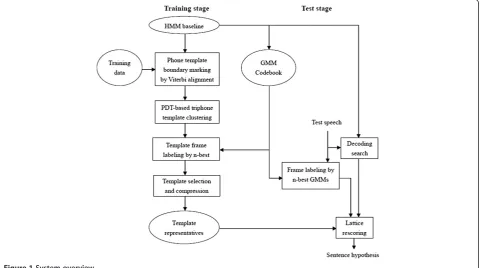
The overall architecture of the proposed template matching method is described in Figure 1. In the train-ing stage, Viterbi alignment is performed on the traintrain-ing data by the baseline model to determine the phone tem-plate boundaries; using the PDT-based triphone state tying structures of the baseline system, template cluster-ing is performed to generate tied triphone templates (Section 3.3); using the GMM codebook derived from the baseline model, the template frames are labeled by the GMMs (Section 3.1); template selection and com-pression are further performed to generate the template representatives (Section 4). In the test stage, the baseline model is first used to perform decoding search on a test speech utterance to generate a word lattice; the test speech frames are labeled by the GMMs in the same way as in training; template matching and best path search are then performed on the word lattice to gener-ate the rescored sentence hypothesis (Section 3.3).
3 Template representation, matching, and clustering
3.1 Template representation
We choose the template unit to be context-dependent phone segments, the context being the immediately left and right phones of each phone segment, and we refer the context-dependent templates as triphone templates. We first carry out forced alignments of training speech data
with their transcriptions to obtain phone boundaries which define the phone templates. We then use a GMM code-book {m1,m2,…,mN} that consists of the GMMs of the phonetic-decision-tree tied triphone states in the baseline HMMs to label the template frames, whereN is the total number of GMMs from the HMM baseline. To do so, we compute the likelihood scores of a feature vector or frame (these two terms are used interchangeably with the under-standing that a feature vector is normally extracted from a frame of data),xt∈Rd(dis the dimension of a real-valued feature vector), of a phone template by all GMMs and take the n GMMs that give the top n likelihood scores, p xt m1ð Þxt Þ≥p xt m2ð Þxt Þ≥…≥p xtmn xð Þt Þ≥…
, to label xt. Each GMM index is also associated with a weightwk xð Þt
that is defined to be proportional to the likelihood score p xtmk xð Þt Þ
, with wk tð Þ¼∑npðxtjmk xtð ÞÞ
l¼1p xðtjml xtð ÞÞ and ∑n
k¼1wk xð Þt ¼1. A template frame is therefore represented as
xt→
m1ð Þxt ⋮ mn xtð Þ 2 4
3
5 w1⋮ð Þxt
wn xtð Þ 2 4 3 5 8 < : 9 =
;: ð1Þ
In general, n < < d, and hence storing the template frames in GMM indices requires a much smaller space than storing the feature frames for the Templates.
3.2 Template matching
In using DTW to measure the dissimilarity between two speech utterances, the allowed range of speaking rate variations can be specified by local path constraints [12]. Letd(i,j) denote the local distance between the ith and the jth frames of two sequences under comparison and D(i, j) denote the cumulative distance between the two sequences up to the time i and j. The symmetric con-straint that we adopt here is defined as
D ið Þ ¼;j d ið Þ þ;j min D if ð−1;jÞ;D ið−1;j−1Þ;D ið;j−1Þg:
ð2Þ
Given a sequence Sx representing a template and a se-quenceSyrepresenting a test segment, their average frame distance is calculated as
D Sx;Sy
¼ 1
N min∅
XN
k¼1d ∅Sxð Þk ; ∅Syð Þk
; ð3Þ
where ∅Sx and ∅Sy are the warping functions that map Sx andSyto a common time axis, and Nis the warping path length. Considering the fact that in HMM-based decoding search the acoustic score of a test segment is the sum of its frame log likelihood scores (the segment acoustic score is therefore the average frame score scaled by the length of the segment), we define the distance be-tween the template Sx and the test segment Sy in the similar way as
D Sx;Sy
¼LD S x;Sy
¼ L
N min∅
XN
K¼1d ∅Sxð Þk ; ∅Syð Þk
ð4Þ
whereLis the length of the test segmentSy. Through scal-ing the average frame distance by the test segment length, the acoustic scores for different hypotheses of a test speech utterance (which in general consists of many seg-ments) can be directly compared in template matching, as in HMM-based decoding search. Note that without the normalization by N in Equation 3, a template matching score for a speech segment would be affected by the length of the time warping path, which may vary with dif-ferent templates; on the other hand, if the rescaling byLis not adopted, then the total distance on a decoding path would be dependent on the number of test segments in the path but not the lengths of these segments.
Commonly used local distances, such as Euclidean or Mahalanobis distances, compute the difference between two feature vectors directly [10], and they are thus of a feature-feature type. Let x and y represent two frames under comparison. The Euclidean distance is
dEucðx;yÞ ¼ðx−yÞ
0
x−y
ð Þ ð5Þ
and the Mahalanobis distance is
dMahðx;yÞ ¼ðx−yÞ
0
Σ−1ðx−yÞ ð6Þ
withΣ as the covariance matrix estimated from training data.
When the template frames are represented by GMM indices, the Euclidean and Mahalanobis distances are no longer suitable. One possibility is to use negated log like-lihood (NLL) score as a local distance. Letxt and yt0 be the frames of a test segment and a training template, re-spectively, and assume that yt0 is labeled by a GMM m1ð Þyt0 . The NLL distance is then
dNNLxt;yt0¼−logp xtjm
1ð Þyt0
: ð7Þ
When yt0 is represented by n GMMs m
1ð Þyt0 ;…;
n
mn y
t0
ð Þ
o
with the weights w1ð Þyt0 ;…;wn yð Þt0
n o
, the NLL
distance becomes
dNNL xt;yt0
¼−logXn
k¼1wk yð Þt0 p xtmk yð Þt0 Þ:
ð8Þ
labels on both the test and the training frames. These two model-model distances are described below.
3.2.1 Log likelihood ratio local distance
Assuming that the test frame xt is labeled by a GMM m1ð Þxt and the training frame yt0 is labeled by a GMM m1ð Þyt0 . The LLR local distance betweenxtandyt0 is then defined as follows:
dLLR xt;yt0
¼ log p xtjm1ð Þxt
p xtjm1ð Þyt0
: ð9Þ
The LLR distance contrasts the fit score of a test frame with its best model against its fit score with the best model of the template frame, and it therefore compares the two frames indirectly through the models. The LLR distance is nonnegative when 1-best GMM is used in frame labeling. When using multiple GMM indices for speech frame rep-resentation, the nonnegativity also holds if the weights are kept uniform, but it is not guaranteed if the weights are nonuniform, where the latter is due to the fact that al-though the GMM scores of the numerator are not smaller than those of the denominator, a skew in the denomina-tor’s weights toward some large GMM scores may make the denominator larger than the numerator. On the other hand, since what we really need is the difference of the nu-merator and denominator log likelihood scores as the dis-similarity between a test frame and a template frame, while a strict-sense log likelihood ratio is not needed here as in statistic hypothesis testing, we can therefore simply take the absolute value of the log likelihood score differ-ence as the distance measurement which is also the recti-fied LLR given in Equation 10:
dLLR xt;yt0
¼logX
n
k¼1
wk xtð Þp xtjmk xtð Þ
−logX
n
k¼1 wk y
t0
ð Þpxtjmk yð Þt0
¼log ∑
n
k¼1wk xtð Þp xtjmk xtð Þ
∑n
k¼1wk yð Þt0 p
xtjmk y t0
ð Þ
ð10Þ
(it is worth mentioning here that although getting a negative log likelihood ratio is a mathematical possi-bility, it never occurred in the experiments described in Section 5).
3.2.2 KL divergence local distance
In either the NLL distance or the LLR distance, the feature vector xtis involved in the distance calculation. Here we consider measuring the local distance between two frames without using the feature vectors. KL divergence is widely
used for measuring the difference between two probability distributions [29]. Since the frames are represented by GMM indices, the KL divergence between GMMs becomes a natural choice for indirectly measuring the dissimilarity of two frames. Because there is no closed-form expression for KL distance of GMMs, we use the Monte Carlo sampling method of Hershey and Olsen [30] to compute the diver-gence from a GMMmxto a GMMmyas
d mxjj my
¼ 1
ns
Xns
i¼1log mxð Þxi myð Þxi
ð11Þ
where the xis are i.i.d. samples generated from the GMM mx. Since the KL divergence is asymmetric, we further define a symmetric KL distance as
dKL mx;my
¼1
2 d mxjj my
þd myjjmx
: ð12Þ
The local distance between the two frame vectors xt and yt0 is then calculated as
d xt ;yt0¼
Xn
k¼1
Xn
l¼1wk xð Þtwl yð Þt0 dKL mk xð Þt;ml yð Þt0
:
ð13Þ
3.3 PDT-based template clustering and matching score calculation
Considering the fact that certain triphone contexts may rarely occur or even be missing in a training set, we investi-gate tying triphone templates into clusters of equivalent contexts to improve the reliability of template matching as well as to handle unseen triphones in recognition. Among many possible clustering algorithms, we decide to utilize the PDT tying structures of the triphone states in the base-line HMMs directly to cluster triphone segments, since the tying structure of a phone state indicates partial similarities among triphone segments. We assume that each phone HMM has three emitting states as commonly used in HTK [31]. For the triphone templates of each monophone, we keep the three tying structures defined by the three emit-ting states of the corresponding phone HMM and use them jointly in template matching.
Specifically, in matching a test speech segment against a triphone arc in a word lattice, we first identify the three tied triphone clusters by answering the phonetic questions in the PDTs, and for an identified cluster i with ki tem-plates, we then choose ffiffiffiffiki
p
-nearest neighbor (KNN) method where K is set as the square root of the training sample size [32].
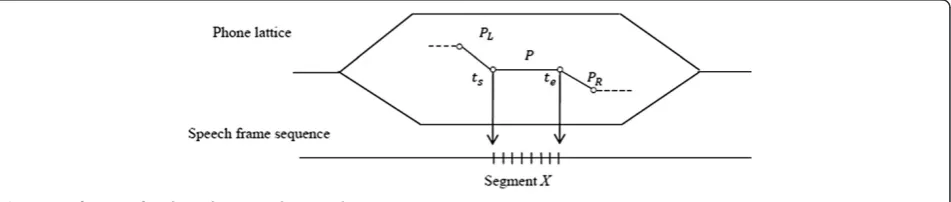
Figure 2 illustrates the process of computing template matching score for lattice rescoring. It shows a phone lattice and a test speech segment X extracted from a speech utterance according to the start and end time of the phone arc P that has a predecessor phone PL and successor phonePR. Figure 3 illustrates the way that the matching scores of X with the three triphone template clusters containing PL−P+PR are averaged to one matching score, which is used to replace the original acoustic score in the phone lattice for the phone arcP.
4 Template selection and compression
When the above-described template matching is used for lattice rescoring in LVCSR, the computation and storage overheads are still high. However, certain redundancies in the training templates can be reduced to improve compu-tation and storage efficiency. We propose three methods of template selection and compression to address this problem. In template selection, the goal is to choose a small subset of templates as the representatives for the full set of training templates. In template compression, new GMMs are generated for labeling the frames of the se-lected template representatives so as to better capture the information in the training Templates.
4.1 Minimum-distance-based template selection
Agglomerative clustering [33] is a hierarchical clustering algorithm and it is widely used in pattern recognition, in-cluding speech recognition [34]. For selecting template representatives, we use the agglomerative clustering algo-rithm to further cluster the templates in each tied triphone cluster at a PDT leaf node, which recursively merges two closest clusters into one cluster until only one cluster is left. Given a distance function D(Ci,Cj) for two clusters, the following procedure describes the algorithm for clus-teringmtemplates {s1,s2,…,sm} in a leaf node of a PDT:
1. Initialize the template setZ1= {{s1}, {s2},…, {sm}}
with each templatesibeing a cluster.
2. Forn=2,…,m: Obtain the new setZnby merging
the two clustersCiandCjin the setZn−1with the
distanceD(Ci,Cj) to be the minimum among all
existing distinct cluster pairs. Stop the clustering process if the number of clusters in the setZndrops
below a threshold.
The cluster distance function D(Ci, Cj) is commonly defined by the distance of their elements D(sx, sy), and the average distance measure is adopted here [33]:
D Ci;Cj
¼ 1
Ci
j jCj
∑sxCi∑syCjD sx;sy
: ð14Þ
Note that D(sx, sy) is the DTW distance of two tem-plates as defined in Section 3.2, and in this step, the local distancedis the Euclidean distance of two frames.
To select a template representative for a cluster, we use the minimum distance from a template to all other templates in the cluster as the criterion, and therefore the method is called minimum distance template selec-tion (MDTS). Given a clusterCi, the template-to-cluster distance is defined as follows [33]:
D sðx;CiÞ ¼ X
sx0∈Ci
sx≠sx0
D sðx;sx0Þ; ð15Þ
and the template s* is selected as the representative for the cluster Ci if its distance to the rest of the templates in the cluster is the minimum, i.e.,
s¼argminsxCiD sðx;CiÞ: ð16Þ
The frames of the selected template representatives are subsequently indexed by theirn-best GMMs according to Section 3.1.
4.2 Maximum-likelihood-based template selection
In maximum likelihood template selection, each frame of a cluster centers*as generated by the MDTS method is relabeled by a set of GMMs that are selected by using a maximum likelihood criterion, so as to make the repre-sentative better characterize the templates in each cluster. For maximum likelihood template selection (MLTS), we
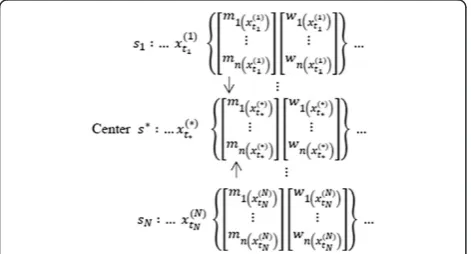
use the DTW described in Section 3.2 to align the tem-plates in a clusterCito the MDTS-initialized template cen-ter s*. Figure 4 illustrates an outcome of aligning the sequences s1,…, sN to s* inCi, where the frames x1
ð Þ t1 ;…;
xð ÞtNN of the sequences s1,…, sN, respectively, are aligned to
the frame xð Þt of the cluster centers
*
. The following pro-cedure describes the MLTS method that is applied to re-label xð Þt of s* by using the aligned frames
X ¼ xð Þt; x
1
ð Þ t1 ;…;x
N ð Þ tN
n o
:
1. Pool the distinct GMMs which are used to label the frames inXinto a local GMM setM.
2. Use theK-medoids algorithm [33] with the KL distance to partition the GMM setMintolclusters Mi,i= 1,…,l, where eachMidefines a subset of
frames that are labeled by the GMMs inMi.
3. Fori= 1,…,l: Use the maximum likelihood criterion to select a GMM ofMias the cluster centermi forMi:
mi ¼argmaxmjiMi X
xϵXMilogpðxjm j iÞ
ð17Þ
wheremjiis thejth GMM inMi.
4. For i= 1,…, l: Calculate the weight wi for each GMM cluster center mi, which is proportional to the likelihood ofXevaluated bymi,i.e.,p X m iÞ
:
wi¼ p X
jmi
∑l
k¼1p Xjmk
¼ e∑xϵXlogp xjm
i
ð Þ
∑l
k¼1e∑xϵXlogp x m
k
: ð18Þ
After the relabeling, the framextis represented by mi and wi, i= 1,…, l. The MLTS procedure is applied to each frame ofs*. The resulting representation ofs*has a form similar to what is described in Section 3.1, with the difference that the best-fitting n GMMs of the baseline HMMs are used to label a frame in Section 3.1, but here the template frames that are aligned to a frame of the MDTS representative are used to select a set oflGMMs to relabel the frame of the representative.
4.3 Template compression
The template compression method aims at taking in more information from the original templates for the template representatives. For each frame of a template representa-tive, instead of selecting only one GMM and excluding the rest of the GMMs for a cluster Mi as in MLTS, here we merge the original GMMs in each clusterMi into a new GMM and use the l new GMMs from the lclusters Mi, i= 1,…,l to relabel the frame. To reduce the negative ef-fect of outlier templates, for each GMM mji in a cluster Mi, we calculate its distance to the cluster centermi based on the KL distancedji¼d m
j i;mi
.From the distancesdji Figure 3Using three PDT clustering structures to calculate the template matching score.
ofMi, the meand and the standard deviationσare com-puted. If a GMM mji is t times standard deviation away fromd, i.e.,
jdji−dj>tσ ð19Þ
then it is considered an outlier and is removed from the merging process. Suppose that after removing the out-liers, there are nG GMMs left in Mi. We first pool the component Gaussian densities from the nGGMMs and normalize the weight of each Gaussian component by
nG. We then merge the pooled Gaussian components ac-cording to the criterion of minimum entropy increment. The entropy increase due to merging two Gaussian components fi~N(µi,Σi) andfj~N(µj,Σj) into N(µ,Σ) is defined as [35]:
ΔE fi; fj
¼ logj j−Σ wi
wiþwj
logj j−Σi wj wiþwj
logΣj
ð20Þ
wherewiand wjare the normalized mixture weights for
fiand fj. The meanμ, covariance Σ, and mixture weight
w of the newly generated Gaussian component are de-fined as
Σ¼ wi
wiþwjΣiþ wj wiþwjΣjþ
wiwj wiþwj
2
μi−μj
μi−μj
0
μ¼ wi
wiþwjμi
þ wj
wiþwjμj
w¼wiþwj:
ð21Þ
The Gaussian components are merged iteratively until the number of components in Mi is below a preset threshold. The remaining Gaussian components are used to construct a new GMM, and the new GMM is used as one of the lGMMs to label the corresponding frame of the template representative.
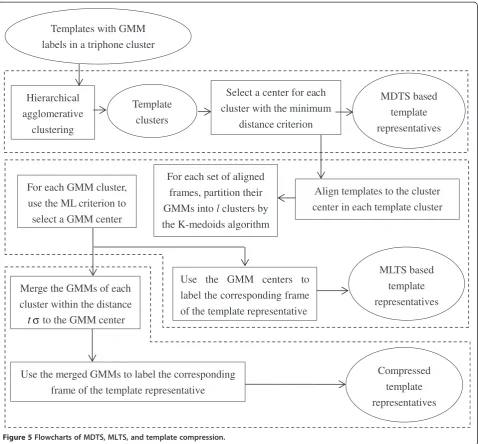
The flowcharts of the above-discussed three template selection and compression methods are given in Figure 5. As shown in the figure, the three methods share the same template representatives that are selected from the original GMM-labeled templates. While MDTS stops here, MLTS reselects the GMM labels for the represen-tative frames, and template compression generates new GMMs and uses them to relabel the frames of the tem-plate representatives. As are shown in the experimental results of Section 5, the refinements on the GMM labels make the template representatives more effective, and when coupled with a proper local distance they allow using only a small fraction of template representatives in lattice rescoring with little performance loss.
5 Experimental results
We performed speaker-independent phone recognition on the task of TIMIT [27] and speaker-dependent large vocabulary speech recognition on the task of telehealth captioning [28]. The experimental outcomes were mea-sured in phone accuracy and word accuracy, respect-ively, for TIMIT and telehealth through aligning each phone or word string hypothesis against its reference string by using the Levenshtein distance [31].
5.1 Corpora
The TIMIT training set consisted of 3,696 sentences from 462 speakers and the standard test set included 1,344 sentences spoken by 168 speakers. The telehealth task included spontaneous speech from five doctors and the vocabulary size was 46,000. A summary of the Tele-health corpus is given in Table 1, where the word counts from the transcription texts are also listed. For a detailed description of this task, please refer to [28].
5.2 Experimental set up and lattice rescoring
For both tasks of TIMIT and telehealth, the speech features consisted of 13 MFCCs and their first- and second-order time derivatives, and crossword tri-phone acoustic models were trained by using HTK toolkit. In calculating a KL distance between two GMMs [30], 10,000 Monte Carlo simulation data samples were generated.
For the TIMIT dataset, the set of 39 phones was de-fined as in [36], and a phone bi-gram language model (LM) was used (trained from the TIMIT training speech transcripts). The HMM baseline was trained with the GMM mixture sizes of 24; and 1,189 GMMs were ex-tracted for template construction. The total original tri-phone templates were 152,715 in the training set. Phone lattices were generated for each test sentence by HTK. The average number of nodes per lattice was in the order of 850, and the average number of arcs was in the order of 2,350.
the order of 700, and the average number of arcs was in the order of 1,950.
In rescoring a lattice, the acoustic score of each phone arc in the lattice was replaced by its corresponding triphone template matching score, where the distance
score of Equation 4 was negated to become a similarity score. By using the acoustic similarity scores and the original language model scores, the best path with the largest sum of acoustic and language model log scores was searched on the lattice using dynamic programming to produce the rescored sentence hypothesis.
5.3 TIMIT phone recognition task
On the TIMIT task, we provide a detailed account of the factors in the proposed template matching methods that affect the rescoring performance, including local dis-tances, number of GMMs employed for frame labeling, template selection, compression methods and their in-teractions with the local distances, and the percentage of selected template representatives. We also examine the
Use the merged GMMs to label the corresponding
frame of the template representative
Compressed
template
representatives
Use the GMM centers to
label the corresponding frame
of the template representative
Merge the GMMs of each
cluster within the distance
to the GMM center
MLTS based
template
representatives
Align templates to the cluster
center in each template cluster
Templates with GMM
labels in a triphone cluster
Hierarchical
agglomerative
clustering
Template
clusters
Select a center for each
cluster with the minimum
distance criterion
MDTS based
template
representatives
For each set of aligned
frames, partition their
GMMs into
l
clusters by
the K-medoids algorithm
For each GMM cluster,
use the ML criterion to
select a GMM center
t
Figure 5Flowcharts of MDTS, MLTS, and template compression.
Table 1 Datasets used in the telehealth task: speech (min)/text (no. of words)
Training set Test set
Dr. 1 210/35,348 19.3/3,248
Dr. 2 200/39,398 29.8/5,085
Dr. 3 145/28,700 12.1/3,988
Dr. 4 180/39,148 14.3/2,759
Dr. 5 250/44,967 27.8/6,421
patterns of phone error reduction and look at the cost-performance tradeoffs.
5.3.1 Local distances
In Figure 6, we compare the phone recognition perfor-mances by using the HMM baseline and the template-matching-based lattice rescoring with the local distances of Mahalanobis, NLL, LLR, and KL divergence. Except for the baseline and the Mahalanobis distance, each frame of a template or a test speech segment was labeled by 1GMM index. The HMM baseline had the phone ac-curacy of 72.72%. In template matching, the Mahalano-bis and NLL local distances improved the baseline by merely 0.11% and 0.12% absolute, respectively, but the LLR and KL distances improved the HMM baseline by 1.30% and 0.96% absolute, respectively. The LLR dis-tance gave higher phone accuracies than the KL disdis-tance did. This may be attributed to the fact that the KL diver-gence measures the difference between GMM distribu-tions but not directly the difference between feature vectors, whereas the LLR distance contrasts the likeli-hood scores of two sets of GMMs for each test frame, and therefore it reflects the characteristics of the test frame more closely. Giving the superiority of the pro-posed LLR and KL distances, we only use these two local distances in the subsequent experiments.
5.3.2 Number of GMMs for frame labeling
In Figure 7, we show the effects of using different num-bers of GMMs (n= 1, n= 3,n= 5, and n= 7) in labeling each frame of the templates. For both LLR and KL distances, the accuracy performance peaked when five GMMs were used for frame labeling, and phone accur-acies of 74.51% and 74.26% were achieved for LLR and KL distances with absolute improvements of 1.79% and 1.54%, respectively, over the HMM baseline of 72.72%. The results confirmed the advantage of using multiple GMMs for frame labeling over using single GMM, as the former induced smaller quantization errors than the
latter. However, using too many GMMs to represent a frame could increase confusion and reduce efficiency. We conducted significance tests on the performance difference between the ‘5GMMs’ case and the HMM baseline. Letxiandyibe the phone recognition accuracy of the ith test sentence for the baseline and a proposed method, respectively. Letti= yi−xiand denote the sam-ple mean and samsam-ple variance of ti ast and s2with the sample size m. The Student’s t test statistic is T ¼t=
s=pffiffiffiffim
ð Þ. In the TIMIT standard test set,m =1,344 and tm−1,1−0.05= 1.65 for one-sided test. For the LLR and
KL local distances, we obtained T>tm−1,1−0.05, and
therefore our proposed template matching methods using the LLR and KL distances improved TIMIT phone recognition accuracy significantly over the HMM base-line at the significance level of 0.05. We also used two-fold cross-validation on the test set to automatically select the number of GMMs for frame labeling, and the case of 5GMM was selected in each validation set. Therefore, the result of the 5GMM case in Figure 7 also represents an open test performance. In the subsequent experiments, five GMMs were used for labeling each frame.
5.3.3 Template selection and compression
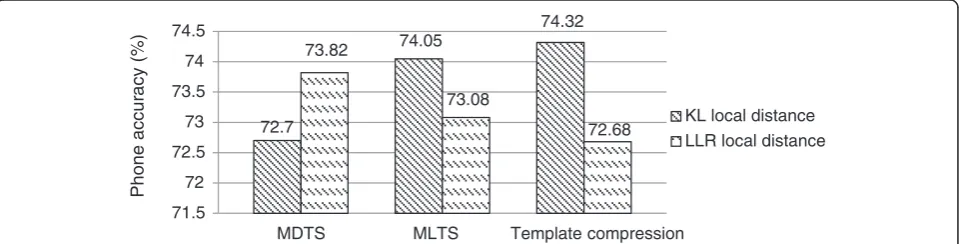
The performances of template selection and compres-sion exhibited a dependency on the local distance mea-sures. Here we discuss how the three methods of (1) MDTS, (2) MLTS, and (3) template compression per-formed when using the LLR and KL distances and show the results in Figure 8, where the number of template representatives were kept to be 20% of the total tem-plates for the three cases (further details are discussed in Section 5.3.5). In template compression, the threshold t in Equation 19 was set to 2 for removing GMM outliers, and the number of Gaussian components in each merged GMM was 24, the same as the GMM mixture size in the baseline HMMs, with a total of 749 newly gen-erated GMMs for the template representatives. In MDTS,
72.72 72.83 72.84 74.02 73.68
62 64 66 68 70 72 74 76
HMM baseline Mahalanobis NLL LLR KL
Pho
ne accuracy
(%)
the phone accuracies were 73.82% and 72.70% for the LLR and KL distance, respectively, and in MLTS, the phone ac-curacies were 74.05% and 73.07% for the LLR and the KL distance, respectively. Relative to MLTS, template com-pression increased absolute phone accuracy by 0.27% with the KL distance and it decreased absolute phone accuracy by 0.40% with the LLR distances. Several points worth noting in Figure 8 are discussed below.
First, MDTS worked well with the LLR distance but poorly with the KL distance, and vice versa for MLTS and template compression. In MDTS, the template rep-resentative frames were labeled in the same way as the test frames, i.e., by the best-fit GMMs of the baseline model, and in this case, a better outcome of LLR than KL is consistent with what was shown in Figure 6 for using all templates. In MLTS, however, the selected tem-plate representative frames were relabeled by GMMs to maximize the likelihood of the aligned template frames, and template compression went further by generating new GMMs from the baseline GMMs and used the new GMMs to relabel the representative frames. Because in MLTS or template compression the template representa-tive frames were no longer labeled by the best-fit GMMs, the LLR distance that contrasted the model-frame fit
became ineffective in comparison with the KL distance that measures the distance between GMMs.
Second, relative to using all of the original templates as discussed in Section 5.3.2, using 20% template repre-sentatives that were selected by MLTS with the KL dis-tance slightly decreased phone accuracy by 0.21% (from 74.26% to 74.05%), but using the template representa-tives selected by MDTS with the LLR distance signifi-cantly decreased phone accuracy by 0.69% (from 74.51% to 73.82%). This difference may be explained by the fact that MDTS simply selects a cluster center as a template representative, but MLTS further refines the GMM indi-ces of each template representative frame to maximize the likelihood of the aligned frames in the corresponding cluster. In this way, MLTS absorbs more information from the training data into the template representatives than MDTS, and so fewer template representatives are needed in MLTS than in MDTS.
Third, with the KL distance, template compression further improved the performance over MLTS, where by using 20% template representatives, phone accuracy was actually improved by 0.06% over the case of using all templates (from 74.26% to 74.32%). This indicates that the new GMMs were more effective in labeling the 72
72.5 73 73.5 74 74.5 75
1GMM 3GMMs 5GMMs 7GMMs
LLR local distance KL local distance HMM baseline
Pho
ne accuracy
(%)
Figure 7Lattice rescoring phone accuracy (percent) using different numbers of GMM indices for frame representation.Using multiple GMMs such as 3, 5, and 7 to label each frame can get better performance than using one single GMM. For both LLR and KL distances, the accuracy performance peaked when five GMMs were used for frame labeling.
72.7
73.82 74.05
73.08
74.32
72.68
71.5 72 72.5 73 73.5 74 74.5
KL local distance LLR local distance
MDTS MLTS Template compression
Phone accur
acy (%)
template representative frames, and the exclusion of the outlier GMMs was helpful, too.
In summary, MDTS worked well with LLR distance, and MLTS and template compression worked well with KL dis-tance. Using the respectively compatible local distances and fixing the selection percentage at 20%, template compres-sion performed the best, MLTS the next, and MDTS the last. Specifically, the accuracy gains over the HMM baseline were 1.6% absolute by template compression with KL, 1.33% by MLTS with KL, and 1.1% by MDTS with LLR. We also conducted the Student’sttest on the performance differences between each of the three methods (with re-spectively compatible distance) and the HMM baseline, and the three methods all significantly improved phone accuracy over the baseline at the level ofα= 0.05.
5.3.4 Evaluation on the outlier threshold t
In Table 2, we show how the threshold value t of Equa-tion 19 for removing the GMM outliers affected the recog-nition performance, where the template selection method was MLTS with the KL distance, and 20% template repre-sentatives were selected. Among the four tvalues studied here, it is observed thatt =2 gave the best phone accuracy performance. Also note that when t=∞, all GMMs in a cluster were used to generate compressed templates, where the existence of outliers degraded the accuracy perform-ance significantly. Accordingly, the threshold t =2 was used in all the template compression experiments.
5.3.5 Evaluation on the number of template representatives in template selection methods
In Figure 9, we show how the percentages of template representatives selected from the total templates affect
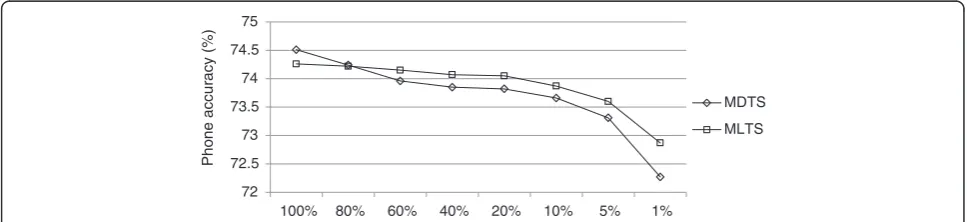
phone accuracies for MDTS and MLTS with their re-spectively compatible distances. The number of GMM clustersl in MLTS was set to 5, corresponding to using five GMMs to label each frame of a template representa-tive. It is seen from the two curves that with the per-centage varied from 100% down to 1%, the phone accuracies decreased for both methods. When 100% templates were used, i.e., without template selection, LLR distance performed better than KL distance, as dis-cussed in Section 5.3.1 and Section 5.3.2. When less than 80% templates were used, MLTS performed better than MDTS since the MLTS templates generalized bet-ter than MDTS templates, as discussed in Section 5.3.3. For MDTS, when the selection percentage reduced from 100% to 60%, the phone accuracy dropped rapidly by 0.55% (from 74.51% to 73.96%), and when the selection percentage reduced from 60% to 20%, the phone ac-curacy reduced slowly by 0.14% (from 73.96% to 73.82%). In contrast, for MLTS, with the selection per-centage reduced from 100% to 20%, the phone accuracy went down gradually by 0.21% (from 74.26% to 74.05%). Moreover, both curves went down rapidly when the se-lection percentage was further reduced below 20%. From Figure 9, we conclude that MLTS is more robust to using a small percentage of template representatives, and the selection percentage of 20% is a reasonable com-promise between accuracy performance and computa-tion and storage cost.
5.3.6 Phone accuracy analysis
In order to better understand the effect of the proposed template matching methods, we compare the patterns of TIMIT phone accuracies from using the methods of all templates with the KL and LLR local distances against that of the HMM baseline. Table 3 provides the phone accuracies of the five broad phone classes (vowels, semi-vowels, stops, fricatives, and nasals) and the accuracy of silence for the HMM baseline and template matching. In Figure 10, we plot the absolute phone accuracy changes
Table 2 Phone accuracies (percent) from using different outlier threshold values for the compressed template representatives
Thresholdtσ 1σ 2σ 3σ ∞
Accuracy (%) 73.95 74.32 73.42 70.89
72 72.5 73 73.5 74 74.5 75
100% 80% 60% 40% 20% 10% 5% 1%
MDTS
MLTS
Phone accur
acy (%)
of template matching against the HMM baseline. For the vowel class, the KL- and LLR-based template match-ing produced absolute phone accuracy gains of 4.82% and 4.84%, respectively, and for the semivowel class, the absolute accuracy gains were 4.05% and 4.38%, in the same order. For the stop class, template matching using the LLR distance made an absolute gain of 2.0% while using the KL distance did not help. For the fricative class, phone accuracies were decreased 2.46% and 2.88% by the KL- and LLR-based template matching, respect-ively. For the nasal class, there were small phone accur-acy gains, and for silence, there were small accuraccur-acy degradation by template matching, but both changes were small and insignificant.
It is not surprising that the template-based methods produced the largest positive impact on semivowels (largest relative phone error reduction). Semivowels are transient sounds and templates can capture their trajec-tory information better than HMM. Similarly, some vowel sounds are nonstationary, such as diphthongs or vowels in strong coarticulation. Stops, having the clos-ure and burst pattern, are nonstationary as well and often have short durations, and they are difficult to model by HMM but can be better represented by tem-plates, as reflected in the accuracy gain by the LLR-based template matching. Fricatives are noise like and without clear trajectory patterns, and their boundaries are also difficult to determine, making template-based methods not as effective as HMMs.
5.3.7 Computation time and memory overhead
We first compare the storage space costs of the conven-tional and the proposed template representation methods, assuming a speech feature vector is 39 dimensional as in the baseline HMM. In conventional template methods that use Mahalanobis local distance, a speech frame is rep-resented by a 39-dimensional vector (float), while in the proposed method a frame is labeled by n GMM indices (short integer) andn−1 weights (float). On a 32-bit ma-chine and with n =5 in our experiments, the proposed method used 26 (5 × 2 + (5–1) × 4) bytes per frame versus the conventional method of 156 bytes per frame, which amounts to an 83% saving in storage space. For the TIMIT dataset, there were 152,715 phone templates and the aver-age length of a phone template was eight frames (with the frame shift of 10 ms), giving a total of 1,221,720 frames and an overhead for template storage of 30.3 MB. In tem-plate selection, the memory overhead was around 6.1 MB when 20% templates were selected to be the representa-tives. In template compression, the memory overhead for template storage was the same as in template selection. However, since there were 749 new GMMs for labeling the frames of the template representatives, there was an extra memory overhead of 5.4 MB.
In Table 4, we provide a comparison on the per-frame computational time for the proposed template-matching-based lattice rescoring and the HMM baseline. The com-putation time was divided into two parts. One part was on test-frame labeling which used GMMs from the HMM
Table 3 Phone accuracies (percent) of vowels, semivowels, stops, fricatives, nasals, and silence
Vowels Semivowels Stops Fricatives Nasals Silence
HMM baseline 63.48 72.47 73.65 74.83 72.03 86.02
KL distance 68.30 76.52 73.45 72.37 72.53 85.48
LLR distance 68.32 76.85 75.65 71.95 72.66 85.57
silence vowels semivowels stops
fricatives
nasals
-16% -12% -8% -4% 0% 4% 8% 12%
KL local distance
LLR local distance
Relative change
baseline and the time was proportional to the total number of GMMs extracted from the HMMs. The other part was the rescoring time which calculated the DTW matching scores between a test segment (time marked by a phone arc on the phone lattice) and templates in a tem-plate clusters (specified by the PDTs of the phone unit). The more templates were in a template cluster, the longer the rescoring time. Since the KL distances between the GMMs were pre-calculated and the likelihood scores used in LLR distance were obtained in the test frame labeling, the time for rescoring was mainly consumed on determin-ing the warpdetermin-ing path in DTW, and hence for the LLR and KL distances, the rescoring times were similar (we there-fore omit the local distance in Table 4). Relative to the decoding time per frame of the HMM baseline, when all templates were used, the test per-frame labeling overhead was 40% and the rescoring overhead was 22%, and hence the overall computational overhead per frame was 62.0%. In template selection, since only 20% template representa-tives were used, the rescoring time was reduced to 1/5 of the all-template case, and the computational overhead be-came 44.4%.In template compression, the number of new GMMs that were merged from the baseline GMMs was about 63% of the baseline GMMs (749 vs. 1,189), the time consumed for test frame labeling also decreased, and the computation overhead was reduced to 26.8%. Based on these numbers, we conclude that by using template repre-sentatives with a selection percentage of 20%, the costs in computation time and storage space were greatly reduced.
5.4 Large vocabulary speech recognition task
Based on the outcomes of the TIMIT phone recognition task, we only report the telehealth results for the following three cases of template matching: (1) all templates with LLR distance, (2) MLTS with KL distance, and (3) tem-plate compression with KL distance, where the cases 2 and 3 used 20% templates as the representatives and word
accuracy was averaged over the five doctors. In template compression, the number of Gaussian components in each new GMM was 16, the same as the GMMs of the baseline; the average number of GMMs generated for the com-pressed template representatives was 1,048 per doctor (the baseline was 1,905 GMMs per doctor). The HMM base-line was trained using crossword triphone models, with an average word accuracy of 78.43%. In Table 5, we compare the recognition word accuracies between the HMM base-line and the template-based methods. In case 1, the aver-age word accuracy was 80.03%, which is an absolute gain of 1.6% over the baseline. In case 2, the average word ac-curacy was 79.40%, which is an absolute gain of 0.97% over the baseline. In case 3, the word accuracy was 79.70%, which is an absolute gain of 1.27% over the base-line. Again, we conducted a Student’sttest on the word accuracy gain (averaged over the five doctors) obtained by each of the three cases over the baseline and found the performance gain in every case to be statistically signifi-cant at the level ofα= 0.05.
In Table 6, the average computation cost of the five doctors is given for the three cases. In comparison with the TIMIT phone recognition task, even though there were more GMMs to be used for test frame labeling and more templates in template clusters, the computation overhead did not increase much, especially for template selection and template compression. In addition, the memory overhead for all five doctors was around 236.2, 47.2, and 73.2 MB for using all templates, selected tem-plate representatives, and compressed temtem-plate repre-sentatives, respectively. Therefore, the template-based methods, especially MLTS and template compression, are affordable for LVCSR.
5.5 Discussion
So far we have shown that representing the template frames by GMMs and using the local distance measures
Table 4 Computational overhead (percent) per frame using all templates, template selection, and template compression for TIMIT phone recognition
All templates Template selection Template compression
Test frame labeling overhead 40.0 40.0 22.4
Rescoring overhead 22.0 4.4 4.4
Overall computational overhead 62.0 44.4 26.8
Table 5 Comparison of word accuracies (percent) between the HMM baseline and the template-based methods
Speakers (no. of words) Dr. 1 (3,248) Dr. 2 (5,085) Dr. 3 (3,988) Dr. 4 (2,759) Dr. 5 (6,421) Average
Baselines 72.14 82.50 84.00 74.20 79.32 78.43
All templates (LLR) 73.53 84.22 85.98 75.74 80.67 80.03
MLTS (KL) 73.22 83.39 84.87 75.35 80.15 79.40
Template compression (KL) 73.55 83.61 85.21 75.71 80.39 79.70
of LLR or KL significantly improved the accuracy per-formance over our HMM baselines, and the proposed methods are much more effective than the conventional template matching methods where the template frames use the original speech features. A question naturally arises is how would the proposed template-matching methods interact with an underlying acoustic model from which the GMMs are derived and the phone or word lattices are generated, and of particular interest is that as a baseline HMM system improves, whether the performance gain we have observed by the proposed template matching methods can still hold. This is a rele-vant issue since a baseline HMM system can be im-proved by using more advanced training methods and better features. Recently, a major advance has been made in using deep neural networks (DNNs) with many hidden layers for speech acoustic modeling, where the resulting DNNs learn a hierarchy of nonlinear feature detectors that can capture complex statistical patterns for speech data. For example, context-independent, pre-trained DNN/HMM hybrid architectures have achieved competitive performance in TIMIT phone recognition [38], context-dependent DNN/HMM has led to large improvements to several public domain large speech recognition tasks [39], and dumping features from deep convolutional neural networks to train GMM/HMM-based systems achieved higher accuracy performance than DNN/HMM hybrid architectures in several tasks [40].
We have investigated this issue in [41] on the TIMIT phone recognition task by performing lattice rescoring with the proposed template-matching methods on top of progressively better HMM baselines, where the test set was the same as discussed in Section 5.1. The HMM base-line system employed discriminative training, neural-network-derived phone posterior probability features, as well as ensemble acoustic models, etc. We observed that with the baseline system phone accuracy raised to 73.25%, 75.66%, 76.51%, and 77.97%, the template-matching-based lattice rescoring delivered consistent performance gains and gave phone accuracies of 74.74%, 77.27%, 77.96%, and 79.55%, respectively, where the phone accuracy of 79.55% was among the best reported results on the TIMIT con-tinuous phoneme recognition task. For the sake of space, we omit the details of these baseline systems. For further information, please refer to [41]. The consistent perform-ance gains support the notion that template matching
improves recognition accuracy through a mechanism dif-ferent from HMM. This is in agreement with the observa-tion in [10] that the template matching system and the HMM system behave differently in word error patterns. Since our template-based methods are compatible with the GMMs trained from neural-network-derived features, it is reasonable to expect that our methods can take advantage of and add value to the advancements in this research direction.
6 Conclusions
In this paper, we have presented a novel approach of inte-grating template matching with statistical modeling for continuous speech recognition. The approach inherits the GMMs and the PDT state tying structures from the base-line HMMs and is therefore easily implemented. Generat-ing template representatives and representGenerat-ing the frames by GMM indices make the approach extendable to LVCSR task. Based on our experimental results from the tasks of TIMIT phone recognition and telehealth LVCSR, we conclude that the proposed method of inte-grating template matching and statistical modeling has significantly improved the recognition performance over our HMM baselines, and the proposed template selection and compression methods have also largely saved computation time and memory space over using all templates with small losses in accuracy performance. Although in the current work we used the basic acous-tic modeling techniques to train our HMM baselines, the proposed template matching methods can take ad-vantage of and add value to more advanced GMM/ HMM systems, and as such they are promising for fur-ther improving the state-of-the-art speech recognition.
Competing interests
The authors declare that they have no competing interests.
Disclosures
The work described in this paper was conducted during the first author’s Ph.D. study at the University of Missouri-Columbia, USA.
Author details 1
Nuance Communications, Inc, 1 Wayside Rd, Burlington, MA 01801, USA.
2Department of Computer Science, University of Missouri, Columbia, MO
65211, USA.
Received: 3 September 2013 Accepted: 14 January 2014 Published: 1 February 2014
Table 6 Average computation overhead (percent) per frame of the five doctors
All templates (LLR) MLTS (KL) Template compression (KL)
Test frame labeling overhead 43.3 43.3 23.3
Rescoring overhead 26.7 5.4 5.4
Overall computational overhead 70.0 48.7 28.7
References
1. M Ostendorf, V Digalakis, OA Kimball, From HMMs to segment models: a unified view of stochastic modeling for speech recognition. IEEE Trans on SAP4(5), 360–378 (1996)
2. S Furui, Speaker-independent isolated word recognition using dynamic features of speech spectrum. IEEE Trans SAPASSP-34(1), 52–59 (1986) 3. H Gish, K Ng, Parametric trajectory models for speech recognition. Proc of
ICSLP1 , 466–469 (1996)
4. J Glass, A probabilistic framework for segment-based speech recognition. Computer Speech and Language17(2–3), 13–152 (2003)
5. G Zweig, P Nguyen, A segmental CRF approach to large vocabulary continuous speech recognition, inIEEE Workshop on Automatic Speech Recognition & Understanding(, Merano, 2009), pp. 152–157
6. L Deng, D Yu, A Acero, A long-contextual-span model of resonance dynamics for speech recognition: parameter learning and recognizer evaluation, inProceedings of IEEE Workshop on Automatic Speech Recognition and Understanding(San Juan, 2005), pp. 145–150
7. K Demuynck, D Seppi, H van Hamme, D van Compernolle, Progress in example based automatic speech recognition, inProceedings of IEEE International Conference on Acoustics, Speech and Signal Processing (ICASSP) (Prague, 2011), pp. 4692–4695
8. TN Sainath, B Ramabhadran, D Nahamoo, D Kanevsky, D van Compernolle, K Demuynck, JF Gemmeke, JR Bellegarda, S Sundaram, Exemplar-based processing for speech recognition. IEEE Signal Process. Mag.29, 98–113 (2012)
9. TN Sainath, B Ramabhadran, S Nahamoo, S Kanevsky, A Sethy, Exemplar-based sparse representation features for speech recognition, inProceedings of I NTERSPEECH 2010(Makuhari, 2010), pp. 2254–2257
10. M de Wachter, M Matton, K Demuynck, P Wambacq, R Cools, D van Compernolle, Template-based continuous speech recognition. IEEE Trans ASLP15(4), 1377–1390 (2007)
11. X Sun, Y Zhao, Integrate template matching and statistical modeling for speech recognition, inProceedings of INTERSPEECH 2010(Makuhari, 2010), pp. 74–77
12. L Rabiner, B Juang,Fundamentals of Speech Recognition(Prentice Hall, Englewood Cliffs, 1993)
13. S Demange, D van Compernolle, HEAR: an hybrid episodic-abstract speech recognizer, inProceedings of INTERSPEECH 2009(Brighton, 2009), pp. 3067–3070 14. L Golipour, D O’Shaughnessy, Phoneme classification and lattice rescoring
based on a k-NN approach, inProceedings of INTERSPEECH 2010 (Makuhari, 2010), pp. 1954–1957
15. K Demuynck, K Demuynck, D Seppi, D van Compernolle, P Nguyen, G Zweig, Integrating meta-information into exemplar-based speech recognition with segmental conditional random fields, inProceedings of IEEE International Conference on Acoustics, Speech and Signal Processing (ICASSP) (Prague, 2011), pp. 5048–5051
16. S Sundaram, JR Bellegarda, Latent perceptual mapping: a new acoustic modeling framework for speech recognition, inProceedings of INTERSPEECH 2010(Makuhari, 2010), pp. 881–884
17. X Sun, Y Zhao, New methods for template selection and compression in continuous speech recognition, inProceedings of INTERSPEECH 2011 (Florence, 2011), pp. 985–988
18. D Seppi, K Demuynck, D van Compernolle, Template-based automatic speech recognition meets prosody, inProceedings of INTERSPEECH 2011 (Florence, 2011), pp. 545–548
19. D Seppi, D Van Compernolle, Data pruning for template-based automatic speech recognition, inProceedings of INTERSPEECH 2010(Makuhari, 2010), pp. 901–904
20. S Sundaram, J Bellegarda, Latent perceptual mapping with data driven variable-length acoustic units for template-based speech recognition, in Proceedings of IEEE International Conference on Acoustics, Speech and Signal Processing (ICASSP)(Kyoto, 2012), pp. 4125–4128
21. G Heigold, P Nguyen, M Weintraub, V Vanhoucke, Investigations on exemplar-based features for speech recognition towards thousands of hours of unsupervised, noisy data, inProceedings of IEEE International Conference on Acoustics, Speech and Signal Processing (ICASSP)(Kyoto, 2012), pp. 4437–4440
22. J Ming, Maximizing the continuity in segmentation- a new approach to model, segment and recognize speech, inProceedings of IEEE International Conference on Acoustics, Speech and Signal Processing (ICASSP)(Taiwan, 2009), pp. 3849–3852
23. J Ming, R Srinivasan, D Crookes, A Jafari, CLOSE—a data-driven approach to speech separation. IEEE Trans ASLP21(7), 1355–1368 (2013)
24. A Garcia, H Gish, Keyword spotting of arbitrary words using minimal speech resources, inProceedings of IEEE International Conference on Acoustics, Speech and Signal Processing, (ICASSP), vol. 1(Atlanta, 2006), pp. 123–127
25. T Hazen, W Shen, C White, Query-by-example spoken term detection using phonetic posteriorgram templates, inIEEE Workshop on Automatic Speech Recognition & Understanding(Merano, 2009)
26. Y Zhang, J Glass, Unsupervised spoken keyword spotting via segmental DTW on Gaussian posteriorgrams, inIEEE Workshop on Automatic Speech Recognition & Understanding(Merano, 2009)
27. L Lamel, R Kassel, S Seneff, Speech database development: design and analysis of the acoustic-phonetic corpus, inProceedings of the DARPA Speech Recognition Workshop, 1989
28. Y Zhao, X Zhang, R Hu, J Xue, X Li, L Che, R Hu, L Schopp, An automatic captioning system for telemedicine, inProceedings of IEEE International Conference on Acoustics, Speech and Signal Processing (ICASSP)(Toulouse, 2006), pp. 957–960 29. S Kullback, Letter to the editor: the Kullback–Leibler distance. Am. Stat.
41(4), 338–341 (1987)
30. JR Hershey, PA Olsen, Approximating the Kullback–Leibler divergence between Gaussian mixture models, inProceedings of IEEE International Conference on Acoustics, Speech and Signal Processing (ICASSP), vol 4 (Hawaii, 2007), pp. 317–320
31. S Young, G Evermann, M Gales, T Hain, D Kershaw, X Liu, G Moore, J Odell, D Ollason, V Valtchev, P Woodland,The HTK Book(Cambridge University Engineering Department, Cambridge, 2009)
32. R Duda, P Hart, D Stork,Pattern Classification, 2nd edn. (Wiley, New York, 2009) 33. S Theodoridis, K Koutroumbas,Pattern Recognition, 3rd edn.
(Academic Press, San Diego, 2006)
34. A Sankar, F Beaufays, V Digalakis, Training data clustering for improved speech recognition, inProceedings of EUROSPEECH(Madrid, 1995) 35. Y Li, L Li, A greedy merge learning algorithm for Gaussian Mixture Model, in
Third International Symposium on IITA, 2009, pp. 506–509. vol. 2, Nanchang, 21–22 November 2009
36. KF Lee, HW Hon, Speaker-independent phone recognition using hidden Markov models. IEEE Trans ASSP37(11), 1641–1648 (1989)
37. X Zhang, Y Zhao, L Schopp, A novel method of language modeling for automatic captioning in telemedicine. IEEE Trans ITB11(3), 332–337 (2007) 38. A Mohamed, G Dahl, G Hinton, Acoustic modeling using deep belief
networks. IEEE Trans ASLP20(1), 14–22 (2012)
39. F Seide, G Li, X Chen, D Yu, Feature engineering in context-dependent deep neural networks for conversational speech transcription, inProceedings of IEEE Workshop on Automatic Speech Recognition & Understanding (Hawaii, 2011), pp. 24–29
40. TN Sainath, A Mohamed, B Kingsbury, B Ramabhadran, Deep convolutional neural networks for LVCSR, inProceedings of IEEE International Conference on Acoustics, Speech and Signal Processing (ICASSP)
(Vancouver, 2013), pp. 8614–8618
41. X Sun, X Chen, Y Zhao, On the effectiveness of statistical modeling based template matching approach for continuous speech recognition, in Proceedings of INTERSPEECH(Florence, 2011), pp. 2163–2166
doi:10.1186/1687-4722-2014-4
Cite this article as:Sun and Zhao:Integrated exemplar-based template matching and statistical modeling for continuous speech recognition.