O R I G I N A L A R T I C L E
Spur Gear Tooth Pitting Propagation Assessment Using
Model-based Analysis
Xi-Hui Liang1•Zhi-Liang Liu2•Jun Pan3•Ming Jian Zuo1
Received: 17 November 2016 / Revised: 28 July 2017 / Accepted: 11 October 2017 / Published online: 8 November 2017
The Author(s) 2017. This article is an open access publication
Abstract Tooth pitting is a common failure mode of a gearbox. Many researchers investigated dynamic properties of a gearbox with localized pitting damage on a single gear tooth. The dynamic properties of a gearbox with pitting distributed over multiple teeth have rarely been investi-gated. In this paper, gear tooth pitting propagation to neighboring teeth is modeled and investigated for a pair of spur gears. Tooth pitting propagation effect on time-vary-ing mesh stiffness, gearbox dynamics and vibration char-acteristics is studied and then fault symptoms are revealed. In addition, the influence of gear mesh damping and environmental noise on gearbox vibration properties is investigated. In the end, 114 statistical features are tested to estimate tooth pitting growth. Statistical features that are insensitive to gear mesh damping and environmental noise are recommended.
Keywords Mesh stiffnessMesh dampingGear dynamicsVibrationStatistical feature Dynamic simulation
1 Introduction
Gearbox is one of the most widely used transmission sys-tems in the world. However, due to high service load, harsh operating conditions or fatigue, faults may develop in gears [1]. Through observations at gearboxes used in Syncrude Canada Ltd, tooth pitting was a common failure mode [2]. When tooth pitting appears on gears, gear mesh stiffness reduces and correspondingly the vibration properties of gears change.
According to the American Society for Metals (ASM) handbook [3], gear pitting damage can be classified into five levels according to pitted areas as follows:
1. Some micro-pitting (pits with dimensions in the order of millimeters) and a few macro-pits on the pinion. No pitting on the gear.
2. Micro-pitting and appreciable macro-pitting on the pinion. Almost no pitting on the gear.
3. Micro-pitting and considerable macro-pitting on the pinion with one or more gross pits. Damage to both the pinion and the gear.
4. Macro-pitting over 50%–100% of the pinion tooth surface. Removal of metal thins the teeth and disrupts load sharing between teeth. Gear unit has greatly increased noise and vibration.
5. Macro-pitting all over the teeth with considerable gross pitting. Teeth are thinned so much by wear that the tips are becoming sharp like a knife.
Supported by Natural Science and Engineering Research Council of Canada (Grant No. RGPIN-2015-04897), International S&T Cooperation Program of China (Grant No. 2015DFA71400), National Key Research and Development Program of China (Grant No. 2016YFB1200401), and National Natural Science Foundation of China (Grant No. 51375078, 51505066).
& Ming Jian Zuo [email protected]
1 Department of Mechanical Engineering, University of Alberta, Edmonton T6G 1H9, Canada
2 School of Mechatronics Engineering, University of Electronic Science and Technology, Chengdu 611731, China
3 Key Laboratory of Reliability Technology for Mechanical and Electrical Product of Zhejiang Province, Zhejiang Sci-Tech University, Hangzhou 310018, China
Some researchers [4–7] created man-made tooth pitting on gears to experimentally explore fault symptoms of a gearbox. For example, in Ref. [8], three pitting levels were created using the electro discharge machining, namely, slight pitting, moderate pitting and severe pitting as shown in Figure1. In these methods, vibration sensors are gen-erally installed on the casing of bearings or the housing of gearboxes to measure the vibration responses. In the first step, all the gears are in perfect condition and signals are collected. Then, a damaged gear is installed in the gearbox and signals are collected. The fault symptoms are investi-gated by comparing the signals from the healthy gearbox with those from the gearbox with a damaged gear. How-ever, these experimental signals are polluted by noise. The fault symptoms may be submerged by the noise and hard to be observed. More importantly, the above comparison between signals can hardly reveal the fault physics of a gearbox.
Feng and Zuo [9] proposed a mathematical model to investigate fault symptoms of a planetary gearbox with tooth pitting. In their model, amplitude modulation and frequency modulation caused by pitting damage are con-sidered. However, their model cannot be used to model pitting growth. In addition, their mathematical model lacks the connection with physical parameters of a gearbox, like gear mesh stiffness and damping [10,11].
Several researchers investigated dynamic properties of a gearbox with tooth pitting through dynamic simulation. Chaari et al. [12], Cheng et al. [13], and Abouel-seoud et al. [14] modeled a single tooth pit in the rectangular shape (all other teeth are perfect) and investigated the single tooth pit effect on the dynamic properties of a gearbox. Rincon et al. [15] modeled an elliptical pit on a single tooth and evaluated the dynamic force of a pair of gears. Ma et al. [16] studied the effect of tooth spalling on gear mesh stiffness. A single rectangular spalling was modeled and the effects of spalling width, spalling length and spalling location on stiffness were investigated, respectively. Saxena et al. [17] incorporated the gear tooth friction effect in modeling a single gear tooth spalling. Liang et al. [18] evaluated the mesh stiffness of gears with multiple pits on a single tooth using the potential energy method. However, all these studies focus on single tooth
pitting modeling. According to the current studies [3,19], pitting propagation to neighboring teeth is a common phenomenon. This study overcomes the shortcomings of single tooth pitting modeling. We will model gear tooth pitting propagation to neighboring teeth and analyze its effect on gearbox vibration.
Gear dynamic models may provide useful information for fault diagnosis [20]. Vibration-based time domain, frequency domain, and time-frequency domain analyses provide powerful tools for fault diagnosis of rotating machinery [21,22]. One traditional technique is based on statistical measurements of vibration signals [23]. Many statistical indicators were proposed for machine fault diagnosis [24–27]. In Liu et al. [25], 34 statistical indica-tors were summarized and 136 features were generated. In Zhao et al. [26], 63 statistical indicators were summarized and 252 features were produced. The features [25,26] were used for the classification of gear damage levels of a lab planetary gearbox. In this study, 36 statistical indicators are selected from the literature. Then, 114 statistical features are generated and tested using simulated vibration signals for the pitting growth estimation of a fixed-axis gearbox. The effect of gear mesh damping and environmental noise on the performance of statistical features will be analyzed. The objective of this study is to simulate vibration sig-nals of gears with tooth pitting covering multiple teeth, investigate pitting effects on vibration properties and pro-vide effective features for pitting growth estimation. The scope of this paper is limited to a fixed-axis gearbox with a single pair of spur gears. A dynamic model is used to investigate the effects of tooth pitting growth on vibration properties of a gearbox. The tooth pitting propagation to the neighboring teeth is modeled. Three pitting levels are modeled: slight pitting, moderate pitting and severe pitting. The vibration signals of a gearbox are simulated for each of the three severity levels. The vibration properties are investigated and fault symptoms are summarized. Statisti-cal features are tested on simulated vibration signals. These features are ranked for pitting growth estimation. The features insensitive to gear mesh damping and environ-mental noise are recommended.
This paper is organized as follows. In Section1, an introduction of this study is given including literature review, our research scope and objective. In Section 2, a pitting propagation model and a method to evaluate mesh stiffness of gears with tooth pitting are presented. In Sec-tion 3, a dynamic model is utilized to simulate vibration signals of a spur gearbox with tooth pitting, and pitting effects on the vibration signals are analyzed. In Section4, 114 statistical features are tested for estimation of gear tooth pitting propagation, and gear mesh damping and environmental noise effect on these features are analyzed.
Slight pitting Moderate pitting Severe pitting
In the end, a summary and conclusion of this study is given.
2 Tooth Pitting Propagation Modeling and Mesh
Stiffness Evaluation
2.1 Tooth Pitting Propagation Modeling
In this study, we assume the pinion (driving gear) has relatively soft gear tooth surfaces and the gear (driven gear) has surface-hardened teeth. Tooth pitting only propagates in the pinion (the gear is always in perfect condition). Tooth pits are modeled in circular shape [6, 7]. All the circular pits have the diameter of 2 mm and the depth of 1 mm. Three pitting levels are modeled as shown in Fig-ure2. The detailed information of these three pitting damage levels is given below:
Slight pitting: 9 circular pits on one tooth and 3 circular pits on each of the two neighboring teeth. All the circular pits center on the tooth pitch line. The surface area of the meshing side of a tooth is 194 mm2. This way, the middle pitted tooth has a pitting area of 14.6% of the tooth surface area. Each of the two neighboring teeth has a pitting area of 4.87% of the tooth surface area. The purpose of this level of damage is to mimic slight pitting damage that corre-sponds to the level 2 pitting damage defined in ASM handbook [3].
Moderate pitting: 18 circular pits on one tooth, 9 cir-cular pits on each of the two neighboring teeth, and 3 circular pits on each of the next neighboring teeth on symmetric sides. All the circular pits center on the tooth pitch line. The pitting areas of the 5 teeth are 4.87%, 14.6%, 29.2%, 14.6% and 4.87%, respectively. We call this damage level the moderate pitting damage corresponding to the level 3 pitting damage defined in ASM handbook [3]. Severe pitting: 36 circular pits on one tooth, 18 circular pits on each of the two neighboring teeth, 9 circular pits on each of the next neighboring teeth on symmetric sides and 3 circular pits on each of the teeth after the next neigh-boring teeth on symmetric sides. For the gear tooth with 36 circular pits, 18 pits center on the tooth pitch line and another 18 pits on the tooth addendum. For other teeth, circular pits all center on the tooth pitch line. The pitting areas of the 7 teeth are 4.87%, 14.6%, 29.2%, 58.4%,
29.2%, 14.6% and 4.87%, respectively. We define this level of damage as the severe pitting damage correspond-ing to the level 4 pittcorrespond-ing damage defined in ASM handbook [3].
2.2 Mesh Stiffness Evaluation
Gear mesh stiffness is one of the main internal excitations of gear dynamics. With the growth of gear tooth pitting, gear mesh stiffness shape changes and consequently dynamic properties of gear systems change. Therefore, accurate gear mesh stiffness evaluation is a prerequisite of gear dynamics analysis.
In Ref. [18], the potential energy method [28, 29] was used to evaluate mesh stiffness of gears with multiple pits on a single tooth. The gear tooth was modeled as a non-uniform cantilever beam. The total energy stored in a pair of meshing gears was the sum of Hertzian energy, bending energy, shear energy and axial compressive energy corre-sponding to Hertzian stiffness, bending stiffness, shear stiffness and axial compressive stiffness, respectively. Their equations are extended here to evaluate the mesh stiffness of gears with tooth pitting distributed over mul-tiple neighboring teeth. The gear system is assumed to be without friction (perfect lubrication), manufacturing error, or transmission error, and the gear body is treated as rigid [18, 28, 29]. The same assumptions will be employed in this paper as this study only focuses on pitting effect on vibration properties.
Figure3 shows a gear tooth modeled as a non-uniform cantilever beam. The tooth fillet curve is approximated using a straight line for the convenience of equation derivation [29]. Each circular pit is expressed by three variables [18]: (u, r, d), where u represents the distance between the tooth root and the circle center of the pit,ris the radius of the pit circle, anddis the pitting depth.
If many circular pits show on a surface, as long as the pits do not overlap with each other and all are within the tooth surface area, the Hertzian contact stiffness kh,
Pitch line Tooth dedendum
Tooth addendum 2 mm
n+3
n-3 n-2 n-1 n n+1 n+2
n n+1 n+2
n-2 n-1
n n+1
n-1
Figure 2 Schematics of pitting damage levels (slight to severe – from top to bottom) on thenth tooth of the pinion and its neighboring teeth
Base circle
Base circle d
F
Fa
Fb
α1
h hx
x d1
α
Action line
Rb
α α2 α3
α1 Rr
Root circle
2r δ O u
A pit
Root circle
δ O δ
r u
L
A pit
2r
bending stiffnesskb, shear stiffness ks and axial
compres-sive stiffnesskacan be expressed as follows [18]:
kh¼
pEðLP
N
1 DLxjÞ
4ð1m2Þ ; ð1Þ
1
kb
¼
1ðZ2:5Þcosa1cosa3 Zcosa0
h i3
ð1cosa1cosa2Þ3
2ELcosa1sin3a2
þ
Z a2
a1
3 1f þcosa1½ða2aÞsinacosag2ða2aÞcosa E 2L½sinaþ ða2aÞcosa33P
N
1 DIxj
R3 b
da;
ð2Þ
1
ks
¼
1:2ð1þmÞcos2a
1 cosa2ZZcos2:a50cosa3
ELsina2
þ Z a2
a1
1:2ð1þmÞða2aÞcosacos2a1
E L½sinaþ ða2aÞcosa 0:5P
N
1
DAxj
Rb
da;
ð3Þ
1
ka
¼
sin2a1 cosa2ZZcos2:a5 0cosa3
2ELsina2
þ Z a2
a1
ða2aÞcosasin2a1
E 2L½sinaþ ða2aÞcosa P
N
1
DAxj
Rb
da;
ð4Þ
whereE, L, mdenote Young’s modulus, tooth width and Poisson’s ratio, respectively;Zis the number of gear teeth;
Nrepresents the number of circular pits on a tooth surface;
a0 is the pressure angle; a1 denotes the angle between
action force F and its decomposition component Fb; a2
indicates the half tooth angle on the base circle; a3
describes the approximated half tooth angle on the root circle;DLxj, DAxj andDIxj(caused by the jth circular pit)
represent respectively the reduction of tooth contact width, area and area moment of inertia of the tooth section where the distance to the tooth root isx; DLxj,DAxj andDIxjare
expressed as follows [18]:
DLx¼ 2
ffiffiffiffiffiffiffiffiffiffiffiffiffiffiffiffiffiffiffiffiffiffiffiffiffiffi
r2 ðuxÞ2
q
; x2 ½ur;uþr; 0; others,
(
ð5Þ
DAx¼
DLxd; x2 ½ur;uþr;
0; others,
ð6Þ
DIx¼
1 12DLxd
3þAxDAxðhxd=2Þ2
AxDAx
; x2 ½ur;uþr;
0; others: 8
< :
ð7Þ
Eqs. (1)–(4) are derived for a single gear tooth (with pitting) which is modeled as a non-uniform cantilever beam. They are all expressed as a function of gear rotation
anglea1. Applying these equations iteratively to each gear
tooth, the stiffness of each tooth can be obtained. But, the values forDLxj,DAxjandDIxjmay be different among teeth
due to the variance of number and location of pits. For a pair of spur gears with contact ratio between 1 and 2, one pair and two pairs of tooth contact takes place alternatively. For a single-tooth-pair meshing duration, the total effective mesh stiffness can be evaluated [18,28]:
kt¼
1
1
khþ
1
kb1þ 1
ks1þ 1
ka1þ 1
kb2þ 1
ks2þ 1
ka2
; ð8Þ
where subscripts 1 and 2 represent the driving gear and the driven gear, respectively.
For a double-tooth-pair meshing duration, there are two pairs of gears meshing at the same time. The total effective mesh stiffness can be obtained as [18,28]:
kt¼kt1þkt2
¼X
2
i¼1
1
1
kh;iþ
1
kb1;iþ
1
ks1;iþ
1
ka1;iþ
1
kb2:iþ
1
ks2;iþ
1
ka2;i
; ð9Þ
wherei¼1 for the first pair andi¼2 for the second pair of meshing teeth.
Utilizing the above equations, mesh stiffness of a pair of spur gears (gear parameters are given in Table1) is eval-uated for each of the three pitting severity levels as shown in Figure2. The mesh stiffness results are shown in Fig-ure4. When angular displacement of the pinion is 0, tooth
n-3 (see Figure2) starts to mesh. Gear mesh stiffness reduces when the pitted teeth mesh. Table2 summarizes the quantifications of stiffness reduction caused by tooth pitting. The averaged mesh stiffness reductiondktis used
Table 1 Physical parameters of a spur gearbox [11]
Parameter Pinion
(driving)
Gear (driven)
Number of teeth 19 31
Module (mm) 3.2 3.2
Pressure angle 20o 20o
Mass (kg) 0.700 1.822
Face width (m) 0.0381 0.0381
Young’s modulus (GPa) 206.8 206.8
Poisson’s ratio 0.3 0.3
Base circle radius (mm) 28.3 46.2 Root circle radius (mm) 26.2 45.2 Bearing stiffness (N/m) k1=k2=5.09108 Bearing damping (kg/s) c1=c2=49105
Torsional stiffness of shaft coupling (N/m)
kp=kg=4.09107
Torsional damping of shaft coupling (kg/s)
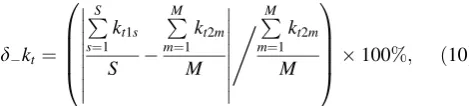
to quantify the mesh stiffness reduction. It is defined as follows [18]:
dkt¼
PS s¼1
kt1s
S
PM m¼1
kt2m
M
, PM
m¼1 kt2m
M
0 B B B @
1 C C C
A100%; ð10Þ
where kt1 and kt2 are the mesh stiffness calculated for a
damaged gear and a perfect gear, respectively, andS and
Mrepresent the mesh stiffness data points collected during the same angular displacement for a damaged gear and a perfect gear, respectively.
Eight mesh periods (see Figure4) are analyzed in Table2because only the mesh stiffness of these eight mesh periods may be affected in our model during one revolution of the pinion. One mesh period is defined as an angular displacement of the pinion experiencing a double-tooth-pair meshing duration and a single-tooth-pair meshing duration. For double-tooth-pair meshing durations, 4, 6 and 8 mesh periods have mesh stiffness reduction caused by slight pit-ting, moderate pitting and severe pitpit-ting, respectively. The maximum averaged mesh stiffness reduction in a
double-tooth-pair meshing duration is 1.57%, 4.26% and 19.02% corresponding to slight pitting, moderate pitting and severe pitting, respectively. While for single-tooth-pair meshing durations, 3, 5 and 7 mesh periods experience mesh stiffness reduction corresponding to slight pitting, moderate pitting and severe pitting, respectively. The maximum averaged mesh stiffness reduction in a single-tooth-pair meshing duration is 11.61%, 55.33% and 55.83% related to slight pitting, moderate pitting and severe pitting, respectively. For each mesh period, the stiffness reduction in the single-tooth-pair meshing duration is larger than that in the double-tooth-pair meshing duration for two reasons: (a) the pitting mostly appear around the pitch line and the pitch line lies on the single-tooth-pair meshing duration, and (b) the perfect gear has a smaller averaged mesh stiffness in the single-tooth-pair meshing duration than the double-single-tooth-pair meshing duration. In the following section, the pitting effect on the vibration properties of a spur gearbox will be investigated.
3 Dynamic Simulation of a Fixed-axis Gearbox
3.1 Dynamic Modeling
A dynamic model (see Figure5) reported in Bartelmus [30] is used directly in this study for gear pitting effect analysis. This model had been used in dynamic analysis of gears with tooth crack [23, 31, 32]. It is a
mass-spring-0 50 100 150
0.2 0.4 0.6 0.8 1 1.2 1.4 1.6 1.8
2x 10 9
Me
sh
st
if
fn
es
s
kt
(N/m)
Perfect Slight Moderate
Severe Angular displacement of the pinion θ1(o)
2
Mesh period 7 6
5 4 3 Mesh
period 1
Figure 4 Pitting effect on gear mesh stiffness
Table 2 Averaged mesh stiffness reduction (%) caused by tooth pitting
Mesh period No.
Double-tooth-pair meshing duration
Single-tooth-pair meshing duration
Slight Moderate Severe Slight Moderate Severe
1 0 0 0.18 0 0 2.84
2 0 0.18 1.04 0 2.83 11.61
3 0.18 1.06 3.27 2.86 11.70 55.78
4 1.04 3.20 5.38 11.61 55.33 55.37 5 1.57 4.26 19.02 2.87 11.73 55.83
6 0.40 1.54 4.17 0 2.87 11.68
7 0 0.41 1.56 0 0 2.86
8 0 0 0.40 0 0 0
Rb1
Rb2
θm
M1
θ1
kt ct
θ2
m1
I1
m2
I2
k1
c1
k2
c2
kx1
cx1
kx2
cx2
Fk
Fc
x1
y1
x2
y2
kp cp
θb
M2
kg cg
damper (8 degrees of freedom) dynamic model with both torsional and lateral vibrations considered. The system is driven by an electric motor with an input torque M1 and loaded with torqueM2. The motor shaft and the shaft that
the pinion mounts on are coupled with a flexible coupling. Similarly, the shaft of the load and the shaft that the gear mounts on are coupled with a flexible coupling. In this model, thex-direction vibration is uncoupled with the y -direction vibration [31]. We pay our attention to the y -direction vibration since this -direction is along with the direction of gear dynamic force.
To emphasize gear fault symptoms caused by tooth pitting, this model ignored transmission errors, the frictions between gear teeth, and other practical phenomena, such as backlash. In addition, we assume the gearbox casing is rigid so that the vibration propagation along the casing is linear as did in Ref. [31]. Consequently, the vibration response properties of gears in lateral directions are con-sistent with those on the gearbox casing.
Only consider the motion in they-direction. The motion equations are given as follows [30]:
m1y€1þc1y_1þk1y1¼ FkFc; ð11Þ
m2y€2þc2y_2þk2y2¼FkþFc; ð12Þ
I1h€1¼kpðhmh1Þ þcpðh_mh_1Þ Rb1ðFkþFcÞ; ð13Þ
I2h€2¼Rb2ðFkþFcÞ kgðh2hbÞ cgðh_2h_bÞ; ð14Þ
Imh€m¼M1kpðhmh1Þ cpðh_mh_1Þ; ð15Þ
Ibh€b¼ M2þkgðh2hbÞ þcgðh_2h_bÞ; ð16Þ
Fk¼ktðRb1h1Rb2h2þy1y2Þ; ð17Þ
Fc¼ctðRb1h_1Rb2h_2þy_1y_2Þ: ð18Þ
The related notations are listed as follows:c1– Vertical
damping of the input bearing,c2– Vertical damping of the output bearing,cg– Torsional damping of the output shaft
coupling, cp – Torsional damping of the input shaft
cou-pling,ct–Gear mesh damping,cx1–x-direction damping of
the input bearing,cx2 –x-direction damping of the output
bearing,fm– Gear mesh frequency,fs– Rotation frequency
of the pinion,I1– Mass moment of inertia of the pinion,I2
– Mass moment of inertia of the gear,Ib– Mass moment of
inertia of the load, Im – Mass moment of inertia of the
driving motor,kg – Torsional stiffness of the output shaft
coupling, kp – Torsional stiffness of the input shaft
cou-pling,kt –Gear mesh stiffness, k1 –y-direction stiffness of
the input bearing, k2 –y-direction stiffness of the output bearing,kx1–x-direction stiffness of the input bearing,kx2– x-direction stiffness of the output bearing,Rb1– Base circle
radius of the pinion,Rb2– Base circle radius of the gear,x1
–x-direction displacement of the pinion, x2 –x-direction
displacement of the gear,y1 –y-direction displacement of
the pinion, y2 –y-direction displacement of the gear, h1 –
Angular displacement of the pinion, h2 – Angular
dis-placement of the gear, hb – Angular displacement of the
load,hm – Angular displacement of the driving motor.
3.2 Numerical Simulation
To investigate pitting effects on vibration properties, vibration signals are simulated for a gearbox of which physical parameters are given in Table1. Gear mesh damping is considered to be proportional to gear mesh stiffness as did in Amabili and Rivola [33]. The gear mesh damping ratio is selected to be 0.07. Four health conditions are considered: perfect condition and three pitting severity levels as shown in Figure2. A constant torque of 11.9 Nm is generated by the driving motor and the shaft speed of load is constrained to be 18.4 Hz. Correspondingly, the theoretical rotation speed of the pinion is 30 Hz (fs) and the
gear mesh frequency (fm) is 570 Hz. The torque and speed
values come from Refs. [18, 31]. Numerical results are obtained using MATLAB ode15 s solver with sampling frequency of 100000. The time duration of simulated sig-nals covers four revolutions of the pinion.
Figure7 shows frequency spectrum of the simulated vibration signals obtained using the fast Fourier transform. Four health conditions (perfect, slight pitting, moderate pitting and severe pitting) are analyzed. Sizable amplitudes show at gear mesh frequency (fm) and its harmonics under
all the four health conditions. In the perfect and slight pitting conditions, the gear mesh frequency and its har-monics dominate the frequency spectrum (the sideband amplitude is very small). While in the moderate pitting and severe pitting conditions, a large number of sidebands appear around the gear mesh frequency and its harmonics. Figure8 presents the zoomed-in frequency spectrum of the simulated vibration signals under the health conditions of moderate pitting and severe pitting, respectively. The frequency interval between sidebands is the characteristic frequency of the pitted pinion (fs, rotation frequency of the
pinion). We can observe that the gear mesh frequency is modulated by the characteristic frequency of the pitted
0 0.005 0.01 0.015 0.02 0.025 0.03
-8 -6 -4 -2 0 2 4
Time(s)
Perfect
y1
(µm)
1 2 3 4 5 6 7 8 9 10 11 12 13 14 15 16 17 18 19
0 0.005 0.01 0.015 0.02 0.025 0.03
-8 -6 -4 -2 0 2 4
Time(s)
Slight pitting
y1
0 0.005 0.01 0.015 0.02 0.025 0.03
-8 -6 -4 -2 0 2 4
Time(s)
Moderate pitting
y1
0 0.005 0.01 0.015 0.02 0.025 0.03
-8 -6 -4 -2 0 2 4
Time(s)
Severe pitting
y1
(µm)
(µm)
(µm)
x 10-1
x 10-1
x 10-1
x 10-1
Figure 6 Displacement signals of the pinion for four health condi-tions of gearbox (the arrows point at weak fault symptoms)
0 1 2 3 4 5 6 7 8 9 10
0 2 4
Perfect
A
m
pl
it
ude
0 1 2 3 4 5 6 7 8 9 10
0 2 4
Slight pitting
0 1 2 3 4 5 6 7 8 9 10
0 2 4
Moderate pitting
0 1 2 3 4 5 6 7 8 9 10
0 2 4
Severe pitting
× fm
× fm
× fm
× fm
A
m
pl
it
ude
A
m
pl
it
ude
A
m
pl
it
ude
(µm) x 10-2
(µm) x 10-2
(µm) x 10-2
(µm) x 10-2
Figure 7 Frequency spectrum of the simulated vibration signals (fm
is gear mesh frequency)
1.5 1.6 1.7 1.8 1.9 2 2.1 2.2 2.3 2.4 2.5 0
1 2 3 4
Moderate pitting
1.5 1.6 1.7 1.8 1.9 2 2.1 2.2 2.3 2.4 2.5 0
1 2 3 4
Severe pitting × fm
× fm
fs fs fs fs fs fs fs fs fs fs fs fs fs fs fs fs fs fs
fs fs fs fs fs fs fs fs fs fs fs fs fs fs fs fs fs fs
A
m
pl
it
ude
A
m
pl
it
ude
(µm)
x 10-2
(µm)
x 10-2
Table 3 Definition of thirty-six statistical indicators [25] Feature Name Definition
F1 Maximum value The maximum value inx(n), i.e., max(x(n))
F2 Minimum value The minimum value inx(n), i.e., min(x(n))
F3 Mean
x¼1
N
PN n¼1
xðnÞ
F4 Peak to peak max(x(n))-min(x(n))
F5 Harmonic mean PNN
n¼1
1 xðnÞ
F6 Trimmed mean Mean excluding outliers
F7 Variance 1
N
PN
n¼1
xðnÞ x
ð Þ2
F8 Standard deviation ffiffiffiffiffiffiffiffiffiffiffiffiffiffiffiffiffiffiffiffiffiffiffiffiffiffiffiffiffiffiffiffi 1
N
PN n¼1
xðnÞ x
ð Þ2
s
F9 Mean absolute deviation N1
PN n¼1
xðnÞ x
j j
F10 Median absolute deviation N1
PN n¼1
xðnÞ xmedian
j j
F11 Interquartile range The 1st quartile subtracted from the 3rd quartile
F12 Peak2RMS maxffiffiffiffiffiffiffiffiffiffiffiffiffiffiffiffiðjxðnÞjÞ
1 N
PN
n¼1
xðnÞ2 r
F13 Skewness 1
N PN
n¼1
xðnÞx
ð Þ3 ffiffiffiffiffiffiffiffiffiffiffiffiffiffiffiffiffiffiffiffiffiffi 1
N PN
n¼1
xðnÞx
ð Þ2 r
3
F14 Kurtosis 1
N PN
n¼1
xðnÞx
ð Þ4
1 N
PN
n¼1
xðnÞx
ð Þ2
2
F15 Shape factor ffiffiffiffiffiffiffiffiffiffiffiffiffiffiffiffi
1 N
PN
n¼1
xðnÞ2 r
1 N
PN
n¼1
xðnÞ j j
F16 Crest factor maxffiffiffiffiffiffiffiffiffiffiffiffiffiffiffiffiðxðnÞÞ
1 N
PN
n¼1
xðnÞ2 r
F17 Clearance factor maxðxðnÞÞ
1 N
PN
n¼1
xðnÞ2
F18 Impulse factor maxðxðnÞÞ
1 N
PN
n¼1
xðnÞ j j
Table 3 continued
Feature Name Definition
F19 Third order central moment 1
N
PN n¼1
xðnÞ x
ð Þ3
F20 Fourth order central moment 1
N
PN n¼1
xðnÞ x
ð Þ4
F21 Root mean square ffiffiffiffiffiffiffiffiffiffiffiffiffiffiffiffiffiffiffiffiffi 1
N
PN n¼1
xðnÞ2
s
F22 Energy operator 1 N
PN
n¼1
DxðnÞDx
ð Þ4
1 N
PN
n¼1
DxðnÞDx
ð Þ2
2
F23 Mean frequency 1
K
PK
k¼1
XðkÞ
F24 Frequency center PK
k¼1
fðkÞXðkÞ
ð Þ
PK
k¼1
XðkÞ
F25 Root mean square frequency ffiffiffiffiffiffiffiffiffiffiffiffiffiffiffiffiffiffiffiffiffiffiffiffiffiffiPK
k¼1
fðkÞ2
XðkÞ
ð Þ
PK
k¼1
XðkÞ v u u u u t
F26 Standard deviation frequency ffiffiffiffiffiffiffiffiffiffiffiffiffiffiffiffiffiffiffiffiffiffiffiffiffiffiffiffiffiffiffiffiffiffiffiffiPK
k¼1
fðkÞF28 ð Þ2
XðkÞ
ð Þ
PK
k¼1
XðkÞ v u u u u t
F27 NA4 1
N PN
n¼1
rðnÞr
ð Þ4
1 M PM m¼1 1 N PN n¼1
rmðnÞrm ð Þ2
2
F28 NA4* 1
N PN
n¼1
rðnÞr
ð Þ4
1
M0
PM0
m¼1
1 N
PN
n¼1
rmðnÞrm ð Þ2
2
F29 FM4 1
N PN
n¼1
dðnÞd
ð Þ4
1 N
PN
n¼1
dðnÞd
ð Þ2
2
F30 FM4* 1
N PN
n¼1
dðnÞd
ð Þ4
1
M0
PM0
m¼1
1 N
PN
n¼1
dmðnÞdm
ð Þ2
2
F31 M6A 1
N PN
n¼1
dðnÞd
ð Þ6
1 N
PN
n¼1
dðnÞd
ð Þ2
pinion (fs). The degree of frequency modulation increases
with the degree of damage of the pitting. In addition, sidebands near gear mesh frequency and its harmonics increase obviously with the growth of tooth pitting severity.
4 Estimation of Pitting Growth Using Statistical
Features
In Section3, we analyzed vibration properties of a spur gearbox for four health conditions (perfect condition and three pitting severity levels). In this section, we test the effectiveness of thirty-six statistical indicators (see Table3) for estimation of pitting growth. Four types of signals are used for the tests: raw signals (RAW), residual signals (RES), difference signals (DIFF), and first-order sideband signals (FSB). RAW denotes the simulated vibration signals in the Section3with the mean subtracted. RES is obtained by removing gear mesh frequencies and their harmonics from the RAW. DIFF is generated by removing the first-order sidebands from the RES. FSB represents the signals containing only the first-order side-bands. Twenty-six statistical indicators (F1 to F26) are
applied to each of the four type signals. Therefore, 104 (2694) features can be generated. The statistical indica-tors F27 andF28are only applied to RES since they were originally proposed for RES [34]. Similarly, the statistical indicators F29 toF34 are only applied to DIFF since they
are specially designed for DIFF [27]. The statistical indi-catorsF35andF36are only applied to FSB [27]. In total, we
generate 114 (104?10) features for estimation of pitting growth.
This paragraph explains the symbols used in the expressions of the 36 statistical indicators as listed in Table3. We use x(n), r(n), d(n), and b(n) to represent RAW, RES, DIFF, and FSB, respectively. The symbol
X(k), k=1, 2,…, K, represents the kth measure of the frequency spectrum of a signal. The symbol f(k) denotes frequency amplitude of thekth spectrum component. The bar notation represents mean, e.g., xis the mean ofx(n). The symbols rm(n),dm(n) and bm(n) denote the mth time
record of rðnÞ, d(n) and b(n), respectively. The symbol
e(n) represents the envelope of the current time record, which is expressed as e(n)=|b(n)?j9H(b(n))|, where
H(b(n)) is the Hilbert transform of b(n).em(n) represents
the envelope of the mth time record of b(n).M describes the total number of time records up to present.M’ repre-sents the total number of time records for a healthy gear-box. In this study,M andM’ equal to 1 for simplicity. A signal x(n) is looped around to calculate Dx(n)=x(n)2–
x(n–1)x(n?1).
Pearson correlation coefficient (PCC) is utilized to quantify the effectiveness of these 114 features. It is a metric to estimate the linear relationship between a single statistical feature and its corresponding label. Its range is [–1, 1]. The value closer to one indicates a better statistical feature for pitting growth estimation. The expression of PCC [35] is given below:
Table 3 continued
Feature Name Definition
F32 M6A* 1
N PN
n¼1
dðnÞd
ð Þ6
1
M0
PM0
m¼1
1 N
PN
n¼1
dmðnÞdm
ð Þ2
3
F33 M8A 1
N PN
n¼1
dðnÞd
ð Þ8
1 N
PN
n¼1
dðnÞd
ð Þ2
4
F34 M8A* 1
N PN
n¼1
dðnÞd
ð Þ8
1
M0
PM0
m¼1
1 N
PN
n¼1
dmðnÞdm
ð Þ2
4
F35 NB4 1
N PN
n¼1
eðnÞe
ð Þ4
1 M
PM
m¼1
1 N
PN
n¼1
emðnÞem ð Þ2
2
F36 NB4* 1
N PN
n¼1
eðnÞe
ð Þ4
1
M0
PM0
m¼1
1 N
PN
n¼1
emðnÞem ð Þ2
2
* means a variant of the original indicator
Table 4 Features with a PCC value greater than 0.97
Ranking Feature PCC Ranking Feature PCC
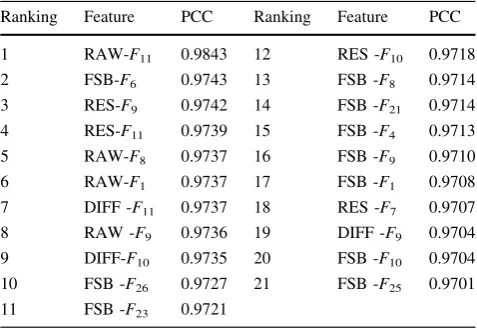
1 RAW-F11 0.9843 12 RES -F10 0.9718 2 FSB-F6 0.9743 13 FSB -F8 0.9714 3 RES-F9 0.9742 14 FSB -F21 0.9714 4 RES-F11 0.9739 15 FSB -F4 0.9713 5 RAW-F8 0.9737 16 FSB -F9 0.9710
q¼ PN i¼1
ðxixÞðyiyÞ
ffiffiffiffiffiffiffiffiffiffiffiffiffiffiffiffiffiffiffiffiffiffiffi PN
i¼1
ðxixÞ2
s ffiffiffiffiffiffiffiffiffiffiffiffiffiffiffiffiffiffiffiffiffiffiffi PN
i¼1
ðyiyÞ2
s ; ð19Þ
wherexiandyirepresent a feature value and a label value,
respectively, for theith health condition of a gearbox;xand
yare the means ofx (x=[x1,x2,…,xN]T) andy(y=[y1, y2,…,yN]T), respectively; andN is the number of health
conditions. In this study, Nis equal to four, and y=[0, 0.146, 0.292, 0.584]T. The elements inycorrespond to the largest tooth pitted area of the pinion in the health condi-tions of perfect, slight pitting, moderate pitting and severe pitting, respectively.
Test results give that only one feature (RAW-F8)
achieves a PCC value of greater than 0.98 while 21 features can get a PCC value of greater than 0.97. These 21 features and their PCC values are given in Table4. Figure9 pre-sents performances of the best six features: RAW-F11,
FSB-F6, RES-F9, RES-F11, RAW-F8, and RAW-F1. Their
PCC values are 0.9843, 0.9743, 0.9742, 0.9739, 0.9737, and 0.9737, respectively. RAW-F11 means the statistical
indicator F11 (see Table3) is tested on RAW. Other
fea-tures can be interpreted in the same way. The feature values are linearly normalized to values between 0 and 1 in Figure9using the following equation:
V normalized¼ ðV current V perfectÞ=
V severe V perfect
ð Þ; ð20Þ
where V_currentdenotes the feature value in current health condition of a gearbox, V_perfect is the feature value in perfect condition, and V_severe represents the feature value in severe pitting condition.
From Figure9, we can see that the best six features share the similar increase trend with the tooth pitting propagation. The feature values change very slightly from perfect to slight pitting even for the best feature RAW-F11
(see Figure9), which indicates the features are not sensi-tive to slight pitting. This is because fault symptoms are very weak under the slight pitting health condition (see Figure6). From slight pitting to moderate pitting and from moderate pitting to severe pitting, a large change of feature values can be observed from the top six features. There-fore, it is much easier to detect moderate pitting and severe pitting than slight pitting.
4.1 Gear Mesh Damping Effect on the Effectiveness of Statistical Features
In many studies, gear mesh damping is ignored or con-sidered to be constant [36–38]. Li and Kahraman [39] demonstrated that it was not proper to use a constant gear mesh damping. Amabili and Rivola [33] modeled the gear mesh damping proportional to gear mesh stiffness and investigated damping effect on the steady state response of a pair of spur gears. In most situations, gear mesh damping ratio ranges from 0.01 to 0.1 [33,39,40]. This study does not intend to propose a new model for gear mesh damping. Our focus is to test gear mesh damping effect on the effectiveness of statistical indicators. The gear mesh damping model reported in Amabili and Rivola [33] is used directly in this study.
ct¼2f
ffiffiffiffiffiffiffiffiffiffiffiffiffiffiffiffiffiffiffiffiffim1m2
m1þm2 kt
r
; ð21Þ
wherem1andm2represents the mass of the pinion and the
gear, respectively,ktandctdenotes the gear mesh stiffness
and damping, respectively, and f is gear mesh damping ratio.
1 2 3 4
0 0.5 1
1 2 3 4
0 0.5 1
1 2 3 4
0 0.5 1
1 2 3 4
0 0.5 1
1 2 3 4
0 0.5 1
1 2 3 4
0 0.5 1 Feature
Label
Feature Label
Feature Label
Feature Label
Feature Label
Feature Label
RAW-F11 FSB-F6
RES-F9 RES-F11
RAW-F8 RAW-F1
Figure 9 Best six features (the numbers 1, 2, 3 and 4 in thex-axis represent the health conditions of perfect, slight pitting, moderate pitting and severe pitting, respectively; they-axis is the normalized feature values)
0 0.05
0.10 0.15
0 0.01 0.02 0.03 -5
0 5
0 0.01 0.02 0.03 -5
0 5
0 0.01 0.02 0.03 -5
0 5
0 0.01 0.02 0.03 -5
0 5
Time(s)
y1
(
m)
y1
(
m)
y1
(
m)
y1
(
m)
) s ( e m i T )
s ( e m i T
Time(s)
x 10-1 x 10-1
x 10-1 x 10⁻¹
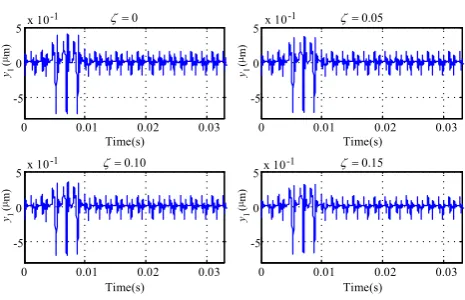
Using the dynamic model in Section3, four damping conditions are tested: no damping, damping ratio of 0.05, damping ratio of 0.10 and damping ratio of 0.15. Figure10 gives an example to illustrate gear mesh damping effect on gear vibration under severe pitting condition. From visual observation, there is no big difference. To quantify the difference, the root mean square is calculated for the
signals to be 1.13lm, 1.09lm, 1.06lm and 1.04lm corresponding to no damping, damping ratio of 0.05, damping ratio of 0.10 and damping ratio of 0.15, respec-tively. Signal amplitude decreases slightly with the increase of damping ratio.
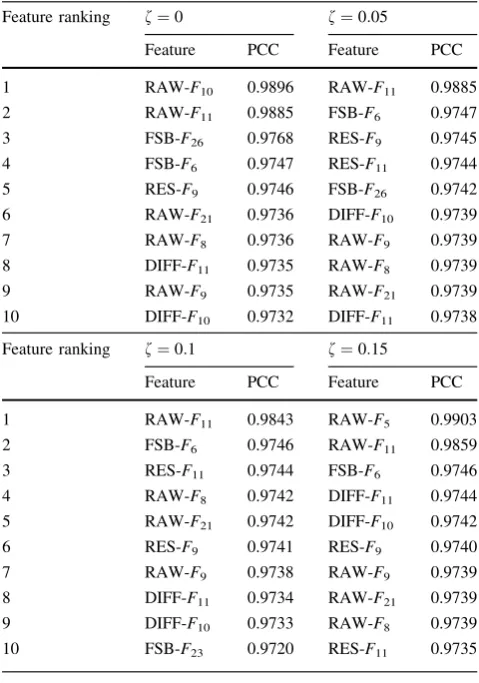
Table5 gives top 10 features for each damping condi-tion. Eight features perform very well. They belong to the top 10 in all damping conditions. These eight features are RAW-F11, FSB-F6, RES-F9, RAW-F21, RAW-F8, DIFF-F11, RAW-F9and DIFF-F10. Damping has negligible effect
on the performance of these eight features.
4.2 Environmental Noise Effect on the Effectiveness of Statistical Features
For the simulated signals, there is no environmental noise involved. In real applications, environmental noise always exists. White Gaussian noise is added to the simulated signals to mimic the environmental noise [41, 42]. Four noise levels are tested: no noise, signal-to-noise ratio (SNR) of 10 db, SNR of 0 db and SNR of –10 db.
Table 5 Top 10 features for each damping condition Feature ranking f¼0 f¼0:05
Feature PCC Feature PCC
1 RAW-F10 0.9896 RAW-F11 0.9885 2 RAW-F11 0.9885 FSB-F6 0.9747 3 FSB-F26 0.9768 RES-F9 0.9745 4 FSB-F6 0.9747 RES-F11 0.9744 5 RES-F9 0.9746 FSB-F26 0.9742 6 RAW-F21 0.9736 DIFF-F10 0.9739
7 RAW-F8 0.9736 RAW-F9 0.9739
8 DIFF-F11 0.9735 RAW-F8 0.9739 9 RAW-F9 0.9735 RAW-F21 0.9739 10 DIFF-F10 0.9732 DIFF-F11 0.9738
Feature ranking f¼0:1 f¼0:15
Feature PCC Feature PCC
1 RAW-F11 0.9843 RAW-F5 0.9903
2 FSB-F6 0.9746 RAW-F11 0.9859 3 RES-F11 0.9744 FSB-F6 0.9746 4 RAW-F8 0.9742 DIFF-F11 0.9744 5 RAW-F21 0.9742 DIFF-F10 0.9742
6 RES-F9 0.9741 RES-F9 0.9740
7 RAW-F9 0.9738 RAW-F9 0.9739
8 DIFF-F11 0.9734 RAW-F21 0.9739 9 DIFF-F10 0.9733 RAW-F8 0.9739
10 FSB-F23 0.9720 RES-F11 0.9735
0 0.01 0.02 0.03 -10
0 10
0 0.01 0.02 0.03 -10
0 10
0 0.01 0.02 0.03 -10
0 10
0 0.01 0.02 0.03 -10
0 10
) s ( e m i T )
s ( e m i T
) s ( e m i T )
s ( e m i T
y(1
m)
y1
(
m)
y(1
m)
y(1
m)
b d 0 1 : R N S e
s i o n o N
: R N S b
d 0 : R N
S –10db
x 10-1 x 10-1
x 10-1 x 10⁻¹
Figure 11 Environmental noise effect on gear vibration under severe pitting condition
Table 6 Top 10 features for each noise level Feature ranking No noise 10 db
Feature PCC Feature PCC
1 RAW-F11 0.9843 DIFF-F5 0.9806 2 FSB-F6 0.9743 DIFF-F10 0.9791 3 RES-F9 0.9742 DIFF-F11 0.9790 4 RES-F11 0.9739 RES-F11 0.9769 5 RAW-F8 0.9737 RES-F10 0.9769
6 RAW-F1 0.9737 RAW-F8 0.9756
7 DIFF -F11 0.9737 RAW-F21 0.9756 8 RAW -F9 0.9736 RES-F9 0.9746 9 DIFF-F10 0.9735 RAW-F9 0.9741 10 FSB -F26 0.9727 RAW-F10 0.9737
Feature ranking 0 db –10 db
Feature PCC Feature PCC
1 FSB-F22 0.9953 RAW-F1 0.9887
2 FSB-F1 0.9813 FSB-F23 0.9755 3 RES-F22 0.9803 DIFF-F11 0.9739 4 FSB-F21 0.9783 DIFF-F10 0.9736
5 FSB-F8 0.9783 RAW-F8 0.9727
6 FSB-F4 0.9778 RAW-F21 0.9727
7 FSB-F9 0.9774 RAW-F9 0.9720
8 FSB-F23 0.9747 DIFF-F23 0.9717 9 FSB-F35 0.9743 RAW-F23 0.9717
Figure11 shows the environmental noise effect on gear vibration under severe pitting condition. With the increase of noise level, the fault symptom becomes weaker and weaker. Under SNR of –10 db, the gear fault symptoms are not visible any more on the time domain waveform.
Table6gives top 10 features for each noise level. Noise has a larger effect on the performance of features than gear mesh damping. None of the features is the shared top 10 among the four noise levels. Some features perform well under low noise level condition but perform badly under strong noise condition. These features cannot be used if background noise is strong. Some features have a large fluctuation on performance with the variation of noise level. These features are not suggested to use since their performance is not stable. Good features should be insen-sitive to noise variation.
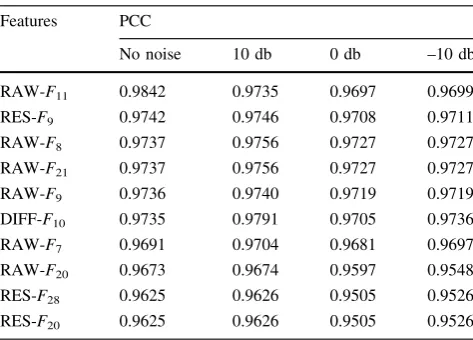
Table7 summarizes the top 10 features with relatively stable performance. The PCC value of these 10 stable fea-tures is insensitive to noise level variation. To avoid the influence of both gear mesh damping and environmental noise, 6 features are suggested to use. They are RAW-F11,
RES-F9, RAW-F8, RAW-F21, RAW-F9, DIFF-F10. These
6 features belong to both the top 8 features selected in Section4.1considering gear mesh damping effect and the top 10 stable features selected in Section4.2 considering environmental noise effect. They are insensitive to neither gear mesh damping nor environmental noise.
Time Synchronous Averaging can remove interference frequencies induced by environmental noise and other irrelevant machine components [43]. But, there is no environmental noise in the simulated signals. Other machine components of the simulated spur gear pair are represented by constant damping and constant stiffness parameters and as a result, there are no irrelevant frequency components caused by other machine components. As shown in Figures7 and 8, only the gear mesh frequency
and the pinion pitting fault induced sideband frequency components are present. When a more complex gearbox system is simulated, TSA may be needed. However, in real applications, especially for the slight pitting damage sce-nario, TSA and subsequent feature extraction may not be adequate for effective fault detection and diagnosis. Advanced signal processing techniques, such as empirical mode decomposition and wavelet analysis, may be used together with TSA for more effective fault detection and diagnosis.
5 Conclusions
This study investigates effects of pitting growth on vibra-tion properties of a spur gearbox and tests the effectiveness of 114 features to estimate the pitting growth. The pitting propagation to neighboring teeth is modeled using circular pits. The potential energy method is applied to evaluate gear mesh stiffness of a pair of spur gears for each of the four health conditions: the perfect condition, the slight pitting, the moderate pitting and the severe pitting. An eight degrees of freedom torsional and lateral dynamic model is used to simulate gearbox vibration signals. Pitting growth effects on vibration properties of a spur gearbox are analyzed. These properties can give insights into devel-oping new signal processing methods for gear tooth pitting diagnosis. At the end, 114 features are tested to estimate the pitting growth. The features are ranked based on the Absolute Pearson Correlation Coefficient. The statistical features insensitive to gear mesh damping and environ-mental noise is recommended. However, further investi-gation of these selected features based on experimental signals is still needed before potential field applications. Our next step is to design and conduct experiments on a lab gearbox with introduced gear tooth pitting and refine the features proposed in this paper.
Open Access This article is distributed under the terms of the Creative Commons Attribution 4.0 International License (http://crea tivecommons.org/licenses/by/4.0/), which permits unrestricted use, distribution, and reproduction in any medium, provided you give appropriate credit to the original author(s) and the source, provide a link to the Creative Commons license, and indicate if changes were made.
References
1. X H Liang, M J Zuo, W H Chen. Dynamics based vibration signal modeling for tooth fault diagnosis of planetary gearboxes, Chapter 7 in: M. Demetgul, M. U¨ nal (Eds.), Fault Diagnosis and Detection, In Tech, 2017: 175–192.
2. M R Hoseini, M J Zuo. Literature review for creating and quantifying faults in planetary gearboxes. Reliability Research Lab, Mechanical Department, University of Alberta, May 2009.
Table 7 Top 10 stable features Features PCC
No noise 10 db 0 db –10 db
RAW-F11 0.9842 0.9735 0.9697 0.9699 RES-F9 0.9742 0.9746 0.9708 0.9711 RAW-F8 0.9737 0.9756 0.9727 0.9727 RAW-F21 0.9737 0.9756 0.9727 0.9727
3. ASM Committee. Friction, lubrication, and wear technology. American Society for Microbiology (ASM) International, 1992. 4. L Gelman, R Zimroz, J Birkel, et al. Adaptive vibration condition
monitoring technology for local tooth damage in gearboxes. In-sight-Non-Destructive Testing & Condition Monitoring, 2005, 47: 461–464.
5. S K Lee, J S Shim, B O Cho. Damage detection of a gear with initial pitting using the zoomed phase map of continuous wavelet transform.Key Engineering Materials, 2006, 306–308: 223–228. 6. F Combet, L Gelman. Optimal filtering of gear signals for early damage detection based on the spectral kurtosis. Mechanical Systems and Signal Processing, 2009, 23: 652–668.
7. H O¨ ztu¨rk, M Sabuncu, I Yesilyurt. Early detection of pitting damage in gears using mean frequency of scalogram.Journal of Vibration and Control, 2008, 14: 469–484.
8. M R Hoseini, Y G Lei, D V Tuan, et al.Experiment design of four types of experiments: pitting experiments, run-tofailure ments, various load and speed experiments, and crack experi-ments. Reliability Research Lab, Mechanical Department, University of Alberta, January 2011.
9. Z P Feng, M J Zuo. Vibration signal models for fault diagnosis of planetary gearboxes.Journal of Sound and Vibration, 2012, 331: 4919–4939.
10. X H Liang, M J Zuo, T H Patel. Evaluating the time-varying mesh stiffness of a planetary gear set using the potential energy method.Proceedings of the Institution of Mechanical Engineers, Part C: Journal of Mechanical Engineering Science, 2014, 228(3): 535–547.
11. X H Liang, M J Zuo, M R Hoseini. Vibration signal modeling of a planetary gear set for tooth crack detection.Engineering Fail-ure Analysis, 2015, 48: 185–200.
12. F Chaari, W Baccar, M S Abbes, et al. Effect of spalling or tooth breakage on gearmesh stiffness and dynamic response of a one-stage spur gear transmission.European Journal of Mechanics-A/ Solids, 2008, 27: 691–705.
13. Z Cheng, N Q Hu, F S Gu, et al. Pitting damage levels estimation for planetary gear sets based on model simulation and grey relational analysis. Transactions of the Canadian Society for Mechanical Engineering, 2011, 35: 403–417.
14. S A Abouel-seoud, E S Dyab, M S Elmorsy. Influence of tooth pitting and cracking on gear meshing stiffness and dynamic response of wind turbine gearbox.International Journal of Sci-ence and Advanced Technology, 2012, 2: 151–165.
15. A F Rincon, F Viadero, M Iglesias, et al. Effect of cracks and pitting defects on gear meshing.Proceedings of the Institution of Mechanical Engineers, Part C: Journal of Mechanical Engi-neering Science, 2012, 226: 2805–2815.
16. H Ma, Z W Li, M J Feng, et al. Time-varying mesh stiffness calculation of spur gears with spalling defect.Engineering Fail-ure Analysis, 2016, 66: 166–176.
17. A Saxena, A Parey, M Chouksey. Time varying mesh stiffness calculation of spur gear pair considering sliding friction and spalling defects. Engineering Failure Analysis, 2016, 70: 200–211.
18. X H Liang, H S Zhang, L B Liu, et al. The influence of tooth pitting on the mesh stiffness of a pair of external spur gears.
Mechanism and Machine Theory, 2016, 106: 1–15.
19. C K Tan, P Irving, D Mba. A comparative experimental study on the diagnostic and prognostic capabilities of acoustics emission, vibration and spectrometric oil analysis for spur gears. Mechan-ical Systems and Signal Processing, 2007, 21: 208–233. 20. X H Liang, M J Zuo, Z P Feng. Dynamic modeling of gearbox
faults: A review. Mechanical Systems and Signal Processing, 2018, 98: 852–876.
21. T H Patel, A K Darpe. Experimental investigations on vibration response of misaligned rotors.Mechanical Systems and Signal Processing, 2009, 23: 2236–2252.
22. T H Patel, A K Darpe. Coupled bending-torsional vibration analysis of rotor with rub and crack. Journal of Sound and Vi-bration, 2009, 326: 740–752.
23. S Y Wu, M J Zuo, A Parey. Simulation of spur gear dynamics and estimation of fault growth.Journal of Sound and Vibration, 2008, 317: 608–624.
24. X M Zhao, M J Zuo, Z L Liu. Diagnosis of pitting damage levels of planet gears based on ordinal ranking. IEEE Conference on Prognostics and Health Management (PHM), Denver, USA, June 20-23, 2011: 1–8.
25. Z L Liu, J Qu, M J Zuo, et al. Fault level diagnosis for planetary gearboxes using hybrid kernel feature selection and kernel fisher discriminant analysis. The International Journal of Advanced Manufacturing Technology, 2012, 67: 1217–1230.
26. X M Zhao, M J Zuo, Z L Liu, et al. Diagnosis of artificially created surface damage levels of planet gear teeth using ordinal ranking.Measurement, 2013, 46: 132–144.
27. P D Samuel, D J Pines. A review of vibration-based techniques for helicopter transmission diagnostics. Journal of Sound and Vibration, 2005, 282: 475–508.
28. D CH Yang, J Y Lin. Hertzian damping, tooth friction and bending elasticity in gear impact dynamics.Journal of Mechan-ical Design, 1987, 109: 189–196.
29. X H Liang, M J Zuo, M Pandey. Analytically evaluating the influence of crack on the mesh stiffness of a planetary gear set.
Mechanism and Machine Theory, 2014, 76: 20–38.
30. W Bartelmus. Mathematical modelling and computer simulations as an aid to gearbox diagnostics.Mechanical Systems and Signal Processing, 2001, 15: 855–871.
31. X H Tian, M J Zuo, K R Fyfe. Analysis of the vibration response of a gearbox with gear tooth faults. ASME International Mechanical Engineering Congress and Exposition, Anaheim, California, USA, November 13-20, 2004: 785–793.
32. Z G Tian, M J Zuo, S Y Wu. Crack propagation assessment for spur gears using model-based analysis and simulation.Journal of Intelligent Manufacturing, 2012, 23: 239–253.
33. M Amabili, A Rivola. Dynamic analysis of spur gear pairs: steady-state response and stability of the SDOF model with time-varying meshing damping.Mechanical Systems and Signal Pro-cessing, 1997, 11: 375–390.
34. P Vecˇerˇ, M Kreidl, R Sˇmı´d. Condition indicators for gearbox condition monitoring systems.Acta Polytech, 2005, 45(6): 35–43. 35. Z L Liu, M J Zuo, H Xu. Fault diagnosis for planetary gearboxes using multi-criterion fusion feature selection framework. Pro-ceedings of the Institution of Mechanical Engineers, Part C: Journal of Mechanical Engineering Science, 2013, 227: 2064–2076.
36. J Lin, R G Parker. Analytical characterization of the unique properties of planetary gear free vibration.Journal of Vibration and Acoustics, 1999, 121: 316–321.
37. A Saxena, A Parey, M Chouksey. Dynamic analysis of multi-mesh geared rotor system using modal analysis.Prognostics & System Health Management Conference, Chengdu, China, Oct. 16-22, 2016: 1–5.
38. X H Liang, M J Zuo, L B Liu. A windowing and mapping strategy for gear tooth fault detection of a planetary gearbox.
Mechanical Systems and Signal Processing, 2016, 80: 445–459. 39. S Li, A Kahraman. A spur gear mesh interface damping model based on elastohydrodynamic contact behaviour. International Journal of Powertrains, 2011, 1: 4–21.
Journal of Mechanism, Transmissions, and Automation in Design, 1985, 107: 54–60.
41. Z P Feng, M J Zuo. Fault diagnosis of planetary gearboxes via torsional vibration signal analysis.Mechanical Systems and Sig-nal Processing, 2013, 36: 401–421.
42. Y F Li, X H Liang, M J Zuo. Diagonal slice spectrum assisted optimal scale morphological filter for rolling element bearing fault diagnosis. Mechanical Systems and Signal Processing, 2017, 85: 146–161.
43. E Bechhoefer, M Kingsley. A review of time synchronous average algorithms.Annual Conference of the Prognostics and Health Management Society, San Diego, CA, September, 2009: 24–33.
Xi-Hui Liang, is currently a postdoctoral research fellow at
Reliability Research Lab, University of Alberta, Canada. His research interests include dynamic modeling of mechanical systems, condition monitoring, fault diagnostics and prognostics, asset management, reliability analysis, maintenance, solid mechanics, finite element analysis, and intelligent manufacturing. E-mail: [email protected]
Zhi-Liang Liu,is an associate professor atUniversity of Electronic Science and Technology of China, China. His research interests
mainly include machinery fault diagnosis and prognosis by using signal processing and data mining techniques. He published more than 30 papers including 10?journal papers. He currently held 7 research grants from National Natural Science Foundation of China, Open Grants of National Key Laboratory, China Postdoctoral Science Foundation, etc. E-mail: [email protected]
Jun Pan,is a professor at ZhejiangSci-Tech University, China. He received the master degree fromZhejiang University, China, in 2002 and the Ph.D. degree from ZhejiangSci-Tech University, China, in 2011. His research interests include modeling and statistical analysis of accelerated life testing/degradation testing,design of testing plans,and estimation of system reliability. E-mail: [email protected]
![Figure 1 Man-made tooth pitting on gears [8]](https://thumb-us.123doks.com/thumbv2/123dok_us/9598043.1942204/2.595.52.287.609.698/figure-man-made-tooth-pitting-on-gears.webp)

![Table 1 Physical parameters of a spur gearbox [11]](https://thumb-us.123doks.com/thumbv2/123dok_us/9598043.1942204/4.595.306.544.486.709/table-physical-parameters-spur-gearbox.webp)

![Table 3 Definition of thirty-six statistical indicators [25]](https://thumb-us.123doks.com/thumbv2/123dok_us/9598043.1942204/8.595.52.299.68.710/table-denition-of-thirty-six-statistical-indicators.webp)