R E S E A R C H
Open Access
A strategic model for network formation
Omid Atabati
1†*and Babak Farzad
2†*Correspondence: [email protected]
†Equal contributor
1Department of Economics, University of Calgary, 2500 University Drive NW, Calgary, AB T2N 1N4, Canada
Full list of author information is available at the end of the article
Abstract
We study the dynamics of a game-theoretic network formation model that yields large-scale small-world networks. So far, mostly stochastic frameworks have been utilized to explain the emergence of these networks. On the other hand, it is natural to seek for game-theoretic network formation models in which links are formed due to strategic behaviors of individuals rather than based on probabilities. Inspired by Even-Dar and Kearns’ model (NIPS 19: 385-392, 2007), we consider a more realistic framework in which the cost of establishing each link is dynamically determined during the course of the game. Moreover, players are allowed to put transfer payments on the formation and maintenance of links. Also, they must pay a maintenance cost to sustain their direct links during the game. We show that there is a small diameter of at
most four in the general set of equilibrium networks in our model. We achieved an economic mechanism and its dynamic process for individuals which firstly, unlike the earlier model, the outcomes of players’ interactions or the equilibrium networks are guaranteed to exist. Furthermore, these networks coincide with the outcome of pairwise Nash equilibrium in network formation. Secondly, it generates large-scale networks that have a rational and strategic microfoundation and demonstrate the main characterization of small degree of separation in real-life social networks. Moreover, we provide a network formation simulation that generates small-world networks.
Keywords: Network formation; Linking game with transfer payments; Pairwise stability; Pairwise Nash equilibrium; Small-world phenomenon
Introduction
In recent years, networks have been extensively studied mostly in terms of their structure but also their formation and dynamics. Structural characteristics of various networks, which emerge from disciplines, such as economics, computer science, sociology, biol-ogy, and physics, have been investigated. Many of these networks, in spite of their different origins, indicate large commonalities among their key structural properties, such as small diameter, high clustering coefficient, and heavy-tailed degree distribution which are often quantified by power-law probability distributions. Hence, it is an excit-ing challenge to study network formation models capable of explainexcit-ing how and why these structural commonalities both occur and evolve. The series of experiments by Milgram in the 1960s [2] were among the pioneering works that quantified the small-world phenomenona and introduced the ‘six degree of separation’. Recent experiments [3] showed that today’s online social networks such as Facebook indicate that the degree
of separation (for almost any two individuals in a given database) must be even smaller than 4.
Thesmall-world modelby Watts and Strogatz [4] was one of the first models that gen-erates networks with small diameter. This work was followed by Kleinberg’s stochastic model [5] that was located in a grid graph. It introduced a process that adds links with distancedto the grid with a probability proportional to 1/dα. These models, however, can not be applicable when there is a strategical purpose in players’ making or losing their connections. In these cases, players, which are represented by vertices, strategically establish and sever their connections to obtain an advantageous position in their social network. Hence, we refer to a class ofgame-theoretic network formation, also known as strategic network formation (see [6,7] for comprehensive surveys). Models in this class are in their early efforts. They generally assume that players make connections based on a utility maximization and treat the network as the equilibrium result of the strategic interactions among players.
Our contribution
Our game-theoretic network formation model is mainly inspired by Even-Dar and Kearns (EK model) [1]. In their model, players (i.e., vertices) seek to minimize their collective distances to all other players. The network formation starts from a seed grid. Also, the cost of establishing each link in this model is considered to be the grid distance between the endpoint players of that link and the power ofα, which is the parameter of the model. Hence, their model uses a fixed link-pricing for each link. Both link creation and link severance are considered unilateral by players. In addition, the equilibrium is defined in terms oflink stability: no players benefit from altering a single link in their link decisions. The EK model achieves small diameter link stable networks within the threshold ofα=2. However, they faced an unbounded diameter that grows with the number of players, when α >2.
We define three types of costs for links: (i) the link-price, (ii) the maintenance cost, and (iii) the transfer payment. The link-pricepijis the price of establishing linkij. Only the
initiator of the connection would bear its payment. It is a one-time charge when estab-lishing the link. We introduce a new viewpoint to this game that better echoes with reality by constructing adynamic link-pricing. When characterizing the formation of a network, the involved dynamics is a crucial and determining element. We aim to effectuate the impact of this dynamics in our model with the revised link-pricing. We update the used distances of each pair of players in the related link-prices from the current network rather than sticking with the initial grid distances.
In addition, we introduce maintenance costs to make the model more real where a player can give up her payment and sever her connection, if she will be better off by doing so. Also, it is reasonable to assume that refunding the link-prices may not be possible in lots of real-world scenarios. Hence, maintenance costs make the link severance scenario well-defined. In our model, playeriis charged for all of its incident links by consider-ing recurrconsider-ing maintenance costscij. In other words, for each decision made in the game,
We use the myopic notion of pairwise stability with direct and indirect transfers (PSt)b as our equilibrium notion. This notion has the advantage of being compatible with the cooperative and bilateral nature of link formation. Moreover, the pairwise stability has the desirable simplicity required for analyzing players’ behaviors under this notionc.
On the other hand, due to the bilateral agreement for any link formation, the typical notion of Nash equilibria have some drawbacks in terms of coordination failures, e.g., an empty network is always a Nash equilibrium. In other words, Nash equilibria networks can contain some mutually beneficial link(s) that are left aside. To solve this coordina-tion problem when employing Nash equilibria, the nocoordina-tion of pairwise Nash stabilitydwas introduced. Pairwise Nash stable (PNSt) networks are at the intersection of the set of Nash equilibrium networks and the set of pairwise stable networks.
In this paper, we not only guarantee the existence of pairwise stable networks but also demonstrate that, in our model, the set of pairwise stable networks coincide with the set of pairwise Nash stable networks. Finally, we show that the general set of equilib-rium networks exhibits a short diameter of at most 4. The rest of this paper is organized as follows. In the ‘Preliminaries’ section, we explain the required preliminaries and pro-vide the setup of our model. ‘Fixed link-pricing model’ section contains an analysis and extension to the EK model. We then provide the main results for our grid-based model with the dynamic link-pricing and transfer payments in the ‘Dynamic link-pricing model with transfer payments’ section. In the ‘Simulations’ section, we present the outcome of a network formation simulation that we carried out.
Preliminaries
The network and players.LetN = {1,. . .,n}be the set ofnplayers forming a networkG. NetworkGis undirected and includes a list of pairs of players who are linked to each other. Linkij∈ Gindicates that playeriand playerjare linked inG. LetGN denote the complete network. The setG = G⊆GNconsists of all possible networks onN. We define networkG0to be the starting network of the game, which is also called theseed network. The set of playeri’s neighbors inGisNi(G) = {j|ij ∈ G}. Similarly,Li(G) =
ij∈G|j∈Ni(G)denotes the set of links, which are incident with playeriinG. Iflis a subset ofLi(G), thenG−lis the network resulted by removing the existing links in the setlfromG. Similarly, ifl=ij|j∈/Ni(G),j=i, then the networkG+lis obtained by adding the links in setltoG.
Theutilityof networkGfor playeriis given by a functionui:G→R+. Letudenote the
vector of utility functionsu=(u1,. . .,un). So,u:G→RN. Also, the value of a network, v(G), is the summation of all players’ utilities in the networkG, i.e.,v(G)= ni=1ui(G).
For any networkGand any subsetli(G)⊆Li(G), the marginal utility for a playeriand a
set of linksli(G)is denoted bymui(G,li(G))=ui(G)−ui(G−li(G)).
is defined:t=t1,. . .,tn. Consequently, the networkG, which is formed by this profile of strategiest, can be denoted as follows:G(t)=jk|i∈Ntjki ≥0, wherej,k∈N.
The payoff function. The distance between a pair of players i andj in G, denoted by dG(i,j), is defined as the length of a shortest path between i and j in G.
Simi-lar to the EK model, players seek to minimize their total distances to all players. This benefit would be considered for each player with respect to the networkG and links benefit both endpointsf. The link-price is defined to be pij = dG(i,j)α for α > 0.
The link-price function is non-decreasing and follows Kleinberg’s stochastic model. Also, functioncij denotes the maintenance cost for the link ij. The utility functionof
player i is the negative of her total distances and links expenses and is defined as follows:
ui(G(t))= − j∈N
dG(t)(i,j)−
j∈Ni
(pij+cij)− jk∈G(t)
tijk. (1)
The dynamic process.The following notion is stated from [15] that motivates the desired dynamics for our analysis.
Definition 1.An improving path represents a sequence of changes from one network to another. The changes can emerge when individuals create or sever a single link based on the improvement in the resulting network relative to the current network.
In each round of the game, one player adapts her strategy with respect to the current state of the network. We assume a random meeting mechanism for vertices (randomly choosing a pair of players), but we start with a seed network instead of an empty network [16,17]. If two networksGandGdiffer in exactly one link, they are said to beadjacent networks. Also, if there exists an improving path fromGtoG, thenGdefeats G.
The equilibrium strategies. In every equilibrium profile of strategies t∗, there is no excess in the offer of transfer payments. A transfer paymentt∗iji is negative if and only if maintaining the existing linkijis not beneficial fori. In other words,i’s utility from networkGis smaller that her utility from networkG−ij. We refer to this difference as a utility gap. Player ican only use a transfer payment equal to her utility gap. Hence, for an equilibrium profile of strategiestjk∗i that forms equilibrium networkG,G(t∗) =
jk|i∈Ntjk∗i=0,j,k∈N
.
We would like to indicate that other generalization of transfers’ distribution among players are not among the main focuses of this paperg.
The Definitions of equilibrium notions are as follows:
Definition 2.A networkG is pairwise stable with transfers (PSt) with respect to a profile of utility functionsuand a profile of strategiestthat creates networkGif
(a) ij∈G =⇒ ui(G)≥ui(G−ij)as well asuj(G)≥uj(G−ij),
(b) ij∈/G =⇒ ui(G)≥ui(G+ij)as well asuj(G)≥uj(G+ij).
Also, PSt(u)denotes the family of pairwise stable networks with transfers.
A pure strategy profilet∗=t∗1,. . .,t∗nforms aNash equilibriumin the linking game with transfers ifui
t∗−iis the equilibrium strategy for all players other thani, andTiis the set of all available
strategies fori. We can also indicate that in the context of network formation, a networkG is Nash stable if∀i∈Nand∀li(G)⊆Li(G):ui(G)≥ui(G−li(G)).
Definition 3.A pure strategy profile t∗ = (t∗1,. . .,t∗n) forms a pairwise Nash equilibriumin the linking game with transfers if
1. It is a Nash equilibrium, and
2. There does not exist anyij∈/G(t∗), andt∈T such that (a) ui
Gtiij,tjij,t∗−ij
≥ui(G(t∗)),
(b) uj
Gtiij,tjij,t−∗ij≥uj(G(t∗)), and
(c) at least one of (1) or (2) holds strictly,
wheret∗−ijincludes all players’ strategies int∗except playeri.
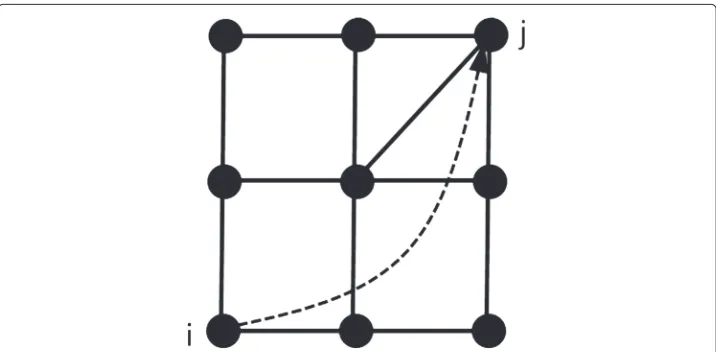
A tutorial example.Suppose that Figure 1 shows a sub-network of a networkGthat is obtained through an improving path. Also, assume that playericonsiders establishing a link to playerjin the next random meeting. For this example, let us assumeα = 2 and cij=10 for alliandj. Furthermore,Bi(G+ij,ij)= −k=i
dG+ij(i,k)−dG(i,k)
defines the benefit of reduced distances in the whole networkGthat playeriis received after adding linkijtoG. We assume thatBi(G+ij,ij)=30 andBj(G+ij,ij)=5 in this example.
According to the dynamic link-pricing,pij = 32 = 9. First, we can verify that playeri
has an incentive to buy linkij, asBi(G+ij,ij)=30≥9+10=19. However, there is no
advantage for playerjin this linking, asBj(G+ij,ij) =5 <10. Therefore, playerjmust
demand the transfer paymenttijj = −5 that makes her indifferent regarding this linkage. Playerican offer the transfer payment tiji = 10−5 = 5 to player j, since creatingij is still beneficial fori, as 30 ≥ 5+19 = 24. Consequently, linkijcan be added toG and networkG is achieved along the improving path of game. The network formation continues until a pairwise stable network with transfers is reached. Note that we can also
consider the indirect transfers that other players may offer for this linkage, which is not stated in this example for simplicity.
Fixed link-pricing model
In this section, we study the EK model [1] and consider an extension to this model. This also helps us to provide some insights regarding our results in the ‘Dynamic link-pricing model with transfer payments’ section.
The presence of cycles
The EK model takes a√n×√ngrid as its seed network. It defines the link-pricepij = dG0(i,j)α forα >0 and definesdG0(i,j)to be the grid distance ofiandj. Consequently, the link prices are fixed during the course of the game. Furthermore, this model defines the setsi∈ {0, 1}n−1to be the action set of playerisuch thatsijis one when playericreates
a link to playerj. Also, each link benefits both endpoints andsij=1 ifsji =1. The utility
function for playeri∈Nisui(G(s))= −j=idG0(i,j)−
j∈Nipij.
In the EK model, link creation is unilateral. Moreover, creation of a link only requires the agreement of at least one of the endpoint players of the link. This is in contrast to our model in which the presence of each link needs the consent of both players. Also, there is no transfer payment and maintenance cost in this model. Players can receive a refund of the link-prices given the severance of links. This model uses the notion of link stability, where link stable networks are immune against unilateral creation or severance of a single link by each player.
A problem that can arise in this model concerns the fact that the network formation may not converge to a link stable network. In other words, there exists the possibility for the formation of cycles in the evolving networks during this network formation model, as it is defined in the following.
Definition 4.A cycleCis a set of networks(G1,. . .,Gk)such that for any pair of
net-worksGi,Gj∈C, there exists an improving path connectingGitoGj. In addition, a cycle Cis aclosed cycle, if for all networksG∈C, there does not exist an improving path leading to a networkG∈/C.
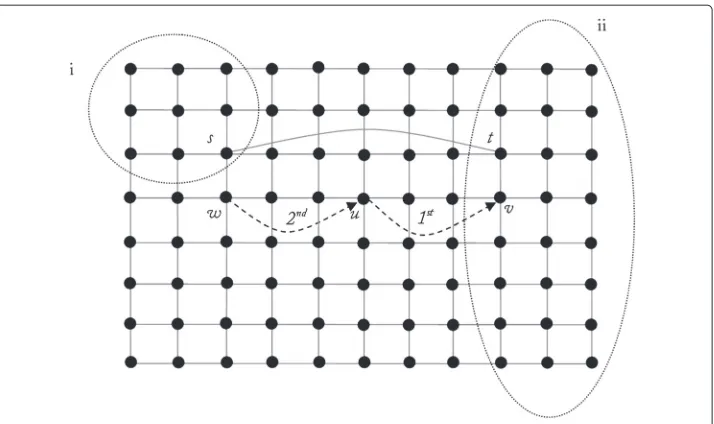
Generally, the presence of negative externalities can be seen as one of the potential reasons in the formation of cycles in linking games. Consider the following grid-based example shown in Figure 2. In this example, we can observe the formation of a cycle in the game.
Assume that 48 < 3α < 49. First, it is easy to verify that player s has an incentive to create linkst. Now, a cycle of strategical updates may be formed as follows. Playeru saves 57 inni=1dG(s)(u,vi)as it can be verified that the distance touof nine players in
Figure 2 An example that the game may not converge to a link stable graph.
linkwu. Thus, a cycle of steps (I) to (IV) may be formed and the game does not con-verge to stability. The example can be expanded to a large-scale grid as well. We note that playerw, by establishingwu, creates a negative externality foru. Since it causes a reduc-tion in playeru’s utility,u decides to severuvthat in overall leads to the formation of a cycle.
Forbidding link severance
In this model, players should be allowed to sever only those links that they themselves have purchased. However, this issue is not clear in the notion of link stabilityh. Let assume an extension of the EK model with forbidding severing links. Forbidding players to sever their links, although limits the applicability of model, makes the convergence of equilibrium networks possible for the network formation.
Proposition 1.Under the assumption of forbidding link severance in the EK model, the convergence of network formation to link stability is guaranteed.
Proof.When there is no link severance, the existence of negative externalities for players is ruled out. In other words, there is no player whose utility can be hurt during the game. Thus, the total value of the network is increased by each change during the dynamic process. This points to the exact pairwise monotonicity, introduced by Jackson and Watts [15], which guarantees the existence of stable networks. The proof of Theorem 1 can be adapted to imply Proposition 1.
Dynamic link-pricing model with transfer payments Existence of pairwise stable network with transfers
and Watts [15]. We show that their arguments can be extended and adapted in our model. As a result, we guarantee the existence of pairwise stable network with transfers in our model.
While improving paths that start from a seed network may end in an equilibrium net-work, it is also possible to find the formation of cycles as the result of an improving path. Jackson and Watts showed that in any network formation model there exists either a pair-wise stable network or a closed cycle. Their argument is based on the fact that a network is pairwise stable if and only if it does not lie on an improving path to any other network. We provide the following lemma and refer to the work of Jackson and Watts [15] for its proof, where the exact arguments can be applied for the notion ofPStinour model.
Lemma 1. In the network formation model with transfer payments, there exists either an equilibrium network fromPSt(u)or a closed cycle of networks.
Theorem 1. In the linking game with direct and indirect transfers given the utility function in(1),
(a) There are no cycles,
(b) There exists at least one pairwise stable network(PSt(u)).
Proof. We can rule out the existence of cycles in a network formation model if we show that the following holds: for any two networksGandG,GdefeatsGif and only ifv(G) > v(G) andGandG are adjacenti. We can briefly argue that our linking game satisfies this condition. Since the direct and indirect transfer payments between players prevent the situations, where a player’s utility can get hurt by actions (link addition or deletion) of others. In fact, this is one of the main function of transfers. Therefore, the value of networks through each improving path must be increased. Conversely, ifGandGare adjacent in an improving path such thatv(G) > v(G),G must defeatG, whereGis a network in the cycle.
Now, since there are finitely many networks that can be reached through the dynamic process, if there is a cycle, then the exact pairwise monotonicity of our linking game implies v(G) > v(G); contradiction. Ruling out the existence of cycles along with Lemma 1 guarantees the existence of at least one pairwise stable network with transfer payments.
Strictly pairwise stability
Now, we show that given the utility functionu(.)in (1), the family of networks in PSt(u) satisfies the notion of strictly pairwise stability. It is first described by Chakrabarti and Gilles [20], which is a variation of pairwise stability.
Definition 5. A networkGisstrictly pairwise stableforuif (a) ∀i∈Nand∀li(G)⊆Li(G),ui(G)≥ui(G−li(G),
(a) ∀i∈N,ij∈/Gimpliesui(G+ij) <ui(G)as well asuj(G+ij) <uj(G).
Definition 6.Letα ≥ 0. A utility functionu(.)isα-submodular in own current links on A ⊆ G if ∀i ∈ N,G ∈ A, and li(G) ⊆ Li(G), it holds that mui(G,li(G)) ≥ αij∈li(G)mui(G,ij).
The caseα=1 corresponds to submodularity, also called superadditivity in [9].
Lemma 2.The utility defined in(1)is submodular in own current links.
Proof.The proof is inspired by the arguments in [18]. First, we show the related inequal-ity in Definition 6 holds for the case when the subsetli(G)consists of two distinct linksij
andik, which is indicated in the below inequality:
mui(G,ij+ik)≥mui(G,ij)+mui(G,ik) (2)
If we consider any player such as m in network G, the distance between i and m (dG(i,m)) contributes to the distance expenses ini’s utility. It is important to note that
removing any link such asijorikfrom the networkGcannot decrease this distance; how-ever, if the removed link belongs to the shortest path betweeniandminG, then the distance would be increased. This argument can be extended to the severance of two links such asijandikfromG.
dG(i,m)≤dG−ij(i,m)≤dG−ij−ik(i,m) (3)
dG(i,m)≤dG−ik(i,m)≤dG−ij−ik(i,m) (4)
In computing the marginal utilities of networksG−ik,G−ij, andG−ij−ik, we should note that the link-prices of removed links cannot be refunded for playeri:
mui(G,ij)= − m=i
dG(i,m)−dG−ij(i,m)
−cij−tiij (5)
mui(G,ik)= − m=i
dG(i,m)−dG−ik(i,m)
−cik−tiki (6)
mui(G,ij+ik)= − m=i
dG(i,m)−dG−ij−ik(i,m)
−cij−cik−tiji −tiik (7)
According to Inequalities (3) and (4), we can simply imply the Inequality (2). Finally, we can easily extend this argument for any subset of linksli(G).
Proposition 2.Given the utility functions u(.)defined in(1),PSt(u)=P(u).
Proof.According to the definitions, it can be derived thatP(u) ⊆ PSt(u). We further prove that PSt(u)⊆ P(u).
there areklinks in the subsetli(G). Hence,ij∈li(G)ui(G−ij)≤(k)ui(G). On the other
hand, based on Lemma 2,ij∈li(G)mui(G,ij)≤mui(G,li(G)). This implies:
(k)ui(G)− ij∈li(G)
ui(G−ij)≤ui(G)−ui(G−li(G)). (8)
Since the left-hand side of Inequality (8) is positive, the expression in the right-hand side must be positive too. So, this proves the first condition in the Definition 5 for the networks in PSt(G).
Convergence to pairwise Nash stability
Calvó-Armengol and Ilkiliç [13] show the equivalency of pairwise stable networks and pairwise Nash stable networks, given a utility function that isα-submodular. It targets the simple observation that given aα-submodular utility function, if a player does not benefit from severing any single link, then she does not benefit from cutting any subset of links simultaneously as well. A similar argument can be adapted to our linking game with transfers as well. So, we provide the following proposition without proof.
Proposition 3.Given a profile of utility functions u in (1) in a linking game with transfers,PSt(u)=PNSt(u).
Small diameter in equilibrium networks
We take a large-scale√n×√ngrid as the seed network in this model. In order to prove the main result for the diameter of the equilibrium networks, we provide the following lemmas.
LetTG(t)(i,j)be the set of players that use linkijin their unique shortest paths toiin the networkG(t):TG(t)(i,j)=
k∈N|dG(t)(i,k) >dG(t)(i,k)
, whereG=G−ij.
Lemma 3.Let G(t) be an equilibrium network and i,j ∈ N be an arbitrary pair of players in this network. If ij∈/G(t), then|TG(t)(i,j)|<
dG(t)(i,j)α+cij+tiji dG(t)(i,j)−1 .
Proof. Sinceiandjare not linked in the equilibrium network, the benefit of establishing ijhas to be less than its linking costs foriandj. On the other hand,TG(t)(i,j)represents the set of players that creates a part of this benefit by reducing the distancedG(t)(i,j)between
iandjto 1. Hence, we can state that payingdG(t)(i,j)α+cij+tiji, which is necessary for
establishingij, cannot be beneficial for playeri. As a result, |TG(t)(i,j)|
dG(t)(i,j)−
< dG(t)(i,j)α+cij+tiji.
Remark 1.For anyi,j∈N,cjican be noted as an upper bound for the transfer payment tiij. Hence, ifc = max∀i,j∈N(cjk), it is an upper bound for any direct transfer payment in
the network.
Lemma 4. In any equilibrium network G(t), for any player i∈N, let Sid = {k ∈ N | dG(t)(i,k) ≤ d}. Then, |Sdi|
1+ d
α+2c
d−1
Proof.The setSdi consists of players in the neighborhood ofiwithin a distance at most d. Furthermore, for each of these players such askin the setSdi, according to Lemma 3, we consider the setTG(t)(i,k). All players outside of this set should use one of players such askin their shortest path toi. As a result, we can cover all players outside the setSdi by allocating a setTG(t)(i,k)toifor all players in setSdi. By doing so, an upper bound of
|TG(t)(i,k)||Sdi| + |Sdi|for the number players in network (n) is achieved.
In order to obtain an upper bound for the setTG(t)(i,k) in wide range of different possible choices foriandk, we definecto be the maximum maintenance cost for all pos-sible links in network. According to Remark 1, this is an upper bound for all the pospos-sible
direct transfer payments as well. Hence,|TG(t)(i,k)| ≤
dα+2c
d−1 . By substituting the upper bounds ofTG(t)(i,k)andSidin|TG(t)(i,k)||Sid| + |Sid| ≥n, the desired inequality can be achieved.
Lemma 5 shows an upper bound for the set|Si2|.
Lemma 5.|S2i| ≤α+2c/k−h1+h2(g1+2)+h3(2f1+f2+3)
, whereis the diameter of any equilibrium network G(t), and0≤k,fi,gi,hi≤1denote some fractions of players in the set S2i based on their reduced distances to player i when forming the link ij. Also, f1+f2+f3=g1+g2=h1+h2+h3=1.
Proof.LetGbe an arbitrary instance from the set of equilibrium networks in our model, which are the set of pairwise stable networks with transfer (G∈PSt(u)), given the utility functionu(.)in (1). Also, lettbe the the profile of strategies for players that formsG. Fur-ther, assume that the largest distance between any two players (or diameter) in networkG exists between two playersiandj. We denoteto be the size this distance. Note that the pair ofiandjis not necessarily unique.
Based on the stable state, we can imply that creationijis not beneficial for neitherinor j. Ifjwants to establish a link toi,|S2i|is a lower bound for thej’s benefit that comes from the reduced distances to players inS2i. This set includesiitself and two subsets of players that are in distance 1 (type 1) and 2 (type 2) fromi. First, letkrepresents players inSi2 such that their distances tojcan be reduced by addingij, as a fraction with respect to all players in|S2i|. Moreover, leth1represents playeriitself as a fraction with respect to all
players in|Si2|. By establishingij,j’s distance toireduced by−1.
Furthermore, leth2andh3represent the fractions of the number of type 1 players and
type 2 players, respectively, inS2i. Their reduced distances forjis computed according to the initial distances of these two types of players inSi2fromj. Among the type 1 players, there are two subsets of players thatg1andg2are their fractions with distance of−1 and fromj, respectively. Furthermore, in type 2 players, there are three subsets of players in terms of their distance from jwith fractions of f1,f2, andf3 that are in distance of −2,−1, andfromj, respectively.
Theorem 2.For a sufficiently large network, there is a small diameter of at most 4 for any equilibrium network in the dynamic link-pricing model with transfer payments.
Proof.Based on our arguments in Lemma 4 and Lemma 5, we can state that
n≤(1+2α+2c)(α+2c)/k−h1+h2(g1+2)+h3(2f1+f2+3)
For sufficiently large network, when the diameter is greater thanh1+h2(g1+2)+ h3(2f1+f2+3), it contradicts Inequality (9). Clearly, we can specify that 3≤2f1+f2+3≤
5 and 2≤g1+2≤3. Thus in this case, the upper bound for the diameter is the weighted
average of 1, 2f1+f2+3, andg1+2, and it is surely smaller than 5. Therefore, the diameter
cannot be bigger than 4 for any choice of parameters. However, we cannot have the same claim for smaller diameter and rule out their possibility.
Simulations
We carried out a set of simulations that improves the EK model by implementing the dynamic link-pricing and a fixed maintenance costc. These simulations generate net-works that show(i)a small diameter of at most 4,(ii)a high clustering coefficient (with respect to edge density), and(iii)a power-law degree distribution. The dynamical sim-ulations are implemented on a grid withn ≈ 1, 000. At each iteration of the dynamic process, two playersiandjare chosen uniformly at random. Then, with probability 1/2 playericonsiders establishing a link toj(ifij∈/G) and with probability 1/2, she considers severing her link toj(ifij∈G). Note that these considerations are such that in each ran-dom meeting, the decision for adding (or removing) a link is implemented based on the corresponded benefit and cost to that link with respect to the current state of the evolved network. We used the notion of link stability. In this set of simulations, we aim to indi-cate our improvements and extension on the EK model in order to generate small-world networks. Note that by using the dynamic link-prices, the emergence of a small diame-ter of at most 4 in link stable networks are directly implied similarly by our argument in the ‘Small diameter in equilibrium networks’ sectionj.
In many instances of our simulations, it can be seen as in Figure 3 that the degree distribution is a good estimation for the power-law degree distributions in the real-life social networks. Figure 3 shows the impact of parameterscandαon the degree distribu-tions of resulting networks. The larger plots are the distribudistribu-tions where their vertical axis is the probability for degrees and their horizontal axis determines different values for the degree of nodes. The smaller plots are the log-log plots of these distributions. Their verti-cal axis are the logarithm of the number or the frequency for nodes with different values
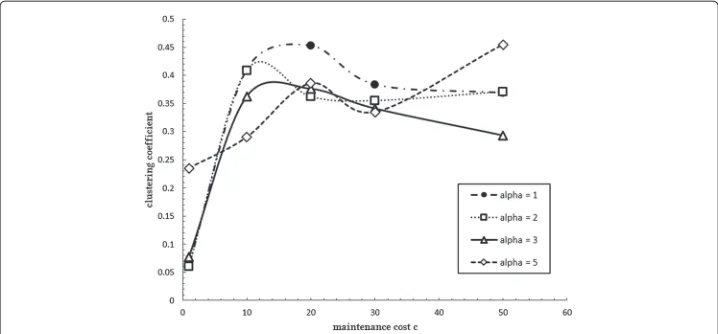
Figure 4 Average clustering coefficients.Structural properties of generated networks in the simulations.
for their degree. Moreover, the appearance of few high degree nodes represents the few hubs in these networks.
Figure 4 demonstrates the clustered structure of the link stable networks: a high average clustering coefficient is present in all instances after increasing the maintenance cost from c = 1. The high clustering in these networks can be highlighted by pointing out their small edge-density in the range from 0.007 for the network withc= 50,α = 5 to 0.069 for the network withc= 1 andα = 1. The diameter in all instances was either 3 or 4 as expected.
Endnotes
aThe principle that individuals are all linked by short chains of connections and
acquaintances.
bThe pairwise stability is the major notion of stability that assumes myopic players and
has been studied in related literature. In a linking game with transfers, it was first introduced as an extension in [8] and then developed in [9,10].
cComputing the best responses of players in Nash equilibria within some similar
models [11,12] are proved to be NP-hard.
dSee [9,10,13,14].
eThis assumption is reasonable in our framework, since the formation of other links
cannot hurt the utility of non-involved players with respect to the distance-based structure of our utility function in (1).
fSee e.g. [8,10,12] for some application instances of distance-based payoff structures.
gSee [18,19] for some instances of study in the case of bargaining between players on
network. In fact, despite the rich literature in general for bargaining between players, bargaining on networks is in its early attempts.
hAdding a charging scheme for the maintenance of existing links is a reasonable
extension that can resolve this issue, and it is studied in our model.
iThis condition is denoted as exact pairwise monotonicity by Jackson and Watts.
jNote that although the existence of stable networks and convergence to the Nash
outcomes would not be guaranteed in this assumption, we achieved a set of link stable networks by implementing many trials for different sets ofαandc.
Competing interests
Authors’ contributions
OA contributed to the characterization of the model and theoretical arguments, and implemented the simulation. BF contributed to the formulation of the problem and the theoretical arguments. Both authors participated in the organization of this research, and read and approved the final manuscript.
Author details
1Department of Economics, University of Calgary, 2500 University Drive NW, Calgary, AB T2N 1N4, Canada.2Department
of Mathematics, Brock University, 500 Glenridge Ave., St. Catharines, ON L2S 3A1, Canada.
Received: 24 October 2014 Accepted: 20 December 2014
References
1. Even-Dar E, Kearns M. A small world threshold for economic network formation. In: Advances in Neural Information Processing Systems 19. Cambridge, MA: MIT Press; 2007. p. 385–392.
2. Milgram S. The small world problem. Psychol. Today 1967;1:61–67.
3. Daraghmi EY, Yuan S. We are so close, less than 4 degrees separating you and me! Comput. Hum. Behav 2014;30: 273–285.
4. Watts D, Strogatz S. Collective dynamics of small-world networks. Nature 1998;393:440–442.
5. Kleinberg J. The small-world phenomenon: an algorithmic perspective. Symposium on the Theory of Computing. New York: Association of Computing Machinery; 2000, pp. 163–170.
6. De Martí J, Zenou Y. Social networks. Handbook of Philosophy of Social Science. London: SAGE Publications; 2011, pp. 339–361.
7. Jackson MO. Social and Economic Networks. Princeton, NJ: Princeton University Press; 2008.
8. Jackson MO, Wolinsky A. A strategic model of social and economic networks. J. Econ. Theory 1996;71:44–74. 9. Bloch F, Jackson MO. Definitions of equilibrium in network formation games. Int. J. Game Theory 2006;34(3):305–318. 10. Bloch F, Jackson MO. The formation of networks with transfers among players. J. Econ. Theory 2007;133(1):83–110. 11. Myerson R. Game Theory: Analysis of Conflict. Cambridge, MA: Harvard University Press; 1991.
12. Fabrikant A, Luthra A, Maneva EN, Papadimitriou C. H, Shenker S. On a network creation game. In: 22nd Annual ACM Symposium on Principles of Distributed Computing. New York: ACM Press; 2003. p. 347–351.
13. Calvó-Armengol A, Ilkiliç R. Pairwise-stability and Nash equilibria in network formation. Int. J. Game Theory 2009;38(1):51–79.
14. Hellman T. On the existence and uniqueness of pairwise stable networks. Int. J. Game Theory 2012;42:211–237. 15. Jackson MO, Watts A. The existence of pairwise stable networks. Seoul J. Econ 2001;14(3):299–321.
16. Watts A. A dynamic model of network formation. Games Econ. Behav 2001;34:331–341.
17. Jackson MO, Watts A. The evolution of social and economic networks. J. Econ. Theory 2002;106:265–295. 18. Gallo E. Essays in the economics of networks. PhD thesis, University of Oxford: Department of Economics; 2011. 19. Bayati M, Borgs C, Chayes J, Kanoria Y, Montanari A. Bargaining dynamics in exchange networks. Working Paper
2011.
20. Chakrabarti S, Gilles R. Network potentials. Rev. Econom. Des 2007;11(1):13–52.
Submit your manuscript to a
journal and benefi t from:
7Convenient online submission
7Rigorous peer review
7Immediate publication on acceptance
7Open access: articles freely available online
7High visibility within the fi eld
7Retaining the copyright to your article