Architecture and Perceived Control
The Role of Architectural Elements in Consumers Perception of Retail Environments
F. Subklew (s0095133) MSc
University of Twente
1st supervisor: T. J. L. van Rompay
Abstract
Previous research in environmental psychology has mostly shown interest in the effect of interior and
ambient features like music, colour and illumination on how consumers think, feel and act.
As criticised by Meyers-Levy and Zhu (2007b), much less is known over the effects of architectural or
layout elements on consumers cognition. As architecture is the basis for all ‘atmospherics’ to take
effect, this study took a closer look on relevant literature and conducted an experiment featuring 3D
models of virtual retail environments, investigating the effects of ceiling height, shelf height and aisle
width on consumers perception of control and their evaluation of the store.
Results indicate that architectural an layout factors in retail environments should get more attention in
environmental psychology. Especially shelf height showed a great influence on consumers perception
Content
Introduction
4
Atmospherics 5
Perceived control 7
Architecture and layout 7
Ceiling height 8
Aisle width 9
Shelf height 10
Method
10
Design and Participants 10
Procedure 11
Stimulus Materials 12
Measures 12
Results
13
Main effects 13
Spaciousness 13
Store Rating 14
Control 14
Approach avoidance 14
Interaction 14
Mediation 15
Discussion
16
References
21
Introduction
The moment one enters a room the most fundamental impression one is experiencing is that of
spaciousness. The experience of space is determined not just by form of pure dimensions, but also
trough the layout of the elements within this space. Shops, stores and supermarkets are aware of this
influence and do their best to welcome the customer with a nice first impression. Well, when thinking
of the buying experience in various retail environments, one detects that those differ considerably in
their architecture and layout. For instance, with the overall price of the products, the whole in-store
design and layout changes. While quality-orientated stores mostly use high shelves and narrow isles,
presenting as many products as possible to the customer, the low-price-orientated discounters prefer
wider aisles and smaller, but wider, shelves, presenting many of their products on the pallets they were
delivered, saving time and money at the cost of store layout.
Some stores even use a combination of shelf heights and aisle widths for different product category
groups or for a different impression in the entrance area than in the rest of the store (see Figure 1).
Even though stores are well concerned about their layout and architecture, scientific research has not
shown much interest in this matter as Meyers-Levy and Zhu (2007a) criticised. Most research in retail
environments that was done in the last years, was focused on so called ‘atmospherics’ (Kotler, 1973),
environmental factors like colour, music or illumination.
This article addresses the question of whether the architectural and layout factors ceiling height, aisle
width and shelf height, influence consumer perception of spaciousness, controle and rating of the
store.
At first, a brief overview over studies in the field of ‘atmospherics’ (Kotler, 1973) will be given, reflecting
Atmospherics
Researchers in the field of environmental psychology have demonstrated that environmental factors,
or ‘atmospherics’ (Kotler, 1973), affect how consumers think (Babin, Hardesty & Suter, 2003), feel
(Leather et al., 2003) and act (Mattila & Wirtz, 2001).
Kotler (1973) was the first to focus attention on the impact of different environmental stimuli and
formed the term ‘atmospherics’. He described atmospherics as “the effort to design buying
environments to produce specific emotional effects in the buyer that enhance his purchase
probability” (Kotler, 1973, p. 50).
While Kotler used the term for all environmental factors, newer studies defined more categories for
the field of atmospherics. Turley and Milliman (2000) distinguish external variables, general interior
variables, layout and design variables and point-of-purchase and decoration variables. Another
classification, used by Harris et al. (2002), distinguishes architectural features, interior design features
[image:5.595.110.489.56.289.2]and ambient features.
Many studies following Kotler (1973) were interested in the effect of interior and ambient features like
music, colour and illumination on consumers’ cognition, mood and behaviour. For instance studies by
Areni and Kim (1994) showed that brighter lighting influenced shoppers to examine and handle more
merchandise and can be used to create a functional store environment and an appropriate store image.
This context was further studied by Barbin et al. (2003), who showed that consumer reactions vary with
a store’s environmental cues, consumers’ cognitive categories representing known store type’s and
salient situational shopping motivations. For fashion-oriented stores, blue interiors are associated with
more favourable evaluations, marginally greater excitement, higher store patronage intentions, and
higher purchase intentions than are orange interiors. However, the results change substantially when
the effect of lighting in combination with colour is considered. The use of soft lights with an orange
interior generally nullifies the ill effects of orange and produces the highest level of perceived price
fairness while controlling for price.
An example for a study addressing multiple factors is that by Eroglu et al. (2005), who examined the
interactive effects of the two atmospheric cues retail density and music tempo and their impact on
shopper responses within a real shopping environment. Based on the schema incongruity model, t was
found that shopper hedonic and utilitarian evaluations of the shopping experience are highest under
conditions of slow music/high density and fast music/low density. Furthermore was shown that music
tempo has effects on behavioural responses such as approach/avoidance tendency and extent of
browsing behaviour.
Other studies discovered the influence of musical style on Restaurant Customers' Spending (North et
al., 2003) or the effect, music tempo has on waiting perceptions (Oakes, 2003), but as Meyers-Levy and
Zhu (2007a) criticised, a lack of attention and theory-guided investigations for structural aspects of
Perceived control
The previous paragraph has shown the considerable attention that has been given to retail and service
environments and their effects on consumer satisfaction, over the past years. Understanding and
measuring consumer satisfaction itself is thereby very fundamental.
Hui and Bateson (1991) and Dion (2004) consider perceived control as a strong mediator for the effect
of consumer density on pleasantness and the consumer's approach-avoidance responses, making it a
good predictor for consumer satisfaction. Van Rompay et al. (2008) showed that perceived control is a
considerable mediator of the main effect of spatial density on pleasure and approach. According to
Averill (1973) there are three different types of control: behavioural, informational and decisional.
Behavioural control refers to the person’s ability of a response that may influence or modify the
characteristics of an event. Informational control refers to the available information and the
interpretation of an event. Finally, decisional control is the degree of choice among various courses of
action.
Architecture and layout
As mentioned earlier, spaciousness is one of the most fundamental experiences, when entering a
room, but has not yet got much attention. While research for the effects of crowding (Dion, 2004; van
Rompay et al., 2008) is quite related to perception of spaciousness, only few aspects are known about
architectural influences on consumer experience (Meyers-Levy and Zhu, 2007a). This is astonishing as
the pure dimension of the hall should be the first of concerns when building a store. Formulating the
above as a question from the point of view of a psychologist: how does the room alone affect the
consumer? Shortly after this, the layout of shelves, aisles, cash desks etc. would be considered. Not
until then would the question after colour, lighting and music arise.
The structural aspects ceiling height, shelf height and aisle width can not only be classified whether or
not they belong to architecture or layout, but also according to the dimension (vertical and horizontal),
while aisle width on the contrary controls the horizontal dimension of spaciousness, constricting the
customers possibilities to move through the store.
The height of store shelves manipulates the consumers’ perception apparently in the vertical mode, as
ceiling height does, but effects even the horizontal apperception, through shelves below eye height,
allowing customers a view over the store and giving them more informational control.
Ceiling height
Ceiling height is obviously one of the first architectural factors that influence ones perception of a
room, when entering. Especially when the room is further empty and only the volume affects the
viewers’ perception of the spaciousness.
The first to write about the possibility that physical edifices can imply different meanings or arouse
different sensations due to the volume of the space they occupy, was Hall (1966). Fischl and Gärling
returned to the topic of architectural factors in retail environments in 2004 and found ceiling height
ranked among the top three details that influence consumers’ psychological well-being. Meyers-Levy
and Zhu (2007b) were the first to show that ceiling height actually primes concepts that affect how
consumers process information. Their three studies supported the theory that a high versus low ceiling
can prime the concepts of freedom versus confinement. These concepts, in turn, prompt consumers’
use of predominately relational versus item-specific processing.
A study by Gort (2007), about the ongoing movement of a disco to a newer and bigger location with
possible image changes, found another effect of ceiling height. In the case of a social event for people
that are looking for new contacts and friends, a lower ceiling leads to a stronger feeling of density and
crowding, which in a party situation boosts pleasure. Comparing the findings of Meyers-Levy et al.
(2007b) and Gort (2007), the better use of a high or low ceiling seems to depend a lot on the context of
The present study assumes a retail store, where people come to buy their everyday products. While
‘shopping’ might be a social event for some, for this study it is implied that this is not the case in a
supermarket.
Hypothesised from this assumption, a low ceiling is associated with a decrease in perceived control of
the customer, while a higher ceiling would stimulate the perception of spaciousness and authority.
Aisle width
The second factor of interest for this study, aisle width, affects not only another dimension of space,
but has also a more physical influence on spaciousness. Hall (1966) called this the tangible variable of
space or ’proxemics’. The only study to show the influence of physical confinement, by Levav and Zhu
(2008), placed people in a laboratory with two different sized aisles (7 and 3.5ft) with candy bowls at
the end, to show that physical confinement can evoke reactance, which leads to variety-seeking
behaviour to regain their freedom.
Furthermore is there uncertainty over the possible comparability of physical confinement through
architecture and crowding as a social phenomenon. While Hall (1966) suggested to inspect physical
distance like social distance, elsewhere it has been argued that retail density should be differentiated
into human density and spatial density (Dion, 2004; van Rompay et al., 2008). Both Dion (2004) and van
Rompay et al. (2008) could not find the mediating effect of perceived control for spatial density, while
spatial density had strong effects on pleasure. Consumers, who face spatial difficulties, feel
uncomfortable, want to leave the store and limit their purchase to strict necessities (Dion, 2004). A
study reported by Machleit et al. (2000) varied spatial density by moving bookracks into the aisle,
reducing available space and restricting movement. In this study the negative effects of spatial density
were stronger than those of human density, which was explained by the idea that spatial density is a
more permanent restriction of the consumers’ space.
With the study of Levav and Zhu (2008) in mind, narrower aisles are anticipated to negatively influence
Shelf height
This influence of architecture and space layout on control in a store environment has not yet been
topic of any research. That is why this study will not only test the effects of ceiling height and aisle
width on the consumer’s perceived control and behaviour, but explores the main effect of shelf height
as a manipulation of perceived control and store evaluation.
It is expected that lower shelves give the customer a better view over the environment, helping him to
navigate through the store, increasing their perception of being in control.
Method
Design and Participants
To test the hypotheses, an experimental design in form of a three-dimensional (3D) scenario, with
ceiling height (high vs. low), shelf height (high vs. low) and aisle width (wide vs. narrow) as independent
between-subjects variables was employed.
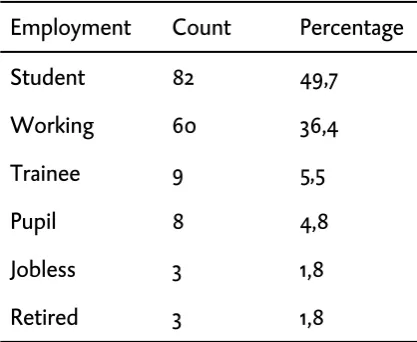
A number of 165 (86 male, 79 female) people from Germany attended the online questionnaire. Nearly
50% of the participants were students. Table 1 shows the exact allocation over their status of
employment. The participants’ age ranged from 13 to 68 years (M = 29.96, SD = 11.4).
Employment Count Percentage
Student 82 49,7
Working 60 36,4
Trainee 9 5,5
Pupil 8 4,8
Jobless 3 1,8
[image:10.595.193.402.560.731.2]Procedure
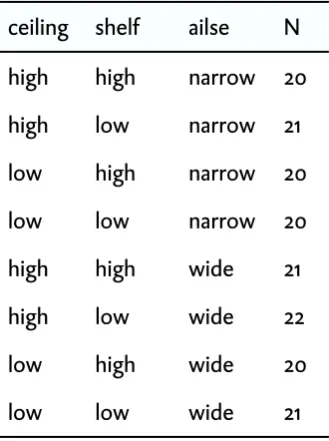
Participants were contacted via e-mail with the request to take part in the online questionnaire and to
pass it down to others. Following the link from the e-mail, a PHP-page automatically led each entrant
randomly to one of the eight experimental conditions. Table 2 shows the distribution over the versions.
At the beginning of the questionnaire the participants were asked to fill in demographic information,
before moving on to the stimulus video. The instructions to the video stated that participants were to
imagine they were visiting the conceptual store and that their evaluation of the store would be
requested. Subsequent to the video, participants filled out the questionnaire.
As motivation to participate in the study, three cinema coupons could be won. To make chance for one
of the tickets, one could leave an e-mail address at the end of the questionnaire.
ceiling shelf ailse N
high high narrow 20
high low narrow 21
low high narrow 20
low low narrow 20
high high wide 21
high low wide 22
low high wide 20
[image:11.595.216.381.433.654.2]low low wide 21
Stimulus Materials
For this study it was chosen to use camera flights through a 3D store models as stimulus materials.
Eight separate 3D models were created, using the 3D modelling solution ’Cheetah 3D’, for each
combination of the manipulations (ceiling height, shelf height and aisle width). The same camera flight
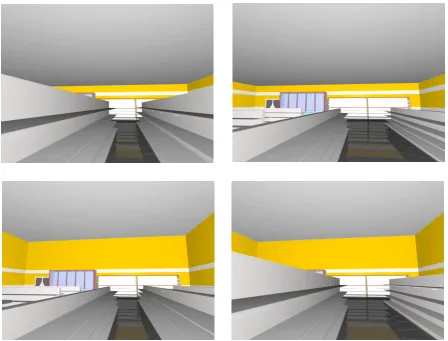
was used to render a video (2,10 min) of each model. Figure 2 shows four screenshots of the same
camera position in different models. For an overview of all models, see Appendix 1.
Measures
Perceived spaciousness was measured with items, based on a scale used by Macheleit et al. (2000). The
[image:12.595.75.524.234.575.2]five items were ’I think the store is very spacious’, ’I feel cramped in the store’ (reverse coded), ’I can Figure 2. Four screenshots of different models at the same time in the flight through, showing
breathe freely in the store’, ’I'm very liberated in the store’ and ’The store makes an open impression to
me’. Coefficient alpha reliability for this 5 -item scale was 0.84.
General store rating was measured based on scales by Bitner (1990) with the five items ’I think the store
is very pleasant’, ’The store seems of low quality to me’ (reverse coded), ’I think the store is very
efficiently’, ’The store seems very professional’ and ’ I find the store very uncomfortable’ (reverse
coded). The coefficient alpha reliability for this scale was 0.77.
Perceived control was measured with items derived from Mehrabian and Russell’s dominance scale
(Mehrabian & Russell, 1974), but were more aimed at the informational control of orientating in the
store. The three items were ’I think in this store, the customer stands in the center of attention’, ’I can
orientate myself easily in the store’ and ’I find the store very manageable’. Coefficient alpha reliability
for this 3-item scale was 0.7.
The last factor that was measured, is the approach-avoidance tendency and was measured with the
three items ’I would like shopping in the store’, ’I would return to the store’ and ’I would recommend
the store to others’. The coefficient alpha reliability for this scale was 0.89.
Results
To test the hypotheses of this study, the data was analysed using three separate 2 (ceiling height) X 2
(shelf height) X 2 (aisle width) full factorial ANOVAs for spaciousness, control and store rating. The
analyses yielded the following surprising results.
Main effects
Spaciousness
A main effect for shelf height was found (F (1, 165) = 19.44, p < .001), showing that higher shelves (M =
3.57, SD = . 84) made the store look bigger than in the low shelf condition (M = 2.96, SD = .97). A similar
positively influenced the perception of spaciousness in the store, in contrast to wide aisles (M = 3.06,
SD = .9). Surprisingly, the influence of ceiling height, formerly shown by other studies, could not be
found in this experiment (p > .24). All other effects were not significant (p < .1).
Store Rating
A main effect for shelf height (F (1, 165) = 11.82, p < .001) was discovered. Participants scored the store
higher in the conditions with high shelves (M = 3.07, SD = .84) than in those, where the shelves ended
below eye height (M = 2.64, SD = . 8). All other effects were not significant (p < .1).
Control
Shelf height even strengthened significant the perception of being in control (F (1, 165) = 19.11, p < .001).
Customer felt less in control between lower shelves (M = 2.3, SD = .77) than when walking through
high shelves (M = 2.87, SD = .92). All other effects were not significant (p < .1).
Approach avoidance
A main effect for shelf height was found (F (1, 165) = 6.84, p < .01). In contrast to the findings in
spaciousness, store rating and the data from control are people more likely to buy (in), return (to) and
recommend the store with lower shelves (M = 2.08, SD = 0.7) than the pendant with high shelves (M =
1.82, SD = .62).
Interaction
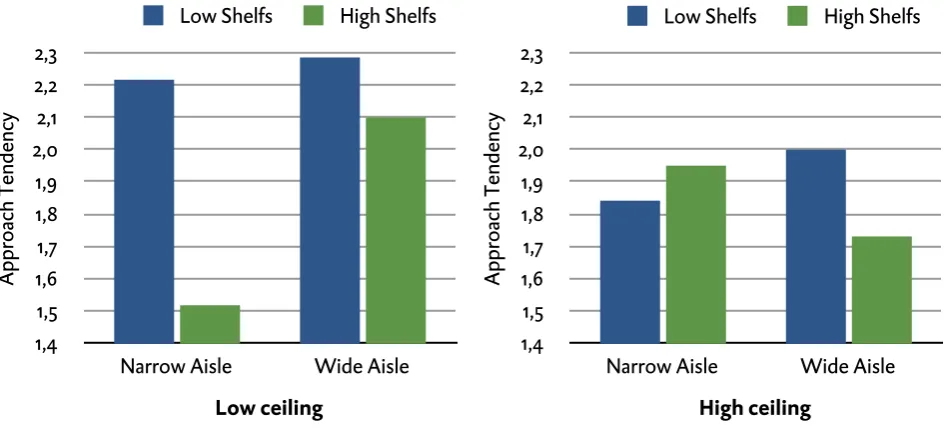
A significant three-way interaction was observed for approach-avoidance tendency between shelf
height, aisle width and ceiling height (F (1, 165) = 4.97, p < .03). As can be seen in Figure 3, customers are
arouses avoidance. In a setting with a high ceiling, the interaction between shelf height and aisle width
is much fainter.
Mediation
Finally, three regression analyses (Procedure by Baron & Kenny, 1986) showed a mediating effect of
spaciousness. Shelf height influences as earlier shown the perception of spaciousness (t = 10.73, p < .
001) and has a significant effect on store evaluation (t = 10.99, p < .001). The regression of spaciousness
and store rating was significant, too (t = 5.18, p < .001). But in a regression analysis with both shelf
height and spaciousness as independent variables the effect of the height of the shelves on the rating of
the store becomes insignificant (t = .82, p > .4), while spaciousness still shows a significant effect (t =
10.38, p < .001). This means that shelf height not directly manipulates the store evaluation, but
influences the perception of spaciousness in the store, which in turn affects the store’s evaluation.
1,4 1,5 1,6 1,7 1,8 1,9 2,0 2,1 2,2 2,3
Narrow Aisle Wide Aisle
Approach Tendency
Low ceiling
Low Shelfs High Shelfs
1,4 1,5 1,6 1,7 1,8 1,9 2,0 2,1 2,2 2,3
Narrow Aisle Wide Aisle
Approach Tendency
High ceiling
[image:15.595.61.534.124.338.2]Low Shelfs High Shelfs
Discussion
The research paper at hand tested the idea that architectural elements in stores influence the
perception and rating of the store. Earlier research had already supported that ceiling height influences
customers perception of the location (Meyers-Levy and Zhu, 2007b; Gort, 2007). While Meyers-Levy
and Zhu (2007b) showed that a higher ceiling evokes freedom related thoughts, the study by Gort
(2007) found quite the contrary. In the need of social contact, people favoured the lower ceiling that
strengthened the perception of density, through the physical confinement of the location.
Unfortunately neither of these findings could be confirmed in this study as ceiling height showed no
significant effect on either spaciousness, the rating of store or the customers’ perception of being in
control.
No influence of ceiling height on the customers’ general perception of spaciousness in the store might
indicate that people define space in a store more on the horizontal dimension in the form of view lines.
This idea gets support in the ’Probabilistic Theory of Perception’ (Bittermann & Ciftcioglu, 2006), which
states that ’visual openness’ can be calculated by the use of mathematical probability. Obviously, an
upright standing person sees mostly objects on the horizontally dimension in his eye height, a fact,
most supermarkets already use when placing their cheaper products in the lowest shelf, while using the
shelf space in eye height for the more profitable products (Lim et al., 2004). Additionally, the
manipulation videos contributed to this effect, through moving the camera with only one exception
around but the vertical axis, never explicit locking up or down.
In contrast to ceiling height, both the manipulation of shelf height and aisle width showed significant
effect on spaciousness, but both also in the oppositional way than was expected. Lower shelves, thus
shelves under the eye height, made participants perceive the store less spacious than in the condition,
there the shelves blocked the view through the room. A possible explanation that needs further
Assumed that the store would generally get rated small, the high shelves would, by blocking the view,
prevent people from fully evaluate on the total space in the room and therefore scoring the room
bigger. Imamoglu (1973) had participants rate spaciousness for a room with three different amounts of
furniture. Judged spaciousness and percentage of floor covered by furniture correlated at r = –.54. This
idea is strengthened by the study of Stamps and Krishnan (2006), who showed that spaciousness is
strongly influenced by boundary roughness. Rougher boundaries (open shelves, shelves with books)
make a space seem larger than if the wall were smooth.
The manipulation of spaciousness between shelves, in other words “aisle width”, was originally
intended to directly influence the perceived spaciousness the customer has to move in the store. As
the results show, the condition using wider aisles, however, led to a lower rating of spaciousness in the
store. What seems very strange at first sight might have a quite simple explanation in the idea that
perception is all about reference as shown by the Gestalt psychology (Köhler, 1967; Rock & Palmer,
1990). As the empty shelves in this experiment were the most present references for the participants
to estimate the overall size of the room, wider placed aisles could give the impression that the store is
smaller than in the condition with narrow corridors. Every participant saw just one version of the store
and could possibly build a different reference model than the other participants.
As the general rating of the store was shown to be mediated by spaciousness, the finding that the store
gave a better impression with higher shelves, comes with no surprise. From the interaction the
conclusion can be drawn that consumers broadly expect a pleasant and comfortable store of high
quality and professionally, to be bigger than others.
A second explanation of the negative effect of small shelves on the store’s rating can be found in the
habits and heuristics, people use to make decisions and evaluate situations. As mentioned in the
introduction, well equipped supermarkets use mostly high shelves and narrow isles, presenting as
many products as possible to the customer, while discounters prefers wider aisles and smaller, but
wider, shelves. Since consumers are accustomed with these differences, the trends to the reverse
The present paper was in particular interested in the influence of shelf height on consumers perception
of control. Averill (1973) introduced three types of control, of which only one was measured in the
study, which explains why no effect on control could be found for ceiling height and aisle width. With
shelf height in mind, only the so called ‘informational control’ was relevant as lowering the shelfs gives
customers a better view over the store environment and feeds them with the needed information to
orientate in the the room. But quite the contrary was found as people actually experienced less
orientation and control over their movement in the store. Two explanations for this surprising
discovery could be found. Consistent with the explanation for the effect of lower ceilings making the
room look smaller, it is possible that participants in general would rate the layout of the shelves in the
store as too bad designed, to be able to easily orientate and manage themselves through the location.
In this case, the use of higher shelves would again prevent the customers from getting the necessary
information to come to this conclusion - resulting in a higher score on the Likert scale.
Another explanation comes from the idea that more could be less as Schwartz (2003) writes in his
book ‘The Paradox of Choice’. The total view over the store might give the customer too much
information and, instead of strengthening the feeling of control, evokes irritation about where to go
next.
The last single factor that was measured would be the most interesting for actual supermarket
managers. Will the customer buy anything, come back and - best of case - recommend the store to
friends and family? As the results of this study show, the virtual customers were significantly the most
likely to return in the conditions with low shelves. While this is the only result that is consistent with
the expectations, the explanation, in link to the other result, is connected to the question which kind of
stores the participants were after. While lower shelves negatively influence the perception of
spaciousness, the overall rating of the store and the perceived control in the store, people were more
likely to buy, return and recommend. The reason again would be the connection of those negative
customers could globally be more interested in discounters, not because they like the feeling in the
store, but for the financial saving.
The fact that no main effect for ceiling height on approach- avoidance could be found, has a possible
explanation in the significant interaction that was found between ceiling height, shelf height and aisle
width for the approach-avoidance tendency. The interaction reveals that the virtual customers would
more likely buy (in), return (to) and recommend the store with a lower ceiling - as long as it does not
use both narrow aisles and high shelves. This findings gives the clear recommendation to weaken the
confinement of customers through the use of lower shelves and/or wider aisles as was predicted for
this study. But most interesting, the higher ceiling evoked in general less need for approach than the
low ceiling (except for the high-shelf-narrow-aisle condition), which gives the impression that the
ceiling was to high, leaving such a strong negative impression on the customers that non of the other
factors matter anymore.
While earlier was mentioned that ceiling height is one of the dimensions of a room, while shelf height
and aisle width were categorised as parts of the store layout, the question may arise, why depth as a
true dimension of space was not examined. As this study was mostly seen as explorative to research
the so far unstudied influences of shelf height on consumer reaction to a retail environment, the two
most relating co-variables were chosen. When manipulating shelves, this almost simultaneously
influences aisle width as the space between shelves. At the same time, aisle width was very obvious to
influence confinement in a more direct manner. Ceiling height was originally chosen, to manipulate the
same dimension as shelf height, with the idea that a higher ceiling could make the changes in shelf
hight more insignificant. Other factors of the store like depth were less related to shelf height and were
excluded from the study to avoid unnecessary complexity.
As the height of the shelves showed significant effects on all factors, even if those were expected
otherwise, the study was successful in showing that shelf height is a powerful architectural factor in a
Some crucial points should be considered for further research in a non-field study. Especially the
reference problem, mentioned in the context of aisle width, was due to technical shortcomings when
building the 3D model. All the same, a new study with more recourse could prevent the reference
problem by placing well known products in the shelves or giving further visual information through
human 3D characters in the corridors. Products will make the model much more complex, but would
additionally make the store environment much more realistic.
The second recommendation is also related to the use of technology. If possible the next study should
use an interactive 3D model, for the reason that active exploration leads to a more efficient object
recognition (Harman et al., 1999). It would be even better if the participants’ movements through the
References
Areni, C. S., & Kim, D. (1994). The influence of in-store lighting on consumers’ examination of
merchandise in a wine store. International Journal of Research in Marketing, 11, 117-125.
Averill, J. R. (1973). Personal Control over Aversive Stimuli and Its Relationship to Stress. Psychological
Bulletin, 80 (4), 286-303.
Babin, B. J., Hardesty, D. M., & Suter, T. A. (2003). Color and shopping intentions: The intervening effect
of price fairness and perceived affect. Journal of Business Research, 56, 541-551.
Baron, R. M., & Kenny, A. (1986). The Moderator-Mediator Variable Distinction in Social Psychological
Research: Conceptual, Strategic, and StatisticalConsiderations. Journal of Personality and Social
Psychology, 51 (6), 1173-1182
Benedikt, M. L., & Burnham, C. A. (1985). Perceiving architectural space: From optic arrays to isovists. In
Persistence and change. Hillsdale, W. H. Warren & R. E. Shaw, NJ: Lawrence Erlbaum, 103-114
Bitner, M. J. (1990). Evaluating Service Encounters: The Effects of Physical Surroundings and Employee
Responses. Journal of Marketing, 54, 69-82.
Bittermann, M. S., & Ciftcioglu, Ö. (2006). Validation of a Visual Perception Model. Joint International
Conference on Construction Culture, Innovation, and Management, November 26-29, Dubai
Dion, D. (2004). Personal control and coping with retail crowding. International Journal of Service
Industry Management, 15 (3), 250-263.
Eroglu, S. A., Machleit, K. A., & Chebat J.-C. (2005). The Interaction of Retail Density and Music Tempo:
Effects on Shopper Responses. Psychology & Marketing, 22 (7), 577-589.
Fischl, G. & Gärling A. (2004). Enhancing Well-Being in Health Care Facilities. in Evaluation in Progress -
Strategies for Environmental Research and Implementation. B. Martens & A. G. Keul, 7-9.
Gort, D. H. (2007) Kleur bekennen - Een experimenteel onderzoek naar de invloed van
omgevingsfactoren voor poppodium Atak Enschede. Bachelor thesis, University of Twente.
Harman, K. L., Humphrey, G. K., & Goodale, M. A. (1999). Active manual control of object views
facilitates visual recognition. Current Biology, 9, 1315-1318.
Harris, P. B., McBride, G., Ross, C., & Curtis, L. (2002). A Place to Heal: Environmental Sources of
Satisfaction Among Hospital Patients. Journal of Applied Social Psychology, 32 (6), 1276-1299.
Hui, M. K., & Bateson, J. E. G. (1991). Perceived Control and the Effects of Crowding and Consumer
Choice on the Service Experience. Journal of Consumer Research, 18, 174-184.
Imamoglu, V. (1973). The effect of furniture on the subjective evaluation of spaciousness and
estimation of size of rooms. In Architectural psychology (pp. 314-352).
Stroudsburg, R. Küller, PE: Dowden, Hutchinson & Ross.
Kotler, P. (1973–1974). Atmospherics as a marketing tool. Journal of Retailing, 49, 48-64.
Köhler, W. (1967). Gestalt Psychology. Psychologische Forschung, 31, XVIII-XXX.
Leather, P., Beale, D., Santos, A., Watts, J., & Lee, L. (2003). Outcomes of Environmental Appraisal of
Different Hospital Waiting Areas. Environment and Behavior, 35, 842-868
Levav, J., & Zhu, R. J. (in press). Seeking Freedom Through Variety. Advances in Consumer Research.
Lim, A., Rodriques, B., & Zhang, X. (2004). Metaheuristics with Local Search Techniques for Retail
Shelf-Space Optimization. Management Science, 50 (1), 117-131.
Macheleit, K. A., Eroglu, S. A., & Mantel, S. P. (2000). Perceived Retail Crowding and Shopping
Satisfaction: What Modifies This Relationship? Journal of Consumer Psychology, 9 (1), 29-42.
Mattila, A. S., & Wirtz, J. (2001). Congruency of scent and music as a driver of in-store evaluations and
behavior. Journal of Retailing, 77, 273–289.
Mehrabian, A., & Russell, J. A. (1974). An approach to environmental psychology. M. I. T. Press,
Cambridge, Massachusetts.
Meyers-Levy, J., & Zhu, R. J. (2007a). The Influence of Ceiling Height: The Effect of Priming on the Type
Meyers-Levy, J., & Zhu, R. J. (2007b). Perhaps the Store Made You Purchase It: Toward an
Understanding of Structural Aspects of Indoor Shopping Environments. in Visual Marketing: From
Attention to Action, M. Wedel & R Pieters, Mahwah, NJ: Erlbaum, 193-224.
North, A. C., Shilcock, A., & Hargreaves, D. J.(2003). The Effect of Musical Style on Restaurant
Customers' Spending. Environment and Behavior 2003, 35, 712-718.
Oakes, S. (2003). Musical Tempo and Waiting Perceptions. Psychology & Marketing, 20 (8), 685-705.
Rock, I., & Palmer, S. (1990). The Legacy of Gestalt Psychology. Scientific American, 263 (6), 48-61.
Schwartz, B. (2003). The Paradox of Choice: Why More Is Less. Ecco, 1 edition
Arthur E. Stamps, A. E., & Krishnan, V. V. (2006). Spaciousness and Boundary Roughness. Krishnan
Environment and Behavior, 38, 841.
Turley, L. W., & Milliman, R. E. (2000). Atmospheric Effects on Shopping Behavior: A Review of the
Experimental Evidence. Journal of Business Research, 49, 193-211.
Van Rompay, T. J. L., Galetzka, M., Pruyn, A. T. H., & Garcia, J. M. (2008). Human and Spatial Dimensions